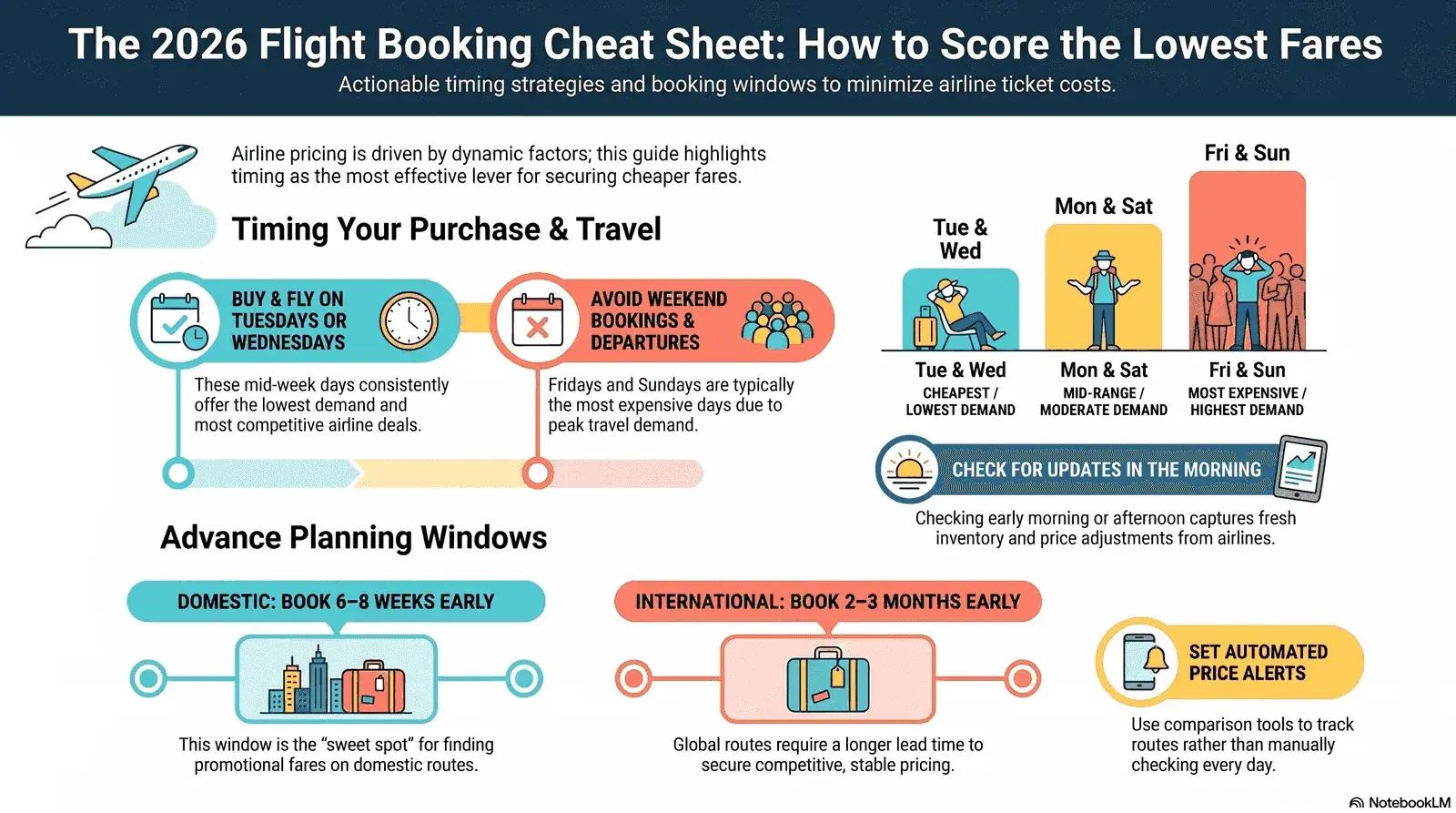
- Tuesday and Wednesday midweek bookings tend to be cheapest. Airlines update fares after weekend demand spikes, so mid-week prices are often the lowest point in any given week.
- 6–8 weeks out is the sweet spot for most routes. Too early and airlines haven't released discounted seats; too late and remaining inventory commands a premium.
- Last-minute deals exist but are unreliable. Waiting for a last-minute bargain is a gamble — plan ahead if dates are fixed, and use price alerts to catch drops automatically.
Finding the best day to buy airline tickets can save you a lot of money. Many travellers wonder when to book flights for the best deals.
Airline ticket prices fluctuate based on several factors. Understanding these can help you make informed decisions.
Timing is crucial when purchasing airline tickets. Knowing the best days and times can lead to significant savings.
Typically, mid-week days like Tuesday and Wednesday offer cheaper fares. Airlines often release deals early in the week.
Booking flights in advance is another strategy to consider. For domestic flights, 6 to 8 weeks ahead is often a practical target.
International flights usually benefit from booking around 2 to 3 months ahead. Flexibility with travel dates can also help.
Using fare comparison tools and setting alerts for price drops can be beneficial. These tools can notify you of sudden deals.
In this guide, we explore strategies to find the best day to buy airline tickets and reduce total booking costs.
Why Flight Prices Fluctuate: Understanding Airline Pricing
Airline pricing might seem unpredictable, but it follows certain patterns. Demand, competition, and operational costs are key factors.
Airlines use dynamic pricing to adjust fares. This means prices can change based on how many seats are sold or left.
Several elements influence airline ticket pricing:
- Demand: Higher demand typically means higher prices.
- Competition: Competing airlines can lead to lower fares.
- Fuel Costs: Fluctuations in fuel prices directly affect ticket costs.
- Time of Booking: How far in advance you book can impact price.
- Seasonality: Peak travel seasons often result in higher prices.
Weekends and holidays usually see a spike in demand, raising ticket prices. Conversely, mid-week flights are often cheaper.
Seasonal factors also play a significant role in price changes. Travelling during holiday seasons or school vacations tends to be more expensive.
The number of available seats affects cost too. As planes fill up, remaining tickets can become pricier.
Understanding these factors helps you make smarter booking decisions and identify better-value fare windows.
What Is the Best Day to Buy Airline Tickets?
The classic travel myth that "Tuesday at midnight" or "Wednesday morning" is the magic window to buy cheap flights is now completely obsolete. Modern airlines use artificial intelligence and real-time dynamic pricing algorithms to adjust fare buckets continuously throughout the day based on demand, seat load factors, and competitor moves. Recent large-scale data analyses from Google Flights and Skyscanner confirm that the day of the week you purchase your ticket has a negligible impact on price—often less than 2%.
Instead of worrying about the day you buy, focus your strategy on the day you fly. Flying on mid-week days, specifically Tuesday or Wednesday, is consistently cheaper than weekend departures (Friday and Sunday) due to lower consumer demand.
Rather than attempting to guess the market, the most effective modern tool is configuring automated price alerts on search engines, allowing algorithms to track fare drops for your specific route and dates.
Best Time to Buy Flight Tickets: Domestic vs. International
For many domestic flights, booking 6 to 8 weeks before departure often yields strong value. In this range, promotional fares are commonly available.
For international travel, the window is usually wider. Booking 2 to 3 months before your trip often provides competitive rates.
International fares may fluctuate more than domestic fares due to airline policy differences and market variation.
Key influences include:
- Competition: More airlines compete on popular routes.
- Seasonality: Peak periods affect international prices heavily.
- Market Demand: Global events and festivals can move fares.
Mid-week remains a useful booking window for both domestic and international travel. Price stability during these days can benefit travellers.
Also consider off-peak windows. For many routes, late autumn or early spring can be cheaper than summer peaks.
Cheapest Days to Book Flights: Myths vs. Facts
A common myth is that weekend booking always gives the best prices. In practice, weekends often show higher prices because browsing and demand are stronger.
Mid-week days, especially Tuesday and Wednesday, are widely seen as better booking windows. That does not mean they are the only cheap days, but they often perform well.
Useful realities to remember:
- Tuesday and Wednesday: Frequently offer competitive deals.
- Weekends: Commonly priced higher.
- Last-minute tickets: Usually cost more than early bookings.
Last-minute bargains do exist, but they are less reliable than planned advance booking.
Best Days of the Week to Fly for Lower Fares
Your actual travel day can affect cost as much as your booking day. Mid-week flights often have lower demand and better fares.
- Tuesday and Wednesday: Often cheapest to fly.
- Friday and Sunday: Often most expensive.
- Monday and Saturday: Often mid-range pricing.
Mid-week travel may also mean less crowded airports and shorter queues.
How Far in Advance Should You Book?
Timing your booking is one of the biggest price levers you can control.
- Domestic flights: Often best around 6 to 8 weeks before departure.
- International flights: Often best around 2 to 3 months in advance.
- Peak seasons: Usually require earlier booking.
Waiting until the last minute can significantly increase costs, especially on high-demand routes.
Best Time of Day to Purchase Airline Tickets
Time of day can matter because fare inventory and pricing updates happen throughout the day.
- Early Morning: More inventory visibility and sometimes better pricing.
- Afternoon: Potential reductions after fare adjustments.
- Late Night: Can be less favourable in some markets.
Monitoring the same route at different times can reveal useful price movement.
When Are Flights Cheapest? Seasonality and Timing Tips
Seasonality is one of the strongest drivers of fare levels. Summer peaks and major holidays often carry premium pricing.
- Peak Seasons: Higher fares due to demand spikes.
- Off-Peak Seasons: Better-value fares and frequent offers.
- Shoulder Seasons: Balanced pricing with milder conditions.
Flexible dates plus seasonal awareness can significantly improve your average booking value.
Special Cases: Holidays, Last-Minute, and Flash Sales
Holiday periods need early planning. Demand rises sharply and fares follow.
Last-minute pricing can be volatile. Sometimes airlines discount empty seats, but many travellers still pay a premium.
Flash sales can offer strong discounts, but they are short-lived and require quick decisions.
- Holiday Flights: Consider flying on the holiday itself.
- Last-Minute Deals: Check frequently for sudden drops.
- Flash Sales: Act quickly when availability appears.
Tools and Strategies to Find the Best Deals
The best approach combines tools, alerts, and flexible planning.
- Set price alerts: Track route changes automatically.
- Use comparison tools: Check multiple airlines and agencies at once.
- Use loyalty rewards: Redeem miles or points where possible.
- Stay date-flexible: Shift by a day or two for better options.
Should You Book Directly or Use Third-Party Sites?
Booking directly with airlines can simplify changes and support. Third-party platforms can make comparison faster and easier.
A practical method is to compare on aggregators, then verify final all-in cost and policy terms on both channels before purchase.
- Customer Service: Airlines may handle disruptions faster.
- Pricing Transparency: Watch for add-on fees on any platform.
- Convenience: Aggregators can speed up route comparison.
Advanced Tips: Alerts, Rewards, and Flexible Travel
Smart travellers combine alerts, rewards, and flexible timing to stack savings.
- Enroll in loyalty schemes: Build value from repeat travel.
- Use co-branded cards: Earn points or route-specific benefits.
- Track multiple platforms: Capture short-lived pricing gaps.
Frequently Asked Questions About Booking Flights
Is it cheaper to book flights on a specific day?
Many fare studies and booking patterns show Tuesday and Wednesday as commonly favourable booking days, though route-level variation still applies.
Does time of day affect flight prices?
It can. Fare updates happen throughout the day, so checking in the morning and afternoon can help you spot lower prices when inventory is repriced.
Are direct flights always cheaper than flights with layovers?
Not always. Direct flights are often priced higher for convenience, while one-stop itineraries can be cheaper on many routes.
How early should I book a flight?
For domestic routes, 6 to 8 weeks is often a useful range.
International itineraries often benefit from booking 2 to 3 months
ahead.
Is it cheaper to book on a specific day?
Tuesday and Wednesday are commonly favourable booking days, though
route-specific variation always applies.
Does time of day matter?
It can. Morning and afternoon checks sometimes surface better
prices after inventory updates.
Can I save by choosing certain travel days?
Mid-week travel, especially Tuesday and Wednesday, is often
cheaper than weekend departures.
Are direct flights more expensive?
Often yes, because convenience is priced in. One-stop options can
reduce fare on many routes.
Key Takeaways: How to Get the Best Price on Airline Tickets
- Book mid-week where possible and compare multiple providers.
- Use alerts and fare calendars rather than checking once.
- Plan ahead with route-appropriate booking windows.
- Stay flexible on dates and stopovers for stronger value.
Conclusion: Smart Booking for Savvy Travellers
Buying cheaper airline tickets is less about luck and more about structured timing. By combining mid-week booking checks, sensible advance planning, seasonal awareness, and route alerts, you can improve your odds of getting a better fare.
Keep comparing, stay flexible, and verify full trip cost before checkout. Consistent habits over time deliver the strongest savings.
Ready to book at a better price?
Compare live fares, track monthly trends, and find smarter booking windows before you pay.
Fare behaviour varies by route, season, and airline inventory. Use this guide as a practical framework and verify final terms, baggage rules, and total cost at checkout.
For a complete UK budget break plan, see How to Plan a UK Summer Break on a Budget with accommodation, dining, and 7-day London itinerary.
For destination ideas and budget route tactics, read Exploring Europe: Cheap Flights from Dublin.
Use Compare Fares Across Multiple Airlines Quickly - 2026 Complete Guide to combine timing strategy with a true total-cost comparison workflow before booking.
- Flight Price Tracking and AI Fare Prediction Tools 2026: Google Flights, Hopper and Beyond — how Google Flights alerts, Hopper Price Freeze, Skyscanner Everywhere search, and AI chatbots compare for tracking Dublin-India and Ireland-Europe fares.
- Best Time to Book Flights in 2026: What the Data Actually Shows — a data-driven deep-dive into optimal booking windows (15–45 days out for most routes), why the Tuesday myth is dead, and when waiting for a price drop backfires.