
- RTW fares are structured alliance products — not DIY itineraries. Oneworld, Star Alliance, and SkyTeam each sell RTW passes with fixed mileage or stop limits; understanding the rules before you search is the difference between a great deal and an expensive mistake.
- Booking in the right currency can shave hundreds off the same fare. Airlines price in local markets — changing the currency selector on the same search genuinely changes the price you pay.
- 3–6 stops is the sweet spot for value. Fewer stops keep the fare low and the journey manageable; adding more stops rarely adds proportional value once you exceed six.
Booking international round-the-world flights cheap sounds like a fantasy reserved for gap-year trust fund travelers, but the reality is more accessible than most people realize. The industry term for these tickets is “RTW fares,” and they are structured products sold by airline alliances with specific rules, stops, and time limits built in. Once you understand how these products work, and where to find the best deals on multi-city flights outside of alliance tools, you can plan a trip spanning multiple continents without spending a fortune. This guide walks you through every step, from foundational rules to final booking confirmation.
What this guide covers
- Key takeaways at a glance
- How to book international round-the-world flights cheap
- Step-by-step process to find affordable RTW flights
- Comparing RTW booking options and price ranges
- Common mistakes when booking cheap RTW tickets
- How to verify and finalize your RTW booking
- My honest take on booking cheap RTW trips
- Find your next RTW deal with Myflightoffers
- FAQ
Key takeaways
| Point | Details |
|---|---|
| RTW tickets have fixed rules | Alliance RTW fares require single-direction travel, specific stop counts, and completion within one year. |
| Iterate before you commit | Testing multiple routes in online RTW builders before purchasing helps you find cheaper compliant options. |
| Deal sites are leads, not guarantees | Advertised low prices on deal platforms are time-sensitive and should be replicated in alliance tools quickly. |
| Transit vs. stopover changes pricing | Keeping a connection under 24 hours classifies it as a transit, which can unlock lower fare inventory. |
| Aggregators speed up comparisons | Using a free flight comparison platform lets you cross-check fares across airlines before committing to any booking. |
How to book international round-the-world flights cheap
Before you open any booking tool, you need to understand what you are actually buying. An RTW fare is not a collection of separate cheap tickets stitched together. It is a single ticket product, typically sold by one of the major airline alliances, with rules that govern how you can use it.
The Star Alliance RTW product allows up to 15 stops, requires travel in one continuous direction (either eastbound or westbound), and must be completed within a window of 10 days to 1 year from the first departure. These constraints are not flexible. Violating them can result in denied boarding or a voided ticket.
Here are the foundational considerations every budget traveler should address before searching for fares:
- Travel direction: Decide early whether you are traveling eastbound or westbound. Mixing directions is not permitted under most alliance RTW rules, and changing direction mid-planning forces you to restart your route.
- Number of stops: More stops generally mean higher fares. Start with the minimum stops that cover your priority destinations, then add others only if they do not push you into a higher price tier.
- Trip duration: A longer trip does not automatically cost more, but it does affect your flexibility. Alliance RTW tickets are valid for up to one year, so you have room to spread out your itinerary.
- Transit vs. stopover: This distinction matters more than most travelers realize. A connection under 24 hours is classified as a transit; anything over 24 hours is a stopover. Transit and stopover rules affect fare pricing and inventory availability directly, and savvy travelers use this difference as a pricing lever.
- Alliance coverage: Star Alliance and Oneworld each cover different carriers and routes. Check which alliance serves your priority destinations before committing to one product.
Pro Tip: Check the best day to buy airline tickets before making any purchase. Timing your booking correctly can save you a meaningful amount even on structured RTW fares.
Step-by-step process to find affordable RTW flights
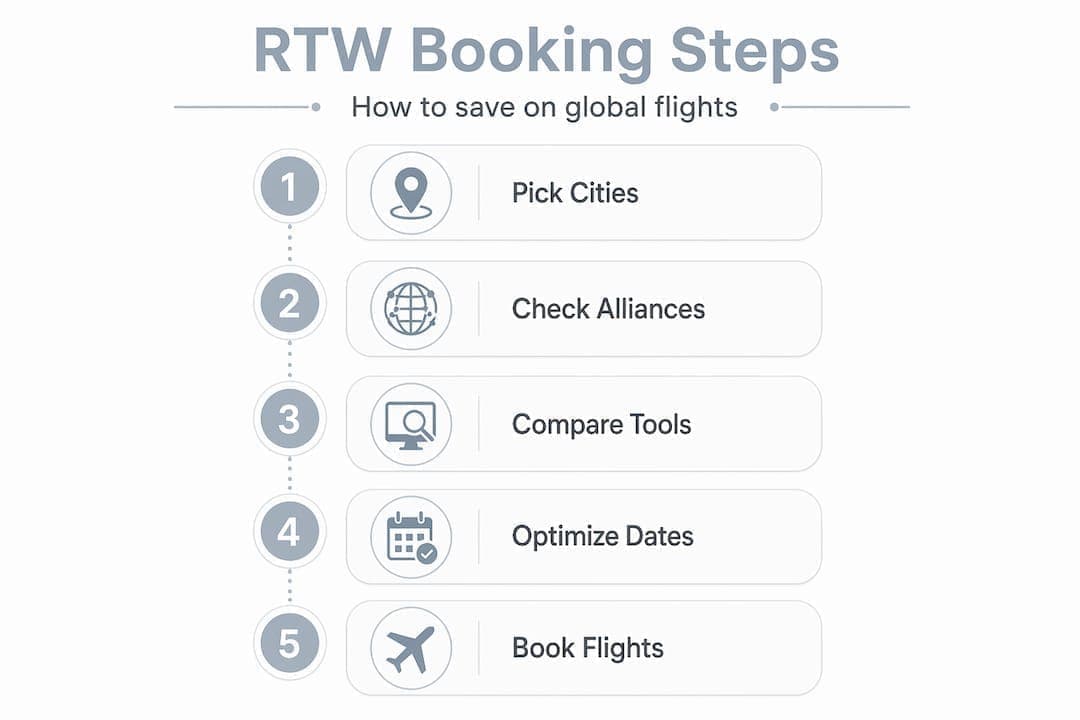
Finding budget international flights for a round-the-world itinerary requires a specific workflow. Jumping straight to a booking page without a plan almost always results in a higher fare or a route that does not comply with alliance rules.
Follow this process to move from idea to confirmed ticket efficiently:
-
Map your priority destinations first. Write down the cities you absolutely want to visit, then check which alliance covers the most of them. This determines your product before you start pricing anything.
-
Use the Star Alliance “Book and Fly” tool to test routes. The Star Alliance booking tool lets you build and adjust itineraries online before committing to a purchase. This planning flexibility is one of its most underused features. You can test different route combinations and see how pricing shifts without paying anything upfront.
-
Check deal aggregators for route inspiration. The Google Flights deals page ranks offers by the highest percentage savings relative to the typical price for that route and time period, not just by the lowest absolute price. A flight that saves you 40% on a normally expensive route is often a better find than a cheap flight on a route that is always cheap.
-
Experiment with dates iteratively. Shifting your departure by even a few days can change the fare tier significantly. Use flexible date views in any search tool to identify the cheapest windows across a two to four week range.
-
Apply the transit vs. stopover rule strategically. If a city is on your route but not a priority for an extended stay, keep your connection there under 24 hours. Classifying it as a transit rather than a stopover can unlock cheaper fare inventory without removing the destination from your itinerary entirely.
-
Complete your booking through the alliance tool or a verified third-party platform. Once your route is confirmed and the price is acceptable, complete the transaction. Do not delay. RTW fares at specific price points are not held.
Pro Tip: When you find a route combination that prices well, screenshot the full itinerary and fare breakdown immediately. Prices can shift between sessions, and having a record helps you replicate the routing if you need to rebook.
Comparing RTW booking options and price ranges
Not all RTW products are built the same, and the price range you should realistically expect depends heavily on which product you choose and how you structure your route.

| Option | Flexibility | Typical cost range | Best for |
|---|---|---|---|
| Star Alliance RTW | Moderate, up to 15 stops | $3,000 to $7,000+ economy | Travelers wanting broad global coverage |
| Oneworld Explorer | Moderate, zone-based pricing | $2,500 to $6,500 economy | Travelers focused on specific regions |
| Third-party RTW deals | Lower, fixed routes | From ~$1,300 to $3,000 | Budget travelers with flexible dates |
| DIY multi-city booking | High, fully custom | Varies widely | Travelers with very specific routing needs |
Third-party deal platforms can surface genuinely low prices. In May 2026, some advertised RTW itineraries were priced as low as approximately €1,213 for a four-week trip covering Europe, the Indian Ocean, Asia, and the Pacific, with six flights and flexible dates in September and October 2026.
A few additional factors that influence where your final price lands:
- Cabin class: Economy RTW fares are dramatically cheaper than business class. Some alliance products offer business class RTW tickets, but these typically start at $5,000 and climb quickly.
- Number of continents: Alliance RTW pricing often scales with the number of continents crossed. Adding a South American leg to an Asia-Pacific route will push you into a higher tier.
- Seasonality: Booking travel during shoulder seasons (April to May or September to October) consistently produces lower fares than peak summer or holiday windows.
- Origin airport: Your starting point matters. Travelers departing from major hub airports in Europe or Asia often access cheaper RTW entry fares than those departing from smaller regional airports.
Common mistakes when booking cheap RTW tickets
Even experienced travelers make avoidable errors when booking affordable round-the-world flights. These mistakes range from misreading fare rules to acting too slowly on time-sensitive deals.
- Confusing transit and stopover status: Booking a 26-hour layover in a city you wanted as a brief stop can reclassify it as a stopover, changing your fare tier. Always check connection times against the 24-hour rule before confirming any segment.
- Ignoring directional rules: Planning a route that doubles back on itself, for example flying east from London to Bangkok and then west to New York, violates the single-direction rule on most alliance RTW products. The booking system may not always catch this immediately, but it can cause problems at check-in.
- Treating deal-site prices as guaranteed: Deal-site RTW prices carry explicit warnings about time sensitivity and fare availability. These prices are best used as route templates to replicate in alliance booking tools rather than as fixed offers you can return to later.
- Not verifying all segments before payment: Confirm every flight segment, including airline, terminal, and connection time, before entering payment details. Errors in a multi-segment booking are significantly harder to correct after purchase.
- Skipping the fine print on changes and cancellations: RTW tickets often have strict change fees. Some are non-refundable after a certain point. Read the fare conditions fully before you pay.
“The cheapest RTW ticket is the one you actually use correctly. A ticket bought at a low price but with misunderstood rules can cost you far more in rebooking fees or missed flights than a slightly higher fare purchased with full understanding of the conditions.”
Hunting for Airline Error Fares: Legal Binding & The 14-Day Cooling Window
When booking complex international itineraries, some travelers look for "airline error fares" (mistakenly priced tickets caused by computer glitches or currency conversion errors). A common myth is that once an Online Travel Agency (OTA) or airline issues an electronic ticket number and PNR, they are legally bound to honor it.
In reality, regulatory bodies like the US Department of Transportation (DOT) and European consumer protection courts have updated their rules. They permit airlines to cancel obvious pricing errors, provided the carrier issues a full, immediate refund and reimburses documented out-of-pocket expenses.
Because of this, you should always observe a strict 14-Day Cooling Window. Never book non-refundable hotels, tours, or connecting flights until at least two weeks have passed and the airline has formally confirmed that the mistake fare is honored.
How to verify and finalize your RTW booking
Once you have identified your route and price, the verification step is where budget travelers most often cut corners. Taking an extra 30 minutes here protects your entire investment.
-
Review all fare conditions in writing. Before payment, locate the fare rules document for your specific ticket. Confirm the validity period, permitted changes, cancellation policy, and any blackout dates.
-
Check that every segment complies with RTW rules. Verify that your route travels in one direction, that your stop count does not exceed the product maximum, and that transit connections are under 24 hours where you intend them to be.
-
Create or link a frequent flyer account. Most alliance RTW tickets allow you to earn miles on partner carriers. Linking your frequent flyer program before ticketing means you collect credit for every segment automatically.
-
Confirm all booking details via email. After purchase, verify that your confirmation email lists every flight segment with the correct dates, times, and airports. Discrepancies between what you booked and what is ticketed need to be resolved before your first departure.
-
Save offline copies of your itinerary. Download or print your full itinerary and all e-ticket numbers. International travel across multiple countries means you may not always have reliable internet access when you need to verify a booking.
My honest take on booking cheap RTW trips
I have spent years watching travelers approach RTW planning the same way: they find a price they like, get excited, and book before they fully understand what they have purchased. The result is almost always a more expensive trip than necessary, either because they paid for flexibility they did not need or because they violated a fare rule and paid to fix it.
What I have learned is that the iterative planning approach is not just a nice-to-have. It is the core skill that separates travelers who find genuinely cheap global flight tickets from those who pay full price. Testing five or six route variations in an alliance builder before committing takes maybe an hour. That hour regularly saves hundreds of dollars.
I also think most travelers underestimate alliance RTW products. Yes, the rules are strict. But the Star Alliance RTW product covers more than 1,000 destinations across 26 member airlines. The coverage is extraordinary for the price, especially if you are traveling economy and can work within the directional constraints.
The one mistake I see most often is treating deal-site prices as the destination rather than the starting point. A €1,213 RTW deal is real, but it is a signal, not a guarantee. Use it to understand what routes are pricing well right now, then replicate that routing in a tool you can actually book through with confidence.
The travelers who consistently find the best RTW fares are not the ones with the most airline knowledge. They are the ones who plan patiently, test multiple options, and read the rules before they get excited about the price.
Find your next RTW deal with Myflightoffers
Planning a multi-city itinerary across several continents takes real research, and having the right tools makes a measurable difference. Myflightoffers aggregates live fare data from multiple airlines and booking platforms in one place, so you can compare cheap global flight tickets across routes without signing up for an account or paying a service fee.

Whether you are building a full RTW circuit or pricing out individual legs to test against an alliance product, the Myflightoffers flight search gives you real-time comparisons that reflect current market pricing. You can also explore the travel tips section for route-specific insights and time-sensitive offers that align with your travel dates. Start searching now and see what your RTW budget can actually cover.
FAQ
What is an RTW ticket and how does it work?
An RTW (round-the-world) ticket is a single fare product sold by airline alliances that covers multiple international stops in one direction. The Star Alliance RTW product allows up to 15 stops and must be completed within one year.
How much does a cheap round-the-world flight typically cost?
Economy RTW fares from major alliances generally range from $2,500 to $7,000 depending on stops and route. Third-party deal platforms have advertised RTW itineraries from around €1,213 for four-week trips with flexible dates.
What is the difference between a transit and a stopover on an RTW ticket?
A transit is a connection under 24 hours, while a stopover is any stay exceeding 24 hours. This distinction directly affects your fare pricing and inventory, so structuring connections carefully can lower your overall ticket cost.
Can I use Google Flights to find RTW deals?
Google Flights is useful for identifying route-specific savings. Its deals page ranks flights by highest percentage savings rather than absolute price, making it a strong tool for spotting underpriced routes to include in your RTW planning.
What is the most common mistake when booking budget RTW flights?
The most common mistake is treating advertised deal-site prices as guaranteed fares. These prices are time-sensitive and should be used as route templates to replicate in alliance booking tools rather than as fixed offers you can return to at any time.
Recommended
- Best Day to Buy Airline Tickets: 2026 Guide | MyFlightOffers
- Ireland Student City Guide 2026: Dublin, Galway, Limerick, Athlone & Cork | MyFlightOffers
- Search Flights Worldwide | Find Cheap Flights | MyFlightOffers
- Indian Payment Guides | MyFlightOffers
Frequently Asked Questions
What is the cheapest way to book a round-the-world flight?
The cheapest approach is to build your own multi-city itinerary using a fare search engine (Google Flights, Kiwi, or ITA Matrix) rather than buying a packaged RTW ticket from an airline alliance. Mix carriers, use open-jaw routings, and aim for shoulder season travel.
How far in advance should I book round-the-world flights?
For budget RTW travel, booking 3-6 months in advance is ideal. Less than 6 weeks out, prices spike significantly. Alliance RTW passes (Oneworld, Star Alliance) must be purchased before departure and routed geographically, making advance planning essential.
Are round-the-world airline alliance tickets worth it?
Alliance RTW tickets (e.g., Oneworld Explorer, Star Alliance RTW) are worth it if you plan to cover 4+ continents with 8+ stops. For 2-3 destination trips, a self-built multi-city itinerary is almost always cheaper and more flexible.
What is an open-jaw routing and how does it save money on RTW trips?
An open-jaw ticket lets you fly into one city and depart from another - for example, fly Dublin to Bangkok, travel overland, and depart from Singapore. This eliminates costly backtracking and can reduce the total airfare by 20-40% compared to returning to your original departure city.