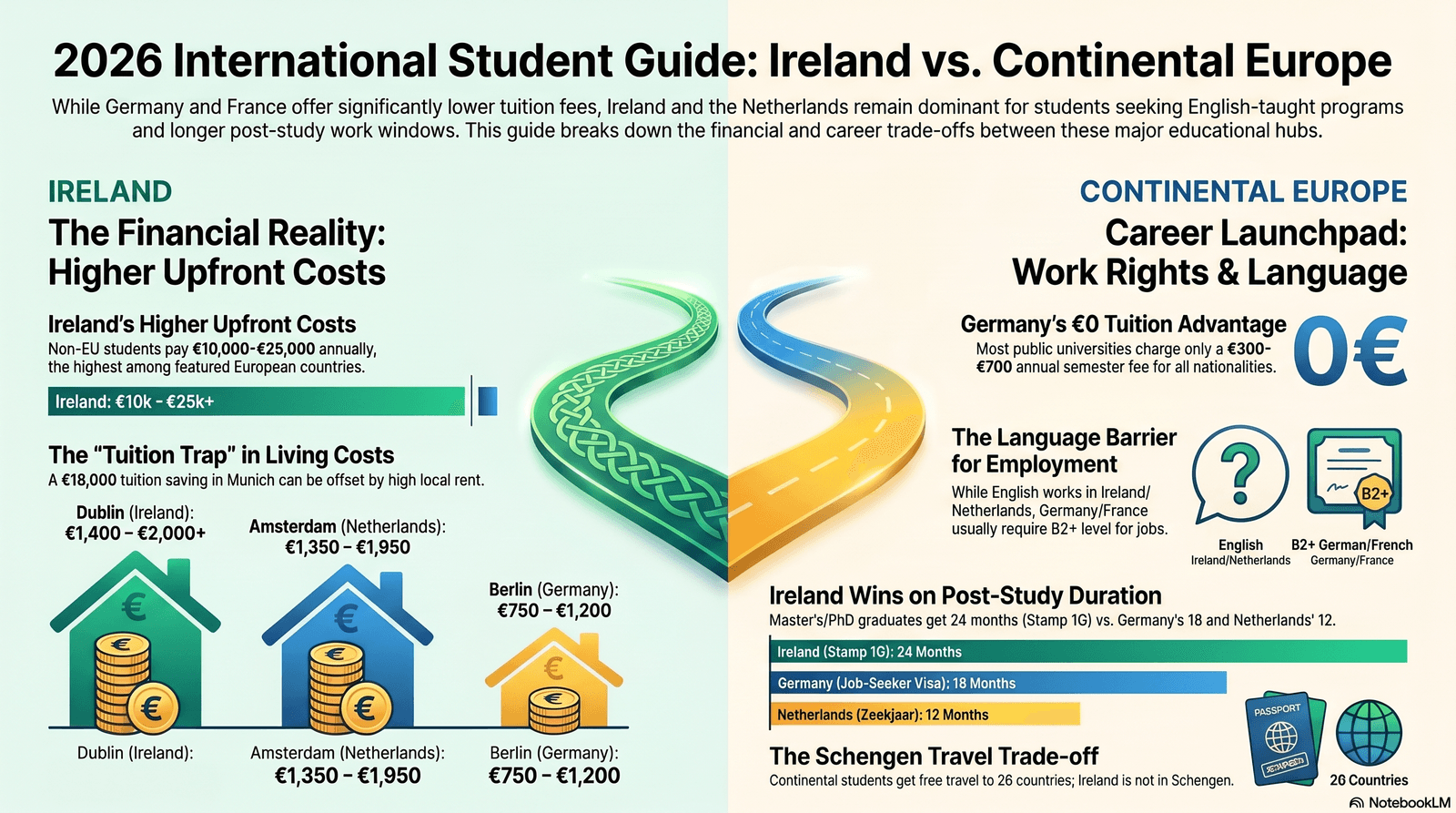
🏆 Lowest tuition in Europe
Germany (public): ~€300/semester admin fee only — tuition-free for all nationalities at most public universities
🇬🇧 Best for English instruction
Ireland (100% English) and Netherlands (2,100+ English programmes) — both far ahead of Germany, France, Spain
🛂 Longest post-study work rights
Ireland: 24 months (Master's/PhD) • Germany: 18 months • Netherlands: 12 months
🌍 Best for EU travel during study
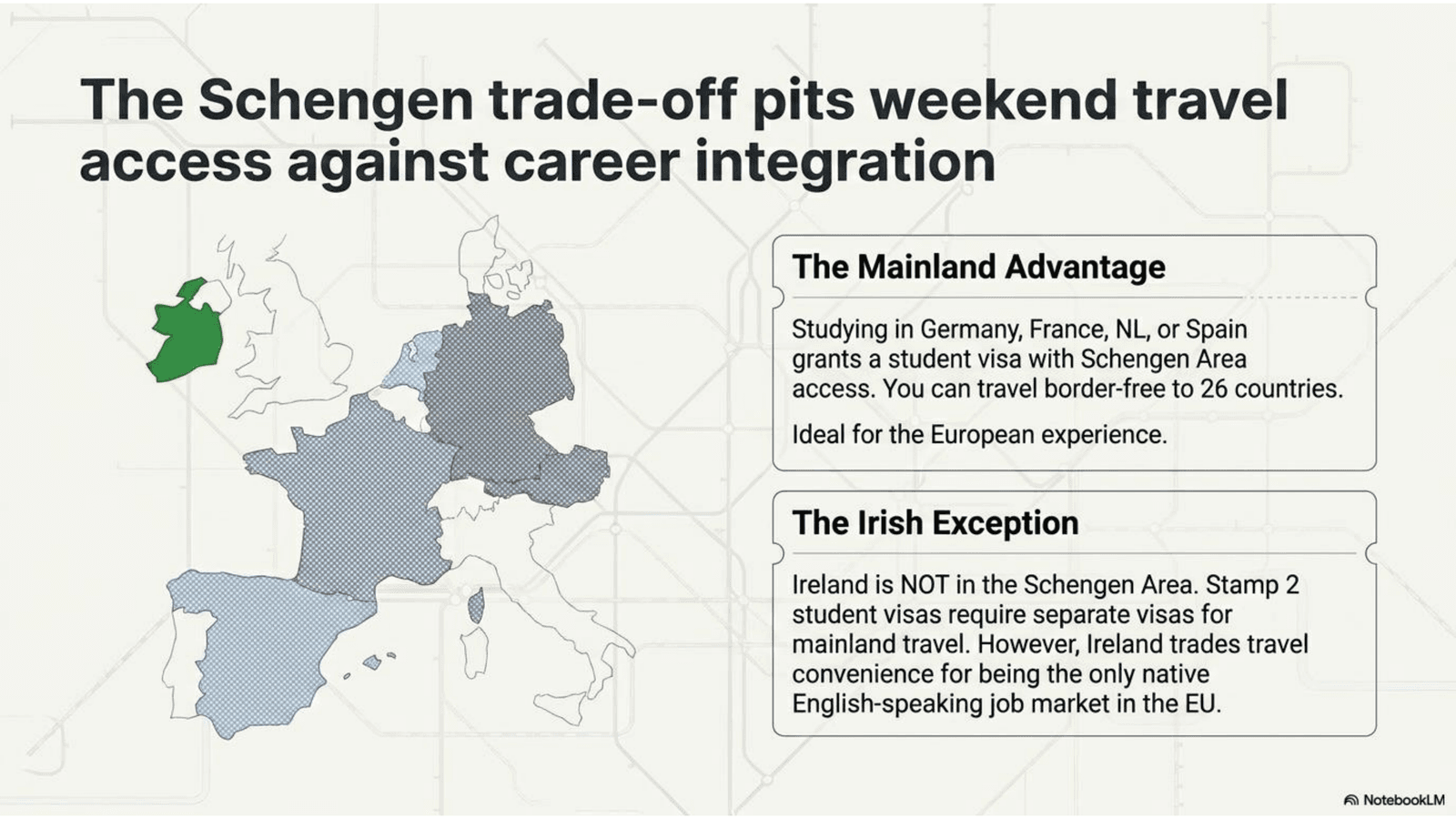
Any Schengen country (Germany, Netherlands, France, Spain, Sweden) — Ireland is NOT in the Schengen Area
What this guide covers
- Why Europe is competing for international students
- Section 1 — Low/no tuition countries compared
- Section 2 — The language barrier question
- Section 3 — Visa and post-study work rights
- Section 4 — Cost of living comparison by city
- Section 5 — Graduate employment after study
- Section 6 — University rankings: trade-offs explained
- Section 7 — Decision framework: which country fits you
- FAQs
Why Europe Is Now Competing Hard for International Students
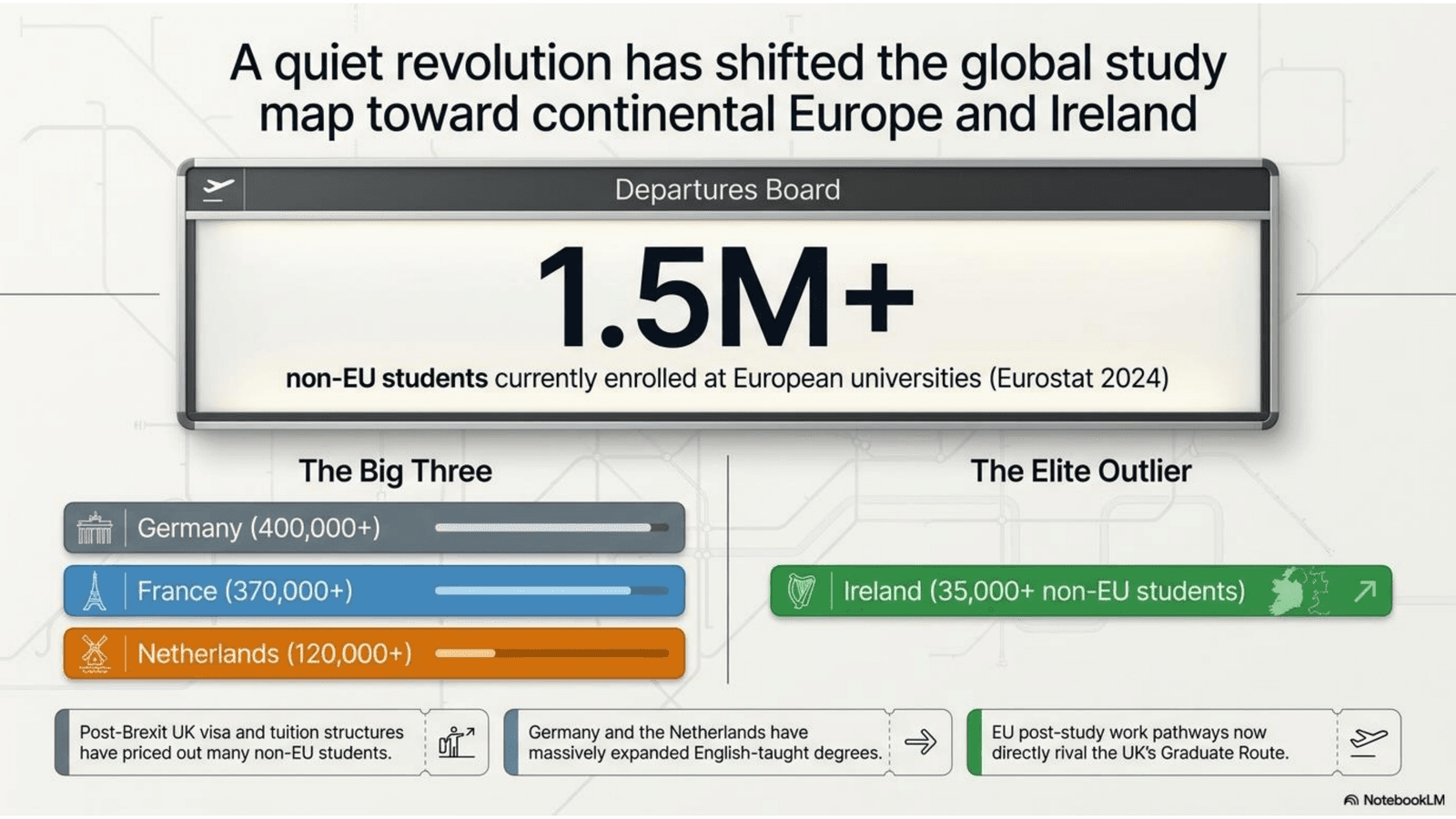
European higher education went through a quiet revolution in the past decade. Historically, students from India, China, Nigeria, and Southeast Asia defaulted to the UK, USA, Canada, or Australia for English-medium study abroad. In 2026, that calculus has shifted.
Three forces are driving students toward continental Europe and Ireland. First, post-Brexit visa and tuition changes in the UK have made it significantly more expensive and bureaucratically complex for non-EU students. Second, several European countries — led by Germany and the Netherlands — have dramatically expanded English-taught degree programmes to attract international talent. Third, post-study work pathways in Germany, Ireland, and the Netherlands have become genuinely competitive with the UK's Graduate Route.
For students from India and China — who form the largest non-EU cohorts studying in Europe — the comparison between Ireland and the rest of the continent now deserves serious, evidence-based analysis. That is what this guide provides.
Over 1.5 million non-EU international students are enrolled at European universities annually, according to Eurostat 2024 figures. Germany hosts approximately 400,000 international students, the Netherlands around 120,000, France around 370,000, and Ireland around 35,000 non-EU international students. Rankings, visa regimes, and tuition policies have made the comparison increasingly relevant for students making a once-in-a-decade decision.
Section 1 — The Big Draw: Low and No-Tuition Countries
The most dramatic difference between Ireland and several continental European competitors is tuition cost. Here is what each country actually charges non-EU international students at public universities in 2025–26.
Germany Near-Free Tuition
Public universities in Germany — with the notable exception of Baden-Württemberg, which reintroduced a €1,500/semester fee for non-EU students in 2017 — charge no tuition to students of any nationality. The fees that do apply are a semester contribution of approximately €100–€350 per semester covering administration, student union membership, and, crucially, a regional public transport pass (Semesterticket) that gives students unlimited use of local buses, trams, and trains for the duration of the semester.
This is not a subsidy restricted to EU citizens. A student from India or Nigeria enrolled at TU Munich or Humboldt University pays the same ~€300 semester contribution as a German student. Total annual "fee" cost for most German public university programmes: approximately €600–€700 per year, versus €10,000–€25,000 per year in Ireland for non-EU students. The difference is structural, not a special offer.
The important caveats: private universities in Germany do charge full international tuition (€5,000–€20,000+ per year); some postgraduate professional programmes at public universities have been redesigned as fee-paying; and the quality of English instruction and living costs vary substantially by city.
Norway and Sweden Mixed
Norway remains tuition-free for all students including non-EU internationals at public universities — a policy maintained through 2025–26. The University of Oslo, NTNU Trondheim, and the University of Bergen charge only a semester fee of approximately NOK 600–800 (~€55–€75). Living costs in Norway, however, are among Europe's highest: Oslo monthly student expenses average NOK 12,000–14,000 (~€1,050–€1,225), and Norway is outside the EU entirely, limiting both Schengen travel rights and EU graduate work paths.
Sweden reversed its free tuition policy for non-EU students in 2011. Swedish public universities now charge non-EU students between SEK 80,000–140,000 (~€7,000–€12,000) per academic year, depending on the programme. Stockholm's living costs are also high. Sweden's value proposition for non-EU students has weakened considerably compared to the pre-2011 era.
Netherlands Medium Tuition
Dutch universities (universiteiten) charge non-EU international students an institutional tuition fee set by each university, typically ranging from €8,000 to €20,000 per year for Bachelor's and Master's programmes. Applied science universities (hogescholen) typically charge €7,000–€12,000. EU/EEA students pay the statutory tuition fee of €2,530 per year. Non-EU students pay the institutional fee, which varies: the University of Amsterdam charges €11,200–€20,000 for most programmes; Delft University of Technology charges €16,000–€19,500 for engineering Master's programmes.
The Netherlands' value argument is its extraordinary density of English-taught programmes — over 2,100 Bachelor's and Master's degrees listed in English on studyfinder.nl — combined with a central Schengen location and a graduate labour market strong in tech and finance.
France Low at Public Universities
French public universities (universités) charge a nationally regulated tuition fee for non-EU students introduced in 2019 under the Bienvenue en France plan. In 2025–26, non-EU students pay approximately €2,770 per year for a Bachelor's degree (licence) and €3,770 for a Master's degree at public universities — significantly lower than Ireland, the Netherlands, or the UK, but not tuition-free. The grandes écoles (Polytechnique, HEC Paris, Sciences Po, CentraleSupélec) charge substantially more: €12,000–€20,000 per year.
France offers Campus France scholarships and the Eiffel Excellence Scholarship Programme for high-achieving international students. The Eiffel scholarship covers tuition, accommodation, and living costs — approximately €1,181 per month for Master's students and €1,400 for PhD students — but is highly competitive.
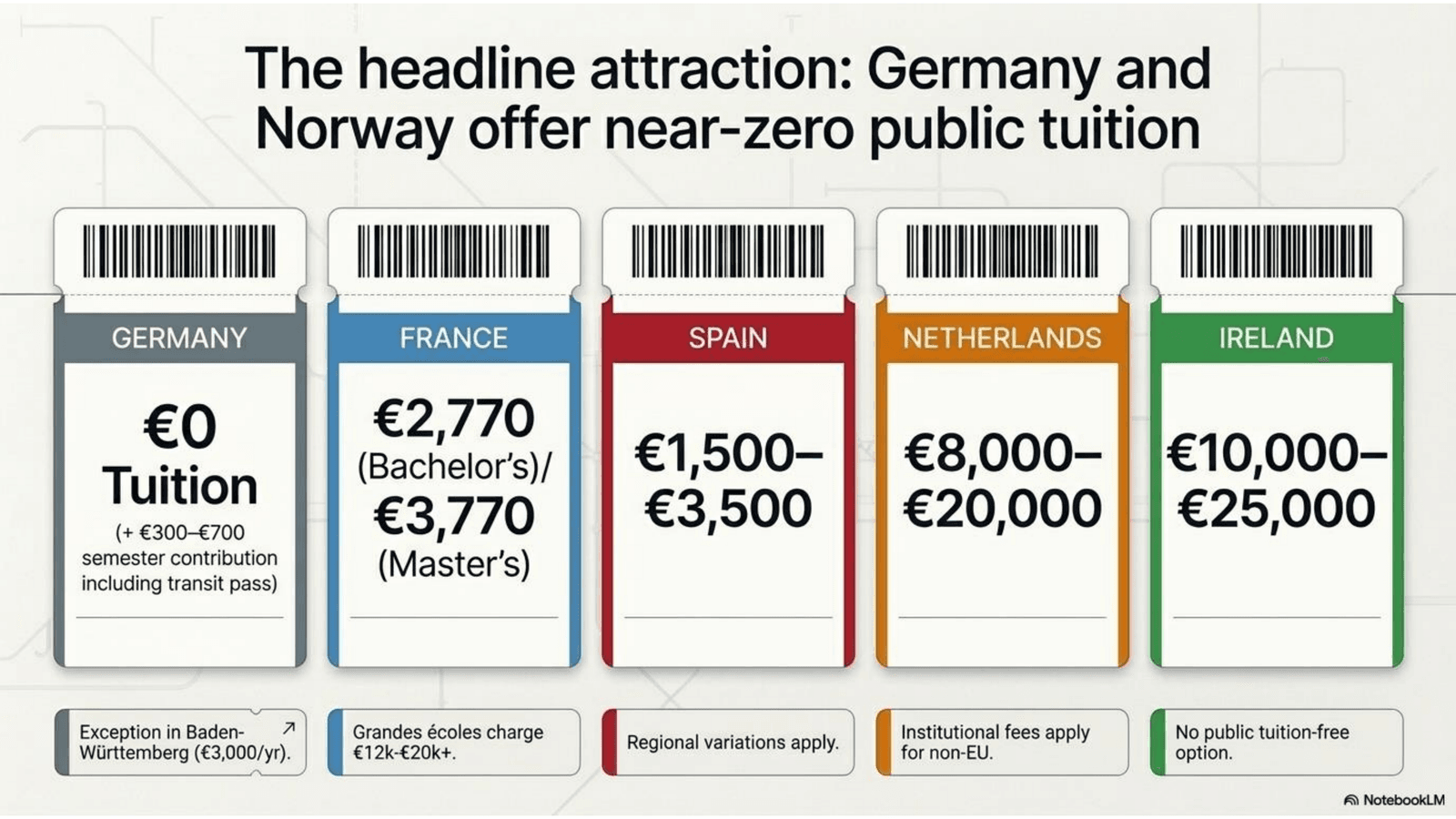
| Country | Annual Tuition (Non-EU, Public University) | Notes |
|---|---|---|
| Germany | €0 tuition + ~€300–€700 semester contribution | Exception: Baden-Württemberg €3,000/yr for non-EU. Private unis charge more. |
| Norway | €0 tuition + ~€60–€75/semester contribution | Very high living costs; outside EU |
| France | €2,770 (Bachelor's) / €3,770 (Master's) | Grandes écoles: €12,000–€20,000+; introduced 2019 |
| Spain | €1,500–€3,500 (varies by region and programme) | Regional variation significant; Catalonia higher than Andalucía |
| Sweden | €7,000–€12,000 | Free until 2011; now charged to non-EU students |
| Netherlands | €8,000–€20,000 | Statutory fee for EU: €2,530; institutional fee for non-EU is higher |
| Ireland | €10,000–€25,000 (undergraduate); €10,000–€30,000 (postgraduate) | Medicine at RCSI: €40,000–€60,000; no tuition-free public option |
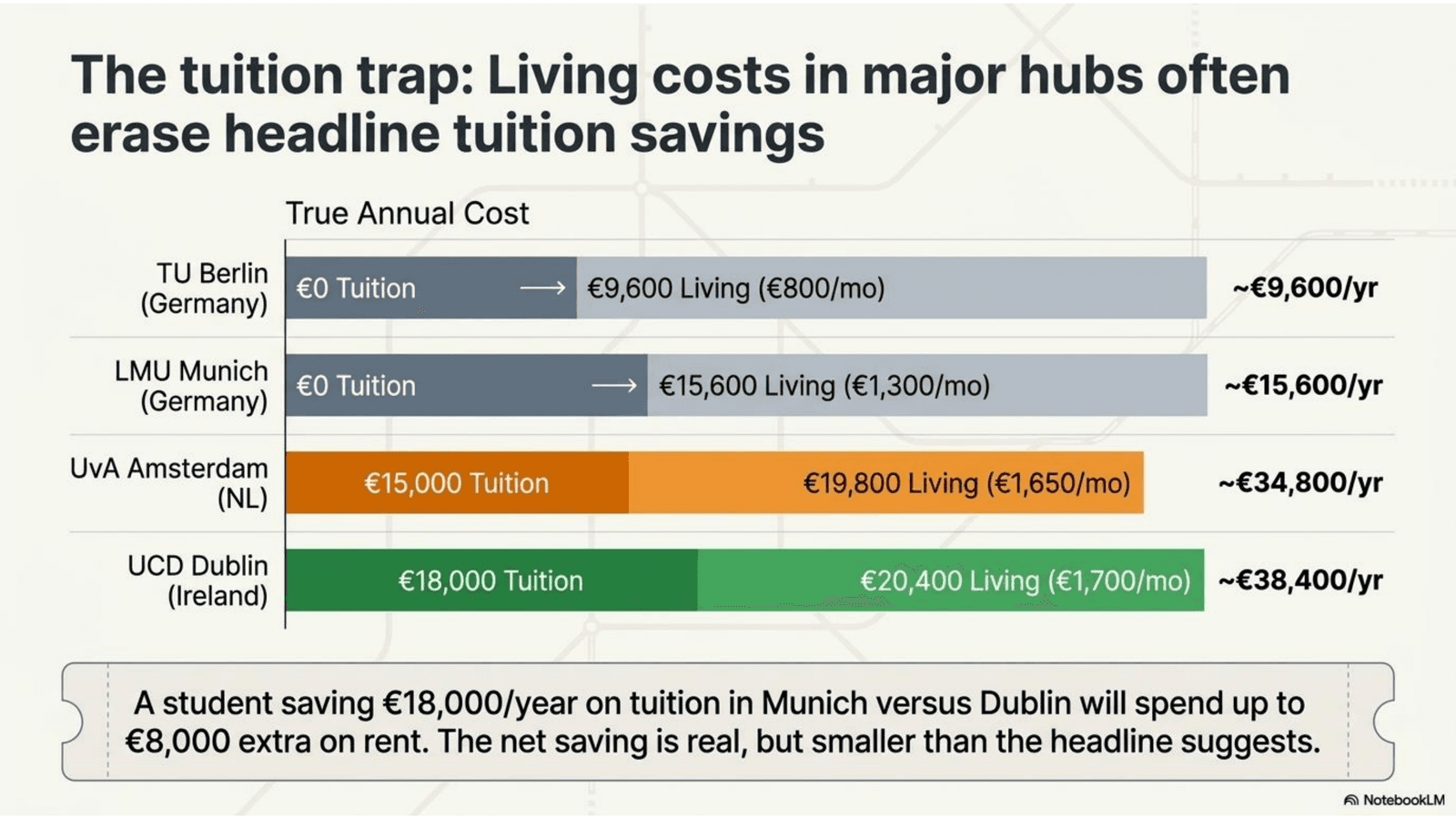
Germany's near-zero tuition is real — but Munich is one of Europe's most expensive cities for rent. A student saving €18,000/year on tuition versus Ireland might spend an extra €5,000–€8,000/year in Munich on accommodation. The net saving exists but is smaller than the headline tuition figure suggests. Always calculate total annual cost (tuition + living), not tuition alone.
Section 2 — The Language Barrier Question
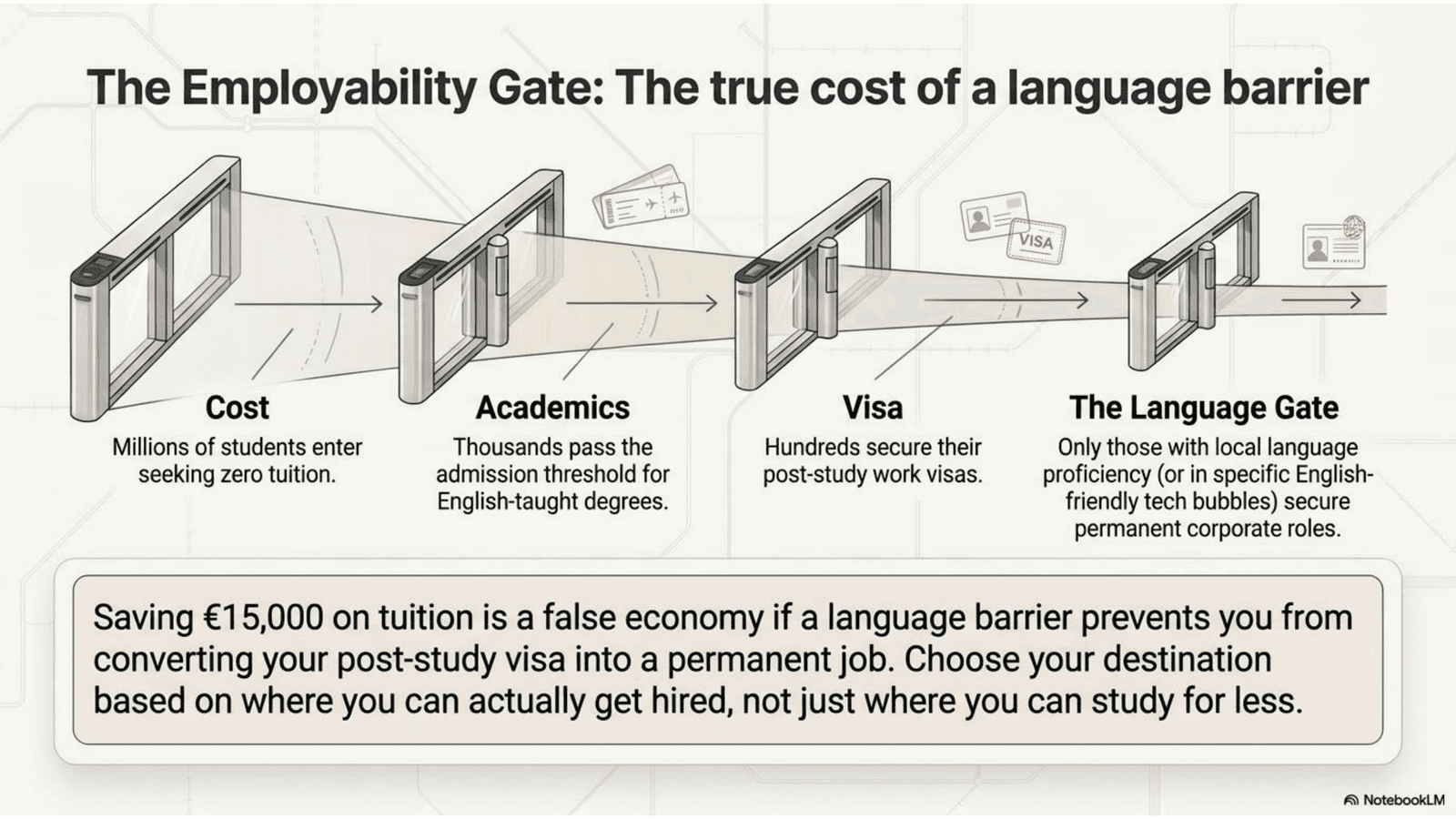
For the majority of international students from India, Nigeria, Kenya, and large parts of Southeast Asia — where English is either an official language or the primary medium of secondary and university education — the language of instruction is not merely a preference. It is a determining factor in academic success, social integration, and graduate employability.
Ireland: No Language Risk
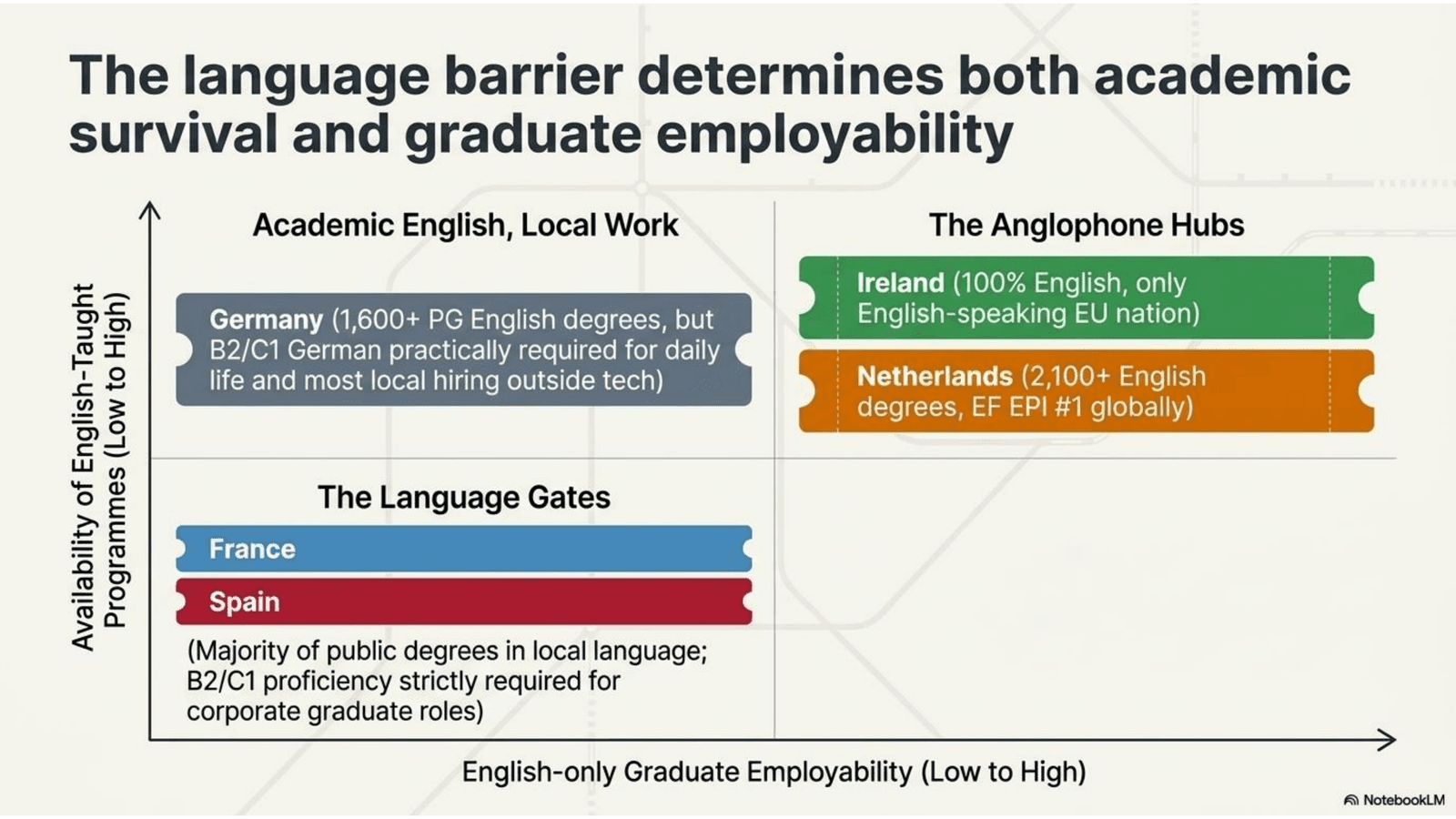
Every undergraduate and postgraduate degree at every publicly funded Irish university is taught entirely in English, with the exception of Irish-language (Gaeilge) programmes at institutions such as the University of Galway's Irish-medium college. There is no language test required for entry to employment after graduation beyond the English proficiency test already required for admission. Ireland is the only English-speaking country in the European Union — a distinction that matters for both study and post-graduation EU career mobility.
Germany: English Growing, German Dominant
Germany's expansion of English-taught programmes has been substantial. The DAAD (German Academic Exchange Service) reported over 1,600 English-taught programmes at German universities in 2025, up from fewer than 400 a decade earlier. These are concentrated in postgraduate (Master's and PhD) programmes, particularly in engineering, natural sciences, business, and data science. Undergraduate Bachelor's degrees taught entirely in English remain rare at German public universities — most Bachelor's programmes still operate in German.
For postgraduate students, Germany's English-medium offer is increasingly credible. For undergraduate applicants, German language skills (typically B2 or C1 on the CEFR scale) remain a practical requirement for most public university programmes. The DSH (Deutsche Sprachprüfung für den Hochschulzugang) or TestDaF language test is required for most German-taught programmes.
Critically, even in English-taught programmes in Germany, daily life — banking, housing contracts, healthcare, local social integration — operates largely in German. Students who do not invest in language learning report significant friction outside the university campus.
Netherlands: Europe's Best Non-Anglophone English Destination
The Netherlands stands apart from other continental countries in its genuine commitment to English-medium higher education. Studyfinder.nl, the official Dutch university programme search portal, listed over 2,100 Bachelor's and Master's programmes taught fully in English as of 2025. The Dutch population's English proficiency is among the highest of any non-native speaking country in the world — EF English Proficiency Index ranked the Netherlands first globally among non-native English-speaking countries in both 2023 and 2024.
Practically, a student in Amsterdam, Delft, or Rotterdam can live, work, study, and socialise entirely in English without significant difficulty. Dutch language skills are not required for admission to English-taught programmes and are not required for most graduate-level tech and finance employment in the Netherlands' international business sector.
France and Spain: Significant Language Barriers Remain
France's higher education system, despite growing internationalisation, still delivers the vast majority of its public university degrees in French. International students at French public universities are generally expected to demonstrate B2-level French (DELF B2 or equivalent). English-taught programmes exist — particularly at Sciences Po, ESSEC, HEC, and some engineering grandes écoles — but they tend to be at the premium, fee-charging end of the market.
Spain similarly teaches the majority of public university programmes in Spanish (or Catalan, Basque, or Galician at regional universities). English-taught postgraduate programmes are expanding, particularly at IE Business School and ESADE in Barcelona, but these are private institutions with commensurate fees (€15,000–€35,000 per year).
Section 3 — Visa and Post-Study Work Rights Compared
Post-study work rights have become one of the most decisive factors in students' country selection decisions. A degree is not just an education — it is an entry ticket to a job market, and the duration and conditions of the post-study stay determine whether the investment pays off.
Ireland — Stamp 1G (Third Level Graduate Programme)
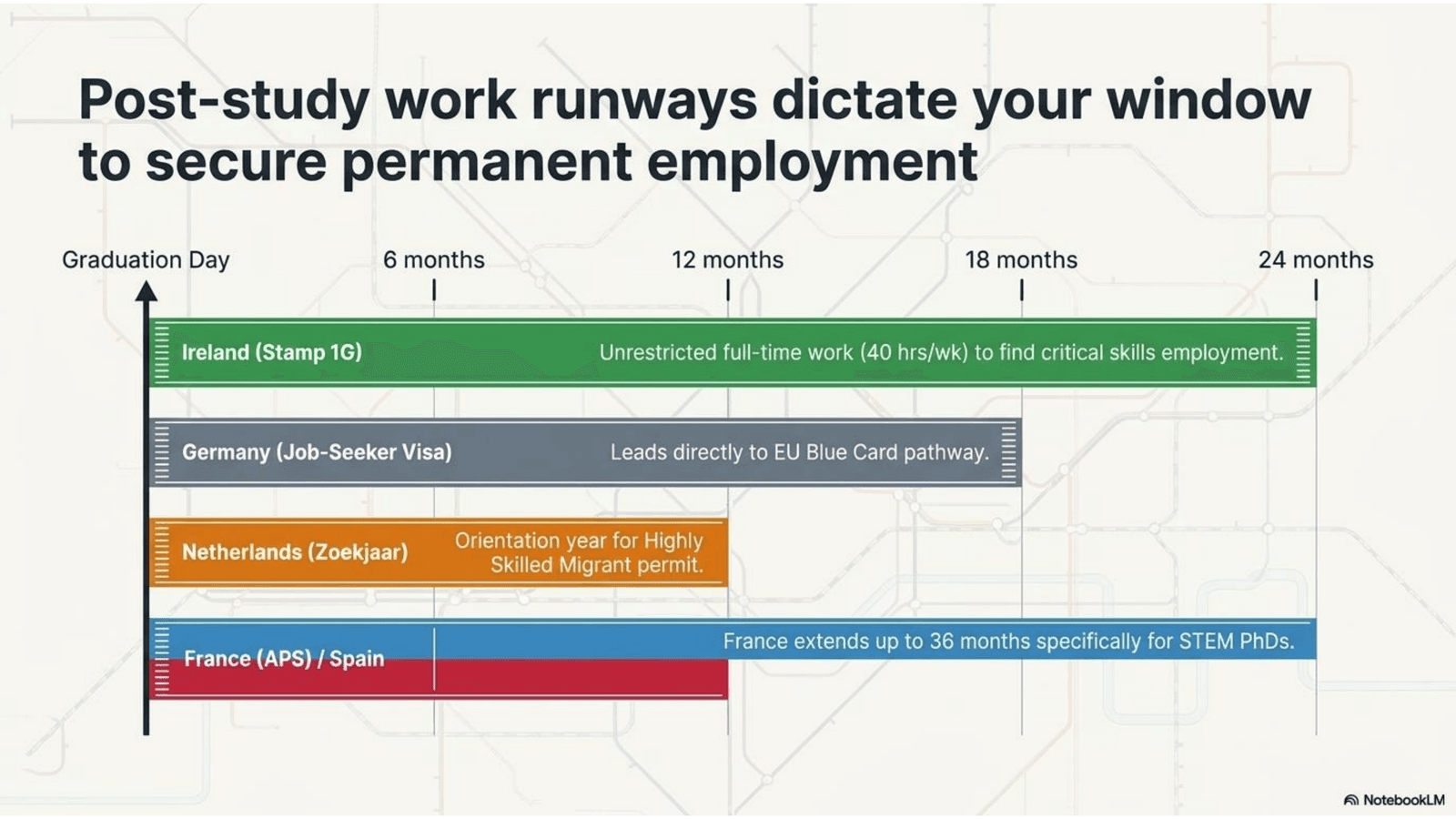
Ireland's Stamp 1G gives non-EU graduates of recognised Irish institutions the right to remain in Ireland to seek and commence graduate-level employment without employer sponsorship. Duration: 12 months for NFQ Level 8 (Honours Bachelor's) graduates; 24 months (in two 12-month blocks) for NFQ Level 9 (Master's) and Level 10 (PhD) graduates. During Stamp 1G, graduates may work full-time (40 hours/week) without a separate work permit. Ireland is not in the Schengen Area — Stamp 1G does not grant Schengen travel rights.
If a graduate secures a qualifying job (Critical Skills Employment Permit at €38,000+ annual salary for most tech, engineering, science, and finance roles), they can transition to a Critical Skills Employment Permit, which after 21 months leads to Stamp 4 — permission to work without any permit. Stamp 4 held for 2 years or longer contributes to the 5-year legal residence required for Irish naturalisation. This is one of the most clearly signposted pathways from student to long-term EU residency available in Europe.
Germany — Job-Seeker Visa (Aufenthaltserlaubnis zur Arbeitssuche)
Germany grants non-EU graduates of German (and, since 2023, select foreign) universities an 18-month post-study residence permit to seek employment. No employer sponsorship is required during this period. Graduates may work in any role during the job-seeking phase — there is no restriction to graduate-level positions during the 18 months, unlike Ireland's Stamp 1G requirement for "graduate-level" employment. Once qualified employment is secured, the EU Blue Card (Blaue Karte EU) is available to those earning above the minimum Blue Card salary threshold (€45,300 general; €35,100 for shortage occupations in 2025). Germany's reformed Skilled Immigration Act (Fachkräfteeinwanderungsgesetz), which came into force in full in 2024, substantially liberalised the pathways for non-EU graduates to remain and work in Germany.
Netherlands — Zoekjaar (Orientation Year Visa)
Dutch graduates of Dutch universities receive a 12-month Zoekjaar (orientation year) residence permit after graduation. This allows them to work without restriction during the year to find a graduate role. If employed after the Zoekjaar, graduates typically move to a Highly Skilled Migrant residence permit (Kennismigrant), available to those earning above the minimum salary threshold (€5,331 per month for those under 30; €7,734 for 30 and over, as of 2025 figures). The 12-month duration is shorter than Ireland's 24 months for Master's graduates and Germany's 18 months.
France — APS (Autorisation Provisoire de Séjour)
France grants non-EU graduates of French institutions an APS (temporary stay authorisation) of 12 months for Bachelor's and Master's graduates, and up to 3 years for PhD graduates in science, technology, engineering, and mathematics. During the APS, graduates may work in any sector for up to 60% of the legal working year. Extension to a long-term work visa requires finding employment with a salary above a set threshold. In practice, language continues to be a meaningful barrier to graduate employment in France for non-French-speaking graduates, even during the APS period.
| Country | Permit Name | Duration (Master's) | Work Allowed | Schengen Access |
|---|---|---|---|---|
| Ireland | Stamp 1G | 24 months | Full-time (40 hrs/week) | No — not Schengen |
| Germany | Job-Seeker Visa | 18 months | Unrestricted | Yes — Schengen member |
| Netherlands | Zoekjaar | 12 months | Unrestricted | Yes — Schengen member |
| France | APS | 12 months (up to 36 for STEM PhD) | Up to 60% of legal work year | Yes — Schengen member |
| Sweden | Job-Seeker Permit | 6 months | Unrestricted | Yes — Schengen member |
| Spain | Búsqueda de empleo | 12 months | Unrestricted | Yes — Schengen member |
Studying in Germany, France, the Netherlands, Sweden, or Spain means your student visa grants you Schengen Area membership — you can travel freely to 26 European countries without border checks. Ireland's Stamp 2 student permission does not include this right. However, for students whose primary goal is post-study employment rather than European travel, Schengen access during the study period is a lifestyle benefit rather than a career-defining factor.
Section 4 — Cost of Living Comparison by City
Tuition tells only part of the financial story. Monthly living costs — driven primarily by rent — can exceed tuition costs across all these destinations. The table below uses verified 2025–26 data from Numbeo, Eurostat, and national student housing organisations.
| City | Country | Rent (shared room) | Groceries | Transport | Total Estimate |
|---|---|---|---|---|---|
| Dublin | Ireland 🇮🇪 | €900–€1,500 | €200–€350 | €100–€140 | €1,400–€2,000+ |
| Amsterdam | Netherlands 🇳🇱 | €900–€1,400 | €200–€330 | €80–€120 | €1,350–€1,950 |
| Stockholm | Sweden 🇸🇪 | €750–€1,200 | €220–€350 | €90–€120 | €1,200–€1,800 |
| Munich | Germany 🇩🇪 | €700–€1,100 | €180–€280 | €0 (included in semester ticket) | €1,050–€1,550 |
| Paris | France 🇫🇷 | €700–€1,100 | €200–€300 | €50–€86 (Navigo student) | €1,050–€1,600 |
| Berlin | Germany 🇩🇪 | €500–€900 | €160–€250 | €0 (semester ticket) | €750–€1,200 |
| Barcelona | Spain 🇪🇸 | €500–€900 | €160–€240 | €40–€60 | €800–€1,300 |
| Madrid | Spain 🇪🇸 | €500–€850 | €150–€250 | €35–€55 | €750–€1,200 |
| Leipzig/Dresden | Germany 🇩🇪 | €300–€550 | €150–€220 | €0 (semester ticket) | €550–€900 |
Section 5 — Graduate Employment After Study
The return on a foreign degree is measured not only in academic credentials but in the employment it enables. Each country's graduate job market reflects its industrial structure, language requirements, and international employer presence.
Ireland — US Tech Headquarters and EU Regulatory Hub
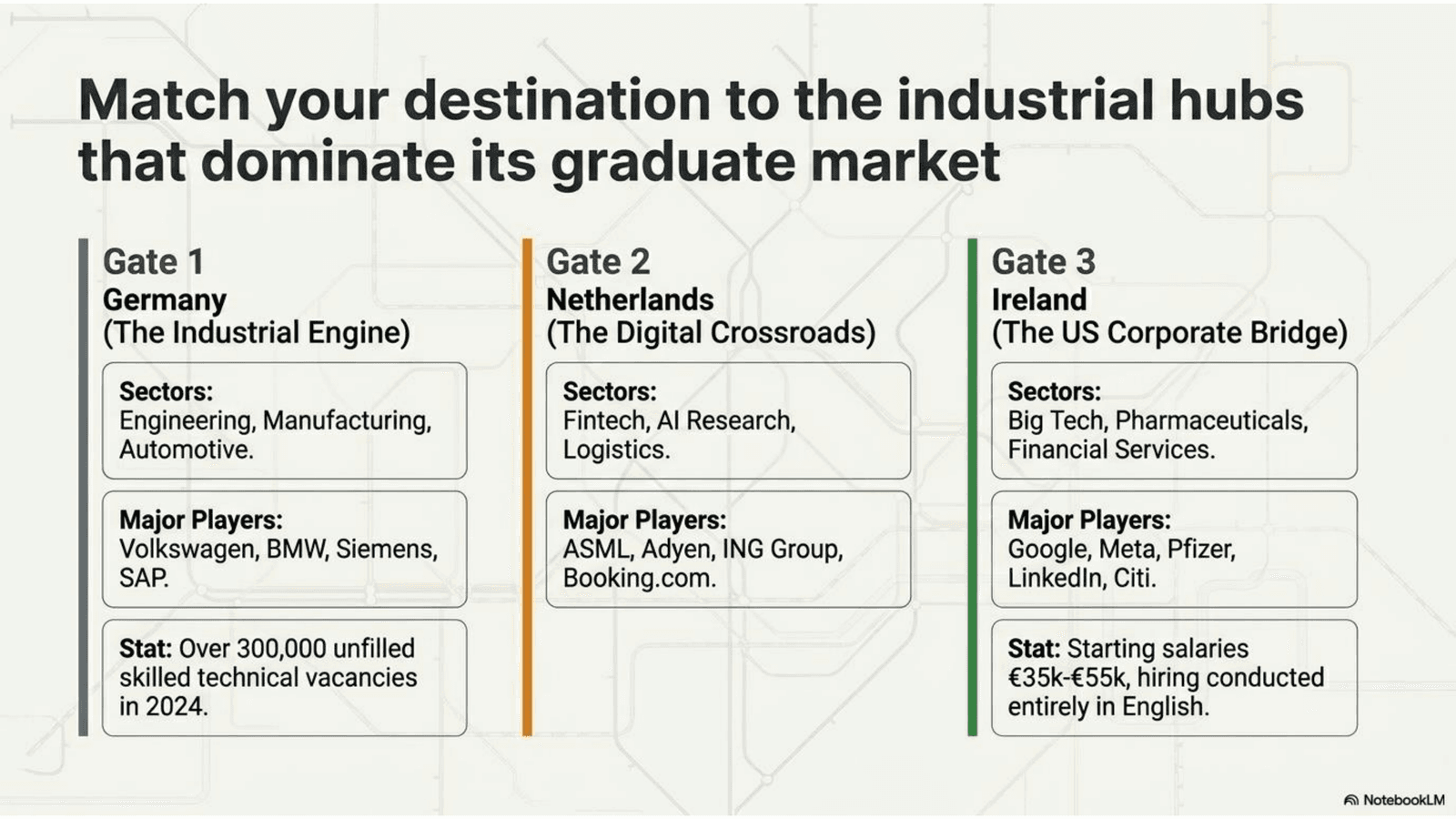
Ireland's graduate employment advantage for international students is specific and potent: it is the European headquarters for an extraordinary concentration of US technology, pharmaceutical, and financial services companies. Google, Meta, Apple, Microsoft, LinkedIn, Salesforce, PayPal, Pfizer, Johnson & Johnson, AbbVie, Citi, and Bank of America all maintain major European operations in Ireland. These companies hire globally, conduct business entirely in English, and actively recruit from Irish universities. Graduate starting salaries in Ireland's tech and finance sectors range from €35,000 to €55,000, with experienced hires earning substantially more.
The critical qualification: Ireland's graduate market is concentrated in specific sectors (tech, pharma, financial services) and in Dublin. Students in unrelated fields or based in smaller Irish cities may find the graduate employment market narrower than the headline figures suggest.
Germany — Engineering Powerhouse, Blue Card Pathway
Germany's graduate market is the largest in Europe for engineering, manufacturing, and industrial technology. Companies including Volkswagen, BMW, Siemens, BASF, Bosch, SAP, and Deutsche Telekom have large graduate hiring pipelines. Germany faces a documented shortage of STEM graduates — the Bundesagentur für Arbeit reported over 300,000 unfilled skilled technical vacancies in 2024 — which creates genuine demand for qualified international graduates.
The EU Blue Card (Blaue Karte EU) in Germany offers a direct pathway for qualified graduate employment: those earning above the minimum threshold (€45,300 general; €35,100 for shortage occupations in 2025) can apply immediately upon securing employment. After 33 months of Blue Card employment (or 21 months with B1 German), graduates can apply for permanent residence. The significant limitation: most German employers outside the international tech sector expect functional German (B2 minimum) even for roles advertised as "English-friendly". Language investment is not optional for long-term career success in Germany.
Netherlands — European Fintech and Logistics Hub
The Netherlands hosts European headquarters for ASML, Philips, ING Group, ABN AMRO, Booking.com, TomTom, and Adyen, alongside significant presences from Uber, Netflix, and Tesla's European operations. Amsterdam is emerging as one of Europe's leading fintech and AI research centres. The Dutch graduate market is genuinely international, with many employers conducting hiring processes entirely in English. The Zoekjaar visa's 12-month window is shorter than Germany's and Ireland's, making early job-seeking strategies important.
France — Consulting, Luxury, and the Language Gate
France's graduate market is deep in consulting (McKinsey, BCG, Bain, Capgemini all maintain major Paris offices), luxury goods and fashion (LVMH, Kering, L'Oréal), aerospace and defence (Airbus, Safran, Thales), and energy (TotalEnergies, EDF). The fundamental challenge for international students: French language skills at professional level (C1 minimum) are a prerequisite for the majority of these roles. Graduates of elite grandes écoles may have an easier path, but even Sciences Po or ESSEC graduates who have not invested in French language proficiency find the Paris job market substantially harder to penetrate than the Dublin or Amsterdam markets.
Section 6 — University Rankings: The Trade-Offs Explained
A common objection to studying in Ireland — particularly from students from countries with competitive academic cultures — is that Irish universities rank lower globally than the very top German, Dutch, and Swiss institutions. This is accurate and worth engaging with honestly.
| University | Country | QS Rank 2026 | Strongest Areas |
|---|---|---|---|
| ETH Zurich | Switzerland | #7 | Engineering, natural sciences, computer science |
| Delft University of Technology | Netherlands | #47 | Engineering, architecture, aerospace |
| TU Munich (Technical University of Munich) | Germany | #52 | Engineering, computer science, life sciences |
| University of Amsterdam | Netherlands | #53 | Social sciences, law, humanities |
| LMU Munich | Germany | #59 | Medicine, natural sciences, humanities |
| Trinity College Dublin | Ireland | #75 | Law, computer science, humanities, medicine |
| KU Leuven | Belgium | #77 | Engineering, medicine, theology |
| Heidelberg University | Germany | #86 | Medicine, life sciences, social sciences |
| University College Dublin | Ireland | #118 | Business, engineering, agricultural sciences |
| University College Cork | Ireland | #246 | Medicine, pharmacy, food science |
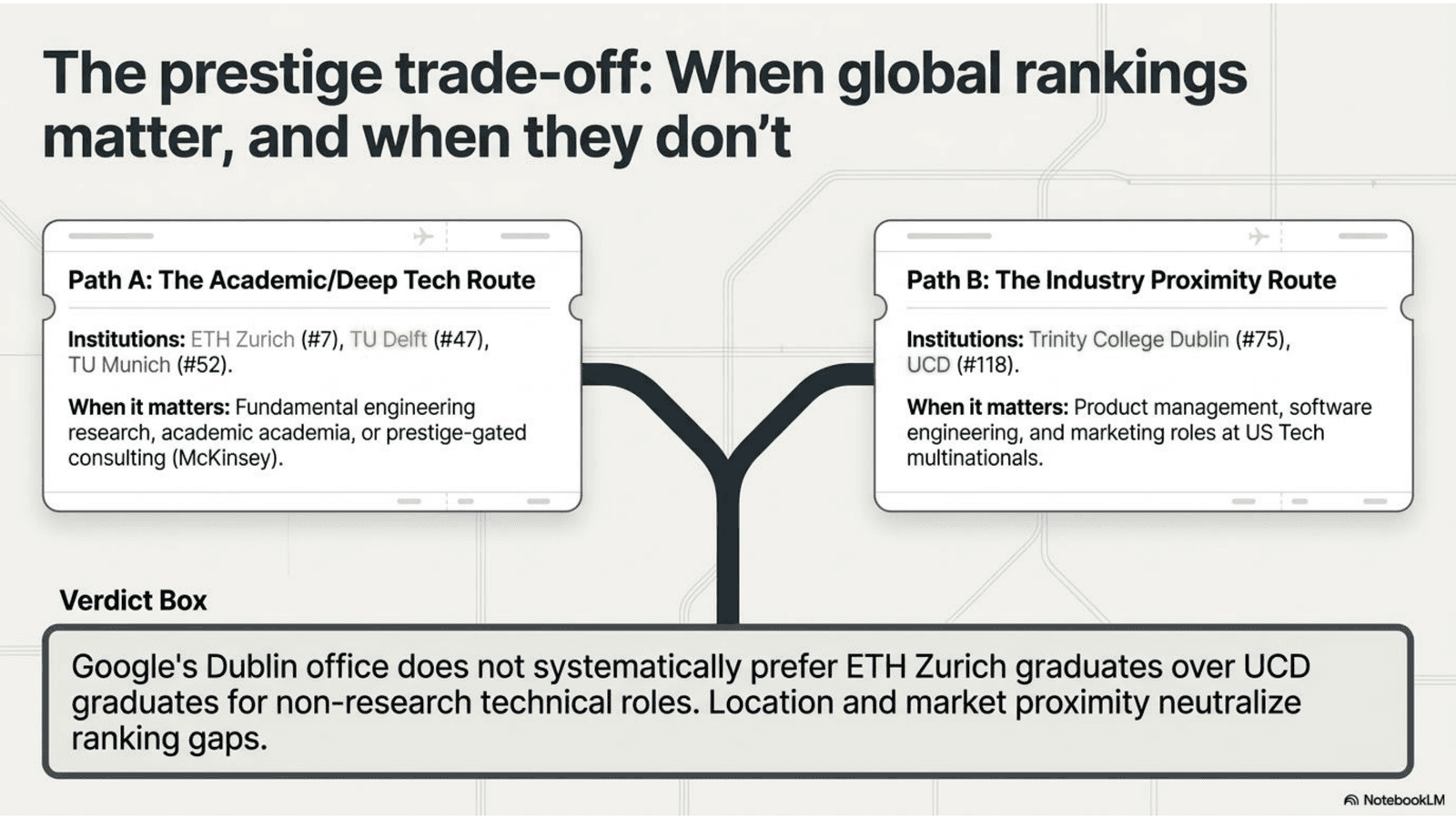
ETH Zurich, TU Munich, and TU Delft rank significantly above TCD and UCD. For students targeting a career in fundamental engineering research, academic academia, or technical industries where institutional pedigree carries direct weight in hiring decisions — these rankings matter.
However, the ranking argument has important limits. For the US technology companies recruiting in Dublin — which are primarily hiring product managers, software engineers, data scientists, and marketers — TCD and UCD graduates are competing on exactly equal terms with graduates from higher-ranked European institutions. Google's Dublin office does not systematically prefer ETH Zurich graduates over UCD graduates for non-research technical roles. Within the specific Irish and European industry contexts where Irish graduates are competing, the ranking gap is less decisive than it appears in a global table.
Section 7 — Decision Framework: Which Country Fits You?
After comparing all factors, the right choice depends on an honest assessment of your priorities, language capabilities, financial position, and career target. Here is a structured decision framework based on the evidence in this guide.
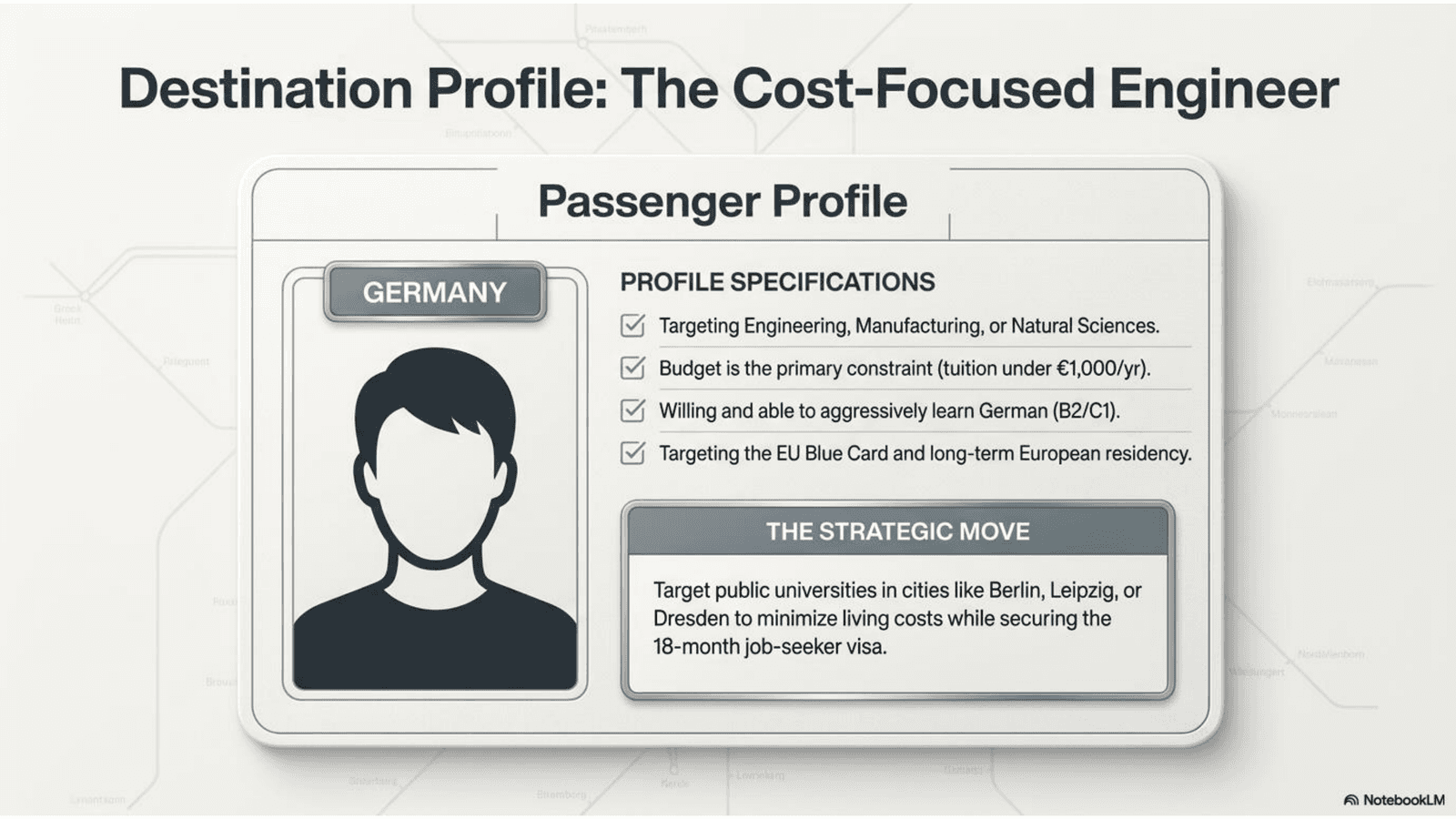
🇩🇪 Choose Germany if:
- Engineering, manufacturing, or natural sciences are your target field
- Cost is the primary constraint and you can commit to learning German
- You want EU Blue Card access and long-term German residence
- You are willing to study a Bachelor's in German
- You target industries where German language is a professional asset
- Berlin or a smaller German city's lower living costs suit your budget
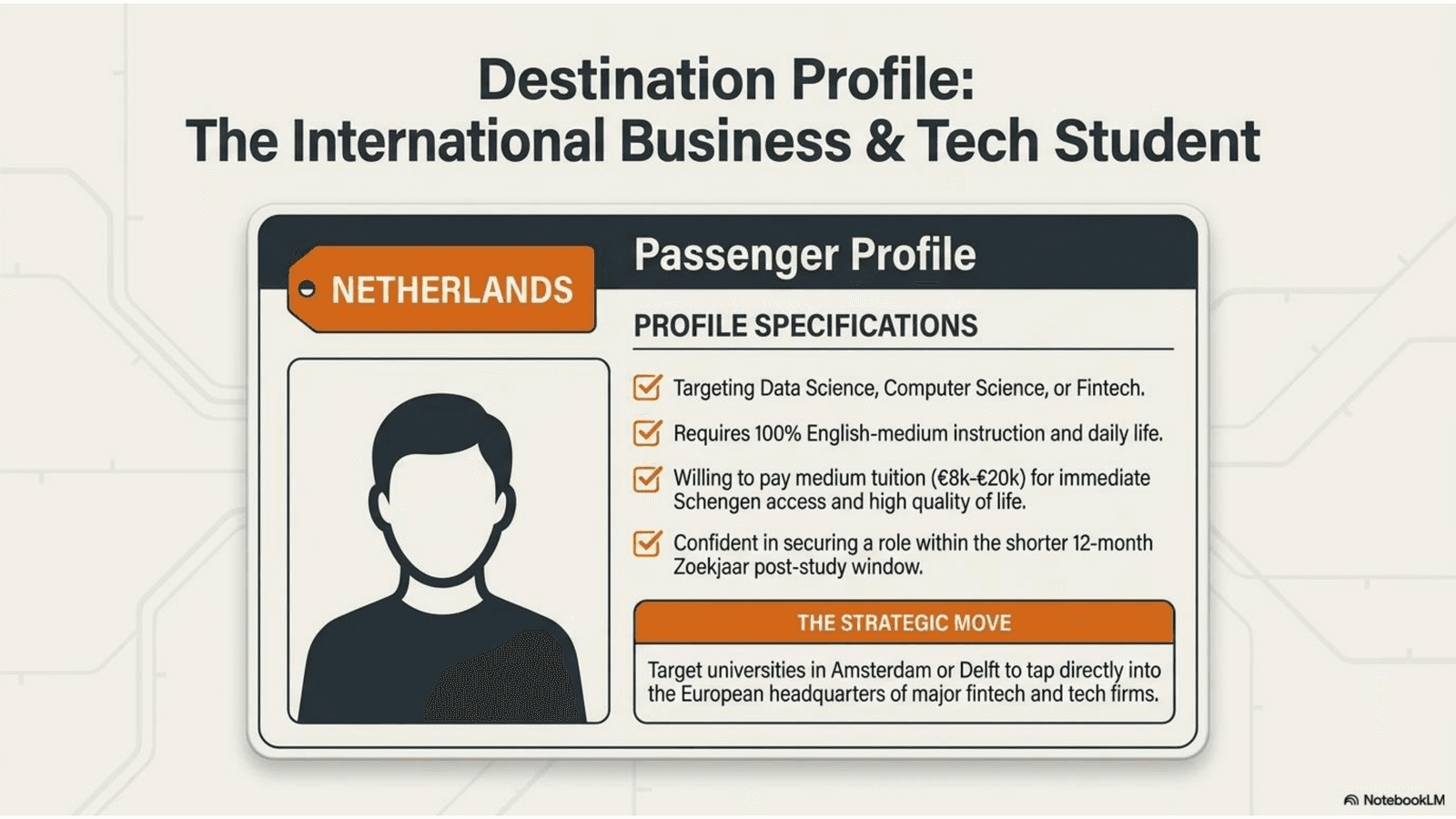
🇳🇱 Choose Netherlands if:
- English-medium instruction is important but tuition lower than Ireland is preferred
- Business, data science, computer science, or fintech is your target field
- Schengen travel freedom during study matters to you
- You are targeting European tech or finance employers (ASML, Adyen, Booking.com)
- Amsterdam's cosmopolitan environment appeals to you
- You are comfortable with a 12-month (not 24-month) post-study window
🇮🇪 Choose Ireland if:
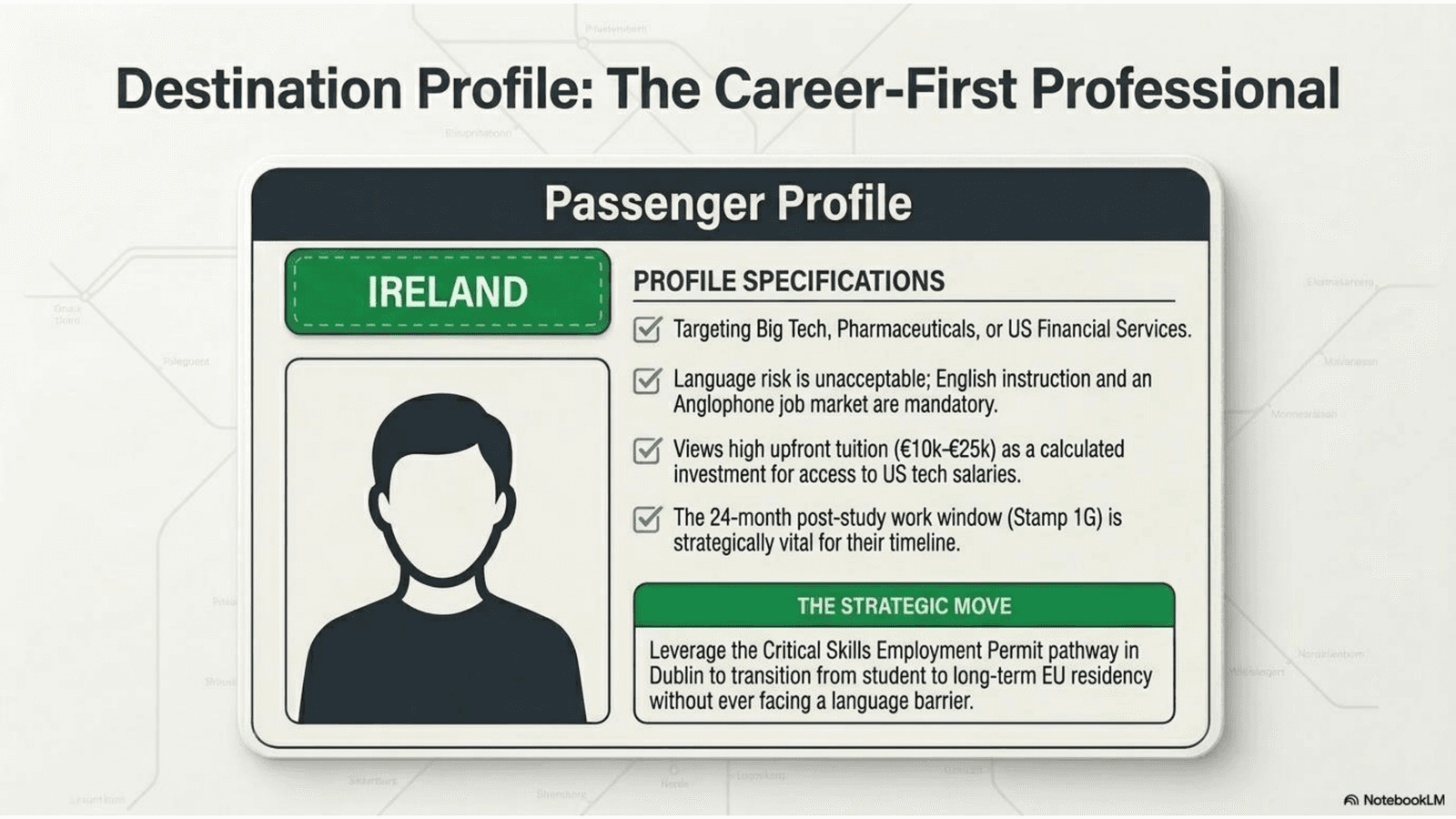
- English instruction is non-negotiable and language learning is not feasible
- Working at US tech companies (Google, Meta, Microsoft, Apple) in Europe is the goal
- A 24-month post-study period (Master's level) is strategically important
- Cultural familiarity and English-medium daily life reduce integration risk
- You want an EU degree with English-speaking career access
- Pharma, biotech, or financial services roles in Ireland are the target
France and Spain offer low tuition and rich cultural and academic environments — but the language barrier for graduate employment is the most significant of any major European study destination. Both are genuinely excellent choices for students who already speak French or Spanish at B2+ level, or who plan to dedicate a year to intensive language acquisition before or during their programme. For students who do not, the lower tuition figures are likely to be offset by reduced graduate employability and narrower career access after graduation.
Bringing It Together: A Comparative Summary
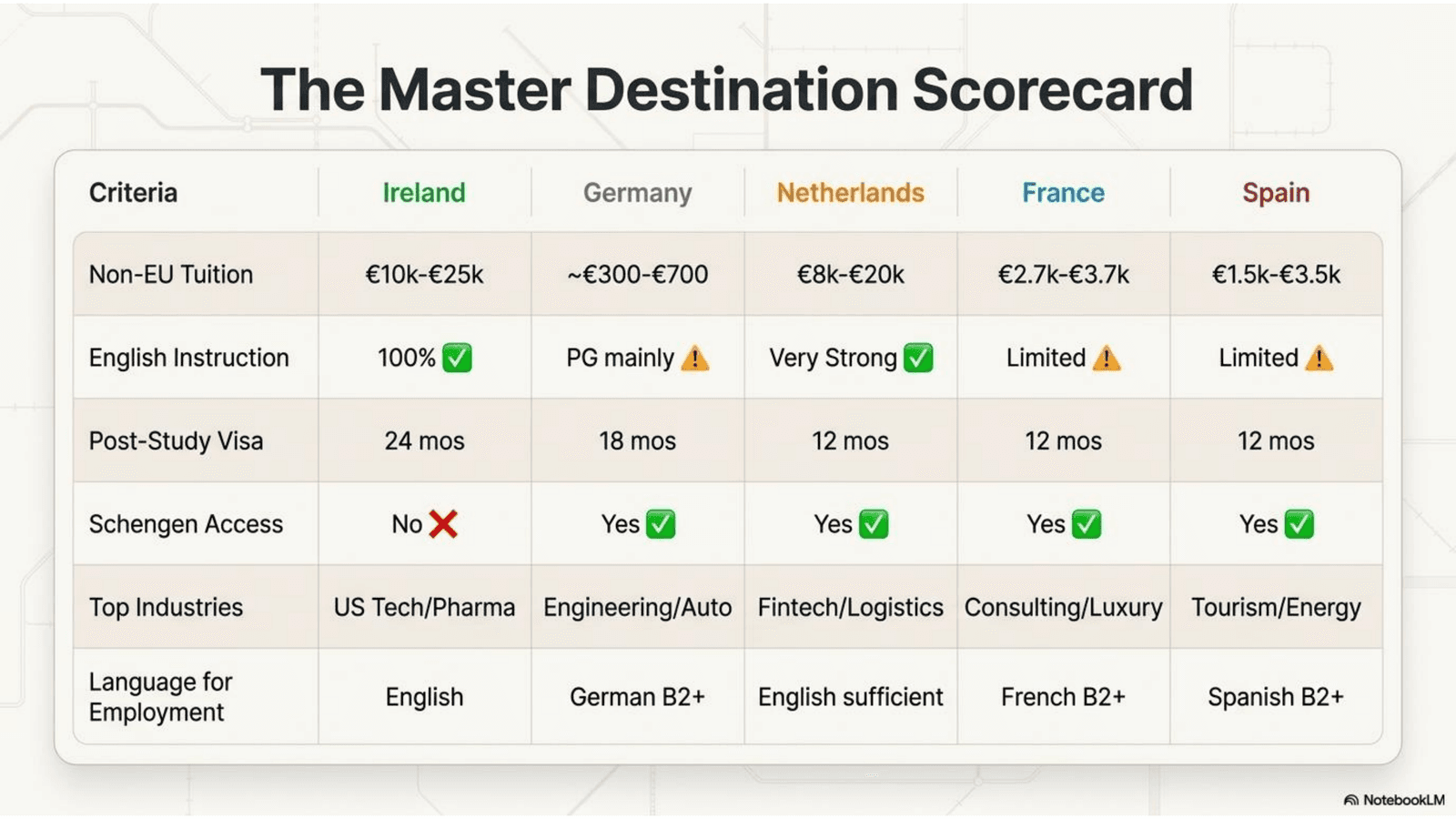
| Factor | Ireland | Germany | Netherlands | France | Spain |
|---|---|---|---|---|---|
| Non-EU tuition | €10,000–€25,000/yr | ~€300–€700/yr | €8,000–€20,000/yr | €2,770–€3,770/yr (public) | €1,500–€3,500/yr |
| English instruction | ✅ 100% | ⚠️ Limited UG; growing PG | ✅ Very strong | ⚠️ Limited at public unis | ⚠️ Limited |
| Post-study work (Master's) | 24 months (Stamp 1G) | 18 months | 12 months (Zoekjaar) | 12 months (APS) | 12 months |
| Schengen access | ❌ Not Schengen | ✅ Yes | ✅ Yes | ✅ Yes | ✅ Yes |
| Living costs (major city) | €1,400–€2,000/month (Dublin) | €750–€1,200/month (Berlin); €1,050–€1,550 (Munich) | €1,350–€1,950/month (Amsterdam) | €1,050–€1,600/month (Paris) | €750–€1,300/month |
| Top university rank | TCD #75 (QS 2026) | TU Munich #52 (QS 2026) | TU Delft #47 (QS 2026) | École Polytechnique #42 (QS 2026) | UB #163 (QS 2026) |
| Key graduate industries | US tech, pharma, finance | Engineering, manufacturing, automotive | Tech, fintech, logistics, life sciences | Consulting, luxury, aerospace | Tourism, energy, telecoms |
| Language required | English only | German (B2+) for most | English sufficient for most | French (B2+) for employment | Spanish (B2+) for most |
Frequently Asked Questions
Is studying in Germany really free for international students?
At most public universities in Germany — outside Baden-Württemberg — yes. Students of all nationalities pay only a semester contribution of approximately €100–€350 covering administration and a public transport pass. Private universities and some professional postgraduate programmes charge full tuition. Total annual "fee" cost at most public universities: under €700 per year.
Which European country has the best post-study work visa for international students?
Ireland leads on duration for Master's and PhD graduates with 24 months of Stamp 1G. Germany offers 18 months. Both are notably stronger than the Netherlands (12 months), France (12 months), and Sweden (6 months). Germany's pathway to the EU Blue Card and permanent residence after 33 months is among Europe's most direct for qualified STEM graduates.
Are there English-taught programmes in Germany?
Yes, particularly at postgraduate level. DAAD reported over 1,600 English-taught programmes as of 2025, mostly at Master's and PhD level. English-taught Bachelor's degrees remain rare. Daily life outside the university still operates largely in German in most cities.
Does studying in Ireland give me access to the Schengen Area?
No. Ireland is not a member of the Schengen Area and maintains its own border controls. Studying in any Schengen member state (Germany, France, Netherlands, Spain, Sweden) provides Schengen travel rights during the study period. For students who plan extensive European travel during their degree, Schengen membership is a material advantage of continental study destinations.
Which is cheaper overall — studying in Germany or Ireland?
Germany is substantially cheaper on tuition (near-zero vs €10,000–€25,000 per year in Ireland). Living costs reduce the gap but do not close it: Berlin is meaningfully cheaper than Dublin; Munich is comparable. A student at a Berlin public university typically spends €9,000–€12,000 per year in total; a student at UCD Dublin typically spends €30,000–€40,000 per year. The financial case for Germany is strong — provided the student can succeed in a German-language programme or gain admission to an English-taught postgraduate programme.
This guide is designed to be read alongside our detailed Ireland-specific study guide:
And for Indian students planning the flight from Ireland to home during breaks:
Planning to use an Indian credit card to book your international student flight? Our guides cover lounge access, forex savings, and rewards on the major Indian bank cards:
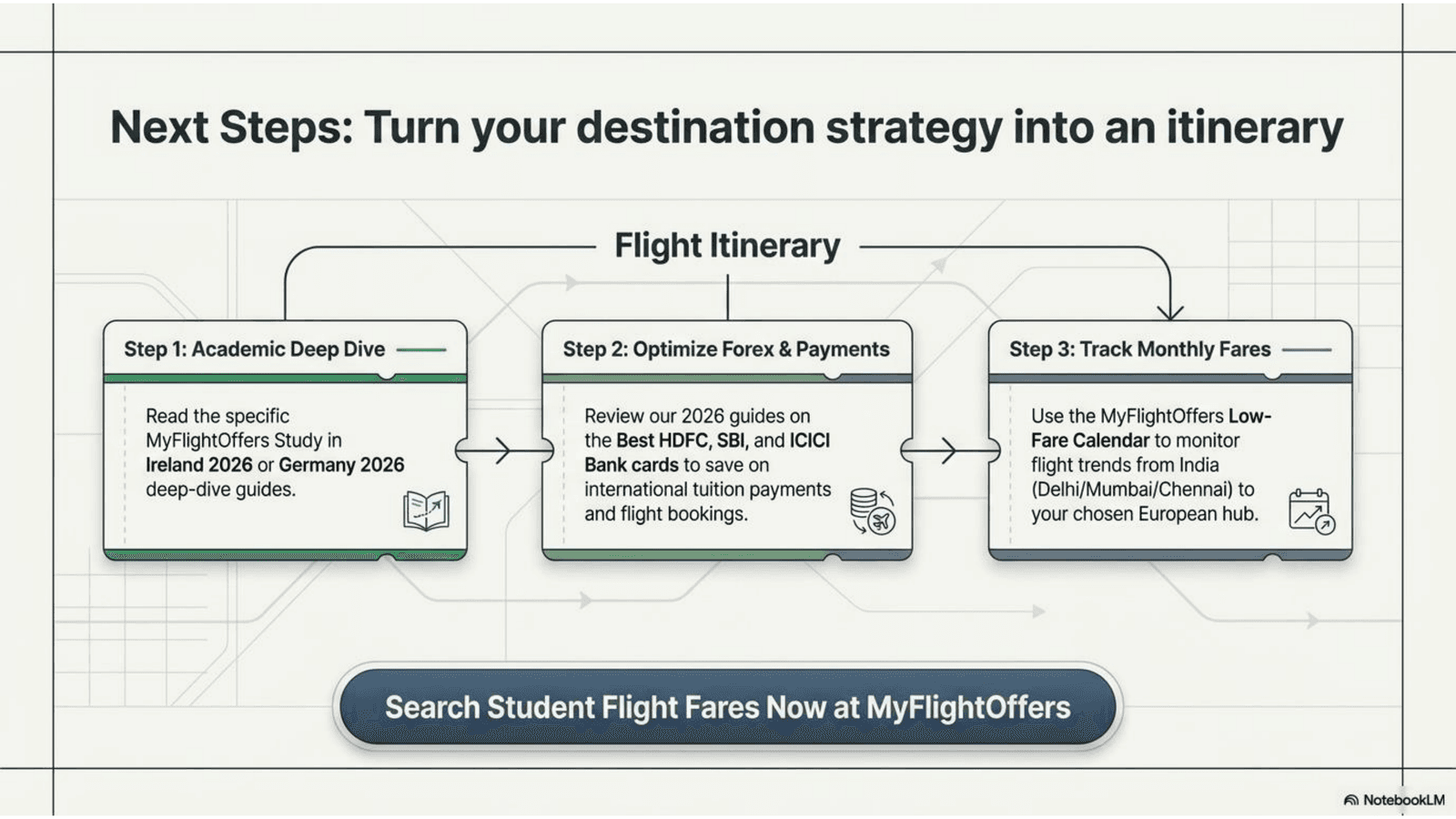
Booked your destination? Now find the best fare
Whether you are flying Dublin–Delhi, Mumbai–Amsterdam, or Chennai–Frankfurt, compare live fares and monthly fare trends before you commit.
All tuition fee figures, post-study work visa durations, living cost estimates, salary thresholds, and university ranking positions cited in this article are based on publicly available information from the following sources: DAAD (daad.de), Studyfinder.nl, Campus France (campusfrance.org), the Dutch Immigration and Naturalisation Service (IND, ind.nl), the German Federal Employment Agency (Bundesagentur für Arbeit, arbeitsagentur.de), the Irish Immigration Service (irishimmigration.ie), QS World University Rankings 2026 (topuniversities.com), Numbeo Cost of Living 2025–26, and Eurostat Higher Education Statistics 2024. Tuition fees, visa regulations, salary thresholds, and programme availability change annually and vary by institution, programme level, and home country. Always verify current terms directly with the relevant university and national immigration authority before making any financial commitment or visa application. MyFlightOffers is not affiliated with any university, government, or immigration authority mentioned in this article. This article does not constitute immigration, financial, or academic advice.