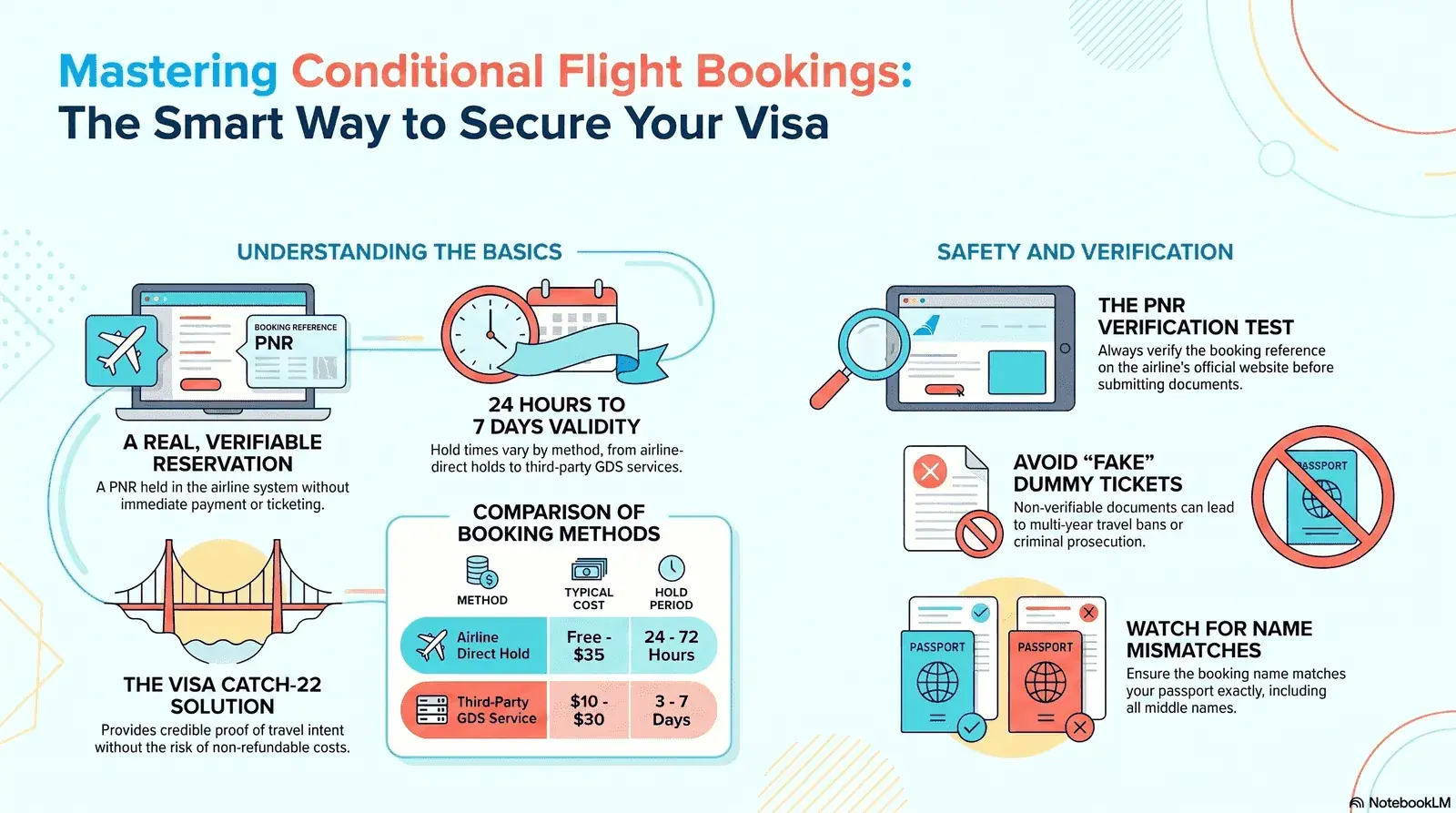
- A conditional booking is a real, verifiable reservation — held but not yet paid. It exists to solve the visa catch-22: embassies want proof of travel plans, but airlines won't refund a non-refundable ticket if your visa is denied.
- It must include a PNR (booking reference) that immigration can verify. A simple itinerary printout without a verifiable reference is not accepted by most embassies — the guide explains what a valid conditional booking document must contain.
- Most holds expire in 24–72 hours. Coordinate your visa application submission timeline before requesting the hold, so the reservation doesn't lapse before the embassy reviews your file.
📋 What is it?
A real, verifiable flight reservation — held but not yet paid or ticketed — used primarily for visa applications.
🎯 Who needs one?
Visa applicants, international students, and anyone required to show proof of onward travel before visa approval.
⏱ How long is it valid?
24 hours via airline direct hold; 3–7 days via third-party GDS reservation services.
💰 What does it cost?
Free (airline 24-hr hold) to $10–$30 / ₹800–₹2,500 via third-party services.
13 questions answered in this guide
- What exactly is a conditional flight booking?
- Is it the same as a dummy ticket or flight itinerary?
- Why do travelers need a conditional booking?
- Which visas and borders require proof of onward travel?
- How does a conditional booking work technically?
- How long does a conditional booking stay valid?
- Two ways to get a conditional flight booking
- How much does a conditional booking cost?
- How to tell a legitimate booking from a fraudulent fake
- Special guidance for Indian travelers
- Can I use a refundable ticket instead?
- What to do after your visa is approved
- Common mistakes that derail visa applications
1 What Exactly Is a Conditional Flight Booking?
A conditional flight booking is a temporary flight reservation held in an airline's booking system with a real, verifiable PNR (Passenger Name Record) that has not yet been fully paid or issued as a ticket. The airline reserves a seat for a defined hold window — typically 24 to 72 hours — during which the traveler must complete payment or the booking automatically cancels and the seat returns to inventory.
The word "conditional" refers to the fact that the reservation exists in the airline's system but is conditional on payment being completed. Unlike a confirmed, ticketed booking — where money has changed hands and a ticket number has been issued — a conditional booking is a placeholder with a deadline. No money has been debited; no travel contract exists.
In everyday traveler language, this concept also goes by the names flight hold, flight reservation, flight itinerary, or — less formally — dummy ticket. Each term describes a slightly different scenario, but all share the same core characteristic: a real booking reference exists in the airline's system, yet the traveler has not yet committed financially.
A PNR (Passenger Name Record) is a unique alphanumeric booking reference — typically five or six characters — generated the moment a flight reservation is created. It exists simultaneously in the airline's own database and in the Global Distribution System (GDS) used by travel agents worldwide. A real PNR can always be looked up on the airline's official website under "Manage My Booking" or "Check-In." If a booking confirmation contains no PNR, or its PNR does not resolve on the airline's site, it is not a real reservation.
2 Is It the Same as a Dummy Ticket or Flight Itinerary?
No. While these terms are sometimes used interchangeably by travelers, treating them as identical is a high-risk visa mistake. Many online third-party sites market cheap "dummy tickets" that are actually generated using automated template systems. These unverified tickets often contain forged, short-lived, or completely fake Passenger Name Record (PNR) codes.
Consulates and embassies worldwide (especially Schengen zone countries, the UK, and Ireland) have integrated automated verification checks linked directly to Global Distribution Systems (GDS). Visa officers regularly run real-time checks on the PNRs submitted in your application. If a consulate's system flags your booking as non-existent or cancelled, your visa application can be rejected on the spot on grounds of presenting fraudulent documentation.
To stay safe and compliant, you should completely avoid unverified online dummy ticket generators. Instead, rely on official airline fare-holding mechanisms (such as Emirates Hold My Fare, KLM Time to Think, or Lufthansa Secure Your Fare) or book through verified travel agencies that can guarantee a live, GDS-verifiable flight reservation for the entire visa review window.
Whether the document is called a conditional booking, dummy ticket, or flight itinerary is secondary. The only question that matters for legal and visa purposes is whether the PNR can be independently verified on the airline's own website. If it can, the document is legitimate. If it cannot, it is fraudulent — regardless of how convincing it looks.
3 Why Do Travelers Need a Conditional Flight Booking?
The primary reason travelers need a conditional booking is to break the visa catch-22: most countries require proof of travel plans when reviewing a visa application, but purchasing a non-refundable international flight before visa approval is a significant and unnecessary financial risk.
A Schengen visa application can take 15–45 business days to process. An Irish student visa takes 4–8 weeks. A UK visitor visa takes approximately 15 working days. Asking a traveler to buy a non-refundable long-haul ticket — often costing ₹40,000 to ₹1,20,000 — before knowing whether the visa will be approved would be financially reckless. A conditional booking resolves this by giving the embassy or consulate credible proof of travel intent without requiring financial commitment.
Beyond visa applications, conditional bookings are also used for:
- Proof of onward travel at ports of entry — some border authorities (US, UK, Australia) ask arriving travelers to confirm they have a return or onward flight booked
- Travel insurance activation — some insurers require a flight itinerary before issuing a travel policy
- University accommodation confirmation — student housing portals often require proof of arrival dates before assigning a room
- Employer leave approval — some companies request flight booking evidence before approving extended international leave
4 Which Visas and Borders Require Proof of Onward Travel?
Most short-stay visa types — tourist, visitor, student entry — and many port-of-entry checks require some form of travel itinerary or flight reservation, but the specific document accepted varies significantly by destination.
| Destination / Visa Type | Proof of Travel Required? | What Is Accepted? | Is a Conditional Booking Sufficient? |
|---|---|---|---|
| Schengen Area (C Visa) | Yes — standard checklist item | Round-trip flight reservation or detailed travel itinerary | ✅ Yes — EU embassies explicitly accept reservations, not only confirmed paid tickets |
| UK Standard Visitor Visa | Recommended — not strictly mandatory | Travel itinerary or booking confirmation | ✅ Yes — UKVI guidance accepts travel itinerary as supporting evidence |
| Ireland Student Visa | Yes — required at entry clearance stage | Proof of transport to Ireland | ✅ Yes — a confirmed or provisionally booked ticket is accepted |
| US B1/B2 Tourist Visa | Not required for the visa interview — border officers may ask at port of entry | Return or onward ticket shown at arrival | ⚠️ Fine for the visa application; have a confirmed ticket when actually flying |
| Canada Tourist / TRV | Not strictly required but strongly recommended | Travel itinerary | ✅ Yes — IRCC guidance accepts flight itineraries as supporting documents |
| Australia Tourist Visa (Subclass 600) | Not required for the online application — border officers may ask on arrival | Return or onward ticket at port of entry | ⚠️ Acceptable at application stage; have a real ticket when you travel |
| UAE Visa on Arrival / Visit Visa | Some airlines ask for return ticket before boarding to UAE | Return booking confirmation | ✅ Yes — a conditional booking confirmation typically satisfies airline check-in staff |
Visa requirements change and specific consulates within the same country can apply checklist items differently. The German Embassy in Dublin, the French Embassy in India, and VFS Global processing centers all publish their own document checklists online. Cross-reference the official checklist for the specific mission processing your application — not a third-party summary — before finalizing your documents.
5 How Does a Conditional Booking Work Technically?
A conditional booking works by creating a reservation in the Global Distribution System (GDS) — the airline industry's shared seat-inventory database — that assigns a passenger's name and itinerary to a specific flight, generating a PNR, but defers ticket issuance until a ticketing deadline passes.
Airlines and travel agents interact with GDS platforms — primarily Amadeus, Sabre, and Travelport — to access real-time seat inventory worldwide. When a reservation is made without immediate payment, the GDS records a booking with a ticketing time limit (TTL) set by the airline's fare rules. During this window, the booking is live: the airline can see it; the passenger can verify it on the airline's website; the seat is held. But until a ticket number is issued — indicated by a 13-digit number prefixed with the airline's two-digit carrier code — no money has been processed and no enforceable travel contract exists between the passenger and the airline.
Third-party conditional booking services operate by holding GDS access — either directly through an IATA-accredited agency or via a sub-agent agreement — and creating these temporary holds on behalf of customers who specifically need them for visa purposes. The service passes the PNR to the customer; the customer verifies it and submits it with the visa application.
6 How Long Does a Conditional Booking Stay Valid?
The hold period depends entirely on how the reservation was created — ranging from 24 hours on an airline's free cancellation window to up to 7 days through a third-party GDS service.
| Method | Typical Hold Period | Cost | Key Notes |
|---|---|---|---|
| Airline direct — free 24-hour cancel | 24 hours | Free | Applies when the flight is booked at least 7 days in advance (US DOT standard, adopted by most major carriers globally); you complete the full booking then cancel within 24 hrs |
| Airline paid hold option ("Hold my Booking") | 24–72 hours | £10–£35 / €12–€38 typically | Offered by British Airways, Finnair, and select others; locks the price and seat for an extended window while you decide |
| GDS / travel agent hold (standard TTL) | 24–72 hours | Free (via an agent booking your actual ticket) | Ticketing deadline set by the airline's fare rules; the agent must ticket by this deadline or lose the fare |
| Third-party GDS reservation service | 3–7 days | $10–$30 / ₹800–₹2,500 | The service creates the hold and passes you the PNR; verify validity period before submitting your application |
A 24-hour hold is useless for a Schengen visa that takes 15–45 business days to process. Most embassies only verify that the booking is active at the time of submission — not throughout the entire processing period. If your application is submitted to a VFS center today, the booking must be verifiable today. Whether it remains valid in three weeks is generally secondary, though some consulates do spot-check during processing. A 3–7 day hold from a third-party service is the practical minimum for same-week visa submissions.
7 Two Ways to Get a Conditional Flight Booking
There are two main routes to a legitimate conditional booking: directly from the airline, or through a third-party GDS reservation service.
✈️ Method 1 — Directly from the Airline
- Go to the airline's official website (e.g., emirates.com, qatarairways.com, airindia.in)
- Search and select your flight, proceed to payment
- Look for a "Hold my Booking," "Pay Later," or "Flight Option" feature — not all airlines offer this
- Complete the hold; download or screenshot the booking confirmation showing your PNR
- Alternatively, complete the full booking, then cancel within the free 24-hour window
- Hold period: 24–72 hours depending on airline and option
- Best for: Travelers applying for a visa with a fast processing time and who are already committed to this specific route and dates
🌐 Method 2 — Third-Party GDS Reservation Service
- Choose a service that explicitly states it uses real GDS access to create verifiable PNRs
- Provide your travel details: route, dates, full name exactly as on your passport
- The service creates a real hold in the GDS and emails you the PNR and booking confirmation
- Verify the PNR on the airline's own website immediately upon receipt
- Costs approximately $10–$30
- Hold period: 3–7 days typically
- Best for: Longer visa processing windows; travelers not yet committed to specific travel dates or routes
8 How Much Does a Conditional Flight Booking Cost?
A conditional flight booking costs nothing through the airline's standard 24-hour free cancellation window, or between $10 and $30 (approximately ₹800 to ₹2,500) through a third-party GDS reservation service that provides an extended hold period.
| Method | Approx. Cost | Hold Period | Best Suited For |
|---|---|---|---|
| Airline free 24-hour hold / cancellation | Free | 24 hours | Visa applications with very fast same-day processing; or when you need the booking only briefly |
| Airline paid "Hold my Booking" feature | £10–£35 / €12–€38 | 48–72 hours | Travelers who want to lock in a specific fare and seat while finalizing visa documents |
| Third-party GDS service — 3-day hold | $10–$18 / ₹800–₹1,500 | 3 days | Standard Schengen or UK visitor visa applications submitted at a VFS center |
| Third-party GDS service — 7-day hold | $20–$30 / ₹1,600–₹2,500 | 5–7 days | Student visas, Irish visa applications, Canadian TRV where processing may span more than a week |
9 How to Tell a Legitimate Booking from a Fraudulent Fake
A legitimate conditional booking always has a real, verifiable PNR in the airline's own system. A fraudulent document looks convincing but produces no result — or a mismatched result — when the PNR is checked on the airline's website.
Run this four-point check the moment you receive any conditional booking confirmation:
- Go to the airline's official website — not a third-party aggregator. Look for "Manage Booking," "Manage My Trip," or the online check-in portal.
- Enter the PNR and your last name exactly as they appear on the booking confirmation. A real reservation will display your full flight itinerary, passenger name, travel dates, and booking status.
- Confirm the passenger name matches your passport exactly — including middle names if they appear on your passport. A name mismatch is a red flag that the document has been altered.
- Check the booking status is active — it should display as "Confirmed," "Open for Ticketing," or similar. "Cancelled," "Expired," or an error message means the hold has lapsed and the document is no longer valid.
Visa fraud involving forged travel documents can result in immediate refusal of the current application, a multi-year ban from future applications for that country (typically 5–10 years for Schengen and UK visas), a permanent record in immigration databases shared between partner countries, and in serious cases, criminal prosecution under the relevant immigration fraud legislation. Consulate fraud detection teams regularly verify PNRs directly with airlines. A PNR that does not exist in the airline's system, or that was not booked in the applicant's name, will be caught. The $10–$30 saving from using a fake service is never worth the consequence. Only use services that provide real, independently verifiable PNRs.
10 Special Guidance for Indian Travelers
Indian travelers face two specific friction points when obtaining conditional bookings: international transaction restrictions on Indian bank cards, and the TCS (Tax Collected at Source) framework that governs overseas travel payments.
The International Transaction Block Problem
Many Indian bank credit and debit cards block international online transactions by default until explicitly enabled by the cardholder. Before paying for a third-party conditional booking service — typically priced in USD and hosted on an overseas server — enable international online transactions through your bank's mobile app or net banking portal. HDFC, ICICI, SBI, Axis, and Kotak cards all require this step. For HDFC specifically, the limit can be set under Cards → Debit/Credit Card Settings → International Transactions in the mobile banking app. Failure to do this before attempting payment is the most common reason conditional booking transactions fail for Indian users.
TCS (Tax Collected at Source) — What Applies and What Does Not
Under Indian income tax rules revised effective October 2023, TCS at 20% applies to remittances under the Liberalised Remittance Scheme (LRS) above ₹10 lakh per financial year, and to overseas tour packages (flight + hotel bundled together) at a flat 2% from 1 April 2026. Standalone international flight tickets purchased separately from an airline or OTA do not attract TCS. However, a conditional booking service fee of $10–$30 (₹800–₹2,500) is far below any TCS threshold and does not attract TCS. For the actual confirmed flight ticket purchased after visa approval — if paid via an Indian bank card or remittance — TCS rules apply on the portion above the applicable threshold. TCS is credited against your final income tax liability and claimable in your ITR; it is not a permanent tax. Consult a qualified chartered accountant for your specific situation before making large overseas travel payments.
Visa Journeys Most Relevant to Indian Travelers
| Destination | Typical Processing Time | Recommended Hold Type | India-Specific Notes |
|---|---|---|---|
| Schengen (Germany, France, Italy, etc.) | 15–45 business days | Third-party GDS hold (3–7 days) submitted at appointment date; renew if visa processing runs long | VFS Global India centers explicitly accept flight reservations; check the specific country checklist |
| UK Standard Visitor | ~15 business days | Third-party GDS hold (3–7 days) or a fully refundable fare | UKVI online application guidance references "travel itinerary" as supporting evidence |
| Ireland Student Visa | 4–8 weeks | Conditional booking at application; confirmed ticket before departure | Irish immigration checks at airport arrival; ensure a real ticket is held by travel date |
| Canada TRV / eTA | 4–12 weeks | Conditional booking submitted with application | IRCC explicitly accepts itineraries as supporting documentation |
| Australia Tourist (Subclass 600) | 3–8 weeks | Conditional booking for application; confirmed ticket before travel | ABF border officials at Australian airports may ask for return ticket on arrival |
11 Can I Use a Refundable Ticket Instead?
Yes — and for high-stakes visa applications, a fully refundable airline ticket is often a stronger choice than a conditional booking, provided you can absorb the higher upfront cost.
A fully refundable flexible-fare ticket is a confirmed, paid booking that can be cancelled at no cost if the visa is denied. Unlike a conditional booking, it is a real ticket with a ticket number — which some consulates and consular officers regard as stronger evidence of genuine travel intent. The downside is cost: refundable fares typically run 1.5x to 3x the price of the cheapest non-refundable economy fare on the same route.
| Approach | Upfront Cost | Risk if Visa Denied | Credibility with Consulate |
|---|---|---|---|
| Conditional booking (GDS hold) | $10–$30 / ₹800–₹2,500 service fee | None — service fee only | Accepted by most consulates |
| Fully refundable airline ticket | Full fare (1.5–3× cheapest economy) | None — full refund on cancellation | Strong — confirmed paid ticket |
| Non-refundable ticket (not recommended) | Full fare (cheapest available) | Full fare lost if visa denied | Strong — but financially dangerous before visa approval |
Fully refundable long-haul fares on routes like Delhi or Mumbai to London, Dublin, or Frankfurt often cost ₹1,00,000–₹2,50,000 return in economy. Cancellation refunds from international airlines to Indian bank accounts can take 7–21 business days to process. If you choose this route, use a credit card with 0% forex markup where possible, and check the refund policy carefully — some "flexible" fares have cancellation charges buried in the fare rules.
12 What to Do After Your Visa Is Approved
Once your visa is approved, allow the conditional booking to expire (or cancel it explicitly) and purchase your actual confirmed flight ticket as promptly as possible.
A conditional booking is a means to an end — it is not the ticket you travel on. Once the visa outcome is known:
- Book promptly after approval. Fares may have risen during the processing period, especially if you applied weeks or months before your intended travel date. If you notice that fares on your route have increased significantly since you made the conditional booking, consider whether a different routing via an alternative hub saves money.
- Check baggage allowances carefully. The cheapest available fare when you rebook may carry more restrictive baggage rules than what you priced during the conditional booking stage. For Indian students moving abroad, a Middle Eastern carrier (Emirates, Qatar, Etihad) typically includes 30–35 kg on India-origin routes versus 23 kg on many European carriers.
- Use the right payment card for the real booking. If you hold a travel credit card with low forex markup — Axis Magnus (2%), HDFC Infinia (2%), SBI Miles Elite (1.99%), or ICICI MakeMyTrip (0.99%) — use it for the confirmed ticket purchase. A long-haul fare of ₹55,000–₹1,10,000 represents meaningful forex savings at lower markup rates.
- For the Irish student visa specifically: Irish immigration at Dublin Airport verifies that arriving students have the means to travel and stay. Have your confirmed, paid ticket ready — a conditional booking will have expired by your travel date and is not sufficient at the border.
13 Common Mistakes That Derail Visa Applications
- Submitting a non-verifiable booking. Any booking confirmation that cannot be verified using the PNR on the airline's own website is fraudulent and grounds for immediate visa refusal.
- Submitting an already-expired hold. If the hold period ended before the consulate reviews the file, the booking is invalid. Verify the booking is active at the moment of submission.
- Booking dates that don't align with the visa requested. Entry and exit dates on the conditional booking must fall within the validity period of the visa you are applying for. A booking showing arrival before the visa validity start date raises red flags.
- Name mismatch with the passport. The name on the booking must match the passport exactly — including middle names if they appear in the passport. Even a minor discrepancy (e.g., "Rajan" vs "Raj") can trigger a legitimacy check.
- Assuming the conditional booking is a travel ticket. A conditional booking is for visa applications only. You cannot use it to check in, board a plane, or cross a border.
- Getting a booking on the wrong route. The booking should show travel to and from (or through) the country you are applying for a visa to enter. A one-way booking can raise questions in jurisdictions that require proof of return.
- Leaving it to the last minute. Third-party services can have processing delays or technical issues. Obtain your conditional booking at least two full working days before your visa appointment. Verify it the morning of your appointment.
- Study in Ireland 2026: Complete Guide for International Students — visa requirements, university applications, scholarships, and flights from India and China
- Finding Affordable Flights from Dublin to Delhi — airlines, fare benchmarks, best booking windows, and visa tips for this popular route
- Airport Lounge Access in India: Complete Credit Card Guide 2026 — DreamFolks, Priority Pass, spend-based criteria, and guest access strategies
- Best SBI Credit Cards for Flights & Travel 2026 — Miles Elite, forex markup, and airline transfer partners
- Best ICICI Bank Cards for Travel 2026 — MakeMyTrip ICICI at 0.99% forex and the full ICICI travel lineup
Frequently Asked Questions
What is a conditional flight booking?
A conditional flight booking is a temporary flight reservation held in an airline's booking system with a real, verifiable PNR (Passenger Name Record) that has not yet been fully paid or issued as a ticket. The seat is reserved for a defined window - typically 24 to 72 hours - during which the traveler can complete payment. If payment is not made, the reservation automatically expires. It is primarily used for visa applications, where travelers need to show proof of travel before their visa is approved.
Is a conditional flight booking the same as a dummy ticket?
In common usage, yes - both terms refer to a legitimate temporary flight reservation with a real, verifiable PNR, used primarily for visa applications. The critical distinction is legitimacy: a real conditional booking has a PNR that can be looked up on the airline's own website. A fraudulent 'dummy ticket' is a forged PDF with no real PNR - submitting one with a visa application constitutes visa fraud.
Is using a conditional flight booking for a visa application legal?
Yes, using a real conditional booking - one with a genuine PNR verifiable on the airline's own website - for a visa application is completely legal. What is illegal is submitting forged or fabricated flight documents with no real reservation behind them. Most Schengen consulates and many other visa authorities explicitly state that flight reservations (not just confirmed, paid tickets) are acceptable as proof of travel.
Do I need a confirmed paid ticket for a Schengen visa application?
No. Most Schengen consulates explicitly accept flight reservations or travel itineraries rather than requiring a fully paid, non-refundable ticket. This is specifically because it would be financially unreasonable to buy a non-refundable international ticket before knowing whether the visa will be approved. A conditional booking with a real, verifiable PNR is widely accepted by German, French, Dutch, Italian, and other Schengen embassies.
How much does a conditional flight booking cost?
Through an airline's own 24-hour free cancellation window, it costs nothing. Through a third-party GDS reservation service that provides an extended hold period of 3-7 days, costs range from approximately $10 to $30 (roughly Rs 800 to Rs 2,500 for Indian travelers). This is a minor cost compared to the risk of purchasing a non-refundable ticket before visa approval.
What happens if I do not pay for a conditional booking before it expires?
If the conditional booking is not paid before the hold deadline, the reservation automatically cancels and the seat returns to inventory. You owe nothing to the airline. If you used a third-party service, you lose the service fee ($10-$30) but have no further liability. You may then need to rebook at a different, potentially higher fare.
How do I verify that a conditional flight booking is real and not fraudulent?
Go to the airline's official website and use the 'Manage Booking' or 'Check-In' tool. Enter the PNR (booking reference) and your last name exactly as they appear on the booking confirmation. A real conditional booking will display your flight itinerary, dates, and passenger name. If the PNR returns an error or no result, the booking is not real and should not be submitted with any visa application.
Can I use a conditional booking to board a flight?
No. A conditional booking is not a ticket. It cannot be used to check in or board an aircraft. It is purely a tool for visa applications or administrative proof-of-travel purposes. To actually travel, you must complete payment and receive a confirmed, issued ticket with a ticket number.
Visa approved? Now find your actual flight.
Compare live fares on the routes that matter — and use the right card to minimise forex costs on your confirmed booking.
The information in this article regarding visa document requirements, embassy checklists, airline hold policies, GDS reservation practices, TCS regulations under the Indian Income Tax Act, and third-party service cost ranges is based on publicly available official guidance from the relevant national immigration authorities (including Schengen member state embassies, UK Visas & Immigration, Immigration Service Delivery Ireland, IRCC Canada, and the Australian Border Force), airline official websites, and Indian tax authority publications as of June 2026. Visa requirements, embassy document checklists, airline hold policies, and Indian tax rules change regularly and without advance notice. Always verify current requirements directly with the relevant embassy, consulate, or immigration authority before submitting any application, and consult a qualified tax or legal professional for advice on TCS and financial planning specific to your circumstances. MyFlightOffers does not provide visa services, is not affiliated with any airline, GDS platform, or third-party booking service, and nothing in this article constitutes legal, immigration, or financial advice.