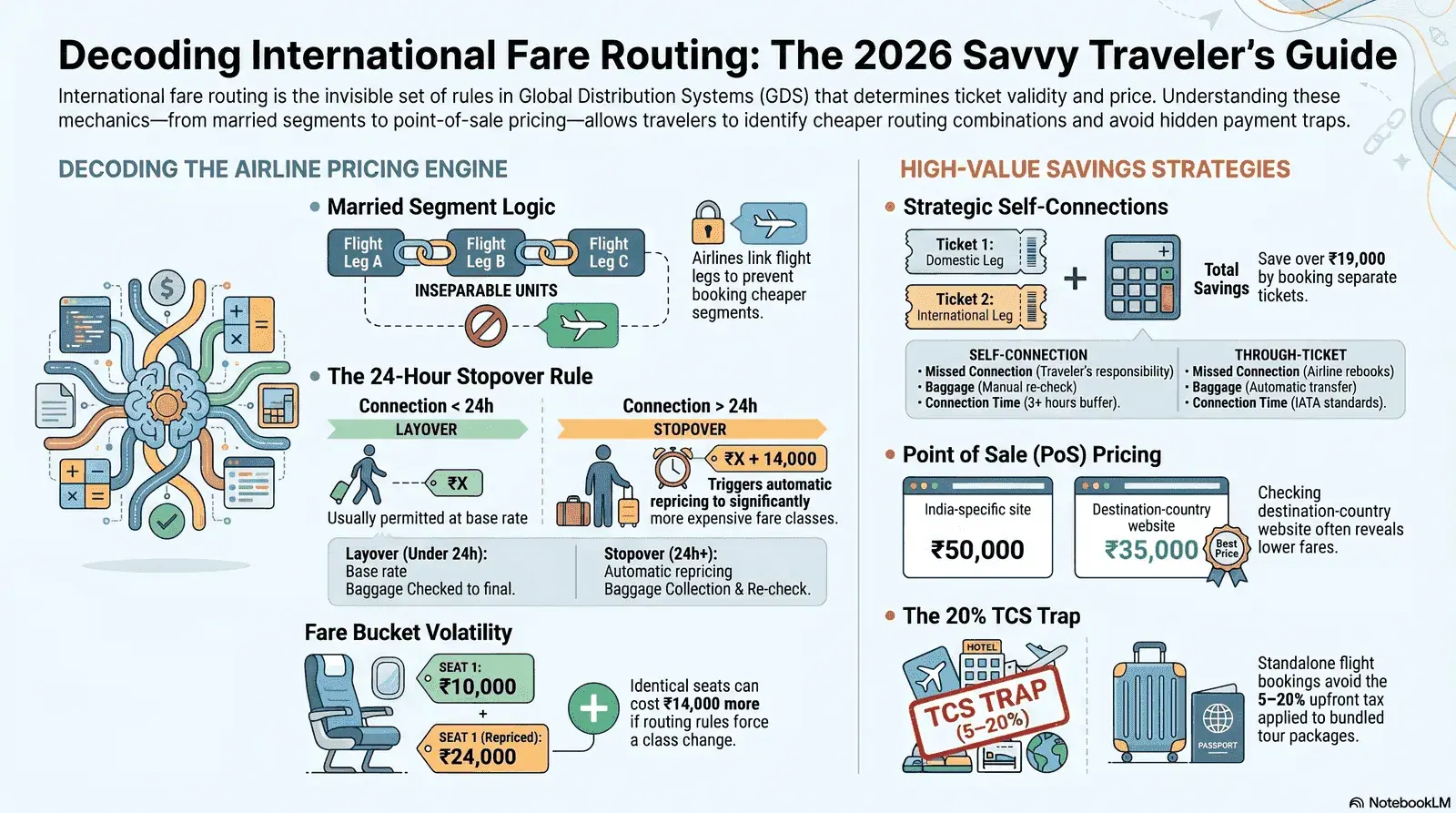
- Fare routing rules specify exactly which airports and carriers your ticket is valid for. Changing one flight in your itinerary without checking these rules can invalidate the entire ticket — even if the origin and destination stay the same.
- Different routings of the same city pair are priced differently. Airlines file separate fares for each permitted routing, so a Delhi–Dublin fare via Dubai and one via London are two distinct products with different prices and rules.
- Routing mismatches are especially costly on code-share and multi-carrier tickets. A carrier or airport not permitted in your fare's routing rules can mean a denied boarding at the gate — the guide explains how to check before you book.
🗺 What it is
Rules specifying which airports and carriers your ticket is valid for between origin and destination.
⚠ Biggest trap
Married segments prevent cheap per-leg pricing — breaking them triggers automatic repricing to a higher fare.
💡 Key saving strategy
Open-jaw tickets and correctly structured self-connections can save ₹8,000–₹30,000 on India routes.
🧾 TCS note
Direct flight purchases ≠ LRS remittance in most cases. Bundled packages attract 5–20% TCS. Always verify with a CA.
12 questions answered in this guide
- What is international fare routing?
- How do fare routing rules actually work — GDS and fare buckets explained
- What is the difference between a layover and a stopover?
- What is married segment logic and why does it block cheaper fares?
- What is a self-connection and how can it save money?
- What are the real risks of self-connecting flights?
- What is an open-jaw ticket?
- What is Point of Sale pricing and Dynamic Currency Conversion?
- How do airline alliances affect your routing options?
- What is hidden city ticketing — and why you should avoid it
- How does fare routing affect TCS for Indian travellers?
- Debunking fare routing myths — and quick tips to use this knowledge
1 What Is International Fare Routing?
International fare routing is the set of rules embedded in an airline ticket that specifies exactly which airports, carriers, and intermediate routes are permitted to connect your origin and destination. These rules are not visible to passengers on the booking screen — they sit inside the fare structure within Global Distribution Systems (GDS) such as Amadeus, Sabre, and Travelport, and they are checked in real time every time you search for a flight.
Every published airline fare belongs to a fare class with its own routing requirements. A discounted economy fare from Delhi to Dublin might only permit routing via specific hub airports — say, Doha or Amsterdam — and only on the issuing carrier or named interline partners. If the itinerary proposed by the search engine does not comply with those rules, the GDS pricing engine automatically selects a higher, more permissive fare class that does comply — and you pay more without any explanation appearing on screen.
When you see two itineraries with the same number of stops and almost identical flight times but a ₹12,000 price difference, fare routing rules are frequently the reason. One itinerary satisfies the cheap fare's routing requirements; the other forces the system into a higher-priced bucket. Understanding this lets you intelligently structure your search — or identify when a slightly different combination of flights would unlock a substantially lower price.
2 How Do Fare Routing Rules Actually Work — GDS and Fare Buckets Explained
Fare routing rules are stored inside GDS platforms as part of each fare's complete rule set, alongside change fees, refundability, minimum stay requirements, and blackout dates. When you search a route, the GDS pricing engine checks every proposed itinerary against those rules and returns the cheapest fare class the itinerary is eligible for.
Each fare class is represented by a letter code. In economy class alone there are typically eight to twelve fare classes:
| Fare Class | Common Label | Typical Restrictions | Routing Flexibility |
|---|---|---|---|
| Y | Full-fare economy | Fully flexible; no minimum stay | Widest — most intermediate points allowed |
| B, M | Semi-flex economy | Changes permitted for fee; advance purchase | Broad — most hubs on carrier network |
| H, K | Standard economy | Advance purchase 7–14 days; some change fees | Moderate — permitted hubs specified |
| Q, L | Saver/sale economy | No changes or high change fee; no refund; no stopover | Narrow — often single hub or direct routing only |
The cheapest "L" class fare might permit routing only via the airline's own hub, prohibit stopovers of 24 hours or more, and require travel completed within 30 days. If your itinerary includes an overnight at the connection point — turning a layover into a stopover — the system silently bumps you to the "H" or "M" class and charges ₹6,000–₹14,000 more. The seat, the airline, and the hub are identical. Only the routing rule changed.
Mileage-Based Rules vs. Routing Restrictions (Category 23)
While historical Maximum Permitted Mileage (MPM) formulations allowed passengers to construct routes based on raw distance, modern global distribution systems (GDS) rely primarily on predefined Routing Restrictions published under Category 23 of an airline's fare rules. Today's computerized booking engines do not let travelers simply guess a path based on geographic mileage. Instead, the fare rules programmatically specify which connecting cities and partner airlines are permitted on a ticket. If an itinerary deviates from these strict combinations—even if it is geographically shorter—it breaks fare combinability rules, forcing the system to quote separate tickets and triggering a significantly higher checkout price.
3 What Is the Difference Between a Layover and a Stopover?
A layover is a scheduled transit connection of under 24 hours at an intermediate airport. A stopover is a deliberate break of 24 hours or more. The 24-hour mark is the standard international aviation rule used by most airlines and GDS systems to distinguish them — though some domestic fares use a shorter threshold of 4 hours.
| Feature | Layover | Stopover |
|---|---|---|
| Duration | Under 24 hours | 24 hours or more |
| Fare impact on basic economy | Permitted — no repricing | Usually prohibited; triggers automatic repricing |
| Baggage handling | Typically checked through to final destination | May require collection and re-check at stopover city |
| Hotel required? | No — you stay airside or in transit | Yes — you leave the terminal and enter the country |
| Free airline programmes | Some carriers offer transit hotel rooms at hub | Qatar Doha Stopover, Emirates Dubai Connect, Singapore Stopover Holiday |
Qatar Airways offers a complimentary one-night hotel stay plus a sightseeing credit for eligible transit passengers through Hamad International Airport (DOH) on their Doha Stopover programme. Emirates operates Dubai Connect, providing complimentary hotel and transfers for transit passengers with long layovers at DXB. Singapore Airlines has its Singapore Stopover Holiday programme for passengers transiting Changi. These turn a routing necessity into a mini-stay at no extra fare cost — but only if your ticket's fare class permits stopovers.
4 What Is Married Segment Logic and Why Does It Block Cheaper Fares?
Married segment logic is a revenue management mechanism where two or more consecutive flight legs are linked as a single inseparable pricing unit. The GDS cannot price those legs individually at their standalone rates — attempting to do so triggers automatic repricing of the entire combination at higher fares.
Here is how it works in concrete terms:
- Qatar Airways prices Dublin (DUB) → Doha (DOH) → Delhi (DEL) as a combined route at ₹62,000 round-trip.
- The Dublin–Doha segment searched independently appears to cost ₹42,000 one-way.
- When a travel agent or GDS tries to book just DUB–DOH without the DOH–DEL continuation, the system detects the married segment rule and reprices both legs at the unrestricted point-to-point rate — ₹85,000 or more.
- The full through-routing (DUB–DOH–DEL) at ₹62,000 is cheaper than the individual "cheap" segment.
Airlines tie segments together to protect the economics of their hub-feed model. If passengers could cherry-pick the cheapest individual segments without completing the full itinerary, airlines would lose the yield that makes long-haul routes financially viable. Revenue management systems flag high-demand segment pairs — particularly those involving the carrier's home hub — for married pricing. As a traveller, this means you cannot reliably "hack" a cheap international itinerary by splitting it at the hub airport. The system detects it and reprices automatically.
5 What Is a Self-Connection and How Can It Save Money?
A self-connection means booking two entirely separate tickets for consecutive flights, with no interline agreement between the two bookings. You manage the connection yourself, collect and re-check your bags, and proceed to the next gate independently of either airline's systems.
For Indian students and travellers, the most practical use case is booking a domestic IndiGo or Air India Express flight from a tier-2 Indian city to Mumbai or Delhi separately from the international onward ticket — since buying the full multi-city journey on a single ticket is often substantially more expensive.
Self-connection also applies across European routes — for example, booking a Ryanair Dublin–London City leg separately from a codeshare Air India London–Delhi service. However, the additional minimum connection time required, baggage re-check procedures, and separate terminal logistics at London airports make this significantly riskier than the Indian domestic-to-international version.
6 What Are the Real Risks of Self-Connecting Flights?
The primary risk of a self-connection is that if your first flight is delayed or cancelled, the operating airline has zero legal obligation to rebook you onto your second, independently booked ticket. Missing the second flight means losing that ticket entirely at full face value.
| Risk Factor | Self-Connection (Two Tickets) | Through-Ticket (Single Booking) |
|---|---|---|
| Missed connection responsibility | Yours — no rebooking obligation from either airline | Airline's — free rebooking on next available flight |
| Baggage transfer | Must collect and re-check at connection city | Bags checked through to final destination |
| Minimum connection time (MCT) | You must research and allow a safe buffer — no automated validation | Airline-managed; IATA MCT standards apply and are enforced |
| Transit visa at hub | Same requirement applies — research for Indian passport holders | Same requirement applies |
| Insurance coverage | Missed connection cover varies — read policy; many exclude self-connections | Standard missed connection cover typically applies |
For domestic-to-international self-connections at Indira Gandhi International Airport (DEL Delhi), domestic arrivals in Terminal 2 require a shuttle bus transfer to Terminal 3 for international departures. Baggage must be collected, re-checked, and cleared through international security. Allow a minimum of 3 hours between your domestic arrival and international departure at Delhi. At Chhatrapati Shivaji Maharaj International Airport (BOM Mumbai), domestic and international terminals are adjacent but separate. Allow at least 2.5 hours. Purchase travel insurance that explicitly includes a missed self-connection clause for the value of your second ticket before relying on this strategy for important journeys.
7 What Is an Open-Jaw Ticket?
An open-jaw ticket is a return itinerary where you fly into one city but depart for home from a different city. The gap in the journey — the "open jaw" — is a surface segment you arrange yourself, which the ticket does not cover.
| Ticket Type | Outbound | Return | Best For |
|---|---|---|---|
| Standard return | Dublin → Delhi | Delhi → Dublin | Single-city visits; no internal travel planned |
| Single open jaw (destination) | Dublin → Delhi | Mumbai → Dublin | Travelling within India between arrival and departure cities |
| Single open jaw (origin) | Dublin → Delhi | Delhi → London | Returning to a different European city than your origin |
| Double open jaw | Dublin → Delhi | Mumbai → London | Multi-destination itineraries on both outbound and return legs |
Open-jaw tickets are priced as the average of two half-round-trip fares. In most cases this is cheaper than buying two separate one-way tickets, which are priced independently at unrestricted rates. For Indian students arriving in Delhi and returning from Mumbai after visiting family across multiple cities, an open-jaw eliminates a backtrack domestic flight that would otherwise cost ₹3,500–₹8,000 and half a day of travel. Search open-jaw itineraries using Google Flights "Multi-city" mode or the equivalent on any major OTA.
8 What Is Point of Sale Pricing and Dynamic Currency Conversion?
Point of Sale (PoS) pricing means airlines set different base fares for the same seat depending on which country version of their booking platform you use — because GDS systems price inventory according to each market's competitive landscape, local demand, and tax treatment. A Delhi–Dublin ticket purchased on the Air India India website in INR may price differently from the same ticket on the Air India Ireland site in EUR or the Air India UK site in GBP.
Step 1: Search your route on the airline's India website with INR selected. Note the final price including taxes. Step 2: Open a new browser session and search the same route, same dates, on the airline's UK or destination-country website. Compare prices after converting to INR at the live mid-market rate (use Google Finance). Step 3: If the foreign-currency version is cheaper, book using an Indian credit card with low or zero forex markup — such as ICICI MakeMyTrip (0.99%), Axis Magnus (2%), SBI Miles Elite (1.99%), or HDFC Infinia (2%) — and pay in the foreign currency only.
Dynamic Currency Conversion (DCC) — the trap inside the trap
Dynamic Currency Conversion is when a foreign airline website or payment terminal offers to charge your Indian card in INR instead of the local currency at checkout. This appears convenient — "we will handle the conversion for you" — but the exchange rate applied by DCC processors typically includes a hidden margin of 3–6% above the mid-market rate. On a ₹75,000 booking that is an invisible loss of ₹2,250–₹4,500. Always select "pay in local currency" (GBP, EUR, USD, AED, QAR) when completing payment on a foreign airline site. Your Indian bank's forex markup — even at a standard 3.5% — is applied transparently and is typically lower than the DCC rate embedded by third-party processors.
9 How Do Airline Alliances Affect Your Routing Options?
Airline alliances — Star Alliance, Oneworld, and SkyTeam — enable member carriers to issue tickets that combine flights operated by partner airlines on a single booking, with baggage checked through to the final destination and miles credited to one loyalty programme. For fare routing, this substantially expands the range of hub-and-carrier combinations that qualify under a single fare class.
| Alliance | Key Members for India Routes | Common India–Europe Routing | Disruption Protection |
|---|---|---|---|
| Star Alliance | Air India, Singapore Airlines, Lufthansa, Swiss, United | Delhi → Frankfurt → Dublin (Lufthansa + Aer Lingus) | Strong — partner rebooking across network |
| Oneworld | British Airways, Cathay Pacific, Japan Airlines, Finnair | Mumbai → London Heathrow → Dublin (BA + Aer Lingus) | Strong — particularly on BA connections |
| SkyTeam | Air France, KLM, Vietnam Airlines, Korean Air | Delhi → Amsterdam → Dublin (KLM) | Strong — KLM/AF connections well coordinated |
| No alliance (Gulf carriers) | Emirates, Qatar Airways, Etihad Airways | Delhi → Dubai / Doha / Abu Dhabi → Dublin | Moderate — own metal only; wide flight frequency |
Alliance membership matters especially for disruption management. If a flight is delayed and you miss a connection, the receiving alliance carrier has a stronger practical obligation to rebook you on the next available partner service. This is not guaranteed across all fare classes, but it is a meaningful protection compared to a self-connection across unaffiliated carriers.
10 What Is Hidden City Ticketing — and Why You Should Avoid It
Hidden city ticketing is booking a ticket to a farther destination and intentionally disembarking at the layover city — because a Delhi–London–Dublin through-ticket is priced cheaper than a direct Delhi–London ticket. The "hidden city" is London, which is actually the intended destination.
- Airlines can and do cancel all remaining segments — including the return leg — when they detect deliberate disembarkation at an intermediate city. You may be stranded at the transit airport.
- Frequent flyer accounts linked to the booking can be suspended or permanently terminated.
- Airlines have pursued passengers for the full fare difference in court. Lufthansa successfully won a case in Germany in 2020 for the difference between the booked price and the point-to-point fare.
- Your checked baggage will be routed to the final ticketed destination (Dublin in the example above). You will arrive in London without your bags.
- This technique cannot be applied to return tickets — the airline cancels the return leg upon detecting the outbound disembarkation.
11 How Does Fare Routing Affect TCS for Indian Travellers?
Tax Collected at Source (TCS) under the Indian Income Tax Act applies differently to international travel expenses depending on whether you purchase a standalone flight ticket or an overseas tour package that bundles flights with hotels and other services. This distinction, driven by how fare routing decisions lead travellers toward different booking structures, has a meaningful cash-flow impact.
| Transaction Type | TCS Rate | Threshold | Practical Note |
|---|---|---|---|
| Overseas tour package (flight + hotel + services bundled) | Flat 2% from 1 April 2026 (previously 5%/20%) | Applies from first rupee spent | Classified as LRS remittance by most banks; TCS collected at point of purchase |
| Standalone international flight ticket (direct airline or OTA, card payment) | Generally 0% at point of purchase | Not typically classified as LRS for individual card transactions | Some banks may apply TCS on large foreign-currency card transactions — verify with your specific bank |
| Education remittance via LRS (wire transfer for tuition) | 2% from own funds above ₹10 lakh; nil via education loan | ₹10 lakh aggregate per financial year | TCS refundable as advance tax credit at ITR filing |
| General LRS remittance (non-education/medical wire transfer) | 20% | Above ₹10 lakh per financial year | Applies to wire transfers and forex cards loaded above the annual threshold |
Booking your international flight as a standalone ticket directly on an airline website — and paying with an Indian credit card — is generally not classified as an LRS remittance by most Indian banks. Bundling your flight, hotel, and transfers into an "overseas tour package" through a travel agent changes the classification and triggers the flat 2% tour-package TCS from 1 April 2026. TCS is not a permanent loss — it is refundable as a tax credit when you file your Income Tax Return — but it ties up cash for 6–12 months. Tax treatment varies by bank and transaction type. Always consult a qualified Chartered Accountant before making large international bookings, particularly for combination packages. Source: Income Tax Act Section 206C (1G), Finance Act 2023.
12 Debunking Fare Routing Myths — and Quick Tips to Use This Knowledge
These are the most widely shared pieces of flight-booking advice that have no structural basis in how airline pricing systems actually work in 2026.
"Clearing your browser cache or using incognito mode shows cheaper fares."
Airline fares live inside GDS systems and are not personalised by your session or cookies. What moves prices is fare bucket availability closing or opening — which is driven by booking pace, not your browsing history.
"Book on a Tuesday at 3 AM for the cheapest fare."
GDS fare updates are continuous and triggered by booking pace and revenue management algorithms — not by the day of the week. Airlines do sometimes load sales on Tuesday nights, but those are promotional events, not a structural pricing pattern.
"Booking 11 months out always gives the cheapest seat."
Airlines open inventory in phases. The cheapest fare buckets open when routes go on sale and close when demand fills them. For India–Europe routes in August, the sweet spot is typically 3–5 months ahead, not 11 months.
"Splitting a through-ticket at the hub always saves money."
Married segment logic prevents this on virtually every major hub-feed route. The GDS reprices automatically the moment you request a hub-feed segment independently.
Quick tips to use fare routing knowledge to your advantage
- Use "Multi-city" mode — not just return: Google Flights' Multi-city mode exposes open-jaw and creative routing options that a simple return search never shows. Spend 10 minutes comparing before committing to a standard return ticket.
- Check PoS pricing on the destination airline site: Before finalising any international ticket, compare prices on the India, UK, and destination-country version of the airline site. A ₹4,000–₹9,000 difference on the same route and date is not uncommon due to PoS pricing.
- Always pay in local currency — never accept DCC: Select GBP, EUR, USD, AED, or QAR at payment. Dynamic Currency Conversion to INR costs 3–6% extra invisibly. Use a low-forex card (ICICI MakeMyTrip at 0.99%, SBI Miles Elite or HDFC Infinia at 1.99–2%) to minimise the remaining markup.
- Book flights separately from hotels for TCS efficiency: Bundling into a travel agent's "overseas tour package" may classify the transaction as LRS and trigger 5–20% TCS. A standalone airline ticket purchase generally does not. The savings on a ₹1 lakh package can exceed ₹5,000–₹20,000 in TCS avoided.
- Use open-jaw for multi-city India visits: Flying into Delhi and out of Mumbai (or vice versa) eliminates the backtrack domestic flight and its cost. Price the open-jaw against a standard return before assuming it is more expensive — it frequently is not.
- Allow minimum 3 hours for self-connections at Delhi and Mumbai: Terminal transfers, baggage re-check, and international security screening take longer than the airport layout suggests. A missed self-connection has no airline remedy. Purchase travel insurance with explicit missed self-connection cover.
- Enable international transactions before booking: HDFC, ICICI, SBI, and Axis cards all require international online transactions to be enabled in the mobile banking app. Failing to do this causes a decline at the final payment step. Fares often rise while you enable the feature and retry — check your card settings before starting any international flight search session.
- Set alerts on two platforms simultaneously: Use Google Flights and Skyscanner in parallel for your route. When both alert at the same time, it is a genuine fare bucket opening — book immediately.
- Check free stopover programmes before booking: Qatar Doha Stopover and Emirates Dubai Connect are official airline-sponsored programmes — not workarounds — that turn a connection into a stay at no extra fare cost on eligible tickets. Research them before booking around either hub.
Put this knowledge to work on your next booking
You now understand how fare routing rules, married segments, Point of Sale pricing, and TCS work. Find the best available fare on your route — then apply your card's offer at checkout.
- Finding Affordable Flights from Dublin to Delhi — 2026 Complete Guide
- Study in Ireland 2026 — Complete Guide for International Students
- Airport Lounge Access in India: Complete Credit Card Guide 2026
- Axis Bank Credit Cards for Flight Bookings 2026 — EDGE Miles, Atlas and Magnus
- Best ICICI Bank Cards for Flights and Travel 2026
- Best SBI Credit Cards for Flights and Travel 2026
- Hidden City Ticketing and Skiplagged in 2026: How It Works and Why It Can Backfire — Hidden city ticketing can save 40–60% — but cancelled returns, lost miles and visa trouble are real risks. 2026 guide including the Skiplagged verdict.
- Best Time to Book Flights in 2026: What the Data Actually Shows — 2026 data on the best time to book flights: optimal booking windows, when the Tuesday myth breaks down, Dublin route-specific timing, and fare tracking tools.
Frequently Asked Questions
What is a married segment in airline ticketing?
A married segment is when two or more consecutive flight legs are linked together as a single pricing unit by an airline's revenue management system. The individual legs cannot be priced independently at discounted rates - if you try to book just one leg, the GDS reprices both at higher unrestricted fares. This is why you cannot split a hub-routing itinerary to exploit cheap individual segment prices.
What is the difference between a stopover and a layover?
A layover is a transit connection of under 24 hours at an intermediate airport. A stopover is a deliberate break of 24 hours or more. Most basic economy and discount fare classes prohibit stopovers, and adding one automatically triggers repricing to a more expensive unrestricted fare class. However, airlines such as Qatar Airways (Doha Stopover) and Emirates (Dubai Connect) offer free or low-cost stopover programmes that are embedded into eligible fares, turning a connection into a mini-vacation.
What is an open-jaw ticket and how can Indian travellers use it to save money?
An open-jaw ticket lets you fly into one city and depart for home from a different city. For example, Dublin to Delhi on the outbound and Mumbai to Dublin on the return. For Indian travellers planning to visit multiple cities in India between arrival and departure, an open-jaw eliminates the need to backtrack to the arrival city, saving the cost and time of a separate domestic flight. Open-jaw fares are typically priced as the average of two half-round-trip fares, making them cheaper than two separate one-way tickets.
What is Point of Sale pricing and how should Indian students handle it?
Point of Sale pricing means an airline charges different amounts for the same seat depending on which country version of its website you use to book. A Delhi-to-Dublin ticket on the Air India India site in INR may cost more or less than the same ticket on the Air India UK site in GBP. Indian students should compare the India, UK, and destination-country versions of airline sites before booking, and always pay in local foreign currency - never accept Dynamic Currency Conversion to INR, as DCC adds a hidden 3-6% exchange rate margin.
Does TCS apply to international flight bookings by Indian travellers?
TCS at 5% applies to overseas tour packages that bundle flights, hotels, and other services. Direct standalone international flight ticket purchases paid by Indian credit or debit card are generally not classified as LRS remittances by most Indian banks and are therefore not subject to the 20% TCS rate that applies to general overseas remittances above the ₹10 lakh annual threshold. Tax treatment depends on how your bank classifies the transaction. Consult a qualified Chartered Accountant for your specific case. Any TCS collected is refundable as a tax credit when you file your ITR.
Information on fare routing rules, GDS mechanics, airline alliance policies, stopover programmes, TCS rates, and Indian banking regulations in this article is drawn from publicly available sources including IATA fare construction rules and Resolution 786 (IATA.org), airline official terms and conditions for Qatar Airways, Emirates, Singapore Airlines, and British Airways, Income Tax Act Section 206C (1G) as amended by Finance Act 2023, RBI Liberalised Remittance Scheme (LRS) guidelines, and the Income Tax Department of India (incometax.gov.in) as of June 2026. Airline fare rules, routing requirements, stopover programme terms, alliance agreements, and TCS thresholds are subject to change by airlines, regulators, and government without notice. Tax treatment of individual card transactions varies by bank and transaction classification; consult a qualified Chartered Accountant before making large international travel purchases or remittances. This article does not constitute financial or legal advice. MyFlightOffers is not affiliated with any airline, GDS provider, or financial institution mentioned.