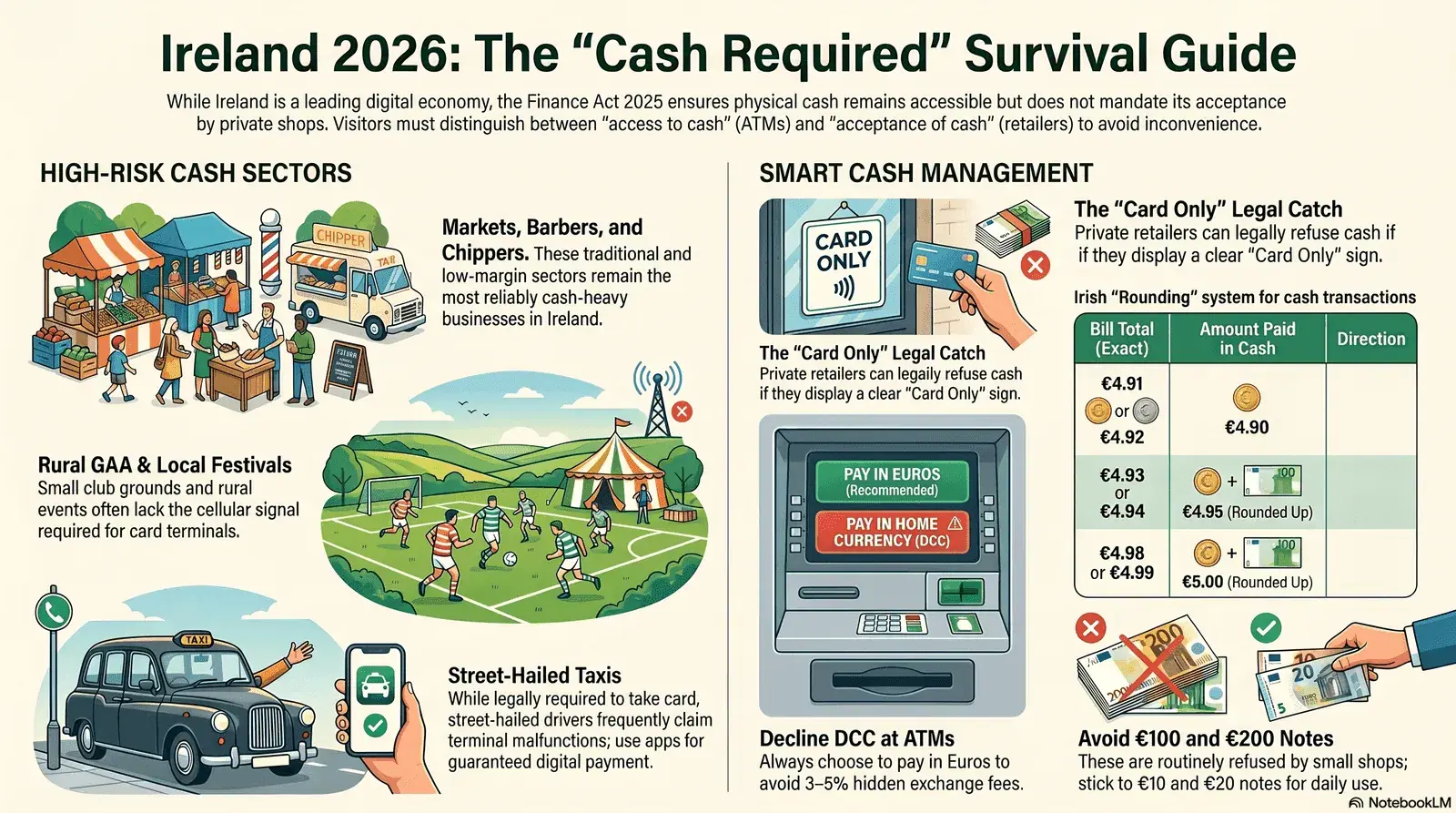
- Carry €100–€150 as a tourist; €200–€300 if you're in your first student week. ATMs near markets and transport hubs are your safest withdrawal points.
- Markets, barbers, chippers, tradespeople, and rural GAA venues are the highest cash-risk spots. These categories are consistently card-refusal hotspots in 2026 despite the broader digital shift.
- Supermarkets, pharmacies, and restaurants are universally card-safe. The gaps that catch people out are informal, occasional, and hyper-local — this guide maps exactly which ones to watch for.
💶 How Much Cash to Carry
€100–€150 for tourists
€200–€300 recommended for students in their first
week
⚠️ Highest Cash-Risk Sectors
Markets · Barbers · Chippers
Rural GAA grounds · Tradespeople · Pop-up vendors
⚖️ Can Shops Refuse Cash?
Yes — with a "Card Only" sign
The 2025 Act protects ATM access, not in-store
acceptance
🏧 Best ATM Strategy
Use Revolut or Wise + bank ATMs
Always decline DCC — always choose to pay in euros
What this guide covers — 11 sections
- The 2026 legal landscape: what the Finance Act actually means
- Access to cash vs. accepting cash — the critical distinction
- Which sectors are most likely to be cash only
- How to spot a cash-only business before you order
- ATM fee traps and how to avoid them in Ireland
- The euro coin rounding system explained
- Why €100 and €200 notes are practically useless in small shops
- What to do if an ATM retains your card
- The "cash stuffing" trend among Irish students
- Will cash disappear from Ireland? The honest 2026 answer
- The ultimate cash checklist for newcomers
The 2026 Legal Landscape: What the Finance (Provision of Access to Cash Infrastructure) Act 2025 Actually Means
The Finance (Provision of Access to Cash Infrastructure) Act 2025 mandates that Ireland's main retail banks maintain physical access to cash — but it does not compel any private shop or business to accept it. This is the single most important distinction any visitor to Ireland needs to understand before they arrive.
The Act, overseen by the Central Bank of Ireland, places legal obligations on the three main retail banks — AIB (Allied Irish Banks), Bank of Ireland, and Permanent TSB — to maintain ATM and cash withdrawal access within defined regional distance thresholds. The policy goal is to protect elderly citizens, people in rural communities, and unbanked individuals who depend on physical currency for everyday transactions. It does not give consumers a right to pay any shop in cash.
From mid-2026, the Act introduced a public-facing mechanism at the Central Bank of Ireland through which anyone can report a local ATM desert — a town, village, or area where physical cash is genuinely inaccessible. If you are travelling in rural Ireland and cannot locate a working ATM within a reasonable distance, this reporting tool is available to flag the gap directly to the regulator. The existence of this regime is itself evidence that access to cash remains a live policy priority in Ireland, not a solved problem.
Access to Cash vs. Accepting Cash — The Critical Legal Distinction
Under Irish contract law, any private retailer can refuse cash payment provided they display a clear "Card Only" notice before a customer enters into a transaction. Euro banknotes and coins are legal tender in Ireland, but the legal tender concept governs the settlement of existing debts — it does not override a shopkeeper's right to set terms for new transactions.
The practical implications are:
- If a café has a "Card Payments Only" sign visible at the door or counter and you order anyway, they are fully entitled to refuse your euro notes.
- If no such sign is displayed and a shop refuses your valid euro banknotes, you have a stronger consumer position — but you are unlikely to resolve this at a busy counter during the lunchtime rush.
- The Finance Act 2025 changed nothing about in-store acceptance rules. It only ensures you can find a working ATM to get cash out in the first place.
Knowing the law is useful background, but it will not help you when a market stall vendor tells you they only take cash and you have none. The more practical skill is knowing which categories of business to carry cash for before you arrive.
Which Sectors Are Most Likely to Be Cash Only in Ireland?
Dublin city centre and the main urban retail strips are overwhelmingly card-friendly in 2026. The further you move from large urban centres — or into certain traditional service sectors — the more frequently you will encounter cash-only policies. The reason is almost always structural: merchant card terminal rental costs, unreliable mobile signal at outdoor venues, tight margins, and longstanding cultural norms around tipping and privacy.
🛒 Outdoor Markets and Food Fleas
Farmers' markets, vintage pop-up fairs, and food flea events across Dublin, Cork, Galway, and smaller towns frequently operate cash only. Card terminal rental and processing fees of 1.5–2.5% per transaction are a real burden when you are selling a €6 artisan loaf.
✂️ Barbershops and Hair Salons
Traditional barbershops in smaller Irish towns and many inner-city neighbourhoods remain one of the most reliably cash-heavy service businesses in the country. Many operate with no card terminal at all, or impose a minimum card spend of €15–€20.
🍟 Late-Night Chippers and Independent Takeaways
Post-pub trade at a chipper — Ireland's beloved late-night fish and chip institution — frequently operates cash only, particularly outside the main city centres. Many independent takeaways processing high volumes of small transactions prefer to absorb no card fees.
🚕 Street-Hailed Taxis
Licensed taxis are legally required to accept card payment, but a minority of drivers — particularly when hailed on the street for short fares — may claim their terminal is unavailable. App-based bookings guarantee digital payment.
🔧 Tradespeople and Emergency Services
Independent plumbers, electricians, locksmiths, and handymen called out for smaller jobs frequently invoice in cash. Budget €50–€200 in cash if you need emergency callout services from an independent tradesperson.
🏐 GAA Grounds and Rural Festivals
Smaller club GAA grounds outside of Croke Park, Semple Stadium, and the main provincial venues commonly use cash-only entry gates and vendor stalls, where mobile signal is insufficient for reliable card terminal operation.
☕ Indie Cafés With Card Minimums
Many independent cafés now accept card but impose a minimum spend of €5–€10. Below that threshold, cash is expected. A quick flat white in a small neighbourhood coffee spot may well require coins.
🎸 Gigs and Live Music Venues
Larger music venues are card-friendly, but smaller pub music nights and community hall concerts — particularly in rural areas — may operate cash at the door. Always check before arriving at an unfamiliar venue.
Outdoor Markets and Food Fleas in More Detail
Weekend markets like the Temple Bar Food Market in Dublin (operating Saturdays and Sundays in Temple Bar Square), the Dún Laoghaire Market south of the city, and the Saturday markets in Galway and Cork's English Market area are popular destinations for both locals and visitors. At these markets, the working assumption should be that cash is expected unless a stallholder explicitly displays a contactless symbol. Budget €20–€40 in €10 and €20 notes for a market visit and you will encounter no friction.
Traditional Barbershops — What to Expect
The traditional barbershop holds a particular place in Irish community life, and many operate on a cash-and-conversation model that predates the card terminal by decades. A standard men's haircut in Dublin ranges from €15 to €25; outside Dublin it can be as low as €10–€15. Add €3–€5 as a tip if satisfied. Do not assume card acceptance — ask at the door or have cash ready before sitting in the chair.
Taxis: Legal Obligation vs. Street Reality
All licensed taxis in Ireland are legally required to be equipped to accept payment by debit and credit card. The National Transport Authority enforces this requirement. In practice, however, a small minority of owner-operators — particularly those who have operated for many years — will claim a terminal malfunction, especially for short fares where the processing fee eats into an already small margin. The most reliable solution is to book via Free Now (formerly MyTaxi), which processes payment digitally within the app. If street-hailing, confirm card acceptance before the journey begins.
GAA Match Gates and Folk Festivals
Major venues like Croke Park and the main provincial GAA grounds have modernised their payment infrastructure and accept card payment. The cash risk is concentrated at smaller club grounds — a Leinster or Munster junior championship match at a rural venue — and at independent music festivals and folk events in fields and community spaces where cellular network capacity is overwhelmed during the event. If attending a local club match or a community festival outside a main town, carry €15–€25 in cash for entry and refreshments.
How to Spot a Cash-Only Business Before You're at the Till
The easiest way to avoid an awkward moment at the counter is to read the visual signals before you queue or sit down. These are the reliable indicators:
- A handwritten or printed sign near the door or till stating "Cash Only", "No Card Payments", "Cash Preferred", or "Minimum Card Spend €X".
- No card terminal visible on the counter. If there is no machine in sight after a quick scan of the till area, assume cash is required or ask before ordering.
- A price board with round numbers — "€12 cut, €5 beard trim" — on a chalkboard or laminated sheet suggests a cash-oriented operation.
- At outdoor market stalls, look for the contactless payment symbol (the wave/WiFi-style icon) displayed on the stall's sign or payment display. Its absence is a strong hint that cash is expected.
- For taxis: before closing the door of a street-hailed cab, glance at the dashboard or centre console for a card terminal unit. If you cannot see one, ask: "Do you take card?" before the journey starts.
ATM Fee Traps in Ireland — and How to Avoid Every Single One
Not all ATMs in Ireland charge the same fees. Using the wrong machine with a non-Irish card can cost you €2–€6 per withdrawal in hidden charges — before the Dynamic Currency Conversion (DCC) trap is even applied.
| Option | Typical Fee | DCC Risk | Best For |
|---|---|---|---|
| AIB / Bank of Ireland / PTSB ATMs | Free for Irish accounts; foreign card fees vary by home bank | Low — offered but easy to decline | Standard withdrawal; widely available |
|
Private standalone ATMs (in newsagents, petrol stations, nightclubs) |
€1.95–€3.95 flat per withdrawal plus any home bank fee | High — DCC often pre-selected on screen | Absolute emergencies only |
| Revolut (in-app ATM withdrawal) | Free up to €200/month; 2% thereafter | None — always processes in euros | Students and regular visitors; best daily option |
| Wise (multi-currency card) | Free up to €200/month (two withdrawals) | None — always processes in euros | Travellers holding multiple currencies |
|
Supermarket cashback (Tesco, Dunnes Stores, SuperValu) |
Free — purchase any item and request cashback up to €100 at the till | None | Convenient alternative when near a supermarket |
| An Post branches | Varies by service; standard cash transactions generally free | None | Rural areas with no nearby bank ATM |
At any ATM or card reader in Ireland, you may be asked whether you want to pay in your home currency (Indian Rupees, US Dollars, Chinese Yuan, British Pounds) or in euros. The screen will often present the home currency option first, framed as a "convenience." It is not a convenience — it is an additional charge. The DCC exchange rate is set by the ATM operator, not by your bank, and typically adds a hidden premium of 3–5% on top of the spot rate. Always select euros. Let the conversion happen through your own bank or fintech card, which will apply a significantly better rate.
The Euro Coin Rounding System — What Every Cash Payer Needs to Know
Ireland stopped minting 1 cent and 2 cent coins in 2015, so all cash transactions are rounded to the nearest 5 cents at the till. Card payments are always charged to the exact cent. This is one of the small surprises that catches out many first-time visitors when their cash receipt shows a different total from the price displayed on the shelf.
| Bill Total (exact) | Amount Paid in Cash | Direction |
|---|---|---|
| €4.91 or €4.92 | €4.90 | Rounded down |
| €4.93 or €4.94 | €4.95 | Rounded up |
| €4.96 or €4.97 | €4.95 | Rounded down |
| €4.98 or €4.99 | €5.00 | Rounded up |
Rounding applies to the total bill only, not to individual items. If you are buying multiple items, the combined total is what gets rounded. 1 cent and 2 cent coins remain legal tender in Ireland and can still be accepted by shops — the rounding convention is a retailer practice, not a legal requirement. However, you will almost never receive 1 cent or 2 cent coins as change.
Why €100 and €200 Notes Are Practically Useless in Small Irish Shops
€100 and €200 euro notes are legal tender in Ireland but are routinely refused by small retailers, market stalls, independent takeaways, and late-night venues. The reasons are practical rather than legal: small businesses cannot give correct change on a large note for a small purchase, and the higher denominations are disproportionately used in counterfeit currency attempts.
- Break any €100 or €200 note at a bank branch, post office, or large supermarket as soon as you arrive. Do not arrive at a market stall with a €200 note expecting €183 in change.
- The most universally accepted denominations for daily cash use in Ireland are €20 and €10 notes. These are accepted virtually everywhere that takes cash at all.
- €50 notes are accepted in most supermarkets and standard retail shops but may be politely declined at a small independent business or late-night takeaway.
- If you arrive in Ireland with large denomination notes from an exchange bureau abroad, walk into any branch of AIB or Bank of Ireland and ask a cashier to break the note into smaller denominations. This is free and takes under two minutes.
What to Do If an ATM Retains Your Card
If an Irish ATM retains your international card, stay calm, stay at the machine, and act immediately. Retained cards happen when a PIN is entered incorrectly multiple times, when the card's magnetic strip or chip is suspected to be damaged, or when the machine itself malfunctions mid-transaction.
- Note the exact address of the ATM and the bank or operator name on the machine before you leave. You will need this for the recovery process.
- If the ATM carries an AIB, Bank of Ireland, or Permanent TSB logo, call their 24-hour card helpline immediately — numbers are on the respective websites and on the stickers on the ATM itself.
- Call your home bank or card issuer at once to freeze the card and request an emergency replacement or emergency cash transfer.
- If you hold a Revolut or Wise account, use the in-app card freeze function immediately — available within seconds from the dashboard. This is the exact scenario where having a backup fintech account active before you arrive in Ireland pays off.
- For genuine emergencies, An Post branches and the main retail banks can arrange emergency cash disbursement with valid photo identification.
The "Cash Stuffing" Trend: Why Irish Students Are Returning to Physical Money
One of the more unexpected developments in 2026 is a notable revival of cash-based budgeting among younger people in Ireland. The "cash stuffing" method — dividing weekly spending into physically labelled envelopes for different categories (food, transport, social, rent buffer) — has gained real traction among international students and young Irish renters navigating one of Europe's most expensive cost-of-living environments.
For international students newly arrived from India, China, or elsewhere, cash stuffing offers a tangible advantage that banking apps do not: you can see exactly how much is left. Splitting a weekly budget of €150 into an envelope labelled "Aldi: €45 / Leap Card top-up: €25 / Social: €40 / Emergency: €40" removes the cognitive overhead of tracking digital transactions across multiple currencies and conversion rates simultaneously. It also eliminates the risk of accidentally spending money earmarked for next week's rent.
Will Cash Disappear from Ireland? The Honest 2026 Answer
The direct answer is: not uniformly, and not soon. Ireland's trajectory toward a cashless economy is real and measurably accelerating — card and contactless payments now account for the vast majority of retail transactions by volume. But the Finance (Provision of Access to Cash Infrastructure) Act 2025 is a clear signal from the Oireachtas and the Central Bank of Ireland that physical currency must remain accessible for the foreseeable future. The legislation reflects the reality that a meaningful share of the Irish adult population — including elderly citizens, those in rural areas, and those without access to standard banking — still depends on cash for everyday life.
The sectors most likely to retain cash practices well into the late 2020s are those covered in this guide: market stalls, barbershops, independent takeaways, tradespeople, and rural community events. Their preference for cash is driven by margin economics and infrastructure constraints, not by habit alone — and those economic pressures are not going away.
Ireland Cash Buffer Calculator
Estimate your weekly physical cash buffer based on real-time 2026 Irish retail trends
Weekly Cash Buffer
€0.00
Total suggested cash
€0.00
The Ultimate Cash Checklist for Tourists and Students Arriving in Ireland
- Before flying: Set up a Revolut or Wise account and load it with your home currency. Both can be activated fully before you land in Ireland and used immediately for card payments and ATM withdrawals at competitive exchange rates.
- At the airport: Withdraw €100–€150 in €20 and €10 notes from an AIB or Bank of Ireland ATM inside Dublin or Shannon Airport. These are bank-branded machines with no standalone ATM surcharge.
- Decline DCC every time: At every ATM and card reader that asks whether to charge in your home currency or euros — always select euros.
- First week as a student: Carry €200–€300 in €20 notes while you open an Irish bank account and familiarise yourself with local payment norms.
- Market visits: Budget €20–€40 in cash for any Saturday or Sunday market. Do not assume contactless.
- Barbershop: €15–€25 in cash including tip. Never assume card acceptance at a traditional barber.
- Late-night chipper: Always carry at least €10–€15 for post-pub food runs. Cash is frequently the only option after midnight.
- Taxis: Book via Free Now for guaranteed card payment. If street-hailing, ask about card acceptance before closing the door.
- Large denomination notes: Break €100 and €200 notes at a bank branch or large supermarket immediately. Carry €10 and €20 notes for daily cash use.
- GAA and local events: Carry €10–€20 for entry and refreshments at smaller grounds or rural festivals.
- Supermarket cashback: Use the free cashback service at Tesco, Dunnes Stores, or SuperValu (up to €100) as an alternative to ATMs — no fee and no DCC.
- Rural ATM desert? Report it to the Central Bank of Ireland via the mid-2026 local deficiency reporting regime.
Before you worry about your physical Euros, make sure you've locked down your travel essentials by reviewing our latest international student flight offers to Dublin or our comprehensive arrival checklist.
Frequently Asked Questions
Can Irish shops legally refuse cash in 2026?
Yes. Under Irish contract law, any private retailer can refuse cash payment provided they display a clear 'Card Only' notice before a customer enters into a transaction. Euro banknotes are legal tender, but this does not compel shops to accept physical currency. The Finance (Provision of Access to Cash Infrastructure) Act 2025 only protects access to ATMs - not in-store cash acceptance.
Which types of shops in Ireland are most likely to be cash only in 2026?
The sectors most likely to require cash in Ireland in 2026 are outdoor market stalls and farmers' markets, traditional barbershops and hair salons, independent late-night takeaways (chippers), some street-hailed taxi drivers, small tradespeople including plumbers and locksmiths, and smaller GAA club grounds and rural festival vendors where card terminals and mobile signal may be unreliable.
How much cash should a tourist or international student carry in Ireland?
For tourists, €100-€150 in mixed denominations (€20 and €10 notes) is a sensible starting amount. International students arriving in Ireland for the first time should carry €200-€300 in cash for their first week to cover emergencies, market purchases, and cash-only services while setting up an Irish bank account or activating a Revolut or Wise account. Avoid €100 and €200 notes as these are routinely refused by smaller retailers.
Do Dublin taxis accept card payment in 2026?
Most Dublin taxis are required to carry a working card terminal. However, in practice a minority of drivers - particularly when hailed on the street for short fares - may claim the terminal is unavailable. Booking via apps like Free Now guarantees digital payment. Always confirm card acceptance before getting into a street-hailed taxi if you have no cash available.
What is the Finance (Provision of Access to Cash Infrastructure) Act 2025?
The Finance (Provision of Access to Cash Infrastructure) Act 2025 is Irish legislation mandating the main retail banks - AIB, Bank of Ireland, and Permanent TSB - to maintain ATM and cash-out access within defined regional distance thresholds. Overseen by the Central Bank of Ireland, the Act introduced a public 'local deficiency reporting regime' in mid-2026, allowing citizens to report ATM deserts directly to the regulator. Crucially, the Act governs access to cash, not the obligation of shops to accept it.
How does Ireland's euro coin rounding system work for cash purchases?
Ireland does not mint 1 cent or 2 cent coins, so cash transactions are rounded to the nearest 5 cents at the till. A bill of €4.93 rounds to €4.95; a bill of €4.97 rounds up to €5.00. Card payments are always charged to the exact cent. The rounding applies to the total bill, not to individual items.
Planning your trip to Ireland?
You now know how to handle cash on the ground. Find the best flight fares to Dublin, compare your travel card options before you fly, and read our complete guide for international students settling in Ireland.
If you are booking flights to Dublin from India, or looking to maximise rewards on your travel spend with an Indian bank card, these guides cover the full picture:
- Study in Ireland 2026: Complete Guide for International Students — universities, fees, scholarships, visa, and Stamp 1G post-study work rights.
- Finding Affordable Flights from Dublin to Delhi (2026 Guide) — airlines, fare benchmarks, booking windows, and visa requirements.
- Airport Lounge Access in India: Complete Credit Card Guide 2026 — DreamFolks vs Priority Pass, spend-based criteria, guest access, and add-on card hacks.
- Best ICICI Bank Credit Cards for Flights & Travel 2026 — including 0.99% forex on MakeMyTrip ICICI and iShop acceleration.
- Axis Bank Credit Cards for Flight Bookings 2026 — EDGE Miles, Atlas vs Magnus, and the April 2026 partner changes explained.
Information about the Finance (Provision of Access to Cash Infrastructure) Act 2025, Central Bank of Ireland regulations, ATM fee structures, merchant cash acceptance policies, taxi regulations, and retail cash practices in this article is based on publicly available information from official Irish government sources, the Central Bank of Ireland, and sector-specific reporting as of June 2026. Individual business cash acceptance policies can change without notice. Always verify current payment policies directly with the relevant business before relying on any payment arrangement. ATM fee structures for international cards depend on your home bank's specific cross-border fee policy, which varies. This article does not constitute financial or legal advice. MyFlightOffers is not affiliated with any bank, fintech provider, or business mentioned in this article.