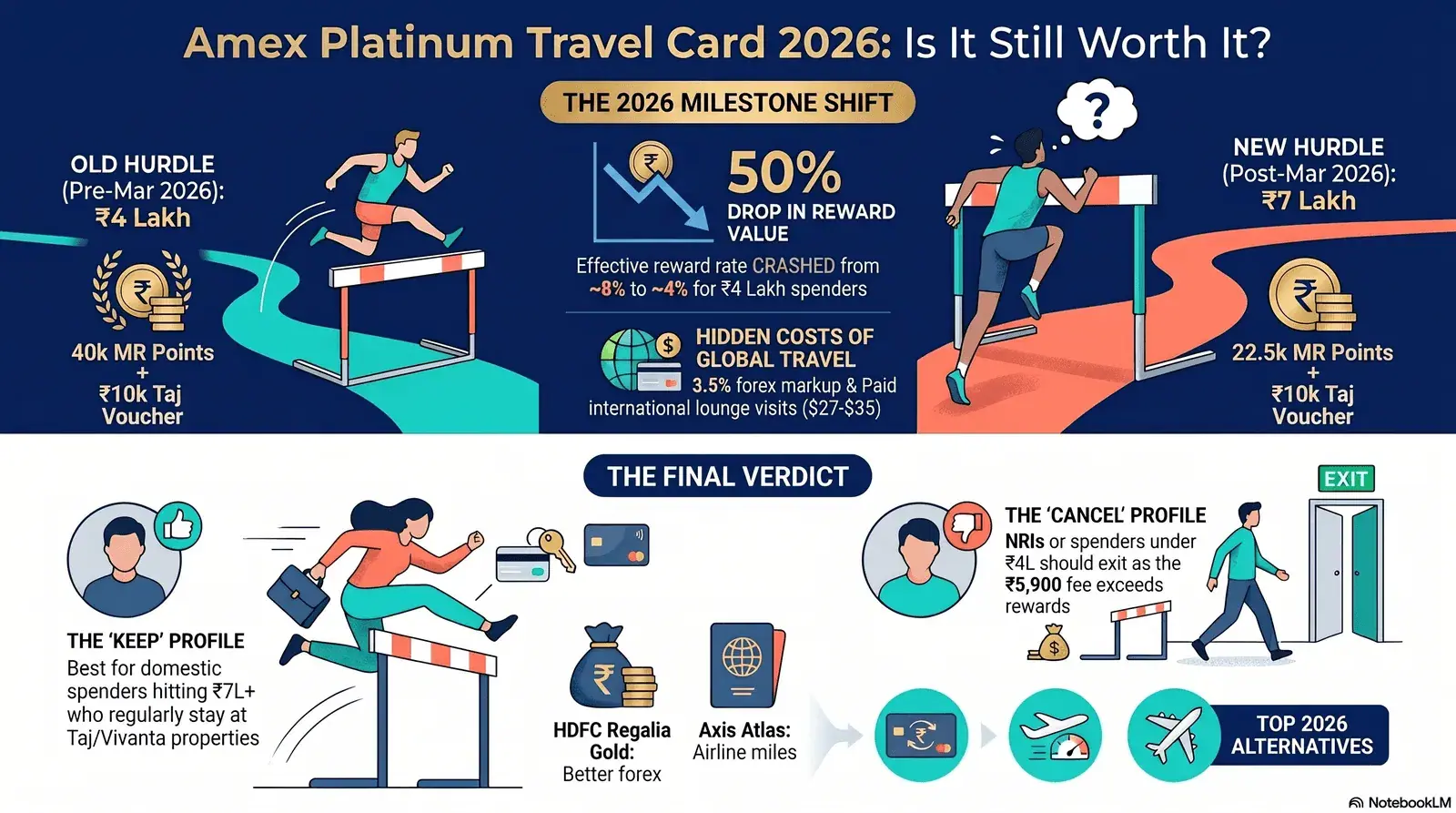
- Devaluation is real: From 9 March 2026, the Taj voucher milestone jumped from ₹4 lakh to ₹7 lakh annual spend — the effective reward rate for mid-tier spenders dropped from ~8% to ~4%.
- High forex cost: Amex India charges 3.5% + GST on all international transactions, making this card expensive for NRIs or frequent international spenders.
- Keep it only if: You confidently spend ₹7 lakh+ per year on eligible domestic categories AND you actually stay at Taj/Vivanta/SeleQtions hotels where the ₹10,000 voucher delivers real value.
Annual / Joining Fee
₹5,000 + GST (no waiver)
Base Earn Rate
1 MR point per ₹50 spent (~0.5–0.6% base)
Taj Voucher Threshold
₹7 lakh annual spend (from 9 Mar 2026)
Forex Markup
3.5% + GST on all foreign currency transactions
In this guide
- What Changed on 9 March 2026
- New Milestone Structure Explained
- The 3.5% Forex Problem for NRIs and International Spenders
- Lounge Access — What the Priority Pass Really Gives You
- How Much Are Amex MR Points Actually Worth?
- The Taj Voucher — Real Value or Marketing Gloss?
- Verdict: Who Should Keep It, Who Should Cancel
- Best Alternatives in 2026
1. What Changed on 9 March 2026
The 9 March 2026 restructure is the most significant devaluation of the Amex Platinum Travel Card since its launch, effectively halving the reward rate for anyone who previously stopped spending at ₹4 lakh per year.
Prior to the change, the card ran a three-milestone structure where spending ₹4 lakh in a membership year unlocked 40,000 bonus MR points and a ₹10,000 Taj Experiences E-Gift Card. That combination delivered an effective return of roughly 8% on the ₹4 lakh spend — making it one of the highest-returning mid-market travel cards in India for domestic spenders.
From 9 March 2026, the goalposts shifted significantly. The third milestone — the one that includes the Taj voucher — now sits at ₹7 lakh annual spend. Cardholders who spent exactly ₹4 lakh previously now find themselves at the second milestone only, collecting 10,000 bonus MR points with no hotel voucher. Their effective reward rate on that ₹4 lakh spend has dropped from approximately 8% to roughly 4%.
One positive change: bonus MR points under the new structure are credited automatically once the spend threshold is reached. Previously, cardholders had to call Amex or initiate the claim manually — an often-frustrating process that many forgot to complete. Auto-credit is a genuine quality-of-life improvement, but it does not offset the reduced value of the milestones themselves.
2. New Milestone Structure Explained
The three-tier milestone structure remains, but all three thresholds have been restructured — the first two deliver fewer bonus points, and the third requires 75% more spending to unlock the same Taj voucher.
| Annual Spend | Milestone Benefit (New — from 9 Mar 2026) | Milestone Benefit (Old — pre-9 Mar 2026) | Change |
|---|---|---|---|
| ₹1.9 lakh | 7,500 bonus MR points | 10,000 bonus MR points | –25% |
| ₹4 lakh | 10,000 bonus MR points | 40,000 bonus MR points + ₹10,000 Taj voucher | –75% effective |
| ₹7 lakh | 22,500 bonus MR points + ₹10,000 Taj voucher | N/A (threshold did not exist) | New tier |
At the ₹7 lakh tier (valuing 1 MR point at ₹0.30 for Platinum Travel redemptions), the 22,500 points are worth approximately ₹6,750 in travel bookings. Add the ₹10,000 Taj voucher and you have ₹16,750 in notional rewards on ₹7 lakh spend — an effective return of roughly 2.4% on total spend, before accounting for the base earn rate. Include the base 1 MR point per ₹50 spent (approximately 14,000 additional points on ₹7 lakh), and the combined effective rate rises to around 3.5–4% when points are redeemed at maximum value.
Cardholder perspective: "I was spending around ₹3.8 lakh a year on the Amex Platinum Travel — dining, online shopping, subscriptions. I'd always push a bit to cross ₹4 lakh for the Taj voucher, which I used for a weekend stay in Mumbai. Now I'd need to spend ₹7 lakh for the same voucher. That's an extra ₹3.2 lakh on a card with limited acceptance and 3.5% forex charges. I've moved my international spends to a zero-forex card and I'm reconsidering whether to keep the Amex at all." — Rohan M., Mumbai-based software professional
3. The 3.5% Forex Markup Problem for NRIs and International Spenders
American Express India applies a 3.5% foreign currency transaction fee (plus GST) on every international spend — one of the highest forex markups among premium Indian travel cards in 2026.
For context, many competing cards have moved to 1.5–2% forex markups. The Axis Atlas charges 2% forex markup. HDFC Infinia charges 2% as well. The Federal Bank Scapia charges zero forex markup entirely. Against this backdrop, the Amex Platinum Travel's 3.5% + GST (effectively ~4.1%) is a significant drag on every international transaction.
The card does offer 3x MR points on international spends, which partially offsets the cost. At a base earn rate of 3 MR points per ₹50 (6 per ₹100), and valuing each point at ₹0.30, the reward rate on international spend is approximately 1.8% — still well below the 4.1% forex cost. In practice, using the Amex Platinum Travel for international purchases costs you a net ~2.3% more than using a zero-forex alternative.
There is also a dynamic currency conversion (DCC) trap to watch for. When booking international flights or hotels on foreign websites, the payment gateway may offer to charge your card in INR rather than the local currency. Always choose to pay in the local currency — DCC typically applies an additional 4–8% markup on top of whatever your bank charges. On the Amex Platinum Travel, accepting DCC could result in a combined cost of 8–12% above the mid-market rate on a single transaction.
4. Lounge Access — What the Priority Pass Really Gives You
The Amex Platinum Travel Card provides 8 complimentary domestic airport lounge visits per year (2 per quarter), plus complimentary Priority Pass membership — but international lounge access under Priority Pass is charged at USD 27–35 per visit, not complimentary.
This is one of the most commonly misunderstood benefits on this card. The card waives the Priority Pass annual membership fee of USD 99, which is a genuine saving. However, every time you actually walk into a lounge outside India under that Priority Pass membership, you are charged a per-visit fee of USD 27 (per some sources) to USD 35 per person. Guests cost the same rate.
| Lounge Type | Benefit | Actual Cost to Cardholder |
|---|---|---|
| Domestic India airport lounges | 8 free visits/year (max 2/quarter) | Free (no charge per visit) |
| International lounges via Priority Pass | Priority Pass membership (USD 99 waived) | USD 27–35 per person per visit |
| Priority Pass guest access | Not complimentary | USD 27–35 per guest per visit |
For a frequent international traveller who uses 10–12 international lounges per year, the Priority Pass visit fees would total USD 270–420 (approximately ₹22,500–35,000) — a cost that many cardholders do not anticipate when they sign up. By contrast, cards like HDFC Infinia and Axis Magnus provide truly complimentary international lounge access with no per-visit charge.
The 8 domestic lounge visits are genuinely free and useful, particularly for travellers who frequently pass through major Indian airports (Mumbai, Delhi, Bengaluru, Chennai, Hyderabad). At 2 per quarter, the allocation is modest but fits the usage pattern of a once-a-month domestic flyer.
5. How Much Are Amex MR Points Actually Worth?
Amex MR points earned on the Platinum Travel Card are worth ₹0.25–₹0.30 each when redeemed for travel on the Amex portal, or potentially more when transferred to airline miles and hotel programmes at 2:1 or 1:1 ratios.
The Amex Membership Rewards programme in India offers multiple redemption paths:
- Amex Travel Online portal: ₹0.30 per MR point for Platinum Travel cardholders (flight, hotel, car bookings). This is the baseline redemption value and the easiest to use.
- Shopping e-vouchers (Flipkart, Amazon, etc.): Approximately ₹0.25 per point — slightly lower value but flexible.
- Cash + Points bill payment: Lower value; generally not recommended.
- Airline miles transfer: Transfers happen at a 2:1 ratio (2 MR points = 1 airline mile) to most partners including Singapore Airlines KrisFlyer, British Airways Executive Club, Emirates Skywards, Qatar Privilege Club, Etihad Guest, and Air India Maharaja Club. At premium cabin redemption rates, each airline mile can be worth ₹1.50–₹3.00+, making this path potentially the highest-value option for frequent flyers who can find award availability.
- Marriott Bonvoy: Transfers at 1:1 ratio (1 MR point = 1 Bonvoy point). Bonvoy points can deliver strong value on luxury hotel redemptions, particularly in India where Taj-competing hotels like JW Marriott and The Westin participate in the programme.
The strategic use of the card is therefore to accumulate MR points over 12 months, combine base earn points with milestone bonus points, then transfer to Singapore Airlines KrisFlyer or British Airways Avios for premium cabin redemptions — particularly Dublin–India or India–Southeast Asia routes where economy fares are high in Indian Rupees but Business Class awards can represent excellent value when booked with miles.
6. The Taj Voucher — Real Value or Marketing Gloss?
The ₹10,000 Taj Experiences E-Gift Card is a genuine benefit for those who stay at Taj Hotels, SeleQtions, or Vivanta properties — but its restrictions make it effectively worthless for cardholders who do not actively book Taj stays.
The voucher can only be redeemed at participating Taj Hotels, Resorts and Palaces, SeleQtions hotels, and Vivanta hotels — it cannot be used on third-party booking sites (MakeMyTrip, Booking.com, Cleartrip) or through travel agents. It must be applied to publicly available rates and is valid for 360 days from the date of issue.
For a cardholder who takes 2–3 domestic leisure trips per year and regularly books Taj or Vivanta hotels, the voucher is straightforward and valuable. A ₹10,000 offset on a typical Vivanta room night (which averages ₹8,000–₹15,000 per night in major cities) is a material saving.
For cardholders who primarily book budget or mid-tier hotels (Ibis, Holiday Inn, Ginger, etc.) or use aggregator discounts via Cleartrip or MakeMyTrip, the voucher provides zero benefit — they cannot use it at their preferred properties.
7. Verdict: Who Should Keep It, Who Should Cancel
After the March 2026 devaluation, the Amex Platinum Travel Card has a narrow but real audience — high-volume domestic spenders who genuinely use Taj Group hotels and can hit ₹7 lakh per year without stretching their budget.
| Cardholder Profile | Recommendation | Reason |
|---|---|---|
| Domestic spender, ₹7 lakh+/year, stays at Taj/Vivanta regularly | Keep | Taj voucher + MR points deliver ~3.5–4% effective return; domestic lounge visits add value |
| Domestic spender, ₹4–6 lakh/year | Reconsider | Reward rate halved; effective return now ~2–3%; better cards available at similar fee |
| Domestic spender, ₹1.9–4 lakh/year | Cancel | Only first milestone achievable; 7,500 MR points (₹2,250 value) vs ₹5,900 fee = net loss |
| NRI / frequent international spender | Cancel | 3.5% + GST forex markup eliminates all rewards value on overseas spend; zero-forex cards are better |
| Business traveller needing unlimited international lounge access | Not suitable | Priority Pass visits charged USD 27–35 each; HDFC Infinia or Axis Magnus provide truly free international lounges |
The card retains its ₹5,000 + GST annual fee (no spend-based waiver). For the card to break even purely on milestone benefits (ignoring base points), a cardholder needs to extract at least ₹5,900 in value from their annual benefits. At the ₹1.9 lakh milestone, 7,500 MR points (₹2,250) do not cover the fee. At ₹4 lakh, 10,000 MR points (₹3,000) do not cover the fee either. Only cardholders who reach the ₹7 lakh milestone — collecting 22,500 points (₹6,750) plus the ₹10,000 Taj voucher — are firmly in positive ROI territory, assuming the Taj voucher is actually redeemed.
There is also an Amex acceptance issue that deserves mention. American Express operates its own payment network in India (not Visa or Mastercard), and merchant acceptance is limited outside major cities, premium restaurants, and large online platforms. Cardholders in smaller cities or those who spend heavily at neighbourhood merchants or kirana stores will find the card practically unusable at a significant portion of their spend points.
8. Best Alternatives in 2026
If the Amex Platinum Travel Card no longer fits your profile after the March 2026 devaluation, three alternatives stand out depending on your primary spend pattern and hotel preference.
| Card | Annual Fee | Reward Rate | Forex Markup | Lounge Access | Best For |
|---|---|---|---|---|---|
| Amex Platinum Travel | ₹5,000 + GST | ~3.5–4% (at ₹7 lakh) | 3.5% + GST | 8 domestic free; intl. charged | Domestic + Taj stays, ₹7 lakh+ spend |
| HDFC Regalia Gold | ₹2,500 + GST | ~3.3–5% via SmartBuy | 2% | 8 domestic + 6 intl. free | Balanced domestic + intl. spenders |
| Axis Atlas | ₹5,000 + GST | 2.5x EDGE Miles on travel | 2% | Unlimited via Priority Pass (paid at lower tier) | Frequent international flyers, miles collectors |
| Marriott Bonvoy HDFC | ₹3,000 + GST | 8 Bonvoy pts/₹50 at Marriott | 2% | 12 free (intl. + domestic) | Marriott loyalists; free night awards |
HDFC Regalia Gold is the most straightforward switch for a former Amex Platinum Travel cardholder. Lower annual fee, better Visa acceptance network, 2% forex markup (versus 3.5%), and 6 complimentary international lounge visits (versus paid access on Amex) make it a practical upgrade for the majority of mid-tier spenders.
Axis Atlas suits miles collectors who want to transfer points to airline programmes. The 2.5x EDGE Miles earn rate on travel spends via the Travel EDGE portal, and the ability to transfer to 20+ partners at a 1:2 ratio, makes it competitive for those who optimise for Business Class awards rather than hotel vouchers.
Marriott Bonvoy HDFC is the direct competitor for hotel-voucher value. It earns 8 Bonvoy points per ₹50 spent at Marriott properties, and offers free night award milestones at ₹6 lakh, ₹9 lakh, and ₹15 lakh spend — redeemable across the vast Marriott global network rather than being restricted to Taj Group properties in India.
Travel industry observation: "The Amex Platinum Travel had a very loyal base among upper-middle-class Indian domestic travellers precisely because the ₹4 lakh milestone was achievable for salaried professionals in metro cities. Moving that to ₹7 lakh puts the meaningful benefit out of reach for a significant portion of that base — and with HDFC and Axis now offering much lower forex markups, the value proposition gap has widened considerably." — Card industry observer, June 2026
🧮 Amex Platinum Travel ROI Calculator
Enter your expected annual spend to see whether the card is worth its ₹5,900 annual cost (₹5,000 + 18% GST). The default annual spend of ₹400,000 is illustrative only — replace it with your own.
Frequently Asked Questions
What changed on the Amex Platinum Travel Card on 9 March 2026?
From 9 March 2026, the third milestone (Taj voucher + bonus MR points) was moved from ₹4 lakh to ₹7 lakh annual spend - a 75% increase. The ₹1.9 lakh milestone now gives 7,500 MR points (previously 10,000), and the ₹4 lakh milestone gives 10,000 MR points with no Taj voucher attached.
Is the Amex Platinum Travel Card worth it after the March 2026 devaluation?
It depends on your spend level. Cardholders who comfortably spend ₹7 lakh+ per year domestically and genuinely stay at Taj/Vivanta/SeleQtions hotels will still get good value. Anyone spending ₹4 lakh or less per year has seen their effective reward rate drop from roughly 8% to 4% - for them, alternatives like HDFC Regalia Gold or Axis Atlas offer better returns.
What is the forex markup on the Amex Platinum Travel Card?
American Express India charges a 3.5% forex markup on all international transactions, plus applicable GST. This makes it one of the most expensive Indian cards for overseas or NRI spending.
Does the Amex Platinum Travel Card give free international lounge access?
No. The card comes with complimentary Priority Pass membership (USD 99 annual fee waived), but lounge visits under Priority Pass are charged at USD 27-35 per person per visit. Domestic lounge access is free - 2 visits per quarter (8 per year).
What are the best alternatives to the Amex Platinum Travel Card in 2026?
HDFC Regalia Gold (lower fee, better acceptance, SmartBuy 5x rewards), Axis Atlas (2.5x EDGE Miles on travel, 20+ transfer partners at 1:2), and Marriott Bonvoy HDFC Credit Card (8 Bonvoy points per ₹50 at Marriott, free night awards) are the leading alternatives in 2026 depending on your spend profile.
Booking flights from Dublin or London to India?
Compare live fares on MyFlightOffers before you decide which card to use at checkout — and pick the lowest currency to pay in.
- GUIDE HDFC Credit Card Flight Offers 2026 — Infinia, Diners Black, Regalia Gold, SmartBuy rewards — which HDFC card wins for flights
- GUIDE Axis Bank Cards for Flight Bookings 2026 — Atlas, Magnus, EDGE Miles earn rates, lounge access and transfer partners compared
- GUIDE Airport Lounge Access in India: Credit Card Guide 2026 — which cards give truly free international lounge access and which charge per visit
- GUIDE Transfer Indian Credit Card Points to Airline Miles 2026 — Amex MR, HDFC SmartBuy, Axis EDGE — which transfer partners and ratios give best value
- GUIDE Federal Bank Scapia Card 2026 — zero forex markup, lifetime free — the best zero-cost alternative for international spend
- Axis Atlas April 2026 Devaluation Explained: What EDGE Miles Are Still Worth and Should You Keep the Card — Axis Atlas April 2026 devaluation: Accor, Marriott & Qatar removed. EDGE Miles value recalculated, annual fee verdict, and the best alternatives in 2026.
All card features, fees, milestone thresholds, MR point values, and forex markups described in this article are based on publicly available official sources as of June 2026. Card terms change — always verify current details directly with American Express India or your card's most recent Schedule of Charges before making any financial decision. MyFlightOffers is not affiliated with American Express or any card issuer mentioned. This article does not constitute financial advice.