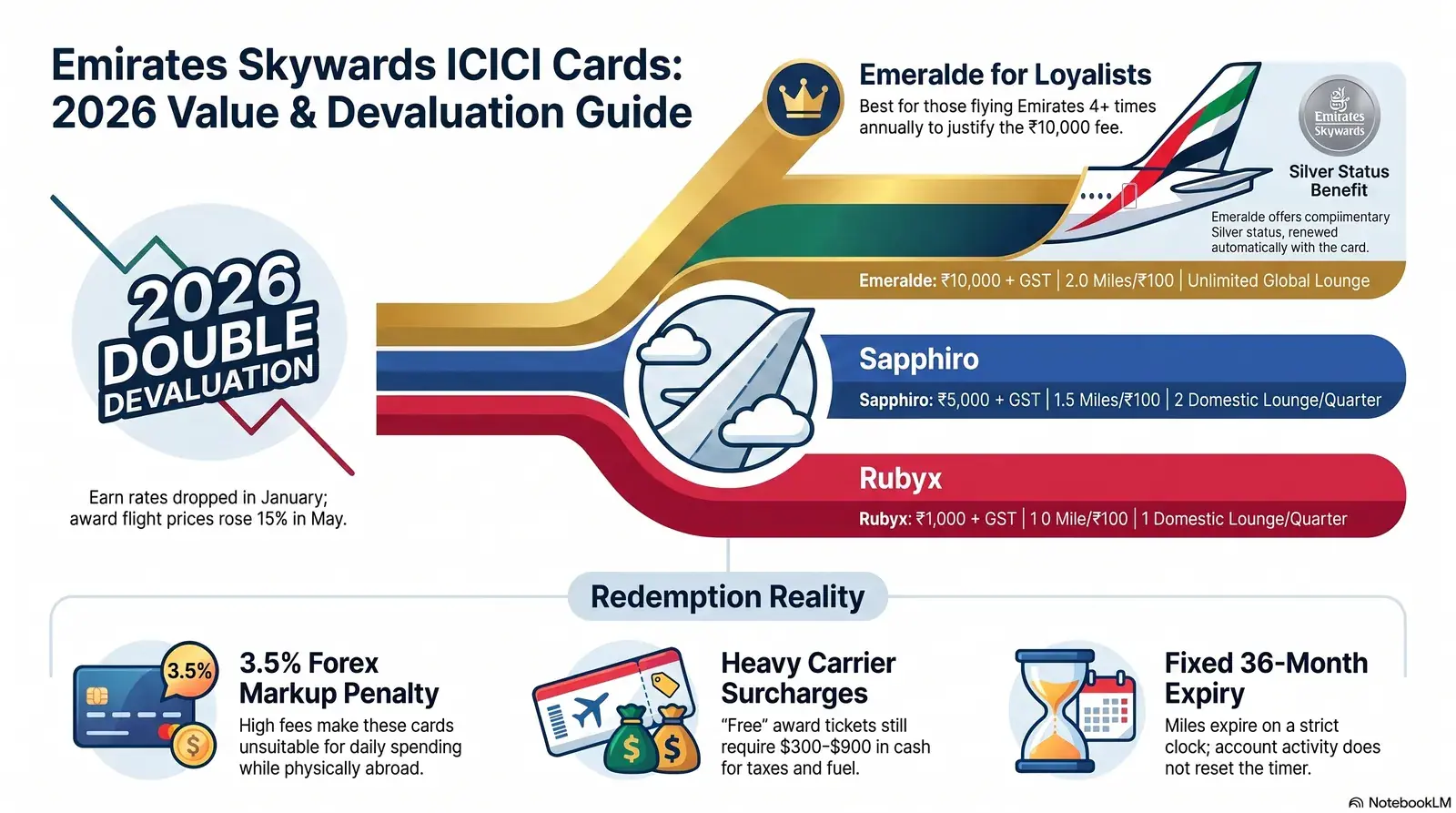
- Devalued twice in 2026: ICICI cut earn rates from 15 January 2026 (Emeralde: 2.5 → 2 miles/₹100; Sapphiro: 2 → 1.5 miles/₹100), and Emirates raised award prices by ~15% from 20 May 2026 — a double hit to value.
- 3.5% forex markup on all three cards: Every purchase on a foreign website (Emirates.com in EUR, hotel in USD) incurs a 3.5% surcharge plus GST, wiping out much of the miles benefit for international spenders.
- Emeralde only for serious Emirates loyalists: At ₹10,000 annually, the Emeralde makes sense only if you fly Emirates 4+ times a year and actively want Silver Tier perks. Otherwise, HSBC TravelOne or IndusInd Avios offers more flexibility for the same or lower fee.
2 miles / ₹100 — Emeralde only (was 2.5 before Jan 2026)
Rubyx at ₹1,000/year — 1 mile / ₹100, entry-level
3.5% + GST on all three variants — a major con
~23,000 Skywards miles Saver (post-May 2026 increase)
What cards are in the Emirates Skywards ICICI range?
ICICI Bank and Emirates offer three co-branded credit cards in India as of 2026: the Emeralde (premium), Sapphiro (mid-tier), and Rubyx (entry-level), each targeting a different spend level and travel frequency. All three earn Skywards miles and carry complimentary Blue Tier Skywards membership as a baseline, but the earn rates, welcome bonuses, lounge benefits, and fee structures differ substantially between them.
| Feature | Emeralde | Sapphiro | Rubyx |
|---|---|---|---|
| Joining + Annual Fee | ₹10,000 + GST | ₹5,000 + GST | ₹1,000 + GST |
| Miles / ₹100 (from Jan 2026) | 2 miles | 1.5 miles | 1 mile |
| Welcome Bonus Miles | 10,000 Skywards miles | 5,000 Skywards miles | None |
| Skywards Tier (Year 1) | Complimentary Silver | Complimentary Silver | Blue (base) |
| Silver Tier Renewal | On card renewal | Requires ₹5 lakh annual spend | Not applicable |
| Domestic Lounge | Unlimited | 2 visits/quarter (spend gate: ₹75,000) | 1 visit/quarter |
| International Lounge | Unlimited (Priority Pass) | 2 visits/year | None |
| Forex Markup Fee | 3.5% + GST | 3.5% + GST | 3.5% + GST |
| Finance Charge | 3.75%/month | 3.75%/month | 3.75%/month |
| BookMyShow BOGO | Yes (₹25,000 quarterly spend gate from Apr 2026) | Yes (₹25,000 quarterly spend gate) | Limited |
Source: ICICI Bank Emirates Skywards page and CardInsider devaluation report, updated August 2026.
Did the Emirates Skywards ICICI credit card earn rates change in 2026?
Yes — ICICI Bank reduced earn rates on all three Emirates Skywards cards from 15 January 2026, making these cards measurably less valuable than they were in 2025. The Emeralde fell from 2.5 miles to 2 miles per ₹100 spent; the Sapphiro dropped from 2 miles to 1.5 miles per ₹100. The Rubyx held steady at 1 mile per ₹100.
Simultaneously, ICICI Bank excluded four spend categories from miles earning entirely across all three variants: Insurance, Utility payments, Government services, and Education payments. These categories are among the highest-volume spends for many Indian households, meaning a card that previously rewarded most expenditure now leaves large portions of routine spending unrewarded.
An Emeralde cardholder who previously earned 2.5 miles on ₹1,00,000 of monthly spend received 2,500 miles. From January 2026 onwards, the same spend yields 2,000 miles — 20% fewer. To hit the same mile accumulation as before, you now need to spend ₹1,25,000 per month. Factor in excluded categories and the effective earn rate on household spend is often closer to 1.6–1.8 miles per ₹100.
What lounge access do you get with Emirates Skywards ICICI cards?
Lounge access varies significantly between the three cards — the Emeralde delivers genuinely unlimited access domestically and internationally, while Sapphiro imposes a quarterly spend gate, and Rubyx has no international lounge benefit at all.
The Emeralde provides unlimited complimentary domestic lounge access and unlimited international lounge access through a complimentary Priority Pass membership, which covers over 1,300 lounges across 140 countries. For a traveller who transits Dubai Concourse C Emirates Lounge four or five times a year, unlimited international lounge access is a genuine premium perk that would otherwise cost $469 (Priority Pass standard membership) or be earned only with much higher-fee cards.
The Sapphiro gives two domestic lounge visits per quarter and two international lounge visits per year — but domestic visits are only activated once you spend ₹75,000 in that quarter. Miss the quarterly threshold and you lose that quarter's visits entirely. Two international visits per year is just enough for a single return trip; anyone making two international trips a year will exhaust their allowance quickly.
The Rubyx provides a single domestic lounge visit per quarter, with no international lounge access. This is fine for a first credit card but adds no value for someone flying to Dublin or other international destinations.
What Skywards tier benefits come with the card?
Both the Emeralde and Sapphiro grant complimentary Emirates Skywards Silver Tier membership in your first year, bypassing the 25,000 Tier Miles normally required to earn it through flying — a shortcut worth approximately three to four return domestic India flights in terms of actual flying required.
Emirates Skywards has four tiers: Blue (base), Silver (25,000 Tier Miles), Gold (50,000 Tier Miles), and Platinum (120,000 Tier Miles plus at least one long-haul Business or First Class flight). Silver Tier unlocks: 25% bonus Skywards miles on Emirates and flydubai flights, priority check-in, and complimentary seat selection on Emirates-operated services.
The critical difference between Emeralde and Sapphiro for Silver Tier renewal: the Emeralde renews Silver Tier automatically on card renewal, meaning you keep the status as long as you pay the ₹10,000 annual fee, regardless of how much you fly. The Sapphiro requires ₹5 lakh (₹5,00,000) in annual card spend to renew Silver at the end of Year 1 — roughly ₹41,700 per month on average. For moderate spenders, Silver Tier via Sapphiro is a first-year benefit only.
Tier Miles are earned exclusively through flights and determine your membership level. Skywards Miles are earned both through flights and card spend, and are spent on award tickets and upgrades. Your ICICI card spend earns Skywards Miles only — not Tier Miles — so the card cannot help you climb from Blue to Silver through spending alone. The card can only give you Silver by courtesy of the joining benefit.
Is the Emirates ICICI card worth it for Dublin–India bookings?
After Emirates raised Classic Reward award prices by approximately 15% from 20 May 2026, a Saver Economy one-way award from Dublin (DUB) to Mumbai (BOM) or Delhi (DEL) via Dubai now requires approximately 23,000 Skywards miles; a Saver Business Class one-way award requires approximately 47,000 miles. These figures represent the post-devaluation Saver pricing; Flex awards cost roughly 50% more miles for better seat availability.
Emirates uses dynamic pricing with no published award chart, so exact mile requirements vary by date, availability, and booking window. The figures of 23,000 miles (Economy Saver) and 47,000 miles (Business Saver) for a DUB–India routing are based on post-May-2026 pricing benchmarks reported by award-booking specialists.
Carrier-imposed surcharges (often called "fuel surcharges") are significant on Emirates award tickets. Expect $300–$500 in taxes and surcharges on a DUB–BOM Economy award, and $500–$900 in Business Class. This cash outlay reduces the net value of your miles and is a persistent criticism of Emirates Skywards versus more surcharge-light programs.
One positive change from May 2026: Emirates now allows one-way Business Class Saver awards at 50% of the roundtrip mile cost when Saver inventory is available. Previously, Saver rates required a roundtrip booking. This makes burning miles on a positioning flight (for example, Dublin to Dubai for a work trip) more affordable.
🧮 Emirates Skywards Miles Earning Calculator
Estimate how many months of card spend it takes to earn enough miles for an Economy or Business award from Dublin to India via Dubai. Based on post-May-2026 Saver pricing: approximately 23,000 miles for Economy and approximately 47,000 miles for Business Class. Default spend of ₹1,00,000 (100,000 rupees per month) is the benchmark Emeralde example used in the devaluation analysis above.
Has Emirates Skywards been devalued in 2026?
Yes, and twice — once on the earning side and once on the redemption side. Emirates Skywards has experienced two significant devaluation events in 2026 that together make it a less attractive proposition than it was 18 months ago.
The first hit was the January 2026 earn-rate cut by ICICI Bank, described above. The second was the May 2026 Classic Reward price increase, in which Emirates raised the miles cost of most award bookings by approximately 15% from 20 May 2026. Routes including those connecting Dubai with London, Mumbai, Delhi, Sydney, and other major cities now require more miles than before. The combined effect: you earn fewer miles per rupee spent, and each mile buys you less of a flight than it did a year ago.
At the programme level, external transfer rates have also worsened. American Express has slashed its Emirates Skywards transfer ratio, and Capital One devalued its own Skywards transfer rate in 2026. This means Indian cardholders who previously topped up Skywards miles from bank rewards programmes now face worse rates.
Emirates Skywards miles expire 36 months (three years) after they are earned, and unlike most US airline programmes, activity in your account does NOT reset the expiry clock. Once a batch of miles hits its three-year anniversary, it vanishes regardless of whether you have been actively earning. Emirates extended miles due to expire March–May 2026 until 30 June 2026 as a temporary measure, but this was a one-off. Plan redemptions carefully to avoid losing miles to the fixed expiry window — especially for low-frequency earners whose miles pile up slowly over years.
What is the forex markup on Emirates Skywards ICICI cards, and how does the DCC trap work?
All three Emirates Skywards ICICI Bank credit cards carry a foreign currency markup fee of 3.5% plus GST, making them expensive instruments for any spending on foreign-currency websites — including Emirates.com itself when priced in EUR, GBP, or AED.
When you book a Dublin–Dubai–Mumbai flight on Emirates India (emirates.com/in) and pay in INR, you avoid the foreign currency conversion — but you are still earning the depressed post-devaluation rate. When you book on the Emirates Ireland site or the UK/UAE site in a foreign currency, the 3.5% markup applies before you even think about miles.
The Dynamic Currency Conversion (DCC) trap: When paying on a foreign merchant terminal or website, you may be offered the option to pay in INR rather than the local currency. This seems convenient but typically applies an inflated conversion rate of 4–8% above the interbank mid-market rate. If you accept DCC on top of the 3.5% ICICI markup, you could be paying 7–11% above the true exchange rate. Always decline DCC and pay in the local currency (EUR in Ireland, GBP in the UK, AED in Dubai). The 3.5% ICICI markup is fixed; DCC adds an avoidable second layer.
For international spending in Europe during your Dublin–India journey — airport transfers, hotels, meals — use a zero-forex card such as Niyo Global or Wise Travel Card instead of the Emirates ICICI card. The 3.5% markup negates miles value on small international transactions quickly.
Enabling international transactions and avoiding OTP blocks
Before using your Emirates Skywards ICICI card on any foreign website — including Emirates.com in a non-INR currency — you must enable international transactions via ICICI Bank's iMobile Pay app or internet banking, otherwise the transaction will decline.
ICICI Bank, like most Indian banks, restricts international e-commerce transactions by default for security. To enable them: open iMobile Pay > Cards > select your Emirates card > Manage Card > switch on "International Online Transactions". Set a sensible daily limit (the default is ₹0 for new cards). For high-value flight bookings (₹50,000+), you may also need to temporarily raise your transaction limit in the same settings. The standard 3D Secure OTP process applies to international transactions, so ensure your registered mobile number can receive SMS while you are abroad.
Note: standalone airline ticket purchases made directly with an airline are not subject to Tax Collected at Source (TCS) under the Liberalised Remittance Scheme (LRS). TCS applies to overseas remittances and tour packages, but direct airline ticket purchases are exempt. This was confirmed under the Finance Act 2025 rules in force from 1 April 2025.
On-the-Ground Insight: "I got the ICICI Emeralde Emirates card because my company books our Gulf trips on Emirates every quarter. The Silver Tier upgrade at check-in and priority boarding is genuinely useful — I skip the long queues at Dublin and Dubai. But I stopped using the card for any spend in Ireland because the 3.5% markup on my grocery runs and hotel bills in EUR costs more than the miles are worth. My Dublin expenses go on my Revolut now." — Rohan T., Irish-based IT consultant, Emirates frequent flyer (Gold via flying)
How does it compare: IndusInd Avios vs HSBC TravelOne vs Axis Atlas?
For most Indian flyers on the Dublin–India route who do not exclusively fly Emirates, a flexible-points card delivers better value in 2026 than any of the Emirates co-branded options. Here is how the landscape compares:
| Card | Annual Fee | Earn Rate | Transfer Partners | Welcome Bonus | Forex Markup | Best For |
|---|---|---|---|---|---|---|
| Emirates Skywards ICICI Emeralde | ₹10,000 | 2 miles/₹100 | Emirates only | 10,000 Skywards miles + Silver Tier | 3.5% | Emirates loyalists, 4+ flights/year |
| IndusInd Avios Visa Infinite | ₹10,000+ | 1.5 Avios/₹100 | Qatar Airways, British Airways, Iberia (Avios ecosystem) | 20,000 Avios | 1.8% | Qatar/BA flyers on DUB–India |
| HSBC TravelOne | ₹4,999 | 1.5 pts/₹100 | 20 partners at 1:1 (Air India, Singapore, BA, Emirates, hotels) | 3,000 pts | 2% | Flexible multi-airline earners |
| Axis Atlas | ₹5,000 | 5 EDGE miles/₹200 (travel), 2/₹200 (other) | 13 partners (reduced after Apr 2026 devaluation — Accor removed) | 5,000 EDGE miles | 3.5% | High travel spenders; weakened post-devaluation |
Sources: MyFlightOffers IndusInd Avios guide; HDFC Bank, Axis Bank, HSBC India official pages, August 2026.
The case for IndusInd Avios over Emirates Skywards ICICI
For flyers who use Qatar Airways or British Airways on the Dublin–India route, IndusInd Avios Visa Infinite is a stronger proposition than Emirates Skywards ICICI Emeralde, despite the same ₹10,000 annual fee. The 20,000 Avios welcome bonus is twice as generous as the Emeralde's 10,000 miles, and Avios can be used across Qatar Airways Privilege Club and British Airways Executive Club — both of which serve Dublin. The forex markup of 1.8% is also lower than the 3.5% on all Emirates ICICI variants, which matters significantly for Indian students and professionals spending in Ireland.
The case for HSBC TravelOne in 2026
After the Axis Atlas April 2026 devaluation removed Accor as a transfer partner and weakened the programme, HSBC TravelOne has emerged as the leading flexible-points travel card in India's mid-premium segment. At ₹4,999 annually, it offers instant 1:1 transfers to 20 airline and hotel partners — including Emirates Skywards, Air India Maharaja Club, Singapore Airlines KrisFlyer, British Airways Executive Club, and Marriott Bonvoy — from a single pool of TravelOne points. This flexibility means you can choose the best award programme for each booking rather than being locked into Emirates miles that have devalued. The 2% forex markup is also meaningfully better than the 3.5% on Emirates ICICI cards.
The main con of TravelOne: the base earn rate of 1.5 points per ₹100 is matched by the post-devaluation Sapphiro rate, and TravelOne's welcome bonus of 3,000 points is much smaller than either Avios or Emirates co-branded cards. However, the breadth of transfer partners makes it the best card for someone who wants to keep options open.
Verdict: who should carry an Emirates Skywards ICICI card in 2026?
Carry the Emeralde if you fly Emirates four or more times a year and specifically value Silver Tier benefits (priority check-in, bonus miles on flights, lounge access at Dubai Concourse C). Otherwise, a flexible card serves you better.
True Cost = Award Fare (in miles) + Carrier Surcharges (cash) + Annual Card Fee
An Economy Saver Dublin–India award costs ~23,000 miles plus approximately $300–$500 in taxes. At the Emeralde earn rate of 2 miles per ₹100, earning 23,000 miles requires ₹11,50,000 (₹11.5 lakh) in eligible card spend. Against a typical cash fare of ₹55,000–₹70,000 for Dublin–Mumbai via Dubai, the miles value only exceeds the cash fare if you can redeem at consistently higher-value redemptions (Business Class or above).
Carry the Sapphiro if you fly Emirates two or three times a year, want entry-level Silver Tier in Year 1, and are comfortable spending ₹5 lakh annually to retain it. Be aware that the Sapphiro's domestic lounge benefit (2 visits per quarter) requires ₹75,000 in quarterly spend to activate — easily missed during slower months.
The Rubyx is an entry-level product for first-time Emirates credit card users or those who want Skywards miles on domestic India spend only. At ₹1,000 annually and 1 mile per ₹100, it costs little but also gives little. Anyone building towards a meaningful award redemption on Dublin–India flights should step up to Sapphiro or consider a flexible alternative.
Choose an alternative if: you split your flying between Emirates, Qatar Airways, and Air India (or Etihad); you spend a material proportion of your budget in Ireland or Europe where the 3.5% forex markup erodes value; or you want to keep transfer options open across multiple programmes. In that scenario, HSBC TravelOne's 20-partner flexibility at ₹4,999 or IndusInd Avios at ₹10,000 (with a significantly lower forex markup) are stronger choices for the Dublin-based Indian traveller in 2026.
Frequently asked questions
Which Emirates Skywards ICICI card gives the best value in 2026?
The Emirates Skywards ICICI Emeralde gives the best value at 2 miles per ₹100 (down from 2.5 after the January 2026 devaluation), unlimited domestic and international lounge access via Priority Pass, 10,000 welcome miles, and complimentary Silver Tier in Year 1. For high spenders who genuinely fly Emirates, it justifies its ₹10,000 annual fee. The Sapphiro at ₹5,000 suits moderate Emirates flyers; the Rubyx at ₹1,000 is an entry-level option only.
Did the Emirates Skywards ICICI credit card earn rates change in 2026?
Yes. From 15 January 2026, ICICI Bank reduced earn rates across all three Emirates Skywards cards: the Emeralde dropped from 2.5 to 2 miles per ₹100, the Sapphiro from 2 to 1.5 miles per ₹100. The Rubyx remains at 1 mile per ₹100. Additionally, no miles are earned on Insurance, Utility, Government, or Education spend across all three cards.
How many miles does it take to fly Dublin to India on Emirates using Skywards miles?
After Emirates raised award prices by approximately 15% from 20 May 2026, a Saver Economy award from Dublin (DUB) to Mumbai (BOM) or Delhi (DEL) via Dubai requires approximately 23,000 Skywards miles one-way. Business Class Saver awards on the same routing require approximately 47,000 miles. Significant carrier-imposed surcharges of $300 to $500 apply on top of the miles, especially in Business Class.
What is the forex markup fee on Emirates Skywards ICICI cards?
All three Emirates Skywards ICICI cards — Emeralde, Sapphiro, and Rubyx — charge a foreign currency markup fee of 3.5% plus GST. This makes them expensive for booking flights on foreign airline websites (such as Emirates.com in EUR or GBP) or for international spending in Europe. For international transactions, a zero-markup card such as Niyo Global or IDFC WOW should be used alongside.
Is the Emirates Skywards ICICI card better than IndusInd Avios or HSBC TravelOne?
It depends on your flying pattern. The Emirates co-branded card rewards Emirates loyalty with Silver Tier and unlimited lounge access (Emeralde) but locks you into one airline at 2 miles per ₹100 with a 3.5% forex markup. IndusInd Avios Visa Infinite (₹10,000 fee, 20,000 welcome Avios) is better for Qatar Airways and British Airways flyers on the DUB–India route. HSBC TravelOne (₹4,999 fee) offers 1:1 instant transfers to 20 partners and is the best flexible-points option in 2026. Unless you fly Emirates specifically four or more times a year and value the Silver Tier, a flexible card serves most Indian travellers better.
Ready to book your Dublin–India Emirates flight? Compare fares now
Find the current best fares on Dublin–Mumbai and Dublin–Delhi via Dubai, compare Emirates against Qatar Airways and Etihad, and check whether paying cash beats an award redemption.
- NEW IndusInd Bank Avios Visa Infinite — Full 2026 Guide for India–Ireland Flyers — earn rates, Qatar Airways sweet spots, and how Avios compares to Skywards for the Dublin route
- Niyo Global vs Wise vs Bank Forex Cards 2026 — the zero-markup card comparison for Indian students and travellers spending in Ireland
- Best HDFC Bank Cards for Flights and Travel 2026 — Infinia, Diners Black, Regalia Gold, and SmartBuy portal strategy explained
- Axis Bank Credit Cards Flight Booking Guide 2026 — includes the Atlas post-devaluation verdict and Horizon as the new mid-tier pick
All information in this article is based on publicly available official sources, bank websites, and award programme documentation as of August 2026. Card fees, earn rates, lounge access terms, and Emirates Skywards award pricing are subject to change without notice. The January 2026 earn-rate reduction and May 2026 award-price increase are both live at time of publication. Always verify current terms directly with ICICI Bank and Emirates Skywards before applying. MyFlightOffers is not affiliated with ICICI Bank or Emirates. This article does not constitute financial advice.