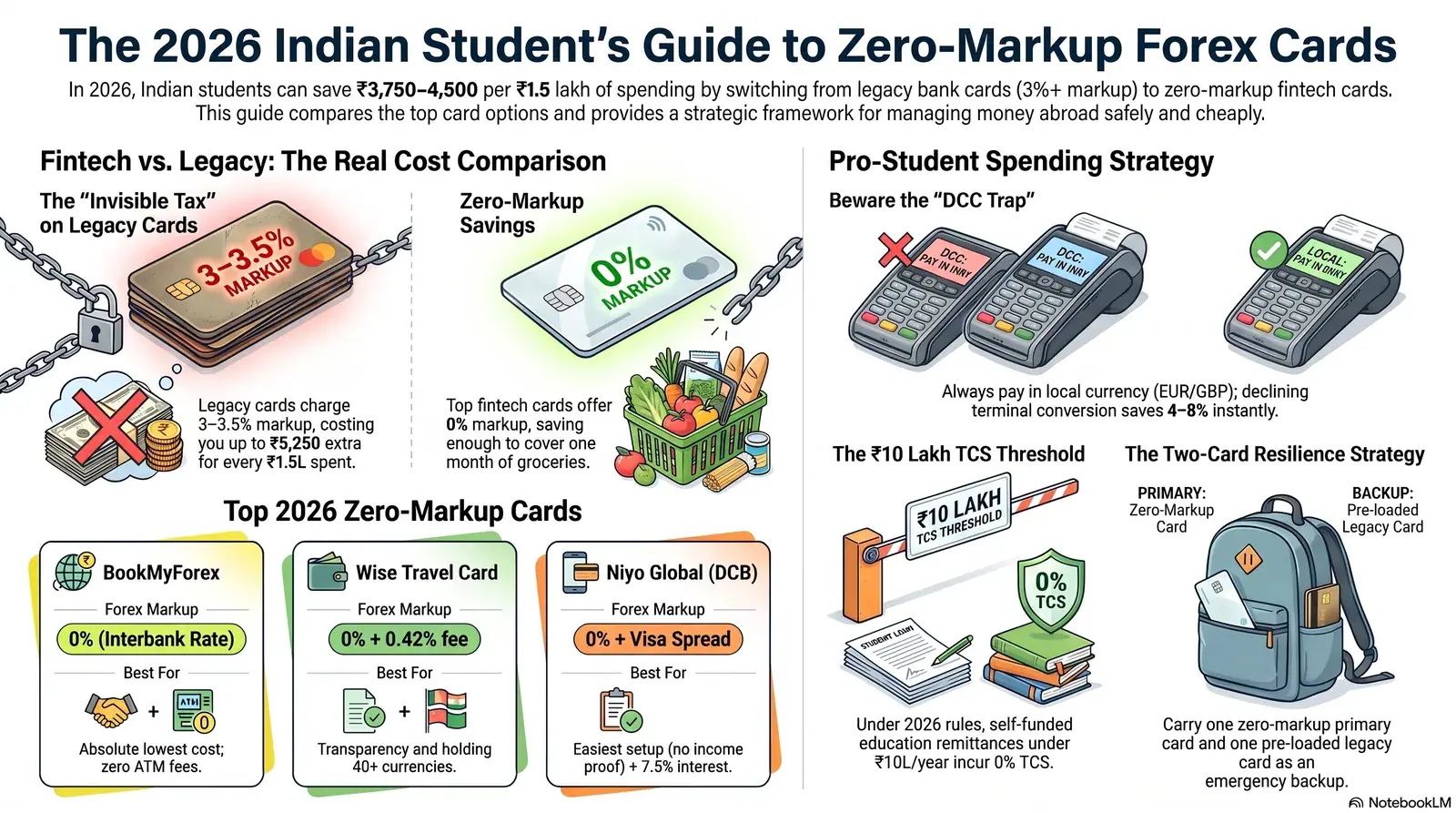
- Zero-markup saves ₹3,750–4,500 per ₹1.5 lakh of spending compared to a standard HDFC or ICICI card with a 2.5–3% forex markup.
- Niyo Global (DCB variant) is the easiest to get — no income proof, no credit score, zero forex markup, and it opens in minutes via the Niyo app. Wise charges 0.42% (INR→EUR) but offers the true mid-market rate and works like a multi-currency wallet.
- Carry two cards: a zero-markup primary card for day-to-day spending, plus an HDFC/ICICI legacy forex card pre-loaded with €300–€500 as backup. Never rely on one card alone when living abroad.
BookMyForex Global Card (true interbank rate, ₹0 ATM fees)
Niyo Global DCB — zero markup, 7.5% savings interest, lounge on ₹50k/quarter
Wise Travel Card — 0.42% INR→EUR, true mid-market rate, 40+ currencies
₹10 lakh / year for self-funded remittances under LRS (Budget 2026)
In this guide
- The 2026 zero-markup landscape
- Niyo Global deep-dive: SBM vs DCB, loading, and hidden costs
- Wise Travel Card: mid-market rate, vKYC, and fee breakdown
- Scapia, IDFC WoW, Fi Money, and BookMyForex
- Legacy bank forex cards: when HDFC and ICICI still make sense
- Real cost comparison: ₹1.5 lakh spend in Ireland/Europe
- ATM withdrawals abroad: cheapest cash strategy
- LRS, TCS, and PAN rules for 2026
- The DCC trap: how to avoid paying 6% extra at foreign terminals
- The two-card strategy: recommended combinations
- Frequently asked questions
1. The 2026 Zero-Markup Landscape
In 2026, at least seven cards available to Indian residents offer zero or near-zero forex markup — a dramatic shift from three years ago when legacy bank cards charging 3–3.5% were the only real option for students heading abroad.
The market now splits into three tiers. The first tier consists of true fintech debit accounts — Niyo Global (via DCB Bank or SBM Bank), Fi Money (via Federal Bank), and the Wise Travel Card — which apply 0% of their own markup on top of the Visa or Mastercard exchange rate. The second tier consists of credit cards with 0% forex markup, most notably the Scapia Federal Bank Credit Card and the IDFC FIRST WoW Credit Card, which offer the same forex benefit while also providing a credit line. The third tier is represented by BookMyForex, which loads USD at the true interbank rate (zero markup, zero ATM fee) and covers 200+ countries.
Legacy bank forex cards from HDFC and ICICI still exist and still carry 1.75–3.5% markup depending on the card variant and currency. They are no longer competitive as primary spend cards but retain a specific use case as backup emergency cards, covered in Section 5.
2. Niyo Global Deep-Dive: SBM vs DCB, Loading, and Hidden Costs
Niyo Global is currently India's most popular zero-markup debit card for international students, available in two variants — issued by DCB Bank and by SBM Bank India — each with slightly different fee structures and interest rates.
Both variants are lifetime-free cards with 0% forex markup on retail transactions across 150+ currencies. You apply via the Niyo app on iOS or Android, complete a video KYC (typically under 10 minutes), and receive a physical Visa Signature card within 7–10 business days. There is no income requirement, no credit score check, and no minimum age beyond the standard 18 years, making it genuinely accessible to first-year students.
The key differences between the two variants are as follows. The DCB Bank variant offers savings interest of up to 7.5% per annum on your account balance, provides one complimentary domestic airport lounge visit per quarter when you spend ₹50,000 or more in that quarter, and charges ₹100 + GST for ATM cash withdrawals abroad after a limited number of free transactions per month. The SBM Bank variant offers a slightly lower interest rate on the linked fixed deposit (up to 6.5% per annum) but operates as a credit card rather than a savings account debit card, which means it builds your credit history. Both variants require a minimum balance of ₹5,000 to avoid the annual maintenance charge.
Niyo adds 0% to the Visa exchange rate. However, Visa itself builds an approximately 0.5–1.5% spread into its published rate above the true mid-market rate (the rate you see on Google Finance). Your real cost is therefore roughly 0.5–1% above mid-market — still far cheaper than the 3–3.5% on legacy bank cards, but not literally zero when measured against the interbank rate.
Loading money onto Niyo is straightforward: you transfer INR from any Indian bank account via UPI, NEFT, or IMPS through the Niyo app. There are no loading fees, no reload charges, and no need to visit a bank branch. This matters practically — you can top up from your Airtel Payments Bank or a parent's SBI account from Dublin on a Sunday night if you run low. The daily international transaction limit for the SBM variant is ₹5 lakh, which covers rent payments, university tuition instalments, and monthly living expenses without issues.
Hidden costs to watch: ATM cash withdrawals abroad cost ₹100 + GST per transaction on the DCB variant after the first free transaction each month. If you are withdrawing cash frequently — for market shopping, transport, or accommodation deposits — these fees add up. At four ATM withdrawals per month, that is approximately ₹500/month in fees, which is worth considering against your overall card cost.
3. Wise Travel Card: Mid-Market Rate, vKYC, and Fee Breakdown
The Wise Travel Card uses the true mid-market exchange rate — the same rate shown on Reuters and Google Finance — and charges a small transparent conversion fee, making it the most cost-transparent zero-markup option for Indian residents in 2026.
Wise does not add a markup to the exchange rate at all. Instead, it charges a small conversion fee that varies by currency pair. For the INR to EUR corridor — the most relevant for students in Ireland — the conversion fee is approximately 0.42% of the amount converted. For INR to GBP the fee is approximately 0.40%, and for INR to USD approximately 1.16%. These fees are shown explicitly in the Wise app before you convert, with no hidden spread in the rate itself.
Card issuance costs ₹460 (though this is frequently waived on promotional offers). There is no annual fee, no monthly fee, and no inactivity charge. The card cannot be used within India, Nepal, or Bhutan due to RBI regulations — it is strictly an international spend card. To sign up from India, you must complete a vKYC (video KYC) process within the Wise app, which typically takes 15–20 minutes and requires your Aadhaar or PAN card.
Wise supports 40+ currencies in a single multi-currency account. You can hold EUR, GBP, and USD simultaneously, convert when the rate is favourable, and spend from the appropriate balance without incurring conversion fees on each transaction. For a student who receives money from parents in INR but pays rent in EUR and occasionally travels to the UK, this multi-currency capability is genuinely useful.
Some Indian residents have reported delays in vKYC approval and card delivery due to RBI compliance reviews. Verify current availability and timelines on wise.com/in before relying on Wise as your primary card. Apply at least 4 weeks before travel.
On-the-Ground Insight: "I converted ₹80,000 to EUR through Wise the night before my connecting flight to Dublin. The rate I got was within 0.4% of the interbank rate, and I could see the exact fee before confirming. My HDFC card would have cost me an extra ₹1,600 on that single conversion. I use Wise for rent and Niyo for coffee and groceries." — Priya S., MSc Data Analytics, University College Dublin, September 2025 intake
4. Scapia, IDFC WoW, Fi Money, and BookMyForex
Beyond Niyo and Wise, four additional zero-markup options cover different student profiles: Scapia Federal for credit card users who want cashback, IDFC WoW for those with no credit history, Fi Money for a clean digital banking experience, and BookMyForex for the absolute lowest exchange rate cost.
Scapia Federal Bank Credit Card (scapia.com) is a lifetime-free credit card with 0% forex markup and 2% value back on all spends, rising to 4% on travel booked through the Scapia app. Cardholders who spend ₹10,000 in a calendar month receive unlimited domestic airport lounge access for that month. It requires a credit check, but Scapia has been known to approve applicants with limited credit history. The key advantage over Niyo is that it builds your credit score and earns cashback simultaneously.
IDFC FIRST WoW Credit Card (idfcfirstbank.com) is a secured credit card — meaning you open a fixed deposit of at least ₹20,000 with IDFC FIRST Bank, and the card is issued against that FD. It is lifetime-free, carries 0% forex markup, and earns 4 reward points per ₹200 spent (0.5% reward rate, redeemable for statement credit). It provides zero lounge access but it is the most accessible credit card on this list for students who have never held a credit card, as the FD eliminates the need for income proof or a credit history.
Fi Money (Fi-Federal Debit Card, via Federal Bank, fi.money) offers 0% forex markup on its Infinite and Prime subscription plans, with a flat ₹100 charge per ATM withdrawal abroad. The Standard plan reverts to 3.5% + GST forex markup, so the plan level matters. Fi Money offers a clean interface, smart spending analytics, and 4X reward points on all spends. The plan pricing should be verified against current Fi Money tariffs before relying on the 0% markup.
BookMyForex Global Card (bookmyforex.com) is a single-currency (USD-loaded) prepaid forex card that gives you the true interbank exchange rate — zero markup — with zero ATM withdrawal fees and zero reload fees. This makes it the cheapest card for pure cost on paper, but it loads only in USD (you spend in EUR with zero cross-currency charges), requires online ordering and delivery, and has less app support than Niyo or Wise. It is the best option for a student whose main concern is absolute cost minimisation and who can plan card loading a few days in advance.
5. Legacy Bank Forex Cards: When HDFC and ICICI Still Make Sense
HDFC and ICICI legacy multi-currency forex cards carry 1.75–3.5% forex markup and are no longer competitive as primary spend cards, but they retain a specific role as pre-loaded emergency backup cards and for large institutional payments.
HDFC's legacy forex cards charge a card issuance fee of ₹300 + GST, a reload fee of ₹75 + GST per reload, and a cross-currency markup of 3% when you spend in a currency different from the one pre-loaded on the card. The HDFC ISIC Student ForexPlus Card is a variant aimed at students, co-branded with the International Student Identity Card network, and includes identity document features — but the fee structure remains the same.
ICICI's equivalent cards carry similar markup rates, typically 3–3.5% depending on the currency combination. Both banks' ATM withdrawal fees abroad are USD 2.00–2.25 per transaction, which is more than double the ₹100 that Niyo charges.
Where legacy cards still earn their place: first, as emergency backup cards that your parents can reload from a branch if your primary card is blocked or lost and you cannot complete a UPI transaction from abroad. Second, for large university fee payments where the university requires a forex instrument rather than a personal card — though this scenario has become rarer as universities increasingly accept SWIFT bank transfers. Third, as the primary card for older travellers and parents who are unfamiliar with fintech apps and prefer working with a relationship manager at a known bank.
Before using any HDFC, ICICI, or SBI card for international transactions, you must enable international usage through the bank's mobile app. HDFC NetBanking → Cards → Debit Card → International Transaction Activation. ICICI iMobile → Services → Card Services → Enable International Use. Failing to do this results in immediate transaction declines at the point of sale, even on a pre-loaded card. Enable international use and set the daily limit to at least ₹2 lakh before departure.
6. Real Cost Comparison: ₹1.5 Lakh Spend in Ireland and Europe
On ₹1.5 lakh of spending in Ireland and Europe, the difference between a legacy bank card and a zero-markup fintech card is approximately ₹3,750–4,500 in your pocket — enough to cover one month of groceries in Dublin.
| Card | Forex markup | Cost on ₹1,50,000 | ATM fee (abroad) | Annual card cost | Best for |
|---|---|---|---|---|---|
| BookMyForex Global | 0% (true interbank) | ₹0 | ₹0 | ₹0 | Absolute cost minimisation |
| Wise Travel Card | 0% + 0.42% conversion (INR→EUR) | ₹630 | ₹0 (2 free/month, then ₹206) | ₹460 (card issuance only) | Transparency, multi-currency |
| Niyo Global DCB | 0% + Visa spread (~0.7%) | ~₹1,050 | ₹100 + GST | ₹0 (LTF) | Easiest to get, savings interest |
| Scapia Federal | 0% + Visa spread (~0.7%) | ~₹1,050 | ₹300 + GST | ₹0 (LTF credit card) | Cashback + credit building |
| IDFC FIRST WoW | 0% + Visa spread (~0.7%) | ~₹1,050 | ₹250 + GST | ₹0 (requires ₹20,000 FD) | First-ever credit card seekers |
| Fi Money (Infinite) | 0% + Visa spread (~0.7%) | ~₹1,050 | ₹100 flat | Subscription cost | Smart banking analytics |
| HDFC ForexPlus | 1.75–2% (in-currency) / 3% cross-currency | ₹2,625–4,500 | USD 2.25/withdrawal | ₹300 issuance + ₹75/reload | Emergency backup card |
| ICICI Bank legacy card | 3–3.5% | ₹4,500–5,250 | USD 2.00/withdrawal | ₹300–500 issuance | Emergency backup card |
Source: Published fee schedules from Niyo, Wise, HDFC Bank, BookMyForex, August 2026. Visa spread is approximate — actual rate varies by currency pair and date.
True Card Cost = (Monthly Spend × Forex Markup%) + (ATM Withdrawals × ATM Fee) + Annual Card Fee
For a student spending ₹60,000/month in Ireland with 4 ATM withdrawals/month: Niyo DCB = ₹700 + ₹472 = ₹1,172. HDFC ForexPlus at 2% = ₹1,200 + ₹800 + reload fees = approximately ₹2,200+. Niyo wins clearly at this spend level.
7. ATM Withdrawals Abroad: Cheapest Cash Strategy
Cash in Ireland and Europe is a secondary payment method in 2026 — most transactions are card-based — but you will still need €50–€150 per month for markets, cash-only shops, and transport in smaller towns. The cheapest ATM strategy minimises withdrawal frequency rather than card switching.
Each card's ATM cost structure differs significantly. BookMyForex is the clear winner with ₹0 per ATM withdrawal with no cap. Wise offers two free ATM withdrawals per month (up to ₹20,000 combined), then charges approximately ₹206 per withdrawal. Niyo DCB charges ₹100 + GST (~₹118) per transaction after the first free transaction per month. Scapia charges ₹300 + GST (~₹354) per ATM withdrawal. IDFC WoW charges ₹250 + GST (~₹295). Legacy HDFC/ICICI cards charge USD 2.00–2.25 (~₹168–189) per withdrawal, plus cross-currency markup if the ATM dispenses EUR while your card holds USD.
The optimal strategy for most students: withdraw larger amounts less frequently. A single ₹12,000 withdrawal (approximately €130) once a week on a Niyo card costs ₹118 in ATM fees. Four withdrawals of ₹3,000 costs ₹472. Use your card for all contactless and POS transactions, and limit ATM visits to one per week. If you are using Wise with two free monthly withdrawals, time your withdrawals to the first and fifteenth of the month to maximise the free allowance.
Always reject the "Convert to INR" prompt at European ATMs and foreign card terminals. This is Dynamic Currency Conversion (DCC), explained in detail in Section 9, and it will instantly add 4–8% to your withdrawal or payment.
8. LRS, TCS, and PAN Rules for 2026
Under the Liberalised Remittance Scheme (LRS) for the financial year 2026, there is zero TCS on overseas spending and remittances up to ₹10 lakh per financial year — a threshold that covers most full-year student budgets without any tax complication.
The TCS (Tax Collected at Source) rules for foreign remittances changed significantly in the Finance Act 2025 (effective 1 April 2025) and were further revised in Budget 2026 (effective 1 April 2026). Here is the current position:
Education loans: 0% TCS regardless of the amount remitted. If your tuition fees are financed by an education loan from a recognised financial institution, TCS does not apply at all on the loan disbursement.
Self-funded education and medical remittances: 2% TCS on amounts exceeding ₹10 lakh in a financial year. If your parents send ₹12 lakh to cover one year of tuition plus living expenses, TCS applies only to the ₹2 lakh above the threshold — so ₹4,000 in TCS collected. This TCS is credited to your PAN and can be claimed as a refund when you file your income tax return (or your parents' ITR if the remittance was from their account).
Other LRS remittances (general overseas spending, tour packages): 20% TCS on amounts above ₹10 lakh. This is the rate that applies if your spending abroad is categorised as general personal remittance rather than education-linked. For most students whose spending is clearly education-related (rent, groceries, transport, tuition), the 2% rate should apply if properly documented.
Standalone airline tickets: No TCS at any amount. Purchasing a flight from India to Dublin on your HDFC card or through an Indian OTA does not attract TCS, regardless of the ticket price.
PAN requirement: Any single forex transaction above ₹50,000, or multiple transactions totalling more than ₹50,000 in a year, requires your PAN to be seeded with the remitting bank. Ensure your PAN is linked to your Niyo, Fi, or Wise account before loading significant amounts.
TCS collected at source is credited to your Form 26AS and can be adjusted against your income tax liability or claimed as a refund when you file your ITR. It is not an additional cost if your income is below the taxable threshold (as it is for most students). However, the cash flow impact — paying TCS now and claiming it back in 12 months — is worth noting when planning your remittance schedule.
9. The DCC Trap: How to Avoid Paying 6% Extra at Foreign Terminals
Dynamic Currency Conversion (DCC) is the single most common and costly payment mistake Indian students make in Ireland and Europe — it adds 4–8% to the transaction cost instantly by converting your payment into INR at the terminal, bypassing your zero-markup card's rate entirely.
Here is how DCC works in practice: you present your Niyo or Wise card at a hotel, supermarket, or ATM in Dublin. The terminal detects that the card is issued in India and offers to "convert" the amount to Indian rupees for your convenience. The displayed INR amount looks familiar, so you press "Accept." At that moment, you have locked in the terminal's exchange rate — typically 4–8% worse than the Visa mid-market rate — and your zero-markup card's benefit is gone entirely. The terminal bank, not Visa, handles the conversion and keeps the spread as profit.
The rule is absolute: always choose the local currency (EUR in Ireland, GBP in the UK, USD in the US) at every terminal and ATM prompt. If the terminal does not offer a choice and converts automatically, ask staff to re-run the transaction and decline DCC. If an ATM converts automatically and you did not press "Convert," call your card provider immediately. Most online travel bookings from India also default to INR billing — check the booking currency before paying for hotels or car rentals on foreign websites and switch to the property's local currency if an option is offered.
Point of Sale (PoS) price arbitrage: A related concept is using the correct booking currency to avoid overpaying. When booking flights on an airline's website, the price shown in INR on the India portal often includes a markup above what the airline charges in the local currency. For Dublin-India routes on Qatar Airways or Emirates, checking the UK (GBP) or EU (EUR) portal and paying in that currency using your zero-markup Niyo or Wise card frequently yields a saving of 3–8% over the INR price.
10. The Two-Card Strategy: Recommended Combinations
The two-card strategy for Indian students in Ireland means carrying one zero-markup primary card for 95% of spending and one pre-loaded legacy backup card held separately in case of loss, card blocking, or an emergency requiring instant cash access without internet banking.
The goal of carrying two cards is resilience, not cost. If your Niyo card is blocked after a suspected fraud alert (common when you first use a new card in a new country), you need an immediately usable backup that does not require a mobile OTP from India to activate. A pre-loaded HDFC or ICICI forex card with €300–€500 in EUR loaded before departure meets this criterion — it functions as a traditional forex card and can be used at any Visa terminal without apps or internet banking.
Here are three recommended combinations based on student profile:
Profile A — Budget student, first card, no credit history: Primary: Niyo Global DCB (zero markup, lifetime free, no credit check). Backup: HDFC ISIC Student ForexPlus Card pre-loaded with €400. Total cost: ₹300 + GST for HDFC issuance, ₹75 reload fee. Both cards provide Visa acceptance at all merchants in Ireland.
Profile B — Student who wants to build credit and earn cashback: Primary: Scapia Federal Credit Card (0% forex markup, 2–4% cashback, builds CIBIL score). Backup: Wise Travel Card for large EUR-denominated transfers (rent, university fees) where the true mid-market rate saves more than the 0.42% fee. Use Wise as a secondary debit instrument, not as a card replacement.
Profile C — Student with family remitting ₹10+ lakh annually: Primary: BookMyForex Global Card (true interbank rate, ₹0 ATM fees, loaded in USD with zero cross-currency charges in EUR). Backup: IDFC FIRST WoW Credit Card (LTF, 0% forex, secured against FD already held for course admission proof). This combination avoids all markup fees and keeps the credit card as a pure emergency instrument.
- Enable international transactions on both cards through the respective mobile apps.
- Set your daily international transaction limit to at least ₹2 lakh on the primary card and ₹1 lakh on the backup.
- Do a test transaction of ₹1 (domestic) immediately after enabling, to confirm activation.
- Store primary and backup cards in separate locations — one in your wallet, one in your checked luggage or a hotel safe.
- Note the international helpline numbers for both cards and save them to your phone before you travel. HDFC international: +91-22-61606161. Niyo support: in-app chat and +91-80-68010604.
One final point on the two-card strategy: consider your Irish banking setup as a third layer. Once you open an Irish bank account (typically with AIB, Bank of Ireland, or N26), you can receive funds directly in EUR. The HDFC Forex Card and Indian debit cards then serve as a transfer mechanism from your Indian account, while your Irish bank account handles EUR spending without any conversion. This is the most cost-efficient long-term setup for students on full-year programmes.
Frequently Asked Questions
Is the Niyo Global card really zero forex markup?
Niyo adds 0% of its own markup on top of Visa's exchange rate. However, Visa itself builds a spread of approximately 0.5–1% above the mid-market rate into its published rates, so your effective cost is not absolutely zero — but it is far lower than the 3–3.5% charged by legacy HDFC and ICICI cards. For most students this distinction is academic: Niyo is the most cost-effective daily-spend card available without a Wise account.
Can Indian students use the Wise card in Ireland and Europe?
Yes. The Wise Travel Card works across the Visa network in Ireland and the EU. However, due to RBI regulations, the card cannot be used within India, Nepal, or Bhutan. Indian residents must complete vKYC to get the card, which costs ₹460 (often waived on promotions). Conversion fees from INR to EUR are approximately 0.42% — among the lowest of any card available to Indian residents.
What is the TCS on loading a forex card abroad in 2026?
Under the Liberalised Remittance Scheme (LRS) for the financial year 2026, there is no TCS on amounts up to ₹10 lakh remitted for self-funded education or general overseas spending. Above ₹10 lakh, TCS is 2% for self-funded education/medical and 20% for other LRS remittances. Education loans attract 0% TCS regardless of amount. Standalone air ticket purchases do not attract TCS.
What is the two-card strategy for Indian students in Ireland?
The recommended setup is: (1) a primary zero-markup card such as Niyo Global DCB, Wise Travel Card, or Scapia Federal for all day-to-day payments; and (2) a backup HDFC or ICICI legacy forex card pre-loaded with €300–€500 in EUR, kept separately in case the primary card is lost, blocked, or not accepted. Never carry both cards in the same wallet.
When do HDFC and ICICI legacy forex cards still make sense?
Legacy multi-currency forex cards from HDFC and ICICI still have a role as emergency backup cards, for large university fee payments where the receiving institution requires a pre-loaded forex card, and for trips to countries with poor fintech coverage. Their 1.75–3.5% markup makes them expensive as primary spend cards, but their wide acceptance, reload flexibility, and institutional familiarity make them a reliable safety net.
🧮 Forex Card Savings Calculator
Enter your estimated monthly spend abroad to see how much you save with a zero-markup card versus a standard 2.5% markup bank card. Based on figures stated in this article: Niyo/Wise Visa spread ~0.7%; legacy card markup ~2.5%.
Ready to fly? Compare live fares for Dublin-India routes now
Once your zero-markup card is sorted, find the cheapest flights on the routes Indian students travel most. Compare Emirates, Qatar Airways, and Etihad live fares and check the monthly fare calendar.
- Best Debit Cards for International Transactions from India 2026: Fees, Limits and Flight Booking Acceptance — Zero-forex debit card picks (Niyo Global, Fi-Federal, RBL Signature+), the 3DS fix for declined flights, TCS thresholds above ₹10 lakh, and the cheapest ATM strategy abroad
- First Credit Card Before Moving Abroad: FD-Backed and Add-On Cards for Indian Students (2026) — FD-backed secured cards compared (IDFC WOW, SBI Unnati, Axis Insta Easy), add-on card strategy, and how to build a 700+ CIBIL score in six months before departure
- RuPay Credit Cards and UPI International 2026: Where Indian Payment Rails Work Abroad — Country-by-country UPI coverage, RuPay forex markup vs Visa/Mastercard, and the truth about using Indian payment rails in Ireland and Europe
- HDFC Credit Card Flight Offers 2026 — How to extract maximum value from HDFC Regalia and Diners Club on flight bookings, including SmartBuy portal tricks
- Axis Bank Credit Cards for Flight Booking 2026 — Axis Atlas EDGE Miles, post-April 2026 devaluation verdict, and which Axis card is still worth holding
- Airport Lounge Access: Complete Credit Card Guide 2026 — DreamFolks vs Priority Pass, spend criteria, and which zero-markup cards include lounge access
- Card Tokenisation for Flight Booking in India 2026 — Why tokenisation matters for saving your zero-markup card details on OTAs safely
All fee structures, TCS thresholds, card features, and regulatory rules in this article are based on publicly available official sources as of August 2026, including published schedules from Niyo, Wise, HDFC Bank, ICICI Bank, IDFC FIRST Bank, Scapia, Fi Money, BookMyForex, and the Reserve Bank of India. Card fees, markup rates, and LRS/TCS rules change with budget announcements and bank policy updates — always verify current details directly with the card issuer and with RBI.org.in before making financial decisions. MyFlightOffers is not affiliated with any card issuer or financial institution mentioned. This article does not constitute financial advice.