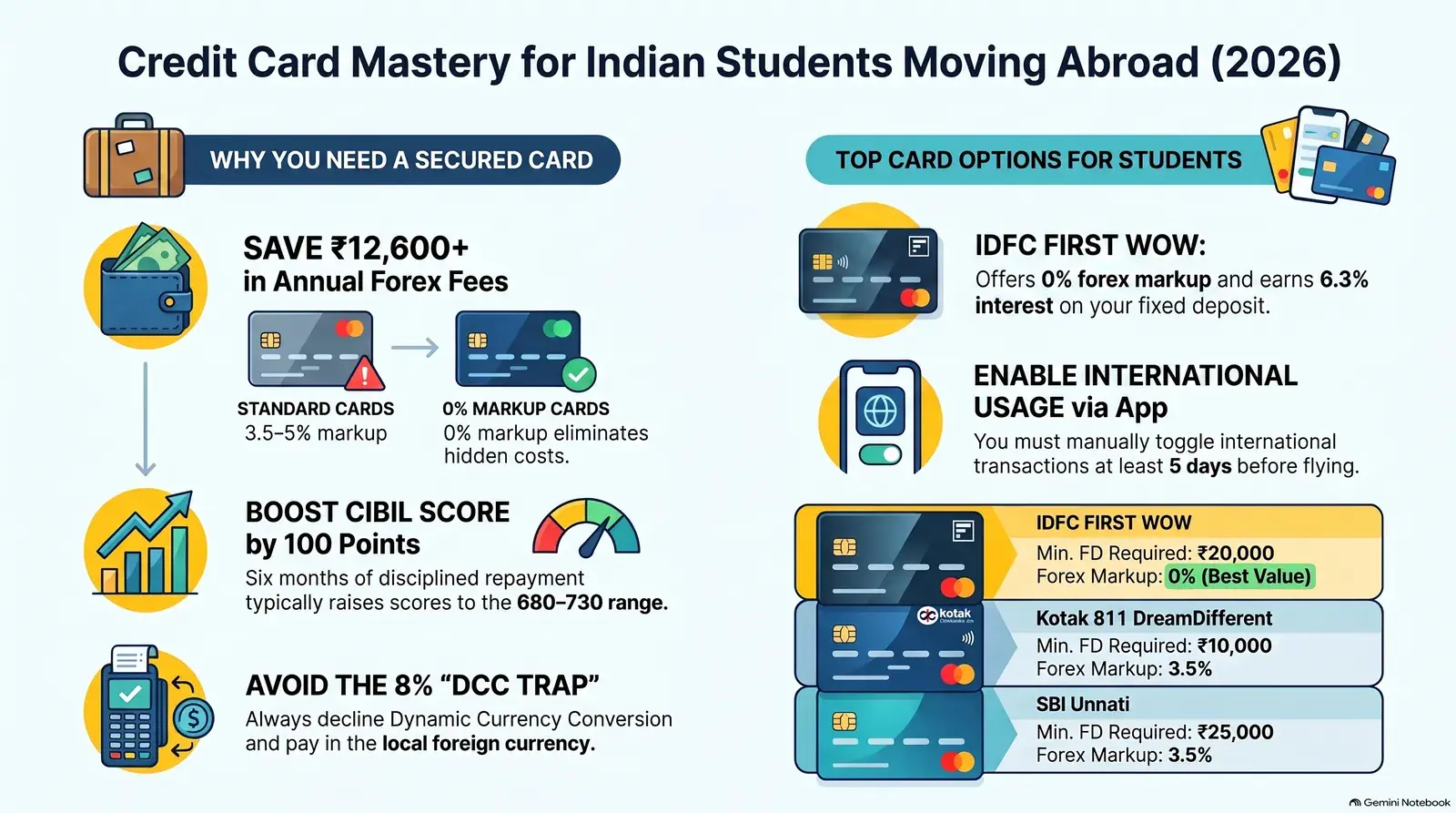
- IDFC FIRST WOW is the best FD-backed card for students going abroad: It is the only FD-backed secured card with zero forex markup and is lifetime free, making it the cheapest card for international spending.
- Add-on cards build your CIBIL score too: If your parent holds a credit card from HDFC, ICICI, SBI, or Axis, getting an add-on card in your name is the fastest path to a credit history with no FD required.
- No TCS on credit card spending abroad: Unlike debit card remittances above ₹10 lakh, international credit card transactions are currently not subject to TCS under the Liberalised Remittance Scheme (LRS).
IDFC FIRST WOW — 0% forex markup, ₹20,000 min FD, lifetime free
Kotak 811 #DreamDifferent — ₹10,000 FD, 90% credit limit
Add-on card on parent's HDFC/ICICI account — no FD, no income proof needed
6–9 months of full repayment + under 30% utilisation
Why Do Indian Students Get Rejected for Regular Credit Cards — and Why Does It Still Matter?
Indian banks reject most student credit card applications because the two primary eligibility criteria — a salary slip proving regular income and an existing CIBIL score above 700 — are almost always absent in a student profile. Without either, a conventional card is out of reach, and the consequence is not just inconvenience. Students who land abroad with only a debit card or UPI-linked account face a series of practical problems that an Indian debit card cannot solve.
Foreign airline websites (Emirates, Qatar Airways, British Airways) and property booking platforms (Booking.com, Airbnb) often require a credit card for holds and pre-authorisations. A debit card may fail 3D-Secure (3DS) authentication if your bank's OTP system blocks cross-border mandates. Even where a debit card is accepted, your bank will charge a forex markup of 2.5–3.5% plus GST on every foreign-currency transaction — costs that add up fast on a student budget. A student spending a representative ₹30,000 per month abroad would pay roughly ₹12,600 per year in forex markup on a standard 3.5% markup card. A zero-markup credit card eliminates that cost entirely.
Beyond spending convenience, credit history built in India follows you abroad. Irish banks, UK banks, and EU lenders do not accept CIBIL scores, but showing a clean repayment record on an Indian credit card demonstrates financial discipline to future lenders and employers. Starting six months before departure gives you enough time to hit 700+ before you fly.
What Are FD-Backed Secured Credit Cards and How Do They Work?
An FD-backed (or secured) credit card is issued against a Fixed Deposit you place with the bank. The bank places a lien on the FD as collateral and issues a credit card with a limit of 75%–100% of the FD amount. Your FD continues to earn interest throughout — typically 6–7% per annum — while the card functions like a normal Visa or Mastercard credit card on OTAs, airline websites, and foreign POS terminals.
Because the bank holds your money as security, no income proof, no salary slip, and no prior CIBIL score are required. Approval is near-guaranteed, making these cards the standard first-credit-card route for students, fresh graduates, and self-employed individuals. The bank reports your monthly repayment behaviour to TransUnion CIBIL, so responsible use builds your score exactly like any unsecured card.
The bank places a lien — not a freeze — on your FD. The deposit continues earning the agreed interest rate. For example, a ₹25,000 FD at 6.5% per annum earns approximately ₹1,625 over 12 months, partially offsetting any annual fee. When you close the card and the lien is lifted, you receive the full FD principal plus accrued interest.
SBI Unnati vs ICICI Instant Platinum vs Axis Insta Easy vs IDFC FIRST WOW vs Kotak 811: Which Secured Card Is Best for Students Going Abroad?
The five most widely available FD-backed credit cards in 2026 differ significantly on forex markup, credit limit percentage, annual fee structure, and reward earning — making the right choice heavily dependent on whether you plan to use the card internationally. The comparison table below covers the exact figures as published on each bank's official website in August 2026.
| Card | Min FD | Credit Limit | Annual Fee | Forex Markup | Reward Rate (International) | Best For |
|---|---|---|---|---|---|---|
| SBI Unnati | ₹25,000 | ~85% of FD | Free (4 yrs), ₹499 from yr 5 | 3.5% + GST | 1 RP / ₹100 | Domestic use; SBI relationship |
| ICICI Instant Platinum | ₹20,000 | ~85% of FD | Lifetime free (with FD) | 3.5% + GST | 2 RP / ₹100 | ICICI existing customers |
| Axis Insta Easy | ₹20,000 | 80% of FD | Lifetime free | 3.5% + GST | 12 RP / ₹200 intl spend | Dining discounts; Axis customers |
| BESTIDFC FIRST WOW | ₹20,000 | 100% of FD | Lifetime free | 0% (zero markup) | 4X RP on all spends | Students going abroad; best overall |
| Kotak 811 #DreamDifferent | ₹10,000 | 90% of FD | Free (limit ≥₹18,000); ₹250 below | 3.5% + GST | 4 RP / ₹100 (online) | Lowest FD requirement |
The IDFC FIRST WOW stands apart as the only secured card with zero forex markup on international transactions. For a student spending ₹30,000 per month abroad, this saves approximately ₹12,600 per year compared to a standard 3.5% markup card (3.5% of ₹3,60,000 annual international spend = ₹12,600). The FD earns 6.3% per annum interest, partially making the deposit itself a productive asset.
💸 Forex Markup Cost Calculator
See how much your choice of secured card costs you in forex markup per year. Based on the 3.5% markup charged by SBI Unnati, ICICI Instant Platinum, Axis Insta Easy, and Kotak 811 versus the 0% markup on the IDFC FIRST WOW.
On-the-Ground Insight: "I applied for three regular credit cards in my final semester at IIT Bombay and got rejected every time — no income, no history. A month before departure, I opened an IDFC FIRST savings account and got the WOW credit card against a ₹25,000 FD. It was the only card that didn't charge me extra when I booked my Ryanair hop from Dublin to Edinburgh in December. By April, my CIBIL had moved from zero to 712." — Priya M., MSc Data Analytics, Technological University Dublin, September 2025 Intake
How Does an Add-On Card on Your Parent's Account Help Build Credit?
An add-on (or supplementary) credit card is a physical Visa or Mastercard issued in your name against a parent's existing credit card account, with no income proof, no credit check, and no separate FD required from you. Most major Indian banks — including HDFC Bank, ICICI Bank, SBI Card, and Axis Bank — allow the primary cardholder to request up to three add-on cards for immediate family members aged 18 and above.
The mechanics are straightforward: the add-on card shares the primary card's credit limit, all transactions are billed to the primary cardholder (your parent), and — crucially — the bank reports the add-on cardholder's repayment behaviour to CIBIL separately. Responsible use, meaning full payments before the due date and utilisation below 30% of the shared limit, builds your CIBIL score just as a standalone card would.
Not all banks report add-on cardholder behaviour to CIBIL separately — verify this with your parent's bank before relying on it for credit building. The shared limit means your spending reduces the parent's available credit. Some banks set a lower sub-limit for add-on cards. Forex markup on an add-on card mirrors the primary card — if the parent holds an HDFC Infinia or Axis Atlas, the add-on inherits its zero or low forex rate; if they hold a basic card at 3.5%, so do you.
The add-on card route is particularly well-suited for students whose parents already hold a mid-tier or premium travel card. An add-on on an Axis Atlas or Magnus inherits zero forex markup and EDGE mile earning, effectively giving you a premium travel card without meeting the income threshold yourself.
What Student-Friendly Fintech Cards Are Available Without Income Proof in 2026?
Several fintech platforms have launched credit or buy-now-pay-later products in 2026 that approve applicants with minimal income documentation, though most are technically pay-later facilities rather than full credit cards reported to CIBIL. Understanding the distinction matters for anyone prioritising credit building over spending convenience.
Slice — now part of North East Small Finance Bank — offers limits between ₹10,000 and ₹2,00,000 for applicants with no prior credit history. Approval is often within 24 hours via Aadhaar eKYC. However, Slice's product functions as a revolving credit facility; confirm whether your issued variant reports to CIBIL before treating it as a full credit card substitute. OneCard also offers an FD-backed variant (minimum FD amount varies by city) and a spend-based unsecured variant for individuals with some transaction history. The OneCard metal card is a Visa product with 5X rewards on top two spending categories and 1% forex markup — lower than most traditional secured cards but not zero.
For a student whose sole goal is CIBIL building before departure, a traditional FD-backed card from a scheduled bank (IDFC FIRST, SBI, ICICI, Axis, Kotak) is safer: CIBIL reporting is well-established, dispute resolution is regulated by the Reserve Bank of India (RBI), and the card is accepted on all airline and OTA platforms without the payment-gateway compatibility questions that occasionally affect newer fintech cards.
How Do You Build a CIBIL Score in 6 Months Before Departure?
A student with a thin or zero CIBIL file can realistically reach 700 within six months by following four consistent habits: paying the full statement balance every month, keeping credit utilisation under 30%, avoiding multiple credit applications, and not closing the card before departure. Most students see a 50–100 point improvement in the first six months of clean behaviour.
CIBIL weighs five factors: payment history (35%), credit utilisation (30%), length of credit history (15%), credit mix (10%), and new enquiries (10%). For a student with a single secured card, payment history and utilisation together control 65% of the score. Keeping your outstanding balance below 30% of your credit limit at the time your bank reports to CIBIL — typically at statement date — is the single fastest lever available. On a ₹20,000 credit limit (IDFC WOW on a ₹20,000 FD), this means keeping your balance at or below ₹6,000 at any point during the month.
Month 1–2: Open FD-backed card. Make one or two small purchases (groceries, Zomato). Pay full balance 3 days before due date. CIBIL file opens; initial score may appear as –1 (no history) until first report cycle. Month 3–4: Continue paying in full. Utilisation steady under 30%. Score typically moves from –1 to 620–680. Month 5–6: Score typically reaches 680–730 range. Keep the card active with at least one transaction per month to avoid it being treated as dormant.
Paying only the minimum due (leaves utilisation high), applying for multiple cards in a single month (hard enquiries drop your score), and closing the FD card before departure (shortens credit history). Leave the card open even while abroad — one small recurring charge (a streaming subscription billed to India) keeps it active.
How Do You Enable Your Indian Credit Card for International Transactions Before Flying Abroad?
All major Indian banks require you to explicitly enable international transaction capability before your card will work at foreign POS terminals, on foreign airline websites, or on international OTAs. Without enabling this, your card will decline even if funds and credit are available — a common and frustrating experience for first-time travellers.
The process differs by bank but is uniformly available via mobile banking app:
HDFC Bank: NetBanking → Cards → Request → Enable International Transactions. You can set a daily limit separately. ICICI Bank: iMobile app → Cards → Manage Card → International Usage → Enable. SBI Card: SBI Card app → Card Controls → Enable International Transactions. The toggle is under "Manage Card". IDFC FIRST Bank: IDFC FIRST Bank app → Cards → Card Controls → Toggle "International Transactions" to On. Axis Bank: Axis Mobile app → Credit Cards → Card Controls → International Usage.
Some banks have a 24–48 hour activation window before international transactions go live. If you try to enable on the day of travel, your first airport lounge access or airline seat upgrade may fail. Also check whether your bank has set a per-transaction limit for international use — the default at some banks is ₹20,000 per transaction, which will block a ₹40,000 one-way flight purchase.
The DCC Trap: Why You Should Never Pay in INR Abroad
Dynamic Currency Conversion (DCC) is a scheme used by foreign merchants and ATMs to offer Indian cardholders the option to pay in Indian Rupees instead of the local currency — at an exchange rate that typically includes a hidden markup of 4%–8% above the mid-market rate. Declining DCC and paying in local currency always saves money.
At a Dublin restaurant, for example, a €50 bill might be presented as ₹4,850 under DCC using a poor conversion rate when the actual mid-market equivalent is closer to ₹4,600. The merchant's acquirer bank pockets the 5% difference. On top of this, your Indian bank then applies its own 3.5% forex markup on the local-currency transaction — making the true total cost of DCC up to 8–10% above the mid-market rate.
The rule is simple: whenever a foreign POS terminal, ATM screen, or online checkout asks "Pay in INR or local currency?", always choose local currency (EUR, GBP, USD, etc.). If using the IDFC FIRST WOW card — which has zero forex markup — declining DCC means you pay at the true mid-market Visa rate with no additional cost whatsoever.
ATM operators in Europe and the UK frequently prompt DCC. The machine says "We will convert the amount to INR for your convenience — do you accept this conversion?" The word "convenience" is misleading. Always press "Decline" or "Proceed without conversion" or "Pay in local currency." The wording varies by machine but the right choice is always to decline the offered INR rate.
Which FD-Backed Card Works Best for Flight Bookings and OTA Offers?
All five FD-backed credit cards in this guide are Visa or Mastercard network cards and are accepted on major OTAs including MakeMyTrip, EaseMyTrip, Yatra, Cleartrip, and ixigo, as well as directly on airline websites such as Emirates, Qatar Airways, IndiGo, and Air India. The practical differences lie in rewards, OTA-specific discounts, and forex costs on international bookings.
The IDFC FIRST WOW offers 30 bonus reward points per flight booking made through the IDFC FIRST Bank mobile app (with 1 RP redeemable for ₹0.50 on travel via the app). On a ₹40,000 international flight booking, this earns 30 bonus RPs worth ₹15, which is modest — but the zero forex markup saves ₹1,400 on the same transaction. The reward arithmetic strongly favours the zero-markup card for international purchases.
The Axis Insta Easy earns 12 reward points per ₹200 on international spend (equivalent to a 3% return in EDGE points) — but after paying 3.5% forex markup plus GST, the net cost is still negative versus a zero-markup card. For domestic OTA bookings where forex markup does not apply, the Axis Insta Easy's dining discounts (minimum 15% off at partner restaurants) and accelerated earn rate on domestic spend make it a reasonable domestic-only pairing alongside a zero-markup card for travel abroad.
Is There TCS on International Credit Card Spending Abroad?
No — as of August 2026, international credit card spending is not subject to Tax Collected at Source (TCS) under the Liberalised Remittance Scheme (LRS). The RBI and CBDT have not brought credit card transactions within the LRS framework, meaning that whether you spend ₹5 lakh or ₹25 lakh on your credit card abroad in a financial year, no TCS is collected at source by the bank.
TCS does apply to other cross-border outflows. Wire remittances and forex card loads above ₹10 lakh per financial year attract 20% TCS under LRS (raised from the earlier ₹7 lakh threshold by the Finance Act 2025). Education remittances via a specified Indian education loan attract 0% TCS. Self-funded education remittances above ₹10 lakh attract 2% TCS per Budget 2026 rules (reduced from the earlier 5%). None of these TCS provisions apply to international credit card swipes — confirmed by the Income Tax Department of India and RBI circulars.
Credit card spend abroad: 0% TCS (not under LRS). Debit card / forex card loads / wire remittances above ₹10 lakh per financial year: 20% TCS. Self-funded education remittances above ₹10 lakh: 2% TCS. Education via specified Indian loan: 0% TCS. TCS paid is claimable as a tax credit in your annual ITR filing.
True Annual Card Cost = Forex Markup (% × Annual Spend) + Annual Fee − FD Interest Earned
Example: A student spending ₹3,60,000 annually abroad on an SBI Unnati card: 3.5% markup = ₹12,600 + ₹0 fee (year 1) − ₹1,625 FD interest (₹25,000 @ 6.5%) = net cost ₹10,975 per year. The same spend on IDFC FIRST WOW: 0% markup = ₹0 + ₹0 fee − ₹1,575 FD interest (₹25,000 @ 6.3%) = net gain ₹1,575 per year.
What Is the Transition Plan from a Secured Card to a Premium Travel Card After Your First Job?
Once you have six months of full repayment history on your secured card and a CIBIL score above 700, you become eligible to apply for entry-level unsecured travel cards — and your secured card's track record is the strongest possible application support you can present.
The natural upgrade sequence for most India-origin students returning after a year or two abroad is: apply for an unsecured card shortly before or after your first salary credit. Target cards suited to frequent India–Europe or India–UK flyers. Good entry points in 2026 include the ICICI Bank Sapphiro (2% forex markup, 4 reward points per ₹100, priority pass lounge access), the Axis Bank Neo or MY ZONE as an EDGE Miles starter, or the Niyo Global card (zero markup, no income proof but debit not credit) as a bridge card while your credit application clears.
When you move to a premium card, keep your secured card open — do not close it. Closing a card shortens your average credit age, which reduces your CIBIL score by 15–30 points. Place one small recurring charge (a ₹149 OTT subscription, for example) on the secured card to keep it active, set a standing instruction for auto-repayment, and let it age quietly in the background. The FD can be retained or broken once the bank's lien release process is complete; most banks allow this 30 days after closure of the card account.
Frequently Asked Questions
Do FD-backed credit cards build CIBIL score?
Yes. Because the bank reports your repayment behaviour to CIBIL each month, responsible use of an FD-backed card builds your score exactly like any other credit card. Paying the full statement balance before the due date and keeping utilisation under 30% typically improves a thin-file score by 50–100 points in six months.
Is there TCS on international credit card spending?
No. As of August 2026, the RBI and CBDT have not brought international credit card spending under LRS. TCS does not apply to credit card transactions made abroad. TCS applies to wire remittances, debit card swipes, and forex card loads above ₹10 lakh per financial year under the Liberalised Remittance Scheme.
Which FD-backed card has zero forex markup?
The IDFC FIRST WOW Credit Card is the only major FD-backed secured card in India that charges zero forex markup on international transactions as of 2026. All other secured cards (SBI Unnati, ICICI Instant Platinum, Axis Insta Easy) typically charge 3.5% plus GST on foreign currency transactions.
Can I book flights on OTAs with a secured credit card?
Yes. FD-backed secured credit cards from SBI, ICICI, Axis, IDFC FIRST, and Kotak are Visa or Mastercard-network cards and are accepted on all major OTAs including MakeMyTrip, Cleartrip, Yatra, and EaseMyTrip, as well as directly on airline websites.
What FD amount do I need for an IDFC FIRST WOW Credit Card?
The IDFC FIRST WOW Credit Card requires a minimum Fixed Deposit of ₹20,000 with IDFC FIRST Bank. Your credit limit equals your FD amount (100% of the deposit). The FD earns 6.3% per annum interest while serving as collateral.
Ready to book your flight to Dublin or London? Check live fares first.
Compare Dublin–India fares across Qatar Airways, Emirates, and Etihad — and pay with your new zero-markup card for maximum savings.
All card fees, FD minimums, forex markup rates, and reward structures are based on information published on official bank websites in August 2026. RBI regulations and TCS rules are subject to change; verify current rules on rbi.org.in and incometaxindia.gov.in. MyFlightOffers is not affiliated with any bank mentioned in this article. This article does not constitute financial or tax advice.
- NEW Niyo Global vs Wise vs Bank Forex Cards 2026 — zero-markup card comparison for students spending abroad
- Card Tokenization for Flight Bookings India 2026 — how the RBI's tokenization rules affect OTA payments and what to do when cards fail
- Best ICICI Bank Credit Cards for Flights and Travel 2026 — upgrade path from secured to ICICI Sapphiro and beyond
- How to Transfer Indian Credit Card Points to Airline Miles 2026 — once you have reward points, here is how to move them to Emirates Skywards or Vistara