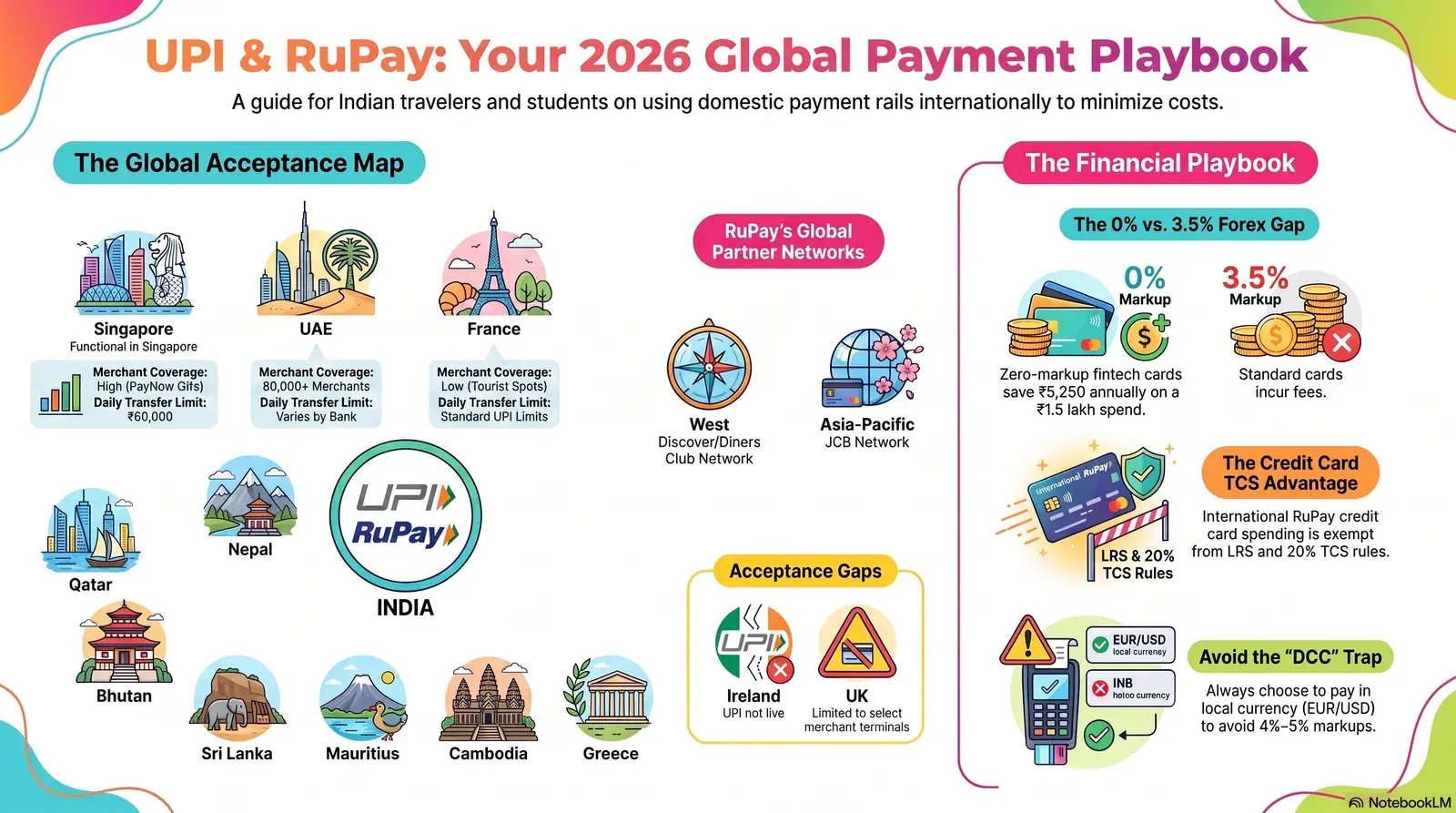
- UPI works in ~10 countries as of August 2026 (Singapore, UAE, France, Qatar, Nepal, Sri Lanka, Bhutan, Mauritius, Cambodia, Greece) but merchant coverage inside those countries is still patchy. Ireland and most of mainland Europe are not covered.
- RuPay forex markup is set by your issuing bank, not NPCI — ranging from 0% (zero-markup fintechs) to 3.5% (legacy bank forex cards). On a typical ₹1.5 lakh student spend abroad, the difference between 0% and 3.5% costs you ₹5,250 a year.
- International credit card spend is not under LRS (per CBDT Circular No. 10/2023, still in force August 2026), so no TCS applies when you use your Indian RuPay credit card abroad.
~10 countries — Singapore, UAE, France, Qatar, Nepal, Bhutan, Sri Lanka, Mauritius, Cambodia, Greece
Discover / Diners Club (Americas, Europe) and JCB (Asia-Pacific, Japan). Only "Global" or "International" variant cards work abroad.
Not live. Ireland is outside the Schengen UPI rollout and has no NPCI bilateral agreement as of August 2026.
MakeMyTrip: 10% off up to ₹7,500 on international flights ≥₹20,000 with Axis Bank RuPay card. EaseMyTrip: up to ₹5,000 off with RuPay Credit on UPI.
1. RuPay's Global Footprint: Discover, JCB, and Which Cards Actually Work Abroad
RuPay credit and debit cards can be used internationally, but only on specific card variants issued on partner networks — not every RuPay card in your wallet qualifies. The National Payments Corporation of India (NPCI) has signed two key international partnerships that underpin RuPay's global reach.
The first is with Discover Global Network, which includes the Discover, Diners Club International, and PULSE networks. This opens acceptance at over 42.4 million point-of-sale terminals and 1.9 million ATMs in more than 200 countries on paper — though the practical coverage (meaning: terminals where Indian RuPay-Discover cards actually go through without a decline) is meaningfully narrower, particularly in southern and eastern Europe and parts of Latin America.
The second is with Japan Credit Bureau (JCB), which gives RuPay JCB Global cardholders acceptance at JCB-enabled merchants. JCB is particularly strong in Japan, South Korea, China, Thailand, and Hong Kong — the RuPay JCB pairing is therefore well-suited for students and travellers heading to East and Southeast Asia, and JCB lounges at airports in Tokyo, Osaka, Shanghai, Hong Kong, Singapore, Dubai, and Bangkok are accessible to eligible cardholders.
Only cards explicitly labelled as "RuPay Global", "RuPay International", "RuPay Select", or "RuPay Platinum" with the Discover or JCB co-brand mark on the card face are enabled for international POS, ATM, and e-commerce transactions. A standard domestic RuPay debit card (issued for Jan Dhan accounts, for example) will be declined at any foreign terminal. Check the card face and your bank's mobile app before travelling.
In practical terms, NPCI International has confirmed bilateral bilateral acceptance live in Nepal, UAE, France, Bhutan, Mauritius, and Sri Lanka — countries where RuPay has dedicated acceptance infrastructure rather than relying solely on the Discover/JCB pass-through. In these markets, merchants may display a RuPay logo alongside Visa and Mastercard, and acceptance rates are materially higher than elsewhere in the Discover network.
2. UPI International 2026: The 10-Country Map (And What "Live" Actually Means)
As of August 2026, UPI is officially operational for outbound Indian travellers in approximately 10 countries, with the depth of merchant acceptance varying significantly from market to market. The expansion target confirmed by NPCI is 20+ countries by FY2029.
| Country | Status (Aug 2026) | Key Partnership | Merchant Coverage | Transfer Limits |
|---|---|---|---|---|
| Singapore | ✔ Live (most mature) | MAS / PayNow linkage | High — most PayNow QR codes work | ₹60,000/day from India; SGD 1,000/day from SG |
| UAE | ✔ Live | Mashreq / NEOPAY, AANI | 60,000+ retail merchants, metro stations, Dubai & Abu Dhabi | Varies by bank |
| Bhutan | ✔ Live | Royal Monetary Authority of Bhutan | High — UPI/RuPay widely used | Standard UPI limits |
| Nepal | ✔ Live | Nepal Rastra Bank | Moderate | Standard UPI limits |
| Sri Lanka | ✔ Live | LankaPay | Moderate | Standard UPI limits |
| France | ✔ Live (limited) | Lyra Network | Low — select tourist & retail outlets | Standard UPI limits |
| Qatar | ✔ Live | QNB | Moderate — airports, malls | Standard UPI limits |
| Mauritius | ✔ Live | Mauritius Commercial Bank | Moderate | Standard UPI limits |
| Cambodia | ✔ Live | BAKONG / NBC | Moderate | Standard UPI limits |
| Greece | ✔ Live (limited) | Local acquirer partnerships | Low — tourist areas only | Standard UPI limits |
| Malaysia | ⚠ MoU signed, not live | PayNet Malaysia | Not yet operational | TBA |
| Japan | ⚠ Trial from Apr 2026 | JCB / Bank of Japan | Pilot phase — limited outlets | TBA |
| Ireland | ✘ Not available | No bilateral agreement | Zero | N/A |
| UK | ⚠ Partial (PayXpert PoS only) | PayXpert Android PoS devices | Very limited — select merchant terminals | N/A |
Singapore: UPI-PayNow — The Most Mature Cross-Border Link
Singapore remains the gold standard for UPI international functionality, with the UPI-PayNow linkage now covering 19 Indian banks and operating 24x7 in real time. From India, you can send up to ₹60,000 per day (approximately SGD 970 at mid-August 2026 rates) to any PayNow-registered mobile number or Singapore bank account. From Singapore, the limit is SGD 1,000 per day. On the merchant side, most QR codes displaying the PayNow mark are compatible with Indian UPI apps, making Singapore the closest thing to a seamless UPI experience outside India.
UAE: 60,000+ Merchants via Mashreq and AANI
The UAE is the most commercially significant UPI market outside South Asia, with over 60,000 retail merchant locations enrolled through the Mashreq Bank NEOPAY and AANI network integration across Dubai and Abu Dhabi. This includes supermarkets, dining venues, and metro stations. Travellers in Dubai generally report a reliable payment experience for everyday spending, though carry a backup Visa or Mastercard for smaller outlets that have not yet enabled UPI QR.
France and the Eurozone: Lyra Network and the Gaps
France is the only eurozone country where UPI is live, running through a partnership with the Lyra payment network, but merchant penetration remains low compared to the UAE or Singapore. Expect acceptance at select tourist and retail locations in Paris and major cities. The rest of the eurozone — including Ireland, Germany, Spain, Italy, and the Netherlands — has no UPI acceptance as of August 2026.
3. How RuPay Credit Cards Work on UPI for International Payments
RuPay credit cards can be linked to UPI apps (Google Pay, PhonePe, Paytm, BHIM) just like a bank account, allowing you to pay via QR scan in any country where UPI merchant acceptance is live — and earn your card's reward points on every transaction. This is a feature unique to RuPay within the UPI ecosystem; Visa and Mastercard credit cards cannot be linked to UPI in the same way.
The link-up process is straightforward: open your UPI app, select "Add Credit Card", and follow the OTP-based verification using your RuPay credit card details. Once linked, when you scan a UPI QR code abroad (in Singapore or UAE, for example), you choose your RuPay credit card as the payment source instead of a bank account. The app converts the foreign currency amount at the prevailing exchange rate, debits your credit line in rupees, and the overseas merchant receives their local currency — all within seconds.
RuPay credit cards on UPI cannot be used for peer-to-peer transfers — you cannot send money to a friend's mobile number or personal UPI ID from a credit card. The credit card option is restricted to merchant QR payments only. For remittances or peer transfers, you must use your linked bank account.
By August 2026, RuPay credit cards on UPI have crossed 100 million active users in India. The milestone reflects the fact that UPI is the dominant checkout method for online transactions in India, and RuPay's integration means cardholders earn reward points on even small UPI transactions — something Visa and Mastercard holders cannot do on the same rails. The practical implication for international travellers: if you are going to Singapore or UAE, bringing a RuPay credit card that is UPI-linked means you can pay merchants via QR and accumulate rewards on every transaction.
On-the-Ground Insight: "I was at a supermarket in Dubai last October and just held up my PhonePe QR scanner. It went through instantly — same experience as India. But when I tried the same thing at a coffee shop in Paris, the terminal said UPI but the transaction timed out twice before I gave up and used my Wise card." — Priya S., MSc Data Science, TU Dublin, September 2025 intake
4. Can I Use UPI in Ireland in 2026?
No. As of August 2026, UPI is not live in Ireland or anywhere else in the eurozone except France (via the Lyra network with limited merchant coverage). Ireland has no bilateral payment agreement with NPCI International, and there is no announced timeline for one. For payments in Ireland, Indian students need a local Irish bank account, a Wise card, or a Revolut account from day one.
For students arriving in Dublin, Cork, or Galway, the payment setup must be done before departure or within the first week of arrival. Irish merchants universally accept Visa and Mastercard (contactless and chip), and many also accept Google Pay and Apple Pay. However, the underlying account must be a European IBAN — your Indian UPI-linked account will not appear as a valid payment method.
Even if your RuPay card carries the Discover/Diners co-brand, Irish ATM acceptance is unreliable. Most Bank of Ireland, AIB, and EBS ATMs in Ireland run on the Visa/Mastercard interchange rails. Some decline RuPay-Discover cards with a generic "card not accepted" error. Do not rely on a RuPay debit card as your primary cash strategy in Ireland — carry a zero-forex card like Niyo Global, Wise, or Revolut as your primary spending instrument.
The UK is marginally better than Ireland. NPCI International partnered with PayXpert to enable UPI and RuPay acceptance on PayXpert Android PoS devices across select UK merchants. However, PayXpert's merchant network is small, and for most practical purposes, a UPI QR payment in London is not a reliable option in 2026. Students at UK universities face the same reality: you need a UK bank account or a Wise/Revolut card.
5. RuPay Forex Markup vs Visa and Mastercard: The True Cost Comparison
RuPay does not impose a network-level forex surcharge on international transactions — the issuing bank sets the markup, which ranges from 0% on zero-markup fintech cards to 3.5% on standard bank forex cards. This is identical in structure to Visa and Mastercard, where the network charges nothing and the bank charges 1.5%–3.5% depending on the product.
| Payment Method | Network | Forex Markup | LRS Applicable? | UPI-Linkable? | Best For |
|---|---|---|---|---|---|
| Niyo Global Card | Visa (DCB/SBM) | 0% | Yes (debit — counts under LRS) | No | Zero-cost spending abroad |
| Wise Travel Card | Visa/Mastercard | 0% (+ small conversion fee) | Yes (debit) | No | 40+ currencies, interbank rate |
| Standard RuPay credit card | RuPay (Discover/JCB) | 1.5%–2% (bank-set) | No (credit card spending excluded) | Yes (for UPI QR payments) | Reward earning via UPI in UAE/SG |
| Premium Visa/MC credit card | Visa / Mastercard | 0%–2% (card-specific) | No (credit card excluded) | No | Wide international acceptance |
| Legacy bank forex card | Visa / Mastercard | Up to 3.5% | Yes (debit — counts under LRS) | No | Pre-loaded fixed-rate budgeting |
| UPI (bank account debit) | UPI / NPCI rails | 0.5%–1.5% (bank conversion) | Yes (debit — counts under LRS) | Native (bank account) | QR payments in live UPI countries |
On a typical student's annual international spend of ₹150,000 (approximately €1,620 at mid-August 2026 rates), the difference between a zero-markup card and a 3.5% legacy card is ₹5,250 per year — enough to cover a month's groceries in Dublin. Use the calculator below to see the numbers for your own spend level.
🧮 Forex Markup Cost Calculator
Enter your estimated annual international spend in rupees to see how much different forex markup rates cost you — and the savings from switching to a zero-markup card.
6. Booking Flights with RuPay Cards: OTA Offers, DCC Traps, and the PoS Playbook
RuPay credit cards work on most Indian Online Travel Agencies (OTAs) and, if carrying the Discover or JCB co-brand, on most international airline websites — but activating international transactions and avoiding the DCC trap are non-negotiable steps before you book.
OTA Offers: MakeMyTrip and EaseMyTrip RuPay Deals in 2026
Both major Indian OTAs have run recurring RuPay promotional offers in 2026. MakeMyTrip ran a flat 10% instant discount of up to ₹7,500 on international flights with a minimum booking value of ₹20,000 using Axis Bank RuPay credit cards (coupon code MMTRUPAYCCINT, valid Fridays through Sundays between March and May 2026). EaseMyTrip has offered up to ₹5,000 off on flight bookings when paying with RuPay Credit on UPI. These offers refresh periodically — check the respective offer pages before every booking.
True Cost = Base Fare + Extra Baggage (if restricted allowance) + Forex Markup Fee
Enabling International Transactions (OTP / e-mandate step)
Before booking on any foreign airline website with a RuPay card, you must enable international transactions in your bank's mobile app — failure to do this is the single most common reason for declined transactions on HDFC, ICICI, SBI, and Axis RuPay cards. Navigate to the Card Settings section of your banking app, find "International Transactions" or "Overseas Usage", and toggle it on. Some banks (notably SBI and Bank of Baroda) require a branch visit or IVR call to enable it; HDFC, ICICI, and Axis allow self-service via mobile banking. Do this at least 24 hours before booking to ensure the setting propagates.
The DCC Trap: Always Pay in Local Currency
Dynamic Currency Conversion (DCC) is one of the most expensive payment mistakes Indian travellers make when booking on foreign airline or hotel websites. When a foreign merchant website or payment gateway detects your Indian card and offers to charge you in Indian rupees rather than the local currency (USD, EUR, GBP), it is applying DCC — typically at a markup of 4%–8% above the mid-market exchange rate. This markup sits on top of your bank's own forex markup, compounding the cost significantly.
The fix is simple: always choose to pay in the merchant's local currency (EUR for European airlines, GBP for British airlines, USD for American carriers). Your Indian bank's forex rate — while not interbank — is almost always cheaper than the rate baked into DCC. On a ₹50,000 flight booking, avoiding DCC can save you ₹2,000–₹4,000 in hidden charges.
Point-of-Sale (PoS) Price Arbitrage for Smarter Bookings
Some airlines show different fares depending on which regional version of their website you use. Air France, for example, may price the same Dublin–Paris route differently on its UK site (in GBP), its Indian site (in INR), and its French site (in EUR). If you have a zero-forex card with no currency restriction, you can check multiple regional sites and book from whichever shows the lowest true cost. A Wise card or Niyo Global card makes this straightforward because there is no forex markup to add to the calculation.
7. LRS, TCS, and RuPay International: What the 2026 Rules Actually Say
International credit card spending abroad — including on RuPay credit cards — does not count under the Liberalised Remittance Scheme (LRS) as of August 2026, per CBDT Circular No. 10/2023, whose deferral remains in force. This means no Tax Collected at Source (TCS) applies when you use your Indian RuPay credit card at a foreign merchant or book on a foreign airline website.
The picture is different for debit cards and forex cards. Spending on a Niyo Global, Fi Money, or any bank debit card abroad counts toward your annual LRS limit of USD 250,000 per financial year (April to March). The TCS structure under the revised 2026 rules (effective 1 April 2026) is:
| Transaction Type | TCS Rate (above ₹10 lakh threshold) | Threshold |
|---|---|---|
| International credit card spend abroad | Nil — excluded from LRS | N/A (CBDT Circular 10/2023) |
| Self-funded education remittances (LRS) | 2% | Above ₹10 lakh / financial year |
| Other LRS remittances (debit/forex card abroad) | 20% | Above ₹10 lakh / financial year |
| Overseas tour packages | 2% flat | No threshold |
| Standalone airline tickets (booked directly) | Nil | Never applied |
Source: Reserve Bank of India (RBI) LRS guidelines and Finance Act 2026 (effective 1 April 2026). The TCS-free threshold for most LRS categories remains at ₹10 lakh per financial year, raised from ₹7 lakh under the Finance Act 2025. TCS paid is fully creditable against your income tax liability at year-end — it is a cash-flow cost, not a permanent expense.
When you pay at a Singapore or UAE merchant using UPI linked to your bank account (not a credit card), that spend is a debit-card-equivalent transaction and counts toward your ₹10 lakh LRS threshold. For most students, whose total overseas spend is well below ₹10 lakh, TCS is not triggered. However, if your family is also remitting funds for tuition or rent, aggregate all LRS outflows carefully — the ₹10 lakh is per-individual, not per-purpose.
8. The Road Ahead: UPI in 20+ Countries by FY2029
NPCI International has confirmed a target of 20+ countries by the end of FY2029, with bilateral "pipes" to seven or eight markets already live and a further 12–15 in various stages of negotiation and testing as of mid-2026.
The markets most likely to go live in the next 12–24 months include Malaysia (MoU already signed as of February 2026 but operational date pending), Japan (JCB trial commenced April 2026), Saudi Arabia, and Thailand (which moved from pilot to wider acceptance through the UPI-PromptPay linkage in mid-2026). NPCI has described its bilateral expansion strategy as building one "pipe" at a time, each requiring a dedicated central bank agreement, local partner acquirer integration, and regulatory approval on both sides — an 18–36 month process per country on average.
For Ireland and the broader eurozone outside France, the outlook is longer term. The European Payments Initiative (EPI) is building its own pan-European instant payment system, and NPCI would need to negotiate with EPI rather than individual central banks. That path is plausible by the late 2020s, but for the class of 2026 arriving in Dublin or Cork, UPI will not be available during their one-year master's programme.
On the RuPay side, the expansion of the Discover Global Network acceptance footprint — particularly in Europe — is progressing but unevenly. RuPay JCB cardholders travelling to Japan will benefit from the April 2026 trial, which targets tourist areas in Tokyo and Osaka first. For the Indian diaspora in the Gulf, acceptance in the UAE is already comprehensive enough to make RuPay a viable primary card for day-to-day spending.
Frequently Asked Questions
Can I use UPI in Ireland in 2026?
No. As of August 2026, UPI is not live in Ireland or anywhere else in the eurozone except France (via the Lyra network with limited merchant coverage). For payments in Ireland, Indian students need a local Irish bank account, a Wise card, or a Revolut account.
Which countries accept UPI payments in 2026?
As of August 2026, UPI is live in approximately 10 countries: Singapore, UAE, Bhutan, Nepal, Sri Lanka, France, Mauritius, Qatar, Cambodia, and Greece. Thailand moved from pilot to wider acceptance in mid-2026. Malaysia has signed an MoU but is not yet operational.
What is the forex markup on RuPay international transactions?
RuPay itself does not charge a network-level forex markup — the issuing bank does. Depending on the bank and card type, this ranges from 0% (zero-markup fintech cards like Niyo) to 1.5%–2% on standard RuPay credit cards, up to 3.5% on legacy bank forex cards.
Does international RuPay spending count under LRS?
International credit card spending abroad — including RuPay credit cards — does not count under the Liberalised Remittance Scheme (LRS) as of August 2026, per CBDT Circular No. 10/2023, whose deferral remains in effect. No TCS applies on overseas credit card spending. Debit card and forex card spending abroad does count toward the annual USD 250,000 LRS limit.
Can I book flights on foreign airline websites with a RuPay credit card?
Yes, if your RuPay card carries the Discover or JCB co-brand, it will be accepted on most international airline websites. However, 3D Secure (OTP) authentication must be enabled for international transactions — log in to your bank's mobile app and turn on the 'International Transactions' toggle before attempting the booking. Some airlines' payment pages do not list RuPay explicitly; choose Discover or Diners Club at checkout.
Compare live fares before you book — pay smart
Now that you know which cards cost you the least abroad, find the cheapest flights for your route and apply the right card at checkout.
All figures, country lists, TCS rates, and forex markup data are based on publicly available official sources as of August 2026. UPI country rollouts change frequently — verify current acceptance directly with NPCI International. Tax rules (LRS, TCS) should be confirmed with a qualified chartered accountant. MyFlightOffers is not affiliated with any bank, payment network, or OTA mentioned. This article does not constitute financial, tax, or immigration advice.
- NEW RuPay Credit Cards and UPI International 2026 — this article: complete country coverage and forex markup guide
- Niyo Global vs Wise vs Bank Forex Cards 2026 — the zero-markup card comparison every student needs before departure
- UPI for International Flight Bookings 2026 — how to use UPI on MakeMyTrip, EaseMyTrip, and foreign airline sites
- Card Tokenization India 2026 — what the RBI "Secure Your Card" checkbox actually does to your international transactions
- TCS on International Travel Spend India 2026 — full TCS guide with LRS threshold, rates by category, and how to reclaim it