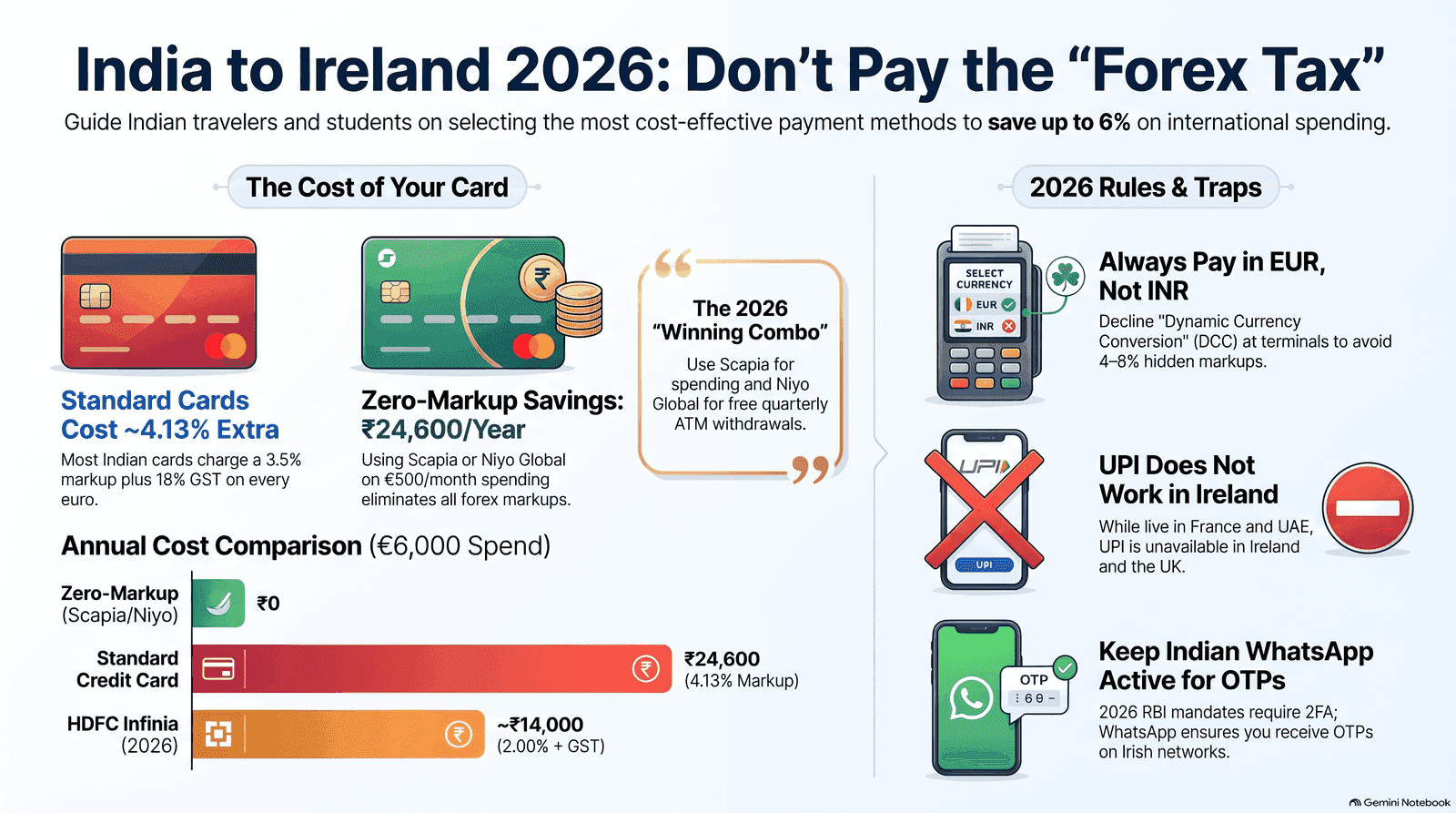
- Zero-markup wins on cost: Scapia Federal Bank (lifetime-free credit card) and Niyo Global (prepaid) both charge 0% forex markup. Standard Indian credit cards cost an effective 4.1% (3.5% + GST). The gap on €6,000/year of overseas spend is ₹24,600.
- UPI does not work in Ireland: UPI merchant payments work in 10 countries as of August 2026 — UAE, Singapore, France, Mauritius, Nepal, Bhutan, Sri Lanka, Qatar, Cambodia and Greece. Ireland, the UK, Germany and the USA are not on that list. Indian students in Ireland must carry a card.
- DCC is the hidden trap: When any Irish terminal asks "pay in INR?", always refuse and pay in EUR. The DCC rate typically adds 4–8% over mid-market — far worse than even a standard card's markup.
Why does the payment method you choose change your real cost by 2–6% on every transaction?
Every international payment made with an Indian card triggers a foreign exchange conversion, and the rate applied determines your true cost. A standard Indian credit card adds 3.5% markup plus 18% GST on that fee — an effective 4.13% extra on every euro spent. A zero-markup card adds nothing. On €500/month of overseas spend, the difference is ₹2,065 per month, or ₹24,780 per year.
The mechanics work like this: when you swipe an Indian card abroad, your bank converts the local currency (EUR in Ireland) to INR at their internal rate. That internal rate is not the mid-market rate you see on Google — it is the mid-market rate plus a markup the bank keeps. The markup pays for the bank's foreign exchange risk, processing fees, and profit margin.
On top of the markup, Indian banks also charge an 18% GST on the foreign transaction fee. So a card with a 3.5% stated markup actually costs 3.5% × 1.18 = 4.13% effective. For a ₹50,000 airline booking on an Emirates website, that is ₹2,065 in fees alone — often invisible because it is baked into the conversion rate rather than shown as a line item.
There is a second hidden cost: Dynamic Currency Conversion (DCC). At terminals in Ireland, the UK and throughout Europe, merchants or ATMs sometimes ask "Do you want to pay in INR or EUR?" The INR option processes through the merchant's own currency conversion engine, which typically applies a 4–8% markup above mid-market. A ₹50,000 transaction at 6% DCC costs ₹3,000 extra — on top of whatever your card charges. Always select the local currency (EUR in Ireland). This single habit can save more money than switching from a standard card to a low-markup card.
If an Irish terminal, online checkout, or ATM asks whether you want to pay in INR, always decline. Select EUR (the local currency). DCC markups run 4–8% above mid-market. From 17 May 2026, HDFC Infinia additionally charges a 1.75% DCC markup when billed in INR at international terminals — making the DCC option even more expensive for Infinia cardholders.
True Cost = Purchase Amount + (Forex Markup % × Purchase Amount) + DCC surcharge (if accepted)
Forex cards in 2026 — best zero-markup options, loading fees and when to lock in the rate
The best prepaid forex cards for Indian students and NRIs in 2026 are Niyo Global (SBM Bank) and BookMyForex Wow — both offer true 0% markup on the currencies loaded. However, Niyo charges ₹110 + taxes per ATM withdrawal after the first free quarterly withdrawal, and BookMyForex's zero-markup rate applies only on orders above ₹1.5 lakh delivered in 65+ cities.
Niyo Global (SBM Bank) — zero markup, one free ATM withdrawal per quarter
The Niyo Global card (issued by SBM Bank India) is a debit-style prepaid travel card that charges 0% forex markup on international transactions. It works across 180+ countries and is accepted wherever Visa is accepted. Key 2026 specifications:
- Forex markup: 0% on international purchases
- ATM withdrawals: 1 free per quarter; ₹110 + taxes thereafter
- Lounge access: 1 free international lounge visit per quarter at 1,300+ airports
- Annual fee: No annual fee if minimum balance is maintained
- Con: ATM withdrawal fee after the first quarterly free visit can add up for cash-heavy travellers; requires opening an SBM Bank account
BookMyForex Wow — true interbank rate, same-day doorstep delivery
BookMyForex Wow launched as India's first "true zero markup" forex card, locking in the interbank rate at the time of loading with no spread added. It supports 15 currencies (including EUR and GBP) and offers same-day doorstep delivery across 65+ Indian cities. The zero-markup rate and free same-day delivery apply on orders above ₹1.5 lakh; smaller orders may carry a small fee. There is no issuance or annual fee.
Traditional bank forex cards — watch the cross-currency fee
HDFC Bank Regalia ForexPlus, ICICI Bank Travel Card, and Thomas Cook Borderless are widely used multi-currency cards, but they carry a 3–3.5% cross-currency conversion fee when you spend in a currency not pre-loaded on the card. If you load EUR but pay in GBP at a UK transit, the cross-currency fee fires. Thomas Cook Borderless charges USD 2.25 per ATM withdrawal abroad. These cards are not zero-markup on the exchange rate at loading — they typically apply a 0.5–1% spread above the RBI reference rate on the day of loading.
TCS on forex card loads — the ₹10 lakh rule
Under the Reserve Bank of India (RBI) Liberalised Remittance Scheme (LRS), forex card loads are treated as overseas remittances. The TCS rules as of Budget 2026:
- Up to ₹10 lakh per financial year: 0% TCS on forex card loads
- Above ₹10 lakh: 20% TCS is collected at source (reclaimable at ITR filing)
- Education remittances via Indian bank loan: 0% TCS regardless of amount
- Budget 2026 flat 2% TCS: applies only to overseas tour packages booked through a tour operator — NOT to standalone card loads or individual flight and hotel bookings
Most Indian students loading €400–600/month (≈ ₹36,000–54,000/month) will stay well within the ₹10 lakh annual ceiling and owe zero TCS on forex card loads.
Indian travel credit cards — the true international cost in 2026
The best Indian credit card for international spending in 2026 is the Scapia Federal Bank Credit Card — it charges 0% forex markup with no annual fee. HDFC Infinia charges 2% (not zero, as frequently stated online). Axis Atlas charges 3.5%. Standard cards from SBI, Kotak and ICICI charge the full 3.5% plus GST effective rate of ~4.1%.
| Card | Forex Markup | Effective Cost (incl. GST) | Annual Fee | International Reward Earn | Best For |
|---|---|---|---|---|---|
| Scapia Federal Bank | 0% | 0% | ₹0 (lifetime free) | No coins on international spends | Students, zero-cost international spending |
| HDFC Infinia Metal | 2.0% | ~2.36% | ₹12,500/yr | 3.3 reward points per ₹150; 5X on SmartBuy | High-spend premium travellers |
| Axis Atlas | 3.5% | ~4.13% | ₹5,000/yr | 5 EDGE Miles per ₹100 on travel; 2 on others | Miles accumulation — NOT lowest forex cost |
| Standard SBI / ICICI / Kotak | 3.5% | ~4.13% | ₹500–₹3,000/yr | Varies | Domestic spend — expensive internationally |
| IndusInd Pioneer Heritage | 1.8% | ~2.12% | ₹30,000/yr | 1.5 reward points per ₹100 internationally | Ultra-premium with low markup |
Is HDFC Infinia really a zero-forex card?
No. HDFC Infinia charges a 2% forex markup on all foreign currency transactions, confirmed by HDFC Bank's own fees-and-charges page as of August 2026. Additionally, from 17 May 2026, HDFC Infinia applies a 1.75% DCC markup when a merchant bills the card in INR rather than local currency. Combined, these can reach 3.75% on a DCC transaction. HDFC Infinia is a premium card worth carrying for domestic spend and SmartBuy rewards, but it is not a zero-markup card for international use. Pair it with a Scapia or Niyo Global for actual zero-markup international spending.
RBI's October 2026 2FA mandate — what it means for your card
From 1 October 2026, the RBI requires Indian card issuers to implement two-factor authentication for non-recurring, card-not-present (CNP) transactions when overseas merchants request it. This closes the gap between India's domestic 2FA (mandatory from April 2026) and cross-border bookings. In practice:
- Booking a flight directly on an airline's foreign website (Emirates.com, Aer Lingus.com) may trigger an OTP on your Indian number
- Low-value transactions on a trusted device pass with minimal friction
- If your Indian mobile number is not active or reachable, the OTP will not arrive and the booking will fail — book via an Indian OTA (MakeMyTrip, EaseMyTrip) as a fallback
- UPI QR-based merchant payments are unaffected — UPI authenticates via UPI PIN, not the card network's CNP flow
On-the-Ground Insight: "I was booking my Dublin-to-Delhi flight on Qatar Airways' website using my ICICI Rubyx card in September 2026. The page kept hanging at checkout — no OTP arrived. My Irish SIM had no roaming on the Indian number. I had to use MakeMyTrip on my phone instead — same fare, same flight, OTP went to my Indian WhatsApp. Always keep your Indian number active on WhatsApp before travelling." — Rohan M., MSc Data Analytics, University College Dublin, 2025 intake
UPI internationally in 2026 — where it works for Indian students and NRIs
UPI is accepted as a payment method in 10 countries as of August 2026: UAE, Singapore, France, Mauritius, Nepal, Bhutan, Sri Lanka, Qatar, Cambodia and Greece. Ireland, the UK, Germany, the USA, Canada and Australia are not on the list. Indian students living in Ireland cannot use UPI for local purchases and must rely on a forex card, credit card, or cash.
What UPI can do for NRIs in Ireland
Even though you cannot scan a QR code in a Dublin supermarket, UPI remains useful in an Irish context in two ways. First, NPCI supports UPI access for NRIs using international mobile numbers from 12 countries, allowing you to link your Irish number to your Indian NRE/NRO account and make payments to merchants inside India. Second, if you travel through Singapore on your India journey, the UPI-PayNow bilateral corridor lets you pay at 12,000+ Singaporean merchants via your UPI app, with a ₹60,000/day limit.
| Country | UPI Works? | Merchant Scale | Notes |
|---|---|---|---|
| Ireland | ❌ No | — | Not in 10-country live list |
| UK | ❌ No | — | Not in live list (MoU pending) |
| UAE | ✅ Yes | 60,000+ merchants | Dubai Duty Free, Lulu Hypermarket; use PhonePe over Google Pay |
| Singapore | ✅ Yes (+ P2P) | 12,000+ merchants + P2P | UPI-PayNow; ₹60,000/day P2P limit |
| France | ✅ Yes | Major tourist sites | Eiffel Tower, Louvre area merchants |
| Qatar (Doha) | ✅ Partial | Qatar Duty Free primarily | ~55% merchant success rate; always carry a card |
The bottom line for students and NRIs based in Ireland: UPI is a useful travel tool when passing through Dubai or Singapore, not a day-to-day payment option in Ireland itself. Do not cancel your international-enabled debit or credit card in favour of UPI.
Cash vs cards on India-Ireland trips — when each wins
Cash in euros is most useful for small rural purchases in Ireland — smaller village pubs, farmers' markets, and some taxis still prefer cash — but carrying more than €100–200 in notes is unnecessary and risky. For flights, online bookings, restaurants, and supermarkets in Dublin, Cork or Galway, a zero-markup card is always cheaper than bureau de change cash.
If you do need cash in euros, the ordering of options from best to worst value is:
- Withdraw from an Irish ATM using a zero-markup card (Niyo Global or a zero-forex credit card) — you get near-interbank rates. Always decline DCC at the ATM ("Do you want us to do the conversion?"). On Niyo Global, use your free quarterly withdrawal here.
- Buy euros in India via BookMyForex or a bank forex card before travel — locks in a competitive rate and avoids airport exchange counters entirely.
- Airport currency exchange counters — worst option; counters at Dublin Airport typically apply a 3–5% spread over mid-market. Only use in an emergency.
Note: An Post Money Currency Card (available in Ireland) is aimed at Irish residents holding foreign currency, not at Indian visitors. Irish debit cards (AIB, Bank of Ireland, Revolut) are the recommended path for Indian students who have opened an Irish bank account — a Revolut EUR account charges zero markup on transactions within the Eurozone.
Live calculator: How much could you save by switching payment methods?
Use the calculator below to estimate your annual forex markup savings. Enter your typical monthly overseas spend in euros and select your current payment method to see what switching to a zero-markup card would save. The calculation uses the markup rates documented in the comparison table above: standard card 3.5%, effective with GST 4.13%; HDFC Infinia 2.0%, effective 2.36%; zero-markup card (Scapia/Niyo) 0%. These are the rates stated by each card issuer as of August 2026. The calculator defaults to an EUR/INR rate of ₹110, in line with the mid-2026 mid-market rate — adjust it to the rate on your booking date for a more precise estimate.
🧮 Forex Markup Savings Calculator
Compare your annual forex markup cost across payment methods based on your monthly overseas spend.
The winning combination — what to carry for India-Ireland travel in 2026
The optimal wallet for an Indian student or NRI travelling the India-Ireland route in 2026 is: one zero-markup credit card (Scapia Federal Bank, lifetime-free) for everyday EUR spending; one Niyo Global prepaid card for ATM cash withdrawals; and an international-enabled Indian credit card (HDFC Infinia or SBI Elite) kept as backup for high-value bookings that need a credit limit.
For everyday spending in Ireland
Use the Scapia Federal Bank Credit Card for all tap-and-go payments at supermarkets, Leap Card top-ups, restaurant bills and online subscriptions. At 0% markup and no annual fee, it costs nothing extra. The downside: Scapia earns no reward coins on international transactions, so you are not building miles. If miles matter, accept a small markup cost and use a travel credit card like HDFC Regalia Gold (2% markup, effective ~2.36% with GST).
For cash withdrawals in Ireland
Use Niyo Global for your quarterly free ATM withdrawal in Ireland. Top up the card in INR before you travel; Niyo converts at interbank rate. If you need more cash in the same quarter, the ₹110 + tax fee per extra withdrawal is still far cheaper than a bureau de change.
For flight bookings and high-value online purchases
Use an international-enabled Indian credit card (ICICI Sapphiro, SBI ELITE, HDFC Infinia) for high-value online purchases. Credit cards provide Section 75 consumer protection, chargeback rights, and higher transaction limits than prepaid or debit cards — critical when booking flights or paying a semester deposit. Enable the card for international CNP transactions in your bank app before you travel, and ensure your Indian mobile number can receive an OTP (use a dual-SIM or keep the Indian SIM active via a data roaming plan or WhatsApp OTP).
For Dubai or Singapore transit
If your India-Ireland journey routes through Dubai (via Emirates or Air India) or Singapore (via Singapore Airlines), activate UPI international in your PhonePe or BHIM app before departure. At Dubai Duty Free, PhonePe has consistently outperformed Google Pay — scan the Magnati QR and your ₹1 lakh daily limit applies. In Singapore, the UPI-PayNow corridor covers 12,000+ merchants and you can send up to ₹60,000/day peer-to-peer to a Singapore bank account.
PoS arbitrage for flight bookings — booking currency matters
When booking a Dublin-to-India flight directly on an airline website, check whether the fare displayed is in EUR or INR. Emirates.com India (emirates.com/in) prices fares in INR; Emirates.com Ireland prices the same fare in EUR. Depending on the EUR/INR exchange rate on the day, the EUR price paid on a zero-markup card may be cheaper than the INR price on the India site. This PoS (Point of Sale) arbitrage is particularly significant on routes where airlines price differently by market. Always compare the EUR price on the airline's Irish site against the INR price on the Indian site, factoring in your card's markup.
Frequently asked questions
Which is cheaper for Indians abroad in 2026 — forex card, credit card or UPI?
A zero-markup forex card (Niyo Global, BookMyForex Wow) or a zero-forex credit card (Scapia Federal Bank) is cheapest at 0% markup. Standard Indian credit cards cost 3.5% plus GST (effective ~4.1%). UPI is not available in Ireland, the UK, the USA or most of Europe as of August 2026, so it cannot replace cards on India-Ireland travel.
Does HDFC Infinia have zero forex markup in 2026?
No. As of 2026, HDFC Infinia charges a 2% forex markup on all foreign currency transactions. From 17 May 2026 it also applies a 1.75% Dynamic Currency Conversion (DCC) markup when a merchant bills in INR at an international terminal. HDFC Infinia is not a zero-markup card — Scapia Federal Bank and Niyo Global are the zero-markup alternatives.
Does loading a forex card attract TCS in 2026?
Forex card loads up to ₹10 lakh per financial year attract 0% TCS. Amounts above ₹10 lakh attract 20% TCS. Education remittances made via a loan from an Indian bank attract 0% TCS regardless of amount. Budget 2026 introduced a flat 2% TCS on overseas tour packages from April 2026, but standalone flight and hotel bookings paid by card do not attract TCS.
Can I use UPI in Ireland in 2026?
No. UPI is not accepted in Ireland, the UK, Germany, the Netherlands, the USA, Canada or Australia as of August 2026. UPI works at merchants in 10 countries — UAE, Singapore, France, Mauritius, Nepal, Bhutan, Sri Lanka, Qatar, Cambodia and Greece. Indian students and NRIs in Ireland cannot use UPI for local purchases and must carry a card.
What is the Dynamic Currency Conversion (DCC) trap and how do I avoid it?
DCC occurs when a foreign merchant or ATM offers to charge your Indian card in INR rather than the local currency (EUR, GBP, USD). The merchant's rate typically embeds a 4–8% markup above the mid-market rate, which is far worse than even a standard credit card's 3.5–4.1% markup. Always select 'pay in local currency' — EUR in Ireland, GBP in the UK — when prompted. Never accept the INR option.
Ready to book your India-Ireland flight? Compare live fares first
Once your payment method is sorted, find the cheapest Dublin–India fares with the right airline and the lowest forex cost on booking.
All information in this article is based on publicly available official sources including the Reserve Bank of India, NPCI, and official card issuer fees-and-charges pages as of August 2026. Forex markup rates, TCS thresholds, and UPI country coverage can change at any time. Always verify current fees with your card issuer and check NPCI International for the latest UPI country list before travel. This article does not constitute financial advice. MyFlightOffers is not affiliated with any bank or payment provider mentioned.
- UPI International Payments 2026: All 10 Countries, How to Set Up and What Still Doesn't Work Abroad — full country-by-country breakdown of UPI acceptance, limits and activation steps.
- Card Tokenization & RBI Authentication Rules for Flight Bookings India 2026 — how RBI's 2FA mandate affects Indian cards on foreign airline websites and how to avoid failed transactions.
- HDFC Credit Card Flight Offers 2026 — cashback and offers when you do use HDFC cards for India-Ireland flight bookings.
- Transfer Credit Card Points to Airline Miles India 2026 — make your card spend work harder for flights even when you use a zero-forex card for daily spend.