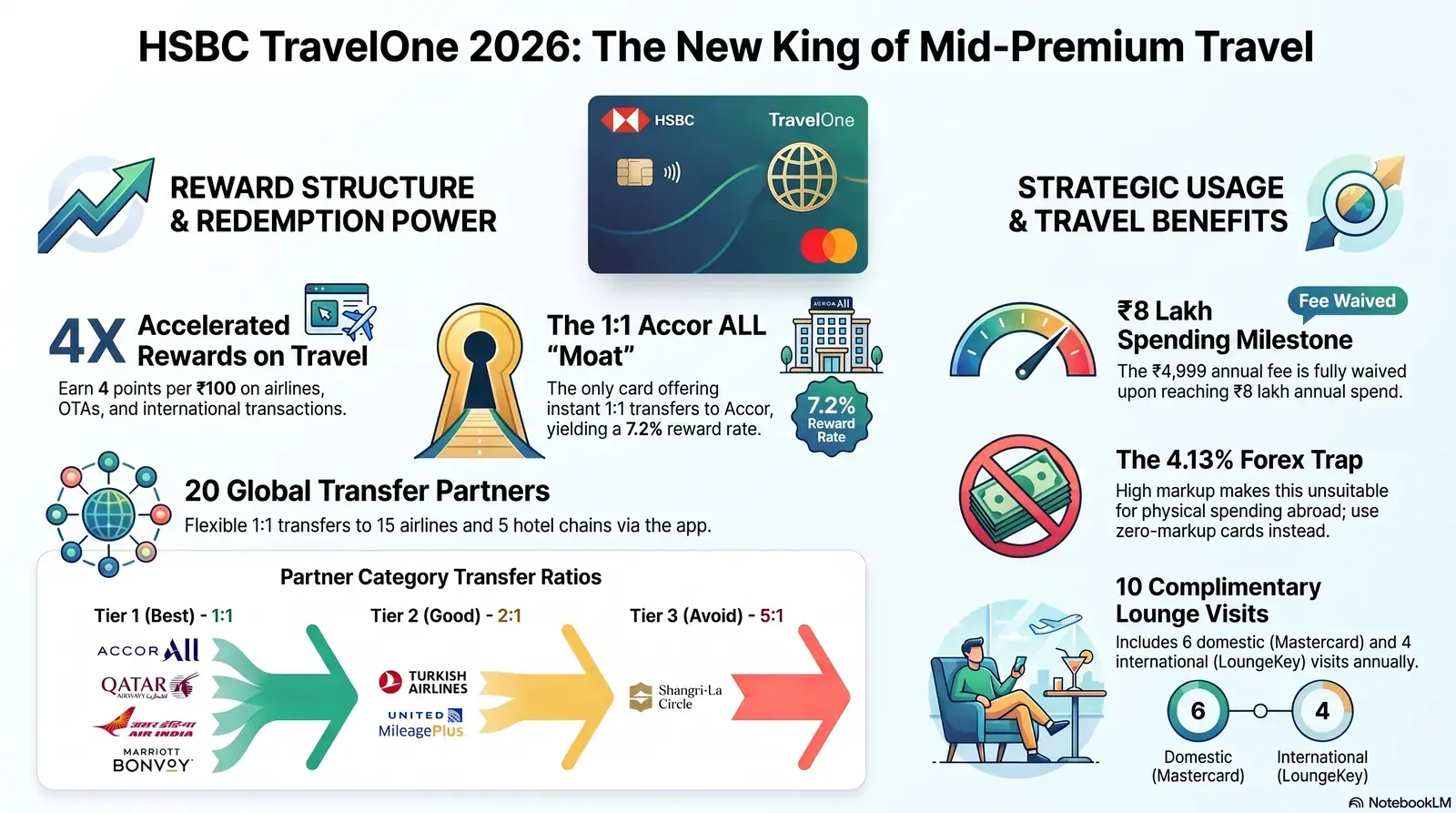
- The fee and waiver: ₹4,999 + GST annually; fully waived if you spend ₹8 lakh in the anniversary year. At ₹12 lakh spend you also earn 10,000 bonus points on top.
- The Accor moat: After Axis Atlas dropped Accor ALL in April 2026, HSBC TravelOne is now the only mid-premium Indian card offering instant, uncapped 1:1 Accor ALL transfers — making the effective reward rate on travel spend up to 7.2% when redeemed at Accor.
- The forex markup problem: A 3.5% + GST (~4.13%) markup on international transactions means the card is NOT suitable as a spending card abroad; use a zero-markup card for overseas purchases and reserve TravelOne for Indian OTA bookings and domestic travel.
₹4,999 + GST
Waived at ₹8L annual spend
4 pts / ₹100
Airlines, OTAs, forex spends
20 total
15 airlines + 5 hotels
3.5% + GST (~4.13%)
Net return on intl spend: −0.13%
In this guide
- Why TravelOne became the most-wanted mid-premium card in 2026
- Earn rates: 4X on travel, 2X on everything else
- The 20 transfer partners: airlines and hotels with ratios
- The Accor advantage: India's only instant 1:1 transfer card
- Lounge access, fees, and eligibility in 2026
- Redemption sweet spots for Ireland-India and Europe flights
- TravelOne vs Axis Atlas vs HDFC Regalia Gold
- DCC trap and PoS arbitrage: using TravelOne abroad
- TCS, OTP blocks, and cross-border payment pain points
- Who should get the TravelOne in 2026
- Personalise your annual reward return
- Frequently asked questions
Why HSBC TravelOne Has Become the Most-Wanted Mid-Premium Travel Card in India (2026)
The HSBC TravelOne credit card inherited the top spot in India's mid-premium travel card segment in 2026 by default — when Axis Bank stopped issuing the Atlas to new applicants and then stripped Accor, Marriott, and Qatar from its EDGE Miles programme in April 2026. That twin exit left a clean gap: a flexible-miles card with broad transfer partners, competitive earn rates, and instant in-app redemptions was exactly what millions of Indian frequent flyers had relied on the Atlas to provide.
The TravelOne is not a new card — HSBC India launched it in early 2025 — but the competitive landscape shifted dramatically around it. With the Atlas gone and the HDFC Regalia Gold anchored to a catalog-redemption model (rather than transferable miles), TravelOne is now the clearest path for a new Indian applicant who wants to accumulate airline miles flexibly at a sub-₹6,000 annual fee.
The card sits on the Mastercard World platform, issues instantly in select cities, and all reward point transfers happen inside the HSBC India mobile app with no phone calls and no transfer fees — a genuine differentiator versus legacy programmes where transfers take 3–5 business days and require a support ticket.
Earn Rates Explained: 4X on Travel, 2X on Everything Else
HSBC TravelOne earns 4 reward points per ₹100 spent on airlines, travel aggregators (MakeMyTrip, Cleartrip, EaseMyTrip), and foreign-currency transactions, with a monthly cap of 50,000 accelerated points (equivalent to ₹12.5 lakh spend); all other eligible spends earn 2 points per ₹100 with no cap.
At the 1:1 transfer ratio that applies to most partners, 4 points per ₹100 equals a 4% reward rate on travel — or roughly 7.2% when redeemed for Accor ALL points (the best cash-equivalent value, discussed below). The 2 points per ₹100 base rate translates to 2% on everything else.
Key exclusions where no points are earned: utility bill payments, insurance premiums, jewellery purchases, education and government payments, tax payments, fuel, financial institution transactions, and e-wallet loads. The list is broader than the old Axis Atlas exclusions; in particular, the utility exclusion means rent paid via platforms like NoBroker does not earn, and insurance EMIs do not earn either.
The 20 Transfer Partners: Full Airline and Hotel List with Transfer Ratios
HSBC TravelOne offers 20 loyalty programme transfer partners — 15 airlines and 5 hotels — making it the widest partner network of any mid-premium travel card currently available to new applicants in India as of August 2026. Transfers are processed instantly or within one business day for most programmes via the HSBC India app, with no transfer fee.
| Programme | Type | Transfer Ratio (HSBC pts : Miles/Pts) | Best Use for India-Europe Flyers |
|---|---|---|---|
| Air India Maharaja Club | Airline | 1:1 | Direct Delhi–Dublin on AI metal; award bookings via Maharaja Club at competitive rates |
| Flying Blue (Air France–KLM) | Airline | 1:1 | Paris CDG connection for India–Ireland; promo awards at aggressive discounts monthly |
| British Airways Avios | Airline | 1:1 | London Heathrow–India segments; distance-based pricing rewards short hops |
| Etihad Guest | Airline | 1:1 | Abu Dhabi connection; good for premium cabin redemptions on AI–Etihad codeshares |
| Singapore Airlines KrisFlyer | Airline | 1:1 | India–Singapore Business at ~45,000 miles one-way Saver; onward SQ partners for Europe |
| Qatar Privilege Club | Airline | 1:1 | Doha hub; best routing for Dublin–India via QR; low surcharges on award tickets |
| Qantas Frequent Flyer | Airline | 1:1 | Australia connections; oneworld alliance access via Qantas classic awards |
| Japan Airlines JAL Mileage Bank | Airline | 1:1 | Tokyo connections; Business class sweet spots on JAL metal |
| EVA Air Infinity MileageLands | Airline | 1:1 | Taipei connections; premium cabin value on EVA Air |
| Thai Royal Orchid Plus | Airline | 1:1 | Bangkok hub; Star Alliance coverage for onward connections |
| Vietnam Airlines Lotusmiles | Airline | 1:1 | Hanoi/Ho Chi Minh connections; SkyTeam coverage |
| AirAsia BIG Loyalty | Airline | 1:1 | Southeast Asia low-cost redemptions; limited long-haul value |
| Turkish Airlines Miles&Smiles | Airline | 2:1 ⚠ | Istanbul hub; devalued from 1:1 in March 2025; still useful for Star Alliance partners |
| United MileagePlus | Airline | 2:1 ⚠ | Star Alliance; devalued from 1:1 in March 2025 |
| Hainan Airlines | Airline | 2:1 ⚠ | Limited India utility; devalued from 1:1 in March 2025 |
| Accor ALL | Hotel | 1:1 | Best value redemption (~₹2/point); 5,400+ hotels in 110 countries including Dublin and Ireland |
| Marriott Bonvoy | Hotel | 1:1 | Wide Dublin and Ireland coverage; Bonvoy points also convert to airline miles at 3:1 |
| IHG One Rewards | Hotel | 1:1 | InterContinental, Holiday Inn portfolio; Dublin properties available |
| Wyndham Rewards | Hotel | 1:1 | Economy to mid-scale; useful for domestic India hotels |
| Shangri-La Circle | Hotel | 5:1 ⚠ | 5 HSBC points = 1 Shangri-La Circle point; weak value — avoid for most use cases |
⚠ = Unfavourable ratio; 2:1 means you need 2 HSBC points to get 1 airline mile. Shangri-La transfers at 5:1 (5 HSBC points per 1 Circle point).
The Accor Advantage: India's Only Instant 1:1 Accor ALL Transfer Card in 2026
After Axis Bank removed Accor Live Limitless from its EDGE Miles programme in April 2026 — effective immediately, with no advance notice — HSBC TravelOne became the only mid-premium Indian credit card offering direct, instant, uncapped 1:1 transfers to Accor ALL.
Why does this matter? Accor ALL points are exceptionally liquid. At Accor properties (the portfolio includes Novotel, Mercure, ibis, Fairmont, Sofitel, and MGallery — more than 5,400 hotels across 110 countries), Accor ALL points convert to a cash value of roughly ₹2 per point. That means:
- 4 HSBC points earned per ₹100 of OTA travel spend
- 4 Accor ALL points transferred (1:1)
- Value at Accor: approximately ₹2 per point, so ₹8 of hotel credit per ₹100 spent = ~7.2% effective reward rate after the GST impact on the fee
For a student whose parents are booking an Ibis or Novotel in Dublin, Cork, or Galway for a college visit, accumulating Accor ALL points via TravelOne flight bookings on MakeMyTrip or Cleartrip is a genuine way to offset hotel costs. The average Novotel Dublin nightly rate in 2026 runs approximately €140–€180; 7,000 Accor ALL points cover roughly a €70 discount, achievable in about 5–6 months of moderate travel spend.
Open the HSBC India app → Rewards → Transfer Points → Select Accor ALL → Enter your Accor ALL member number → Enter the number of points to transfer (minimum 1,000). Transfer is confirmed instantly in most cases. No fees charged by HSBC; Accor may apply their own terms on receipt. Always transfer in multiples of 500 for clean account management.
On-the-Ground Insight: "My parents used their HSBC TravelOne to book my Dublin flight on MakeMyTrip — a ₹68,000 round trip earned 2,720 Accor points. We transferred them and got a ₹5,440 Accor discount on their Dublin Novotel stay when they visited for my graduation. The transfer took under 30 seconds in the app." — Priya R., University College Dublin, MSc Data Analytics, 2026 Intake
Lounge Access, Fees, and Eligibility Criteria in 2026
HSBC TravelOne provides 6 complimentary domestic airport lounge visits per year via the Mastercard Lounge Access programme (covering 50+ lounges across major Indian airports) and 4 complimentary international airport lounge visits per year via LoungeKey (access to 1,000+ lounges globally), with no minimum spend required to unlock either benefit.
Guest access is chargeable — there is no complimentary guest allowance. Visits above the annual quota are charged at the prevailing lounge walk-in rate. The absence of a spend-based trigger (unlike cards such as the HDFC Regalia Gold, which sometimes tie lounge access to minimum quarterly spends) makes the TravelOne simpler to manage.
| Fee / Feature | HSBC TravelOne | Axis Atlas (existing holders) | HDFC Regalia Gold |
|---|---|---|---|
| Annual Fee | ₹4,999 + GST | ₹5,000 + GST (discontinued for new applicants) | ₹2,500 + GST |
| Fee Waiver Threshold | ₹8 lakh annual spend | Not applicable (Atlas no longer issued) | ₹4 lakh annual spend |
| Travel Earn Rate | 4 pts / ₹100 (OTA, airlines, forex) | 5 EDGE Miles / ₹100 on travel (1:2 ratio to partners) | Up to 10X on SmartBuy portal only |
| Base Earn Rate | 2 pts / ₹100 | 2 EDGE Miles / ₹100 | 4 pts / ₹150 |
| Flexible Transfer Partners | 20 (15 airlines + 5 hotels) | ~12 remaining after April 2026 cuts | Primarily catalog/portal redemptions |
| Accor ALL Transfer | ✓ Instant 1:1 (only card offering this) | ✗ Removed April 2026 | ✗ Not available |
| Forex Markup | 3.5% + GST (~4.13%) | 3.5% + GST | 2% + GST (~2.36%) |
| Domestic Lounge Visits | 6 / year (Mastercard) | 8 / year | 12 / year + guest |
| International Lounge Visits | 4 / year (LoungeKey) | 4 / year | 6 / year (DreamFolks) |
| Available to New Applicants (2026) | ✓ Yes | ✗ No (discontinued) | ✓ Yes |
Eligibility for HSBC TravelOne (as of August 2026): Minimum annual income of ₹6 lakh (salaried); age 18–65 years; a CIBIL score of 750 or above; residence in one of the eligible cities: Delhi/NCR, Mumbai, Bengaluru, Hyderabad, Chennai, Pune, Kochi, Coimbatore, Jaipur, Chandigarh, Ahmedabad, Kolkata, Amritsar, Baroda, Indore, or Lucknow. Applications are processed via HSBC India's official website or select branches.
Redemption Sweet Spots for Ireland-India and Europe Flights
For Indian families with students in Ireland or frequent Ireland-India travellers, HSBC TravelOne points are most valuable when transferred to Qatar Privilege Club, British Airways Avios, or Air India Maharaja Club, all at 1:1 and all offering direct routing options through the main hubs serving Dublin.
Here are the most useful redemption strategies for the Dublin corridor in 2026:
Qatar Privilege Club (1:1 transfer) — Best for Dublin routing. Qatar Airways is the dominant carrier on Dublin-India routes via Doha (DOH). Award availability on QR is generally good for economy; business is tighter but achievable 3–6 months out. A sample round-trip economy award Dublin (DUB) to Hyderabad (HYD) via DOH runs approximately 45,000–55,000 Qmiles in the current award chart (verify current pricing at Qatar Privilege Club). At 4 HSBC points per ₹100 of OTA spend and a 1:1 ratio, you need ₹11.25–13.75 lakh of eligible TravelOne spend to earn enough for that award — spread over roughly 18–24 months of regular travel spending for a family that books flights regularly.
British Airways Avios (1:1 transfer) — Best for distance-based redemptions. BA uses a distance-based pricing chart, which rewards short redemptions. A Dublin (DUB) to London Heathrow (LHR) return in economy costs only 9,000 Avios — earned from just ₹2.25 lakh of TravelOne travel spend. From Heathrow, India sectors on British Airways are priced at roughly 52,500 Avios one-way in economy. British Airways Executive Club also accepts Avios from Iberia Plus, enabling competitive redemptions on Iberia metal from Madrid.
Air India Maharaja Club (1:1 transfer) — Best for direct Delhi flights. Air India operates a direct Delhi (DEL) to Dublin (DUB) route. Maharaja Club award pricing for this sector starts at approximately 50,000 miles one-way in economy under the 2026 award chart (see Air India Maharaja Club for current pricing). Air India is now a Star Alliance member, meaning Maharaja Club miles also cover economy redemptions on Lufthansa, Swiss, and Singapore Airlines.
Flying Blue (1:1 transfer) — Best for promo award months. Air France-KLM's Flying Blue programme offers monthly Promo Awards at 25–50% discounts on select routes. The Paris CDG hub has direct connections to both Dublin and major Indian cities. Monitoring promo award drops (announced monthly) can yield Economy awards at 15,000–25,000 miles on India-Europe sectors.
HSBC TravelOne vs Axis Atlas vs HDFC Regalia Gold: Head-to-Head Verdict
For a new applicant in 2026, HSBC TravelOne is the clear winner if your priority is earning flexible airline and hotel miles; HDFC Regalia Gold wins on lounge access volume and lower forex markup; Axis Atlas is irrelevant for anyone who cannot already hold the card, and its devaluation has materially reduced its value even for existing holders.
The Regalia Gold is a better card for families who travel frequently as a group and need lounge guest access (12 domestic visits plus guests, versus TravelOne's 6 domestic with no guest), or for holders who do most of their spending on HDFC SmartBuy, where 10X points on flight and hotel bookings through the portal can outperform TravelOne's 4X on OTAs. The Regalia Gold's 2% forex markup is also materially better for cardholders who spend regularly in foreign currency. Its principal weakness is that it does not offer flexible mile transfers to airline programmes — points are redeemed in a catalog or converted at fixed, often unfavourable rates.
The TravelOne's weakness is equally clear: it is not a card to carry abroad. At 4.13% effective forex markup, you give back almost exactly what you earn on international transactions. The recommended two-card setup is TravelOne for Indian OTA flight and hotel bookings (capturing 4X accelerated earn), plus a zero-markup card such as a zero-forex card (Federal Bank Scapia, RBL World Safari, or the Wise Travel Card) for all spending while actually travelling abroad.
DCC Trap and PoS Arbitrage: How to Use Your TravelOne Abroad Without Losing Money
Dynamic Currency Conversion (DCC) is a payment trap where a foreign merchant's terminal offers to charge your Indian card in INR rather than the local currency — this should always be declined, because the merchant bank applies its own conversion rate (typically 4–8% above mid-market) on top of HSBC's existing 3.5% + GST markup, creating a combined loss of 8–12% on the transaction.
When you pay at an Irish, UK, or European PoS terminal, always select "Pay in EUR" (or GBP, DKK, etc.) when the terminal asks for currency choice. This gives you the Mastercard interbank rate and limits the conversion cost to HSBC's 3.5% + GST. Even better: for any foreign-currency spending during travel, switch to a dedicated zero-markup card. Do not use TravelOne as your primary spending card when physically abroad; use it only for Indian OTA and airline bookings where the earn rate justifies the cost and no forex conversion occurs.
PoS price arbitrage refers to the practice of checking whether the Indian version of an airline website (e.g., Qatar Airways India priced in INR) is cheaper than the same fare on an international version of the same site priced in EUR or GBP. For Indian residents booking on a card that earns 4X on forex spends, sometimes the EUR-priced fare on the international site — after forex conversion — is cheaper than the INR fare on the India site. Run the comparison: if (EUR fare × exchange rate × 1.0413) < INR fare, the international site wins on total cost even with HSBC's forex markup factored in.
TCS, OTP Blocks, and Cross-Border Payment Pain Points in 2026
Tax Collected at Source (TCS) under the Liberalised Remittance Scheme (LRS) applies to international credit card spends above ₹10 lakh per financial year since the Finance Act 2025 raised the TCS-free threshold from ₹7 lakh to ₹10 lakh; for self-funded education remittances, Budget 2026 further reduced the TCS rate from 5% to 2% above that threshold, effective 1 April 2026.
For context, TCS on standalone airline ticket purchases has never applied under LRS (the RBI has consistently excluded direct ticket purchases from LRS classification). What TCS does apply to is loading a forex card or remitting money abroad under the LRS umbrella. Students booking their own flights on foreign airline sites with the TravelOne need not worry about TCS on the ticket itself, but parents remitting money to a child's Irish bank account should be aware that amounts above ₹10 lakh in a financial year attract 2% TCS (self-funded education) or 20% TCS (general remittance). TCS is not a tax but a tax advance — it is credited against your income tax liability and fully refundable at ITR filing if your total tax liability is lower.
OTP and international transaction blocks are a common pain point when using Indian credit cards on foreign airline websites. HSBC TravelOne requires international transactions to be enabled via the HSBC India app (Settings → Card Controls → International Transactions). For high-value bookings (flights above ₹1–2 lakh), call HSBC customer care on 1800-267-3456 to request a temporary limit increase before the transaction. Failing to do this is the most common reason a TravelOne transaction fails on, say, QatarAirways.com or BA.com when booking a business class ticket.
Who Should Get the HSBC TravelOne in 2026
HSBC TravelOne is the right card for any Indian frequent flyer who wants transferable airline and hotel miles, does most of their travel booking on Indian OTAs, and does not need a card to use as their primary spending instrument when physically abroad.
The card is particularly valuable for four profiles:
Students' parents with children in Ireland or the UK: Booking flights from India to Dublin or London on MakeMyTrip or Cleartrip is the highest-earn use case — 4 points per ₹100, transferable 1:1 to Qatar, British Airways, or Air India miles for award redemptions on the same routes. Over a 3-year degree programme, a family regularly booking flights and hotel stays for college visits could accumulate 30,000–60,000 Accor or airline miles annually.
NRIs and frequent Gulf-route flyers: If you book India flights from the UAE or UK via Indian OTAs (which many NRIs continue to do for better pricing), the 4X earn rate and 1:1 Qatar transfer make TravelOne the most efficient accumulation card for the Doha-hub corridor. The ₹8 lakh fee-waiver threshold is reachable if flight bookings alone run ₹3–4 lakh per year and add domestic travel and hotel spend on top.
Mid-spend professionals hitting ₹8–12 lakh annual card spend: The fee waiver at ₹8 lakh and the 10,000-point milestone at ₹12 lakh create two clear targets. A professional spending ₹3 lakh on OTA travel (4X), ₹2 lakh on dining and entertainment (2X), and ₹3 lakh on other categories (2X) earns approximately 18,000 points annually, waives the ₹5,899 fee, and at the Accor value rate receives ₹36,000 in hotel credit — a 5.6% effective return on eligible spend.
Points enthusiasts who lost their Axis Atlas access: If you were on a waitlist for Atlas or joined the travel card scene after Atlas closed to new applicants, TravelOne is the natural entry point. The earn rates are slightly lower than Atlas at its peak, but the Accor moat and the broader hotel partner set (Marriott, IHG, Wyndham all at 1:1) make it arguably more versatile in 2026 than Atlas ever was for hotel redemptions.
One clear negative for all profiles: the card is not suitable as a travel spending card abroad. A zero-markup card must accompany it for any spending while physically outside India. This two-card approach is the recommended setup for any Indian frequent flyer using TravelOne, and it is the only way to actually capture the full rewards value without giving it back to forex markup.
Personalise Your Annual Reward Return: TravelOne Calculator
All rates and thresholds used below are stated in this article: 4 pts/ ₹100 on travel and OTA bookings, capped at 50,000 accelerated points per month; 2 pts/ ₹100 on other categories with no cap; annual fee of ₹4,999 + 18% GST (₹5,899 effective); fee waived at ₹8 lakh annual spend; 10,000 bonus points at ₹12 lakh annual spend; Accor ALL value of ₹2 per point. The calculator opens with ₹30,000 monthly travel spend and ₹20,000 monthly non-travel spend as illustrative starting points; adjust both figures to match your own spending pattern.
🧮 Personalise Your Annual Reward Return
Illustrative only — based solely on rates stated in this article. Actual points may vary by merchant category and HSBC’s points-credit policy. Always verify current earn rates at HSBC India.
Compare live fares before you book your Ireland-India flight
Once your TravelOne points are ready to redeem, use the MyFlightOffers fare calendar to find the cheapest base fare — so you know exactly when a points booking outperforms a cash ticket.
Frequently Asked Questions
What is the annual fee of HSBC TravelOne credit card in 2026?
The HSBC TravelOne credit card has a joining and annual fee of ₹4,999 plus GST (approximately ₹5,899 at 18% GST). The annual fee is fully waived if you spend ₹8 lakh or more in the anniversary year.
How many transfer partners does HSBC TravelOne have in India?
HSBC TravelOne has 20 transfer partners in India as of 2026: 15 airline loyalty programmes and 5 hotel loyalty programmes. Most transfer at a 1:1 ratio; Turkish Airlines Miles&Smiles, United MileagePlus, and Hainan Airlines transfer at 2:1 following a devaluation in March 2025.
Is HSBC TravelOne good for booking flights to Ireland from India?
Yes. Booking on Indian OTAs such as MakeMyTrip or Cleartrip for Dublin flights earns 4 reward points per ₹100 spent, which can be transferred 1:1 to Qatar Privilege Club (for Doha connections), British Airways Avios (for London Heathrow connections), or Air India Maharaja Club (for direct Delhi-Dublin segments). For a ₹70,000 Dublin fare, that is 2,800 miles earned.
What happened to Axis Atlas credit card in 2026?
Axis Bank stopped issuing the Atlas credit card to new applicants in 2026. In April 2026, Axis Bank also removed Accor Live Limitless, Marriott Bonvoy, and Qatar Airways Privilege Club from its EDGE Miles transfer partners with no advance notice, significantly reducing the card's value for hotel redemptions.
Does HSBC TravelOne have a forex markup fee?
Yes. HSBC TravelOne carries a foreign currency markup of 3.5% plus GST, which equals approximately 4.13% on international transactions. Since the 4X earn rate on forex spends yields roughly 4% in rewards, the net return on international spend is slightly negative (-0.13%). Always pay in local currency at the point of sale to avoid Dynamic Currency Conversion on top of this markup.
- NEW Air India Maharaja Club Guide 2026 — Star Alliance earning, April 2026 award chart overhaul, tier thresholds, and which Indian cards transfer to Maharaja Points today
- NEW Axis Bank Credit Cards for Flight Bookings 2026 — EDGE Miles explained, Atlas vs Magnus vs Horizon, and what the April 2026 devaluation means for existing holders
- Best HDFC Bank Cards for Flights & Travel 2026 — Infinia, Diners Black, Regalia Gold, and SmartBuy portal strategy
- How to Transfer Indian Credit Card Points to Airline Miles (2026) — step-by-step guide for all major Indian bank transfer programmes
- Airport Lounge Access Guide 2026: Best Indian Credit Cards — Priority Pass, LoungeKey, DreamFolks — which card gets you the most visits
All card features, earn rates, transfer partners, fees, and eligibility criteria are based on publicly available official sources as of August 2026 including HSBC India's official product pages, CardExpert, and regulatory data from the Reserve Bank of India. Credit card terms change without notice — always verify current benefits directly at hsbc.co.in before applying. MyFlightOffers is not affiliated with HSBC Bank plc or any financial institution mentioned. This article does not constitute financial advice.