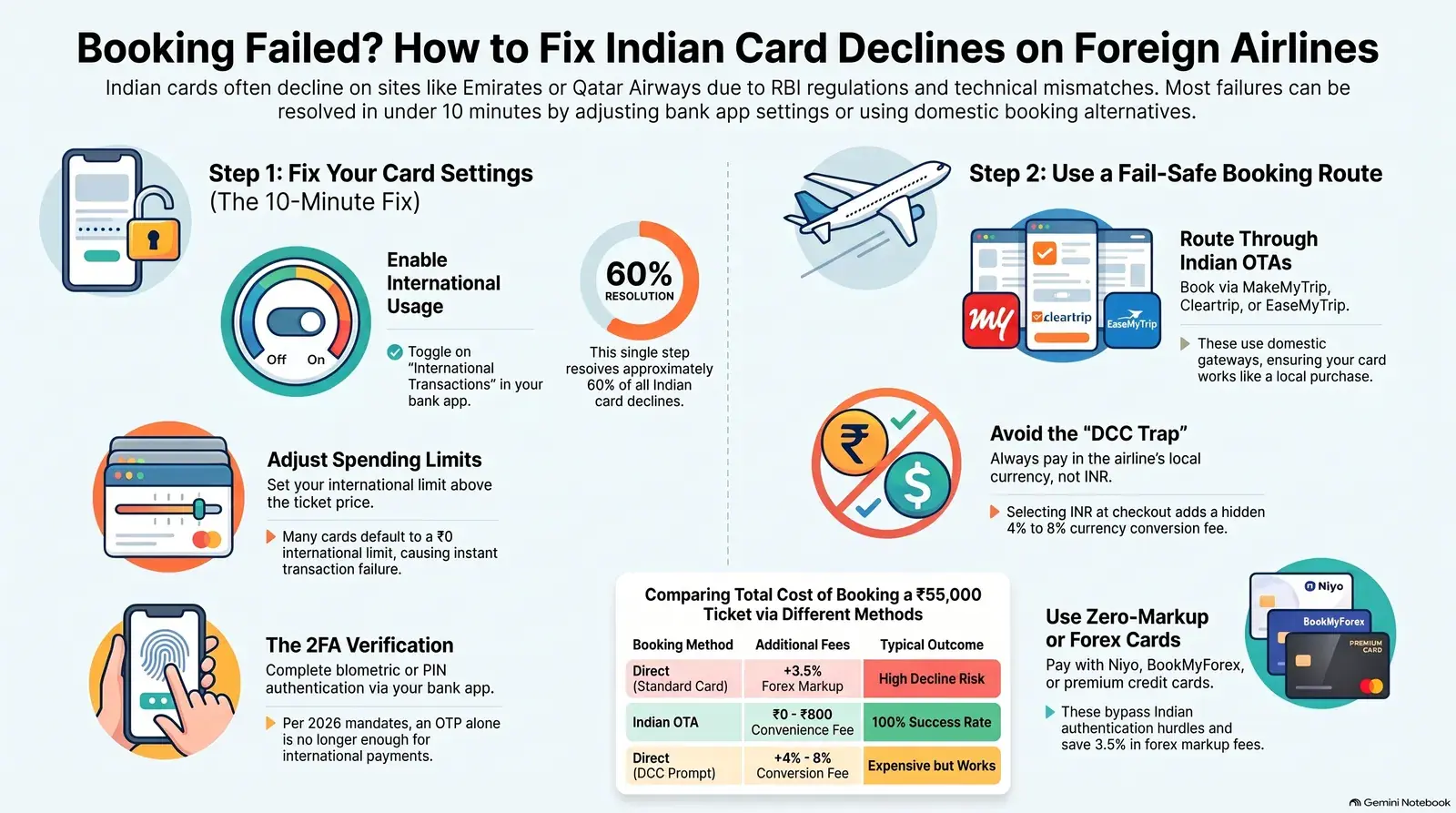
- Most declines are a one-toggle fix: Indian cards issued after March 2020 have international transactions disabled by default. Open your bank app, go to Card Controls, and switch international usage on. On our reading of the failure modes below this is the single most common fix — we estimate it accounts for roughly 60% of declines, though no Indian bank publishes decline-reason data.
- RBI's October 2026 2FA mandate changes the rules: From 1 October 2026, OTP alone is no longer enough for cross-border card-not-present transactions. Your bank must also add a second authentication factor — expect your bank app to prompt for a PIN or biometric after your OTP.
- The instant fallback is an Indian OTA: MakeMyTrip, Cleartrip, and EaseMyTrip carry live Emirates, Qatar Airways, and Etihad inventory and route payment through domestic Indian gateways — your card works as if it were a domestic purchase.
International transactions disabled (default off since March 2020)
Bank app → Card Controls → Enable International Usage
1 October 2026 — 2FA mandatory for cross-border CNP transactions
Book same flight on MakeMyTrip / Cleartrip — domestic gateway, no CNP issues
Why Is My Indian Card Declined on Foreign Airline Websites? The 5 Most Common Causes
Indian credit and debit cards are declined on foreign airline sites for five specific, identifiable reasons — and understanding which one applies to your situation is the key to choosing the right fix. Foreign airline websites are particularly prone to declines compared to foreign hotel or OTA sites because they operate on merchant-side payment infrastructure based abroad, which does not always align with the authentication mechanisms preferred by Indian card issuers.
Cause 1 — International transactions are disabled on the card
This is the single most common cause, responsible for the majority of declines from Indian-issued cards on foreign airline sites. The Reserve Bank of India (RBI) directed banks from March 2020 onward to issue cards with international transactions disabled by default for safety. The card you received from your bank almost certainly arrived with international use switched off unless you specifically requested it during application. You will see a generic "Transaction Declined" or "Authorization Failed" message with no further explanation. The fix: toggle international usage on in your bank app or internet banking portal — a process that now takes under two minutes for most major banks (see Step 1 below).
Cause 2 — International spending limit set to zero or too low
Even if international transactions are technically enabled, your bank may have set your international per-transaction or per-day limit to zero, or to an amount lower than the ticket price. RBI directed banks to cap overseas spend on cards based on each customer's risk profile, and many banks default this limit to ₹0 or ₹10,000 for accounts that have not previously made international transactions. A ₹55,000 Emirates fare will always decline against a ₹10,000 limit. Call customer care (Step 2) to raise this limit — most banks can do it instantly via a phone call, with the new limit active within minutes.
Cause 3 — 3D Secure version mismatch
Foreign airline payment pages increasingly use 3D Secure 2.0 (3DS 2.0) for authentication, while many Indian bank systems still run on the older 3DS 1.0 protocol, and the two do not communicate seamlessly. In a 3DS 2.0 flow, the airline's payment gateway sends a structured authentication request that your bank's older 3DS 1.0 system may reject silently, without ever showing you an OTP page. You will see the authentication screen flash briefly and then return a decline — frustratingly, without any OTP prompt. Banks like HDFC Bank and ICICI Bank have been progressively upgrading to 3DS 2.0, but the upgrade is not complete across all card types and all merchants as of August 2026. If Cause 1 and Cause 2 are not the issue, try a card from a different bank or switch to an alternate route (Step 3).
Cause 4 — OTP not received, or OTP timed out
Foreign airline payment pages typically allow between 60 and 90 seconds to complete 3D Secure OTP authentication, and an OTP that arrives late — or not at all — causes a hard decline that is difficult to distinguish from a limit or authentication failure. OTP delivery to Indian mobile numbers can be delayed by international SMS routing when the payment page is served from an overseas server. The most common fix: keep your Indian SIM active in a device with strong network signal before initiating payment, and ensure your bank has your correct registered mobile number. If you are outside India, consider using an eSIM that retains your Indian number — read our eSIM guide for maintaining your Indian number abroad.
Cause 5 — Fraud detection triggers on an unfamiliar merchant
Bank fraud-detection algorithms flag transactions to merchants your card has never transacted with before, particularly when the merchant category code (MCC) is international airline and the billing country is overseas. This is an invisible automatic block — you receive no OTP prompt and no error code, only a decline. Whitelisting the specific merchant with your bank (covered in Step 2) is the targeted fix for this cause. SBI, in particular, is known to apply aggressive fraud detection on first-time international airline bookings, requiring a customer-initiated merchant whitelist request before the transaction can proceed.
How Has RBI's October 2026 2FA Mandate Changed Foreign Airline Payments?
From 1 October 2026, Indian card issuers must apply a risk-based additional-authentication mechanism to cross-border card-not-present (CNP) transactions — both recurring and non-recurring — meaning a single SMS OTP may no longer be sufficient to authenticate a payment on a foreign airline website. The RBI issued these directions in late 2025 as part of its broader framework to apply the same security standards to international online transactions as already exist for domestic payments (which moved to mandatory 2FA from 1 April 2026).
In practice, this means:
- Card issuers must validate cross-border CNP transactions when overseas merchants or acquirers request authentication.
- Banks must register their Bank Identification Numbers (BINs) with international card networks (Visa, Mastercard) to enable the handshake.
- A risk-based mechanism governs which transactions require step-up authentication — high-value or first-time merchant transactions will see additional prompts.
- OTP alone satisfies only one of the two required factors. Your bank may prompt you to confirm a PIN, use fingerprint authentication in the app, or approve via an in-app push notification as the second factor.
For travellers booking flights in August–September 2026, some banks have already rolled out the new flow, while others are still in transition. If your bank's app now asks you to confirm a purchase with both an OTP and a biometric, this is the new 2FA mandate in action — not a bug. The 1 October 2026 cross-border CNP deadline is set by the Reserve Bank of India (Authentication Mechanisms for Digital Payment Transactions) Directions, 2025, issued on 25 September 2025.
On-the-Ground Insight: "I tried booking my flight to Boston using my father's SBI credit card on the airline's US site. The transaction failed four times because of a hidden ₹2,00,000 per-day international limit on the card. We had to call the bank to manually lift the limit via net banking before the fare expired. The OTP came fine each time — it was the invisible spending cap that was blocking it." — Aman S., NEU Boston, Fall 2025 Intake
Step 1 — Enable International Transactions in Your Banking App (Bank-by-Bank Guide)
Before calling customer care or switching to an alternate payment route, open your bank's mobile app and check whether international transactions are enabled on your card — this resolves the majority of declines in under two minutes. The path differs by bank, but the concept is the same: find Card Controls or Card Usage Settings, then toggle "International Usage" from Off to On. The change takes effect immediately on most platforms.
| Bank | App Name | Path to Enable International Transactions | Time to Activate | Forex Markup Fee |
|---|---|---|---|---|
| HDFC Bank | HDFC Mobile Banking | Cards → Debit/Credit Cards → Request → Set Card Controls/Usage → Customise → International Usage → ON | Instant | 3.5% + GST (standard); 2% on Regalia Gold and Infinia |
| SBI / YONO | YONO SBI | Menu → Service Request → Manage Card → Select Account → Enable International Transactions | Instant | 3.5% + GST (standard debit/credit) |
| ICICI Bank | iMobile Pay | Cards → Debit Cards → Manage Debit Card Limits → Select Card → International → Enable | Instant | 3.5% + GST (standard); lower on Emeralde Private (2%) |
| Axis Bank | Axis Mobile | Cards → Manage Card → Card Controls → International Usage → Toggle ON | Instant | 3.5% + GST (standard cards and Atlas) |
| Kotak Mahindra | Kotak 811 | Cards → Manage Card → Card Preferences → International Transactions → Enable | Instant | 3.5% + GST (standard) |
| Yes Bank | YES Mobile | My Cards → Card Controls → International Usage → Enable | Instant | 3.5% + GST (standard) |
After enabling international usage, navigate to the card limit settings and verify your international per-transaction and per-day limit. If it shows ₹0 or a figure below your fare amount, raise it in the same screen (most apps allow this to up to ₹5,00,000 per day or your credit limit, whichever is lower). A toggle set to ON with a ₹0 limit will still decline.
Step 2 — Call Your Bank to Whitelist the Airline or Raise the International Limit
If enabling international transactions in the app does not resolve the decline, the next step is a direct call to your bank's customer care to request a merchant whitelist for the specific airline and a one-time limit raise for the transaction amount. This directly addresses Causes 2 and 5 from the list above, and most banks can activate both changes within minutes while you remain on hold.
When you call, have the following information ready:
- Your card number (last 4 digits), registered mobile number, and date of birth for verification.
- The name of the airline website (e.g. "emirates.com" or "qatarairways.com") — specify it is an international airline website with a foreign merchant ID.
- The exact amount of the transaction you are trying to complete.
- The booking currency (USD, AED, GBP, EUR) — different from the INR equivalent.
Ask the representative for three specific actions: (1) confirm that international card-not-present transactions are enabled, (2) set your international per-day limit to at least the transaction amount plus 10% buffer for forex fluctuations, and (3) whitelist the airline's merchant name or URL for the next 48 hours. Many banks — particularly HDFC and ICICI — can apply a temporary 24–48 hour whitelist during the call itself, after which you should retry the airline website immediately while the session is still active.
Airline fare locks held in a shopping cart typically expire in 20–30 minutes. If your card's international block is the issue and your bank's call queue is long, consider switching to the Indian OTA route (Step 3) to secure the fare while you continue working on the card fix in parallel.
Step 3 — Alternate Payment Routes That Always Work
If your card continues to decline after Steps 1 and 2, or if you need to secure the fare immediately without delay, three alternate payment routes bypass the international card-not-present authentication entirely. Each has different cost implications and setup requirements.
Route A — Book via an Indian OTA (fastest, no additional cost)
Booking the exact same fare on an Indian OTA (MakeMyTrip, Cleartrip, or EaseMyTrip) routes the payment through a domestic Indian payment gateway, making the transaction indistinguishable from a domestic airline booking as far as your bank is concerned. All Indian cards, UPI, and net banking work seamlessly. The trade-off: OTAs sometimes carry fares that are ₹500–₹2,000 higher than the airline's own direct site on the same day due to their own markup, though price parity is common. Always compare before booking. See the inventory details in the next section.
Route B — Pay with a forex card or a zero-markup international card
A multi-currency forex card loaded with USD, AED, GBP, or EUR bypasses the entire Indian card authentication stack — it is treated by the foreign airline's payment system as an internationally issued card and processes without an Indian OTP. Cards like the Thomas Cook Multi-Currency Prepaid Card, Niyo Global, and BookMyForex Prepaid Card carry zero forex markup on loaded currencies and are designed specifically for this use case. The con: you need to load the card in advance, and exchange rate fluctuations between loading and booking can add or remove value. Low-markup Indian credit cards — HDFC Regalia Gold and HDFC Infinia at 2%, IDFC First Wealth at 1.5% — cut the markup roughly in half versus the 3.5% standard, and the genuinely zero-markup IDFC FIRST WOW! charges 0%. Note that the Axis Atlas, despite its travel positioning, still carries a 3.5% forex markup — it is an earning card, not a forex-saving one.
Route C — Net banking via the OTA checkout
If you prefer not to use a card at all, Indian OTA checkouts accept NEFT/IMPS-backed net banking for high-value transactions above the UPI ₹1 lakh per-transaction ceiling. MakeMyTrip and Yatra both support net banking via their domestic checkout — select "Net Banking" at the payment screen and choose your bank from the drop-down. This route is slower (the bank portal redirect can take 2–3 minutes) but is reliable and avoids card authentication issues entirely.
Which Indian OTAs Reliably Carry Emirates, Qatar Airways, and Etihad Inventory?
All three major Indian OTAs — MakeMyTrip, Cleartrip, and EaseMyTrip — carry live seat inventory for Emirates, Qatar Airways, and Etihad Airways on all routes they operate from Indian airports, and prices typically match the airlines' own websites within ₹500–₹2,000 for economy fares. The inventory comes via GDS connections (Amadeus and Galileo), ensuring real-time seat availability rather than cached or limited fare classes.
| Indian OTA | Emirates | Qatar Airways | Etihad Airways | UPI Accepted? | Net Banking? | OTA-Specific Fee |
|---|---|---|---|---|---|---|
| MakeMyTrip | ✓ Full inventory | ✓ Full inventory | ✓ Full inventory | Yes (up to ₹1 lakh/txn) | Yes | ₹0–₹600 convenience fee |
| Cleartrip | ✓ Full inventory | ✓ Full inventory | ✓ Full inventory | Yes | Yes | ₹0–₹500 convenience fee |
| EaseMyTrip | ✓ Full inventory | ✓ Full inventory | ✓ Full inventory | Yes | Yes | Typically ₹0 (no convenience fee model) |
| Yatra | ✓ Available | ✓ Available | ✓ Available | Yes | Yes | ₹0–₹400 depending on fare type |
One important caveat: Indian OTAs do not always surface the airline's student club fares, military fares, or promotional sale fares that are available exclusively through the airline's direct channel. If the fare you are trying to book is a loyalty-rate or promotional price, it may not appear on the OTA. In that case, fix the card authentication issue directly (Steps 1–2) rather than switching to the OTA route.
True Cost (OTA) = Airline Fare + OTA Convenience Fee + Forex
Markup (₹0 if paying in INR via OTA)
True Cost (Direct) = Airline Fare + Forex Markup Fee (3%–3.5% on
standard cards)
On a ₹55,000 Emirates ticket, the direct booking with a standard card adds ₹1,650–₹1,925 in forex markup, while an OTA adds ₹0–₹600 in convenience fee with zero forex markup. OTA often wins on total cost, even before accounting for the time saved avoiding authentication issues.
The DCC Trap: Always Pay in Local Currency on Foreign Airline Websites
When your Indian card does go through on a foreign airline's payment page, you will often see a prompt asking whether you want to pay in Indian rupees (INR) — this is Dynamic Currency Conversion (DCC), and accepting it is an expensive mistake that adds 4%–8% to the cost of your ticket.
DCC works like this: the airline's overseas payment processor detects that your card was issued in India, looks up an exchange rate, and offers to convert the fare into INR for your convenience. The rate it uses is not the mid-market rate — it is a rate that builds in a fat conversion margin for the payment processor. The same card purchase that would cost ₹55,000 via mid-market USD/INR conversion can become ₹57,700–₹59,400 under DCC.
- When the payment page shows a currency selection (INR vs USD/AED/GBP/EUR), always select the airline's local billing currency — not INR.
- If a pop-up asks "Pay in INR for a guaranteed rate?" — click No or Pay in [foreign currency].
- Use a low- or zero-forex-markup card (Niyo Global and IDFC FIRST WOW! at 0%, IDFC First Wealth at 1.5%, HDFC Regalia Gold and Infinia at 2%) for maximum savings: you get your bank's conversion rate with a 0%–2% markup, far better than the 4%–8% DCC rate.
- If you are unsure which option was selected, check your bank statement: a DCC transaction appears with INR already converted before it reaches your account, while a non-DCC transaction shows the foreign currency amount with a forex conversion line below it.
TCS Implications When Booking International Flights from India
Tax Collected at Source (TCS) rules under the Liberalised Remittance Scheme (LRS) do not apply to overseas credit card spending abroad, but they may apply if you are remitting funds from India to pay for a flight on a foreign airline's website. This distinction matters when choosing your payment method.
As of the financial year 2026–27, the LRS TCS framework works as follows:
- Overseas credit card spending abroad: explicitly carved out of LRS — no TCS applies. If you are physically outside India and pay for your next flight using your Indian credit card, you will not attract TCS regardless of amount.
- Debit card and forex card spending from India: counts toward your USD 250,000 annual LRS limit. Above ₹10 lakh in a financial year, a 20% TCS is levied on the excess. You can claim this TCS back when filing your income tax return, but the cash outflow is immediate.
- Overseas tour packages: a flat 2% TCS from the first rupee applies as of 1 April 2026, regardless of amount, when booked as a bundled package through a registered operator.
- Standalone airline ticket from India: if you pay for a foreign airline's flight on their website from India using an Indian credit card, the transaction may or may not count as LRS remittance depending on how your bank classifies it. Consult a tax advisor if your total international transactions are approaching ₹10 lakh in the financial year.
For most individual flight bookings (₹40,000–₹1,50,000 per ticket), TCS is not triggered if you are using a credit card and your cumulative LRS spend for the year is below ₹10 lakh. However, if you are booking for a family of four on Emirates Business Class (easily ₹6–8 lakh), keep a running total. The 20% TCS on LRS above ₹10 lakh is a ₹20,000 outflow on every additional ₹1 lakh — a meaningful cash flow impact even if it is eventually refunded at tax time.
Frequently Asked Questions
Why does my Indian credit card keep getting declined on Emirates.com?
The most common reasons are: international transactions disabled on the card (the default for cards issued after March 2020), a per-day international limit of zero, a 3D Secure version mismatch between your bank (3DS 1.0) and Emirates (3DS 2.0), or an OTP that times out before you can enter it. Enable international usage in your bank app first; if that fails, call customer care to raise the limit and whitelist the Emirates merchant.
What is RBI's October 2026 2FA mandate for cross-border transactions?
From 1 October 2026, Indian card issuers must apply a risk-based additional-authentication mechanism to cross-border card-not-present (CNP) transactions, both recurring and non-recurring. Banks must register their BINs with card networks and build a risk-based validation mechanism. This means OTP alone is no longer sufficient — you need OTP plus a second factor such as a PIN or biometric.
Can I book Emirates, Qatar Airways or Etihad through an Indian OTA?
Yes. MakeMyTrip, Cleartrip and EaseMyTrip all carry live inventory for Emirates, Qatar Airways and Etihad Airways. Booking through an Indian OTA routes your payment through a domestic Indian payment gateway, so Indian cards, UPI and net banking all work without international authentication issues.
Does TCS apply when I book a flight on a foreign airline website from India?
Overseas credit card spending abroad is outside the Liberalised Remittance Scheme (LRS) and attracts no TCS. However, if you remit money from India to pay for a flight (e.g. via a forex card or debit card loaded from an Indian account), that spend counts toward your LRS limit. Above Rs. 10 lakh in a financial year, a 20% TCS applies. Booking your ticket on the foreign airline's Indian-rupee payment page using an Indian credit card does not clearly trigger LRS, but consult a tax advisor for your specific situation.
What is Dynamic Currency Conversion and how do I avoid it on airline websites?
Dynamic Currency Conversion (DCC) is when a foreign airline's payment page offers to charge your card in Indian rupees instead of the booking currency (USD, GBP, EUR, AED). The DCC rate includes a hidden markup of 4% to 8% above the mid-market rate. Always select 'Pay in [local currency]' — USD, GBP, AED, or EUR — and let your bank handle the conversion, especially if you hold a zero-forex-markup card.
Ready to book? Compare live fares before you commit
Use our fare calendar to find the cheapest dates across Emirates, Qatar Airways, and Etihad — then decide whether to book direct or via an Indian OTA once you know your card is set up correctly.
All information in this article is based on publicly available official sources as of August 2026, including RBI directions, bank-published card control guides, and OTA fare availability data. RBI guidelines, bank app interfaces, and OTA inventory may change. Always verify current rules directly with your card-issuing bank and the Reserve Bank of India. This article does not constitute financial, tax, or legal advice. TCS implications should be verified with a qualified tax advisor for your specific circumstances.
- NEW RBI October 2026 2FA Mandate for International Card-Not-Present Transactions — what changed on 1 October 2026 and the bank-by-bank guide to enabling international settings before your next booking
- NEW Card Tokenisation for Flight Bookings in India 2026 — how RBI's tokenisation mandate affects saved cards on airline apps and OTAs
- Transfer Credit Card Points to Airline Miles — India 2026 Guide — step-by-step guide to moving HDFC, Axis, and Amex points to KrisFlyer, Avios, and Air India
- HDFC Credit Card Flight Offers 2026 — current HDFC bank-level discounts and co-branded offers for flight bookings
- PhonePe Flight Booking Guide 2026 — how to use PhonePe UPI for domestic and international flights, including inventory and limits