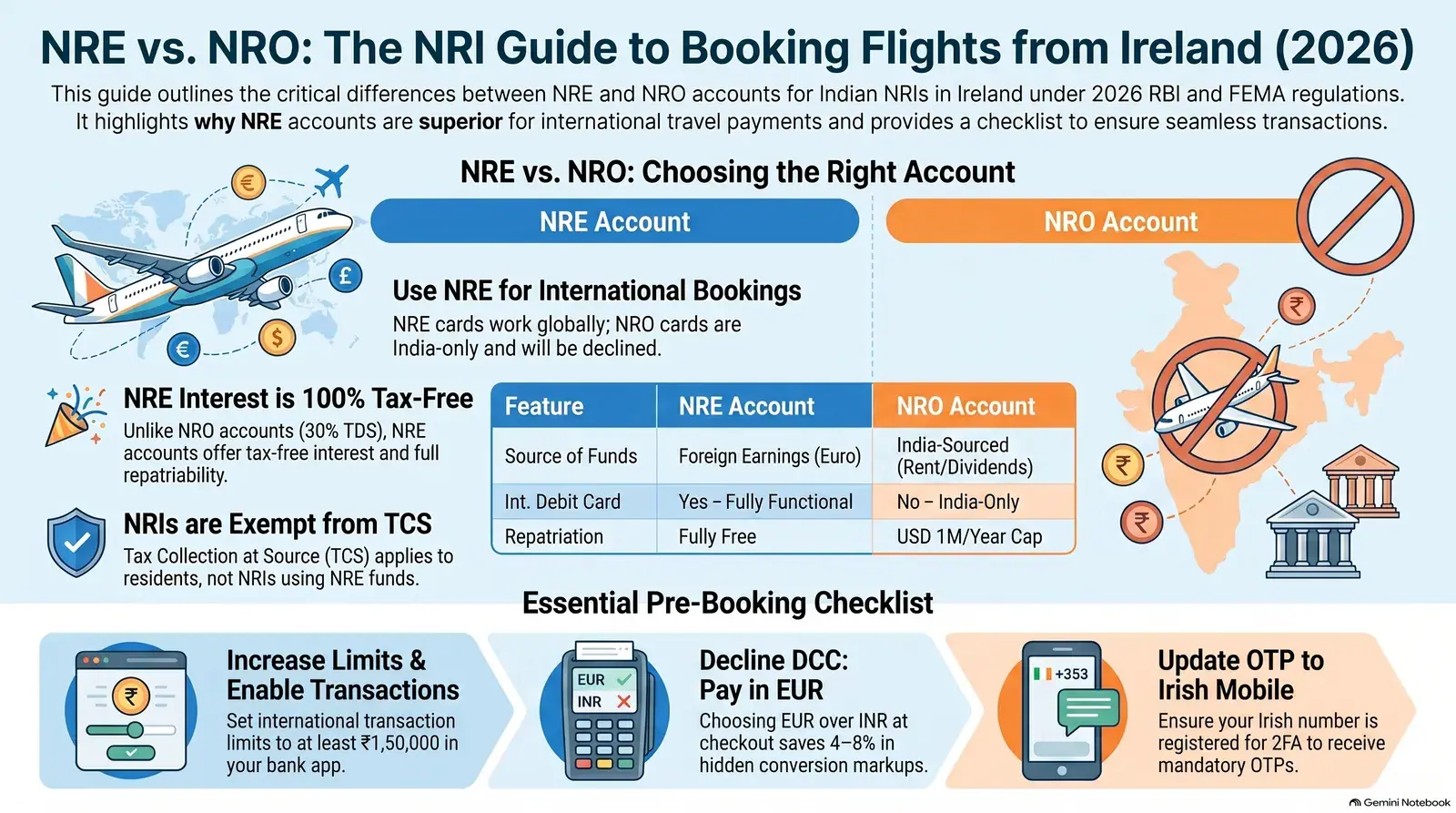
- Use your NRE account, not NRO: NRE debit cards work internationally and can pay for flights on MakeMyTrip, Cleartrip, and EaseMyTrip. NRO debit cards are India-only and will be declined on international airline sites.
- No LRS or TCS if you are an NRI: The Liberalised Remittance Scheme and TCS rules apply only to resident Indians — not to NRIs drawing on an NRE account. Paying for your Dublin-India flight from NRE funds is a standard FEMA current account transaction with no TCS deduction.
- Expired KYC freezes everything: If your NRE or NRO Re-KYC is overdue, the bank freezes all operations — blocking purchases, withdrawals, and flight bookings. Update KYC proactively by emailing self-attested documents from your registered email before the deadline.
Yes — usable worldwide including Indian OTAs
No — India-only; declined on foreign sites
No — NRIs are exempt from LRS entirely
USD 1 million per financial year (Form 145 required)
What is the difference between an NRE and NRO account for flight bookings?
The single most important difference for flight booking is that NRE debit cards can be used internationally while NRO debit cards are restricted to India-only transactions. If you try to pay for an Emirates or Qatar Airways ticket on their international website using an NRO debit card, the transaction will be declined at the point-of-sale authorisation — not because of a limit or a fraud flag, but because the card is structurally not enabled for cross-border use.
NRE (Non-Resident External) accounts are designed to hold foreign earnings — the salary you earn in Ireland and the transfers you make from your Irish bank account. Funds are held in Indian rupees but originate from outside India. Interest on NRE savings accounts is completely tax-free in India under the Income Tax Act 2025, and both principal and interest can be freely repatriated with no annual cap under FEMA. The key phrase is "freely repatriable" — this is what makes the NRE account the correct instrument for an NRI spending internationally on flight tickets.
NRO (Non-Resident Ordinary) accounts hold India-sourced income — rent from a property in India, dividends from Indian equities, pension payments from an Indian employer, or the sale proceeds of Indian assets. Interest on NRO accounts is taxable in India at a flat 30% TDS. Repatriation from NRO accounts is capped at USD 1 million per financial year (April to March), and every such transfer requires Form 145 (the 2026 rename of Form 15CA) and, for amounts above ₹5 lakh, Form 146 (the 2026 rename of Form 15CB) — a certificate from a Chartered Accountant confirming all Indian taxes on the funds have been paid.
| Feature | NRE Account | NRO Account |
|---|---|---|
| Source of funds | Foreign earnings remitted to India (Irish salary, savings) | India-sourced income (rent, dividends, pension) |
| Interest taxation (India) | Tax-free | 30% TDS on interest |
| Repatriation | Fully free — no annual cap, no documentation | USD 1 million per FY; Form 145 + Form 146 required |
| Debit card — international use | Yes — usable worldwide on airline sites and Indian OTAs | No — India-only; declined on international sites |
| Joint holding rules | With another NRI only (resident relative as POA only) | Resident Indian or another NRI permitted as joint holder |
| Best for flight booking? | Yes — primary account for international payments | No — domestic INR transactions only |
How do I use an NRE-linked card to pay for flights on MakeMyTrip, Cleartrip and EaseMyTrip?
To pay for India-departure flights on MakeMyTrip, Cleartrip, or EaseMyTrip using your NRE-linked debit or credit card, you select the card as your payment method exactly as any Indian resident would — there is no NRI-specific booking flow and Indian OTAs do not require a special NRI mode. However, several pre-booking steps are essential to prevent a declined transaction at checkout.
Step 1: Enable international transactions on your NRE card
Most Indian banks ship NRE debit cards with international transactions disabled by default — you must activate this through your bank's app or NRI cell before attempting any overseas or online-international purchase.
For ICICI Bank NRE accounts, log in to iMobile Pay, navigate to "Manage Cards," select your NRE debit card, and enable "International Transactions." For HDFC Bank NRE accounts, open the HDFC Bank app, go to "Cards" → "Debit Card" → "International Usage" and switch it on for online transactions. For SBI NRE accounts, call the SBI NRI helpline or visit your nearest branch to request international enablement, since the YONO app may not support NRE card controls for NRI account holders based abroad.
The Reserve Bank of India has required since 1 October 2020 that all card issuers let customers switch international transactions on or off and set per-transaction and per-day limits for card-not-present use through digital banking channels. Check and increase your online international spending limit before booking a high-value flight — many default limits are set as low as ₹40,000 per day.
Step 2: Select the right OTA and watch for the DCC trap
MakeMyTrip, Cleartrip, and EaseMyTrip all carry the major Dublin-India airlines — Emirates, Qatar Airways, Etihad, and Air India — and all three accept NRE debit cards, credit cards, and UPI International for INR-denominated bookings.
When booking from the airline's Irish or UK website directly (where fares may be quoted in EUR or GBP), you must actively refuse Dynamic Currency Conversion (DCC). DCC is where the airline's payment processor offers to charge your NRE card in INR rather than EUR, applying a hidden markup of 4% to 8% above the mid-market exchange rate. On the Emirates and Qatar Airways payment pages, a currency selector or checkbox appears at checkout — always choose EUR (the local currency). Your own bank then handles the conversion at a transparent interbank rate, typically 1.5% to 3% better than DCC. On a ₹90,000 ticket, avoiding DCC saves ₹3,600 to ₹7,200 in a single booking.
True Cost = Base Fare (EUR) × EUR/INR Spot Rate + Forex Markup Fee + Checked Baggage Add-On
On-the-Ground Insight: "I booked my Mumbai flight on the Emirates Ireland website using my HDFC NRE Platinum debit card. The payment page defaulted to charging ₹92,400 for a €1,040 ticket — but the actual mid-market rate that day was €1 = ₹87.50, putting the fair value at ₹91,000. I unchecked the INR option and paid in EUR instead. My statement showed ₹91,120 — saving over ₹1,200 on one booking just by changing the currency setting." — Arjun V., Software Engineer, Dublin, NRI since 2023
Is paying for a Dublin-India flight from my NRE account a repatriation transaction under FEMA?
No — paying for an airline ticket using your NRE account debit card or by wire is classified as a current account transaction under FEMA, not a capital account or repatriation transaction, and is freely permitted with no annual cap and no documentation requirements.
Under FEMA (Foreign Exchange Management Act), all foreign exchange transactions fall into two categories. Current account transactions — including trade in services, travel expenses, and personal maintenance remittances — are freely permitted for NRIs without limit or reporting. Capital account transactions — investments in property, securities, and certain large asset movements — are subject to FEMA limits and approval requirements.
Paying for an airline ticket, whether on an Indian OTA or directly on an airline's website, is a current account payment for a travel service. NRE account balances are fully repatriable, meaning the funds can move back to your Irish account at any time without a cap. But the word "repatriation" in RBI terminology specifically means moving funds from India back to your overseas bank account. A card purchase for a flight is not that; it is a service payment. No Form 145, no Form 146, no CA certificate, and no RBI reporting are required for individual flight bookings from an NRE account at any fare level.
What if I need to use NRO funds for a flight?
If you need to use NRO funds, the cleanest approach is to first transfer the required amount from your NRO account to your NRE account — up to USD 1 million per financial year with Form 145 — and then pay for the flight from the NRE account using the international-enabled card. Alternatively, you can book on an Indian OTA where the charge is processed as a fully domestic INR transaction within India's payment infrastructure; in that case an NRO card may work for India-origin domestic card charges, though the card's international restriction still blocks bookings where the airline's acquiring bank is outside India.
Can OCI cardholders and PIOs in Ireland open and use an NRE account?
Yes — Overseas Citizens of India (OCI) and Persons of Indian Origin (PIO) are fully eligible to open both NRE and NRO accounts under RBI and FEMA regulations, and the account rights are identical to those of Indian passport-holding NRIs.
The RBI's FEMA notifications on NRI accounts explicitly include OCI and PIO holders in the category of eligible persons. For OCI cardholders based in Ireland, the documentation requirements are straightforward: a valid overseas passport (your Irish passport or the passport of your country of citizenship), your OCI card as identity proof, and proof of your current Irish address. Accepted Irish address proofs include a utility bill, Irish bank statement, employment letter, or IRP card, all dated within the last six months.
| Document type | Indian Passport NRI | OCI Cardholder (Ireland) |
|---|---|---|
| Identity proof | Valid Indian passport | Overseas passport + OCI card |
| NRI/overseas status proof | Irish visa or IRP card | Irish visa or IRP card |
| Overseas address proof | Utility bill, Irish bank statement, or IRP card | Same — any of the above, within 6 months |
| NRE account eligibility | Yes | Yes |
| NRO account eligibility | Yes | Yes |
| Joint holding | With another NRI (NRE); with resident or NRI (NRO) | Same rules apply |
Re-KYC requirements for OCI cardholders in Ireland
Indian banks conduct periodic Re-KYC updates for all NRI, OCI, and PIO account holders — failure to complete Re-KYC within the stipulated timeframe results in a temporary account freeze that blocks all purchases, withdrawals, and transfers including flight bookings.
The frequency depends on risk categorisation: high-risk accounts every 2 years, medium-risk every 8 years, and low-risk every 10 years. Banks send notifications to your registered email and mobile number before the deadline. If your registered contact details are from before you moved to Ireland — an old Indian mobile number or a former email — you may miss the notification entirely. Update your contact details first, then complete the Re-KYC.
To update Re-KYC from Ireland: email your bank's NRI cell from your registered email with self-attested copies of your current passport or OCI card, your current Irish visa or IRP card, and your current Irish address proof. HDFC Bank, ICICI Bank, SBI, and Axis Bank all accept email-based Re-KYC for overseas NRIs and typically update the account within 3 to 5 business days.
Do LRS limits and TCS apply when an NRI pays for flights from an NRE account?
No — the Liberalised Remittance Scheme (LRS) and the TCS rules that apply to overseas payments are applicable only to resident Indians, not to NRIs drawing on an NRE account balance. This is one of the most frequently misunderstood points among Indian professionals who have recently moved to Ireland on a work permit or student visa.
The RBI's Liberalised Remittance Scheme allows resident Indians to remit up to USD 250,000 abroad per financial year for education, travel, healthcare, gifts, and investments. Tax Collected at Source (TCS) under Section 206C(1G) of the Income Tax Act applies to LRS remittances above certain thresholds: a flat 2% TCS on overseas tour packages booked as a bundled package through a registered operator (effective from 1 April 2026, with no ₹10 lakh threshold for bundled packages), and 5% TCS on other LRS remittances above ₹10 lakh per year. Note that TCS is a credit, not a final tax — resident Indians can offset it against their income tax liability at year-end filing.
None of this applies to an NRI. Once you become an NRI under FEMA — which happens when you have spent more than 183 days outside India in a financial year — the LRS framework simply does not apply to you. NRIs have their own separate FEMA permissions for moving money into and out of India, and they do not need to use LRS. Paying for a Dublin-India flight from your NRE account is not an LRS transaction under any reading of the rules, and no bank in India should deduct TCS on such a payment.
- Overseas bundled tour packages: 2% TCS, no ₹10 lakh threshold (from 1 April 2026)
- Other LRS remittances (individual flights, forex cards): 5% TCS above ₹10 lakh per year
- NRIs using NRE accounts: Exempt — LRS does not apply to NRIs
- TCS is creditable against income tax at filing — not a permanent extra cost for residents either
What about the e-Arrival Card for Ireland-to-India travel in 2026?
From 1 April 2026, India's Bureau of Immigration mandates an e-Arrival Card (eAC) for all foreign nationals and OCI cardholders arriving in India, to be submitted online within 72 hours before arrival. This is separate from payment method but is a step every OCI cardholder returning to India from Ireland must complete before every trip. Indian passport-holding NRIs are currently exempt from the eAC requirement, but all OCI cardholders must complete it regardless of how they paid for their ticket or how many times they have previously visited India.
What are the most common pitfalls when using an NRE or NRO account for flight bookings?
The five most common reasons an NRI's Indian bank card is declined when booking international flights are: international transactions not enabled, an NRO card used where an NRE card is required, an expired KYC freeze, an insufficient daily international spending limit, and an OTP that cannot reach the registered Irish number.
Pitfall 1: International transactions not enabled on the card
Most banks disable international card-not-present transactions by default. Enable this in your bank's app before booking — not at checkout — because the activation can take 30 minutes to 2 hours to propagate through the card network.
Pitfall 2: Confusing the NRO card with the NRE card
If you hold both an NRE and NRO account with the same bank, you may have received debit cards for both. The cards look nearly identical; the difference is usually only in a small label on the back or the card number prefix. Check which account each card is linked to in your bank app before booking. Using the NRO card for an international purchase generates a clean decline that offers no explanation.
Pitfall 3: Expired KYC freezing the account
RBI requires all banks to conduct periodic KYC updation for NRI accounts. If your account's KYC is overdue, the bank freezes all account operations without advance warning at the transaction level — you simply receive a decline. Check your account status in your bank's NRI app before travelling, and email self-attested KYC documents proactively as described in the OCI/PIO section above. The SBI Global International Debit Card has a default ATM withdrawal limit of ₹40,000 per day; on higher-end ICICI NRI cards, daily retail limits vary by tier. A Dublin-India flight costing ₹85,000 to ₹1,10,000 will exceed many standard daily limits — increase your online international spending limit to at least ₹1,50,000 before booking.
Pitfall 4: OTP not reaching your Irish number
The RBI requires from 1 October 2026 that all card issuers apply additional-factor authentication (2FA) to cross-border card-not-present transactions. If your registered mobile number with the bank is still an Indian number that you no longer receive, you will not receive the OTP, and the transaction will time out at checkout. Update your registered mobile to your current Irish number through your bank's NRI cell or the bank app before attempting any international booking.
Pitfall 5: Incorrect purpose code on NRO-to-NRE transfers
When transferring from NRO to NRE accounts, Indian banks require a purpose code under FEMA. Using the wrong code or leaving it blank is a common reason bank compliance teams hold or reject the transfer, delaying funds you need for an imminent flight booking. The correct purpose code for an intra-bank NRO-to-NRE transfer is typically P1301 (personal remittances) — confirm the specific code with your bank's NRI cell before initiating the transfer.
- Confirm which card (NRE or NRO) you are using — check the linked account in the bank app
- Enable "International Transactions" and "Online International Purchases" in the bank app
- Check and increase your daily online international spending limit to at least ₹1,50,000
- Verify your KYC status is active and not frozen
- Confirm your registered mobile number is your current Irish number for OTP delivery
- At checkout, always choose EUR (not INR) to avoid Dynamic Currency Conversion markup
How much are you overpaying? Forex markup calculator
When you pay for a EUR-denominated flight ticket with an Indian NRE debit card, your bank applies a forex markup fee on top of the spot exchange rate. Standard NRE debit card markup rates in 2026: HDFC NRE Platinum charges 2% forex markup; SBI Global International charges 2.5% to 3%; ICICI Bank NRI cards charge 2%. Zero-markup alternatives: the IDFC FIRST Bank WOW Card charges 0% forex markup (FD-secured, NRI-eligible), and the Wise multi-currency card converts at the interbank rate with 0% forex markup. DCC (airline auto-converts to INR) adds 4% to 8% above market rate — the most expensive option. Use the calculator below to see how much each option costs on your specific fare.
🧮 NRE Card Forex Markup Calculator (Ireland to India Flights)
Enter your flight fare in EUR and the current EUR/INR rate, then select your card's forex markup to see the true cost in INR and how much you save vs. a zero-markup card. The pre-filled values are illustrative only: EUR 900 is a typical Dublin–India return economy fare, not a quoted price, and the 90 EUR/INR spot rate is a round placeholder — replace both with your own fare and the live rate before reading the result.
| Card / Method | Forex Markup | Extra cost on ₹81,000 ticket (EUR 900 at ₹90) | Notes |
|---|---|---|---|
| IDFC FIRST WOW | 0% | ₹0 | FD-secured credit card; NRIs eligible; lifetime-free |
| Wise Travel Card | 0% (interbank rate) | ₹0 | Multi-currency prepaid; holds EUR, GBP, INR |
| HDFC NRE Platinum Debit | 2% | ₹1,620 | Standard NRE debit; international use enabled |
| ICICI Bank NRI Debit | 2% | ₹1,620 | iMobile app control for international toggle |
| SBI Global International | 2.5–3% | ₹2,025–₹2,430 | ATM limit ₹40,000/day; call NRI cell for higher card limits |
| DCC (airline auto-converts) | 4–8% | ₹3,240–₹6,480 | Merchant-imposed — always decline at checkout |
Frequently asked questions
Can I use my NRE account debit card to book international flights on MakeMyTrip or Cleartrip?
Yes. NRE account debit cards are enabled for international transactions and can be used on MakeMyTrip, Cleartrip, and EaseMyTrip to book India-departure and Dublin-India flights. NRO account debit cards are restricted to India-only transactions and cannot be used for international bookings. Ensure you have enabled international card-not-present transactions in your bank's app before booking.
Is paying for a Dublin-India flight from my NRE account a repatriation transaction?
No. Paying for an airline ticket from an NRE account is a current account transaction permitted under FEMA — it is not a capital account or repatriation transaction. NRE account balances are freely repatriable with no annual cap, so debit card purchases and wire payments for travel are permitted without Form 145 or CA certification.
Does LRS TCS apply when an NRI uses their NRE account to book flights?
No. The Liberalised Remittance Scheme (LRS) applies only to resident Indians, not to NRIs. An NRI drawing on their NRE account balance to pay for flights is not making an LRS remittance, so TCS under section 206C(1G) does not apply.
Can OCI cardholders in Ireland open an NRE account?
Yes. Overseas Citizens of India (OCI) and Persons of Indian Origin (PIO) are eligible to open both NRE and NRO accounts under RBI/FEMA regulations. Required documents include a valid overseas passport, OCI card as identity proof, and proof of overseas address such as a utility bill, Irish bank statement, or IRP card.
What happens if my NRI account KYC expires?
If you fail to complete Re-KYC within the bank's stipulated timeframe, the bank will temporarily freeze the account. This means no withdrawals, purchases, or transfers including flight bookings. To update KYC from Ireland, send self-attested copies of your passport, Irish visa or IRP, and overseas address proof from your registered email to your bank's NRI cell.
Ready to book your Dublin-India flight? Compare live fares now.
Check live fare calendars for Dublin to Delhi, Mumbai, and Hyderabad — find the cheapest booking window before you pay with your NRE card.
All information in this article is based on publicly available official sources including the Reserve Bank of India, Bureau of Immigration India, and official bank websites, as of September 2026. FEMA rules, TCS thresholds, KYC requirements, and card limits change regularly. Always verify current information directly with your bank's NRI cell and the RBI before making financial decisions. MyFlightOffers is not affiliated with any organisation mentioned. This article does not constitute financial, tax, legal, or immigration advice.
- Card Tokenization for Flight Bookings in India 2026 — how RBI's tokenization mandate affects NRI card payments on Indian OTAs
- Transfer Credit Card Points to Airline Miles in India 2026 — convert HDFC, ICICI, Amex, and Axis points to KrisFlyer, Avios, and Air India miles
- Dublin to Delhi: Best Bank Card Offers 2026 — which Indian bank cards give the best deals on Dublin-Delhi fares right now
- PhonePe Flight Booking Guide 2026 — UPI International via PhonePe for NRIs booking flights from Ireland