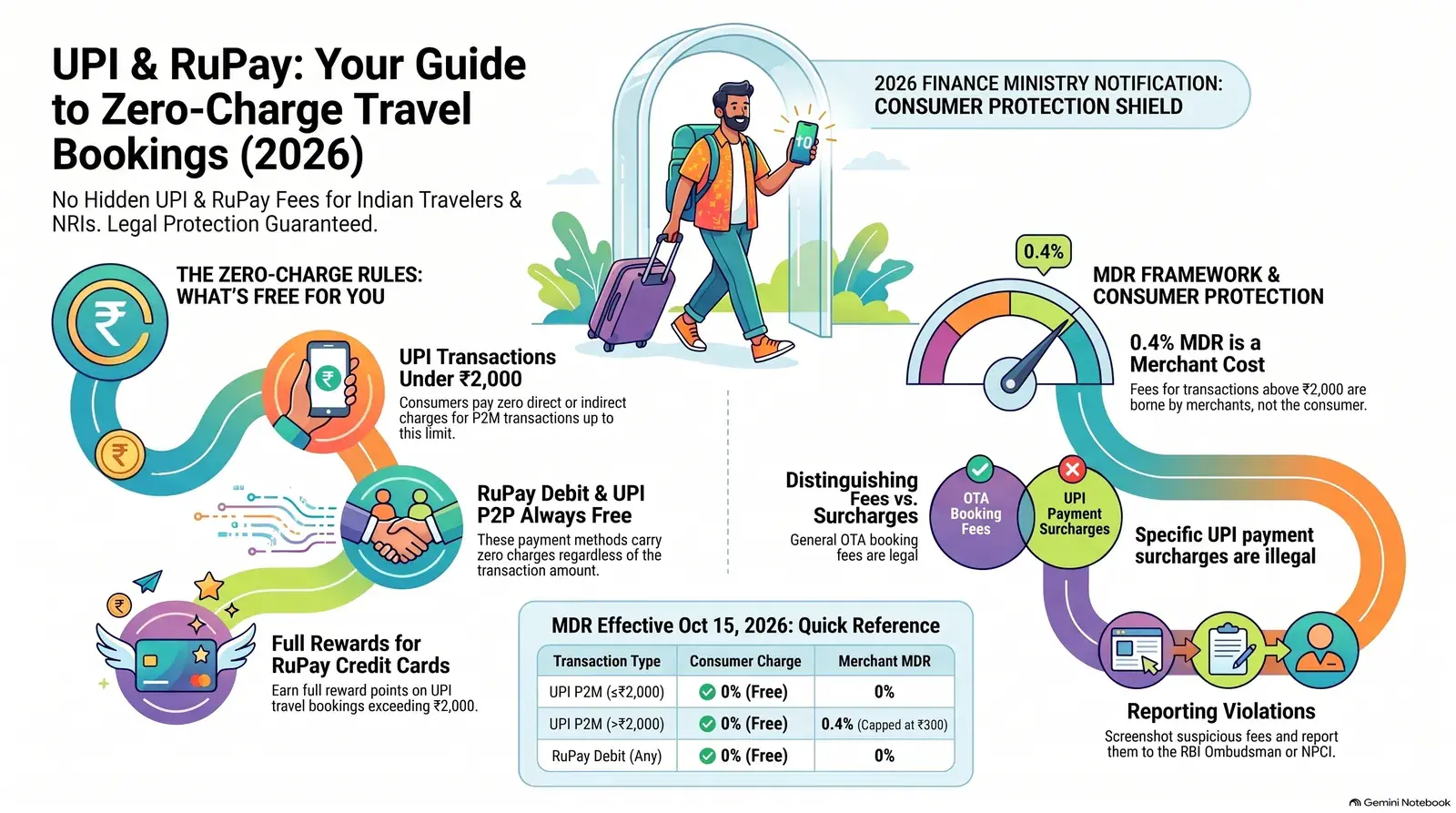
- UPI up to ₹2,000 is now legally free: The September 14 2026 Finance Ministry notification under Section 10A of the PSS Act prohibits banks from charging — directly or indirectly — on UPI transactions up to ₹2,000 and on all RuPay debit card transactions regardless of value.
- Above ₹2,000 P2M: MDR is a merchant cost, not yours: From October 15 2026, a 0.4% MDR (capped at ₹300) applies to person-to-merchant UPI transactions above ₹2,000. This is charged to the merchant, not passed to you. OTA convenience fees are a separate, pre-existing charge.
- RuPay credit card UPI gets reward parity: NPCI's September 2026 mandate requires banks to award the same reward points for RuPay credit card UPI payments as for regular RuPay credit card swipes — closing a loophole that previously cost frequent UPI payers thousands of points.
September 14, 2026
Up to ₹2,000 per transaction
Yes — any transaction value
Merchant absorbs — not your cost
What did the September 14 2026 Finance Ministry notification actually say about UPI charges?
The Ministry of Finance issued a gazette notification on September 14 2026 under Section 10A of the Payment and Settlement Systems Act, 2007, legally prohibiting banks and payment system operators from imposing any charge — direct or indirect — on UPI transactions up to ₹2,000 and on all transactions made via RuPay-powered debit cards, regardless of value.
The notification came after Parliament passed the Taxation and Other Laws (Amendment) Bill, 2026 in the Monsoon Session that ended August 13 2026. That Bill amended Section 10A of the PSS Act, 2007 — which previously imposed a blanket ban on Merchant Discount Rate (MDR) for UPI and RuPay debit transactions. The amendment converted that blanket ban into an enabling framework: the government now has the power to designate which payment modes receive statutory zero-charge protection, and to allow MDR on others.
The September 14 2026 notification exercised that power by explicitly protecting two categories:
| Payment Mode | Protection Under Notification | Transaction Value Cap | Who Is Protected? |
|---|---|---|---|
| UPI (P2M) | Zero direct or indirect charge | Up to ₹2,000 per transaction | Both payer and merchant |
| UPI (P2P) | Free regardless of amount | No cap — all P2P is free | Both sender and receiver |
| RuPay Debit Card | Zero direct or indirect charge | No cap — any transaction value | Both payer and merchant |
| UPI (P2M) above ₹2,000 | MDR of 0.4% from Oct 15 2026 | Capped at ₹300 (for ₹75,000+) | MDR charged to merchant only |
Sources: TaxScan — Ministry of Finance Notification; SCC Online — NPCI UPI MDR FAQs
Why this matters for the August bill's critics: When Parliament passed the amendment bill in August 2026, consumer groups worried it opened the door to charges on all UPI transactions. The September 14 notification is the government's formal answer: sub-₹2,000 P2M and all P2P remain legally free. MDR only applies above ₹2,000 P2M — and crucially, it is a cost borne by the merchant, not the consumer.
The Finance Minister's office clarified in an X (Twitter) post: "The amendment is an enabling provision. It does not impose any tax or transaction charge on UPI users. It enables the Government to specify, through notification, the electronic payment modes that will continue to receive statutory protection against charges." — @nsitharamanoffc, August 2026
What can banks not charge — even under alternative fee names?
Banks and payment system providers cannot levy any charge on covered UPI and RuPay debit transactions, regardless of the name they give that charge. The notification's "direct or indirect" language closes the loophole of relabelling fees.
Before the notification, some payment intermediaries experimented with labelling fees as "processing fees," "gateway charges," "digital convenience fees," or "platform surcharges" — all of which would have effectively been UPI charges under a different name. The September 14 notification's use of the phrase "no direct or indirect charge" covers all of these:
- Transaction fee for UPI payments up to ₹2,000
- Processing fee for RuPay debit card payments (any amount)
- Gateway charge specifically for using UPI or RuPay debit
- Platform fee levied on a payer for paying via UPI
- Convenience fee explicitly tied to the UPI payment method (as opposed to a booking service convenience fee that applies regardless of payment method)
What banks CAN still charge on covered transactions: The notification prohibits payment-method charges, not service charges. An OTA charging ₹200 as a booking service convenience fee applies that charge equally whether you pay via UPI, debit card, or credit card — it is not a UPI-specific fee and is therefore outside the notification's scope. The distinction is whether the fee changes based on your payment method choice.
For special merchant categories including railways, telecom, insurance, and fuel, a flat MDR of ₹5 per transaction applies on UPI payments above ₹2,000. Airlines and OTAs are general P2M merchants — they fall under the standard 0.4% MDR framework, not the ₹5 flat rate. Source: ANI News — UPI MDR Framework
How to report a prohibited charge: If you see a charge specifically for using UPI or RuPay debit on a qualifying transaction, you can:
- Screenshot the checkout page showing the fee tied to your payment method
- Report via the RBI Ombudsman portal
- File a complaint with NPCI through their helpdesk
- Contact your bank directly — the acquiring bank is jointly responsible
On-the-Ground Insight: "I booked a ₹1,800 Air India Express ticket in September using PhonePe. At checkout, a ₹15 'UPI handling fee' appeared. I screenshotted it and emailed Air India Express's payments team citing the September 14 notification. The refund came in three days. The notification gives you real standing to push back." — Rohan K., University College Dublin, September 2026
RuPay credit card UPI reward parity: what the NPCI September 2026 mandate means
NPCI has mandated that from September 2026, banks must award the same reward points, benefits, and features on RuPay credit card UPI transactions as on regular RuPay credit card swipes — closing a significant loophole that had been quietly costing frequent UPI payers thousands of points annually.
Before this mandate, many banks were offering lower reward rates (sometimes zero points) for RuPay credit card transactions routed through UPI, even when the same card swiped physically would earn full rewards. NPCI observed this disparity and issued a circular requiring issuers to achieve parity.
The exact wording of the NPCI circular states: "Issuers shall ensure that reward points, benefits, features, and other ancillary offers should not be lower (directly or indirectly) for RuPay Credit Cards on UPI transactions and RuPay credit cards, except for transactions where the issuer does not earn any interchange fee."
Practical impact for flight bookers: If you hold an Axis Bank, HDFC, ICICI, or SBI Card RuPay credit card and you were previously avoiding UPI to preserve your reward points, that trade-off no longer applies for flight transactions above ₹2,000. Check your card's specific rewards program documentation post-September 2026 to confirm your bank has implemented the parity.
| Scenario | Transaction Size | RuPay Credit Card Rewards (Pre-Sept 2026) | RuPay Credit Card Rewards (Post-Sept 2026) |
|---|---|---|---|
| Flight booking via UPI | ₹45,000 return fare | Often 0 or reduced points | Same as physical card swipe (parity mandate) |
| Flight booking via UPI | ₹1,500 domestic leg | Often 0 points | May still be 0 (below ₹2,000 interchange exception) |
| Physical card swipe at airport | Any amount | Full rewards earned | Full rewards earned (no change) |
How does the notification affect OTA flight bookings using PhonePe, GPay and Paytm?
For flight bookings under ₹2,000 on Indian OTAs (MakeMyTrip, EaseMyTrip, HappyFares), using PhonePe, Google Pay, or Paytm UPI is now legally guaranteed to be surcharge-free at the payment step. For bookings above ₹2,000, UPI remains free to you as a consumer — the 0.4% MDR from October 15 2026 is charged to the OTA, not passed on to you.
Most domestic flight tickets in India fall between ₹2,000 and ₹50,000. Under the new MDR framework effective October 15 2026, a ₹10,000 UPI payment to book a Mumbai–Delhi flight on MakeMyTrip or EaseMyTrip incurs 0.4% MDR on MakeMyTrip — that is ₹40 per booking that the OTA pays to NPCI/the bank. You as the consumer pay nothing extra for the UPI step itself.
For NRIs and OCI holders in Ireland using Indian UPI accounts to book international flights (Dublin–Mumbai, Dublin–Delhi) on Indian OTAs:
- PhonePe: Supports international mobile numbers from select countries including Ireland (linked to NRE/NRO accounts). UPI payments work for OTA flight bookings and are subject to the same zero-charge rules on qualifying transactions.
- Google Pay (GPay): Accepts UPI payment for flight bookings on all major Indian OTAs. NRI accounts linked to an NRE/NRO bank account can transact.
- Paytm: Supports UPI payments for flight bookings; NRI-linked accounts work for MakeMyTrip, EaseMyTrip and Goibibo flight payments.
Some travellers have asked whether splitting a ₹10,000 booking into five ₹2,000 UPI payments keeps all transactions under the MDR threshold. NPCI has indicated this approach is not a recognised workaround — the merchant categorisation and NPCI's framework determine MDR applicability, not the individual payment amount alone. More importantly, splitting to five payments of exactly ₹2,000 each on a single booking would be flagged as structuring behaviour. Stick to single payments — MDR is a merchant cost, not yours.
OTA card offers valid in September 2026 remain unaffected: The UPI zero-charge notification has no bearing on OTA bank card discount programmes. MakeMyTrip's 10% discount with HDFC/ICICI/Axis cards (cap ₹5,000, minimum ₹15,000 booking) and EaseMyTrip's Tuesday/Saturday 8% debit card offer remain active through September–October 2026. These are loyalty and promotional offers layered above the payment infrastructure, not payment-method charges.
What still costs money when booking flights via UPI in 2026?
The September 14 2026 notification removes UPI-specific payment charges, but several other legitimate fees remain: OTA booking convenience fees, credit card EMI conversion charges, and Dynamic Currency Conversion (DCC) markups on foreign airline websites all continue to apply and are outside the notification's scope.
OTA booking convenience fees
OTA convenience fees (typically ₹149–₹499 per passenger per sector on Indian platforms) are booking service fees, not UPI payment fees, and are outside the zero-charge notification.
A convenience fee is what MakeMyTrip, EaseMyTrip, and Goibibo charge for their booking platform service — the software, customer support, cancellation management, and price comparison engine. This fee applies whether you pay by UPI, net banking, debit card, or credit card. It is not a charge for the UPI payment method itself. DGCA's March 2026 fare transparency guidelines now require OTAs to display this fee on the search results page, not hide it until checkout.
Platforms with zero or low convenience fees as of September 2026 include HappyFares (zero convenience fee for UPI on all domestic flights) and direct airline websites for Air India, IndiGo, and Akasa Air. Booking direct on an airline website typically saves ₹0–₹150 vs. an OTA convenience fee.
Credit card EMI conversion charges on UPI
If you use a RuPay or Visa/Mastercard credit card linked to a UPI handle and select EMI at checkout, the EMI conversion charge still applies — this is a credit feature cost, not a payment-method charge, and is unaffected by the September 14 notification.
No-cost EMI on flight bookings (where the merchant or bank absorbs the interest) is available on some platforms for transactions above ₹5,000 with eligible cards. HDFC Bank, SBI, Axis, and ICICI credit cards offer no-cost EMI on MakeMyTrip and EaseMyTrip for flight bookings, with 3–12 month tenors. Processing fees of 1–2% may apply even on "no-cost" EMI plans depending on the bank.
Dynamic Currency Conversion (DCC) on foreign airline websites
When booking directly on Emirates, Qatar Airways, or Etihad using an Indian UPI-linked card, the DCC trap remains: the payment gateway may offer to charge you in INR at a rate embedding a 4–8% markup. This is unrelated to the UPI charge notification.
If a foreign airline website displays "Pay ₹XXXXX instead of €XXX for your convenience," this is DCC (Dynamic Currency Conversion). Always click "Pay in EUR" (or USD/GBP depending on the airline). The DCC rate typically embeds a 4–8% markup above the mid-market rate. On a €800 Dublin–Mumbai return, that can mean ₹4,000–₹8,000 extra for nothing. The September 14 UPI notification has no bearing on DCC — it is a currency conversion fee, not a UPI fee.
True Cost = Base Fare + OTA Convenience Fee + Forex Markup (DCC or card markup)
Example: ₹45,000 fare on MakeMyTrip with ₹400 convenience fee = ₹45,400. Same fare booked direct on Air India at ₹0 convenience fee = ₹45,000. The UPI payment step is free on both — but the OTA's convenience fee is ₹400 more. Always compare all-in totals.
Action checklist: how to verify you are not being overcharged at UPI checkout
The most reliable way to spot an illegal UPI surcharge at checkout is to toggle between payment methods and watch whether the total changes. If the total drops when you switch from credit card to UPI for the same transaction, the platform is charging a payment-method fee — permissible for credit cards, but illegal for UPI on qualifying transactions under the September 14 2026 notification.
Follow these six steps before confirming any flight payment via UPI:
Step 1: Check the total before selecting a payment method. Under DGCA's March 2026 fare transparency guidelines, all flight booking platforms must display the fully-inclusive fare on the search results page — including any convenience fees. Note this base all-in total before proceeding to payment.
Step 2: At the payment selection screen, compare totals across methods. Select UPI, note the total. Then switch to debit card, then credit card. If the total increases when you move to credit card but does not change between UPI and debit card, that is normal (platforms may charge extra for credit card processing). If the total changes between UPI and debit card for the same transaction under ₹2,000, that is a potential violation.
Step 3: Read the fee breakdown line by line. Look for any line item that says "UPI fee," "digital payment surcharge," "gateway fee (UPI)," or similar. A legitimate convenience fee should be labelled as a booking service fee and should apply identically regardless of payment method.
Step 4: For international flight bookings on foreign airline sites via UPI, decline DCC. If a "Pay in INR" prompt appears, decline it and pay in the airline's home currency instead. Note that some banks block UPI for transactions on foreign websites — in that case, use a zero-forex Indian credit card.
Step 5: Screenshot any suspicious fee before paying. If you see a fee you believe is prohibited under the September 14 notification, screenshot the checkout page with the fee clearly labelled, complete your booking (if possible), and file a complaint with the Reserve Bank of India or NPCI helpdesk after.
Step 6: For NRIs and OCI holders in Ireland using NRE/NRO-linked UPI. Confirm your Indian bank app has international UPI enabled for your Ireland mobile number. ICICI Bank, HDFC, and SBI all support NRI UPI with international numbers. Go to your bank's NRI app, enable "International UPI" in settings, and link your Irish phone number to your NRE/NRO account before attempting to pay on Indian OTAs from Ireland.
| Platform | Convenience Fee (UPI) | Convenience Fee (Credit Card) | Zero Fee Option |
|---|---|---|---|
| MakeMyTrip | ₹0–₹350 (booking-level fee, not UPI-specific) | ₹0–₹499 | Sometimes zero on select routes |
| EaseMyTrip | ₹0 for UPI (UPI is zero-fee platform) | Up to ₹499 | UPI always zero on domestic |
| HappyFares | ₹0 (zero convenience fee) | ₹0 | All payment methods zero fee |
| IndiGo Direct | ₹0 for UPI | ₹0–₹150 | UPI zero on direct site |
| Air India Direct | ₹0 for UPI | ₹0–₹150 | UPI zero on direct site |
Source: HappyFares.in convenience fee guide, September 2026. Verify current fees on each platform before booking.
Frequently asked questions
What did the Finance Ministry notification on September 14 2026 say about UPI charges?
The Ministry of Finance notification issued on September 14 2026 under Section 10A of the Payment and Settlement Systems Act, 2007 prohibits banks and payment system providers from levying any direct or indirect charge on UPI transactions up to ₹2,000 and on all RuPay-powered debit card transactions regardless of value.
Are UPI transactions above ₹2,000 free for consumers booking flights?
For consumers, UPI transactions above ₹2,000 remain charge-free at the point of payment — the 0.4% MDR introduced from October 15 2026 is a merchant-side cost that platforms like MakeMyTrip and airlines absorb, not a surcharge passed to you. However, some OTAs may add their own convenience fees unrelated to MDR.
Can banks charge UPI fees under a different name?
No. The September 14 2026 notification explicitly prohibits both direct and indirect charges. A bank that relabels a UPI fee as a processing fee, gateway fee, or platform fee is in breach of the notification and can be reported to RBI.
Do I earn reward points when I pay for a flight with my RuPay credit card via UPI?
Yes. NPCI mandated from September 2026 that banks must offer the same reward points, benefits, and features for RuPay credit card UPI transactions as for regular RuPay credit card transactions, with the exception of transactions where the issuer earns no interchange fee.
What payment charges still apply when booking flights from India in 2026?
Convenience fees charged by OTAs as a booking service charge (₹149–₹499 per passenger on some platforms), credit card EMI conversion charges, Dynamic Currency Conversion (DCC) markups on foreign airline sites, and credit card surcharges on some platforms all still apply and are separate from the UPI charge prohibition.
How do I verify I am not being overcharged at checkout when booking a flight with UPI?
At checkout, toggle between UPI, debit card, and credit card payment options. If the total changes when you switch payment methods specifically for UPI on transactions under ₹2,000, the platform may be violating the September 14 2026 notification. For flights above ₹2,000 booked on OTAs, a legitimate convenience fee is a booking service charge, not a UPI payment fee.
🧮 UPI Flight Booking Cost Calculator
See your true booking cost after UPI zero-charge rules and any OTA convenience fee. Uses September 2026 figures from this article.
Book your Dublin–India flight with zero UPI charges
Use the September 2026 zero-charge rules to your advantage. Compare live fares on Indian OTAs via MyFlightOffers before you book — and check the monthly fare calendar for the cheapest windows on Dublin–Delhi and Dublin–Mumbai routes.
This article is based on the Finance Ministry Gazette notification dated September 14 2026, the Taxation and Other Laws (Amendment) Bill passed by Parliament in August 2026, NPCI circulars on UPI MDR and RuPay credit card reward parity, and publicly available OTA convenience fee schedules as of September 2026. Payment regulations, bank policies, OTA fee structures, and reward programmes change frequently. Always verify current rules on official government and bank portals before making financial decisions. MyFlightOffers is not affiliated with any bank, OTA, or payment provider mentioned. This article does not constitute financial, tax, or legal advice.
- PhonePe Flight Booking Guide 2026 — how to use PhonePe UPI for domestic and international flight bookings, with cashback offers
- Card Tokenization and Flight Booking India 2026 — RBI's tokenization mandate and how it affects saving cards on OTAs
- Transfer Credit Card Points to Airline Miles India 2026 — maximise RuPay and Visa credit card reward points by transferring to frequent flyer programmes
- HDFC Credit Card Flight Offers 2026 — HDFC card discounts on MakeMyTrip, EaseMyTrip and airline direct sites