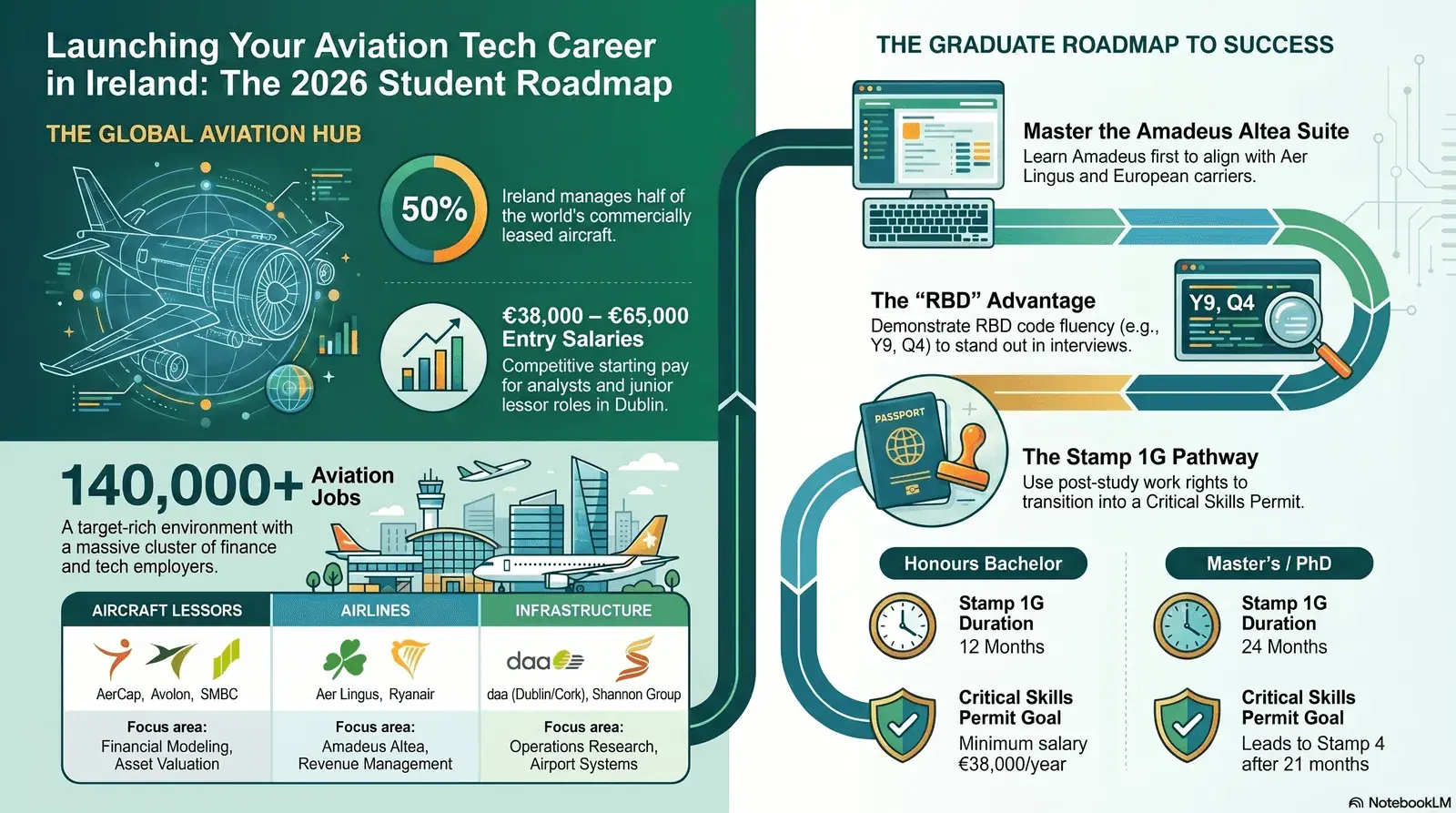
- Ireland manages ~50% of the world's leased aircraft fleet — AerCap, SMBC Aviation, and Air Lease Corporation are all headquartered here, making Dublin one of the best cities in the world to start an aviation tech career.
- GDS skills (Amadeus, Sabre, Travelport) are the practical entry point — RBD fare bucket logic, availability display reading, and PNR management are learnable in weeks and directly map to analyst roles at airlines and travel tech firms.
- Your Stamp 1G gives you 2 years post-study work permission — enough time to land a GDS analyst, operations co-ordinator, or aircraft leasing support role without needing employer sponsorship.
🌍 Aviation Capital
Dublin & Shannon
~50% of world's leased aircraft managed from Ireland
✈ Top Employer
AerCap — world's largest aircraft lessor
HQ Dublin; 3,000+ aircraft managed
💻 GDS to Learn First
Amadeus Altea Suite
Used by Aer Lingus and 100+ airlines
💶 Entry Salary Range
€38,000 – €65,000
Analyst to lessor junior roles, Dublin 2026
10 questions answered in this guide
- Why Ireland is the world's aviation capital — and what that means for your career
- What is a GDS and why does every airline depend on it?
- Amadeus, Sabre, and Travelport — which system should you learn first?
- RBD codes and fare buckets — the technical skill that sets analysts apart
- Which companies in Ireland are actively hiring aviation tech graduates?
- Entry-level aviation tech roles and salary benchmarks in Dublin (2026)
- Certifications that open doors: from IATA to Amadeus Academy
- University programmes in Ireland that align with aviation tech careers
- Stamp 2, part-time work, and your Stamp 1G post-graduation pathway
- Quick tips to break into aviation tech as an international graduate
Q1 Why Ireland Is the World's Aviation Capital — And What That Means for Your Career
Ireland-based companies manage approximately 50% of the world's commercially leased aircraft fleet, a concentration of aviation financial and operational expertise that exists nowhere else on earth. This is not marketing — it is a structural feature of the Irish economy dating back to 1975.
In 1975, an Irish entrepreneur named Tony Ryan founded Guinness Peat Aviation (GPA) in Shannon, Co. Clare — widely regarded as the world's first dedicated aircraft operating lease company. The model GPA pioneered — purchasing aircraft and leasing them to airlines on long-term operating leases rather than finance leases — became the dominant structure for airline fleet financing globally. Shannon built the legal, financial, and talent infrastructure around it, and Dublin absorbed the major lessors as the sector scaled.
- Ireland-based lessors manage approximately 50% of the world's leased commercial aircraft fleet (a figure cited consistently across OECD, IATA, and Aviation Finance Ireland reports)
- AerCap, headquartered in Dublin, is the world's largest aircraft lessor (NYSE: AER), managing a portfolio of 3,000+ owned, managed, and committed aircraft
- Avolon, also Dublin-headquartered, ranks among the top three lessors globally
- SMBC Aviation Capital, headquartered in Dublin's Spencer Dock, manages 600+ aircraft globally
- Ireland's aviation sector supports over 140,000 jobs (direct and indirect) according to the Irish Aviation Authority's annual state of the industry reporting
The practical implication for an international student is significant: when you graduate from an Irish university and apply for Stamp 1G post-study work permission, you are doing so in the country that houses the world's most dense cluster of aviation finance, leasing, operations, and technology employers — all operating in English, all embedded in the EU regulatory framework, and all competing for precisely the analytical and technical talent that graduate programmes produce.
Q2 What Is a GDS and Why Does Every Airline Depend on It?
A Global Distribution System (GDS) is a centralised technology platform that aggregates and distributes airline seat availability, pricing, and booking functionality to travel agencies, online travel agents (OTAs), and corporate booking tools worldwide. Every time a travel agent, Expedia, or a corporate portal displays a flight price and completes a booking, they are querying a GDS.
The GDS sits between the airline's internal inventory control system (called the Passenger Service System, or PSS) and the external sales channels. It performs three critical functions:
- Availability aggregation: pulls real-time inventory data from hundreds of airlines and presents it in a standardised format that any travel agent or booking tool can query
- Fare distribution: transmits airline fare rules and pricing from the ATPCO (Airline Tariff Publishing Company) fare filing to the booking interface
- Booking and ticketing: creates Passenger Name Records (PNRs), issues e-tickets, and communicates the confirmed booking back to the airline's PSS
For international students, understanding GDS architecture is important not because you will be a travel agent, but because airlines, lessors, and aviation data companies hire analysts who understand why a seat priced at €249 is being sold today on one channel but shows as €319 on another — and can diagnose and correct distribution discrepancies worth millions in revenue annually.
IATA's NDC standard (New Distribution Capability) allows airlines to distribute richer, ancillary-bundled content directly via APIs rather than through the GDS content model. Aer Lingus and Ryanair both invest heavily in NDC-based direct distribution. However, the traditional GDS continues to process the majority of global agency and corporate bookings. The most employable candidates in 2026 understand both — GDS cache logic and NDC XML schema and offer-order architecture. Do not dismiss GDS knowledge as outdated; dismiss only the myth that NDC has already replaced it.
Q3 Amadeus, Sabre, and Travelport — Which System Should You Learn First?
Learn Amadeus first if you are targeting Irish or European aviation roles. Amadeus dominates European airline passenger service systems and is the GDS most directly relevant to employment in Ireland.
| GDS Platform | Airline PSS Product | Ireland / EU Relevance | Career Application |
|---|---|---|---|
| Amadeus | Altea Suite (CM, DCS, RES) | ⭐⭐⭐ Highest — Aer Lingus, Iberia, Lufthansa Group all use Altea | Distribution analyst, revenue management, airport operations, IT implementation |
| Sabre | SabreSonic, AirVision RM | ⭐⭐ Moderate — stronger in North America; used by some European carriers | Revenue management analyst, North American airline ops, OTA connectivity |
| Travelport | Galileo / Worldspan (consolidated) | ⭐⭐ Moderate — relevant for travel management company and TMC roles in Ireland | Travel agency-side distribution, corporate travel, TMC analyst |
The Amadeus Altea Suite — what it actually does
The Amadeus Altea Suite is a cloud-hosted Passenger Service System used by over 200 airlines globally. It has three core modules:
- Altea CM (Customer Management): manages inventory (the number of seats available to sell in each fare bucket), pricing, and seat-level control — the core revenue management-facing module
- Altea RES (Reservation System): handles booking creation, PNR management, and ticketing — this is what travel agents and airline reservation agents work in
- Altea DCS (Departure Control System): manages check-in, boarding passes, load control, and gate management — the operational side on departure day
For entry-level roles in Ireland, Altea CM knowledge is the most directly valued skill: it ties directly into revenue management analyst work at airlines like Aer Lingus and into distribution system implementation roles at technology providers.
Q4 RBD Codes and Fare Buckets — The Technical Skill That Sets Aviation Analysts Apart
A Reservation Booking Designator (RBD) is a single letter code — such as Y, M, Q, or J — that an airline assigns to a specific fare bucket within a cabin class. Airlines do not sell a single price per cabin — they manage 10 to 20 distinct price points simultaneously, opening and closing them in real time based on demand.
When you see a GDS availability display like this:
...each letter-number pair is an RBD code and its available seat
count. Y9 means full-fare economy has 9 or more seats
available. Q4 means only 4 seats remain at the Q fare
level. V1 means a single seat is left at the very
restricted V price point. W0 and S0 mean
those cheaper buckets have been closed by the revenue management
system.
The cabin-level RBD hierarchy
(Full / Restricted)
(Full → Restricted)
(Unrestricted → Lightly Restricted)
(Advance Purchase Required)
(Deeply Restricted / Closed)
(Interline, Group, Award)
Revenue management and distribution teams at airlines, lessors, and aviation data firms routinely receive CVs from candidates who understand fares at a surface level — lowest price, cabin class, refundability. What distinguishes analytically strong candidates is the ability to explain why a particular booking class is closed, what the revenue trade-off of opening it would be, and how GDS cache refresh schedules affect the accuracy of what consumers actually see. Demonstrating RBD literacy in a cover letter or interview — even at a conceptual level — immediately signals technical depth that most master's graduates cannot show.
Revenue management systems — including Sabre's AirVision RM, Amadeus's Revenue Management solution, and PROS Airlines RM — continuously recalibrate which RBD buckets should be open based on booking pace, competitive fare levels, and historical demand curves for each specific flight date. Entry-level analysts feed these systems data, review output recommendations, and make override decisions. It is applied mathematics with an €18,000 per-flight revenue impact on a busy Dublin–London route.
Q5 Which Companies in Ireland Are Actively Hiring Aviation Tech Graduates?
The Irish aviation employer landscape divides into four categories: aircraft lessors, airlines, airport operators, and aviation technology and services firms. Each has distinct hiring profiles, and knowing which category aligns with your skills prevents wasted applications.
AerCap
World's largest aircraft lessor (NYSE: AER). Graduate analyst, financial analyst, technical operations, IT, and legal roles. High competition; strong financial modelling and Excel skills essential. HQ: Leopardstown, Dublin 18.
Avolon
Third-largest aircraft lessor globally. Analyst and associate-level roles in finance, asset management, and legal. Dublin HQ. Typical entry point: structured finance graduate programme or data analyst roles.
SMBC Aviation Capital
600+ aircraft managed globally. Roles in portfolio analytics, technical management, and operations. HQ: Spencer Dock, Dublin 1. Subsidiary of Sumitomo Mitsui Banking Corporation.
Aer Lingus
Ireland's flag carrier. Part of IAG since 2015. Graduate roles in revenue management, network planning, IT/digital, and operations. Amadeus Altea user — GDS fluency directly valued. Uses Dublin and Manchester bases.
Ryanair (Technology Division)
Europe's largest low-cost carrier. Ryanair runs its own proprietary reservation system and operates a major in-house technology team. Roles in data engineering, software engineering, digital product, and pricing analytics. Competitive and fast-paced.
daa (Dublin Airport Authority)
Operates Dublin and Cork airports. Graduate roles in operations management, commercial analytics, IT systems, and airport planning. daa International also consults on global airport development. Entry point: graduate development programme.
Shannon Group
Manages Shannon Airport and Shannon Heritage. Located at the historic birthplace of the aircraft leasing industry. Shannon Free Zone hosts several aviation and aerospace companies. Ideal for students studying at University of Limerick or TUS Athlone.
Civil Aviation Authority (Ireland)
Regulates aviation safety and airspace in Ireland. AirNav Ireland (airnavireland.ie) manages air traffic management. Roles in safety oversight, licensing, data analysis, and air traffic systems. Less commercial than airlines/lessors but provides strong regulatory expertise.
Q6 Entry-Level Aviation Tech Roles and Salary Benchmarks in Dublin (2026)
Entry-level aviation analyst and technology roles in Dublin pay between €38,000 and €65,000 annually, with aircraft lessors at the upper end of that range due to the financial complexity of their operations. The figures below are indicative based on publicly available job postings and industry salary reporting for the Dublin market as of mid-2026. Always verify on individual employer careers pages.
| Role | Employer Type | Indicative Salary Range (Dublin) | Key Skills Required |
|---|---|---|---|
| Revenue Management Analyst | Airline (Aer Lingus, Ryanair) | €40,000 – €52,000 | RBD knowledge, Excel/SQL, Amadeus or Sabre RM familiarity |
| GDS / Distribution Analyst | Airline or OTA | €38,000 – €50,000 | GDS Cryptic / GUI, PNR management, NDC API basics |
| Aviation Data Analyst | Lessor, Airline, MRO | €40,000 – €55,000 | Python or R, SQL, aircraft utilisation metrics, Power BI |
| Junior Analyst (Aircraft Leasing) | AerCap, Avolon, SMBC Aviation Capital | €42,000 – €65,000 | Financial modelling, CAPE/EIS, aircraft valuation frameworks |
| Airport Operations Analyst | daa, Shannon Group | €36,000 – €48,000 | Operations research, turnaround management, AMS/BHS systems |
| Airline IT / PSS Specialist | Airline, Amadeus, tech vendor | €42,000 – €60,000 | Amadeus Altea implementation, API integration, IT project management |
Lessor junior analyst roles (AerCap, Avolon, SMBC) are among the best-compensated entry-level positions in Irish aviation, but they require a specific skill set: financial modelling in Excel to international finance standard, familiarity with aircraft asset valuation methodologies (AVAC, MIBA), and the ability to present structured finance scenarios in writing. These roles are not typically filled from aviation management degrees alone — candidates from finance, economics, or combined finance-aviation programmes are strongly preferred. If lessor roles are your target, ensure your master's programme includes financial modelling and corporate finance modules alongside any aviation-specific content.
Q7 Certifications That Open Doors: From IATA to Amadeus Academy
The most directly employable certification for an international student targeting Irish aviation roles in 2026 is the IATA Foundation in Travel and Tourism, followed by an Amadeus product-specific certification for GDS-facing roles.
Tier 1: IATA Certifications (globally recognised)
The IATA Training and Development Institute offers industry-standard credentials at every seniority level. For students targeting their first aviation role, the most relevant are:
- IATA Foundation in Travel and Tourism (Diploma) — entry-level credential covering the structure of the airline industry, GDS basics, ticketing fundamentals, and geography. Recognised by Irish aviation employers as a minimum competency baseline. Study time: 3–6 months self-paced or through an approved ATEC school.
- IATA Revenue Management Certificate — directly aligned with analyst roles at Aer Lingus and aviation data companies. Covers pricing strategy, fare construction, inventory management, and overbooking methodology. Study time: 4–8 weeks with guided assignments.
- IATA Airline Operations Fundamentals Certificate — covers departure control, load control, dangerous goods regulation, and ground handling. Strong for daa airport operations or ground handling management roles.
- IATA Airline Business Foundation Certificate — covers airline economics, network planning, alliances, and distribution. Useful as background knowledge for any aviation analyst or commercial role.
Tier 2: Amadeus Platform Certification
Amadeus Training Hub offers both self-paced and instructor-led courses covering Altea CM inventory management, Amadeus Selling Platform Connect (the agent GDS interface), and Amadeus APIs for NDC connectivity. These are practical, product-specific skills directly applicable to Aer Lingus IT implementation roles, airline distribution analyst positions, and travel management companies. Amadeus does not publicly publish a single certification cost; pricing is accessible through registered Amadeus partner or training institution accounts.
Tier 3: Sabre Training (for North America-facing roles)
Sabre provides training programmes covering SabreSonic reservation systems and AirVision Revenue Manager. For students targeting roles at carriers using Sabre — including Ryanair for some specific back-office systems — Sabre training provides a complementary second-system credential that differentiates candidates who know only Amadeus.
Q8 University Programmes in Ireland That Align With Aviation Tech Careers
No single Irish university programme is exclusively dedicated to GDS and aviation operations technology — but several programmes at TU Dublin, Shannon College (University of Limerick), and DCU provide modules directly aligned with the skills Irish aviation employers seek.
| Institution | Programme Type | Aviation Relevance | Link |
|---|---|---|---|
| Shannon College of Hotel Management (University of Limerick) | BBS / MBA with Hospitality & Aviation focus | Highest for Shannon-cluster aviation roles; industry placements at Shannon Airport and aviation MRO companies | ul.ie/shannon-college |
| TU Dublin | Airline, Aviation & Travel Management (BA) | High for airline operations, GDS, and travel management roles; practical GDS training modules included | tudublin.ie |
| Dublin City University (DCU) | Business Analytics (MSc); various business programmes | High for data science, revenue management analytics, and IT-side aviation roles; strong industry links | dcu.ie |
| University College Dublin (UCD Smurfit) | MSc in Business Analytics; MBA | Medium-High — financial modelling and analytics skills applicable to lessor analyst roles; limited aviation-specific modules | smurfitschool.ie |
| University of Limerick (UL) | BBS Aviation Studies modules; Engineering programmes | Medium — proximity to Shannon creates strong industry placement access; check current aviation module availability | ul.ie |
Irish university programmes and module structures change annually. The information above reflects publicly available 2025–26 data. Before applying, verify current aviation-related module content directly with the university's international admissions office. For the most aviation-specific undergraduate programme, the TU Dublin Airline, Aviation & Travel Management degree remains the closest match in the Irish market to a dedicated aviation operations curriculum.
Q9 Stamp 2, Part-Time Work, and Your Stamp 1G Post-Graduation Pathway
International students on Stamp 2 (student permission) may work up to 20 hours per week during academic term and up to 40 hours per week during official academic holidays, making aviation-adjacent part-time work entirely feasible during study.
What you can do on Stamp 2 in the aviation sector
- Ground handling and passenger services roles at Dublin or Shannon airports (often shift-based, compatible with study schedules)
- Entry-level reservation and ticketing support roles at travel management companies or online travel agencies
- Data entry and operations support roles at aviation services companies
- Airport retail, food and beverage, and passenger-facing commercial roles (builds airport familiarity and creates introductions)
- Internships or structured work placements — if your programme includes a formal placement period, you may work full-time during that period under Stamp 2
Stamp 1G: your post-graduation runway
| Qualification Level | Stamp 1G Duration | Work Rights | Next Step |
|---|---|---|---|
| NFQ Level 8 (Honours Bachelor) | 12 months (non-renewable) | 40 hours/week, any sector | General Employment Permit or Critical Skills Employment Permit (if salary qualifies) |
| NFQ Level 9 (Master's) | 24 months (2 × 12-month periods) | 40 hours/week, any sector | Critical Skills Employment Permit (€40,904+ threshold); leads to Stamp 4 after 21 months employment |
| NFQ Level 10 (PhD) | 24 months (2 × 12-month periods) | 40 hours/week, any sector | Critical Skills Employment Permit; fast-track to Stamp 4 |
The Critical Skills Employment Permit (CSEP) is available for roles in specified occupations at a minimum salary of €40,904 per year (raised from €38,000 on 1 March 2026; verify the current threshold at enterprise.gov.ie). Revenue management analysts, aviation data scientists, aircraft leasing analysts, GDS implementation specialists, and airline IT roles all qualify under the CSEP eligible occupations list. Securing a CSEP within your Stamp 1G window leads to Stamp 4 permission (which allows you to work without any permit) after 21 months of employment — the most direct pathway to long-term work rights in Ireland and the EU.
Q10 Quick Tips to Break Into Aviation Tech as an International Graduate
- Start with IATA Foundation before you apply anywhere. It is the industry's minimum competency signal. Hiring managers at Aer Lingus and daa expect it. Complete it before your first application, not after you get rejected once.
- Learn to read a GDS availability display before your interview. Being able to interpret a cryptic availability string like "Y9 B9 M4 Q1 K0" on a whiteboard differentiates you from 95% of aviation management graduates who have never seen one.
- Target Shannon as well as Dublin. Shannon's aviation cluster (Shannon Group, MRO companies, aviation training providers) has a smaller applicant pool and stronger local employer-university relationships through University of Limerick and Shannon College. Competition for entry roles in Shannon is meaningfully lower than in Dublin.
- Attend the Irish Aviation Summit and Aviation Finance Ireland events. These are annual industry networking events where lessors, airlines, and service providers recruit. Student tickets are typically discounted. One conversation at an industry event is worth ten cold applications.
- Build a dataset project using OAG or FlightAware API data. Publicly available flight schedule and performance data from OAG or FlightAware can be used to build a portfolio analysis of route performance, fare bucket behaviour, or capacity utilisation. A tangible data project on GitHub demonstrating aviation-specific analytical thinking is the strongest differentiator available to a candidate who does not yet have work experience.
- Apply to daa and Shannon Group graduate programmes in September. Both organisations run annual graduate development programmes that accept applications in the early autumn for positions starting the following summer. These programmes are specifically designed for graduates of Irish universities, making Stamp 1G-eligible international students directly eligible. Check daa.ie/careers and shannongroup.ie/careers in September each year.
- Do not overlook aviation fintech and insurtech companies. Dublin has a growing cluster of companies providing financial and risk management services to lessors and airlines — including aircraft asset valuation platforms, aviation insurance brokers, and aviation ERP system providers. These companies are smaller, less-known, and actively hiring analysts with combined aviation and data skills.
- Use LinkedIn's Dublin aviation network aggressively. Search "Aer Lingus Revenue Management" or "AerCap analyst" and message alumni from your own university who are working in these roles. A warm introduction from an alumni contact — even a brief LinkedIn message asking for a 15-minute call about their career — dramatically increases your interview probability at companies where applications are otherwise opaque.
Planning to study in Ireland and pursue an aviation career? These related guides cover the full picture:
- Targeting the 2026 Skill Gaps: High-Salary Sectors Hiring Graduates in Ireland — where Irish wages are rising fastest in 2026 and which graduate roles qualify for the Critical Skills Employment Permit
- Study in Ireland 2026: Universities, Costs, Scholarships & Flights — Part 1
- Finding Affordable Flights from Dublin to Delhi — 2026 Complete Guide
- Airport Lounge Access in India: Complete Credit Card Guide 2026 — for your journeys home
- Axis Bank Credit Cards for Flight Bookings 2026 — maximise miles on your India–Dublin route
Frequently Asked Questions
Is Ireland a good destination for international students pursuing aviation tech careers?
Yes - Ireland is arguably the single best country in the world for a career in aviation technology and aircraft leasing. Ireland-based companies manage approximately 50% of the world's commercially leased aircraft fleet. Dublin is home to AerCap (world's largest aircraft lessor), Avolon, SMBC Aviation Capital, Aer Lingus, and Ryanair's technology division. Shannon Airport is where the global aircraft operating lease industry was born in 1975. For international students on Stamp 2 and Stamp 1G visas, the combination of deep employer density, English-language operations, and EU work rights makes Ireland uniquely positioned.
Which GDS system is most widely used in Ireland and should I learn first?
Amadeus is the most widely deployed GDS in Ireland and across European airlines. Aer Lingus uses the Amadeus Altea suite for passenger services. Amadeus should be the first system international students learn - it covers inventory management, reservations, and departure control. Sabre is dominant in North American airline operations and provides strong value for students targeting US carrier operations or global OTA roles. Travelport (formerly Galileo and Worldspan) is relevant for travel agency-side distribution roles.
What is an RBD code and why does it matter for aviation analysts?
RBD stands for Reservation Booking Designator - the single-letter code (such as Y, B, M, H, Q, K) that an airline uses to label each fare bucket within a cabin class. When a GDS displays 'Y9 B9 M9 Q4 K1 V0', it means economy is open from full-fare Y through Q with 4 seats, K has only 1 seat, and V is sold out at that price point. Revenue management analysts set these thresholds using algorithms to maximise yield. Analysts who can read and interpret RBD availability are valued by airlines, lessors, and distribution teams because they understand how ticket prices are constructed at a structural level - not just visible surface pricing.
How much does an entry-level aviation analyst earn in Dublin?
Entry-level aviation tech and analyst roles in Dublin typically pay between €38,000 and €55,000 annually depending on role type and employer. Revenue Management Analyst roles at airlines such as Aer Lingus start from approximately €40,000-€50,000. Junior analyst roles at aircraft lessors (AerCap, Avolon) generally start higher at €42,000-€65,000 due to the financial complexity involved. GDS and distribution analyst roles at technology providers or airlines range from €38,000-€52,000. All figures are indicative for 2026 and should be verified on individual employer careers pages.
Can international students on a Stamp 2 visa work in Irish aviation tech?
Yes. International students on Stamp 2 (student permission) may work up to 20 hours per week during academic term and up to 40 hours per week during official academic holidays. Entry-level aviation operations roles, airline ground operations support positions, and aviation internships are all accessible on Stamp 2. After graduation, Stamp 1G (Third Level Graduate Programme) gives Master's and PhD graduates 24 months to find and begin graduate-level aviation employment, during which the Critical Skills Employment Permit can be applied for.
What IATA certifications are most valuable for aviation tech careers in Ireland?
The IATA Foundation in Travel and Tourism diploma is the strongest entry-level credential, widely recognised by Irish employers. For revenue-side roles, the IATA Revenue Management certificate is directly aligned with analyst roles at Aer Lingus, Ryanair, and aviation data companies. The IATA Airline Operations Fundamentals certificate is valuable for airport, ground handling, or operations centre roles. All certifications are available through the IATA Training and Development Institute at iata.org/en/training/. Amadeus product-specific certifications through the Amadeus Training Hub at amadeus.com/en/training are an additional practical credential for GDS-facing roles.
Is NDC making traditional GDS systems obsolete - and does that affect my career choice?
NDC (New Distribution Capability) is an IATA standard that allows airlines to distribute richer, more personalised content directly to travel agencies and OTAs, bypassing the traditional GDS content model. NDC is not replacing GDS systems but is adding a parallel distribution channel alongside them. Most major airlines - including Aer Lingus - are implementing NDC alongside existing GDS connectivity. For students, this means GDS knowledge remains essential, but understanding NDC XML schemas, API connectivity, and offer-and-order models creates an additional specialist career lane. Students who understand both GDS cache logic and NDC direct-connect architecture are the most sought-after candidates.
Which Irish university programmes align best with an aviation tech career?
Shannon College of Hotel Management (affiliated with University of Limerick) is Ireland's most aviation-focused higher education institution, offering programmes in hospitality, tourism, and management with direct links to the Shannon aviation industry cluster. TU Dublin (Technological University Dublin) offers tourism and aviation management-related programmes. For data science and systems roles, DCU's business analytics and computing programmes align strongly with revenue management and GDS analyst roles. International students should check each university's current course catalogue directly as programme structures change annually.
Ready to book your flight to Dublin?
Compare live fares from India and beyond to Dublin before committing to your university start date — then put your future aviation knowledge to work.
All company information, salary ranges, certification details, university programme descriptions, immigration rules (Stamp 2 / Stamp 1G / Critical Skills Employment Permit thresholds), GDS system descriptions, RBD code conventions, and employer hiring profiles in this article are based on publicly available information from official sources including AerCap, Amadeus, IATA, Irish Immigration Service, Department of Enterprise, Trade and Employment, and individual university admissions pages as of June 2026. Salary figures are indicative ranges based on publicly available job postings and industry reporting; actual compensation varies by employer, role seniority, and candidate profile. GDS system architectures, certification programmes, and employer hiring practices change without notice. Always verify current details directly with the employer, university, or certification provider before making career or financial decisions. MyFlightOffers is not affiliated with any employer, university, GDS provider, or government body mentioned in this article. This article does not constitute career, legal, or financial advice.