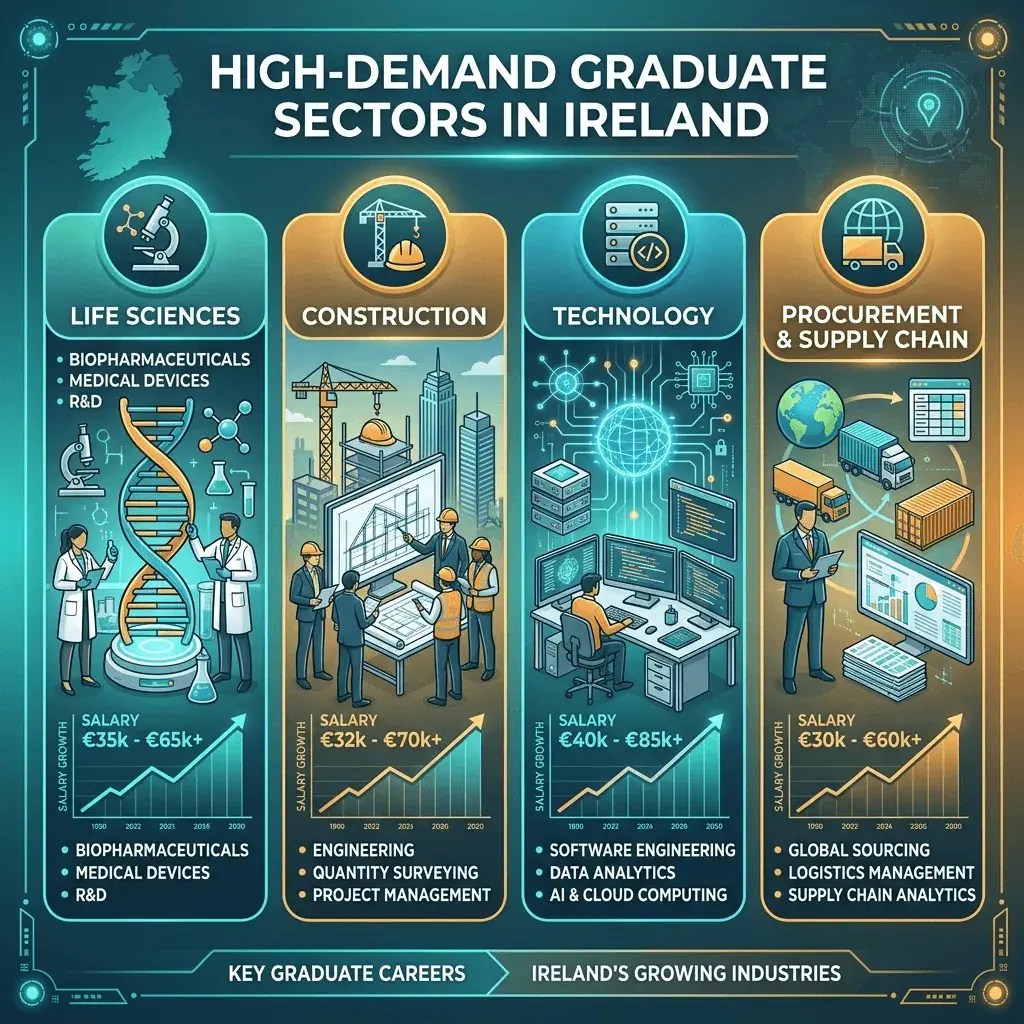
- 96% of Irish employers report skill shortages, and the worst-hit sectors pay the most — life sciences led 2026 wage growth at +6.1%, ahead of procurement (+3.8%) and construction & property (+2.8%) in the Hays Ireland 2026 Salary Guide.
- Target roles on the Critical Skills Occupation List from the start — software, data/AI, engineering, pharma science, finance and several construction roles all qualify, opening the Critical Skills Employment Permit and the path to Stamp 4.
- Your Stamp 1G window is the runway, not the destination — Level 9/10 graduates get up to 24 months; pick a shortage sector early so your job hunt has the wind behind it.
Fastest-rising pay (2026)
Life Sciences +6.1%
Procurement +3.8% · Construction +2.8%
Employers reporting shortages
96% of Irish employers
Hays Ireland 2026 Salary Guide, 600+ professionals
Graduate permit threshold
€36,848 (recent-graduate CSEP)
Standard degree CSEP €40,904 from 1 Mar 2026
Construction worker gap
~80,000–111,000 by 2030
Roughly 25,000 new entrants needed each year
What this guide covers
- Why 2026 is a buyer's market for graduates
- The three fastest-growing wage sectors
- Life sciences: Ireland's pharma engine
- Procurement & supply chain
- Construction & the built environment
- Technology, AI and the wider shortage list
- Finance & Fintech: Ireland's fourth high-demand sector
- Mapping a sector to your visa pathway
- How to position yourself as a graduate
- Frequently asked questions
1 Why 2026 Is a Buyer's Market for Skilled Graduates
When almost every employer says it cannot find the people it needs, the negotiating power shifts toward candidates who hold the right skills. The headline figure from the Hays Ireland 2026 Salary Guide — that 96% of employers experienced skill shortages in the past year — is not an abstract statistic. It is the reason graduate starting salaries in shortage areas are climbing, why employers are more willing to sponsor Critical Skills Employment Permits, and why a well-targeted degree or job search converts far faster than a scattergun one.
For international students this matters twice over. First, you are working against a fixed visa clock, so every month spent chasing roles in oversupplied fields is a month you do not get back. Second, the roles that qualify you for a Critical Skills Employment Permit — your bridge from a temporary Stamp 1G to long-term Stamp 4 residency — are precisely the shortage occupations employers are most motivated to fill. Aligning your field with the gap is therefore both a salary decision and an immigration decision.
Ireland's shortages are driven by long-run forces: a small domestic talent pool, multinational clustering in pharma and tech, an ageing construction workforce, and ambitious national targets for housing and infrastructure. These do not resolve in a single year, which is why the same sectors keep appearing at the top of demand surveys. A graduate entering one of them in 2026 is stepping into a multi-year hiring need, not a temporary spike.
2 The Three Fastest-Growing Wage Sectors in 2026
Wage growth is the clearest signal of where demand outstrips supply. The Hays Ireland 2026 Salary Guide ranked life sciences, procurement, and construction & property as the standout sectors for average pay increases. Below is how they compare, with the graduate-entry context that matters most when you are choosing a track.
| Sector | Avg. 2026 pay growth | Why the gap exists | Indicative graduate entry salary |
|---|---|---|---|
| Life Sciences / Pharma | +6.1% | QA, R&D and microbiology shortages across a large multinational base | €40,000–€70,000 |
| Procurement / Supply Chain | +3.8% | Strategic and digital procurement skills in short supply; certification premium | €37,000–€55,000 |
| Construction & Property | +2.8% | National housing targets and an ageing, retiring workforce | €38,000–€60,000 |
| Technology (context) | High demand | AI/ML engineering postings growing fastest; software and cyber still outstrip graduate supply | €45,000–€75,000+ |
A sector with the highest percentage pay growth is not always the one with the highest absolute graduate salary. Technology and banking advertised some of the highest pay overall (around €80,000 at experienced levels), but life sciences saw the steepest increase. For a graduate, fast-rising sectors signal where employers are most desperate — and most willing to hire and train newcomers.
3 Life Sciences: Ireland's Pharma Engine (+6.1%)
Life sciences recorded the strongest salary growth of any sector in 2026 at an average of 6.1%, and the shortage is concentrated in exactly the roles graduates can train into. Hays specifically flagged quality assurance specialists, research and development scientists, and microbiologists as commanding the biggest increases. Ireland's deep cluster of pharmaceutical and medical-device multinationals — concentrated around Cork, Dublin, Limerick and Galway — means these shortages have an outsized pull on hiring.
Quality Assurance / Quality Control
QC microbiology and QA validation roles are advertised constantly across Cork, Waterford and the Munster pharma belt. Most require a science degree plus familiarity with cGMP and regulatory testing — an accessible entry point for life sciences graduates.
Research & Development Scientists
R&D scientist roles sit among the biggest individual pay-risers. Master's and PhD graduates in biological, chemical and pharmaceutical sciences are well placed, especially with dissertation or lab experience to point to.
Process & Validation Engineering
Biomedical and process engineers feed the medical-device giants (Medtronic, Boston Scientific, Stryker) in Galway and Limerick. Many of these engineering roles appear on the Critical Skills Occupation List.
Regulatory Affairs / Pharmacovigilance
Regulatory and pharmacovigilance roles reward detail-oriented science graduates and are a strong fit for those who prefer documentation and compliance to bench work.
4 Procurement & Supply Chain (+3.8%)
Procurement was the second-fastest riser at 3.8%, and it is one of the most under-appreciated graduate routes in Ireland. The function has shifted from a back-office cost centre to a strategic discipline, and employers are short of people with the digital and analytical skills modern procurement now demands. With hundreds of open procurement roles and thousands of broader supply chain vacancies advertised across Dublin, Cork, Kildare, Limerick and Athlone, the pipeline is healthy.
Entry-level buyer and procurement roles typically start around €37,000 and rise toward €70,000 with experience. Crucially, professionals who add a recognised certification — such as MCIPS, CPSM or CSCP — consistently earn more, with 2026 projections pointing to a meaningful premium for certified staff. For a graduate, that is a clear, low-cost way to stand out early.
You do not need a supply chain degree to enter procurement. Graduates from business, economics, engineering and data backgrounds all fit, because the modern role leans on forecasting, supplier analytics and increasingly AI-assisted planning. If you enjoy spreadsheets, negotiation and untangling logistics, this is a high-demand field with a clear progression ladder and rising pay.
5 Construction & the Built Environment (+2.8%)
Construction's 2.8% average increase understates the scale of its labour problem. Ireland has set out to deliver tens of thousands of new homes a year alongside major infrastructure, and the sector simply does not have the people. Industry analysis in early 2026 estimated a need for roughly 80,000 to 111,000 additional workers — on the order of 25,000 new entrants per year — to hit housing and infrastructure targets to 2030. The sector employs around 177,600 people today, and roughly one in five of those is expected to retire within the decade.
For graduates, the opportunity is not only on-site trades. The shortage runs right through professional and technical roles — quantity surveyors, civil and structural engineers, site and project managers, building services engineers, and architects — several of which sit on the Critical Skills Occupation List. Indicative graduate salaries in these professional construction roles commonly start in the high-€30,000s to €60,000 depending on discipline and location.
The same shortage that lifts construction salaries also slows project delivery and pushes up costs across the sector. For a graduate that means strong, durable demand — but also a working environment under real pressure to deliver. Choose employers with structured graduate programmes and clear mentoring rather than the highest headline number alone.
6 Technology, AI and the Wider Shortage List
Beyond the three fastest wage-risers, technology remains a structural shortage with some of the highest absolute graduate salaries in the country. Ireland's most in-demand skills for 2025–2026 are led by software development and engineering, followed by cybersecurity, artificial intelligence and machine learning, data analytics, cloud and DevOps, healthcare and nursing, pharmaceutical science, and construction trades. The gap between domestic computer-science output and the number of engineering roles has not closed despite expanded third-level provision.
Within tech, AI and machine-learning engineering has emerged as the fastest-growing category, with job postings reported to be growing strongly year-on-year and median salaries well above the broader software average. Healthcare is its own acute gap: the HSE has been operating with thousands of vacancies across nursing, midwifery and allied health professions, all of which feature heavily on the eligible-occupations lists.
Software development & engineering, cybersecurity, AI/ML, data analytics, cloud & DevOps, pharmaceutical and life sciences skills, healthcare and nursing, and construction trades. If your degree or self-taught skills map onto any of these, you are aiming at a documented national shortage rather than guessing.
6b Finance & Fintech: Ireland's Fourth High-Demand Sector
Ireland is the EU base for many of the world's largest financial services firms — and the talent gap in regulated finance and fintech is growing as fast as in tech. Dublin's IFSC (International Financial Services Centre) hosts over 430 international financial institutions including Citi, JPMorgan, and Bank of America. The Central Bank of Ireland is the EU supervisory body for hundreds of fintech and fund management firms that passported into the EU post-Brexit. Graduate roles in compliance, risk, fund accounting, AML (anti-money laundering), and quantitative analysis appear consistently on the Critical Skills Occupation List.
Chartered accountants, actuaries, and financial analysts with qualifying degrees sit directly on the Critical Skills Occupation List. The ACA (ICAI) and ACCA professional qualifications are both supported in Ireland, with many Big Four firms offering sponsored routes. Graduate entry salaries for finance roles in Dublin typically start at €32,000–€45,000 for trainee chartered accountant positions, rising quickly once you are professionally qualified. Fintech-specific roles (payments engineering, RegTech, crypto compliance) routinely sit at €45,000–€65,000 for experienced graduates.
Many finance graduate roles qualify for the Critical Skills Employment Permit without needing a salary above €40,904 in the first year, because the trainee accountant or analyst role progression is well-understood by Irish employers who have sponsored hundreds of permits in this track. If you have a finance, economics, maths, or data degree, this is a sector worth researching alongside life sciences and tech when you plan your Stamp 1G job search.
7 Mapping a Sector to Your Visa Pathway
Picking a shortage sector is only half the move — the other half is checking it lines up with the Critical Skills Occupation List so it unlocks an employment permit. Many of the roles above already do: software developers, IT managers, engineers (civil, mechanical, electrical, chemical), biochemists and medical lab scientists, chartered accountants and actuaries, architects and quantity surveyors, and a growing set of recent additions are all eligible. Always confirm a specific role against the current list published by the Department of Enterprise, Trade and Employment (DETE) before you commit, because the list is reviewed regularly.
| Permit / situation | Minimum annual salary (2026) | Key condition |
|---|---|---|
| Critical Skills — recent graduate | €36,848 | Qualified within the 12 months before applying and the job is on the Critical Skills Occupation List |
| Critical Skills — relevant degree | €40,904 | Standard CSEP threshold for degree-required roles |
| Critical Skills — without relevant degree | €68,911 | Higher threshold where no relevant degree is held |
The progression is straightforward in shape: graduate on a Level 8 or 9/10 programme, move onto the Third Level Graduate Programme (Stamp 1G) to job-hunt with full work rights, secure a qualifying role, and have your employer apply for the Critical Skills Employment Permit. After roughly two years on that permit you can typically apply for Stamp 4, which removes the need for any permit to work in Ireland. A 50% EEA-nationals rule applies to the hiring company, so most established multinationals and scaling Irish employers are comfortable with the process.
Salary thresholds, the occupations list and graduate-permission durations all change. Treat every figure here as a 2026 snapshot and confirm the live position at enterprise.gov.ie and irishimmigration.ie before making study, job or visa decisions.
8 How to Position Yourself as a Graduate
In a shortage market your job is to make it obvious, fast, that you reduce an employer's pain. That means mapping your existing modules, projects and dissertation to the exact shortage role, then closing the small gaps with low-cost signals.
- Pick one shortage track and commit early. Decide in your final semester whether you are aiming at life sciences QA, procurement, a construction profession or a tech specialism, and tailor your CV and projects to it rather than staying generic.
- Add the cheap credibility signal. A procurement certification path (MCIPS), a cloud or data certificate, a cGMP short course, or a relevant software portfolio each turns a generalist degree into a targeted profile.
- Translate coursework into outcomes. Replace "completed a data module" with a measurable result — a model, a lab validation, a supplier analysis — that mirrors the role you want.
- Confirm the role is permit-eligible. Before you accept, check the job title against the Critical Skills Occupation List and the salary against the current threshold so your offer also secures your immigration path.
- Network where the shortage employers are. In-person events, sector meetups and university careers links convert far better than cold applications — see our Dublin networking guide below.
Heading to Ireland to chase one of these careers?
Use the MyFlightOffers fare tools to find the cheapest month to fly to Dublin before your studies or your graduate job search begin.
9 Frequently Asked Questions
Which sector in Ireland had the highest salary growth in 2026?
Life sciences, at an average of 6.1%, according to the Hays Ireland 2026 Salary Guide. Procurement (+3.8%) and construction & property (+2.8%) followed. Within life sciences, QA specialists, R&D scientists and microbiologists saw the biggest individual increases.
How many Irish employers are facing skill shortages in 2026?
96% of employers reported skill shortages in the past year, based on feedback from more than 600 professionals in the Hays Ireland 2026 Salary Guide. That near-universal shortage is the main reason wages are rising in the sectors above.
What salary do graduates need for a Critical Skills Employment Permit in 2026?
From 1 March 2026 the standard CSEP threshold for degree-required roles is €40,904, with a reduced €36,848 threshold where you qualified within the previous 12 months and the role is on the Critical Skills Occupation List. Confirm the current figure at enterprise.gov.ie before relying on it.
How many construction workers does Ireland need by 2030?
Estimates in early 2026 ranged from roughly 80,000 to 111,000 additional workers — about 25,000 new entrants per year — to deliver housing and infrastructure targets. With around one in five of the current 177,600-strong workforce expected to retire this decade, the gap is set to persist.
Can international graduates work in these high-demand sectors after studying in Ireland?
Yes. The Third Level Graduate Programme (Stamp 1G) lets eligible non-EEA graduates stay 12 months (Level 8) or up to 24 months (Level 9/10) to find work with full work rights and no salary restriction. Securing a qualifying role then opens the Critical Skills Employment Permit and, over time, Stamp 4 residency.
- NEW Critical Skills Employment Permit After Stamp 1G: The 2026 Roadmap from Graduate to Stamp 4 — once you've secured a role in a critical skills sector, here's the exact permit pathway: €40,904 salary threshold, Trusted Partner employers, the 9-month employer-change rule, and Stamp 4 after 21 months.
- NEW Stop Writing Basic CVs: How International Students in Ireland Build a Seniorized Graduate CV That Wins (2026) — once you've identified your target sector, reframe your experience using the NFQ framework, STAR bullets, and the action verbs Dublin ATS systems screen for in 2026.
- NEW Remote vs. Return-to-Office: Negotiating Flex Work on a Stamp 1G Visa — once you've targeted a high-salary sector, here's how to negotiate a hybrid working pattern in the interview without jeopardising your Stamp 1G or your sponsorship path.
- NEW Ireland Tech Jobs 2026: The AI Jobs Barometer CV Guide — how PwC's 2026 AI Jobs Barometer is reshaping entry-level tech hiring, and how to rewrite your CV/interview approach.
- Dublin Networking Guide 2026: Post-Study Jobs for International Students — how to turn the shortage into offers through in-person networking, referrals and the Critical Skills Employment Permit conversation.
- Aviation Tech Careers in Ireland 2026: GDS, Airline Operations & International Students — a sector-specific deep dive into breaking into aviation tech roles on Stamp 1G.
- Should I Study in Ireland? — Universities, Courses, Costs & Flights (2026) — the foundational guide to choosing a course, costs and the Stamp 1G route.
- The Indian Student's Money Survival Guide to Ireland (2025–2026) — banking, transfers and budgeting once you land your first Irish salary.
All salary, skill-shortage, sector growth, employment-permit and graduate-permission information in this article is based on publicly available sources as of June 2026, including the Hays Ireland 2026 Salary Guide, the Department of Enterprise, Trade and Employment (enterprise.gov.ie), the Irish Immigration Service (irishimmigration.ie), and published industry and recruitment research. Salary figures, percentage growth, permit thresholds, the Critical Skills Occupation List and Stamp 1G durations are subject to change without notice and individual salaries vary by employer, role and location. Always verify current information directly with the relevant authority. MyFlightOffers is not affiliated with any organisation mentioned. This article does not constitute financial, tax, immigration, or career advice.