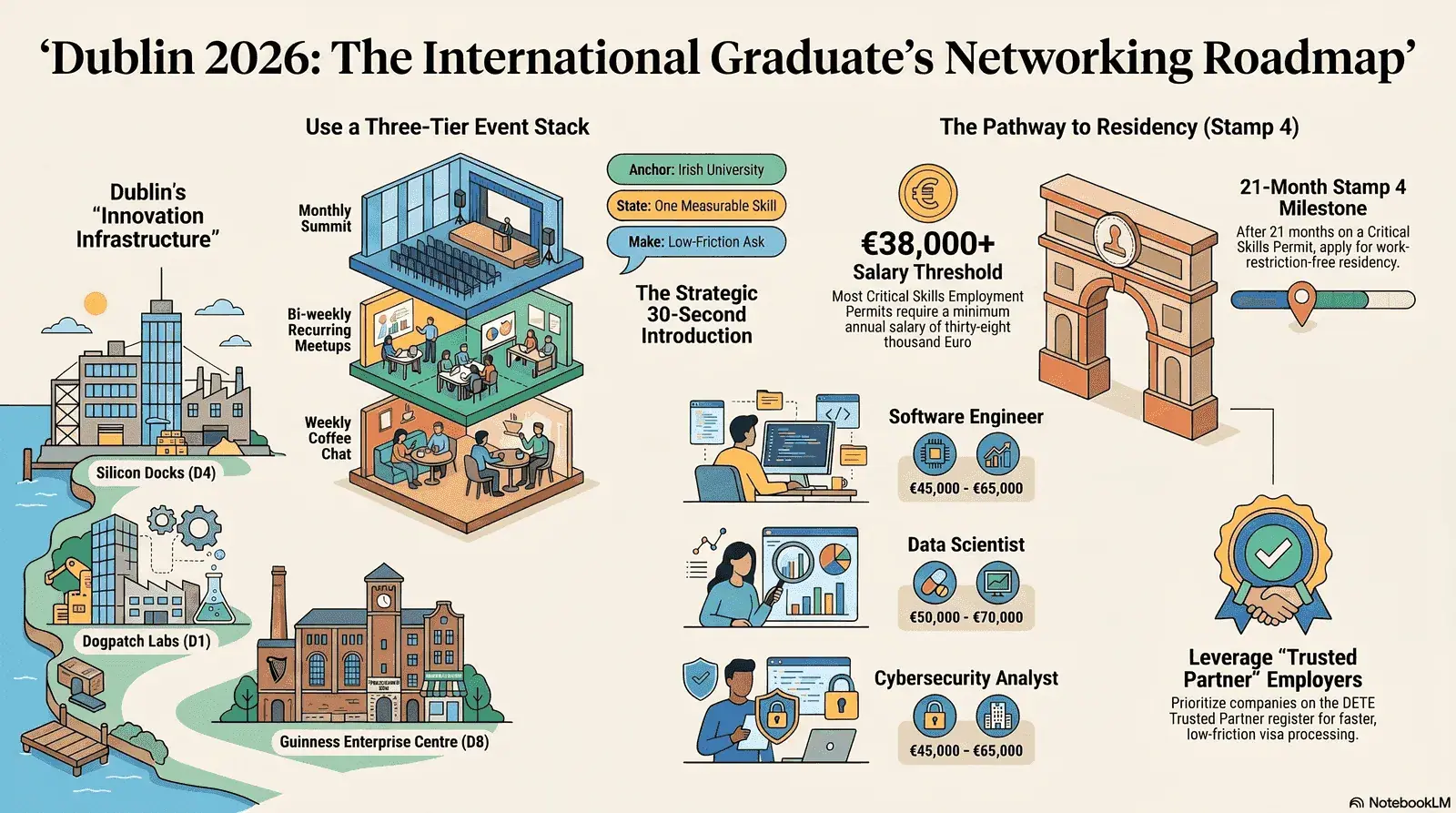
- Your Stamp 1G window is 24 months (Level 9) or 12 months (Level 8) — in-person networking at Dublin tech and industry meetups converts into job offers at dramatically higher rates than cold LinkedIn applications or job board CV submissions.
- Internal referrals drive ~40% of tech hires in Dublin — attend sector-specific MeetUp.com events, follow up with a LinkedIn connection request the same evening, and reference the specific conversation you had; this is the playbook that works.
- Target roles on Ireland's Critical Skills Occupations List from day one — these roles qualify you for a Critical Skills Employment Permit, your primary long-term immigration pathway beyond Stamp 1G.
Time you have on Stamp 1G
12 months (Level 8) 24 months (Level 9/10)
Clock starts from date of final results
The permit target
Critical Skills Employment Permit
€40,904+ salary employer applies to DETE
Primary networking area
Silicon Docks, Grand Canal Dock (D4)
Google, LinkedIn, Salesforce, Stripe, HubSpot
Path to Stamp 4
21 months on Critical Skills Permit
Then Stamp 4 no permit needed to work
10 sections in this guide
- Why online applications alone are not enough
- Dublin's high-value physical networking hubs
- Best events and communities to join in 2026
- Building your weekly event stack
- The strategic 30-second introduction
- The 12-hour post-event follow-up sequence
- How to raise the visa sponsorship conversation
- Critical Skills Eligible Occupations target roles
- Common mistakes that kill networking momentum
- Your 30-day action plan
📅 Stamp 1G Visa Timeline Planner
Calculate your visa start, expiry, and key professional job-hunting milestones based on your Irish graduation timeline.
🗺️ Key Milestone Timeline
1 Why Online Applications Alone Are Not Enough in Dublin's 2026 Job Market
Online job portals are a necessary starting point but an insufficient strategy for international graduates in Dublin in 2026. Research from LinkedIn's talent insights reports and independent hiring surveys in the Irish market consistently shows that a substantial share of professional roles particularly at junior-to-mid level in tech, pharma, and financial services are filled through internal referrals before a formal posting attracts significant application volume.
For graduates on Stamp 1G, two compounding pressures make the online-only approach particularly costly. First, the visa timeline is fixed: you have a defined window to find and start employment, and months spent waiting for algorithms to surface your profile are months you cannot recover. Second, international graduates without prior Irish work experience often lack the local contextual signals (Irish university placements, recognizable Irish employer names on a CV) that ATS systems and Irish hiring managers use as fast filters.
Ireland's tech ecosystem has a strong referral culture, shaped by the relatively small size of the professional community. Dublin's tech sector is dense but not enormous decision-makers in the same industry often know each other. An internal referral from a respected colleague carries disproportionate weight in this environment compared to larger markets like London or Berlin. This is not a reason to abandon job boards; it is a reason to treat physical networking as a parallel strategy from day one.
2 Dublin's High-Value Physical Networking Hubs
Dublin has a concentrated cluster of innovation infrastructure spanning less than five kilometres. Knowing which venues attract which type of professional and when lets you allocate your limited networking energy precisely.
Grand Canal Dock / Barrow Street
European HQs of Google (Gordon House, Barrow Street), LinkedIn (Wilton Plaza), Salesforce (Spencer Dock), HubSpot, Workday, and Stripe cluster within walking distance. The surrounding streets Hanover Quay, Charlotte Quay, Grand Canal Square have a high density of informal post-event socialising. Knowing the geography means you can propose natural follow-up locations that feel effortless, not contrived.
Dogpatch Labs CHQ Building, Custom House Quay
One of Ireland's most active startup and tech community hubs. Dogpatch Labs hosts pitch nights, founder talks, and industry-specific roundtables, many open via free Eventbrite registration. For graduates in data science, SaaS, or fintech, Dogpatch events place you in the same room as product leads, CTOs, and talent heads from Ireland's fastest-growing companies. Check dogpatchlabs.com for the current events calendar.
Guinness Enterprise Centre Taylor's Lane
The GEC houses over 100 growth-stage businesses and regularly runs networking breakfasts, industry panels, and talent-to-company matching events. It is specifically designed to connect skilled professionals with scaling Irish companies exactly the employer profile that actively navigates the Critical Skills Employment Permit process. Check gec.ie for upcoming events.
The Digital Hub Thomas Street
Ireland's first dedicated digital business quarter for creative and digital media companies. Regular industry events skew toward UX, digital marketing, creative tech, and media roles sectors with growing representation on the Critical Skills Eligible Occupations list. Useful for graduates in design, product, and communications disciplines. Check thedigitalhub.com for events.
3 Best Events and Communities to Join in Dublin in 2026
The most productive networking events for Stamp 1G graduates in Dublin in 2026 span three categories: major industry summits, startup ecosystem events, and recurring professional community meetups. Each serves a different function in your overall relationship-building strategy.
| Event / Community | Best For | Frequency | Typical Cost | How to Register |
|---|---|---|---|---|
| Dublin Tech Summit | Senior tech contacts, multinationals | Annual (typically May/June, RDS Dublin) | Paid; student rate available | dublintechsummit.com |
| Dogpatch Labs events | Startup, SaaS, fintech founders and leads | Monthly+ | Usually free | Eventbrite.ie / dogpatchlabs.com |
| NDRC Demo Days | Early-stage startups seeking talent | Several per year | Free | ndrc.ie |
| Enterprise Ireland events | Irish-owned scaling tech companies | Regular | Free (some ticketed) | enterprise-ireland.com |
| AmCham Ireland events | US multinationals (Google, LinkedIn, Meta, Stripe) | Quarterly+ | Membership or event-based | amcham.ie |
|
Meetup.com Dublin groups (Dublin JS, PyData Dublin, Dublin AI & ML, Dublin AWS User Group, Women in Technology Ireland) |
Stack-specific peer networks; informal hiring conversations | Weekly / monthly per group | Free | meetup.com |
| Startup Grind Dublin | Founder ecosystem, early-to-growth stage companies | Monthly | Free / nominal | startupgrind.com |
| Dublin Chamber events | Cross-sector business networking, SMEs and multinationals | Regular | Free for some; ticketed | dublinchamber.ie |
On Meetup.com and Eventbrite.ie, always filter for in-person events in Dublin. Online events build knowledge but do not build the physical presence that generates referrals. Showing up consistently at the same recurring in-person meetup even once a month converts you from a stranger to a familiar face faster than attending a different online event every week.
4 Building Your Weekly Event Stack
Not all networking events deliver equal return on the time you invest. A tiered approach prevents burnout and concentrates your preparation energy where it has the most impact.
- Tier 1 once per month: A major industry event: Dublin Tech Summit, an AmCham roundtable, an Enterprise Ireland mixer, or a Dogpatch Labs showcase. These attract senior decision-makers and heads of talent. Arrive with three targeted conversations planned. Research speakers and sponsors in advance. Prepare a portfolio or project summary you can reference briefly.
- Tier 2 twice per month: Mid-tier recurring meetups. The Meetup.com and Eventbrite communities are the consistent engine of relationship-building. Attend the same recurring events not a different one each time. Familiarity builds credibility faster than novelty.
- Tier 3 weekly: Low-commitment touchpoints. An online industry webinar by an Irish company, a LinkedIn Live with a Dublin-based professional, or a coffee with one person from your existing network. This tier maintains momentum between larger events and creates the compounding relationship density that leads to referrals.
5 The Strategic 30-Second Introduction
Your introduction at a Dublin networking event must do four things in 30 seconds: establish your Irish credentials, communicate a specific outcome-oriented skill, create relevance to their world, and end with the lowest-friction ask possible.
This is your strongest local credential and instantly signals cultural familiarity. Lead with it. "I just completed my MSc in Data Analytics at UCD" positions you as a local graduate, not a remote candidate.
Not your degree title the concrete result you delivered. "I built a predictive churn model for a fintech dataset that reduced model error by 22% in my dissertation." One sentence. One specific, measurable outcome.
One sentence connecting your work to their company or industry. "I know [Company] is scaling its data team for the Irish market that's the exact problem set I want to work on."
Not "do you have any openings?" that ends the conversation. "Would you have 20 minutes to share what you look for in data hires here? I'd genuinely value your perspective." This creates a reason to meet again.
The instinctive reflex to "get it out of the way early" actually creates a compliance concern in the listener's mind before they have decided they want to hire you. Establish your value first. Your permit situation is an administrative process that your employer's HR team manages it is not your problem to solve in a networking introduction.
6 The 12-Hour Post-Event Follow-Up Sequence
Send your LinkedIn connection request within 12 hours of meeting someone at an event. After 24 hours, the conversation fades. After 48 hours, your name is likely gone from their immediate memory. The follow-up sequence below is the difference between a business card that gets lost and a relationship that leads to a referral.
- LinkedIn connection within 12 hours personalized note referencing one specific detail from your conversation. "Really appreciated your perspective on the skills gap in Dublin's data engineering market particularly what you said about production-scale pipeline experience." Generic "great to meet you" messages get treated as generic.
- Value-add message 35 days later share one genuinely useful resource (an industry report, a relevant article, a brief technical observation) with no ask attached. This establishes you as a contributor, not just a taker.
- Coffee chat request 710 days later a specific, low-commitment ask. "I'm researching the Dublin data engineering market before narrowing my focus. Would you have 20 minutes for a coffee near Grand Canal Dock? I have specific questions I think you'd have sharp insight on."
- Loom video for roles you care most about a 60-second screen recording with voice overlay (loom.com is free to start) addressing a specific challenge the company faces is a genuine differentiator in a market where every other message is text-only. Use sparingly and only when you have done the company-specific research to make it credible.
7 How to Raise the Visa Sponsorship Conversation Without Derailing It
Introduce your Stamp 1G status after genuine mutual interest has been established typically in the second or third substantive conversation and frame it as a streamlined administrative process, not a hiring hurdle.
A direct, confident framing that works: "I should mention I'm currently on the post-study work permission, which means I can start immediately and work full-time without any restrictions. If we find the right fit, the Critical Skills Employment Permit is a one-time application your HR team submits to the DETE. It's designed to be straightforward for employers hiring qualified graduates from Irish universities, and for companies on the DETE Trusted Partner register, processing is typically fast."
The Department of Enterprise, Trade and Employment (DETE) operates a Trusted Partner Initiative under which registered companies can use an accelerated employment permit application process. For graduates networking with large multinationals and scaling Irish tech companies, it is worth knowing that many established Dublin employers hold Trusted Partner status meaning the permit process is a familiar, low-friction administrative step for them, not an unknown risk. You can search for registered Trusted Partners at enterprise.gov.ie.
8 Critical Skills Eligible Occupations Roles Worth Targeting in Your Networking
Your networking strategy should be focused on sectors where your skills appear on Ireland's Critical Skills Eligible Occupations List—the official document published by the Department of Enterprise, Trade and Employment (DETE) that determines which roles qualify for a Critical Skills Employment Permit. Always verify the current list at the official DETE Critical Skills Eligible Occupations List before finalising your job search strategy, as the list is reviewed annually.
| Permit Type | Minimum Salary Threshold (2026) | Key Conditions & Requirements |
|---|---|---|
| General Employment Permit (GEP) | €34,000 | Base threshold for general employment roles. |
| Critical Skills Employment Permit (CSEP) - Degree Holders | €40,904 | For roles requiring a relevant degree on the Critical Skills list. |
| Critical Skills Employment Permit (CSEP) - Non-Degree / Other | €44,000 | For specific professional categories or non-degree roles. |
| Role | Typical Starting Salary (Dublin 2026) | Key Networking Target Sectors |
|---|---|---|
| Software Developer / Engineer | 45,000- 65,000 | Tech multinationals (Google, Meta, Stripe), fintech startups |
| Data Scientist / ML Engineer | 50,000- 70,000 | Tech, pharma, financial services, insurance |
| Cybersecurity Analyst | 45,000 - 65,000 | Tech, financial services, professional services |
| Financial Risk Analyst | 45,000 - 60,000 | Banking (Citi, BoA, JP Morgan IFSC), insurance, fintech |
| Pharmacovigilance / Regulatory Affairs | 40,000 -55,000 | Pharma multinationals (Pfizer, J&J, AbbVie) in Cork, Dublin, Limerick |
| Biomedical / Process Engineer | 40,000 - 55,000 | Medical devices (Medtronic, Boston Scientific, Stryker) in Galway, Limerick |
Once you start employment on a Critical Skills Employment Permit, the clock runs toward your next critical milestone: after 21 months of employment on that permit, you become eligible to apply for Stamp 4. Stamp 4 removes the requirement for any employment permit to work in Ireland you can change employer, take on freelance work, or start a business without restriction. It is also a significant step on the long-term path toward Irish residency and, eventually, citizenship. Always verify current rules with the Irish Immigration Service (irishimmigration.ie) before making any residency planning decisions.
9 Common Mistakes That Kill Networking Momentum in Dublin
- Treating every conversation as a job application. Events where you ask people "do you know of any openings?" in the first meeting are events you will not be invited back to. Irish professional culture values the relationship before the transaction. Build the relationship first.
- Going to an event unprepared. Research the speakers, sponsors, and typical attendee profile before you walk in. Know which companies you want to learn about. Have two or three informed, specific questions prepared. Arriving without context signals that you are not serious about the industry you want to join.
- Only attending once. A single appearance at a meetup makes you a stranger. Three appearances makes you a regular. Regularity builds credibility in a way that a single impressive appearance cannot. Pick two or three recurring events and commit to them for a full quarter.
- Following up with a generic "great to meet you." A message that could have been sent to anyone is treated as if it was sent to everyone. Reference the specific conversation. Name a detail. Show that you were paying attention.
- Raising the visa requirement too early. Introducing your permit situation before the person has decided they are interested in you professionally converts an open conversation into a risk assessment. Earn their professional interest first. The permit follows the interest, not the other way around.
- Underestimating Irish workplace informality. Irish professional interactions are significantly more indirect and informal than the corporate cultures many international graduates come from. "We should grab a coffee" is a genuine invitation, not a polite dismissal. Following up on it within a week is expected, not pushy. Match the register of the conversation you are entering.
- Networking only online after having been in Dublin. Once you are physically in Ireland, the online-only approach is a strategic downgrade. The entire advantage of being in Dublin proximity, presence, shared physical community is wasted when you spend your Stamp 1G period networking exclusively through screens.
10 Your 30-Day Action Plan to Build a Dublin Professional Network
| Week | Actions | Target Outcome |
|---|---|---|
| Week 1 | Register on Meetup.com and Eventbrite.ie. Identify 58 events to attend this month. Update LinkedIn: Irish university name, skills keywords from the DETE Critical Skills list, and a headline like "Data Engineer | MSc UCD | Open to Opportunities." Research two or three target companies in your sector. | Event calendar set; LinkedIn optimised; target companies identified |
| Week 2 | Attend your first Tier 2 Meetup event. Aim for three to five genuine conversations. Send LinkedIn follow-up requests within 12 hours with personalised notes referencing specific conversation points. | First warm connections made; follow-up sequence started |
| Week 3 | Send value-add messages to Week 2 contacts. Register for one Tier 1 event (Dogpatch Labs event, Enterprise Ireland mixer, or AmCham function). Attend a second Tier 2 event. Begin Tier 3 weekly coffee with one existing contact. | Relationships warming; higher-tier event booked; Tier 3 cadence established |
| Week 4 | Request coffee chats with two contacts from weeks 23. Attend your Tier 1 event with three targeted conversations planned. Review the DETE Critical Skills Eligible Occupations list and map your skills to the highest-demand roles in your discipline. | First informational interviews scheduled; critical skills alignment confirmed |
Frequently Asked Questions
Should I mention my Stamp 1G status at Dublin networking events?
Not in the first or second conversation. Establish your professional value first. Once genuine hiring interest exists, frame it clearly: "I'm on post-study work permission I can start immediately, and the Critical Skills Employment Permit is a one-time HR process your team submits to the DETE."
What is the fastest path from Stamp 1G to Stamp 4 in Ireland?
Secure a role on the DETE Critical Skills Eligible Occupations list at a salary of €40,904 or above (as of 1 March 2026; verify current threshold at enterprise.gov.ie). Your employer applies for the Critical Skills Employment Permit. After 21 months on that permit, you are eligible to apply for Stamp 4 no permit required to work in Ireland.
How do I find networking events in Dublin in 2026?
Use Meetup.com, Eventbrite.ie, and LinkedIn Events filtered to Dublin. For curated startup and tech events, check dogpatchlabs.com, gec.ie, and enterprise-ireland.com directly. AmCham (amcham.ie) and Dublin Chamber (dublinchamber.ie) publish their own event calendars.
What salary qualifies for the Critical Skills Employment Permit?
The general minimum is €40,904 per year (as of 1 March 2026). Some shortage occupations may have different thresholds. Always verify current figures at enterprise.gov.ie before any planning decisions.
Is it acceptable to ask someone about job openings at a Dublin networking event?
In Irish professional culture, yes it collapses the relationship before it has formed. A better first ask is for insight: "What skills do you find most critical for data hires on your team?" Job opportunities emerge from the relationship over subsequent conversations, not from the first handshake.
How soon after graduating should I start networking in Dublin?
The ideal time to start is during your final semester before Stamp 1G begins. Starting your event calendar and LinkedIn outreach while still enrolled puts you months ahead. The Stamp 1G window is fixed; warm relationships need time to develop.
- Student Internships and Placements in Ireland 2026: How to Find, Negotiate and Work Full-Time Hours on Stamp 2 — how Stamp 2 students can work full-time on accredited placements, where to find paid roles, and how to convert a placement into a CSEP job offer
- Student Clubs and Societies in Ireland 2026: How to Use Them to Network, Save Money and Get Hired — how to turn society membership into a professional network, employer contacts, and CV evidence for the Irish job market
This guide on professional networking complements our broader resources for international students in Ireland:
What salary do I need to qualify for a Critical Skills Employment Permit in Ireland?
The general minimum salary for the Critical Skills Employment Permit is €40,904 per year (as of 1 March 2026). Some roles in specific shortage occupations may have different thresholds. Always verify current salary requirements at enterprise.gov.ie before relying on this figure for planning.
Can I attend Dublin Tech Summit as a student or recent graduate?
Yes. Dublin Tech Summit offers student and graduate ticket categories at reduced rates. Check the official Dublin Tech Summit website for current pricing and registration ahead of the annual event, which is typically held at the RDS (Royal Dublin Society) in Ballsbridge.
- Stamp 1G to Critical Skills Employment Permit 2026: New €40,904 Threshold, Graduate Carve-Out and Roadmap to 2027 — the updated CSEP salary threshold from March 2026, graduate carve-out at €36,848, and full application checklist
- Stop Writing Basic CVs: How International Students in Ireland Build a Seniorized Graduate CV That Wins (2026) — once networking opens the door, make sure your CV walks through it: NFQ framework, STAR bullets, and the action verbs Dublin ATS systems screen for on Stamp 1G
- Remote vs. Return-to-Office: Negotiating Flex Work on a Stamp 1G Visa — how to use your statutory right to request remote working and smart interview scripts to win a hybrid role without risking your visa or sponsorship
- Targeting the 2026 Skill Gaps: High-Salary Sectors Hiring Graduates in Ireland — which sectors are paying the most and hiring hardest (life sciences, procurement, construction) and how to target Critical Skills roles before you network
- Aviation Tech Careers in Ireland 2026: GDS, Airline Operations & International Students — how to break into GDS analyst, revenue management, and aircraft leasing roles at AerCap, Aer Lingus, and Ryanair Labs on Stamp 1G
- Study in Ireland 2026: Universities, Costs, Scholarships & Flights Part 1 GOI-IES scholarships, tuition costs, Stamp 1G detail, and flights from India and China
- Finding Affordable Flights from Dublin to Delhi (2026 Complete Guide) airlines, fare benchmarks, best booking windows, and visa requirements
- Airport Lounge Access India: Complete Credit Card Guide 2026 DreamFolks vs Priority Pass, spend-based criteria, and guest access for your India trips home
- Critical Skills Employment Permit After Stamp 1G: The 2026 Roadmap from Graduate to Stamp 4 — From Stamp 1G to a Critical Skills Employment Permit in 2026: the salary threshold, CSEP vs GEP, employer sponsorship, Stamp 4 timing and pitfalls.
Planning your Dublin arrival? Compare flight fares first.
Use the MyFlightOffers fare calendar to find the cheapest month to fly before your networking journey in Dublin begins.
All immigration information, permit thresholds, salary requirements, Stamp 1G durations, DETE programme details, and venue and event references in this article are based on publicly available information from the Irish Immigration Service (irishimmigration.ie), the Department of Enterprise, Trade and Employment (enterprise.gov.ie), and official venue websites as of June 2026. Immigration rules, permit salary thresholds, the Critical Skills Eligible Occupations list, and event programmes are subject to change without notice. Always verify current requirements directly with irishimmigration.ie, enterprise.gov.ie, and individual venue event calendars before making any career, visa, or travel decisions. MyFlightOffers is not affiliated with any Irish government department, venue, employer, or event organiser mentioned in this article. This article does not constitute immigration, legal, or career advice.