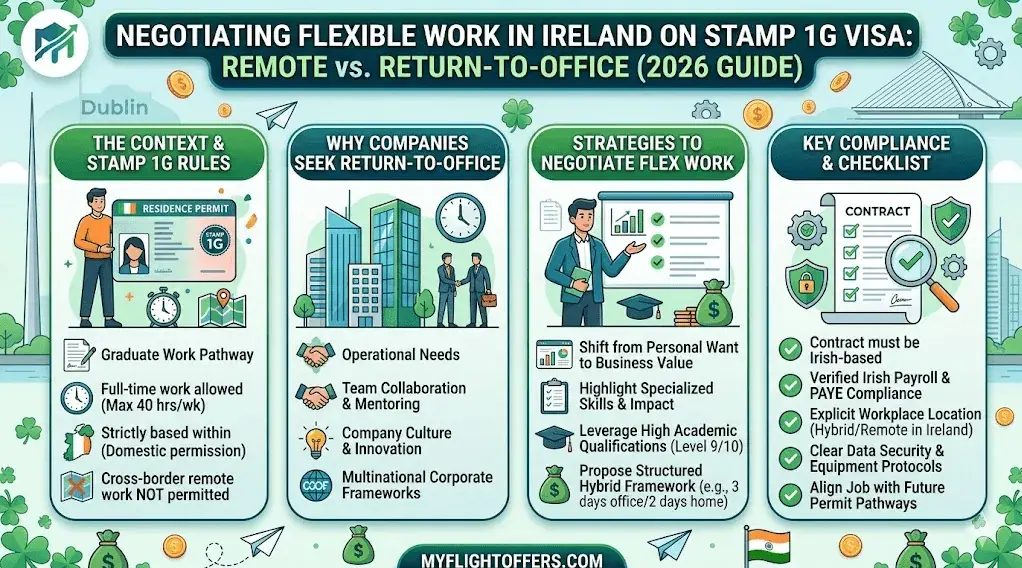
- You have a real, statutory right to request remote working — under the Work Life Balance and Miscellaneous Provisions Act 2023, all employees, including Stamp 1G holders, can request remote work from day one, with the arrangement starting after six months of service. In 2026 the Department of Enterprise found 94% of requests are approved in full or in part.
- Your home-working address must be in Ireland — Stamp 1G lets you work up to 40 hours a week, remote or hybrid, but your immigration permission is tied to residence in the State. You cannot live abroad and work remotely for an Irish employer.
- Timing and framing win the negotiation — never open with remote demands. Prove your value first, raise hybrid at the offer stage framed around productivity, and never trade away an employer willing to sponsor your Critical Skills Employment Permit just to save a commute.
Your legal right
Request remote work from day one
Work Life Balance Act 2023, Part 3
When it can start
After 6 months continuous service
Written request, 8+ weeks before start
Approval rate (2026)
94% approved in full or part
DETE statutory review, March 2026
The hard limit
You must reside in Ireland
No working abroad on Stamp 1G
7 sections in this guide
- The 2026 Irish workplace tension point
- The legal framework: what Stamp 1G holders need to know
- Can you actually work remotely on Stamp 1G?
- The 3-phase remote negotiation strategy
- Overcoming employer objections: ready scripts
- Remote, hybrid and on-site: an honest comparison
- Your action plan and final reality check
1 The 2026 Irish Workplace Tension Point
Ireland's job market in 2026 is split: employees overwhelmingly want hybrid work, while a vocal minority of employers are pushing for a return to the office. Understanding which side of that divide a prospective employer sits on is the single most useful piece of intelligence you can gather before you negotiate.
The Hays Ireland 2026 Salary & Recruiting Trends research, based on a survey of over 600 employers and professionals, captures the standoff precisely. Half of employees say they would not consider accepting a future job that does not offer hybrid working. Yet more than one in ten organisations say they want to reduce the flexible work options available and bring more staff on-site. At the same time, 79% of employers already offer some form of hybrid working, and 38% expect employees to attend the workplace more frequently in the year ahead. In other words, hybrid is the norm, but the direction of travel at a minority of firms is back toward the desk.
The same Hays research found that skills shortages remain acute, with 96% of employers reporting them over the past year, and that nearly nine in ten employers plan to hire in the next 12 months. That demand gives well-qualified graduates more leverage than they assume. A company that genuinely needs your skills is far more likely to flex on working pattern than a graduate fixated on sponsorship tends to believe. Leverage is real; the trick is using it without burning the relationship.
For a Stamp 1G graduate, there is an added psychological hurdle. You are not only choosing a job; you are choosing the employer who may one day apply for your Critical Skills Employment Permit and set you on the path to longer-term residence. That long game can make you feel you have no right to ask for anything. The rest of this guide dismantles that belief, because Irish law gives you the same flexible-working rights as any colleague, and a smart negotiation protects both your lifestyle and your sponsorship.
2 The Legal Framework: What Stamp 1G Holders Need to Know
Your right to request remote and flexible working comes from the Work Life Balance and Miscellaneous Provisions Act 2023, and it applies to you on a Stamp 1G exactly as it applies to an Irish citizen. Knowing the statutory boundaries turns a nervous request into a confident, informed conversation.
The detail is set out clearly by Citizens Information and governed by the Workplace Relations Commission (WRC) Code of Practice. Three points matter most for a new graduate.
| Regulatory point | The practical fact | What it means for Stamp 1G grads |
|---|---|---|
| Right to request | Under the Work Life Balance Act 2023, every employee holds a formal right to request a remote arrangement. | You can submit a written request from your first day, but you must complete six months of continuous service before an approved arrangement can legally start. |
| How to apply | The request must be in writing, made as soon as is reasonably practicable and at least eight weeks before the proposed start date. | The WRC publishes template forms; using the official format signals you understand the process and makes refusal harder to justify. |
| WRC enforcement 2026 | The DETE statutory review (March 2026) found 94% of requests approved in full or in part. | Irish employers favour structured consultation over blanket refusal. The odds of a fair hearing are firmly in your favour. |
| Immigration catch | An employment permit and immigration permission are location-specific and tied to residence in the State. | You cannot live abroad or leave Ireland while working on a Stamp 1G. Your remote workspace must be an address within the Republic of Ireland. |
An employer can refuse a request, but only after considering it objectively, fairly and reasonably, weighing business needs against your needs, and replying in writing (generally within four weeks, extendable by a further eight). If they ignore the process entirely, you can refer a complaint to the Workplace Relations Commission within six months of the breach. This is not a tool for the first week of a graduate job, but knowing it exists changes the power dynamic of the whole conversation.
One important 2026 update: following the statutory review, Ministers confirmed that no legislative change is needed because the Act is working effectively, but the WRC has been asked to strengthen its Code of Practice with clearer templates, better guidance on giving transparent reasons for decisions, and more structured consultation. For you, that means the paperwork around requests is becoming more standardised and easier to navigate, not less.
3 Can You Actually Work Remotely on a Stamp 1G Visa?
Yes — Stamp 1G gives you full, unrestricted permission to work up to 40 hours per week for any employer, and that work can be remote or hybrid, provided you live in Ireland. The visa itself places no restriction on whether your work happens at a desk in the office or at a desk in your apartment; the restriction is on where you reside.
The Stamp 1G is the post-study graduate permission. As Citizens Information and the Irish Immigration Service set out, it lasts 12 months for Level 8 honours graduates and 24 months for Level 9 and Level 10 (master's and PhD) graduates. You can take any paid employment, full-time, with no employer sponsorship required during this period. Self-employment is not permitted, and you must apply for the permission within six months of receiving your final award. Crucially, that permission requires you to be resident in the State.
Some graduates assume "remote" means they can fly home to India, Nigeria or Brazil and keep working for their Dublin employer online. It does not. Ireland has no digital nomad visa, and your immigration permission lapses if you are not resident in the State. If you accept a fully remote role, your home office still has to be a real Irish address with reliable broadband. Working from outside Ireland on a Stamp 1G can put both your current permission and any future Critical Skills Employment Permit application at risk.
There is also a longer-term reason to keep your work physically in Ireland. From 1 March 2026, the Critical Skills Employment Permit minimum salary rose to €40,904, with a reduced recent-graduate threshold of €36,848 for those who qualified from an Irish institution within the previous 12 months. The General Employment Permit minimum rose to €36,605. Securing a role that meets these thresholds, with an employer based and operating in Ireland, is your bridge from Stamp 1G to a permit and ultimately to Stamp 4. A genuinely Ireland-based hybrid role keeps that bridge intact; an informal "work from another country" arrangement quietly undermines it.
4 The 3-Phase Remote Negotiation Strategy
Win flexibility by sequencing the conversation: prove your value in the interview, introduce your hybrid preference at the offer stage, and lock the agreed split into your written contract. The order is everything. Raise remote work too early and you look like a candidate optimising for comfort; raise it at the right moment and you look like a professional optimising for output.
Never make remote work your opening question. Keep the early focus entirely on your skills, your Irish qualification and your fit for the role, so the employer comes to see you as a high-value talent asset before flexibility ever enters the discussion. Quietly research the company's real remote footprint on Glassdoor and by looking at current staff profiles on LinkedIn so you know what is realistic.
When the verbal offer is on the table, introduce your preferred hybrid cadence and anchor it to output, not lifestyle: "I do my deepest analytical work in a distraction-free home office, which lets me protect in-person time for collaboration and team building." You are not asking for a favour; you are describing how you deliver your best work.
Ensure the agreed split (for example, three days at home, two in the office) is documented in your contract or a remote working policy. Under the WRC Code of Practice, a remote arrangement should set out clear contact parameters and IT and data-security expectations. A verbal promise of "we're flexible" is worth little once a new manager arrives; a written clause survives.
Notice what the strategy does not do: it never pits flexibility against the job itself. If an employer is offering genuine Critical Skills sponsorship and a strong career path, a slightly less flexible pattern is a price worth paying. Flexibility is a two-way street, and the graduate who understands that negotiates from a position of credibility rather than entitlement.
5 Overcoming Employer Objections: Ready-to-Use Scripts
When an employer pushes back on hybrid working, respond with cooperation and confidence rather than retreat — short, prepared scripts let you hold your ground professionally. Below are the two objections graduates hear most, with responses you can adapt to your own voice.
The right to request remote and flexible working under the Work Life Balance and Miscellaneous Provisions Act 2023 applies to all employees in Ireland. Your Stamp 1G status does not reduce your employment rights. An employer who suggests otherwise is mistaken, and a calm, factual correction often resolves the point on the spot — without you ever needing to escalate.
Quoting legislation in a friendly offer conversation can feel adversarial. Lead with cooperation; keep the legal point in reserve and deploy it only if you meet genuine resistance or misinformation. The goal is a strong working relationship from day one, not a victory in your first week.
6 Remote, Hybrid and On-Site: An Honest Comparison for Stamp 1G Graduates
For most international graduates, a hybrid arrangement is the strongest choice — it protects your visa, accelerates your integration, and still gives you meaningful flexibility. The table below weighs each pattern against the things that actually matter when you are new to Ireland and building toward sponsorship.
| Factor | Fully on-site | Hybrid (recommended) | Fully remote |
|---|---|---|---|
| Visa / residence safety | No issue | No issue (Irish address) | Safe only if you stay resident in Ireland |
| Networking & referrals | Strongest | Strong | Weakest — easy to feel isolated |
| Onboarding speed | Fastest | Fast | Slowest for a first Irish role |
| Commute cost & time | Highest | Reduced | Eliminated |
| Sponsorship signal to employer | Maximum visibility | High visibility | Lower visibility — be deliberate |
| Best for | Highly collaborative or lab-based roles | Most graduate office roles | Specialist roles with mature remote culture |
The pattern to be most careful with is full remote. It is perfectly legal on a Stamp 1G as long as you remain resident in Ireland, and it can suit a specialist role at a company with a mature remote culture. But for your first Irish job it carries hidden costs: the internal referrals that drive a large share of Irish hiring come from being in the room, and a manager who barely sees you is a manager less invested in championing your permit application. If you do take a remote role, be deliberate about showing up to team events, company socials and industry meetups in person.
Hybrid is the recommendation here, but it is not free of downside: you still carry commute costs on office days, and you have to be disciplined about which work you do where. The point is balance. For the overwhelming majority of graduate office roles in Ireland in 2026, a documented three-two or two-three split is the sweet spot between lifestyle, integration and the visibility that earns sponsorship.
7 Your Action Plan and Final Reality Check
Treat flexibility as something you earn through value and secure through process — not something you demand on day one or trade your sponsorship away to get. Here is how to put everything above into practice before, during and after your job search.
- Research the real footprint. Before any interview, check the company's hybrid reality on Glassdoor and by reading current employees' LinkedIn posts and profiles, so your ask matches what is genuinely on offer.
- Fix your home setup. Make sure you have a reliable, high-speed Irish broadband connection and a workable home workspace before you pitch a hybrid schedule. You should be able to say, honestly, that you are set up to deliver from home.
- Know your statutory rights. Read the official WRC Code of Practice on the right to request remote working so you understand your protections as an equal member of the Irish workforce.
- Protect the permit, always. Never prioritise remote work over an employer who actively offers a clear Critical Skills Employment Permit sponsorship pathway. The permit is your future in Ireland; a commute is a temporary cost.
The reality check is simple. Ireland's 2026 market gives qualified graduates more leverage than fear suggests, and the law gives you the same flexible-working rights as everyone else. But leverage and rights are tools, not weapons. Used with judgement — value first, flexibility framed around output, sponsorship protected — they let you build the kind of life in Ireland that made you choose to study here in the first place.
Frequently Asked Questions
Can I work remotely on a Stamp 1G visa in Ireland?
Yes. Stamp 1G gives you full, unrestricted permission to work up to 40 hours a week for any employer, and that work can be remote or hybrid once your employer agrees. The key limit is location: your immigration permission requires you to live in the Republic of Ireland, so your home-working address must be in the State. You cannot live abroad and work remotely for an Irish employer on a Stamp 1G, because an employment permit and immigration permission are tied to residence in Ireland.
When can I legally start a remote working arrangement in Ireland?
Under the Work Life Balance and Miscellaneous Provisions Act 2023, you can submit a formal request to work remotely from your first day in a new job, but you must complete six months of continuous service before an approved arrangement can take effect. The request must be made in writing as soon as is reasonably practicable and no later than eight weeks before the proposed start date.
How often are remote working requests approved in Ireland?
Very often. The statutory review of the legislation published by the Department of Enterprise, Trade and Employment in March 2026 found that 94% of employees' requests were approved either fully or in part, and that employers reported minimal administrative burden in operating the system.
Do Stamp 1G holders have the same remote working rights as Irish citizens?
Yes. The right to request remote and flexible working under the Work Life Balance and Miscellaneous Provisions Act 2023 applies to all employees in Ireland regardless of nationality or immigration status. Once you are lawfully employed on a Stamp 1G, you have the same statutory right to request a remote arrangement as any Irish or EU colleague.
Should I ask about hybrid working in a job interview?
Ask, but time it correctly. Do not make remote work your opening question. Establish your skills and fit first, then raise your preferred hybrid cadence once a verbal offer is on the table or imminent. Frame it around productivity and output rather than personal preference, and never prioritise remote work over an employer who is willing to sponsor your Critical Skills Employment Permit.
Can my employer refuse a remote working request?
Yes, an employer can refuse, but they must follow the WRC Code of Practice. They must consider the request objectively, fairly and reasonably, weighing the needs of the business against the needs of the employee, and they must respond in writing within four weeks (extendable by a further eight weeks). If you believe the process was not followed correctly, you can refer a complaint to the Workplace Relations Commission within six months of the breach.
Ready to fly to Ireland? Compare live fares first.
Whether you're arriving for your studies or flying home between job offers, use the MyFlightOffers fare calendar to find the cheapest month to travel before you settle into your new Irish role.
All information on the Work Life Balance and Miscellaneous Provisions Act 2023, the WRC Code of Practice, Stamp 1G conditions, remote working requests, and employment permit salary thresholds in this article is based on publicly available official sources as of June 2026, including citizensinformation.ie, workplacerelations.ie, enterprise.gov.ie and irishimmigration.ie. Immigration rules, permit thresholds, and flexible-working guidance are subject to change without notice. Always verify the current position directly with the relevant authority before making any career, visa, or travel decisions. MyFlightOffers is not affiliated with any organisation, government department or employer mentioned. This article does not constitute financial, tax, immigration, or legal advice.
- Dublin Networking Guide: How International Students Land Post-Study Jobs in 2026 — the in-person playbook for turning Stamp 1G into internal referrals, job offers and a Critical Skills Employment Permit.
- Targeting the 2026 Skill Gaps: High-Salary Sectors Hiring Graduates in Ireland — which sectors are paying the most and hiring hardest, and how to aim your search at Critical Skills roles.
- Revenue.ie Emergency Tax Guide for International Students — set up your PPS number and tax credits correctly so your first Irish pay packet is not eaten by emergency tax.