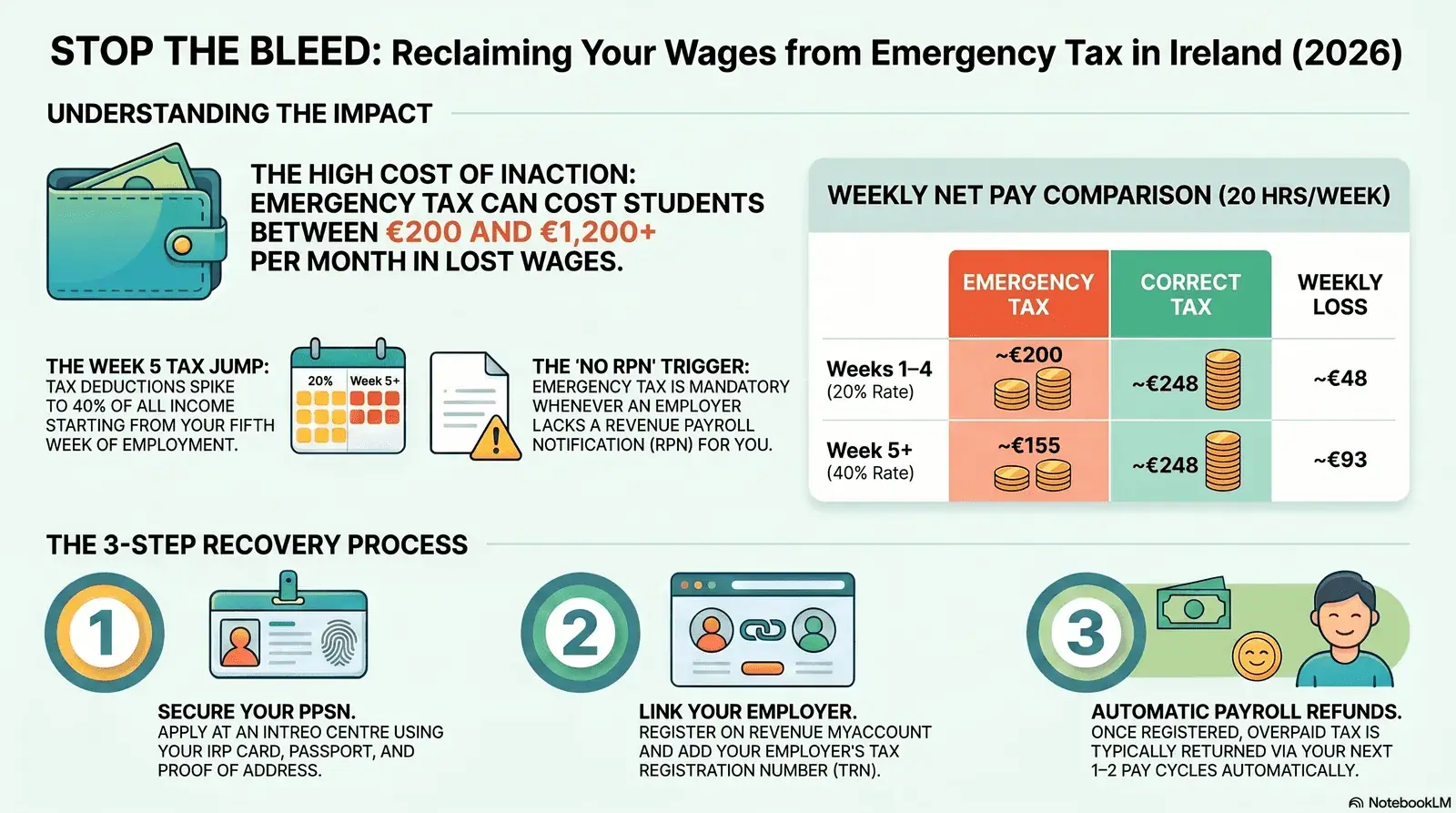
- Emergency tax is not automatic or permanent: it kicks in because Revenue has no payroll notification for you — your employer cannot stop it without you registering on Revenue MyAccount first.
- Fix it in 4 steps: get your PPSN → create a Revenue MyAccount → add your employer → receive your Tax Credit Certificate. This stops emergency tax on your next payslip.
- If you were already taxed at emergency rates, reclaim it: file a Statement of Liability at year-end via myaccount.revenue.ie — most students get €200–€600 back.
Revenue Ireland does not automatically assign tax credits to a new employee. You must register your employer on Revenue MyAccount yourself. Until you do, every payroll run will use emergency rates. This guide walks you through every single step.
🚨 What is emergency tax?
Tax at 20%–40% with no credits applied — because Revenue has no payroll notification (RPN) for you.
🔑 The one-step fix
Register on Revenue MyAccount, add your employer's TRN. Revenue issues the RPN. Done.
📋 Required first step
You must have a PPSN before you can register with Revenue. Apply at your local Intreo Centre.
💶 Refund speed
Overpaid emergency tax is returned automatically via payroll in most cases within 1–2 pay cycles after your RPN is active.
7 critical questions answered in this guide
- What is emergency tax and why did it happen to me?
- How do I get a PPSN as an international student?
- How do I set up Revenue MyAccount? (Step-by-step walkthrough)
- How do I register my employer and stop emergency tax?
- How do I claim my emergency tax refund?
- How do I file a Statement of Liability (year-end review)?
- What tax credits can I claim as an international student?
- Pre-employment tax checklist
💶 Ireland Student Emergency Tax Estimator
Calculate your weekly take-home pay and see how much emergency tax will be withheld if you haven't registered on Revenue MyAccount.
📄 Weekly Pay & Tax Comparison
| Metric / Phase | Registered (Normal Tax) | Weeks 1–4 (Emergency) | Week 5+ (Emergency) |
|---|---|---|---|
| Gross Pay | - | - | - |
| PAYE Withheld | - | - | - |
| USC Withheld | - | - | - |
| PRSI (Weekly estimate) | - | - | - |
| Weekly Take-Home | - | - | - |
💰 Total Impact Summary
| Total Gross Earned (over 5 weeks) | - |
| Total Emergency Deductions (PAYE + USC) | - |
| Estimated Emergency Tax Refund Claimable: | - |
1 What Is Emergency Tax and Why Did It Happen to Me?
Emergency tax is applied when your employer has no Revenue Payroll Notification (RPN) on file for you. Without an RPN, your employer cannot apply your personal tax credits or standard rate cut-off, resulting in significantly higher tax deductions than your actual liability — up to 40% of all income from week five of employment.
Ireland operates a PAYE (Pay As You Earn) system in which Revenue sends each employer a digital RPN before every payroll run. The RPN tells the employer exactly how much tax to deduct from your wages based on your personal circumstances. If you have not registered with Revenue — which requires a PPSN — no RPN exists, and your employer is legally required to apply emergency tax instead.
According to Revenue's official emergency tax guidance:
- Weeks 1–4 of employment (no RPN): Your employer applies the standard tax rate (20%) but with no standard rate cut-off point and no personal tax credits. USC is also charged at emergency rates with no lower threshold exemption.
- Week 5 onwards (still no RPN): Your employer deducts tax at the higher rate (40%) on all income, still with no credits or cut-off. This is the rate that causes the biggest shock on student payslips.
Real-World Impact: The Numbers That Should Make You Act Today
Ireland's national minimum wage is €14.15 per hour from 1 January 2026 for workers aged 20 and over (up from €13.50 in 2025) — confirm the current figure at gov.ie. At 20 hours per week — the maximum permitted on Stamp 2 during term time — here is what emergency tax actually costs:
| Employment period | Weekly gross | Net after emergency tax | Net after correct tax* | Weekly loss |
|---|---|---|---|---|
| Weeks 1–4 (20% emergency) | €270 | ~€200 | ~€248 | ~€48 |
| Week 5+ (40% emergency) | €270 | ~€155 | ~€248 | ~€93 |
| Holiday period (40 hrs/week) | €540 | ~€315 | ~€494 | ~€179 |
*Correct-tax estimate based on 2025 credits (€4,000 combined) and standard USC rates. Figures are illustrative — check your payslip against revenue.ie for exact amounts.
🧮 Interactive 2026 Student Tax Refund Estimator
Input your details below to instantly calculate how much emergency tax is being over-deducted from your paycheck.
What You Paid
€0.00
What You Owed
€0.00
Your employer is legally prohibited from applying tax credits without an RPN from Revenue. It is not a choice or an administrative shortcut — it is a statutory obligation. The employer cannot resolve this unilaterally. Only you can trigger the RPN process by registering with Revenue.
2 How Do I Get a PPSN as an International Student?
A Personal Public Service Number (PPSN) is your unique Irish tax identification number and the mandatory prerequisite for registering with Revenue. Without a PPSN you cannot set up Revenue MyAccount, and without MyAccount you cannot stop emergency tax. As a non-EU student on Stamp 2, you are fully entitled to a PPSN and can apply as soon as you have your IRP card.
Your PPSN is issued free of charge by the Department of Social Protection. Full application guidance is at gov.ie — Get a PPS Number.
Step-by-Step: Applying for Your PPSN
1Book your appointment online or in person
Go to MyWelfare.ie and search for "PPS Number". You can book an appointment at your nearest Intreo Centre or DSP office. Many centres also accept student walk-ins on weekday mornings — call ahead to confirm availability.
2Gather your four required documents
- IRP Card (Irish Residence Permit — your Stamp 2 permission card issued by the Garda National Immigration Bureau)
- Valid passport — the same document used to enter Ireland
- Proof of Irish address — utility bill, bank letter, or official university correspondence dated within the last three months. A letter from your university housing office on headed paper is usually accepted.
- Reason for needing a PPSN — a university enrolment letter or a signed contract of employment is sufficient
3Attend your appointment (10–20 minutes)
Bring originals, not photocopies. Your PPSN is either issued at the counter on a printed letter or posted to your Irish address within 3–5 working days. Keep this letter safe — you will need the PPSN number for Revenue, banking, and GP registration.
3 How Do I Set Up Revenue MyAccount? — Complete Step-by-Step Walkthrough
Revenue MyAccount (myaccount.revenue.ie) is the online portal where you manage your entire Irish tax record. Setting it up is the single most important step to avoid or resolve emergency tax — and it takes approximately 10–15 minutes.
1Navigate to Revenue MyAccount
Go to myaccount.revenue.ie. You will see a "Sign in" button and a "Register" link. If you are setting up for the first time, click "Register".
2Enter your PPSN and personal details
You will be prompted for:
- Your PPSN
- Your date of birth
- Your full name exactly as printed on your IRP card
- Your Irish mobile number — required for SMS verification codes. Use a +353 number that can receive texts immediately.
Revenue sends a one-time code to your mobile to confirm your identity. If you do not yet have an Irish SIM, consider picking one up from Three, Vodafone, or Eir before attempting this step.
3Set up or link your MyGovID account
Revenue MyAccount uses MyGovID for secure authentication — Ireland's single government login system. If you do not have a MyGovID, you will be guided to create one during the Revenue registration process. For the full range of Revenue features (including some year-end filing), upgrading to a verified MyGovID using your IRP card details is recommended.
4Log in and check your tax record
Once inside MyAccount, navigate to "Manage My Record". Here you will see:
- Your current tax credits (Personal Tax Credit, Employee Tax Credit)
- Your standard rate cut-off point for the year
- Any existing registered employments
If you see zero credits or no employments listed, that confirms exactly why emergency tax is being deducted from your wages.
Portal: myaccount.revenue.ie
MyGovID: mygovid.ie
PAYE Helpline: 1800 80 80 90 (Mon–Fri 9:30am–4pm, free from Irish mobiles and landlines)
Full Revenue guidance: revenue.ie — Emergency Tax
4 How Do I Register My Employer and Stop Emergency Tax?
Once you are inside Revenue MyAccount, adding your employer takes under five minutes. Revenue will automatically issue an updated RPN to your employer. From the next payroll run, your correct tax credits and cut-off will be applied — and any previously over-deducted emergency tax is returned automatically.
What Is a Tax Registration Number (TRN)?
To link your employer, you need their
Tax Registration Number (TRN) — also called an
Employer Registration Number. This is a Revenue-specific
identifier (typically 7 digits followed by a letter, e.g.
1234567A), distinct from the Companies Registration
Office (CRO) number. Ask your HR department, payroll contact, or
manager. It appears on your contract of employment and on every
payslip once it has been issued.
1Navigate to "Jobs and Pensions" in MyAccount
Log in to myaccount.revenue.ie. From the main dashboard, select "Manage My Record" then "Jobs and Pensions" (or "Employments" depending on your interface version).
2Click "Add a new employment"
Select "Add a new employment". You will be asked to enter your employer's TRN, your start date, and to confirm whether this is your only job (this determines how your tax credits are allocated — select "Yes" unless you have a second concurrent employment).
3Confirm and submit
Review the details and click "Confirm". Revenue processes the request and issues an updated RPN to your employer's payroll system — typically within 24–72 hours. Your employer's payroll software will automatically pick up the RPN at the next scheduled run.
4Notify your payroll contact (recommended)
Send a quick email to your HR or payroll contact: "I've registered with Revenue MyAccount and linked your TRN. A Revenue Payroll Notification should now be available for my next payroll run. Can you confirm receipt?" This is not mandatory, but it significantly reduces the chance of the RPN being missed in a busy payroll cycle.
5 How Do I Claim My Emergency Tax Refund?
In the majority of cases, overpaid emergency tax is returned automatically through your payroll once your employer applies the RPN. No separate claim is needed — the system self-corrects. If you have left the job or it is year-end, you may need to request a Statement of Liability to receive a direct refund.
Automatic Refund via Payroll (Most Common)
When your employer applies the RPN for the first time, their payroll software recalculates your cumulative tax position for the current tax year. Any over-deducted emergency tax is returned to you in your next payslip or spread over remaining pay periods in the tax year. Check your next two payslips carefully — the refund line should be visible.
Manual Claim for Prior-Year Emergency Tax
If you were on emergency tax for a long period, changed jobs, or left Ireland before the automatic refund cleared — you need to request a Statement of Liability (see Section 6 below). Revenue calculates the exact tax owed versus tax paid, and any overpayment is transferred directly to your registered Irish bank account.
Revenue allows you to claim tax refunds for up to four tax years from the current year. If you worked in Ireland in 2022, 2023, or 2024 and paid emergency tax that you never reclaimed, you can still claim today. In 2026, you can submit claims for tax years 2022, 2023, 2024, and 2025 simultaneously. Use Revenue MyAccount to request a Statement of Liability for each prior year. See Revenue's guidance at revenue.ie — Claiming a refund for a prior year.
6 How Do I File a Statement of Liability (Year-End Review)?
A Statement of Liability — formerly called a P21 Balancing Statement — is Revenue's year-end summary of your total income, total tax paid, and any resulting refund owed to you or underpayment owed by you. For most part-time student workers, this document will show a refund, particularly if emergency tax was deducted at any point during the year.
Statements of Liability become available through Revenue MyAccount after December 31 of the relevant tax year. Ireland's tax year runs January 1 to December 31.
When to Request a Statement of Liability
- After December 31 of any year you worked in Ireland — to reconcile all credits and overpayments
- If emergency tax was deducted and not automatically refunded through payroll
- If you had multiple employers in the same year and credits were split incorrectly
- If you are permanently leaving Ireland and want all Irish tax matters settled
How to Request It in Revenue MyAccount
- Log in to Revenue MyAccount.
- Select "Review your tax" or navigate to "Statement of Liability" under the PAYE section.
- Choose the tax year you want to review (e.g., 2025).
- Revenue automatically pre-populates your income from all registered employments using the payroll data it received from your employers throughout the year.
- Confirm or amend any figures (e.g., rental income or foreign income not already captured).
- Submit. Revenue typically issues the statement within 5–10 working days.
- Any refund is paid directly to your Irish bank account. Ensure your bank account details are saved in MyAccount under "My Profile" → "Bank Account" before submitting.
When reviewing your Statement of Liability, also consider claiming the Rent Tax Credit (up to €2,000 for qualifying private rental payments in 2025 — check current limits at revenue.ie — Rent Tax Credit), health expenses relief (at 20% on qualifying medical costs), and tuition fees relief if applicable. These credits do not apply automatically — you must claim them.
7 What Tax Credits Can I Claim as an International Student?
International students employed in Ireland are entitled to the same PAYE tax credits as any Irish worker. With the combined Personal Tax Credit and Employee Tax Credit in 2025, the effective income tax on annual earnings up to approximately €20,000 is zero. Emergency tax is an avoidable over-deduction, not a reflection of your real liability.
| Tax credit | Amount (2025) | Who is eligible? | How it reduces your tax |
|---|---|---|---|
| Personal Tax Credit | €2,000 | All Irish tax residents | Reduces your income tax liability by €2,000 |
| Employee (PAYE) Tax Credit | €2,000 | All PAYE (employed) workers | Reduces income tax liability by a further €2,000 |
| Combined total | €4,000 | All PAYE workers | Zero income tax on approx. first €20,000 of earnings (2025 standard rate 20%) |
| Rent Tax Credit | Up to €2,000 | Private renters — must be claimed | Reduces tax on qualifying rental payments — claim via MyAccount |
Working 20 hrs/week at €14.15 for 47 weeks of the year: Annual
earnings ≈ €13,301
Income tax: 20% × €13,301 = €2,660 — minus €4,000 in credits =
zero income tax.
USC: annual income above the €13,000 exemption, so USC applies
to the full amount — 0.5% × €12,012 + 2% × €1,289 = €60 + €26 =
~€86/year. Note the 2026 wage rise pushes this
profile just over the exemption; at 2025 rates the same hours
fell under €13,000 and paid no USC at all.
PRSI: Weekly earnings of €283 are below the €352/week PRSI
threshold for most Class A workers — €0 (verify
at
citizensinformation.ie — PRSI).
Total annual deductions on correct tax: ~€86.
Compared to emergency tax (week 5+ basis, 40% with no credits):
~€5,320 per year.
Always verify the current year's credits and thresholds directly on revenue.ie — Tax Credits and Reliefs. Credits are typically updated each year in October's Budget. Citizens Information maintains a plain-English guide at citizensinformation.ie — Income Tax Credits.
Pre-Employment Tax Checklist for International Students
Complete every item on this list before your first payroll date to avoid emergency tax entirely. If you are already on emergency tax, start from item 1 today.
- Collect your IRP card from the Garda National Immigration Bureau (GNIB) — usually issued within 3–4 weeks of arriving on a long-stay student visa.
- Apply for your PPSN at a local Intreo Centre — bring IRP card, passport, and proof of Irish address.
- Create a Revenue MyAccount profile at myaccount.revenue.ie using your new PPSN.
- Set up a MyGovID account at mygovid.ie for secure login — needed to access all MyAccount features.
- Ask your employer for their Tax Registration Number (TRN) before your first payroll date.
- Add your employer's TRN under "Jobs and Pensions" in Revenue MyAccount.
- Email your HR or payroll contact confirming that a Revenue Payroll Notification should now be on file.
- Add your Irish bank account details to Revenue MyAccount under "My Profile → Bank Account" so any refund can be paid directly.
- After December 31, log back into Revenue MyAccount and request a Statement of Liability for the tax year — claim any remaining refund and any additional credits (Rent Tax Credit, health expenses).
- Remember: refund claims can go back four years — if you paid emergency tax in any prior year and never reclaimed it, submit historical claims too.
Planning to study in Ireland or preparing for a first term? Read our related guides:
- NEW Student Internships and Placements in Ireland 2026: How to Find, Negotiate and Work Full-Time Hours on Stamp 2 — covers PAYE, PRSI, the €14.15/hr minimum wage, and the €4,000 combined tax credit all placement students need to register with Revenue before starting work.
- NEW How to Apply for a PPS Number in Ireland as an International Student (2026 Guide) — the MyWelfare.ie application, required documents, appointment booking, and what to do the moment your PPSN letter arrives.
- Best Part-Time Jobs for International Students in Ireland 2026 — Sectors, Pay and How to Get Hired
- Study in Ireland 2026: Complete Guide — Universities, Costs & Scholarships (Part 1)
- Finding Affordable Flights from Dublin to Delhi — 2026 Complete Guide
- Airport Lounge Access in India: Complete Credit Card Guide 2026
- Axis Bank Credit Cards for Flights 2026 — EDGE Miles, Atlas & Magnus
- Internships and Work Placements on a Stamp 2 Visa: 2026 Rules for International Students in Ireland — Internships on a Stamp 2 visa in Ireland (2026): the 20-hour rule, 50% placement exception, minimum wage rights, PPS tax, and how to spot scams.
- Stamp 2 to Stamp 1G: How to Apply for Ireland Graduate Permission Without Mistakes (2026) — Stamp 2 to Stamp 1G 2026: complete step-by-step guide — eligibility, €300 fee, document checklist, ISD portal walkthrough, timing traps, and refusal advice.
Frequently Asked Questions
What is emergency tax in Ireland?
Emergency tax is deducted when your employer has no Revenue Payroll Notification (RPN). With no RPN, your employer deducts 20% with no credits for the first four weeks, then 40% on all income from week five. It is resolved by registering with Revenue MyAccount and adding your employer's Tax Registration Number.
How long does it take to stop emergency tax after registering with Revenue?
Once you add your employer's TRN to Revenue MyAccount, Revenue typically issues an updated RPN within 24–72 hours. Your employer will apply it at the next payroll run. For weekly-paid employees, this means correction within 1–2 pay cycles. For monthly-paid employees, it may take up to four weeks if you miss a cut-off. Always notify your payroll team as well — it speeds the process significantly.
Can international students get emergency tax refunded in Ireland?
Yes. Overpaid emergency tax is normally returned automatically via payroll once your RPN is active. For prior years, request a Statement of Liability via Revenue MyAccount. Refunds are paid to your Irish bank account. You can claim back up to four prior tax years. See revenue.ie — Prior Year Refunds.
What documents do I need for a PPSN application?
IRP card, valid passport, proof of Irish address (utility bill, bank letter, or university accommodation letter dated within three months), and a reason for needing a PPSN (enrolment letter or employment contract). Apply at your nearest Intreo Centre or book via MyWelfare.ie. Full guidance at gov.ie — Get a PPS Number.
I have two part-time jobs. How do I split my tax credits?
By default, Revenue allocates all credits to your primary job. If you hold two simultaneous employments, log into Revenue MyAccount, go to "Manage My Record", and use the credit allocation tools to split your Personal and Employee Tax Credits between employers based on expected earnings. Revenue's Citizens Information guide on second jobs in Ireland explains the options clearly.
What is the difference between a PPSN and a TRN?
Your PPSN (Personal Public Service Number) is your own Revenue tax identification number, issued by the Department of Social Protection. Your employer's TRN (Tax Registration Number) is their Revenue-issued employer identification number — a different, separate reference. You need both to correctly register your employment with Revenue and receive an RPN.
Can students from India claim a Double Taxation Agreement benefit on Irish earnings?
The India–Ireland Double Taxation Agreement (DTA) primarily covers business profits and certain investment income, not standard PAYE employment income. Indian students working part-time in Ireland are generally liable for Irish income tax on those Irish-source earnings under normal PAYE rules. However, any Irish tax paid may be creditable in India on remitted income — consult a qualified tax advisor in India for your specific situation. The India–Ireland DTA text is available at incometaxindia.gov.in.
How do I stop emergency tax as an international student in Ireland?
To stop emergency tax you must: (1) Get a PPSN from your local Intreo Centre. (2) Register for Revenue MyAccount at myaccount.revenue.ie. (3) Add your employer's Tax Registration Number (TRN) under the Employments section. Revenue will then issue an RPN to your employer, who will apply your correct tax credits from the next payroll run.
How do I get my emergency tax refunded in Ireland?
Once you register with Revenue and your employer receives and applies your RPN, any overpaid emergency tax is typically returned automatically through your payroll within 1-2 pay cycles. For prior years, request a Statement of Liability via Revenue MyAccount. Tax refunds can be claimed for up to four years.
What documents do I need to apply for a PPSN as an international student in Ireland?
You need your IRP (Irish Residence Permit) card, your valid passport, proof of your Irish address (utility bill, bank letter, or official university correspondence dated within the last three months), and a reason you need a PPSN (a letter of enrolment or an employment contract is sufficient). Apply at your nearest Intreo Centre or book online via MyWelfare.ie.
How much tax should an international student actually pay on part-time earnings in Ireland?
With a Personal Tax Credit (€2,000 in 2025) and Employee Tax Credit (€2,000 in 2025), most students earning under approximately €20,000 per year pay zero income tax. USC applies from the first euro but amounts to roughly €90-€220 annually on typical part-time student earnings. Emergency tax - up to 40% with no credits - is a temporary, avoidable over-deduction, not your real tax liability.
Arriving in Ireland soon? Get financially set up before day one.
Sorting your PPSN and Revenue registration in your first week means you never lose a single euro to emergency tax. For flights, accommodation costs, and everything else you need before landing — explore our complete guides.
All tax rates, credits, thresholds, payroll notification procedures, PPSN application processes, and Statement of Liability guidance in this article are based on publicly available information from Revenue.ie, citizensinformation.ie, and the Department of Social Protection as of June 2026. Tax credit amounts, standard rate bands, PRSI thresholds, and PPSN application procedures are reviewed by Revenue and the Irish government annually and may change. Always verify current rules directly at Revenue.ie or by calling the Revenue PAYE Helpline on 1800 80 80 90 before making any decisions. This article does not constitute tax, financial, or legal advice. For personalised Irish tax guidance, consult a qualified Irish Tax Institute-registered advisor or contact Revenue directly.