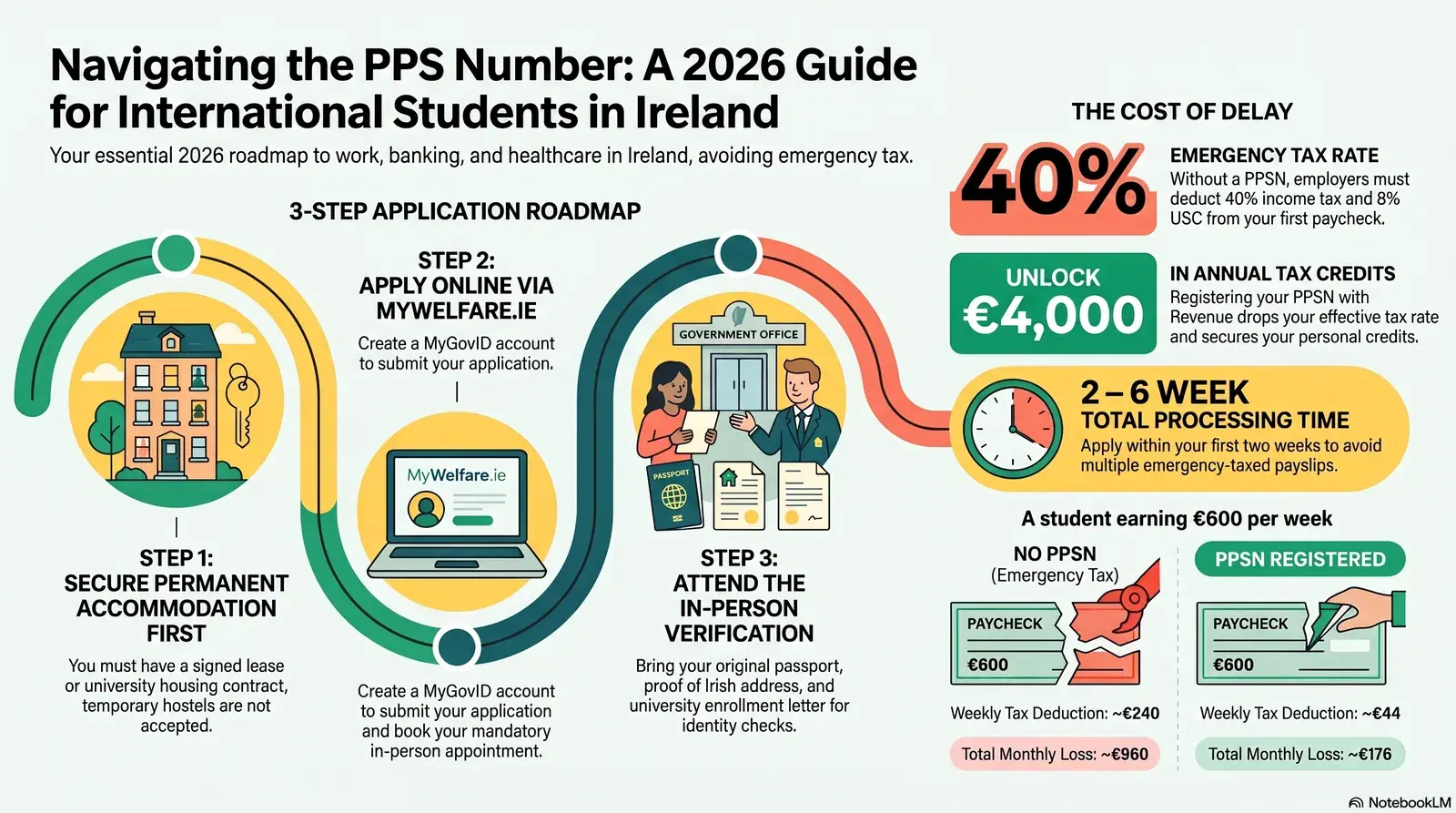
- You need a permanent Irish address first. Hotels, hostels, and Airbnbs are not accepted as proof of address — secure a student accommodation contract or private tenancy before you apply.
- Apply via MyWelfare.ie, then attend an in-person appointment. The entire process is now online-first but requires a mandatory face-to-face verification at an Intreo Centre or PPSN Allocation Centre — no walk-ins are accepted.
- Without a PPSN, your employer deducts 40% tax from day one. Register your employment with Revenue immediately after receiving your PPS number to unlock your €4,000 in annual tax credits and drop your effective rate to 20%.
Free — €0
2–6 weeks end-to-end; 3–10 working days after appointment
Online via MyWelfare.ie + mandatory in-person appointment
40% income tax + 8% USC from day one
In this guide
- What is a PPS Number and why do you need one?
- When should you apply? Timing matters
- Documents you need for your PPS application
- Step-by-step: applying via MyWelfare.ie
- The short-term accommodation problem — and how to solve it
- What happens on appointment day?
- Processing times: when does your PPSN arrive?
- What to do the moment you receive your PPS number
- Emergency tax: the real cost of working without a PPSN
- Frequently asked questions
What is a PPS Number and Why Do International Students Need One?
A Personal Public Service (PPS) number is Ireland's unique tax and public-services identifier — a string of 7 digits followed by one or two letters — that links you to all state systems. It is issued by the Department of Social Protection and is required for virtually every interaction with Irish public services.
As an international student, you will need your PPSN for the following purposes:
- Employment: Employers must use your PPSN to deduct PAYE income tax, PRSI, and USC through the Revenue system. You cannot be paid legally without providing it.
- Revenue / tax: Registering your employment at Revenue's myAccount requires a PPSN. Without registration, emergency tax applies.
- Banking: AIB, Bank of Ireland, and PTSB require a PPSN from residents to open a current account.
- Healthcare: Registering with a GP, applying for a medical card through the HSE, and accessing the Drugs Payment Scheme all require a PPSN.
- University registration: Your institution uses your PPSN for official student records and state grant applications.
- Driver licensing: Applying for a learner permit or driver licence through the NDLS requires a PPSN.
- Social welfare (if eligible): Any social welfare benefit or payment requires a PPSN.
When Should You Apply? Timing Matters
Apply for your PPS number as soon as you have a permanent Irish address — ideally within your first two weeks of arrival, before you start any part-time job. The application process cannot begin before you arrive in Ireland, and you cannot use a temporary or transitional address such as a hotel or hostel (see the accommodation section below).
The two most common mistakes international students make with their PPSN are:
- Applying too late — waiting until they have a job offer instead of applying on arrival. Processing takes 2–6 weeks, meaning you may receive multiple emergency-taxed payslips before your PPSN lands.
- Applying without a valid address — using a Airbnb or a friend's sofa that does not generate verifiable address documents, which causes the application to be rejected or delayed.
The optimal sequence is: secure your accommodation → apply for PPSN via MyWelfare.ie → attend your appointment → receive your PPSN by post → register with Revenue myAccount → start work with correct tax treatment from day one.
What Documents Do You Need for Your PPS Application?
You must provide three categories of document: proof of identity, proof of your Irish address, and evidence of why you need a PPS number. All documents must be originals or certified copies and must be brought to your in-person appointment.
| Document Category | What International Students Should Bring | Common Mistakes to Avoid |
|---|---|---|
| Proof of identity | Current passport (non-EU nationals must present their passport — a driving licence from a non-EU country is not accepted alone) | Expired passport; student ID card instead of passport |
| Proof of Irish address | Tenancy agreement or lease signed by landlord; utility bill (gas, electricity, broadband) in your name dated within 3 months; official bank statement; or a letter from your college confirming your on-campus accommodation address | Bill older than 3 months; hotel booking confirmation; short-term Airbnb contract; bill in landlord's name only |
| Evidence of need | A letter from your university confirming your enrolment, your course, your start date, and the academic year. Your college's international student office or registration office can produce this letter. | Bringing only a course acceptance letter from before arriving; using an employer letter if you have not yet registered your employment formally |
According to Citizens Information Ireland (last edited May 2026), the address document must show your name and address and must not be older than 3 months. For EU nationals, a current passport or national identity card suffices as identity proof; for all non-EU nationals (including Indian students), a current passport is required.
Step-by-Step: How to Apply for a PPS Number via MyWelfare.ie
The application is fully online via MyWelfare.ie and requires you to create a MyGovID account first — the entire process from account creation to appointment booking takes around 20–30 minutes.
- Create a basic MyGovID account. Go to mygovid.ie and register with your email address and Irish mobile phone number. A basic account requires only email verification — no additional identity verification is needed for the PPSN application at this stage.
- Start the PPSN application on MyWelfare.ie. Log in at services.mywelfare.ie, navigate to Identity Services → Personal Public Service (PPS) Number, and click Apply.
- Enter your personal details and reason for applying. Select "Education / Study" as the reason. Enter your full legal name exactly as it appears in your passport — name mismatches on payslips and your PPSN record cause Revenue problems later.
- Review the document list. The system will display the specific documents you must bring to your appointment. Take a screenshot or note these down — they are also emailed to you.
- Book your in-person appointment. Select a location, date, and time that suits you. Dublin has appointments at the PPSN Registration Centre at 22 King's Inns Street, Dublin 1 (Mon–Fri, 9:30am–4:00pm) and at Parnell Street Intreo Centre. Cork, Galway, Limerick, and Athlone all have local Intreo Centres. If no slots are available online, call 0818 927 999 (Monday to Friday, 9am–5pm) — the phone line often has slots not visible online.
- Confirm your appointment. You will receive a MyWelfare notification with your appointment reference, the location address, and the documents list. Save this — you will need your reference number on the day.
- Attend your appointment. Bring all original documents. The officer will verify your identity, check your address proof, confirm your reason, and photograph you. Your application is then sent for processing. You do not receive your PPS number on the day.
- Receive your PPS number by post. If your application is approved, the Department of Social Protection sends your PPSN to your registered Irish address. In 2026, most letters arrive within 3–10 working days of the appointment.
The Short-Term Accommodation Problem — and How to Solve It
Students who arrive in Ireland before their permanent accommodation begins face a genuine barrier: hotels, hostels, and short-term sublets do not generate the utility bills or lease agreements needed as proof of address. The Department of Social Protection is explicit that short-term temporary accommodation cannot be used as an address for a PPSN application in the standard sense.
However, there are three legitimate workarounds:
- Official confirmation letter from accommodation manager. According to Citizens Information, an official confirmation of address signed by a hotel administrator, manager, hostel manager, school principal, or property owner is acceptable. Ask the hotel reception to write a letter on headed paper stating your full name, the hotel address, and the dates you are residing there.
- Staying with friends or relatives. If you are staying at a friend's or family member's home, bring an original household utility bill from that address plus a signed handwritten note from the bill holder confirming you live there. The note can even be written directly on the bill itself.
- Get your student accommodation contract early. Many Irish universities (UCD, TU Dublin, UCC, DCU, NUI Galway) issue accommodation contracts weeks before your move-in date. Even if you have not moved in yet, the signed contract with your name and the accommodation address is typically accepted.
On-the-Ground Insight: "I arrived a week before my college accommodation opened and was stuck in an Airbnb. My college's accommodation office gave me my room contract in advance — signed and on headed paper — and that worked perfectly as proof of address at the King's Inns appointment. The officer didn't ask whether I had actually moved in yet." — Priya S., MSc Data Analytics, DCU, September 2025 Intake
What Happens on Appointment Day?
Your in-person appointment is a document verification and identity check — the officer takes your details, copies your documents, and photographs you, but does not issue your PPS number on the spot. The appointment itself typically takes 10–20 minutes.
What to expect:
- Arrive at least 10 minutes early. The PPSN Registration Centre at 22 King's Inns Street (Dublin 1) is open Monday to Friday, 9:30am–4:00pm. Regional Intreo Centres have varying hours — check your confirmation notification.
- Bring all original documents — photocopies or screenshots on your phone are not accepted.
- The officer will check your identity against the passport, verify your address document, confirm your reason for applying, and take a biometric photograph.
- After the appointment, your application undergoes further checks by the Department of Social Protection's Client Identity Services. This is where processing time is added.
- If additional information is needed, the Department will contact you by post or email — keep your contact details updated in MyWelfare.ie.
Processing Times: When Does Your PPSN Arrive?
In 2026, the Department of Social Protection typically posts your PPS number letter within 3–10 working days of your in-person appointment, with the full end-to-end process (from starting the online application to holding your PPSN letter) taking 2–6 weeks.
Processing times vary based on:
- Appointment availability: At peak times (late August and September, when thousands of students arrive for the new academic year), appointment slots can be 2–4 weeks away. During quieter months (November–April), slots appear within days.
- Document completeness: Applications with all correct, readable documents sail through. Missing documents mean follow-up correspondence, which adds weeks.
- Postal delivery: The letter is posted to your registered Irish address. Keep this address current in your MyWelfare.ie profile.
| Stage | Typical Duration (2026) | Notes |
|---|---|---|
| MyGovID account creation | 5–10 minutes | Email and Irish phone number required |
| Online application completion | 15–20 minutes | Includes reason for application and personal details |
| Appointment availability | 1 day–4 weeks | Peak: late August–September; Off-peak: same week |
| In-person appointment (the meeting itself) | 10–20 minutes | No PPS number issued on the day |
| Post-appointment processing | 3–10 working days | Department of Social Protection internal review |
| Postal delivery | 1–3 working days | Sent to registered Irish address |
| Total end-to-end | 2–6 weeks | Apply on arrival — do not wait for a job offer |
If more than 6 weeks have passed since your appointment and you have not received your letter, contact Client Identity Services directly: call (071) 967 2616 or 0818 927 999, or email [email protected]. The postal address for written enquiries is: Client Identity Services, Department of Social Protection, Shannon Lodge, Carrick-on-Shannon, Co. Leitrim, N41 KD81.
What to Do the Moment You Receive Your PPS Number
The second your PPSN letter arrives, complete three actions in the same day: register with Revenue myAccount, notify your employer, and update any pending applications (bank account, GP registration) that were waiting on your PPSN.
Step 1: Register with Revenue myAccount
Go to revenue.ie/myAccount and register using your PPSN, your date of birth, and your Irish address. This creates your Revenue profile and unlocks the PAYE Services section where you manage your employment records and tax credits.
Step 2: Register your employment
In Revenue myAccount, go to PAYE Services → Manage Your Tax → Add Job or Pension. Enter your employer's details. Revenue will then issue a Revenue Payroll Notification (RPN) to your employer, which switches your tax deductions from emergency basis to the standard PAYE basis — restoring your tax credits.
In 2026, a single PAYE worker receives a Personal Tax Credit of €2,000 and a PAYE (Employee) Tax Credit of €2,000, for a combined annual credit of €4,000. At the standard 20% income tax rate, this makes approximately the first €20,000 of annual earnings tax-free. Emergency tax bypasses all of this — so every week of delay costs you money.
Step 3: Claim back any emergency tax already deducted
If your employer has already deducted emergency tax in previous payslips, Revenue will automatically adjust future deductions once the RPN is issued — typically resulting in a larger net pay in your next payslip as credits are applied retrospectively within the tax year. You can also view your income and tax summary in myAccount under "View Your Tax" to confirm the adjustment has been applied.
- Register with Revenue myAccount at revenue.ie
- Add your employer under PAYE Services → Add Job
- Provide your PPSN to your employer in writing (email is fine)
- Give your PPSN to your bank if it was withheld pending the number
- Register with your GP / HSE — provide PPSN at first appointment
Emergency Tax: The Real Cost of Working Without a PPSN
If you start working before you receive your PPS number and fail to provide it to your employer, Irish tax law requires your employer to apply emergency tax — deducting income tax at 40% on all earnings from your first day, with no personal tax credits applied.
According to Revenue's emergency tax rules:
- No PPSN provided: All income taxed at 40% from day one, plus USC at 8%. No tax credits applied. This applies from your first payslip.
- PPSN provided but employment not registered with Revenue: Standard rate band (20%) applies for your first 4 weeks, then all income is taxed at 40% — still with no credits. This is marginally better but still very expensive after week 4.
- Both PPSN provided AND Revenue registered: Correct PAYE applies — standard 20%/40% split with your full Personal (€2,000) and PAYE (€2,000) credits deducted.
To illustrate: a student earning €600 per week (part-time retail or hospitality work, common in Dublin) would lose approximately €240 per week in income tax alone under full emergency tax, compared to roughly €44 per week once correctly registered (assuming no other income). That is a difference of nearly €200 per week — or €800 per month.
Emergency tax overpayments are recoverable within the same tax year through Revenue's automatic adjustment system, or by filing an end-of-year tax return via myAccount. However, the money is effectively interest-free borrowed by the state until you reclaim it — do not rely on a future refund as a substitute for registering promptly.
Frequently Asked Questions
What is a PPS number and why do international students need one in Ireland?
A PPS (Personal Public Service) number is Ireland's unique tax and social-services identifier — always 7 digits followed by one or two letters — that links you to all state systems. International students need it to be paid legally by an employer, register with Revenue, open a bank account at traditional Irish banks, access HSE healthcare, and register your course at your university. Without it, employers must deduct income tax at the emergency rate of 40% from day one.
What documents do I need to apply for a PPS number as an international student?
You need three categories of document: proof of identity (your current passport for non-EU nationals), proof of your Irish address (utility bill, tenancy agreement, or bank statement dated within 3 months), and evidence of why you need the PPSN (a letter from your Irish university confirming enrolment). Short-term addresses such as hotels and hostels are not accepted unless accompanied by an official confirmation letter from the hotel manager or administrator.
How long does it take to get a PPS number after the in-person appointment?
In 2026, the Department of Social Protection posts your PPS number letter within 3–10 working days of your appointment. Overall end-to-end time from starting the online application to holding your PPSN letter is typically 2–6 weeks depending on appointment availability and processing volumes. Apply as soon as you have a permanent Irish address — do not wait until you have a job offer.
What happens if I start working in Ireland without a PPS number?
If you provide no PPS number at all, your employer must deduct income tax at the emergency rate of 40% from your very first day of pay, plus USC at 8%, with no personal tax credits applied. Once you receive your PPSN, register your employment with Revenue via myAccount at revenue.ie, and Revenue will issue a Revenue Payroll Notification so your employer can switch you to the standard rate and restore your Personal Tax Credit (€2,000) and PAYE Tax Credit (€2,000), effectively making the first ~€20,000 of annual earnings tax-free.
Can I use short-term accommodation like a hotel as proof of address for my PPS application?
Hotels and hostels are normally not accepted as proof of an Irish address, but an official confirmation letter signed by the hotel administrator, manager, or property owner can be substituted. If you are staying with friends or relatives, a household utility bill plus a signed note from the bill holder confirming you live there is acceptable. The best solution is to secure a student accommodation contract or private tenancy agreement before applying.
Planning your move to Ireland? Compare live flight fares first.
Whether you are flying from Delhi, Mumbai, or Bengaluru, find the cheapest seasonal fares, extra baggage deals, and student airline offers before you book your flight to Dublin.
All information in this guide is based on publicly available official sources including Citizens Information Ireland, Department of Social Protection (Gov.ie), and Revenue.ie as of July 2026. PPS application procedures, required documents, processing times, and tax rates can change. Always verify current information directly with the relevant authority before acting. MyFlightOffers is not affiliated with any government body mentioned. This article does not constitute legal, tax, or immigration advice.
- NEW IRP Card Registration: A Step-by-Step Guide for International Students in Ireland (2026) — How to book your Burgh Quay appointment, the €300 fee, what to bring, and when your IRP card arrives.
- Ireland Banking Guide for International Students 2026 — Which Irish bank accounts need a PPS number, which don't, and how to open one in your first week.
- Revenue.ie Emergency Tax Guide for International Students — How to reclaim emergency tax already deducted and register correctly with Revenue.
- The Indian Student's Money Survival Guide in Ireland — Banking, forex cards, remittances, and managing day-to-day costs on a student budget.
- Leap Card & Public Transport Guide for International Students in Ireland (2026) — Student Leap Card, 90-minute fare, weekly cap, and using public transport across Ireland.