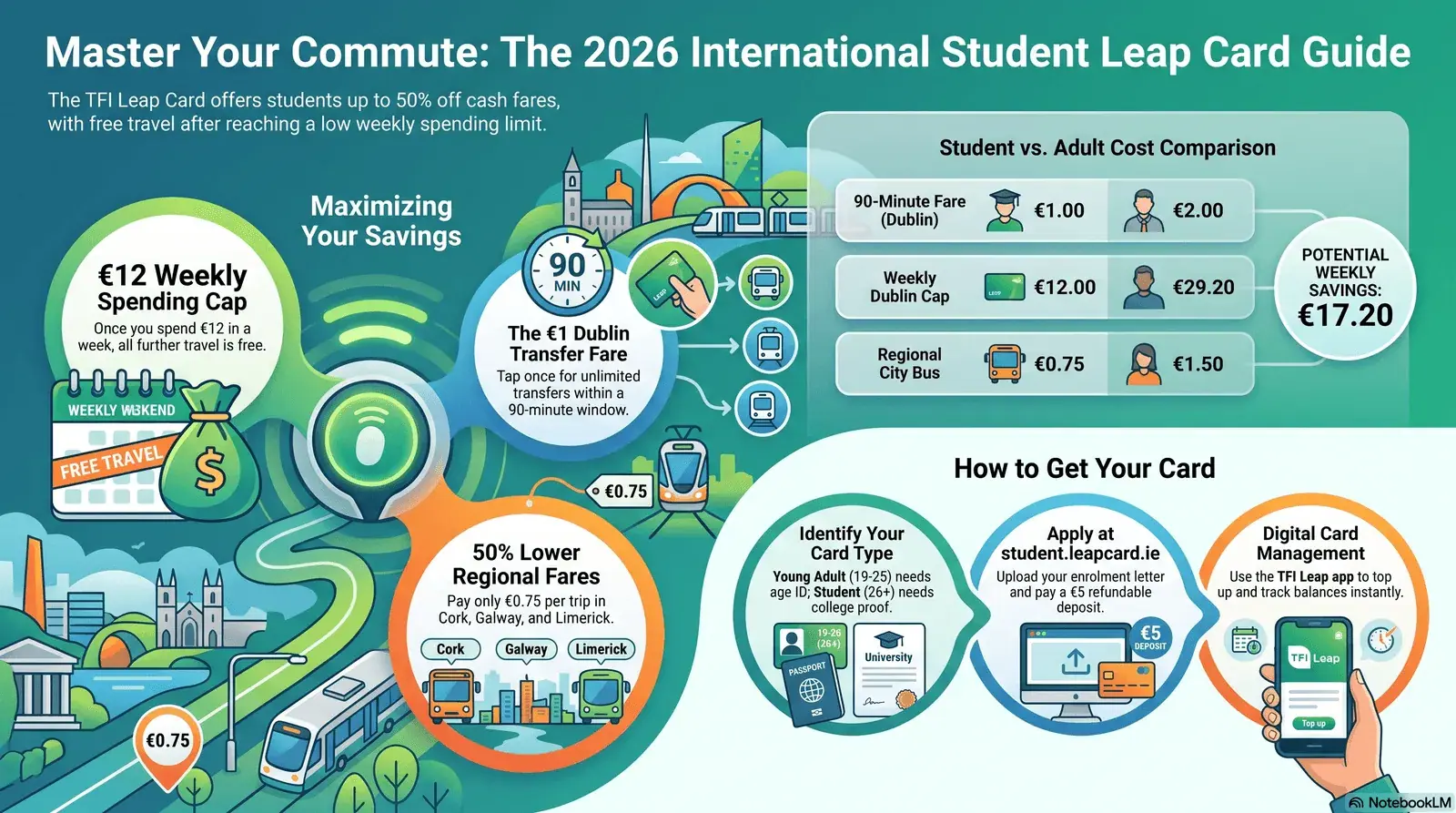
- Get a Student Leap Card, not a standard Leap Card. The student version gives you up to 50% off all TFI fares and caps your weekly Dublin spend at just €12 (vs €29.20 for adults) — a potential saving of €17.20 every week.
- The 90-Minute Fare is your best friend in Dublin. At €1 per student journey, one tap covers unlimited connecting bus, Luas, and DART transfers within 90 minutes — perfect for the commute from accommodation to campus.
- Apply online before you arrive at student.leapcard.ie with your university enrolment letter and passport. Allow up to 5 working days for approval before collecting at a Student Leap Card agent.
€5 refundable deposit + min. €5 credit
€12.00 in Dublin zone
€1 — covers all connecting modes
€0.75 per single trip
In this guide
- What is the TFI Leap Card and why do international students need one?
- Student Leap Card vs Young Adult Leap Card — which is right for you?
- How to apply for a Student Leap Card step-by-step
- How does the TFI 90-Minute Fare work?
- What are the daily and weekly fare caps in 2026?
- Using your Leap Card in Dublin: Bus, Luas, DART, and Commuter Rail
- Using your Leap Card in Cork, Galway, and Limerick
- Leap Top-Up app: check balance, top up, and track your cap
- Alternative transport: taxis, bike-sharing, and cycling
- Weekly Transport Savings Calculator
- Frequently asked questions
What is the TFI Leap Card and why do international students need one?
The TFI Leap Card is Ireland's national rechargeable smart travel card, accepted on Dublin Bus, Go-Ahead Ireland city services, Luas trams, DART, Irish Rail commuter trains, and Bus Éireann city services across Ireland. Without one, you pay cash fares which can be 20–50% higher than the equivalent Leap rate, and you lose access to the multimodal fare capping that makes Dublin's transport network genuinely affordable.
For international students specifically, the case is clear: Transport for Ireland (TFI) operates the most complex and cost-effective transport network in the country. Navigating it without a Leap Card means paying full cash fares for every individual journey, missing free transfers within 90 minutes, and never benefiting from the weekly spending cap. A student who travels into Dublin city five days a week and returns home will hit the €12 weekly cap by Wednesday and ride for free from Thursday onwards — a concrete financial advantage in an expensive student city.
The card is also accepted at a growing network of outlets across every county in Ireland, making top-ups straightforward whether you are based in Dublin, Cork, Galway, or Limerick. The physical card costs a refundable €5 deposit (returned when you close your account), so the upfront cost is negligible.
Student Leap Card vs Young Adult Leap Card — which is right for you?
The key rule: if you are aged 19–25, get the Young Adult Leap Card regardless of your student status — it gives identical discounts without any enrolment verification. If you are 26 or older (or 16–18), apply for the Student Leap Card instead, which requires proof of full-time enrolment.
Both cards provide the same fare discount — up to 50% off standard adult fares — and both are accepted on all TFI services. The distinction matters because the application process differs: the Young Adult card is issued automatically based on age (no institution verification needed), while the Student card requires uploading an official enrolment letter from your Irish college or university.
| Card Type | Who Qualifies | Discount | Verification Required | Where to Apply |
|---|---|---|---|---|
| Young Adult Leap Card | All persons aged 19–25 | Up to 50% off adult fares | Age only (ID at collection) | Leap Card retailers or online |
| Student Leap Card | Full-time students aged 16–18 or 26+; all international students in eligible full-time programmes | Up to 50% off adult fares | Enrolment letter + photo ID | student.leapcard.ie |
| Standard Adult Leap Card | Anyone 26+ not in full-time education | ~14% off cash fares | None | Any Leap retailer or online |
| Child Leap Card | Children aged 5–15 | ~50% off adult fares | None | Any Leap retailer |
How to apply for a Student Leap Card step-by-step
The Student Leap Card application is entirely online at student.leapcard.ie and takes about 10 minutes to complete — but allow up to 5 working days for your institution to verify enrolment before the card is issued.
Here is the step-by-step process for 2026:
- Go to student.leapcard.ie/New-Card and begin the new card application form.
- Select your institution from the dropdown and enter your student ID number. Your college's student union or student services office can supply this if you have not received it yet.
- Upload proof of enrolment — an official letter from your registrar or student services confirming you are a full-time student for the 2025/26 academic year. Most Irish colleges issue enrolment letters automatically via the student portal at the start of term.
- Upload a passport-style photo (JPEG, max 200 KB). The photo will appear on the card.
- Pay the €5 refundable card deposit by debit or credit card. You can optionally pre-load travel credit (minimum €5) at this step.
- Wait for an approval email — typically within 1–5 working days. Do not visit the collection point without receiving this email.
- Collect your card at any Student Leap Card agent (most university Students' Unions operate as collection points). Bring your order confirmation email and a valid photo ID (passport or national ID card).
On-the-Ground Insight: "I arrived two weeks before my enrolment letter was ready. I bought a standard Leap Card at Spar for immediate use, then went to the Students' Union Leap desk on Freshers' Week with my letter and swapped to a Student Card. The process took about 15 minutes and I got the deposit back on the old card straight away." — Priya M., University College Dublin, September 2025 intake
How does the TFI 90-Minute Fare work?
The TFI 90-Minute Fare charges your Leap Card once — €1 for students/young adults, €2 for adults — and then allows unlimited connecting journeys within 90 minutes of your first tap-on, all for free. The fare covers Dublin Bus, Go-Ahead Ireland city services, Luas, DART, and commuter rail within Zone 1.
In practical terms: if you board a Dublin Bus at 8:00 AM and tap your Student Leap Card, you pay €1. If you then board the Luas at 8:40 AM to reach your final destination, that tram ride costs nothing. Your 90-minute window expires at 9:30 AM. Any tap after 9:30 AM starts a new €1 charge. The clock always begins at your first tap, not your last.
- You must tap on every vehicle, even within the 90-minute window — the system deducts nothing extra, but you must physically tap.
- The 90-minute window applies to services within Dublin city (Zone 1): Dublin Bus, Go-Ahead Dublin, Luas, DART, and Zone 1 commuter rail.
- Bus Éireann Expressway intercity routes (Dublin to Cork, Galway, Limerick) are not covered by the 90-minute fare — these charge separately.
- The fare is deducted on your first tap only. Subsequent taps within the window show a €0.00 charge on the screen.
What are the daily and weekly fare caps in 2026?
In 2026, the Student/Young Adult Leap Card caps your daily transport spend at €3.00 and your weekly spend at €12.00 in Dublin — once you reach the cap, every further journey that day or week is free. The adult equivalent caps are €5.00 daily and €29.20 weekly, so the student card saves up to €17.20 every single week.
The weekly capping period runs from Monday at 4:30 AM to the following Monday at 4:29 AM. Unspent cap space cannot be carried forward — it resets each week. This means a student who commutes on Monday, Tuesday, and Wednesday and hits the €12 cap can travel freely for the remainder of the week (Thursday through Sunday) at no additional charge.
| Card Type | Single Journey (Zone 1) | 90-Min Fare | Daily Cap | Weekly Cap |
|---|---|---|---|---|
| Student / Young Adult (19–25) | ~€1.05–€1.20 | €1.00 | €3.00 | €12.00 |
| Standard Adult | ~€2.00–€2.40 | €2.00 | €5.00 | €29.20 |
| Child (5–15) | ~€0.65 | €0.65 | — | — |
Sources: Leap Card Fare Capping (Transport for Ireland, 2026); TFI Bus Fares 2026.
Using your Leap Card in Dublin: Bus, Luas, DART, and Commuter Rail
Dublin's four main transport modes — Dublin Bus, Luas tram, DART coastal rail, and Irish Rail commuter trains — all accept the Leap Card, share the same fare-capping pool, and are seamlessly connected through the TFI Zone system introduced in April 2025.
Dublin Bus and Go-Ahead Ireland
Dublin Bus and Go-Ahead Ireland operate the majority of surface bus routes within Dublin city and its suburbs. With a Student Leap Card, the 90-minute fare at €1 per journey is the standard charge within the core city zone. Dublin Bus routes connect most residential student areas to campus — University College Dublin (UCD) is served by the 39A and 145 routes; Trinity College Dublin by the cross-city Luas; Dublin City University (DCU) by multiple orbital routes from the city centre.
Luas — Red and Green Lines
Luas operates two tram lines across Dublin, with fares ranging from €2.00 (one zone) to €2.60 (eight zones) for adults and approximately €1.00–€1.30 for Student Leap Card holders depending on zones crossed. The Green Line runs from Broombridge in north Dublin through the city centre to Bride's Glen in the south — directly connecting Stephens Green (UCD bus connections), Charlemont (canal area), and Sandyford (south suburbs). The Red Line connects Connolly Station and The Point (north quays) to Tallaght and Saggart in southwest Dublin.
For students, the Luas Green Line is particularly useful: it terminates at Broombridge near the Phibsborough area, and the cross-city section puts students within walking distance of most city centre campuses without ever boarding a bus. During the academic year, Luas platforms at Harcourt and St Stephen's Green are heavily used by students commuting from Dundrum, Sandyford, and Leopardstown.
DART and Commuter Rail
The DART (Dublin Area Rapid Transit) runs along Dublin's coastline from Malahide and Howth in the north to Greystones in County Wicklow, while commuter rail extends west to Maynooth and Longford and south to Arklow. Zones 1 through 4 cover Dublin and commuter towns up to approximately 50 km from the city centre. Student Leap Card holders travel within Zone 1 at the 90-minute rate (€1) and pay zone-based fares for longer journeys.
Students living in coastal areas like Dún Laoghaire, Bray, Malahide, or Clontarf find the DART significantly faster than bus alternatives for commuting to city centre campuses. As of 2026, all four zones (Zone 1 to Zone 4) are supported by the Leap Card, with multimodal capping active across all modes within each zone pool.
Using your Leap Card in Cork, Galway, and Limerick
The TFI Leap Card is accepted on Bus Éireann city bus services in Cork, Galway, Limerick, and Waterford — with Student/Young Adult Leap Card holders paying just €0.75 per city journey (adults pay €1.50), a 50% saving on every trip.
Cork
University College Cork (UCC) students and those at Munster Technological University (MTU) use the Cork city bus network extensively. Leap Card Cork provides fare information specific to the city. Cork city single fares with a Student Leap Card are €0.75; the adult Leap rate is €1.35 (not €1.50 — Cork city adult fares are slightly lower than Bus Éireann's other cities at Leap rate). The main Bus Éireann city services in Cork operate on Routes 205, 206, 207, 208, 220, and 223 connecting CIT/MTU Bishopstown campus, UCC, Cork city centre, and surrounding suburbs.
Galway
University of Galway and Atlantic Technological University (ATU) students in Galway rely on Bus Éireann's city routes, with Student Leap fares of €0.75 per single journey. Key routes for students include Route 401 (Salthill to Merlin Park), 405 (GMIT/ATU), and 406 (Westside). Irish Rail also connects Galway to Dublin Heuston — student fares from Galway to Dublin start at €8.30 (confirmed on Irish Rail's student fares page), making a weekend trip to Dublin affordable for students enrolled at Galway institutions.
Limerick
University of Limerick (UL) students and those at TUS (Technological University of the Shannon) use Bus Éireann city services in Limerick, paying €0.75 per journey with a Student Leap Card. Irish Rail connects Limerick to Dublin Heuston with student fares from €10.39. The Limerick to Dublin journey takes approximately 2 hours by train, making it a viable option for semester-break travel compared to coach services, though Bus Éireann Expressway coaches offer no Leap discount on intercity routes — you pay the full cash fare regardless of your Leap Card type.
Does the Leap Top-Up app let you check your weekly cap progress?
Yes — the free Leap Top-Up app (iOS and Android) shows your current balance, your last five transactions, how close you are to your daily and weekly cap, and how many minutes remain in your active 90-minute window. These are the features that students consistently find most useful once they understand the capping system.
The app requires an NFC-enabled device — iPhone 7 or newer, or an NFC-capable Android phone with NFC turned on in Settings. It is available free on the App Store and Google Play.
Key features of the Leap Top-Up app in 2026:
- Instant balance check without touching a card reader
- Top-up with custom amounts or preset values (€10, €20, €30)
- Track your last 5 transactions
- See daily and weekly cap progress (so you know when free travel kicks in)
- Monitor minutes remaining in an active 90-minute window
- Purchase and load prepaid zonal tickets (as of April 2025 new zonal fare system)
Alternatively, you can enable Auto Top-Up on the Leap Card website — your card automatically recharges from a linked debit/credit card when your balance falls below a set threshold (e.g. €5). This is particularly useful for students who do not want to think about topping up manually during a busy exam period.
Physical top-up is also available at Spar, Centra, Tesco, Londis, Post Office branches, and dedicated TFI Leap vending machines in major transport hubs. The online Leap Card account at leapcard.ie also allows you to register your card and block it if lost or stolen — registered cards can be replaced with your balance intact.
On-the-Ground Insight: "The weekly cap feature was the biggest surprise for me. I commuted into UCD five days a week and by Thursday my card just stopped charging. At first I thought the machine was broken — then I realized I'd hit the €12 cap and was traveling free. I saved about €70 in my first month compared to what my housemate was paying as an adult card holder." — Chisom A., University College Dublin, MSc Computer Science, October 2025
What are the alternatives to public transport for students in Ireland?
For journeys the Leap Card network does not cover efficiently — late nights, suburban areas with poor bus frequency, and very short city-centre hops — students in Ireland use taxis (via app) or bike-sharing.
Taxis and ride-hailing apps
Taxis in Dublin are regulated with a 2026 base fare of €4.10 and a per-km rate of €1.14 during daytime hours (higher after 20:00 and on Sundays). A 10 km trip costs approximately €15 during the day. An airport-to-city-centre taxi (roughly 12–15 km) typically costs €20–€30 depending on traffic and destination. Unlike many other countries, Ireland does not have private ride-hailing in the Uber model — Uber Ireland operates as UberTaxi and dispatches licensed SPSV (small public service vehicle) drivers at the same metered rate.
The three most popular taxi apps among Dublin students are Free Now (formerly MyTaxi, the most widely used locally), Bolt (good backup when Free Now is surge-pricing), and Uber (same licensed taxi pool as Free Now). Install all three — there is no pricing advantage to any app since all drivers must follow regulated metered fares, but availability differs by time of day.
Bike-sharing: DublinBikes, Bleeper, and MOBY
Three bike-sharing services operate in Dublin in 2026: DublinBikes (docked), Bleeper (stationless), and MOBY Bikes (stationless, electric and pedal options). For campus-to-city or campus-to-accommodation short trips — typically 1–4 km — bike-sharing is often faster than waiting for a bus and significantly cheaper than a taxi. Many students at institutions near the Grand Canal or the DART corridor find cycling competitive with the Luas for inner-city commutes, especially during the academic year when bus frequency drops in the evenings.
Cycling infrastructure in Dublin has expanded significantly since 2022, with protected lanes along many key commuting corridors. Citizens Information provides an overview of cyclist rights and road rules in Ireland for newcomers.
Renting a car for trips beyond the network
For weekend trips to areas public transport does not reach well — the Wild Atlantic Way, Connemara, or rural accommodation viewings — compare car hire deals before booking directly with a depot. If you hold an Indian licence, read our guide to renting a car in Ireland as an Indian student first — it covers licence validity, insurance excess, and age surcharges.
Weekly Transport Savings Calculator
Use this calculator to estimate how much your Student Leap Card saves you compared to an adult Leap Card each week in Dublin. The student daily cap is €3.00 and the weekly cap is €12.00; the adult caps are €5.00 daily and €29.20 weekly (source: TFI Fare Capping page, 2026).
🧮 Student Leap Card Weekly Savings Estimator
Enter your typical weekly journey pattern to see how much you save versus an adult Leap Card.
Can international students get a Student Leap Card in Ireland?
Yes — full-time international students enrolled at an approved Irish college or university are eligible for the Student Leap Card, regardless of nationality or visa type. The eligibility requirement is full-time enrolment at an approved institution, not Irish residency or citizenship. Students on Stamp 2 visas at Irish third-level colleges are fully eligible.
What is the weekly fare cap for a Student Leap Card in Dublin in 2026?
The weekly fare cap for Young Adult and Student Leap Card holders in Dublin is €12.00 in 2026. Once you reach this amount in a single weekly capping period (Monday 4:30 AM to the following Monday 4:29 AM), all further TFI journeys that week cost nothing. The adult weekly cap is €29.20, representing a potential saving of €17.20 per week for student card holders.
How does the TFI 90-Minute Fare work on the Leap Card?
The TFI 90-Minute Fare charges you once — €1 for students, €2 for adults — and covers all connecting Dublin Bus, Luas, DART, and commuter rail journeys within Zone 1 for 90 minutes from your first tap. Each subsequent vehicle requires a tap (zero charge deducted), and the 90-minute window does not reset with each tap — it runs from the original first tap time.
Does the Leap Card work outside Dublin in Cork, Galway and Limerick?
Yes — the TFI Leap Card is accepted on Bus Éireann city bus services in Cork, Galway, Limerick, and Waterford, with student fares at €0.75 per single city trip. Irish Rail student fares are also available on intercity routes (e.g., Dublin to Galway for €8.30). Note that Bus Éireann Expressway intercity coaches do not apply student discounts via Leap Card — for those routes, Irish Rail is usually better value.
How do I top up my Leap Card in Ireland?
You can top up at any Leap Card retailer (Spar, Centra, Tesco, Londis, An Post), at TFI Leap vending machines, via the free Leap Top-Up app, or by setting up Auto Top-Up on the Leap Card website. Auto Top-Up is the most convenient option — it recharges your card automatically when your balance falls below a threshold you set, using a linked debit or credit card.
Planning your flight to Ireland? Compare live fares first.
Once you land, your Student Leap Card handles everything on the ground. Before you fly, compare real-time airfares on MyFlightOffers to get the best deal on your flight to Dublin.
All Leap Card fares, caps, and eligibility rules are based on publicly available official sources from Leap Card and Transport for Ireland as of July 2026. Fares and caps are subject to change by TFI. Always verify current information at the official TFI and Leap Card websites before travelling. MyFlightOffers is not affiliated with Transport for Ireland or the National Transport Authority. This article does not constitute financial or transport planning advice.
- NEW Ireland Student Survival Guide: Hidden Subsidies 2026 — Discover the transport tax credit, rent tax credit, medical card, and other cost-of-living supports most international students miss in their first year.
- The Indian Student's Money Survival Guide in Ireland — Bank accounts, forex cards, sending money home, and avoiding TCS pitfalls — the complete financial guide for Indian students in Ireland.
- Ireland Banking Guide for International Students 2026 — How to open an AIB, Bank of Ireland, or N26 account as a new arrival, and which card to use for everyday spending.
- Study in Ireland 2026: Visa, Housing and IRP Guide — The essential pre-arrival checklist covering your student visa, finding accommodation, and registering with immigration.
- The Complete Student Discount Masterlist for Ireland 2026: ISIC, TFI Young Adult Card and 50+ Ways to Save — Student discounts Ireland 2026: ISIC, Student Leap Card, TFI Young Adult Card, UNiDAYS deals, free Office 365 and 50+ savings across transport, tech and more.
- Student Clubs and Societies in Ireland 2026: Network, Save Money and Get Hired — Irish student societies 2026: how they save money (€12/week Leap Card), build your network and boost your CV for Irish employers. When to join and what to prioritise
- Driving Licence Exchange & Car Ownership for International Students in Ireland (2026) — Can you drive in Ireland with an Indian licence? How to convert it, buy a used car, get insurance, and understand motor tax and NCT costs in 2026.