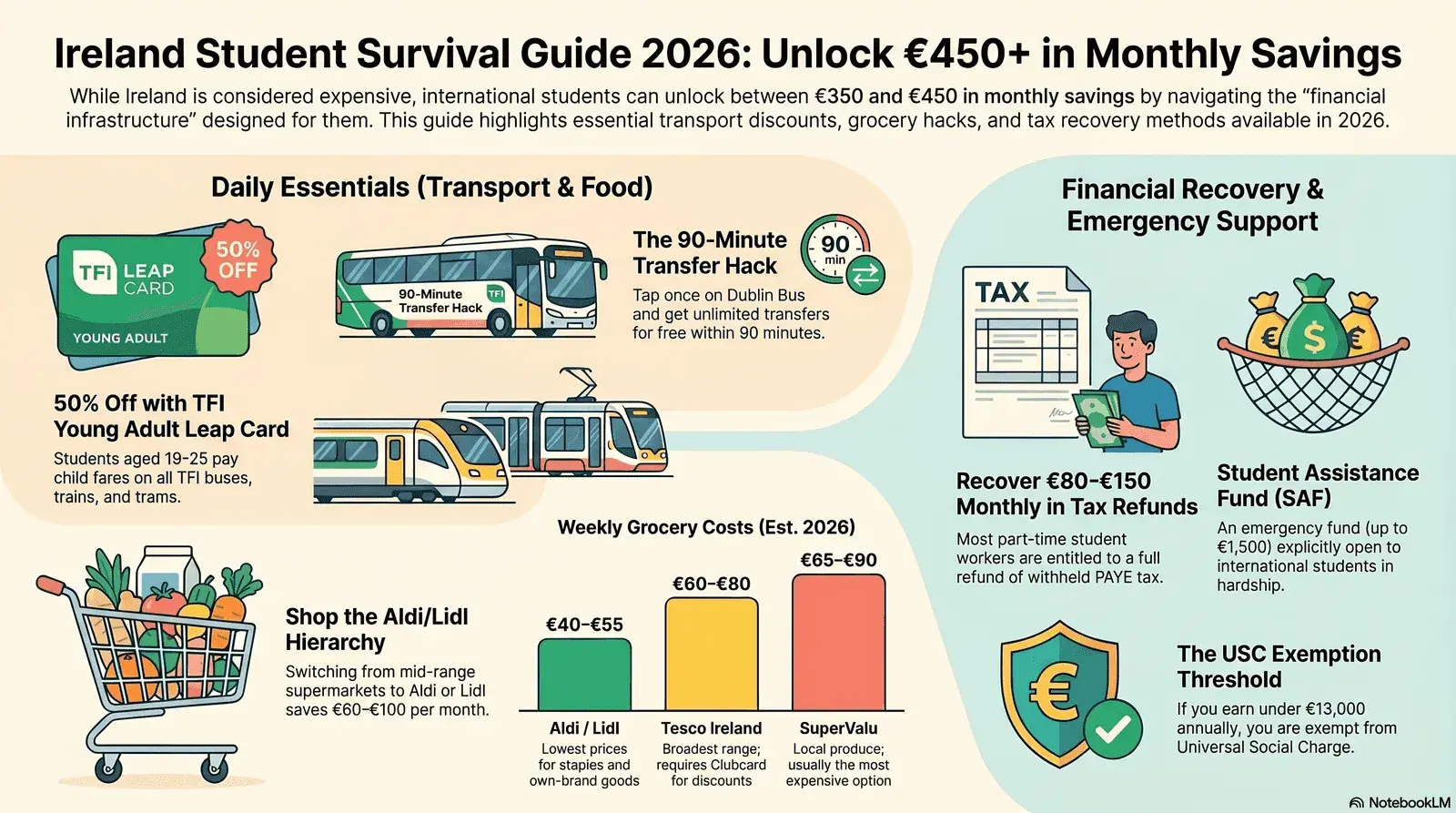
- You can save €230–€400 per month by combining the TFI Young Adult Leap Card (50% off all bus, tram & train if under 26), grocery switching to Aldi/Lidl, and the Too Good To Go app — subsidies most students never find.
- The Student Assistance Fund (SAF) is open to international students — unlike SUSI — and can provide emergency cash grants for rent, food, or essential equipment through your college's Student Services office.
- Most part-time student workers are owed a tax refund: file a simple end-of-year return at myaccount.revenue.ie to claim back overpaid PAYE tax — the average refund is €200–€600.
💶 Monthly Saving Potential
€230–€400/month
Transport + groceries + tax refund combined
🚌 Biggest Single Win
TFI Young Adult Leap Card
50% off every bus, tram & train journey if aged under
26
🏫 Emergency Resource
Student Assistance Fund (SAF)
Open to international students — unlike SUSI
💰 Year-End Refund
Revenue myAccount (PAYE)
Most part-time student workers are owed tax back
What this guide covers
💶 2026 Ireland Student Savings Calculator
Estimate how much cash you can claw back each month using hidden Irish subsidies, transport hacks, and tax refunds.
The calculator opens on age 22, a typical postgraduate age, purely so the Young Adult Leap Card rate applies by default.
The calculator opens on age 22 (a typical postgraduate age) purely so the Young Adult Leap Card rate applies by default.
💰 Estimated Monthly Savings Breakdowns
1 How Much Can I Save on Public Transport as an International Student in Ireland?
By registering for the TFI Young Adult Leap Card, students aged 19–25 access child fares — approximately 50% off adult prices — across every TFI public transport service in Ireland, saving a regular Dublin commuter €600–€900 per year. Students aged 26 and over should ask their college's student union about institution-specific travel schemes and the Irish Rail Student Railcard, which provides 25% off rail fares regardless of age.
The TFI Young Adult Leap Card — Your First Priority on Arrival
The Young Adult Leap Card is issued by Transport for Ireland (TFI) and is valid for passengers aged 19 to 25 (under 26 on the day of travel). It entitles the holder to pay the child fare — roughly half the adult Leap Card rate — on Dublin Bus, Luas, DART, Irish Rail commuter services, Bus Éireann, and TFI Local Link rural routes. The card is not automatic: you must apply and register at leapcard.ie or collect and register at any Payzone outlet or An Post office. Proof of age is required at registration.
An adult single Leap Card journey on Dublin Bus costs €2.00. A Young Adult fare on the same route is approximately €1.00. For a student making two return journeys per day on five days a week, this represents a saving of approximately €2.00 per day — €520 per academic year — before accounting for any weekly or monthly capping benefits that apply to Leap Card users.
The Dublin 90-Minute Transfer Hack
This is the most underused saving on the Leap Card system, and almost no arriving student is told about it. When you tap on a Dublin Bus service using any Leap Card, you receive a 90-minute unlimited transfer window. During that window, you can board additional Dublin Bus routes at no extra charge. The second, third, or even fourth bus within those 90 minutes costs nothing beyond the first fare paid.
In practice, this means you can route a grocery run, a trip to the library, or a college commute across multiple bus connections for the cost of a single Young Adult fare — around €1.00. Students who live in suburbs with limited direct routes and chain two or three connections each way save several euros on every return journey.
Travelling Between Cities on a Student Budget
For inter-city travel between Dublin and Athlone, Cork, Galway, or Limerick, the Young Adult Leap Card discount applies to Irish Rail and Bus Éireann services. Students travelling Dublin–Cork by train pay child fares on Leap Card — a significant discount on standard published fares, especially for routes booked day-of. For longer trips or advance planning, the Irish Rail Student Railcard (available to full-time students of any age at irishrail.ie) gives 25% off all standard fares and is worth holding alongside your Leap Card as a secondary saving instrument.
2 What Is the Best Grocery Strategy for Students in Ireland in 2026?
Shopping exclusively at Aldi or Lidl instead of Tesco or SuperValu saves an average of €15–€25 per week per person — €60–€100 per month — on an equivalent basket of goods. Combined with the Too Good To Go app and supermarket loyalty programmes, a focused student can bring their monthly grocery spend to €130–€180, down from a typical €250–€320 for students shopping without a strategy.
The Supermarket Hierarchy — Aldi and Lidl First, Always
Ireland has a clear supermarket cost hierarchy. For students, the rule is simple: start at Aldi or Lidl for every weekly shop. Both chains stock comprehensive ranges of dry goods, dairy, fresh produce, bread, and meat at prices that consistently undercut the major Irish supermarkets by 25–40% on comparable items. Own-brand products at both chains match or exceed the quality of branded equivalents at Tesco or SuperValu.
| Supermarket | Weekly Shop (1 person) | Loyalty Programme | Best For |
|---|---|---|---|
| Aldi | €40–€55 | None (lowest prices instead) | Staples, produce, dairy, own-brand |
| Lidl | €40–€55 | Lidl Plus app (offers & coupons) | Meat, fresh bread, weekly specials |
| Dunnes Stores | €55–€75 | Real Rewards card | Irish brands, wide variety |
| Tesco Ireland | €60–€80 | Clubcard (meaningful discounts) | International foods, broadest range |
| SuperValu | €65–€90 | Real Rewards (shared with Centra) | Local and Irish produce |
The Too Good To Go Advantage
Too Good To Go is a food-rescue app active across Dublin, Cork, Galway, Limerick, and most other Irish cities. Restaurants, cafés, and bakeries near university campuses list surplus food bags at closing time — typically priced at €3.99–€5.99 — containing €12–€18 worth of prepared food, baked goods, or ingredients. This represents a 60–70% reduction on retail value. Students with evening or late-night lectures can collect a bag on the way home and replace an entire meal for under €5.
The app is free. Download it, enable location services, and browse available collections within walking or cycling distance. The most in-demand bags (from popular cafés) sell out quickly — check at noon each day to secure that evening's collection.
cisean.com — Price Comparison Before You Shop
cisean.com is Ireland's dedicated grocery price comparison tool, covering Aldi, Lidl, Tesco, Dunnes Stores, and SuperValu. Before each weekly shop, enter your standard list into Cisean and compare the total basket cost across all five retailers. It takes under three minutes and regularly identifies which supermarket is cheapest that week for your specific combination of items — promotional pricing means the winner changes week to week. The tool is free, requires no registration, and works on mobile.
Loyalty Cards and the Reduced-Item Window
Hold both a Tesco Clubcard and a Dunnes Real Rewards card. Neither requires a minimum spend, and both issue periodic coupons and personalised discounts on items you regularly buy. The Lidl Plus app issues weekly digital coupons that can reduce specific items by 20–50%. These are worth activating before checkout.
Supermarkets mark down perishables approaching their use-by date — typically starting between 19:00 and 21:00 (earlier on Sundays and public holidays when stores close sooner). Students with flexible schedules can time their shop to find yellow "reduced" stickers on meat, fish, bakery items, and ready meals at 30–50% off. Buy and freeze on the day; this is one of the highest-value, zero-effort savings available.
3 What Financial Support Can International Students Access Through Their College in Ireland?
The Student Assistance Fund (SAF) — administered directly by each higher education institution — is open to international students experiencing unexpected financial hardship, unlike the SUSI grant which is EU-only. Emergency awards typically range from €200 to €1,500 and are accessed through your college's Student Services or Welfare office.
The Student Assistance Fund — The Quietly Available Emergency Lifeline
Most international students arrive in Ireland knowing that SUSI (Student Universal Support Ireland) does not apply to them. What far fewer know is that the SAF — a separate, discretionary fund administered by individual colleges and part-funded by the Higher Education Authority (HEA) — is explicitly available to students regardless of their fee-paying status or nationality.
The SAF is not a regular grant and cannot be used to pay tuition fees. It is emergency and exceptional-needs funding designed to prevent students from dropping out due to acute financial crisis. Qualifying circumstances include unexpected loss of family financial support, emergency medical or dental costs not covered by health insurance, essential living costs during a period of sudden income loss, and accommodation emergencies.
Go to your college's Student Services, Student Welfare, or Financial Aid office — not the international office. Bring documentation of your financial difficulty: bank statements, a letter explaining your circumstances, evidence of the unexpected cost, and your student ID. Applications are assessed case-by-case. There is no standard form across all Irish institutions — ask the welfare office directly for their current process. Apply as soon as a financial difficulty arises; the fund is finite and allocated throughout the academic year.
Student Union Emergency Hardship Support
In addition to the college-level SAF, most Irish university Student Unions (SUs) maintain their own smaller emergency hardship funds, typically capped at €100–€300 per student per academic year. These are faster to access than the SAF — often same-day — and can cover immediate needs like groceries, transport, or essential household items while a larger SAF application is processed. Contact your SU welfare or student support officer directly.
Free Community Events and Cultural Programming
Every major Irish city and county council publishes a free events calendar. Dublin City Council, Cork City Council, Galway City Council, and Limerick City and County Council all fund and promote free arts, music, film, sports, and cultural events throughout the year — many of which are actively promoted to students. The annual Culture Night in September (free entry to museums, galleries, and cultural institutions across Ireland), Bealtaine festival, and council-funded outdoor events provide meaningful social and cultural access at zero cost.
4 Can International Students in Ireland Claim Tax Back from Revenue?
Yes — international students on Stamp 2 who earn income from part-time work pay PAYE income tax at source, and most who earn below approximately €20,000 per year are entitled to a refund of some or all withheld tax by claiming unused personal and employee tax credits through Revenue's free myAccount portal. This is one of the most commonly missed financial entitlements among international students in Ireland.
Your Work Rights on Stamp 2 (The 20 and 40 Hour Rules)
International students on Stamp 2 (student permission) may work up to 20 hours per week during academic term time and up to 40 hours per week during official academic holiday periods — Christmas (typically mid-December to mid-January), Easter (approximately two weeks), and summer (June to September). Ireland's national minimum wage is €14.15 per hour for adults aged 20 and over as of 1 January 2026, as regulated by the Workplace Relations Commission (WRC).
A student working 20 hours per week for 30 term-time weeks and 40 hours per week for 14 holiday weeks earns approximately: (20 × 30 × €14.15) + (40 × 14 × €14.15) = €8,490 + €7,924 = €16,414 gross per year. Against this, the personal tax credit (€2,000) and employee (PAYE) tax credit (€2,000) total €4,000 — which offsets €20,000 worth of income tax liability at the 20% standard rate. Most students at this earning level owe zero income tax, and if their employer withheld PAYE throughout the year, they are entitled to a full refund.
Claiming Your PAYE Refund via Revenue myAccount — Step by Step
- Register: Go to revenue.ie → myAccount → Register. You will need your PPSN (Personal Public Service Number), which you received when registering for work. Irish mobile number or postal address is required.
- Verify employment: In myAccount, navigate to "PAYE Services" → "Review your tax 20XX". The system automatically imports your employment details from your employer's payroll submissions.
- Claim credits: Ensure your Personal Tax Credit and Employee Tax Credit are applied. If they are not showing, add them via "Manage Your Tax" in the PAYE Services section.
- Request a refund: If the system calculates an overpayment, a refund will be issued automatically to the bank account on file, typically within 3–5 working days. You can also request a P21 (end-of-year statement) to confirm the figures.
- Repeat annually: Revenue assessments are done per calendar year. File each January–December tax year separately. You can file up to four years retrospectively.
If you do not register as a new employee with Revenue before your first payslip, your employer is legally required to apply "Emergency Tax" — a rate of up to 40% on all income, regardless of your actual liability. Emergency tax is recoverable but causes weeks of income disruption. Register at revenue.ie → myAccount as soon as you receive your job offer and before your first working day.
The USC Exemption Most Students Do Not Know About
The Universal Social Charge (USC) is a tax applied in addition to income tax. Crucially, anyone earning less than €13,000 in a calendar year pays zero USC. Students who work only during term time and earn below this threshold are USC-exempt. If your employer deducted USC at source because they assumed you would earn more, you can claim it back via the same Revenue myAccount process above. For students earning between €13,000 and €22,920, USC is charged at 0.5% on the first €12,012 and 2% on the remainder — very modest, but still worth verifying and reclaiming if over-deducted.
Managing Utility Bills in Shared Rentals
Most international students live in shared houses or apartments where electricity, gas, and broadband costs are split between residents. Three practices make this manageable and fair:
- Use Switcher.ie to compare electricity and gas suppliers at your address. Switching supplier takes 15 minutes and routinely saves €150–€300 per year on energy costs. Introductory rates are available for new accounts.
- Set up a shared bill-splitting app (Splitwise or Monzo Shared Tabs) from day one. Disputes over unpaid utility bills are among the most common causes of housemate tension and tenancy problems. Automate the fairness.
- Apply for the Irish Government Electricity Credit if applicable. Check gov.ie for the current status of energy support credits; credits have been issued to domestic electricity accounts in recent years and your landlord or accommodation provider may be passing these through to tenants. Ask explicitly.
- Check if your broadband is being over-specced. A household of three students almost never needs speeds above 200Mbps, which is available on standard plans for €35–€45 per month split multiple ways — far less than the premium plans many landlords or previous tenants set up by default.
5 Turning Monthly Savings into Your Ticket Home
The savings outlined in this guide are not abstract. Add them up monthly: €50–€90 on transport, €90–€140 on groceries, €90–€175 in tax and utility recovery. At the conservative end, that is €230 per month that previously left your account without returning value. At the higher end, it exceeds €400 per month — the cost of a return economy flight from Dublin to Delhi in off-peak months.
The practical goal of every subsidy and savings strategy in this guide is to rebuild financial agency. Not just surviving Ireland, but affording to leave it when you need to: to go home for Christmas, to fly to a job interview in London, or to take the European weekend that makes a year abroad feel like more than an exercise in financial stress management.
When booking flights from Dublin back to India or onward to other destinations, the choice of payment card matters as much as the choice of airline. Our Indian Payment Guides series covers every major bank card's flight booking rewards, lounge access, and forex savings:
- Best HDFC Bank Cards for Flights & Travel 2026 — SmartBuy 10X, Infinia, Regalia Gold
- Best SBI Credit Cards for Flights & Travel 2026 — Miles Elite, KrisFlyer SBI, 1.99% forex
- Best ICICI Bank Cards for Flights & Travel 2026 — Emeralde, MakeMyTrip ICICI (0.99% forex)
- Axis Bank Credit Cards for Flights 2026 — EDGE Miles, Atlas, Magnus, April 2026 changes
- Airport Lounge Access in India: Complete Credit Card Guide 2026 — DreamFolks, Priority Pass, guest access hacks
Quick-Reference FAQ
What is the TFI Young Adult Leap Card and how do I get one?
The TFI Young Adult Leap Card gives passengers aged 19–25 approximately 50% off all public transport fares in Ireland, including Dublin Bus, Luas, DART, Irish Rail, Bus Éireann, and TFI Local Link. Register and order at leapcard.ie. Proof of date of birth is required. Top up at any Payzone outlet, An Post office, or through the Leap Top Up app.
Can international students on Stamp 2 apply for the Student Assistance Fund?
Yes. The SAF is not restricted to EU/EEA students — unlike SUSI. It is a discretionary emergency fund administered by each college's Student Services or Welfare office, open to any student in genuine unexpected financial hardship. Apply as soon as a need arises; contact your college's Student Services office directly for the application process.
What is the 90-minute fare rule on Dublin Bus and how do students use it?
When you tap on a Dublin Bus service with a Leap Card, you begin a 90-minute transfer window. Any additional Dublin Bus journeys boarded during that 90-minute window are free of charge — you are not tapped on again for subsequent buses. Young Adult Leap Card holders pay approximately half the adult rate for the opening journey, then travel as many onward connections as needed within the 90-minute window at no further cost.
How do I register with Revenue and claim my PAYE tax refund?
Register at revenue.ie → myAccount using your PPSN, Irish address, and identification. Once registered, use PAYE Services → Review your tax to check whether personal and employee tax credits have been applied. If your employer over-deducted PAYE (common if you did not register before starting work), Revenue will calculate the overpayment and issue a refund directly to your bank account, usually within 3–5 working days.
How many hours can I work per week as an international student in Ireland?
Students on Stamp 2 may work up to 20 hours per week during academic term time and up to 40 hours per week during official academic holidays: Christmas, Easter, and summer. Ireland's minimum wage is €14.15 per hour (for adults aged 20+, as of January 2026). Exceeding the 20-hour weekly limit during term time is a breach of Stamp 2 conditions and risks your student permission. Track your hours carefully.
Which supermarket is cheapest for students in Ireland?
Aldi and Lidl are consistently the cheapest options for a standard weekly grocery shop, typically €40–€55 per person — approximately 25–40% less than Tesco or SuperValu for an equivalent basket. Use cisean.com to compare weekly prices across all five major Irish supermarkets before each shop, and use Too Good To Go to collect surplus food bags near your campus at 60–70% off retail value.
Ready to plan your next trip home from Dublin?
You have the savings strategy. Now find the best available fare for your route and put your financial discipline to work.
- Leap Card & Public Transport Guide for International Students in Ireland (2026) — how to get your Student Leap Card, use the €1 90-minute fare, hit the €12 weekly cap, and travel Dublin, Cork, Galway and Limerick on a student budget
- Choosing Your Arrival Airport: Dublin vs Cork vs Shannon for International Students (2026) — should you land in Dublin, Cork, or Shannon? Compares routes, ground transport costs, IRP registration locations, and which airport is closest to your campus
- Mental Health Support for International Students in Ireland 2026 — Free & Low-Cost Services Guide — free and low-cost mental health services including Jigsaw, Turn2Me, university counselling wait times, and crisis helplines for students in Ireland
- Driving Licence Exchange & Car Ownership for International Students in Ireland (2026) — how to use your Indian licence for 12 months, convert it via Reduced EDT, buy a used car safely, and what insurance, motor tax, and NCT actually cost
- The Complete Student Discount Masterlist for Ireland 2026: ISIC, TFI Young Adult Card and 50+ Ways to Save — every verified student discount in Ireland from the €1.00 TFI 90-minute fare and €12 weekly cap to free Microsoft 365, 50% off Spotify, UNiDAYS tech deals and a monthly savings calculator
Frequently Asked Questions
What is the TFI Young Adult Leap Card and how does it benefit international students in Ireland?
The TFI Young Adult Leap Card gives passengers aged 19-25 access to child fares - approximately 50% off adult fares - across all TFI public transport in Ireland, including Dublin Bus, Luas, DART, Irish Rail, Bus Éireann, and TFI Local Link services. Students register and top up at leapcard.ie, Payzone outlets, or post offices. A regular Dublin commuter saves approximately €600-€900 per year compared to paying cash adult fares.
Can international students in Ireland access the Student Assistance Fund (SAF)?
Yes. The Student Assistance Fund (SAF) is administered by individual higher education institutions and is open to international students on Stamp 2 who experience genuine, unexpected financial hardship. Unlike the SUSI grant, which is available only to EU/EEA residents, the SAF is a discretionary emergency fund. Students apply through their college's Student Services or Welfare office. Emergency awards typically range from €200 to €1,500 depending on circumstances and institutional budgets.
Can international students in Ireland claim income tax back from Revenue?
Yes. International students on Stamp 2 who earn income from part-time work pay PAYE income tax at source through their employer's payroll. If their total annual earnings are low enough that their unused personal tax credit (€2,000) and employee tax credit (€2,000) exceed their gross tax liability, they are entitled to a refund. Students claim their refund through Revenue's free myAccount portal at revenue.ie at the end of the tax year. Most part-time student workers earning under €20,000 per year receive a meaningful refund.
What is the best grocery shopping strategy for students in Ireland in 2026?
The most cost-effective strategy is to shop primarily at Aldi or Lidl for dry goods, dairy, and fresh produce, where a weekly shop typically costs €40-€55 per person - roughly 25-40% less than Tesco or SuperValu for the same basket. Supplement with the Too Good To Go app, which allows students to collect surplus food bags from restaurants and shops near campus at 60-70% off retail value. Use cisean.com to compare grocery prices across all major supermarkets in seconds before each shop.
How many hours can international students work in Ireland in 2026?
International students on Stamp 2 (student permission) may work up to 20 hours per week during academic term time and up to 40 hours per week during official academic holiday periods: Christmas, Easter, and summer. Ireland's national minimum wage is €14.15 per hour for adults aged 20 and over as of 1 January 2026. At 20 hours per week on minimum wage, a student earns approximately €1,132 per month gross during term time.
All information in this article — including TFI Leap Card fare structures and eligibility, Dublin Bus 90-minute transfer rules, Student Assistance Fund availability, Revenue PAYE tax credit amounts and refund processes, USC thresholds, minimum wage rates, Stamp 2 work hour limits, and supermarket price comparisons — is based on publicly available information from Transport for Ireland (leapcard.ie, transportforireland.ie), Revenue (revenue.ie), the Higher Education Authority (hea.ie), the Irish Immigration Service (irishimmigration.ie), and the Department of Social Protection (gov.ie) as of June 2026. All figures, thresholds, and rules are subject to change without notice. Always verify current terms directly with the relevant Irish government body, your college's Student Services office, or Revenue before making financial decisions. This article does not constitute financial, legal, or immigration advice. MyFlightOffers is not affiliated with Transport for Ireland, Revenue, any Irish higher education institution, or any supermarket or application mentioned in this article.
This survival guide is one part of the MyFlightOffers international student resource library for Ireland. Read our companion guide for universities, tuition fees, GOI-IES scholarships, cost-of-living city breakdowns, flights from India and China, and Stamp 1G post-study work rights:
- Health Insurance for International Students in Ireland 2026: Which Plans Work and What They Actually Cover — VHI PublicPlus Care from €186.77/yr vs Level Health Plan A from €162.26/yr, the €25,000 visa minimum, Indian travel insurance year-1 rule, and how to claim on an Irish student plan.
- Indian Grocery and Food Budget Guide for Students in Ireland 2026: Eat Well on 60 Euro a Week — supermarket rankings (Lidl/Aldi vs Tesco/SuperValu), Indian grocery stores by city, a €60 weekly meal plan, batch cooking guide, TooGoodToGo tips, and Irish customs rules for food from India.
- Car Rental in Ireland for Indian Students 2026 — Licence Rules, Age Surcharges and Booking Tips — Indian driving licence validity, IDP application, under-25 surcharges, CDW insurance, and left-hand driving tips
- The Indian Student's Money Survival Guide to Ireland (2025–2026) — banking, Wise transfers, DCC avoidance, TCS rules & Irish scam protection
- Revenue.ie Emergency Tax Guide for International Students 2026 — PPSN, MyAccount, and reclaiming overpaid tax
- Surviving Your MSc in Ireland 2026 — grading bands, Turnitin rules, the 40% resit cap, and Stamp 2 academic risk
- Ireland Student Medical Health Guide 2026 — GPs, walk-in clinics, prescription limits & insurance claims
- Study in Ireland 2026: Complete Guide for International Students (Part 1 — Universities, Costs & Flights)
- Finding Affordable Flights from Dublin to Delhi — 2026 Complete Guide
- Student’s Guide to Stress-Free Travel 2026 — airport CT scanners, visa renewal backlogs, student club hacks & TCS tax
- Surviving Your First Irish Winter: A Guide for International Students (2026) — how to manage 7-hour winter days, storage heater bills, Seasonal Affective Disorder, damp and mould rights, and whether to fly home for Christmas or wait for cheaper January fares.