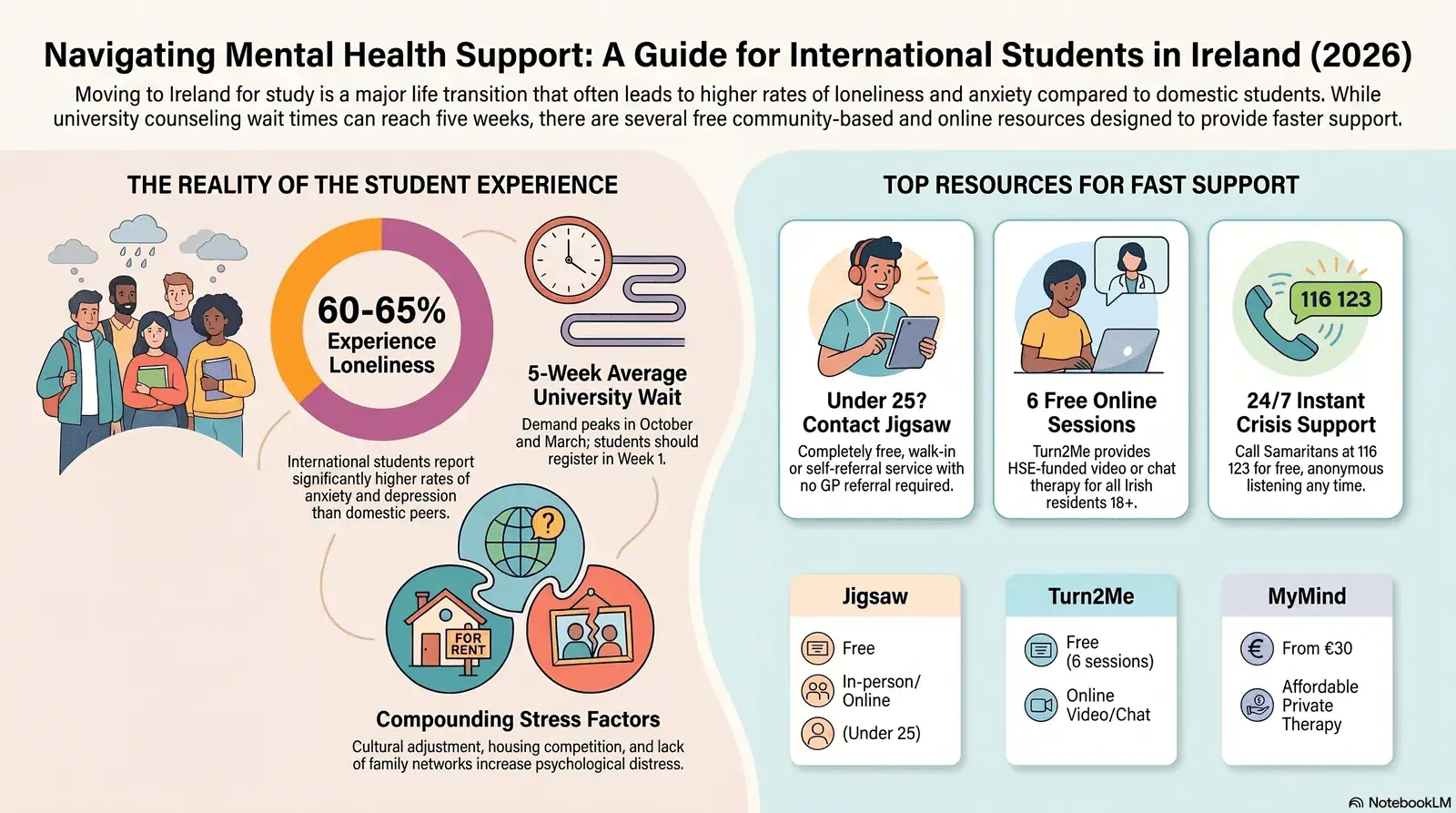
- Free counselling exists beyond campus: Jigsaw (age 12–25, no referral needed), Turn2Me (6 free HSE-funded sessions), and Niteline (9pm–2:30am term-time listening service) are available to international students at no cost.
- University counselling has waiting times: UCD averaged ~25 working days (5 weeks) in 2024/25. Register in Week 1 of semester and use community services while you wait.
- In a crisis, call 999/112 or Samaritans 116 123: Budget 2026 placed specialist mental health nurses in all major A&E departments — you will not be turned away.
Best free service (under 25)
Jigsaw — walk-in or self-refer, no GP needed
Best free online sessions
Turn2Me — 6 HSE-funded video/chat sessions
24/7 crisis line
Samaritans: 116 123 (free, any phone)
Lowest-cost private therapy
MyMind — from €30/session for students
In this guide
- Why mental health challenges are common for international students
- University counselling services
- Free community services: Jigsaw, Pieta House, Samaritans, Niteline
- Online therapy and mental health apps
- Talking to your GP about mental health
- When to seek emergency help
- Full services comparison table
Why Mental Health Challenges Are Common for International Students
International students face a unique combination of stressors that domestic students rarely encounter simultaneously: cultural adjustment, academic pressure in a new language or teaching system, financial strain, social isolation, and the complete absence of the family and friendship networks that normally act as a buffer against psychological distress.
A 2025 systematic review published in Frontiers in Psychiatry that analysed studies from across Europe, North America, and Australia found elevated rates of anxiety ranging from 2.4% to 43%, depression from 3.6% to 38.3%, and psychological distress in 31.6% to 54% of international students. Loneliness was reported by 60–65% of respondents across multiple cohorts. Students aged 21–30 and female students were identified as groups at elevated risk.
For students arriving in Ireland — often for the first time — the adjustment period is compounded by Ireland's notoriously competitive housing market, high cost of living, and grey November weather that can genuinely affect mood. Indian students in particular frequently describe the cultural contrast as sharper than expected: the social dynamic is different, the food is unfamiliar, and the casual Irish communication style (which can read as dismissive to students from more formal cultures) takes time to decode.
On-the-Ground Insight: "I didn't realise how much I was struggling until Week 6 of semester. I kept thinking it was normal to feel this way — homesick, anxious, not sleeping properly. I finally walked into the Jigsaw office in Blanchardstown and they saw me within two weeks. The fact that it was completely free meant I didn't have to feel guilty about using the service." — Priya M., MSc Data Analytics, TU Dublin, 2025
Recognising that these feelings are a normal — and documented — response to a major life transition is the first step. The second is knowing where to go. Ireland has a genuinely good ecosystem of mental health supports, many of them free, but the system is not well signposted for newcomers.
University Counselling Services: How to Access, Waiting Times
Every Irish university and most institutes of technology provide a free student counselling service, staffed by qualified therapists, and available to all registered students including international and postgraduate students. The key practical difference from the community services below is that university counselling is embedded in your institution and your therapist will already understand the academic pressures of your specific programme.
How to register
The process varies slightly by institution but the general steps are: (1) go to the Student Counselling or Student Wellbeing page on your university's website, (2) complete an online self-referral form (usually a 10-minute questionnaire about your current situation and concerns), and (3) wait for an appointment confirmation by email. You do not need a GP referral and you do not need to be in crisis — university counsellors routinely help with everyday stress, exam anxiety, and adjustment difficulties.
Waiting times in 2026
The honest picture is that waiting times can be significant at major universities. UCD Student Counselling Service reported an average wait of 24.94 working days (approximately five weeks) in the 2024/25 academic year, with demand peaking in October–November and March–April. Maynooth University and University of Galway offer hybrid services (in-person and online) and group counselling workshops to extend reach while managing waitlists.
While waiting for your university appointment, use the community services detailed below — they are not a lesser option; several are staffed by clinical professionals and offer evidence-based therapies.
University counselling by institution (2026)
| University | Service name | Format | Typical wait | How to access |
|---|---|---|---|---|
| UCD | Student Counselling Service | In-person & online | ~5 weeks (2024/25 avg) | Self-referral via ucd.ie portal |
| Trinity College Dublin | Student Counselling Service | In-person & online | Varies by term | Online registration form |
| DCU | Student Support Services | In-person | 2–4 weeks | Walk-in or email referral |
| University of Galway | Student Counselling | In-person, online, group | Varies; group workshops faster | Self-referral via ugalway.ie |
| Maynooth University | Counselling Service | In-person & online | Variable | Online self-referral form |
| TU Dublin | Student Support Services | In-person | 1–3 weeks | Email or phone booking |
| UCC | Student Counselling & Development | In-person & online | 2–5 weeks | Self-referral via ucc.ie |
| UL | Student Affairs / Counselling | In-person | Variable | Self-referral via ul.ie |
Free Community Services: Jigsaw, Pieta House, Samaritans, Niteline
Ireland has a network of free, community-based mental health organisations that are open to international students and require no GP referral, no insurance, and — in most cases — no waiting list. These services range from one-to-one clinical therapy to peer listening support, and many are available online or by phone so you can access them from your student accommodation at midnight if that is when you need them.
Jigsaw — The National Centre for Youth Mental Health
Who it is for: Anyone aged 12–25 in Ireland, including international students.
What it offers: Free one-to-one sessions with a qualified Jigsaw clinician, available in person at 18 locations across Ireland (Dublin, Cork, Galway, Limerick, Wicklow, and more) and online. No GP referral required — you can self-refer directly on jigsaw.ie or simply walk into a hub. Jigsaw also offers online chat support and a range of self-help resources.
Wait time: Jigsaw aims to see all young people within a few weeks of first contact. A single timely session with a clinician is often all that is needed, though many young people return for several sessions.
2026 update: Jigsaw received an additional €1.3 million in Budget 2026 funding to open new hubs and expand capacity. If you are under 25, this is your first port of call.
Pieta House
Who it is for: Anyone in Ireland experiencing suicidal ideation, self-harm, or bereaved by suicide. No age limit. Available to all residents regardless of visa status.
What it offers: Free, one-to-one therapeutic counselling for people in suicidal distress or engaging in self-harm. Pieta's 24/7 crisis line is available by calling 116 123 (same number as Samaritans — both organisations share the crisis line infrastructure) or by texting "HELP" to 51444.
2026 update: In March 2026, Pieta announced that three centres (Waterford, Athlone, Tralee) would transition to a co-located model within HSE Integrated Healthcare Areas to reduce costs while maintaining outreach. Online and phone services remain unaffected.
Samaritans Ireland
Who it is for: Anyone in distress, at any time, day or night. 25 branches across Ireland staffed by over 2,000 trained volunteers.
What it offers: Confidential emotional support by phone (116 123, free from any phone including mobiles) and email ([email protected]). Not just for crisis — Samaritans regularly support people dealing with loneliness, anxiety, or the feeling that things are getting too much. Calls are free from Irish mobile networks and landlines.
Practical note for international students: The service is available in English. If English is not your strongest language in a moment of distress, let the volunteer know and they will speak slowly and simply. The listening model does not require you to have a specific problem — you can call simply to talk.
Niteline / Nightline Ireland
Who it is for: Students at participating Irish universities including UCD, TCD, MU, NCAD, NCI, RCSI, ITT, and ITB.
What it offers: A confidential, anonymous listening service run by trained student volunteers, supervised by qualified counsellors. Available by phone on 1800 793 793 (freephone) during term time, every night from 9pm to 2:30am. Particularly useful for the late-night hours when anxiety tends to peak and other services are closed.
Practical note: Niteline is not a crisis counselling service — it is a peer listening service. If you are in immediate danger, call 999. Use Niteline for the nights when you cannot sleep and just need to talk to someone who understands student life.
Aware
Who it is for: Anyone in Ireland affected by depression, anxiety, or bipolar disorder, and their families.
What it offers: Free support groups (in person and online), a helpline, and structured educational programmes including Life Skills and Mood Matters. Aware's support groups are peer-led and anonymous, which many international students find easier to engage with than formal counselling. The online groups are particularly accessible for students in regional locations.
Online Therapy and Mental Health Apps Available in Ireland
Online mental health platforms have expanded significantly in Ireland since 2023, and several now offer free or heavily subsidised sessions to students, funded either by the HSE or by university partnerships. These are not inferior to in-person therapy — clinical trials consistently show video-based CBT achieves comparable outcomes to face-to-face sessions for anxiety and mild-to-moderate depression.
Turn2Me
Who it is for: All Irish residents aged 18 and over, including international students on any visa.
What it offers: Six free one-to-one counselling sessions by video or instant message with a qualified therapist, fully funded by the HSE. Turn2Me also offers free online support groups covering anxiety, depression, loneliness, and grief. Sessions are anonymous and conducted through their secure platform — no need to register with your real name.
How to access: Create a free account at turn2me.ie, complete a short wellbeing check-in, and book a session. The platform typically has shorter wait times than university counselling.
Togetherall
Who it is for: Students at Irish universities that have a Togetherall subscription (check with your Student Union — many Irish HEIs are subscribed).
What it offers: A 24/7 anonymous online mental health community moderated by clinical practitioners. You can post, read others' experiences, access structured self-help courses (CBT-based), and contact a practitioner at any hour. Togetherall is particularly valuable during holidays when university services are closed.
MyMind
Who it is for: Anyone in Ireland seeking affordable private therapy. Sliding-scale fees based on income.
What it offers: One-to-one therapy by video or in person (Dublin, Cork, Limerick, Galway, Mayo, Carlow) with qualified psychologists, psychotherapists, and counsellors. Full-time students pay from approximately €30–€45 per session — significantly below the standard market rate of €80–€120. Sessions are available in multiple languages, which is significant for international students who may express themselves more naturally in their first language.
How to access: Use the "Find a therapist" tool on mymind.org, filter by income level, and book directly. No GP referral required.
Mental health apps worth using
Apps cannot replace therapy but they provide accessible, evidence-based techniques you can use independently between sessions or while waiting for an appointment:
| App | Focus | Cost | Evidence base |
|---|---|---|---|
| Headspace | Mindfulness & meditation | Free trial; ~€13/month | Peer-reviewed studies on anxiety reduction |
| Calm | Sleep, anxiety, meditation | Free trial; ~€15/month | Research-backed sleep improvement |
| Woebot | CBT-based chatbot | Free | RCT-tested; reduces depression symptoms |
| SilverCloud | CBT for anxiety & depression | Free via HSE/universities | HSE-commissioned platform; clinical evidence |
| MindShift CBT | Anxiety management | Free | Developed by Anxiety Canada; CBT-based |
How to Talk to Your GP About Mental Health (and Referral Paths)
Your GP (General Practitioner) is the gateway to the HSE's public mental health system in Ireland, and registering with a GP should be one of your first actions after arriving — not something you delay until you feel unwell.
How to register with a GP in Ireland
As an international student, you are entitled to access GP services in Ireland. Most students pay a standard consultation fee (typically €50–€70 per visit). However, if you hold a Medical Card or a GP Visit Card (income-tested — some students qualify), GP visits are free. Your university's Student Health Centre also typically offers GP-equivalent services at a reduced student rate; check your institution's website for fees.
What to say to your GP
Many international students hesitate to discuss mental health with a GP because they are unsure how to describe what they are feeling, or because discussing mental health with a doctor feels culturally unfamiliar. The following approach works well in an Irish GP setting:
- Book a standard appointment and mention at reception that you would like to discuss "mental health or emotional wellbeing" so the GP allocates enough time.
- Describe concretely what you have been experiencing: "I have been feeling very anxious / low / unable to sleep for the past [X] weeks."
- Mention the context: "I am an international student, I have been in Ireland for [X] months, and I don't have family support nearby."
- Ask specifically: "Can you refer me for talking therapy, or tell me what public options are available?"
What your GP can refer you to
| Referral pathway | What it provides | Cost | Wait |
|---|---|---|---|
| Primary Care Psychology | Short-course CBT / counselling (6–8 sessions) | Free (HSE-funded) | Varies by area; typically 4–12 weeks |
| Community Mental Health Team (CMHT) | Specialist psychiatric assessment and ongoing care | Free (HSE-funded) | 3–6 months routine; faster if urgent |
| SilverCloud online CBT | Self-guided digital CBT programme | Free (GP referral code) | Same week |
| Private psychiatrist / psychologist | Specialist assessment; faster access | €150–€250/session (some covered by student health insurance) | 1–3 weeks |
When to Seek Emergency Help and What to Do
If you or someone you know is in immediate danger of harming themselves or others, call 999 or 112 immediately — this applies 24 hours a day, 7 days a week, and emergency services in Ireland will respond regardless of your visa status or nationality.
What counts as a mental health emergency
The following situations warrant immediate emergency intervention:
- You or someone else is actively suicidal and has a plan or means to act on it
- You or someone else has already taken an overdose or self-harmed severely
- You are experiencing severe confusion, paranoia, or hallucinations (psychotic episode)
- You feel you cannot keep yourself safe and have no one around to help
A&E and the 2026 changes
Budget 2026 funded significant structural improvements to how Ireland's emergency departments handle mental health presentations. There were over 50,000 mental health A&E presentations in Ireland in 2024 (Mental Health Commission figure). The government response was to embed specialist mental health nursing teams in the emergency departments of all Model 4 hospitals out-of-hours, alongside five new adult liaison psychiatrists. This means that if you arrive at a major hospital A&E in mental health crisis, there will be a specialist clinician to assess you — not just a general emergency nurse.
Non-emergency crisis options (when you are in distress but not in immediate danger)
| Service | Contact | Hours | Best for |
|---|---|---|---|
| Samaritans | 116 123 (call, free) / [email protected] | 24/7 | Emotional distress, suicidal thoughts, loneliness |
| Pieta House Crisis Line | 116 123 or text HELP to 51444 | 24/7 | Suicidal crisis, self-harm |
| Niteline (students only) | 1800 793 793 (freephone) | 9pm–2:30am (term time) | Late-night distress; peer listening |
| HSE Urgent Help page | hse.ie/urgent-help | Always online | Directory of local crisis services by county |
| Togetherall | Via university login | 24/7 | Anonymous peer support; online community |
Full Services Comparison Table
Use this table to identify the right service based on your situation, age, and whether you need free, low-cost, or immediate support.
| Service | Cost | Age | Format | Wait time | Referral needed? |
|---|---|---|---|---|---|
| Jigsaw | Free | 12–25 | In-person / online | ~2 weeks | No — self-refer |
| Turn2Me | Free (6 sessions) | 18+ | Video / chat | Days | No — self-register |
| University Counselling | Free | Enrolled students | In-person / online | 2–6 weeks | No — self-refer |
| Togetherall | Free (university) | Students | Online community | Instant | No — university login |
| SilverCloud (HSE) | Free | 18+ | Online CBT programme | Same week | GP referral code |
| Primary Care Psychology | Free | All | In-person | 4–12 weeks | Yes — via GP |
| MyMind | From €30/session | All | In-person / online | Days | No — self-book |
| Samaritans | Free | All | Phone / email | Instant | No |
| Pieta House | Free | All | Phone / text / in-person | Instant (crisis line) | No |
| Niteline | Free | Students | Phone | Instant (9pm–2:30am) | No |
| Aware | Free | All (18+) | Online / in-person groups | Days | No |
| A&E / Emergency | Free / card-holder rates | All | In-person | Immediate | No — walk in or call 999 |
Frequently Asked Questions
Is Jigsaw free for international students in Ireland?
Yes. Jigsaw is completely free for anyone aged 12 to 25 in Ireland, including international students. No GP referral is needed - you can self-refer online or walk into any of their 18 locations. Jigsaw received €1.3 million in additional Budget 2026 funding to expand capacity.
How long is the wait for university counselling in Ireland?
Waiting times vary by university. UCD's average wait was approximately 25 working days (5 weeks) in the 2024/25 academic year. Demand typically peaks around October-November and March-April. Register early in semester one and use free community services like Turn2Me or Jigsaw while waiting.
What free online therapy is available to students in Ireland?
Turn2Me offers 6 free counselling sessions via video or instant message for all Irish residents, funded by the HSE. Togetherall provides free 24/7 anonymous peer support for students at many Irish universities. MyMind offers sliding-scale sessions from €30 for full-time students.
What should I do in a mental health emergency in Ireland?
Call 999 or 112 immediately if there is immediate danger to life. For urgent but non-life-threatening crisis support, go to your nearest A&E. Budget 2026 funded specialist nursing teams in all Model 4 hospital emergency departments to handle mental health presentations. You can also call Samaritans 24/7 on 116 123 (free from any phone).
Can a GP in Ireland refer me for free mental health care?
Yes. Your GP can refer you to Community Mental Health Teams (CMHTs), which provide free specialist psychiatric care under the HSE. They can also refer you to CAMHS if you are under 18. Many GPs can also prescribe a short course of therapy under the Primary Care Psychology service. Bring your student ID and a description of your symptoms to your first GP appointment.
Planning your trip to Ireland? Compare live student fares.
Once your mental health support is sorted, make sure your flight to Ireland doesn't break the bank. Compare live fares across airlines, including student discounts and flexible tickets.
All service information in this guide is based on publicly available official sources as of June 2026. Service availability, hours, fees, and eligibility criteria can change. Always verify current details directly with the relevant organisation before accessing a service. MyFlightOffers is not affiliated with any organisation mentioned in this article. This article does not constitute medical, psychological, or healthcare advice. If you are in immediate danger, call 999 or 112.
- NEW Ireland Student Medical & Health Guide 2026 — how to register with a GP, get a medical card, and navigate the HSE as an international student
- Ireland Student Survival Guide: Hidden Subsidies 2026 — discounts on transport, culture, food, and utilities most international students never claim
- The Indian Student's Money Survival Guide in Ireland — banking, forex cards, sending money home, and managing finances in Ireland
- Student Stress-Free Travel Guide 2026 — how to travel Europe affordably and avoid the most common booking mistakes