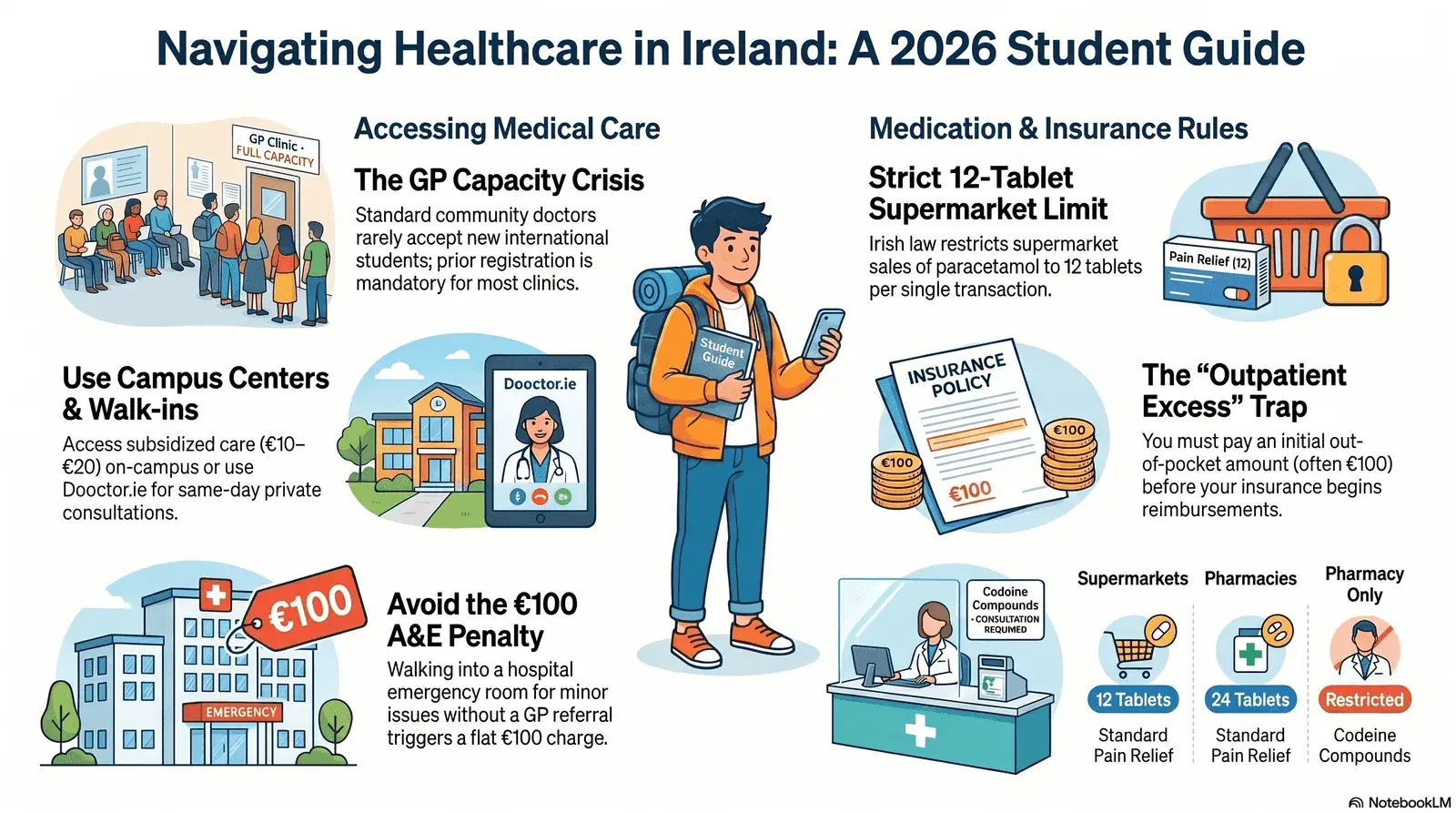
- Most community GPs in Ireland are not taking new patients — use Dooctor.ie walk-in clinics as your first-line alternative (typically €50–€75, no appointment needed); do not wait until you are ill to research this.
- Your college doctor is the cheapest option — often free or heavily subsidised for registered students — but register in your first week of term, not when you are already sick and slots are full.
- Many medicines freely available in India require a prescription in Ireland — antibiotics, strong pain relief, and some antihistamines cannot be bought over the counter; factor GP visit costs into your health budget.
🩺 Community GP Status
Severe capacity limits
Most standard clinics are not taking new patients or
walk-ins
🚀 Instant Care Access
Dooctor.ie Walk-In Network
Same-day consultation clinics across major student town hubs
🛒 Retail Medication
Supermarket limits active
Supermarkets sell max 12 paracetamol tablets per transaction
💸 Non-Referral Penalty
€100 Public A&E Charge
Avoid hospital emergency rooms for minor bugs without a GP
note
10 sections covered in this guide
- The reality of the Irish GP crisis and student options
- Campus medical centers: Subsidized on-campus care
- The rise of walk-in care: Dooctor.ie infrastructure
- Step-by-step walkthrough: Accessing walk-in care
- Over-the-counter meds: Supermarket limits and rules
- The top 5 pharmacy groups in Ireland
- The Holland & Barrett boundary: Supplements vs. meds
- Protecting your academic year: The seasonal flu vaccine
- Navigating the private health insurance claim maze
- The 24-hour emergency protocol: A&E vs. 112/999
🏥 Student Medical Expense Estimator
Estimate your annual out-of-pocket medical costs in Ireland, factor in private student health insurance refunds, and claim your 20% Med 1 tax relief.
🩺 Annual Out-of-Pocket Breakdown
1 The Reality of the Irish GP Crisis and the 2026 Student Bottleneck
Standard community General Practitioners (GPs) across Ireland operate strictly on a prior-registration model and are facing extreme capacity shortages, meaning they rarely accept walk-in appointments or new international student registrations. Understanding this structural limit is critical to avoid being left without medical support during an acute illness.
In Ireland, a General Practitioner functions as the mandatory gatekeeper to the rest of the healthcare system. You cannot simply book an appointment with a specialist or walk into a public clinic for non-emergency diagnostics without a formal referral letter from a registered doctor. Because local neighborhood clinics are at full capacity, incoming students trying to register with a local GP near their accommodation are regularly turned away with weeks-long waiting lists.
International students frequently assume they can walk directly into any local community medical center when they develop flu symptoms or require a prescription renewal. Doing so without prior registration will result in being turned away by reception staff. For minor or acute health issues, students must look to specialized student access options rather than traditional neighborhood practices.
2 Campus Medical Centers: Subsidized On-Campus Care Systems
Most major Irish universities and technological universities operate dedicated on-campus Student Health Centers that offer fully free or highly subsidized triage consultations for currently enrolled international students. These campus centers understand student visa frameworks and act as your immediate primary care provider during term time.
Whether you are studying at University College Dublin (UCD), Trinity College Dublin (TCD), University of Galway, University College Cork (UCC), or the Technological University of the Shannon (TUS) in Athlone, your student services levy covers access to on-campus medical teams. These centers are staffed by fully licensed GPs and specialized clinical nurses who can issue valid Irish medical certificates for academic extensions and write prescriptions recognized by local pharmacies.
At the TUS Athlone campus, the Student Health Center handles primary care through an integrated triage system. Students can speak with a college nurse for basic health checks, diagnostic assessments, and minor care at no cost. If the nurse determines that a prescription or complex medical assessment is required, an appointment is scheduled with the visiting campus GP. This costs a subsidized fee (typically €20 to €30), compared to the standard €70 to €95 fee charged by private doctors outside campus.
3 The Rise of Walk-In Care: Complete Guide to Dooctor.ie Infrastructure
Dooctor.ie operates an extensive network of private, walk-in medical clinics across Ireland designed to bypass the community GP bottleneck by offering same-day appointments without requiring prior permanent registration. This infrastructure is an essential medical alternative when campus health centers are closed during holidays or fully booked during peak exam weeks.
The platform handles the acute care gaps that international students frequently encounter. If you develop an infection, require immediate blood tests, or need diagnostic reviews over the weekend, these clinics provide face-to-face consultations with certified doctors. They operate outside the rigid framework of traditional community practices, allowing any international passport holder or resident to walk in, pay a flat service fee, and receive immediate medical attention.
Verified 2026 Dooctor.ie Clinical Hub Locations
The network covers major urban centers and regional student towns, with clinics located across the following hubs:
Athlone: Central hub access for regional
students.
Galway: Locations in Roscam and
Knocknacarra.
Limerick & Ennis: Comprehensive Mid-West
coverage.
Swords (Dublin): Main North Dublin access
point.
Dundalk: Serving Northeast student
populations.
Portlaoise & Kilkenny: Key South-Leinster
locations.
Carrigtwohill (Cork): Serving the South-Coast
academic hub.
Waterford: Southeast city center clinic.
Abbeyfeale & Tipperary: Regional care
points.
4 Step-by-Step Walkthrough: Accessing Walk-In Care via Dooctor.ie
To successfully use a walk-in service like Dooctor.ie, you must Check their digital dashboard for real-time site hours, register your basic identity details online or at the reception desk, and secure a complete receipt for your insurance provider. Following this sequence ensures you receive prompt treatment and maintain a valid paper trail for financial reimbursement.
-
Verify Live Clinic Hours online
Visit the official digital platform at dooctor.ie to confirm the exact daily operating schedule for your nearest branch. Operating hours can vary by location, and checking online confirms the clinic is open before you travel. -
Select Your Targeted Medical Service
Determine whether your visit is for a general medical consultation, specialized blood work, a specific vaccine, or a women's health screening. Specifying your need at reception helps the clinic route you to the right clinical professional. -
Present Your Passport and Student Credentials
Provide clear identification to the administration staff. Keeping your passport, current GNIB/IRP card details, and your official Irish university student card on hand helps complete registration smoothly. -
Complete the General Medical Consultation
Explain your medical history and current symptoms clearly to the attending doctor. If you brought medication from your home country, bring the original packaging or prescription letters so the doctor can verify generic names and match them with equivalent treatments available in Ireland. -
Collect Your Regulated Irish Prescription
If the doctor prescribes medication, they will issue an authorized physical prescription or send an electronic prescription directly to your preferred pharmacy via the secure Healthlink network. -
Secure an Itemized, Stamped Receipt
Pay the consultation fee at the front desk and request a detailed, itemized receipt with the clinic's official stamp. This document is mandatory to clear outpatient thresholds and claim refunds from your private insurance provider.
5 Over-the-Counter (OTC) Realities: Supermarket Essentials vs. Behind-the-Counter Restrictions
Basic over-the-counter painkillers and cold treatments are widely available in general grocery supermarkets like Tesco, Dunnes Stores, Lidl, and Aldi, but strict safety regulations limit purchases to a maximum of 12 paracetamol tablets per transaction. If your medical needs require larger quantities or targeted treatments, you must buy them directly from a licensed pharmacy counter.
The Health Products Regulatory Authority (HPRA) enforces strict rules governing the sale of over-the-counter pain relief medicines to protect public health. These rules cover packaging sizes, retail locations, and compound access points:
| Medication Type | Retail Outlets | Maximum Pack Size Limit | Legal Sale Conditions |
|---|---|---|---|
| Standard Paracetamol / Ibuprofen | Supermarkets (Tesco/Lidl) & Pharmacies | 12 Tablets (Supermarket) / 24 Tablets (Pharmacy) | Open shelf access; restricted quantity per single checkout transaction |
| Multi-Symptom Cold Relief (Lemsip Max) | Supermarkets & Pharmacies | 10 Sachet Packs | Available on open shelves; cannot be mixed with other paracetamol products |
| Codeine-Based Compounds (Solpadeine) | Strictly Pharmacy Counters Only | Restricted pack limits | Behind-the-counter; requires a mandatory interview with a pharmacist |
| Antibiotics & Heavy Therapeutics | Strictly Pharmacy Counters Only | Determined by prescription | Requires a valid, signed prescription from an Irish-registered doctor |
If you request codeine-based pain relief (such as Solpadeine) at an Irish pharmacy counter, the pharmacist is legally required to question you before completing the sale. They will ask about your specific symptoms, other medications you are taking, and how long you have needed pain relief. This is a standard safety screening protocol under Irish law, not a personal interrogation.
6 The Top 5 Pharmacy Groups in Ireland and Their Digital Portals
Ireland's retail pharmacy sector is anchored by five primary pharmacy chains that offer prescription fulfillment, emergency contraception, and integrated seasonal vaccination services across every county. Familiarizing yourself with these groups ensures you can quickly find medication dispensing points near your accommodation or campus.
High Street & Shopping Centre Presence
The largest health and beauty retailer in the state, with branches across all major urban zones including Dublin, Cork, and Limerick. Boots offers a robust mobile app to manage prescriptions and uses the Swiftqueue platform for booking seasonal flu and travel vaccinations.
Community-Focused Care Network
Operating an extensive network of neighborhood dispensaries throughout Ireland. LloydsPharmacy focuses heavily on local community access, making it a reliable choice for setting up recurring prescription services or getting expert over-the-counter advice for minor winter bugs.
Digital Integration and Rapid Fulfillment
Well-known for its progressive digital services, McCabes allows students to upload photos of their prescriptions via a secure app to arrange rapid, contact-free collection. This service is ideal for quickly finding equivalent treatments for chronic conditions.
Urban Academic Proximity Clusters
Maintains deep coverage across primary Dublin commuter corridors and major regional high streets. Hickey's pharmacies are frequently located near major university hubs, providing convenient access to essential student services like emergency contraception and emergency prescription extensions.
Independent Local Co-Op Framework
A large alliance of independent community pharmacies operating under a shared national brand. Life Pharmacy branches offer personalized local care, which is particularly helpful in regional student towns like Athlone or Carlow where independent chemists handle regional healthcare access.
7 The Holland & Barrett Boundary: Supplements vs. Regulated Therapeutics
Holland & Barrett operates strictly as a health wellness retailer selling nutritional supplements, vitamins, and herbal items, which are classified legally as food products and cannot be used as a substitute for regulated medical treatments. Confusing dietary supplements with approved medicines can be a dangerous mistake when managing acute illnesses.
If you develop a bacterial infection, severe respiratory distress, or an acute illness, purchasing herbal remedies or high-dose vitamin formulations from a wellness store will not resolve the underlying condition. Regulated medications go through rigorous clinical testing and safety monitoring by the HPRA, and can only be dispensed by licensed pharmacies. Supplements are intended to support general health and fill nutritional gaps, not to treat, cure, or prevent specific medical conditions.
Always check the product packaging for a formal regulatory registration mark. Legitimate over-the-counter and prescription medicines feature a clear product authorization number (PA or PPA number) printed directly on the box, along with an itemized patient warning leaflet. If a product lacks this official registration data, it is a dietary supplement and should not be used to treat acute medical issues.
8 Protecting Your Academic Year: Securing the Seasonal Flu Vaccine
The Health Service Executive (HSE) strongly advises all university students to get the seasonal flu vaccination each autumn, which can be administered at any major pharmacy chain or campus clinic for a standard private fee of approximately €30 to €40. Ensuring you are protected before the winter flu wave peaks helps safeguard both your health and your academic schedule.
The seasonal flu vaccine is updated annually to target the most common virus strains predicted for the winter season. The booking window typically opens in late September and continues through November. For students living in shared, high-density student accommodation, getting vaccinated is an effective way to prevent outbreaks that can disrupt study and exam preparation.
9 Deconstruct the Private Health Insurance Claim Maze (The "Excess" Trap)
To successfully claim medical reimbursements from your student health insurance provider, you must collect an itemized receipt with an official clinic stamp and submit it via your insurer's mobile app, while keeping in mind your policy's annual outpatient excess threshold. Failing to understand how the excess framework operates is the primary reason international students miss out on valid claims.
All non-EU international students must hold a valid private medical insurance policy to satisfy their Stamp 2 visa conditions. Whether your coverage is through a specialized international student provider like StudyAndProtect (often underwritten by companies like Laya Healthcare) or standard plans from Vhi or Irish Life Health, your policy features an **Outpatient Excess Fee**. This excess represents the initial out-of-pocket amount you must pay each year before your insurance company begins reimbursing your medical costs.
If your student health insurance policy has an annual outpatient excess of €100 and you visit a walk-in clinic twice (paying €70 per consultation, totaling €140), your insurer will subtract the €100 excess from your total claim. Your reimbursement check will be exactly €40. However, you must still upload both receipts to your insurer's digital app. Logging every receipt updates your profile and ensures that once you clear the excess threshold, subsequent eligible medical expenses are reimbursed at your policy's full percentage rate.
10 The 24-Hour Emergency Protocol: A&E Charges vs. 112/999 Emergency Dispatch
For life-threatening medical emergencies, you should call 112 or 999 immediately for an emergency ambulance response, whereas walking into a public hospital's Accident & Emergency (A&E) department for minor ailments without a formal doctor's referral letter will trigger a mandatory flat charge of €100. Knowing when to use community walk-in clinics versus emergency hospital departments will save you significant money and keep critical emergency resources free for serious cases.
Public hospital emergency units (such as the Mater Hospital or St. Vincent’s Hospital in Dublin, or University Hospital Galway) are under constant operational pressure. If you attend an A&E department for minor health concerns like a cold, simple skin rash, or a long-standing minor injury, you will face long wait times that can last from six to twelve hours. You will also be billed the full €100 non-referral fee, which is rarely covered by base-level private student health insurance policies.
- When to choose Walk-In Clinics (Dooctor.ie): High fevers, persistent coughs, minor cuts requiring basic stitches, ear pain, urinary track infections, and prescription renewals.
- When to choose Public Hospital Emergency Departments (A&E): Sudden chest pain, breathing difficulties, suspected bone fractures, severe head injuries, or sudden, severe allergic reactions.
- The Free GP Referral Advantage: If an on-campus college doctor or a walk-in GP examines you and determines that hospital care is necessary, they will write an official referral letter. Presenting this letter at the A&E reception desk waives the €100 hospital fee entirely.
Frequently Asked Questions
Can I walk into any GP clinic in Ireland as a new student without registration?
No, standard community GP clinics operate on a strict pre-registration model and rarely accept walk-in patients due to severe capacity limits. For acute needs, you should use your university's internal health center or a private walk-in clinic network like Dooctor.ie.
What is Dooctor.ie and how do international students use it?
Dooctor.ie is a private walk-in clinic network that allows international students to secure same-day, face-to-face medical care, blood tests, and prescriptions without needing to be permanently registered with a community general practitioner.
Can I buy over-the-counter painkillers or cold medication in Irish supermarkets?
Yes, basic medications like paracetamol and ibuprofen can be purchased at supermarkets like Tesco or Dunnes Stores, but under HPRA rules, non-pharmacy retail shops are legally limited to selling a maximum pack size of 12 tablets per transaction. Larger quantities must be purchased directly from a pharmacy counter.
How do I claim money back for medical bills from my student health insurance?
You must request an itemized, stamped receipt from your medical clinic and upload it directly through your insurer's mobile app. Be mindful of your policy's annual outpatient excess fee, which must be cleared before reimbursement payments are issued.
- HSE Find a GP Tool: hse.ie — search for registered community medical practices across Ireland
- Dooctor.ie Walk-In Portal: dooctor.ie — verify live clinic hours and locations in Athlone, Limerick, Galway, and Swords
- HPRA Safety Registry: hpra.ie — access official details on regulated over-the-counter and prescription medications
- Swiftqueue Booking System: swiftqueue.com — book seasonal flu shots and diagnostic appointments at participating major pharmacies
- StudyAndProtect Portal: studyandprotect.com — submit medical insurance claims and review international student policy terms
This healthcare manual is part of the MyFlightOffers international student series for Ireland 2026:
- Health Insurance for International Students in Ireland 2026: Which Plans Work and What They Actually Cover — VHI PublicPlus Care vs Level Health Plan A, the €25,000 visa minimum, Indian travel insurance year-1 rule, and how to claim
- Mental Health Support for International Students in Ireland 2026 — Free & Low-Cost Services Guide — Jigsaw, Turn2Me, university counselling wait times, GP referral paths, and what to do in a mental health crisis
- Navigating the 2026 Irish Rental Market Without Getting Scammed — Avoid ghost listings, use RTB registries, and protect your deposit in Dublin, Cork, and Galway
- The 2026 Student’s Guide to Stress-Free Travel — Bypass airport lines with C3 scanners, join Student Clubs to handle visa delays, and calculate baggage costs
- Ireland Student Survival Guide 2026: Hidden Subsidies & Savings — Your complete financial roadmap covering transport cards, tax refunds, and grocery budget strategies
- Finding Affordable Flights from Dublin to Delhi 2026 — Best booking windows, carrier options, and fare benchmarks for your trips home
Plan your budget and check your flights to Dublin
Now that you understand the healthcare landscape, compare live fares for your travel dates to plan your full allocation before heading to campus.
All medical infrastructure information, clinic operations, walk-in fees, location metrics for Dooctor.ie, campus health policies, public A&E fees, over-the-counter medicine regulations by the HPRA, and health insurance guidelines in this article are based on publicly available data from the Health Service Executive (hse.ie), the Health Products Regulatory Authority (hpra.ie), independent walk-in clinical networks, and insurance providers as of June 2026. Healthcare systems, clinic hours, pricing, and medical guidelines can change without notice. Always verify current details directly with official healthcare portals, clinic apps, and your insurance provider before making final medical or financial decisions. MyFlightOffers is an independent platform and is not officially affiliated with any government department, specific medical network, or insurance firm mentioned. This content is for informational purposes only and does not constitute formal medical or legal advice.