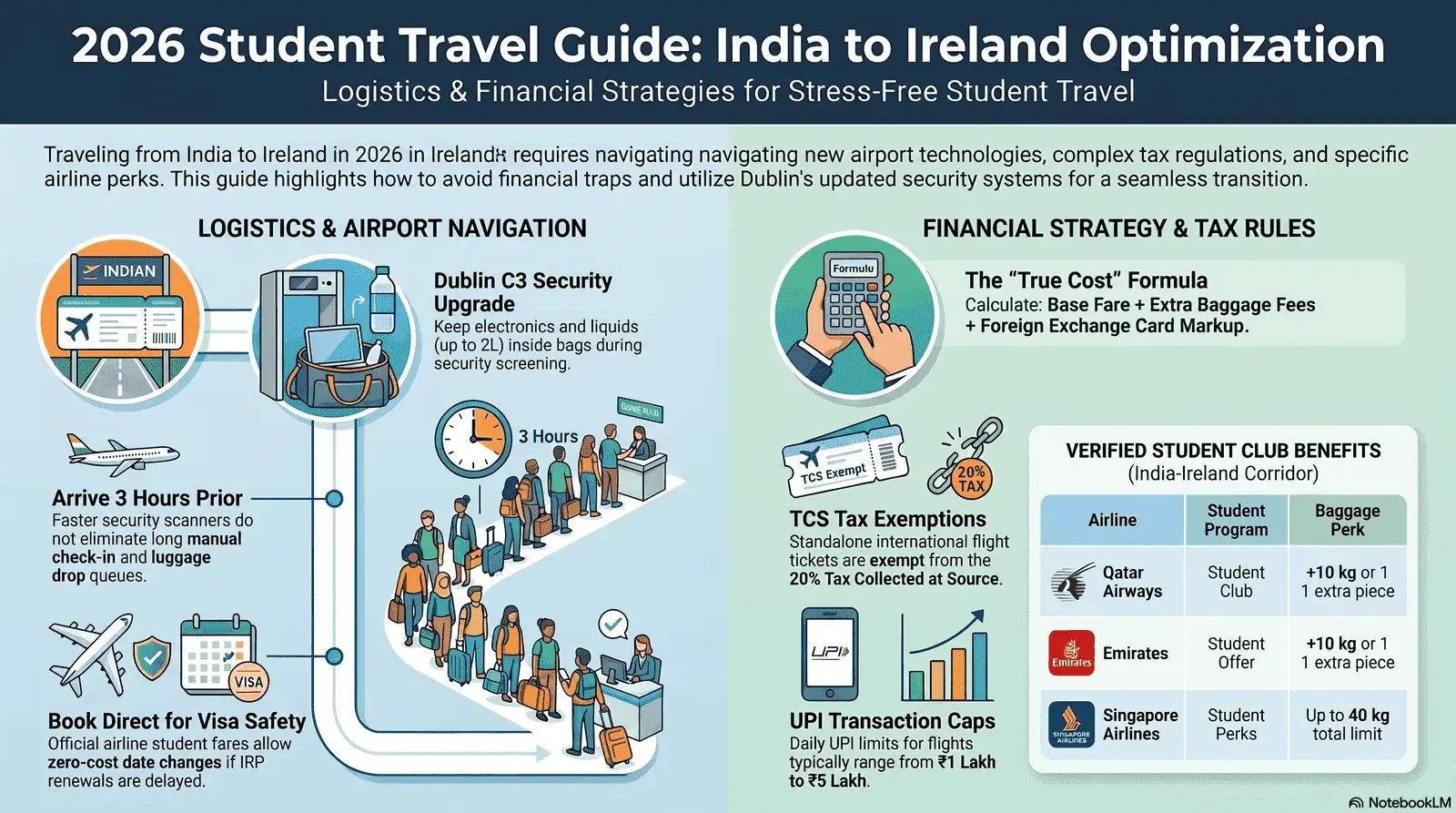
- Dublin Airport's C3 automated e-gates process biometric passports in under 30 seconds — use them instead of manual queues; have your passport bio page face-down on the reader and look directly at the camera.
- Book flights with flexible change rules — IRP renewal backlogs and visa delays can shift your departure date by weeks; a €30–€50 flexible-fare upgrade can save hundreds in rebooking fees.
- Carry your IRP card and university enrolment letter at every airport checkpoint — immigration officers at Dublin may request proof of student status on re-entry; having these prevents delays even if your visa stamp is current.
Dublin Security Status (2026)
Full C3 CT Scanners Active
Liquids & electronics stay inside cabin bags
Delayed IRP Travel Safety Net
Airline Student Club Privileges
Zero-cost date changes via direct bookings
Indian Cross-Border Tax
0% TCS on Standalone Tickets
2% for education remittance over ₹10 Lakh
Primary UPI Transaction Cap
₹1 Lakh to ₹5 Lakh Daily
Varies by bank; requires portal sync
10 sections in this guide
- Why traditional booking advice fails Indian students
- Navigating Dublin Airport’s 2026 security setup
- Protecting your ticket against IRP backlogs and delays
- Airline Student Clubs: Side-by-side comparison
- The True Cost baggage formula vs. low-cost traps
- Outsmarting Dynamic Currency Conversion (DCC)
- Whitelisting cross-border payments on Indian apps
- Decoding 2026 TCS brackets on student flights
- Common transit mistakes made by Indian passport holders
- Your pre-departure 48-hour checklist
1 Why Traditional Booking Advice Fails Indian Students in 2026
Generic travel tropes like "clear your browser cookies" or "book your ticket on a Tuesday at 3:00 AM" are entirely ineffective strategies for international student routing. Modern airline commercial distribution relies on highly sophisticated global distribution systems (GDS) and algorithmic pricing frameworks governed by Global Married Segment logic. These systems dynamically adjust pricing based on origin-and-destination patterns, real-time demand curves, and fare bucket availability rather than user-side browsing behaviors.
For Indian students moving between hubs like Delhi or Mumbai and Dublin, the pricing engine maps the entire route layout comprehensively. If you are flying during seasonal student migration windows—such as the high-demand periods late August through September or January's spring intake—pricing algorithms recognize the systemic directional capacity deficits. Attempting to time your booking down to a specific hour is useless when structural inventory management rules dictate the price curves. Success requires looking past superficial web myths and mastering the core parameters of student fare structures and cross-border payment limits.
Airlines regularizing long-haul routes via the Middle East or Europe do not look at individual flight legs in isolation. For instance, an itinerary matching Delhi to Doha and Doha to Dublin is evaluated as a single "married segment." The carrier's pricing engine will frequently unlock cheaper inventory for this integrated path than it would for someone seeking to purchase just one of those legs by itself. This is why multi-sector coordination and direct alliance integration are foundational strategies for locking in favorable rates.
2 Navigating Dublin Airport’s 2026 Security Setup: The C3 Scanner Rule
While Dublin Airport continues its rollout of next-generation C3 computed tomography scanners across Terminal 1 and Terminal 2, scanner availability varies by lane. You must still pack assuming standard 100ml limits and electronic removal policies could apply, as you may be routed through older security lanes during peak operational periods. This diagnostic checkpoint architecture generates detailed three-dimensional internal scans of bags, allowing departing passengers to leave all laptops, electronic tablets, and liquids up to two liters entirely inside their carry-on bags.
Where active, C3 lanes permit liquids up to two liters and electronics to remain inside bags. However, due to ongoing lane upgrades and potential lane redirections, you must prepare for standard security screening. Don't let the promise of new scanners encourage late arrivals. As ground processing points often encounter delays due to record terminal traffic, check-in and luggage drop queues remain common before you even reach the scanners.
While the security scanner lanes move much quicker, the process for checked baggage check-in at individual airline counters is still highly dependent on manual validation steps. If you are handling large international luggage allocations (the typical 2-bag allowance), you must remain prepared for long lines at the desks. Always give yourself a full three hours before long-haul flights to complete check-in requirements comfortably.
3 Protecting Your Ticket Against IRP Backlogs and Visa Delays
To safeguard your ticket investments against unexpected Irish Residence Permit (IRP) appointment delays, you should book direct student fares through official carrier programs instead of using third-party online travel agencies (OTAs). If your physical IRP card expires while you are waiting on a renewal appointment, you cannot legally board a commercial aircraft back into Ireland unless you possess an official immigration status confirmation letter from the Department of Justice (Immigration Service Delivery) or hold a valid multi-entry visa.
Purchasing ultra-low-cost, inflexible tickets through unverified online agencies often leads to unexpected fees when schedules must be altered. Standard promotional tickets generally carry severe change fees along with steep fare differences. By dealing directly with carriers through dedicated student-club avenues, you gain access to helpful contract terms designed to buffer against changing administrative timelines.
4 Airline Student Clubs: Side-by-Side Comparison
Enrolling in an official airline student program provides transparent access to higher checked-luggage limits and zero-fee booking alterations. Always verify programmatic details directly through the carrier’s primary ecosystem, as verification portals interface with global student clearinghouses to confirm current academic status.
| Airline | Student Program Name | Base Discount Tier | Baggage Metric Allocations | Verification Method |
|---|---|---|---|---|
| Qatar Airways | Student Club | 10% to 20% Tiered Scale | +10 kg or 1 supplementary piece | University ID or Official Enrollment Letter |
| Emirates | Student Offer | Up to 10% Price Relief | +10 kg or 1 supplementary piece | Valid Student ID or Institutional Offer Copy |
| Singapore Airlines | Student Perks | 10% off selected fare codes | Up to 40 kg total weight limit | KrisFlyer Academic Verification Link |
5 The True Cost Baggage Formula vs. Low-Cost Traps
You can find the real cost of a flight by combining the base fare with potential extra luggage fees and adding your card provider's cross-border conversion markup. The most appealing upfront price on a flight engine can quickly become a bad deal if it does not match the heavy packing needs of international students.
Moving abroad for a long academic term typically means carrying 30kg to 40kg of total baggage distributed across two primary suitcases. Standard base tickets on many European airlines frequently restrict you to a single checked bag capped at 23kg. Paying for an extra 23kg piece at the airport counter can cost between €120 and €200 each way, which easily wipes out any savings from a cheaper initial ticket.
True Cost = Base Flight Fare + Cost of Extra Checked Bag (If
                restricted to 23kg) + Foreign Exchange Card Markup Fee
Evaluating your travel options using this simple formula helps you see that a slightly more expensive ticket on a Middle Eastern airline—which natively includes a generous two-piece baggage allocation up to 40kg—is often the more economical choice for your journey.
6 Outsmarting Dynamic Currency Conversion (DCC) at Checkout
To avoid costly Dynamic Currency Conversion (DCC) charges, you must ensure that your transaction is billed in the local currency of the payment card used. When an international airline portal detects an Indian card at checkout, it will often offer to show and process the total charge in Indian Rupees (INR) as a convenience.
This payment option frequently hides uncompetitive internal exchange rates set by the merchant's processing bank rather than your card issuer. These backend exchange fees can add an unnecessary 3.5% to 5.5% markup to your transaction. Choosing to be billed in the local currency of the platform or the airline's regional origin allows your own bank to manage the conversion at standard network rates, keeping costs transparent.
As you approach the payment screens on international booking platforms, watch closely for subtle prompts or pre-selected checkboxes that ask: *“Would you like to be billed in your home currency (INR)?”* Always opt out of this choice. Insist on keeping the transaction in the original currency of the platform (like EUR or GBP) and rely on a high-quality zero-forex card to handle the exchange efficiently on your behalf.
7 Whitelisting Cross-Border Payments on Indian Banking Apps
You can reliably complete high-value flight transactions by using UPI on the regional Indian versions of airline websites, provided the total purchase amount fits within your bank's daily UPI transfer limits, which typically run from ₹1 Lakh to ₹5 Lakh. If your booking exceeds these amounts, you should use Net Banking or a pre-configured credit card to avoid immediate automated fraud declines.
Securing high-value tickets from India requires careful navigation of fraud detection systems. To prevent transactions from failing during time-sensitive booking windows, make sure to adjust your payment settings ahead of time:
Open App Card Controls
Log into your primary Indian banking application (such as HDFC Regalia, ICICI iMobile, or SBI Card). Navigate to the security options and locate the global payment management menu.
Enable International Access
Manually switch on the "International Usage" and "Online/E-commerce Transaction" toggles, which are often deactivated by default on newer cards to prevent fraud.
Raise Spending Limits
Temporarily increase your single-transaction spending ceiling to cover the full cost of your long-haul tickets, ensuring the payment clears without triggering automated transaction blocks.
Deploy Zero-Forex Fintech
For managing any secondary local transit bookings or flight changes once you arrive in Europe, use reliable zero-forex solutions like Niyo Global, Fi, or BookMyForex to avoid standard 3.5% card conversion markups.
8 Decoding 2026 TCS Brackets on Student Flights and Remittances
Under updated tax guidelines, standalone international flight tickets purchased directly through airlines or domestic travel sites are fully exempt from the 20% Tax Collected at Source (TCS) rate, which applies strictly to pre-packaged overseas holiday tours. Furthermore, broad cross-border educational remittances and connected student travel expenses face a highly reduced 2% TCS rate once transactions cross the annual ₹10 Lakh threshold.
It is important to understand that standalone flight tickets are treated differently than bundled holiday packages. When you book an individual flight from India to Ireland, you will not face steep upfront tax deductions. Even for large educational transfers that go over the ₹10 Lakh mark, the 2% rate keeps your immediate cash needs manageable.
Any TCS amount collected during your travel bookings is never a permanent fee. The system logs these payments as an advance tax credit linked directly to your PAN card. You can easily claim a full refund or offset the balance against your family's liability when filing your annual Income Tax Return (ITR), backed by clear documentation in your Form 26AS portal.
9 Common Transit Mistakes Made by Indian Passport Holders
- Booking Self-Transfer Itineraries across Different Airlines: Purchasing separate tickets to save a bit of money can backfire if your first flight is delayed. You will be responsible for collecting your luggage, clearing customs, and checking back in for your next flight, all while risking your entire journey if you miss the connection.
- Overlooking European Airport Transit Visa (ATV) Rules: If your route includes transit through a Schengen area airport, make sure you verify specific visa rules. Indian passport holders generally require a valid Airport Transit Visa when changing planes between two different airports within the Schengen zone or when connecting via specific European portals without a valid Irish entry sticker or physical IRP.
- Mismanaging the Middle East Connection Windows: Opting for a flight with a short 45-minute layover in massive hubs like Doha or Dubai leaves very little room for error. If your first flight encounters a brief delay, your checked bags might not make the connection to your Dublin flight, creating unnecessary stress upon arrival.
- Relying Entirely on Digital Copies of Immigration Papers: While smartphone screen captures are convenient, border officials regularly ask to review physical documentation. Always keep clear, printed copies of your university admission letter, proof of tuition payment, and up-to-date bank statements in your carry-on bag.
10 Your Pre-Departure 48-Hour Checklist for Hassle-Free Travel
| Timeframe | Required Step | Expected Result |
|---|---|---|
| 48 Hours Before | Log into your airline profile to complete online check-in. Upload your student verification papers or passport details to lock in your extra baggage allowance and secure your seat. | Digital boarding pass issued; baggage allowance confirmed. |
| 24 Hours Before | Double-check your mobile banking apps to confirm that international usage profiles and transaction limits are updated. Pack all essential physical immigration records neatly inside your carry-on bag. | Card access ready for transit stops; immigration documents organized. |
| 6 Hours Before | Check live flight tracking dashboards to monitor the incoming aircraft status. Verify that your luggage tags match your final airport destination code (DUB) before leaving for the terminal. | Early notice of any scheduling adjustments; baggage routing accurate. |
Frequently Asked Questions
Can I use UPI to pay for international student tickets?
Yes, you can use UPI to purchase student tickets on the localized Indian sites of major airlines like Qatar Airways or Emirates, provided the total amount fits within your bank's daily transfer cap, which generally ranges between ₹1 Lakh and ₹5 Lakh.
How does delayed IRP card renewal affect my travel plans out of Ireland?
If your physical IRP card is expired and your renewal is still pending, you cannot legally board a flight back into Ireland without an official status letter from the Department of Justice or a valid multi-entry visa. Note that while airline Student Clubs offer flight booking flexibility to reschedule travel if an IRP card is delayed, they do not resolve or bypass the immigration backlog itself.
What is the new security policy for baggage at Dublin Airport in 2026?
Dublin Airport Terminals 1 and 2 are rolling out advanced C3 CT scanners, but since availability varies by lane, you must still pack assuming standard 100ml limits and electronic removal policies could apply.
Are standalone international flights from India hit by the 20% TCS rate?
No. Standalone international flight tickets booked directly through an airline or domestic portal are exempt from the 20% upfront TCS rate, which applies only to packaged holiday tours. Educational remittances and linked travel spend face a significantly reduced 2% TCS once transactions pass the annual ₹10 Lakh mark.
This travel guide complements our broader resources for international students in Ireland:
- Ireland Student Medical Health Guide 2026 — Access community GPs, bypass wait times via Dooctor.ie walk-in clinics, learn pharmacy rules, and claim insurance
- Study in Ireland 2026: Universities, Costs, Scholarships & Flights Part 1 GOI-IES scholarships, tuition costs, Stamp 1G detail, and flights from India and China
- Finding Affordable Flights from Dublin to Delhi (2026 Complete Guide) airlines, fare benchmarks, best booking windows, and visa requirements
- Airport Lounge Access India: Complete Credit Card Guide 2026 DreamFolks vs Priority Pass, spend-based criteria, and guest access for your India trips home
- EU Entry/Exit System (EES) 2026 — What Indian Students in Ireland Must Do Before Their Next Schengen Trip — EES went live 10 April 2026: biometric registration at every Schengen border, how the 90-day rule is now automatically enforced, and why ETIAS does not apply to Indian passport holders
Ready to book your flight to Ireland? Compare fares seamlessly.
Use the MyFlightOffers live fare calendar to explore the most economical travel windows before your upcoming academic term begins.
- Ireland to Schengen: Do Indian Students Need a Separate Schengen Visa? (2026 Guide) — complete guide to applying from Dublin: which embassy, €90 fee breakdown, EES biometric registration from April 2026, and cheapest Schengen getaways for students
- Car Rental in Ireland for Indian Students 2026 — Licence Rules, Age Surcharges and Booking Tips — everything you need to know about renting a car in Ireland on an Indian driving licence, including IDP requirements, under-25 surcharges, CDW insurance explained, and how to drive on the left
- Ireland to India Semester-Break Flights 2026: Cheapest Booking Strategies for Students — when to book for Christmas, Easter and summer breaks, how far in advance to lock in the cheapest fare, student discounts on Air India and Emirates, and open-jaw routing tricks
All immigration metrics, tax rules, TCS brackets, airport scanner policies, and program terms outlined in this article are based on publicly available documentation from the Irish Immigration Service (irishimmigration.ie), the Department of Justice, the Department of Enterprise, Trade and Employment (enterprise.gov.ie), the airport operator daa, and the Reserve Bank of India as of June 2026. Travel rules, tax laws, and operational airport procedures can change without notice. Always verify current frameworks directly with official government portals and your carrier's dashboard before making final travel, visa, or financial decisions. MyFlightOffers is an independent service and is not officially affiliated with any government agency or airline mentioned herein. This content is provided for informational purposes only and does not constitute formal legal, financial, or immigration advice.