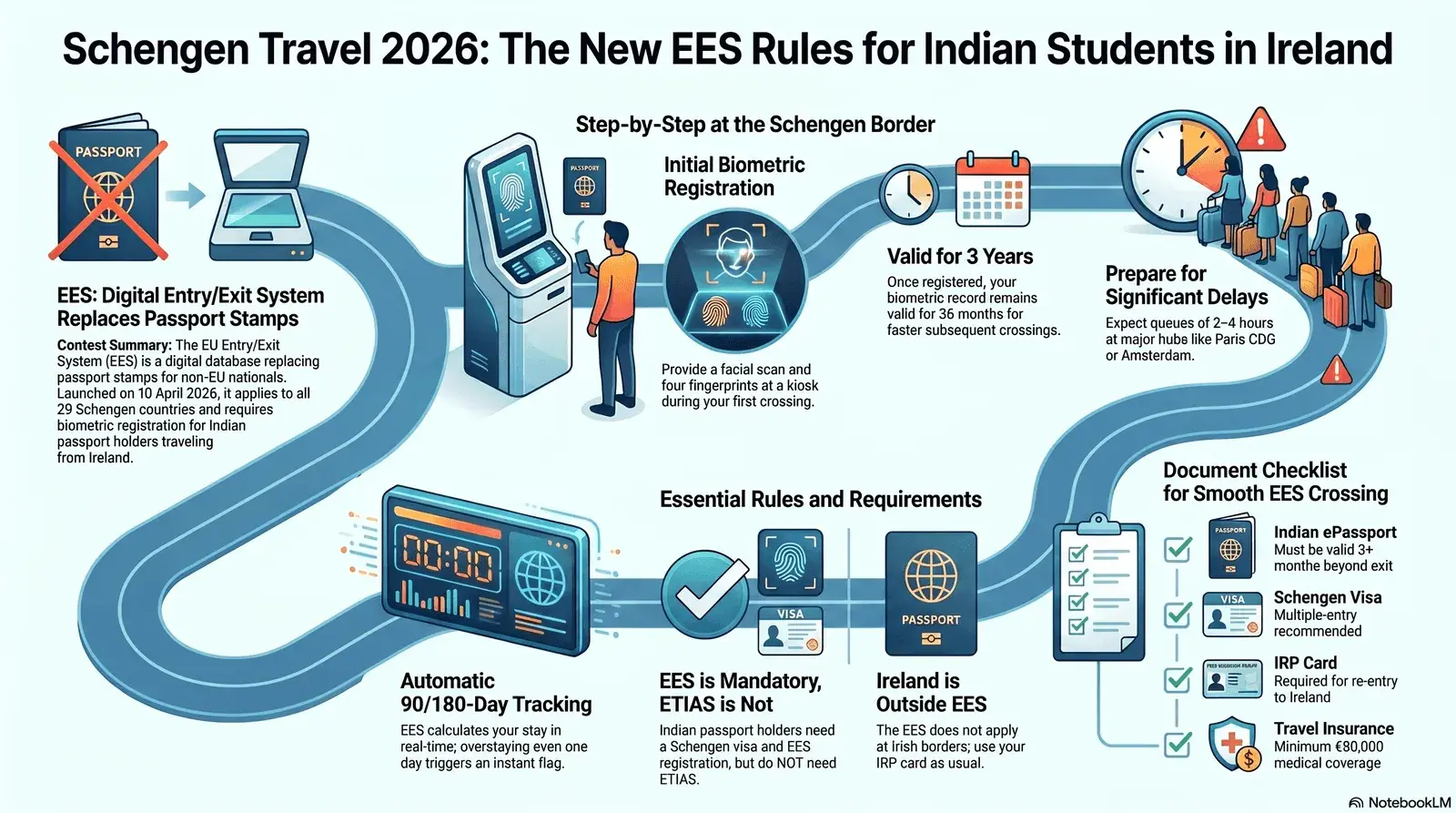
- EES is live now (10 April 2026): Every time you cross into the Schengen Area — from Dublin to Amsterdam, Paris, Barcelona or anywhere else — you must provide a facial scan and four fingerprints. No pre-registration required, but it slows down border queues significantly.
- The 90-day Schengen rule is now automatically enforced: EES tracks your days in real time. Both entry and exit days count. Overstaying by even one day flags you instantly at the border and can affect future visa applications.
- ETIAS does NOT apply to Indian passport holders: ETIAS (no confirmed launch date — the EU withdrew its 2026 target in July 2026) is only for visa-exempt nationalities. Because Indian citizens need a Schengen visa, ETIAS is irrelevant to you — but EES is mandatory for everyone, including visa holders.
EES launch date
10 April 2026 (full rollout across all 29 Schengen countries)
Applies to Indian students in Ireland?
Yes — every Schengen border crossing, visa or no visa
Does Ireland use EES?
No — Ireland is outside Schengen; Irish border is unaffected
Biometrics needed
Facial image + 4 fingerprints (once every 3 years)
In this guide
- What EES is and what went live on 10 April 2026
- What happens at the Schengen border: biometrics step by step
- How EES affects Stamp 2 and Stamp 1G holders travelling to Schengen
- The 90-day Schengen rule: how EES enforces it automatically
- What to bring to your first EES border crossing
- EES vs ETIAS: the difference explained for Indian passport holders
1. What EES Is and What Went Live on 10 April 2026
The EU Entry/Exit System (EES) is a digital border management database that replaces the old passport stamp. It became fully operational across all 29 Schengen countries on 10 April 2026, having been introduced gradually from 12 October 2025. Rather than an officer stamping your passport with an ink stamp, the system now creates a digital record every time a non-EU national crosses a Schengen external border — recording entry date, exit date, the border post where you crossed, and your biometric data.
The EES was mandated by the European Parliament and Council through Regulation (EU) 2017/2226. Its stated goals are to replace the unreliable passport stamp system (stamps fade, can be forged, and give no automatic count of days), to detect identity fraud, to flag overstays automatically, and to support law enforcement by giving border authorities a searchable record of who entered and when.
The 29 countries covered by EES are all the current Schengen states: Austria, Belgium, Croatia, Czech Republic, Denmark, Estonia, Finland, France, Germany, Greece, Hungary, Iceland, Italy, Latvia, Liechtenstein, Lithuania, Luxembourg, Malta, Netherlands, Norway, Poland, Portugal, Slovakia, Slovenia, Spain, Sweden, and Switzerland, plus Bulgaria and Romania which joined Schengen in full in 2024.
The European Commission's Migration and Home Affairs directorate confirmed the 10 April 2026 full operational date in late March 2026. Major international airports went live first (Paris CDG, Amsterdam Schiphol, Madrid Barajas, Frankfurt), with land borders and smaller ports of entry following over the subsequent weeks.
For Indian students in Ireland, the practical change is immediate and unavoidable. Every time you fly from Dublin to a Schengen country — whether for a semester break trip to Barcelona, a weekend in Amsterdam, or a conference in Berlin — you will go through EES when you land at the Schengen airport. And every time you leave that Schengen country to come back to Dublin, your exit is also registered.
2. What Happens at the Schengen Border: Biometrics Step by Step
At your first EES crossing, a border officer or automated kiosk collects a facial image and four fingerprints (index fingers of both hands plus two additional), links them to your passport chip data, and creates a permanent digital record in the central EES database. The entire biometric capture takes approximately 90 seconds at the kiosk itself, but queue times at busy airports can add 2–4 hours on top of that during summer 2026's peak travel season.
Here is exactly what happens at the border in sequence:
Step 1 — Passport scan: You place your passport (biometric chip-enabled) on the scanner. The kiosk or officer reads your personal data from the chip: name, date of birth, nationality, document number, and expiry date.
Step 2 — Facial image capture: A camera on the kiosk captures your facial image. This is matched against the photo on your passport chip and against any existing EES record.
Step 3 — Fingerprint capture: You place your fingers on the scanner. Four fingerprints are captured. Note: children under the age of 12 are exempt from fingerprinting but are still photographed. Children under 6 are entirely exempt from biometric registration.
Step 4 — Visa check: If you hold a Schengen visa (as Indian passport holders must), the system cross-checks your biometric data against the Visa Information System (VIS). Because your fingerprints were already taken when you applied for your Schengen visa, the EES does not store them again — it simply references the VIS record. The EU's official EES data page confirms this: biometric data already held in VIS is not duplicated in EES.
Step 5 — Entry logged: The system records your entry: date, time, border post, remaining Schengen days authorised. The officer's screen shows this information in real time. If everything is in order, you are admitted. If you have exceeded your 90 days, you are refused.
On exit: When you leave the Schengen Area (e.g. boarding your flight back to Dublin from Paris CDG), you go through passport control again and EES logs your exit. The system then calculates the total days used in the current 180-day window.
After your first EES registration, subsequent crossings are faster. The system recognises you from your biometric record, and the update process (logging a new entry or exit) takes less time than initial registration. Your biometric record remains valid in the EES database for three years. If you do not cross a Schengen border for three years, the record expires and you will need to re-register next time.
The EU's official Travel to Europe portal has also launched a mobile app that allows you to pre-register your passport data and facial image up to 72 hours before arrival, potentially reducing the time at the border kiosk. Pre-registration is optional but recommended if you are travelling through a historically busy airport.
On-the-Ground Experience: "I flew Dublin to Paris CDG on 14 April 2026 — four days after full EES rollout. The queue at CDG after landing took 2 hours 40 minutes. My passport and Schengen visa were fine, fingerprints went through, but there were only 8 kiosks open for non-EU passengers on a busy evening flight. I nearly missed my TGV train to Lyon. If you're connecting anywhere in Schengen with less than 3 hours, book a later connection." — Priya M., MSc Computer Science, University College Dublin, April 2026
3. How EES Affects Stamp 2 and Stamp 1G Holders Travelling to Schengen
EES applies to your Schengen crossings, not to your Irish immigration status. Your Stamp 2 or Stamp 1G permission is an Irish immigration stamp issued by the Irish Immigration Service Delivery and it has no legal effect at Schengen borders — those borders care about your Schengen visa and your EES record.
Here is how to think about the two separate systems:
| System | Issued by | Controls what | Applies where | Indian student action required |
|---|---|---|---|---|
| Stamp 2 / Stamp 1G | Irish Immigration Service | Right to live, study, work in Ireland | Ireland only | Renew before expiry; carry IRP card |
| Schengen Visa (C-type) | Embassy of Schengen country | Right to enter Schengen zone for up to 90 days | 29 Schengen countries | Apply before each trip (unless multiple-entry visa valid) |
| EES | EU (European Commission) | Digital record of each Schengen entry & exit | 29 Schengen countries' external borders | Register biometrics at first crossing; no separate application |
| Irish border re-entry | Irish Immigration | Right to re-enter Ireland | Irish ports of entry | Carry valid IRP card + passport; standard check, no EES |
A critical point: Ireland is not part of the Schengen Area and EES does not apply at Irish borders. When you land back in Dublin after a Schengen trip, you go through standard Irish immigration. The Irish officer checks your passport and your IRP card (Irish Residence Permit). They do not use EES. Citizens Information Ireland confirms Ireland maintains its own separate entry requirements outside the Schengen system.
For Stamp 1G holders, the picture is identical — EES is about your Schengen crossings, not your Irish immigration status. Whether you are a Stamp 2 student currently enrolled or a Stamp 1G graduate work permit holder, every time you cross into a Schengen country, EES applies.
One practical change EES brings for students with multiple-entry Schengen visas: previously, if you had an old visa and passport stamps from a previous trip, there was some margin for ambiguity about days used. With EES, every entry and exit is digitally timestamped and instantly visible to border officers. If you have, for example, spent 60 days in Europe across two trips in the past 180 days, the next border officer will see exactly 30 days remaining before you even hand over your passport.
4. The 90-Day Schengen Rule: How EES Enforces It Automatically
The 90/180-day rule means you may spend a maximum of 90 days in the Schengen Area within any rolling 180-day window. EES now calculates this automatically and in real time — there is zero ambiguity, zero margin for honest mistakes, and zero tolerance for overstays.
The calculation works as follows. On any given day you attempt to enter the Schengen Area, the system looks backwards at the last 180 days and counts how many days you have been physically present in any of the 29 Schengen countries. The count is across all countries collectively — a week in France plus a weekend in Germany plus three days in Italy all count toward the same 90-day allowance. Both the day you enter and the day you exit count as full days spent.
For Indian students in Ireland, the most common way to approach the limit is through repeated short trips during semester breaks and bank holidays. The table below illustrates how days add up:
| Trip | Dates (example) | Days used | Running total | Days remaining |
|---|---|---|---|---|
| Christmas break — Paris | 20 Dec – 2 Jan | 14 | 14 | 76 |
| Semester break — Barcelona | 14 Feb – 21 Feb | 8 | 22 | 68 |
| Easter — Rome + Florence | 1 Apr – 14 Apr | 14 | 36 | 54 |
| Summer trip — Germany + Netherlands | 1 Jun – 30 Jun | 30 | 66 | 24 |
| Late summer — Greece | 1 Aug – 31 Aug | 31 (but only 24 allowed) | OVERSTAY | REFUSED at border |
Note that in this scenario, the December days start dropping out of the 180-day window from 18 June onwards (180 days after 20 December). This is why the "rolling" nature of the window matters — days used early in the cycle gradually free up. Tools like the Schengen Calculator at SchengenTraveler.com let you input your travel history and see exactly how many days you have remaining.
Before EES, a traveller could theoretically dispute a border officer's manual day count. With EES, the digital record is considered definitive. If EES says you have used 90 days, you have used 90 days — the officer cannot override the system without escalating to senior officials. The practical advice: track your days yourself using a Schengen calculator, and always know your remaining days before you attempt to enter Schengen.
Overstaying your 90 days under EES has serious consequences. You can be immediately refused entry, held for questioning, deported, and your overstay is permanently recorded in the EES database — which border officers in all 29 Schengen countries can see. An overstay record makes future Schengen visa applications significantly harder to approve. The European Commission EES page confirms that the system is specifically designed to detect and flag overstays automatically.
5. What to Bring to Your First EES Border Crossing
For your first EES crossing, you need your valid biometric passport, your valid Schengen visa (either single- or multiple-entry), your Irish Residence Permit (IRP) card, and any travel documents the Schengen visa officer requested when they issued your visa (such as proof of accommodation, return ticket, or travel insurance).
The single most important document is your passport. It must be a biometric (ePassport) with a chip — identifiable by the small gold rectangle symbol on the front cover. EES kiosks read passport chip data electronically. If your passport chip is damaged or unreadable, you will be directed to a manual lane, which can take considerably longer.
Here is the full checklist for your first post-EES Schengen trip:
- Valid Indian biometric passport — valid for at least 3 months beyond your planned exit from Schengen
- Valid Schengen visa — single-entry for a one-off trip, multiple-entry if you travel to Schengen frequently (strongly recommended)
- IRP card (Irish Residence Permit) — shows you are legally resident in Ireland; useful context if questioned at the border
- Proof of accommodation — hotel booking confirmation or host letter for all nights of your stay
- Return or onward ticket — flight or train back to Dublin
- Travel insurance — with minimum €30,000 medical coverage (Schengen visa requirement)
- Proof of funds — bank statement or credit card; approximately €70–€100 per day is the unofficial guideline many member states apply
- University enrolment letter (recommended, not always mandatory) — explains your student status in Ireland if questioned about your ties to Ireland
Documents you do not need to bring for EES specifically: EES has no separate application form, no pre-registration certificate, and no fee. Registration happens automatically at the border kiosk when you scan your passport and biometrics for the first time.
One practical tip: before travelling, use the EU's official Travel to Europe app to optionally pre-register your passport data and a photo. This can reduce processing time at the kiosk, though the border officer will still verify your identity in person and may take fingerprints regardless. The app is available for both iOS and Android.
Allow significantly more time at the airport on your first EES trip. The EU and airline industry bodies recommend arriving 3 hours before international flights if travelling through a major Schengen airport. Airlines including Aer Lingus and Ryanair have issued reminders to passengers about EES processing times ahead of summer 2026. IATA has warned of potential 6-hour queues at peak times at the busiest airports. The airports with the longest reported queues in April–June 2026 are Paris CDG, Geneva, Barcelona El Prat, Madrid Barajas, and Amsterdam Schiphol.
6. EES vs ETIAS: The Difference Explained for Indian Passport Holders
EES and ETIAS are two completely separate EU systems, and only EES applies to Indian passport holders. EES (live since 10 April 2026) is a digital border-crossing record system that applies to everyone — visa holders and visa-exempt travellers alike. ETIAS (no confirmed launch date) is a travel authorisation for visa-exempt nationalities only, and because Indian citizens require a Schengen visa, ETIAS does not apply to you at all.
The confusion between EES and ETIAS is understandable — both are EU "Smart Borders" initiatives introduced under the same legislative programme, and both are being rolled out in 2026. The European Commission published a clear explainer on 28 April 2026 specifically addressing the difference. Here is a side-by-side breakdown:
| Feature | EES (Entry/Exit System) | ETIAS (Travel Authorisation) |
|---|---|---|
| Status (June 2026) | Live — fully operational since 10 Apr 2026 | Not yet live — no confirmed date (2026 target withdrawn July 2026) |
| Who it applies to | All non-EU/EEA nationals — regardless of visa status | Visa-exempt nationalities only (e.g. US, UK, Canadian citizens) |
| Does it apply to Indians? | Yes — mandatory for every Schengen crossing | No — Indians need a Schengen visa, not ETIAS |
| Application needed? | No — registration happens automatically at the border | Yes — online application, fee (€20), pre-travel |
| What it does | Records every entry & exit digitally; tracks 90-day limit | Pre-screens travellers for security/immigration risk before they travel |
| Replaces passport stamps? | Yes | No — separate from both stamps and EES |
| Fee | None | €20 per application (valid 3 years or until passport expires; raised from €7 in 2025) |
The official EU EES vs ETIAS explainer (January 2026) puts it plainly: "ETIAS conditions travel, while EES governs entry into and exit from the territory." Another way to think about it: ETIAS is the gate-check before you get to Europe; EES is the stamp-replacement system once you actually cross the border. Indians cannot use the ETIAS gate because the Schengen visa is their gate.
There is one scenario where ETIAS becomes relevant to an Indian student in the future: if India were ever added to the Schengen visa-free list (currently not the case and not anticipated in the near term), Indians would then need ETIAS instead of a Schengen visa. As of June 2026, this is not the position.
In summary: as an Indian student in Ireland in 2026, the only new EU border system you need to understand is EES — it is live, it is mandatory, and it affects every Schengen trip you take. ETIAS is a system for other nationalities that does not concern Indian passport holders.
Frequently Asked Questions
Does EES apply to Indian students living in Ireland on Stamp 2 or Stamp 1G?
Yes. EES applies to all non-EU/EEA nationals entering the Schengen Area, regardless of where they live. Indian students in Ireland who travel to France, Germany, Spain or any of the 29 Schengen states must register biometrics at the Schengen border under EES from 10 April 2026 onwards.
Does Ireland participate in EES?
No. Ireland is not part of the Schengen Area and EES does not apply at Irish borders. When you return from a Schengen trip to Ireland, you go through standard Irish immigration. EES only affects your crossings into and out of the 29 Schengen countries.
Do I need to pre-register for EES before I travel?
Registration is not mandatory in advance, but the EU's official Travel to Europe app lets you pre-register passport data and a facial image up to 72 hours before arrival to speed up the border process. Most travellers register for the first time at the border itself.
What is the difference between EES and ETIAS for Indian passport holders?
EES (live since 10 April 2026) is an automatic digital border registration system that records every entry and exit of non-EU nationals into the Schengen Area - no prior application needed. ETIAS (no confirmed launch date — the EU withdrew its 2026 target in July 2026) is a travel authorisation that must be applied for and paid for before travel. Crucially, ETIAS does NOT apply to Indian passport holders because Indians already require a Schengen visa; ETIAS is only for visa-exempt nationalities.
How does EES enforce the 90-day Schengen rule?
EES automatically calculates how many days you have spent in the Schengen Area over the previous 180-day rolling window. When you cross a Schengen border, the officer's system instantly shows your remaining days. Days in all 29 Schengen countries are counted collectively. Both the entry day and the exit day count as full days used.
How long does EES biometric registration take at the airport?
First-time registration takes approximately 90 seconds per traveller at the kiosk, but long queues at major airports such as Paris CDG, Barcelona and Geneva are causing total wait times of 2-4 hours during peak periods in summer 2026. Budget at least 3-4 hours before your international flight if travelling through a major Schengen hub.
Planning your Schengen semester break? Compare flight fares before you book.
Now that you know what EES means for your next trip, make sure you're also getting the best fare. Dublin to Paris, Barcelona, Amsterdam and all major Schengen cities — compare live fares and check our monthly fare calendar for the cheapest windows.
All information in this article is based on publicly available official sources as of June 2026, including the European Commission EES page, the EU Travel to Europe portal, and the Irish Immigration Service. EES implementation details and border processing times continue to evolve. Always verify current visa, immigration, and border requirements directly with the relevant embassy, Irish Immigration Service, and the official EU EES documentation before travel. MyFlightOffers is not affiliated with any organisation mentioned. This article does not constitute legal, immigration, or travel advice.
- GUIDE Study in Ireland 2026 — Visa, Housing & IRP Complete Guide — everything from your student visa application to registering with immigration on arrival
- Ireland Student Survival Guide 2026 — Hidden Subsidies & Discounts — the supports most students miss, from transport cards to GP visit cards
- The Indian Student's Money Survival Guide in Ireland — banking, forex cards, sending money home, and managing your budget in euros
- Student Stress-Free Travel Guide 2026 — booking cheap flights from Dublin, baggage tips, and maximising semester breaks