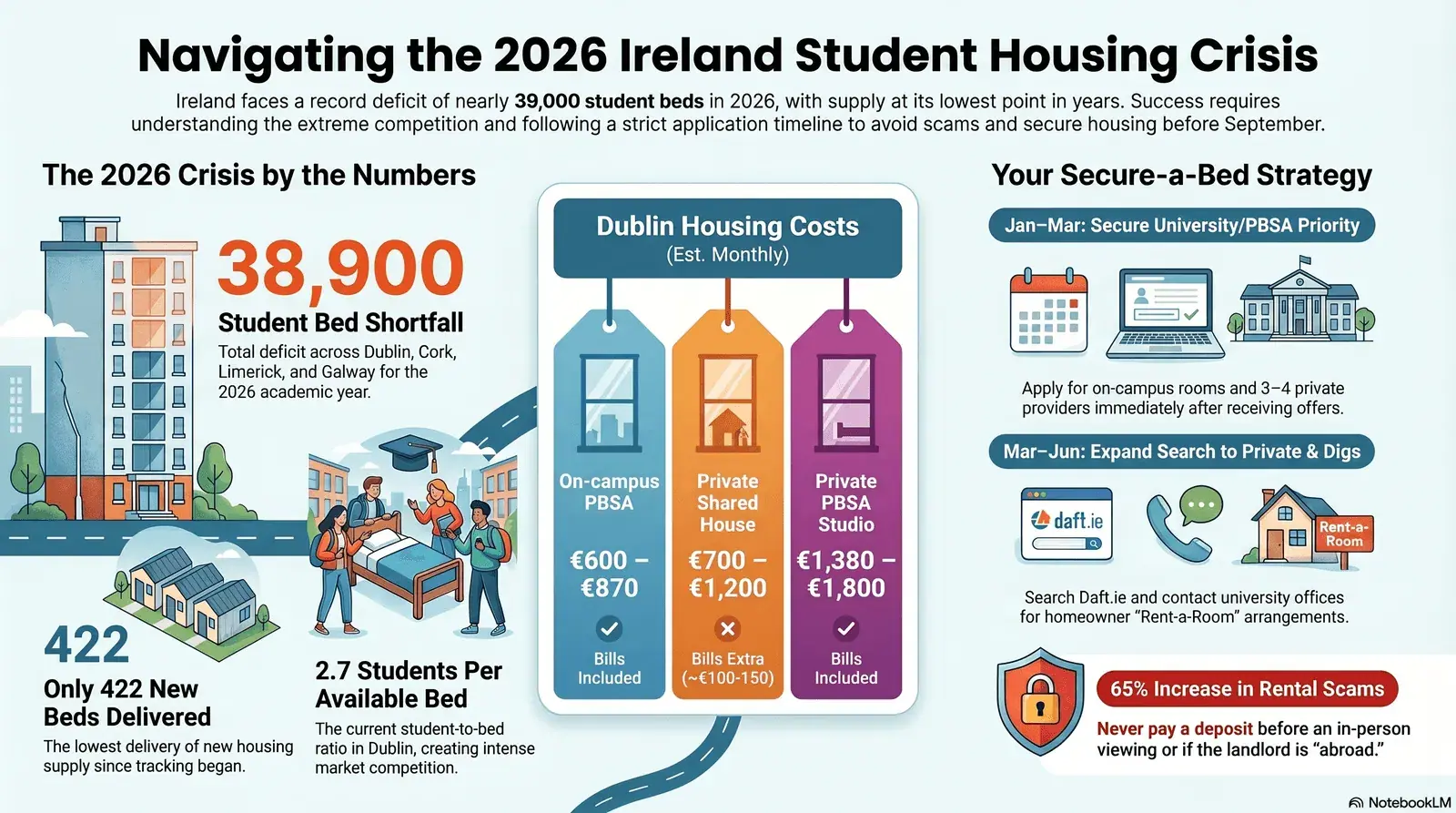
- The gap is enormous: Ireland has a deficit of 38,900 student beds in 2026, with just 422 new beds expected to be delivered this academic year — start your search the moment you receive your offer letter.
- PBSA fills up by March: Purpose-built student accommodation providers open applications in January and most popular options are gone before April; late applicants are left with only private rental, digs, or homestay.
- Never pay a deposit remotely: Rental scams targeting international students have surged 65% since 2019 — always view a property in person and verify the landlord via the RTB register before transferring any money.
Bed Deficit (2026)
38,900 across Dublin, Cork, Limerick & Galway
New Beds Projected (2026)
Only 422 — the lowest delivery year since tracking began
Cheapest Option
Digs (rent-a-room) — €600–€900/month incl. meals
Average Dublin Room Rent
~€770/month (shared house); €1,100–€1,800/month (PBSA)
In this guide
1. How Bad Is Ireland's Student Accommodation Shortage in 2026?
Ireland's student accommodation shortage in 2026 is the most severe on record, with a deficit of at least 38,900 bed spaces across Dublin, Cork, Limerick, and Galway — and just 422 new beds projected to be delivered this year. At the end of 2025, total purpose-built student accommodation (PBSA) stock stood at approximately 47,600 beds nationally, according to research published by Cushman & Wakefield and reported by The Irish Times. Against the total student population requiring accommodation, the shortfall reaches 53,000 beds if a tighter commutable-distance definition is used for Dublin.
Dublin faces the sharpest pressure. With a student-to-available-bed ratio of 2.7, roughly two out of three students who need accommodation in Dublin simply cannot be housed in PBSA at all. The city alone accounts for an estimated 34,300 of the national shortfall, with Galway adding another 10,800 beds to the gap. Only 657 student beds were delivered across all of Ireland in 2025, and 2026 looks even worse with just 422 projected completions.
In March 2026, the Government announced a National Student Accommodation Strategy 2026–2035 targeting delivery of 42,000 new beds over nine years through a mix of on-campus development, PBSA incentives, and a revamped Rent-a-Room digs scheme. Roughly 25% of the new supply is expected to come from homeowners offering digs under the Rent-a-Room scheme. However, none of this helps students arriving in September 2026 — the pipeline takes years to translate into actual beds.
What this means practically: if you are an international student with a September 2026 start date and have not yet confirmed accommodation, you are not alone — but you need to act now. The sections below map every available option with honest cost ranges, realistic timelines, and the red flags that cost students thousands of euros in lost deposits every year.
2. When to Start Looking — Month-by-Month Timeline From Acceptance
The single most important variable in Ireland's 2026 accommodation market is timing: students who begin their search within two weeks of receiving an offer letter secure housing; students who wait until April or May frequently cannot. Here is the realistic calendar for a September 2026 intake student.
| Month | Action | Why it matters |
|---|---|---|
| Jan–Feb 2026 | Apply for on-campus university accommodation immediately after offer letter | On-campus lists fill in weeks; late applicants get waitlisted |
| Jan–Mar 2026 | Apply to 3–4 PBSA providers simultaneously | Popular PBSA rooms (ensuites, studios) sell out by March |
| Mar–Apr 2026 | Expand search to private rental on Daft.ie and Rent.ie | Private landlords list September rooms from March onwards |
| Apr–May 2026 | Contact university accommodation office for digs listings; explore homestay platforms | Digs providers are often not on main portals — direct outreach works better |
| May–Jun 2026 | Finalise and sign lease or licence agreement; pay deposit (in-person only) | Confirm before buying your flight to avoid arriving with no address |
| Jul–Aug 2026 | If still searching: co-living, short-term lets, or plan a two-week hostel buffer on arrival | Last-resort options need to be booked early too — hostels fill in August |
On-the-Ground Reality: "I received my UCD offer in January and applied for on-campus accommodation the same day. I was still waitlisted. I ended up in a PBSA studio in Phibsborough for €1,350 a month — not what I budgeted, but at least I had somewhere to sleep on day one." — Priya M., MSc Computer Science, UCD, September 2025 intake
The lesson is clear: in Ireland's 2026 market, applying early is not a strategy — it is a necessity. Every week of delay narrows your options and pushes you toward more expensive or less convenient alternatives.
3. Purpose-Built Student Accommodation (PBSA) — How to Apply and What It Costs
Purpose-built student accommodation (PBSA) is the most structured, safest, and predictable option for international students in Ireland — but it is also the most expensive and the first to run out. PBSA blocks are purpose-designed with ensuite rooms, shared social kitchens, study rooms, gyms, laundry facilities, and 24/7 staffed reception. All bills (electricity, internet, heating) are typically included in a single weekly fee, which simplifies budgeting considerably.
How to apply for PBSA
Apply directly through the PBSA provider's website as soon as you have your offer letter — do not wait for your CAO or IUA offer to be fully confirmed. Most providers accept conditional bookings and will refund your holding deposit if you do not ultimately enrol. Major providers operating in Ireland in 2026 include Yugo, Aparto, Uninest, Ires Resi, and campus-specific blocks run by individual universities.
University-run on-campus accommodation should always be your first application. Trinity College Dublin, UCD, UCC, DCU, NUI Galway (University of Galway), and TU Dublin all offer on-campus rooms that are generally cheaper than private PBSA. Check each university's accommodation portal from January onwards — applications typically open in February or March for September intake. UCD Residences, for example, opens PhD student bookings from 1 June and randomises CAO applicants in late August.
What does PBSA cost in Ireland in 2026?
| Room Type | Weekly Cost | Monthly Equivalent | What's included |
|---|---|---|---|
| University on-campus (shared room) | €140–€200 | €600–€870 | Bills, basic furnishings |
| Private PBSA (ensuite) | €250–€325 | €1,080–€1,400 | All bills, gym, laundry, security |
| Private PBSA (studio) | €320–€420 | €1,380–€1,800 | All bills, private kitchen, gym |
The figures above are based on 38–42 week academic year contracts. PBSA providers in Ireland rarely offer short-stay contracts under 38 weeks for student rooms — this is important if your course runs fewer than 38 weeks, as you may be paying for accommodation you do not use. Always confirm contract length and cancellation terms before paying a holding deposit.
Under the rental law changes effective 1 March 2026, a national system of rent control now applies to all new tenancies in Ireland — including new student-specific accommodation (SSA). For PBSA where construction commenced after 10 June 2025, annual increases can track CPI with no 2% cap. SSA-specific rent resets to market rate are only permitted once every three years from 1 March 2029. The key point for you: your deposit cannot exceed one month's rent, and you must receive a minimum of 28 days' notice to end your tenancy.
4. Private Rental — Daft.ie & Rent.ie Strategy and Scam Avoidance
Private rental — renting a room or apartment from a private landlord through platforms like Daft.ie or Rent.ie — is the second-most common route for students, but it carries the highest risk of scams and the greatest variability in price and quality.
How to use Daft.ie and Rent.ie effectively
Set up saved searches with email alerts on both platforms from March 2026 onwards. Daft.ie's student section allows filtering by university proximity and monthly price range. Rent.ie organises its student accommodation listings by university or college, which makes it easy to narrow by institution. When a new listing appears, message within the first two hours — desirable rooms receive dozens of enquiries per day.
Average private room rents in Dublin in 2026 sit at approximately €770 per month for a shared house room, rising to €800–€1,200 per month in central areas near Trinity, UCD, or DCU. The national average room rent near an Irish college is €565 per month. Galway, Cork, and Limerick remain more affordable, typically €500–€750 per month for a shared room.
Rental scam warning — how to protect yourself
An Garda Síochána has reported a 65% increase in accommodation scams since 2019, and international students are disproportionately targeted because they cannot view properties in person before arriving. Scammers typically follow one of three patterns: (1) claiming to be abroad and unable to show the property, asking for a deposit to "secure" the room; (2) showing multiple prospective tenants around the same property, collecting deposits from several people and disappearing; or (3) appearing legitimate until the student arrives to find the keys do not work and the landlord is unreachable.
- Landlord says they are "abroad" or "in another country" and cannot meet you in person
- Rent is significantly below the market average for the area (€400/month Dublin — too good to be true)
- Listing was recently copied from another site — reverse image search all property photos
- Requests deposit or first month's rent before any in-person viewing or key exchange
- Address in messages does not match the address on the original listing
- Emails or messages contain grammatical errors or feel templated
- Landlord is not registered with the Residential Tenancies Board (RTB)
The safest protocol: insist on an in-person viewing, test the front door key yourself before handing over any money, and verify the landlord's name against the RTB register at rtb.ie. An unregistered tenancy is not just a legal problem for the landlord — it means you have fewer protections if a dispute arises. Threshold, Ireland's housing charity, offers a free advice line (1800 454 454) and can help you review a lease before signing.
If you must search remotely before arriving, use a trusted contact already in Ireland — a family member, a fellow student, or a verified contact from your college's international office — to conduct a physical viewing on your behalf. Never pay more than a holding deposit (typically one to two weeks' rent) without a signed lease in hand.
5. Digs, Homestay, and Co-Living as Backup Options
If PBSA is fully booked and private rentals in your budget are scarce, digs, homestays, and co-living offer viable — and in some ways superior — alternatives that many international students overlook.
What are digs in Ireland?
Digs are a traditional Irish arrangement where a homeowner rents a furnished room in their own home, often including breakfast and an evening meal — and they are one of the most affordable options available in Ireland in 2026. Under Ireland's Rent-a-Room Relief scheme, homeowners can earn up to €14,000 per year tax-free by renting a room in their principal residence — a powerful incentive that has led the government to actively promote digs as part of the National Student Accommodation Strategy 2026–2035, with a target of 25% of new supply coming from this route.
Typical digs costs in Dublin in 2026 run from €600 to €900 per month including meals, making them substantially cheaper than PBSA or even many shared houses once you account for food costs. The arrangement is governed by a licence agreement (not a lease), and the RTB does not regulate digs — so there is less legal protection than a standard tenancy. This is offset by the fact that you are living with the homeowner directly, which removes the scam risk and provides a natural support system for new arrivals.
Find digs through your university's accommodation office (most keep internal digs registers), Rent.ie's digs listings, Daft.ie, or community Facebook groups for Irish students. Always use a written licence agreement — Threshold provides a free template.
Homestay
Homestay is similar to digs — you live with a local family — but the arrangement is typically brokered through a specialist agency that vets both homeowners and students, providing an additional layer of quality assurance. Agencies such as ISA Accommodation and Homestay.com match students with approved host families in Dublin and other Irish cities. Costs range from €20 to €35 per night for short-stay, or €700–€950 per month for academic-year arrangements including meals.
Homestay is particularly well-suited to students in their first semester in Ireland — the family provides an immediate support network, helps with local orientation, and removes the isolation that many international students experience in their first weeks. The main limitation is that host families are primarily located in suburban residential areas, which may involve a daily commute of 30–60 minutes by bus or DART.
Co-living
Co-living spaces — professionally managed buildings where residents have private rooms but share common areas, kitchens, and coworking lounges — have grown in Dublin and Cork since 2022 and offer a middle ground between PBSA and private rental in terms of cost and community. Providers such as CollegeCribs.ie and platforms like uhomes.com list co-living options. Costs typically fall in the €900–€1,400 per month range in Dublin with bills included. Many co-living operators offer flexible 6-month rather than 12-month contracts, which suits students on academic-year courses.
| Option | Monthly Cost (Dublin) | Bills Included? | Best For | Main Risk |
|---|---|---|---|---|
| On-campus PBSA | €600–€870 | Yes | First-year students wanting campus life | Runs out by March; limited availability |
| Private PBSA (ensuite) | €1,080–€1,400 | Yes | Students prioritising security & amenities | High cost; 38-week minimum contracts |
| Private rental (shared house) | €700–€1,200 | No (add €100–€150) | Students wanting independence & flexibility | Scam risk; competitive market |
| Digs | €600–€900 (incl. meals) | Partial (incl. meals) | Budget-conscious; new arrivals | Less legal protection; less privacy |
| Homestay | €700–€950 (incl. meals) | Yes (agency managed) | First semester; language learners | Suburban location; commute required |
| Co-living | €900–€1,400 | Yes | Postgrads; students wanting community | Less student-specific; variable quality |
6. What to Do If You Arrive in Ireland Without Accommodation
If you arrive in Ireland for September intake without confirmed long-term accommodation, do not panic — but act immediately on the steps below, in this order. Given the scale of the 2026 shortage, this situation is more common than universities officially acknowledge, and there are structured resources available.
Step 1: Contact your university accommodation office on day one
Every major Irish university maintains an emergency accommodation list and short-term housing referral system specifically for students who arrive without confirmed housing. TU Dublin runs a free Studentpad search engine for students to find accommodation near campus. UCD operates AccommodationPad, which in 2025 featured 153 properties. NUI Galway, UCC, and DCU all maintain similar internal registers that are not publicly listed — you only get access by registering with the accommodation office in person.
Step 2: Book a hostel or budget hotel for your first two weeks
Do not assume you will find long-term accommodation in your first 48 hours — budget for a two-week hostel buffer that buys you time to search properly without pressure. Dublin hostels in August–September 2026 cost approximately €25–€50 per night for a dorm bed. Book this before you travel. Arriving in Ireland with no short-term address at all creates compounding stress that makes the accommodation search far harder.
Step 3: Apply to the Student Assistance Fund
The Student Assistance Fund (SAF) is an emergency financial support programme administered through your college's Access Office — if your housing situation is causing financial hardship, you may be eligible for a grant to cover emergency accommodation costs. In the 2024/25 academic year, €440,000 was allocated to the SAF specifically for students in housing difficulty. Contact your college Access Office for eligibility criteria and to make an application.
Step 4: Engage Threshold's housing advice service
Threshold is Ireland's national housing charity and provides free, expert advice to anyone experiencing housing difficulty — including students. Their freephone advice line (1800 454 454) is open Monday–Friday and their advisors can help you understand your rights, review any lease or licence you are being asked to sign, and point you towards local authority emergency supports if needed.
Under Irish immigration law, all non-EEA students must register with the Irish Naturalisation and Immigration Service (INIS) and obtain an Irish Residence Permit (IRP) within 90 days of arrival. Registration requires a fixed Irish address. A hostel address is generally accepted for initial registration, but you will need to update your registered address once you find permanent accommodation. Contact Irish Immigration for current registration requirements.
Practical tips if you are still searching after arrival
Set Daft.ie and Rent.ie alerts to "instant" so you receive new listings in real time. Go to viewings within the same day — properties in Dublin are sometimes offered and filled within hours. Use your university's student union noticeboard and Facebook groups (search "[University Name] accommodation 2026") for peer-to-peer sublets that never make it to commercial platforms. Ask your course department if any continuing students are looking for housemates before the semester starts.
Frequently Asked Questions
How bad is Ireland's student accommodation shortage in 2026?
As of early 2026, Ireland faces a deficit of 38,900 student bed spaces across Dublin, Cork, Limerick and Galway. Only 422 new beds are projected to be delivered in 2026. Dublin has the most acute pressure with a student-to-bed ratio of 2.7.
When should I start looking for student accommodation in Ireland for September 2026?
You should start as soon as you receive your offer letter - ideally by January or February 2026 at the latest for September 2026 intake. University on-campus accommodation typically opens applications in spring; PBSA providers open in January-March. Private rental searches should begin no later than April.
What is PBSA and how do I apply?
PBSA stands for Purpose-Built Student Accommodation - purpose-designed blocks with ensuite rooms, shared kitchens, gyms, and 24/7 security. Major providers in Ireland include Yugo, Aparto, Uninest and ires. You apply directly through their websites or via your university's accommodation office. Apply as early as January for September intake.
What should I do if I arrive in Ireland without accommodation?
Contact your university's accommodation office immediately - most have emergency housing lists, accommodation pads (like UCD's AccommodationPad or TU Dublin's Studentpad), and emergency Student Assistance Fund grants. Book a short-stay hostel or Airbnb for your first 1-2 weeks while you search. Never pay a deposit remotely before viewing a property in person.
Flying to Ireland for September 2026? Compare live fares first.
Once your accommodation is confirmed, lock in your flight. India–Dublin fares via Emirates, Qatar Airways, and Etihad rise sharply after June — check the fare calendar now and set a price alert.
- NEW Ireland Rental Scams 2026: How International Students Stay Safe — RTB verification, ghost listing detection, and the step-by-step landlord check before you pay a deposit
- Study in Ireland 2026 — Visa, Housing & IRP Complete Guide — end-to-end guide from student visa application to collecting your IRP card on arrival
- The Indian Student's Money Survival Guide in Ireland — bank accounts, sending money home, tax credits, and avoiding forex fees from Day 1
- Ireland Banking Guide for International Students 2026 — AIB, Bank of Ireland, N26, Revolut — which account to open first and what documents you need
- Tenant Rights for Students in Ireland 2026: RTB, Deposits, Rent Caps & Eviction Rules — after you secure accommodation, know your legal rights: the 2% national rent cap, deposit rules, notice periods, and how to take your landlord to the RTB
- Bringing Your Spouse and Family to Ireland as an Indian Student or Graduate (2026 Guide) — Can Indian students on Stamp 2 or Stamp 1G bring a spouse to Ireland? 2026 family reunification rules, income thresholds, visa steps and work rights.
All information in this article is based on publicly available official sources as of June 2026, including The Irish Times, Cushman & Wakefield Ireland, RTB, Citizens Information, and the Irish Government. Rent figures are indicative ranges drawn from publicly available market data. Accommodation availability, pricing, and legislation change frequently — always verify current information directly with your university accommodation office, the provider, or an official Irish government source. MyFlightOffers is not affiliated with any organisation mentioned. This article does not constitute financial, tax, legal, or immigration advice.