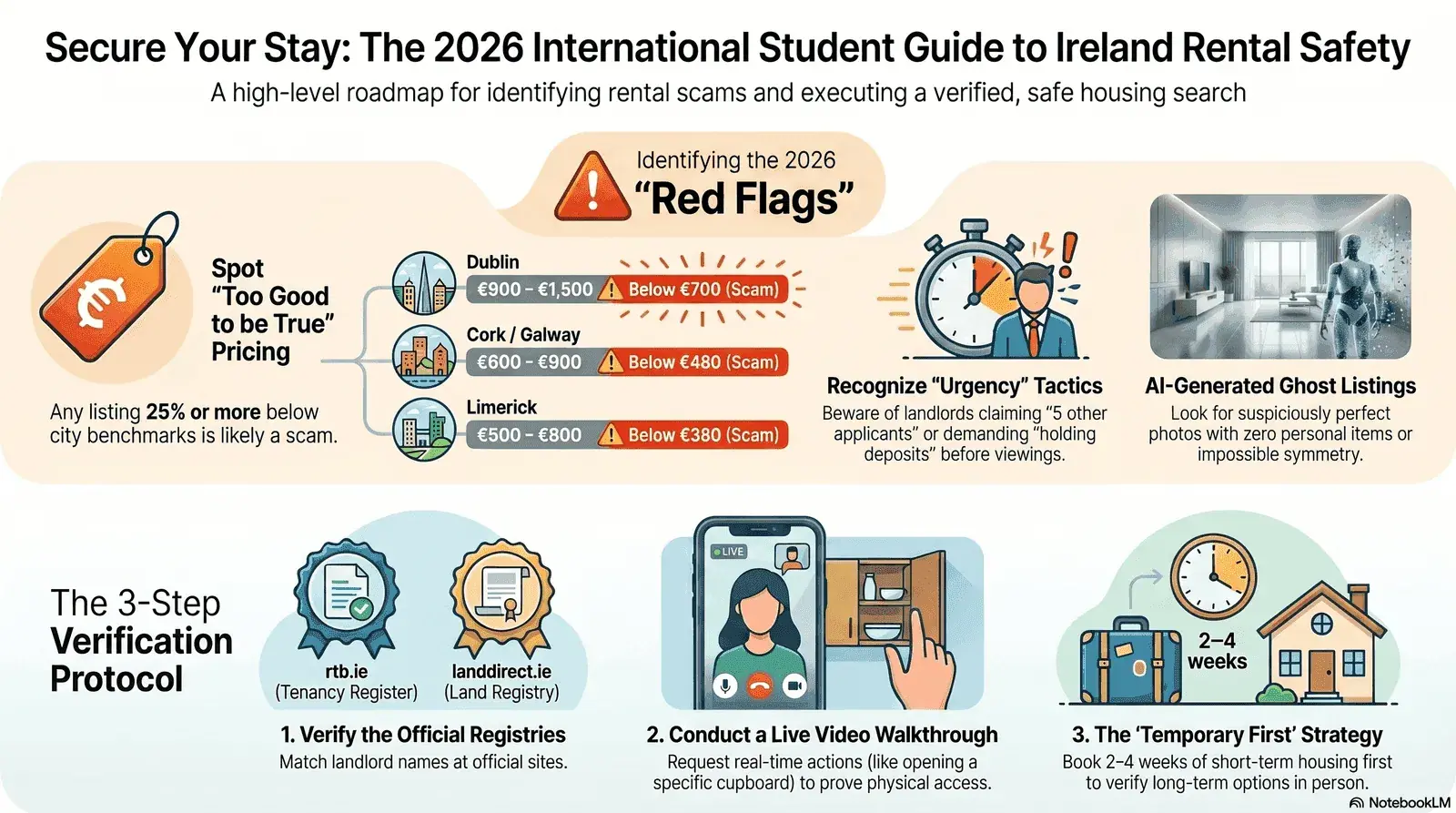
- Never wire a deposit before viewing in person — scammers target students searching from abroad; verify every landlord through the RTB (Residential Tenancies Board) at rtb.ie and never send money via international transfer for a property you have not physically entered.
- Any listing significantly below market rent is almost certainly a scam — Dublin 1-bed median rent is €2,200+/month in 2026; a "€800/month in Dublin 2" listing is bait, not a deal.
- Use only verified platforms: Daft.ie, Myhome.ie, and your university's accommodation office; avoid Facebook Marketplace for deposits until you have verified ownership via the Land Registry (landdirectaccess.ie).
🏠 Market Reality
Severe shortage in Dublin, Cork & Galway
Students are the single most-targeted group by scammers
pre-arrival
⚠ Top 2026 Threat
AI-generated ghost listings
Indistinguishable from real listings without RTB + Land
Registry checks
✅ Verification Tools
rtb.ie + landdirect.ie
Two official Irish registries confirm every legitimate
tenancy
🛡 Safe Strategy
Book temp accommodation first
2–4 weeks in PBSA or hostel, then view long-term options in
person
10 sections covered in this guide
- Why 2026 is particularly dangerous for student renters
- The three scam types you must understand
- Red flags in 2026 ghost listings
- How to spot a fake lease agreement
- Verify the property and landlord — step-by-step
- Shadow sublets explained
- Safe payment rules — never break these
- Pre-arrival safety checklist
- What to do if you are targeted or scammed
- The no-risk arrival strategy for 2026
🛡️ Rental Listing Risk Index Scorer
Check a potential Irish rental listing for common scam indicators to calculate its safety and risk level.
Why 2026 Is Particularly Dangerous for International Student Renters
The 2026 Irish rental market combines a structural housing shortage with AI-generated scams sophisticated enough to fool experienced tenants — and international students searching from 5,000 kilometres away are the most exposed group. Understanding why the risk is elevated this year is the first step in protecting yourself.
Every September, a wave of international arrivals floods the same small pool of shared houses in cities where rental vacancy rates are critically low. Scammers monitor this cycle precisely. They begin placing fraudulent listings in February and March, targeting students finalising visa applications and desperately trying to secure accommodation before landing.
The 90 to 180 days before you land in Ireland is when your risk is highest. You cannot physically view properties, you are under deadline pressure, and scammers design their operations around this exact window — offering the "perfect" listing at a suspiciously good price with one condition: send the holding deposit before someone else takes it. AI image tools now produce apartment photos indistinguishable from real photography, and language models generate professional lease agreements in minutes.
The Three Scam Types You Must Understand Before Searching
There are three primary rental scam structures targeting Irish housing applicants in 2026: ghost listings (non-existent properties), shadow sublets (unauthorised subleasing), and deposit-first traps (upfront payment for a property you will never occupy). Each operates differently and requires different detection methods.
| Scam Type | How It Works | Primary Detection Method |
|---|---|---|
| Ghost Listing | Property does not exist. Photos are AI-generated or stolen from legitimate listings elsewhere. | Reverse image search + Eircode validation on Google Maps |
| Shadow Sublet | Real property, but advertised by an existing tenant who has no legal right to sublet. Deposit collected, landlord evicts you on arrival. | Land Registry check at landdirect.ie to match registered owner |
| Deposit-First Trap | Real or plausible-looking listing. Scammer collects deposit and disappears. Property belongs to someone else entirely. | RTB register verification + live video walkthrough before any payment |
Red Flags in 2026 Ghost Listings
A genuine Irish rental listing will appear on a verified platform, be priced within current market rates, and offer live video viewing without hesitation. Any departure from these three characteristics demands immediate caution before you share personal information or financial details.
2026 Benchmark Rents: Know What Is Realistic
The single most reliable red flag is pricing that is significantly below the current market. Use these 2026 ranges as your baseline filter:
| City | Shared Room (Realistic Range) | Red Flag Price (Too Cheap) | Private Studio (Realistic) |
|---|---|---|---|
| Dublin | €900 – €1,500 / month | Below €700 | €1,400 – €2,200 |
| Cork | €600 – €900 / month | Below €480 | €1,000 – €1,600 |
| Galway | €600 – €900 / month | Below €480 | €1,000 – €1,500 |
| Limerick | €500 – €800 / month | Below €380 | €850 – €1,300 |
A listing 25% or more below these ranges is not a bargain — it is almost certainly a scam. Scammers price listings attractively to generate volume enquiries and urgency from students who believe they have found a rare deal.
Platform Trust Hierarchy: Where to Search
Not all listing platforms carry equal risk. Use this structure to guide your search strategy:
daft.ie, rent.ie, myhome.ie, your university's official accommodation portal, PBSA operator websites (Aparto, Uninest, etc.)
Facebook Groups (must RTB verify), SpareRoom.ie, Airbnb short-term. All require full verification before payment.
Craigslist, WhatsApp-only listings, unsolicited emails or DMs, listings shared in unverified student group chats.
Classic Urgency Red Flags to Recognise
- "I have 5 other applicants" — engineering artificial competition to pressure a fast payment decision
- "Send a €200 holding deposit within 24 hours" — any pre-viewing payment request is a scam signal
- "I'm currently abroad but my agent will handle the viewing" — absent landlord is a classic scam pattern
- "No viewing until after the holding deposit" — legitimate landlords always allow viewing before payment
- Unusually perfect photos with no personal items — AI-generated or stock images used to misrepresent properties
How to Spot a Fake Lease Agreement in 2026
A legitimate Irish tenancy agreement must reference the Residential Tenancies Act 2004, include the landlord's full legal name and address, provide or commit to provide an RTB registration number, and cannot contain clauses that override your statutory tenant rights. AI-generated lease agreements in 2026 look professionally formatted but consistently miss or misrepresent these critical elements.
What Every Legitimate Irish Tenancy Agreement Must Contain
- Landlord's full legal name and correspondence address (not just a mobile number)
- Full property address including Eircode
- Tenancy start date and duration (fixed-term or periodic)
- Monthly rent amount and payment method (bank transfer, standing order, etc.)
- Deposit amount — should not exceed one month's rent per RTB guidance
- Notice periods for both parties — minimum 28 days for tenancies under 6 months under the Residential Tenancies Act 2004
- Reference to the Residential Tenancies Act 2004 — by name, not a vague "applicable Irish law"
- RTB registration number, or a specific written commitment to register the tenancy within one month of commencement
Fraudulent lease agreements in 2026 are often flawlessly formatted — professional fonts, correct paragraph structure, even fake "witnessed by a solicitor" clauses. The tells are in the details: landlord addresses that resolve to non-residential buildings on Google Maps; RTB reference numbers that do not match any registration on rtb.ie; notice period clauses that give only 7 days (illegal for most tenancies); and "as-is" possession clauses that waive your right to a habitable property. A real solicitor-reviewed agreement costs money to produce — scammers use language models that create convincing structure but cannot replicate accurate legal compliance.
Verify the Property and Landlord — Step-by-Step
The non-negotiable verification steps for any Irish rental are: checking the property's rental history on the Residential Tenancies Board (RTB) register, confirming legal property ownership via the Land Registry at landdirect.ie, conducting a live real-time video tour, and requesting a lease review via Threshold before any money transfers. These validation measures eliminate the vast majority of scams.
-
RTB Rental History Check —
rtb.ie
Check the public RTB tenancy register to verify if the property has a legitimate rental history. Note that the public register only displays historically and currently registered tenancies, not the names of prospective landlords or vacant properties looking for tenants. You cannot simply type a stranger's name into the public RTB search tool to prove they are a legitimate landlord for a vacant room. However, a complete absence of any rental history on a known rental property can be a warning sign. -
Land Registry Check —
landdirect.ie
For true ownership confirmation, use landdirect.ie (the official Land Registry portal) to search by the property's Eircode or full address (requires a nominal statutory fee of €5). The digital folio shows the actual legal registered owner. That name must match the person claiming to be your landlord. Discrepancies are a major warning sign, and any reluctance to allow you to check this is a clear red flag. -
Eircode Validation — eircode.ie
Confirm the Eircode resolves to the correct address at eircode.ie, then cross-check on Google Maps Street View. If the code resolves to a vacant lot, commercial building, or a different address entirely, do not proceed. -
Reverse Image Search on Listing Photos
Drag listing photos into Google Images or TinEye (tineye.com). If images appear on foreign property sites, other Irish listings, or stock photo libraries, the listing is fake. AI-generated photos show impossible symmetry, perfect lighting, and zero personal items. -
Live Video Walkthrough — Non-Negotiable
Request a live WhatsApp or Zoom tour with specific, real-time requests: "Open the second kitchen cupboard," "Show the view from the living room." These requests cannot be faked by someone without physical access. A pre-recorded tour is not sufficient. -
Landlord Identity Verification
Request a government-issued photo ID and cross-reference the full name against the Land Registry folio and RTB registration. If the landlord uses a letting agent, verify the agent is licensed at psr.ie (Property Services Regulatory Authority). -
Official Lease Review via Threshold
Before signing any tenancy agreement or transferring funds, send your draft lease to Threshold (threshold.ie), Ireland's national housing charity. They provide a free, professional lease review service for students to ensure the tenancy terms are legally compliant and protect you against fraudulent terms.
Shadow Sublets — The Hidden 2026 Risk Explained
A shadow sublet occurs when a current tenant illegally advertises and rents a property as if they were the landlord, collects a deposit from a new "tenant," and leaves the new tenant with no legal right to occupy the property. Unlike a ghost listing, the property is real — making shadow sublets harder to detect and emotionally more devastating to discover on arrival.
In a shadow sublet, the person advertising the property is living there legitimately as a tenant. They may hold a valid lease and know the property well, which is why they can answer detailed questions convincingly. Their motivation varies: they may have already found a new place to live, intend to move out quietly, and pocket your deposit before the actual landlord ever knows. In more aggressive versions, they continue living in the property and deny any arrangement when you arrive.
The following responses, taken together, suggest you may be dealing with an unauthorised sublet rather than the registered landlord or an authorised agent: evasiveness about showing a current lease or ownership documentation; inability to answer detailed questions about building management (who to call for maintenance, how refuse collection works, where the fuse box is); reluctance to allow a Land Registry check; hesitation when asked directly "Is this your property or are you the registered tenant?" A legitimate landlord or licensed letting agent will answer all of these questions without hesitation.
Safe Payment Rules — Never Break These
Never transfer any money — deposit or advance rent — to a landlord you have not verified through RTB and Land Registry checks, and never use untraceable payment methods such as cryptocurrency, gift cards, or international wire transfers from a foreign bank account to an unverified Irish recipient.
- Pay only via traceable bank transfer within Ireland (SEPA transfer from an Irish bank account after you have arrived and opened an account). This creates a paper trail that supports bank dispute resolution.
- Maximum deposit is one month's rent per RTB guidance. The standard upfront cost is deposit (1 month) + first month's rent in advance = 2 months' total. Any request above this is a red flag.
- Demand a written, signed receipt immediately upon paying the deposit. Irish law requires landlords to issue a rent book or equivalent documentation. A refusal to provide a receipt is illegal and a serious warning sign.
- Never pay via cryptocurrency, PayPal Friends & Family, gift cards, or WhatsApp payment links. These methods are untraceable, irreversible, and are used exclusively in scams.
- Never wire an international transfer to pay a deposit before arrival. If you have no Irish bank account yet, this is a signal to use the temporary accommodation strategy (covered in the section below) and pay only after you arrive, verify, and open an account.
- Get a signed lease agreement before or simultaneously with paying any deposit. Paying a "holding fee" with no signed document has no legal standing in Irish tenancy law.
Pre-Arrival Safety Checklist
Complete this checklist for every property you are considering before transferring any money or signing any agreement from outside Ireland. A single failed check does not automatically confirm a scam, but should trigger further verification before proceeding.
- ☐ Listing appears on a Tier 1 platform (daft.ie, rent.ie, university portal, or PBSA operator website)
- ☐ Listed price falls within the 2026 benchmark rent range for the city
- ☐ Eircode resolves correctly on eircode.ie and matches the address shown on Google Maps Street View
- ☐ Property listing photos pass reverse image search on Google Images or TinEye — photos do not appear elsewhere on the internet
- ☐ RTB tenancy register search at rtb.ie confirms an active or historical registration for the property
- ☐ Land Registry check at landdirect.ie confirms registered owner name matches the landlord's identity
- ☐ Live video walkthrough completed with specific, real-time requests made and fulfilled
- ☐ Landlord photo ID verified and cross-referenced with registry records
What to Do If You Are Targeted or Scammed
If you have paid money to a fraudulent landlord, act within the first 24 hours — your bank's ability to reverse the transaction decreases rapidly after that window. The following steps should be taken immediately and in this sequence.
- Contact your bank immediately. Explain that you have been the victim of a rental fraud. Banks can sometimes initiate a payment recall or fraud dispute if the receiving account has not yet cleared the funds. Acting within 24 hours gives the best chance of recovery. In Ireland, contact your bank's fraud line directly.
- Report to An Garda Síochána. File a report at your nearest Garda station, or report online at garda.ie/en/reportacrime/. For online fraud, you may also contact the Garda National Cyber Crime Bureau. Obtain a report reference number — this is required for insurance claims and bank dispute processes.
- Report the listing on the platform. Daft.ie, Facebook, and Rent.ie all have "Report Listing" or "Report Scam" functions. Remove the listing from circulation to protect other students. Contact the platform's support team directly with your case reference number.
- Contact Threshold (threshold.ie). Threshold is Ireland's national housing charity and offers free advice on tenants' rights, including guidance for students who have been defrauded. They can also advise on your legal position if you have signed an agreement with a fraudulent party.
- Notify your university's accommodation office. University accommodation offices maintain lists of verified landlords and can issue student-wide warnings when new scam patterns are identified. They may also have emergency housing support options.
- For students from India: If the payment originated from an Indian bank account, also notify your Indian bank's international transactions team and file a cyber fraud report with the National Cyber Crime Reporting Portal (cybercrime.gov.in).
The No-Risk Arrival Strategy for 2026 Students
The single most effective defence against rental scams is not to commit to long-term accommodation before you arrive in Ireland. Book 2 to 4 weeks of verified short-term accommodation, arrive in Ireland, view properties in person, complete the verification steps above, and then sign a lease from within the country with a traceable local bank transfer.
Short-term options available to students arriving in Ireland include university-operated short-stay accommodation (most Irish universities reserve a limited number of rooms for this purpose — contact your university's accommodation office), PBSA short-term bookings with operators like Aparto, Uninest, or Student Roost, reputable hostels in Dublin (Isaacs, Kinlay, Jacobs Inn), and Airbnb for one to two weeks from verified Superhost accounts. The cost of 3 weeks' temporary accommodation — typically €400–€700 — is almost always less than the deposit you would lose to a scam. It also gives you the emotional and logistical space to find the right long-term option without panic.
Once you arrive and begin viewing properties in person, prioritise properties listed with licensed letting agents registered with the Property Services Regulatory Authority (PSRA) at psr.ie. Licensed agents carry professional indemnity insurance and operate under binding codes of conduct that offer meaningful protection that an individual landlord does not.
Frequently Asked Questions
How do I verify a landlord is legitimate in Ireland before paying a deposit?
Use three official steps: check the RTB tenancy register at rtb.ie, verify ownership via the Land Registry at landdirect.ie, and complete a live video walkthrough before any payment.
What is the RTB and why does it matter for renting in Ireland?
The Residential Tenancies Board (RTB) is Ireland's statutory body regulating private rentals under the Residential Tenancies Act 2004. All landlords are legally required to register with the RTB. An unregistered landlord has fewer legal protections to offer you and is operating outside the law.
What is the maximum deposit a landlord can charge in Ireland?
RTB guidance sets the standard deposit at one month's rent. Combined with first month's rent in advance, total upfront cost should not exceed two months' rent. Any request above this is a significant red flag.
Is it safe to pay a deposit before arriving in Ireland?
No. Pre-arrival payment to an unverified party is the primary way international students lose money in the Irish rental market. Complete all verification steps first, and where possible, pay only after you arrive and view the property in person.
What is a shadow sublet?
A shadow sublet is when an existing tenant illegally rents the property as if they were the landlord. Detect it by running a Land Registry check — the registered owner's name must match your landlord.
Where should I report a rental scam in Ireland?
Report to An Garda Síochána at garda.ie, the platform where the listing appeared, your bank's fraud team, and Threshold (threshold.ie). For students from India, also report to cybercrime.gov.in.
- RTB Tenancy Register: rtb.ie — check registration status of any Irish rental
- Land Registry: landdirect.ie — verify property ownership (approx. €5 per search)
- Eircode: eircode.ie — validate any Irish address and postcode
- PSRA (Licensed Agents): psr.ie — verify letting agents are licensed
- Threshold (Housing Charity): threshold.ie — free advice on tenant rights
- Citizens Information: citizensinformation.ie — official government guidance on Irish tenancy law
- Garda Crime Reporting: garda.ie/en/reportacrime/ — report rental fraud
This guide is part of the MyFlightOffers international student series for Ireland 2026:
Is it safe to rent in Ireland before arriving as an international student?
It is not safe to pay a deposit or sign a tenancy agreement for a property you have not physically viewed or had verified through official channels. The recommended approach is to book verified short-term accommodation (university halls, reputable hostels, or Airbnb) for your first 2-4 weeks after arrival, then view long-term rental options in person before committing. Pre-arrival payment to an unverified landlord is the single most common way international students lose money in Ireland.
What is a shadow sublet and how do I detect one?
A shadow sublet occurs when an existing tenant illegally advertises and rents the property as if they were the landlord, collects a deposit, and then either disappears or leaves you with no legal right to occupy the property. To detect a shadow sublet: run a Land Registry search at landdirect.ie to verify the owner's name, ask the landlord directly for proof of their lease or ownership document, and be suspicious if they are evasive about showing identification or cannot answer detailed questions about the building.
What should a legitimate Irish tenancy agreement include?
A legitimate Irish tenancy agreement must include: the landlord's full name and address; the property address with Eircode; the start date and duration of the tenancy; the monthly rent and payment method; the deposit amount; the required notice periods for both parties; and a reference to the Residential Tenancies Act 2004. It should also include or commit to provide the RTB registration number. Any agreement that lacks these elements, contains clauses waiving your legal notice rights, or is delivered as an AI-perfect template with no property-specific details should be treated with extreme caution.
What do I do if I have been scammed by an Irish rental listing?
If you have been scammed: (1) Contact your bank immediately to attempt a payment reversal - acting within 24 hours gives the best chance of recovery; (2) Report the fraud to An Garda Síochána online at garda.ie/en/reportacrime/ or at your nearest station; (3) Report the listing on the platform (Daft.ie, Facebook, etc.) to have it removed; (4) Contact Threshold (threshold.ie), Ireland's housing charity, for advice on tenants' rights; (5) Notify your university's accommodation office so they can alert other students. For Indian students, also notify your originating bank in India if the transfer came from an Indian account.
How do I check property ownership in Ireland?
You can check property ownership in Ireland through the Land Registry (also known as the Property Registration Authority) at landdirect.ie. Search by the property's Eircode or address to access the property folio, which lists the registered owner. A basic search costs approximately €5. The name on the folio should match the name of the person claiming to be your landlord. If it does not match, ask for a written explanation - the property may be owned by a company or held in trust, but an unwillingness to explain discrepancies is a red flag.
- Ireland Student Medical Health Guide 2026 — Access community GPs, bypass wait times via Dooctor.ie walk-in clinics, learn pharmacy rules, and claim insurance
- The 2026 Student’s Guide to Stress-Free Travel — Beat airport security lines with C3 scanners, join Student Clubs to beat visa delays, and audit your baggage costs
- Ireland Student Survival Guide 2026: Hidden Subsidies & Savings — Complete financial roadmap covering transport, tax refunds, grocery strategies, and emergency funds
- Study in Ireland 2026: Universities, Costs & Flights (Part 1) — Top 10 universities, GOI-IES scholarships, IELTS requirements, and cost of living by city
- Finding Affordable Flights from Dublin to Delhi 2026 — Airlines, booking windows, fare benchmarks, and visa requirements
- Airport Lounge Access India: Complete Credit Card Guide 2026 — DreamFolks, Priority Pass, and lounge access strategies for your journey
- Ireland Student Accommodation Crisis 2026 — How to Secure Housing Before September Intake — 38,900 bed deficit explained, month-by-month search timeline, PBSA costs, digs vs homestay comparison, and what to do if you arrive without a room
Now check your flights to Dublin
Your accommodation strategy is clear. Compare live fares for your arrival date so you can plan your full budget before confirming your programme offer.
Study in Ireland Cost Estimator – interactive calculator for tuition, living expenses, and visa funds.
- Tenant Rights for Students in Ireland 2026: RTB, Deposits, Rent Caps & Eviction Rules — once you have found a legitimate tenancy, this companion guide covers the 2% national rent cap, deposit protection, valid eviction notices (90–224 days), and how to use the RTB dispute process
All rental market benchmarks, RTB verification procedures, Land Registry search processes, legal references to the Residential Tenancies Act 2004 and its amendments, deposit norms, and platform recommendations in this article are based on publicly available information from the Residential Tenancies Board (rtb.ie), the Property Registration Authority (landdirect.ie), Threshold (threshold.ie), Citizens Information (citizensinformation.ie), and An Garda Síochána (garda.ie) as of June 2026. Rental market conditions, scam patterns, and legal requirements can change. Always verify current terms directly through official Irish government sources before making any housing decision. MyFlightOffers is not affiliated with any Irish government body, property platform, or housing charity. This article does not constitute legal or financial advice.