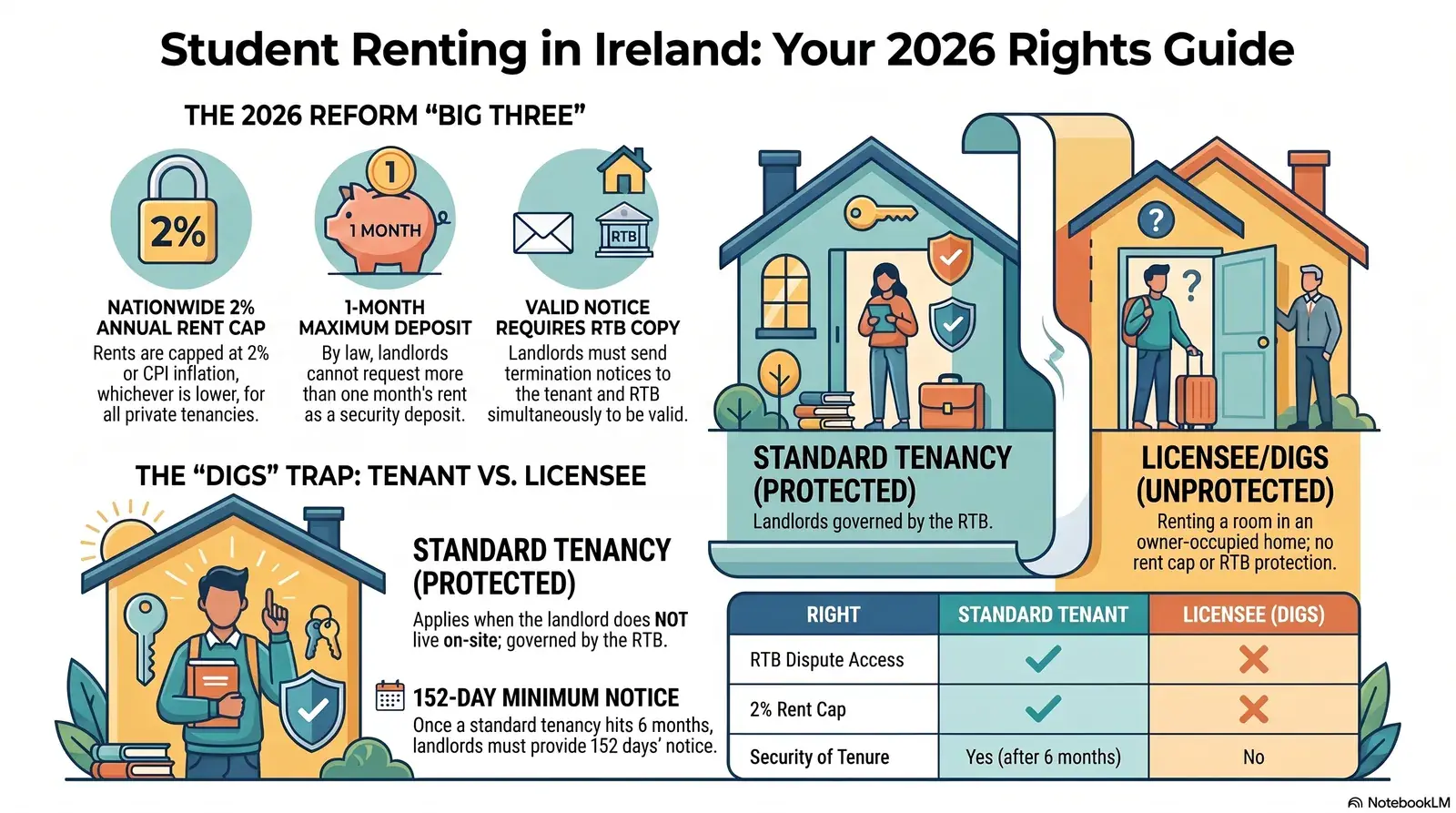
- The rent cap: From 1 March 2026, all private rents in Ireland are capped at 2% per year (or CPI inflation, whichever is lower). Rent Pressure Zones no longer exist. This cap applies everywhere, including student houses in Cork, Galway, and Limerick.
- Digs are a trap: If you rent a room in a house where your landlord also lives, you are a licensee, not a tenant. You have no RTB protection, no statutory notice rights, and no access to the rent cap. Disputes go to the Small Claims Court, not the RTB.
- After 6 months, eviction gets harder: Once you pass the 6-month mark in a standard tenancy, your landlord can only end it for one of a small number of legally specified reasons — and must give you 152 days' written notice at minimum.
1 month's rent — no more
2% per year or CPI (lower applies)
Free (mediation) / €15 online (adjudication)
152 days from your landlord
8 sections covered in this guide
- Tenant or Licensee? The Distinction That Changes Everything
- What Changed in March 2026: The New Rental Framework
- The 2% National Rent Cap: How It Works in Practice
- Deposit Protection: What Your Landlord Can Keep
- Minimum Standards Your Accommodation Must Meet
- Notice Periods and Valid Grounds for Eviction
- Taking a Dispute to the RTB: Process, Cost, and Timeline
- Documentation Habits That Win Disputes
Am I a Tenant or a Licensee? The Distinction That Changes Everything
The single most important question to ask when you move in anywhere in Ireland is whether you are a tenant under the Residential Tenancies Act or a licensee who lives with the consent of the homeowner. The legal gap between these two statuses is enormous and determines whether you have RTB protection at all.
A standard tenancy — renting a house, apartment, or flat where the landlord does not live on the same property — is governed by the Residential Tenancies Act and regulated by the RTB. You receive the full suite of protections: rent controls, statutory notice periods, deposit rules, and access to RTB dispute resolution.
A licensee arrangement — commonly called "digs" or a rent-a-room setup — is where you rent a room in a private home in which the owner continues to live. This arrangement sits entirely outside the Residential Tenancies Act. The rent cap does not apply. There are no statutory notice periods. Your landlord can ask you to leave at any time. The RTB cannot hear your dispute. Threshold, Ireland's national housing charity, confirms that your only redress for an unfairly withheld deposit as a licensee is the Small Claims Court, which costs approximately €25.
Many students arriving in Ireland for the first time are placed in digs through informal channels, college notice boards, or Facebook groups. Because digs are cheaper and more abundant than standard rentals, they are attractive. But you trade legal security for affordability. If your landlord asks you to leave before your exams, there is no RTB remedy. Plan to move into a standard RTB-registered tenancy as soon as you can afford to.
| Right or Entitlement | Standard Tenant (RTB) | Licensee (Digs / Rent-a-Room) |
|---|---|---|
| Access to RTB dispute resolution | ✓ Yes | ✗ No |
| National 2% rent cap applies | ✓ Yes | ✗ No |
| Maximum deposit of 1 month's rent | ✓ Yes (statutory) | ✗ Not enforced by RTB |
| Statutory minimum notice periods | ✓ Yes (90–224 days) | ✗ No (reasonable notice only) |
| Security of tenure after 6 months | ✓ Yes (limited termination grounds) | ✗ No |
| Deposit dispute route | RTB | Small Claims Court (~€25) |
| Rent-a-Room Relief (tax for landlord) | N/A | Up to €14,000/year tax-free for landlord |
What Changed in March 2026: The New Rental Framework
The Residential Tenancies (Miscellaneous Provisions) Act 2026 was enacted on 24 February 2026 and its main provisions took effect on 1 March 2026, introducing the most significant overhaul of Irish tenancy law since the original Residential Tenancies Act 2004.
The three headline changes are: the abolition of Rent Pressure Zones (RPZs), a single national rent cap replacing them, and new minimum tenancy duration rules for tenancies created on or after 1 March 2026.
Under the previous system, RPZs covered specific areas — primarily Dublin and large cities — where rent increases were capped at HICP inflation or 2%, whichever was lower, while properties outside RPZs faced no cap at all. From 1 March 2026, this geographic patchwork is gone. Every private residential tenancy in Ireland, regardless of location, is now subject to a maximum annual rent increase of the lower of CPI inflation or 2%. As of mid-2026, Irish CPI sits below 2%, meaning the effective cap is currently below 2% for most tenants.
The second major change is the introduction of Tenancies of Minimum Duration (TMD) for new tenancies created from 1 March 2026. These tenancies run in 6-year cycles. When a cycle ends, it automatically renews for another 6 years. The landlord's ability to end the tenancy during a cycle depends on their size — whether they are classified as a "small" or "large" landlord under the new framework.
A large landlord is any landlord with four or more tenancies, or any corporate entity regardless of how many tenancies they hold. Large landlords cannot end a TMD tenancy to sell the property, accommodate a family member, or carry out refurbishment — they must wait until the end of the 6-year cycle, and even then face restrictions. This matters to students who rent from property management companies or large private landlords, which is increasingly common in Dublin purpose-built student accommodation.
A small landlord (1 to 3 tenancies) retains more flexibility: they can end a tenancy during the cycle to sell in cases of genuine financial hardship, or to accommodate a close family member in cases of hardship. At the end of the 6-year cycle, small landlords can also end tenancies to refurbish, change use, or for family occupation.
If your tenancy started before 1 March 2026, the new TMD rules do not apply to you. Your tenancy continues under the pre-existing Part 4 rules: after 6 months you gain security of tenure, and the landlord can only terminate for 6 specified reasons. The 2% national rent cap does apply to you from 1 March 2026, because it covers all existing tenancies too.
The 2% National Rent Cap: How It Works in Practice
From 1 March 2026, your landlord can raise your rent by no more than 2% per year, or the rate of Consumer Price Index (CPI) inflation, whichever is lower — and this rule now applies to every private rental in Ireland, not just those in former Rent Pressure Zones.
Before a landlord can implement any rent increase, they must give you at least 90 days' written notice. Crucially, from 1 March 2026, this notice must be sent to you and to the RTB on the same day. A notice that is not copied to the RTB simultaneously is legally invalid and cannot be enforced.
To calculate whether a proposed increase is legal, use the RTB Rent Calculator on rtb.ie. Enter your current rent and the date of your last review. The calculator shows you the maximum lawful rent. If your landlord is seeking more, you can challenge it as an improper conduct at the RTB.
You can also verify your landlord's registration status and check the rent history of your property on the RTB Rent Register. This public database shows what was legally paid at a property in previous tenancies, which is useful context when your landlord proposes an increase.
On-the-Ground Insight: "My landlord sent me a rent increase letter in April 2026 saying rent would go from €1,100 to €1,250. I checked the RTB Rent Calculator and the legal maximum was €1,122. When I showed him the RTB printout, he backed down immediately. That €128 per month adds up to €1,536 over a year — not money I can afford to lose on a student budget." — Priya M., University of Limerick, September 2025 Intake
The national availability crisis makes this cap critical. According to a January 2026 survey by Threshold and Housing Rights, rental listings nationally fell to a record low of under 1,800 properties in February 2026 — down 22% year-on-year. In that environment, a landlord who knows you cannot find an alternative has significant leverage; knowing the rent cap and how to enforce it through the RTB is your main counterweight.
Check If Your Rent Increase Is Legal (2026 Calculator)
Enter your current rent and the proposed new amount. The calculator applies the 2% national cap (effective 1 March 2026, per the RTB) to show whether the increase is lawful. Your landlord must also give you at least 90 days' written notice, copying the RTB simultaneously. For example, a tenant paying €1,000 a month who is notified of a rent review to €1,025 — a 2.5% increase — is being asked to pay €5 above the 2% cap (max legal rent: €1,020) and can refer the notice to the RTB.
📑 Rent Increase Legality Checker (Ireland 2026)
Uses the 2% annual national cap introduced on 1 March 2026 (RTB / Citizens Information). Results are indicative only.
Deposit Protection: What Your Landlord Can and Cannot Keep
The maximum deposit a landlord can charge in Ireland is one month's rent. If you were asked for more than this, you are entitled to a refund of the excess — and your landlord is in breach of the Residential Tenancies Act.
Your landlord must register your tenancy with the RTB within 30 days of the tenancy start date. You can verify this yourself for free on the RTB's public register at rtb.ie/compliance/check-the-register. If your tenancy is not registered, you cannot access RTB dispute resolution — but importantly, you can also report an unregistered tenancy to the RTB, which can take enforcement action against the landlord.
At the end of your tenancy, your landlord may only withhold deposit money for three reasons: rent arrears, unpaid bills that you were contractually responsible for, and damage that goes beyond normal wear and tear. The law is explicit that everyday deterioration — minor scuffs on walls, carpet wear from foot traffic, small marks on surfaces — constitutes normal wear and tear and cannot be deducted. The landlord must return the remaining deposit promptly after you vacate.
The single most effective thing you can do is conduct a thorough video walkthrough of the entire property on your first day, noting every pre-existing mark, stain, and damaged item. Email the video to your landlord that same day requesting written acknowledgement. This timestamped evidence is extremely powerful at RTB adjudication and almost impossible for a landlord to dispute.
If your landlord refuses to return your deposit or makes deductions you disagree with, you can file a dispute with the RTB. The online dispute process costs €15. Resolution by adjudication typically takes 4 to 8 weeks from the date of filing. The RTB can issue a Determination Order requiring the landlord to return the deposit; if they refuse to comply, the Order can be enforced through the District Court.
Minimum Standards Your Accommodation Must Meet
Every private rented home in Ireland must meet legally required minimum standards. Your landlord is legally obliged to maintain the property to these standards — and if they fail to do so, you can report them to your local authority, which has inspection and enforcement powers.
The Minimum Standards Regulations require the following, among other provisions:
Every habitable room must have a fixed heating appliance capable of providing effective warmth — typically a storage heater, gas fire, or central heating radiator. A portable electric heater does not satisfy this requirement. Every room must have adequate ventilation and a combination of natural and artificial lighting. All gas, oil, and electricity installations must be maintained in safe working order. The property must not be overcrowded: the law defines overcrowding by reference to both the number of occupants and the floor area available per person.
If your accommodation fails these standards, do not wait for your landlord to act. Contact your local authority housing department directly. They have the power to inspect the property, serve enforcement notices on the landlord, and, in serious cases, prohibit the property from being let. You cannot be evicted in retaliation for making a complaint to the local authority — retaliatory termination is itself a ground for an RTB complaint.
Common student housing problems that trigger minimum standards complaints include broken or absent heating, inadequate fire safety equipment (smoke alarms, fire blankets, fire doors in HMOs), persistent damp and mould caused by structural problems rather than condensation, and shared kitchen or bathroom facilities in a state of disrepair. Each of these is a landlord obligation, not a tenant obligation.
Notice Periods and Valid Grounds for Eviction
For the first six months of any tenancy, your landlord can end the tenancy for any reason at all, provided they give you written notice and copy that notice to the RTB. After six months, only a limited set of legally specified reasons justify termination — and the notice periods become substantially longer.
The following notice periods apply to landlord-initiated terminations under the March 2026 framework. These are the current RTB-published figures as of July 2026:
| Tenancy Length | Minimum Notice Period (Landlord) |
|---|---|
| Less than 6 months | 90 days |
| 6 months to 1 year | 152 days |
| 1 year to 7 years | 180 days |
| 7 years to 8 years | 196 days |
| More than 8 years | 224 days |
Shorter notice periods apply in specific circumstances. If a tenant fails to pay rent, the landlord must first issue a 28-day rent arrears warning notice (copied to the RTB) giving you time to pay. If the arrears remain unpaid after 28 days, the landlord can then serve a Notice of Termination giving 28 days to vacate. For serious anti-social behaviour that threatens the structure of the property or the safety of others, the landlord can give 7 days' notice without a prior warning notice.
When you want to leave, your notice obligations as a tenant are considerably shorter:
| Tenancy Length | Minimum Notice Period (Tenant) |
|---|---|
| Less than 6 months | 28 days |
| 6 months to 1 year | 35 days |
| 1 to 2 years | 42 days |
| 2 to 4 years | 56 days |
| 4 to 8 years | 84 days |
| 8 or more years | 112 days |
For a Notice of Termination to be legally valid, it must be in writing, must clearly state the date the tenancy is to end, must be signed by the landlord (or their authorised agent), and must be delivered in a way that can be evidenced. From 1 March 2026, any notice from a landlord must also be simultaneously served on the RTB on the same day it is served on you — a notice served only to you, without the RTB copy, is legally invalid.
For tenancies created from 1 March 2026, the valid grounds for a landlord to terminate are set out in the Residential Tenancies (Miscellaneous Provisions) Act 2026. The main grounds available to all landlords are: the tenant has breached their obligations (including non-payment of rent), or the property no longer meets the tenant's needs (for example, is too small for a growing family). Small landlords have additional grounds — selling under financial hardship during the cycle, and multiple additional grounds at the end of the 6-year cycle. Large landlords (four or more tenancies, or any corporate entity) cannot end a tenancy during the TMD cycle to sell, to accommodate a family member, or for refurbishment.
If you live in purpose-built student accommodation registered as Student Specific Accommodation (SSA) with the RTB, the unlimited duration and TMD rules do not apply to your tenancy. SSA tenancies follow a different framework designed around academic years. Check your lease carefully to determine which category applies to you.
Taking a Dispute to the RTB: Process, Cost, and Timeline
If your landlord has unlawfully increased your rent, wrongly withheld your deposit, served an invalid notice of termination, or breached any other term of the Residential Tenancies Act, you can file a formal dispute application with the RTB online. This is your primary and most effective remedy as a tenant.
The RTB dispute resolution system has three levels. The first is mediation, which is free and conducted by telephone. The mediator speaks to each party separately in a back-and-forth process until an agreement is reached or it becomes clear no agreement is possible. Mediation is faster than formal adjudication and is often resolved within a few weeks.
If mediation fails or is not suitable, the case moves to adjudication. This is a more formal hearing based on the written evidence you submit. Filing a dispute application online costs €15. An adjudicator reviews the evidence and makes a determination, typically within 4 to 8 weeks from the date of application. You will be given at least 21 days' notice before any hearing. The adjudicator's determination is binding unless appealed.
Either party can appeal an adjudication decision to the Tenancy Tribunal. Tribunal appeals cost €85 (after adjudication) or €30 (after a failed mediation). The Tribunal is a panel of three members and hears the case anew. As of 2025, the average time to resolve a Tribunal case was 17 weeks from application. Tribunal decisions are published and enforceable through the District Court.
| RTB Process | Cost | Format | Typical Timeline |
|---|---|---|---|
| Mediation | Free | Telephone (separate calls) | Weeks, depending on parties |
| Adjudication | €15 online / €30 paper | Evidence-based hearing | 4–8 weeks |
| Tribunal (appeal) | €85 (after adjudication) | Panel of 3 members, full hearing | ~17 weeks (2025 average) |
You can also report a landlord to the RTB for specific breaches of rental law (called "improper conducts") using the online reporting form at rtb.ie/compliance/report-a-landlord. The RTB investigates these reports and can sanction landlords who fail to comply with rental law. If you prefer not to have the landlord know you made the report, you can also call the RTB directly on 0818-776-297.
For free advice before you file anything, contact Threshold, the national housing charity. They offer free tenancy advice by phone, email, and in-person at offices in Dublin, Cork, and Galway. They can help you assess whether your issue is worth pursuing and guide you through gathering the right evidence.
Documentation Habits That Win Disputes
The most common reason tenants lose RTB disputes that they should have won is insufficient evidence. Irish tenancy law places a significant premium on written, timestamped records — and the habit of creating them costs nothing but discipline.
Start before you even move in. On the day you collect the keys, walk through every room with your phone recording a video. Narrate what you see: every scuff, damp patch, broken fitting, or missing item. Email the video to your landlord the same day and ask for written acknowledgement. If they do not respond, your sent email is still timestamped evidence that you flagged the issues before occupation began. This single step prevents the vast majority of deposit disputes.
Throughout your tenancy, pay rent by bank transfer, never cash. Your bank statement serves as an irrefutable payment record. If you must pay cash for any reason, get a signed receipt with the date and amount on every occasion. Keep every piece of communication with your landlord in writing — WhatsApp and email both create a timestamped record. If your landlord raises something verbally, follow it up in writing: "Just to confirm our conversation this morning about the broken boiler..."
When you receive any formal notice from your landlord — a rent review notice, a Notice of Termination, a warning about behaviour — photograph it immediately and note the date you received it. The RTB's clock on notice periods starts from the date the notice was validly served, so getting this date right matters enormously for your rights. If a notice arrives by post, keep the envelope with the postmark as evidence of service date.
At the end of your tenancy, conduct a joint walkthrough with your landlord and get them to sign an inventory check-out form. Photograph every room again at move-out. Compare side by side with your move-in video. Any new damage that appears in the landlord's deduction list but does not appear in your move-out photos is immediately suspect. Submit both sets of photos to the RTB as evidence if you dispute deductions.
Day one of every tenancy: (1) Video walkthrough of all rooms, narrating pre-existing damage. (2) Photograph all fixtures, fittings, appliances, and furniture, noting condition. (3) Email video and photos to landlord, request written acknowledgement. (4) Photograph utility meters and record readings. (5) Check your tenancy is registered at rtb.ie/check-the-register within 30 days of your start date.
Frequently Asked Questions
Do I have any rights if I'm renting a room in a landlord's home in Ireland?
If you rent a room in a home where the landlord also lives, you are a licensee, not a tenant. This means you are outside the Residential Tenancies Act and have no RTB protections — no rent caps, no statutory notice periods, and no right to dispute rent increases with the RTB. Your route for deposit disputes is the Small Claims Court.
What is the maximum deposit a landlord can charge in Ireland in 2026?
The maximum deposit is one month's rent. If your landlord asks for more, you can demand a refund of the excess. The landlord must register your tenancy with the RTB within one month of the tenancy start date.
Can my landlord evict me without reason in Ireland?
After the first six months of a tenancy, a landlord cannot terminate a tenancy without a valid legal reason. For tenancies created from 1 March 2026, landlords with four or more tenancies (large landlords) cannot end a tenancy to sell, refurbish, or accommodate a family member during the 6-year Tenancy of Minimum Duration.
How do I take my landlord to the RTB?
Submit a dispute application online at rtb.ie. Mediation is free. Adjudication costs €15 online. You will be given at least 21 days' notice before any hearing. Most adjudicated disputes resolve within 4 to 8 weeks from the date of application.
What are the minimum standards for rented accommodation in Ireland?
Every rented property must have a fixed heating appliance capable of warming each habitable room, adequate ventilation, adequate natural and artificial lighting, and all gas, oil, and electricity installations maintained in safe working order. Local authorities enforce these standards and can inspect on complaint.
Planning your flights to Ireland? Compare live fares first.
Find the cheapest Ireland-bound fares, compare Gulf carrier routes, and track the best booking windows before you commit.
All information in this article is based on publicly available official sources as of July 2026, including the Residential Tenancies Board (rtb.ie), Citizens Information (citizensinformation.ie), the Government of Ireland (gov.ie), and Threshold (threshold.ie). Tenancy law changes regularly — always verify current rules directly with the RTB or a qualified solicitor. This article does not constitute legal advice. MyFlightOffers is not affiliated with any organisation mentioned.
- GUIDE Ireland Rental Scams 2026: How International Students Stay Safe — ghost listings, shadow sublets, RTB verification, and a step-by-step landlord-check roadmap
- Ireland Banking Guide for International Students 2026 — opening a bank account, the best cards for students, and sending money home
- The Indian Student's Money Survival Guide in Ireland — budgeting, forex cards, TCS, and managing your finances from Dublin
- Complete Guide to Studying in Ireland for International Students — visas, accommodation, costs, and what to expect in your first semester