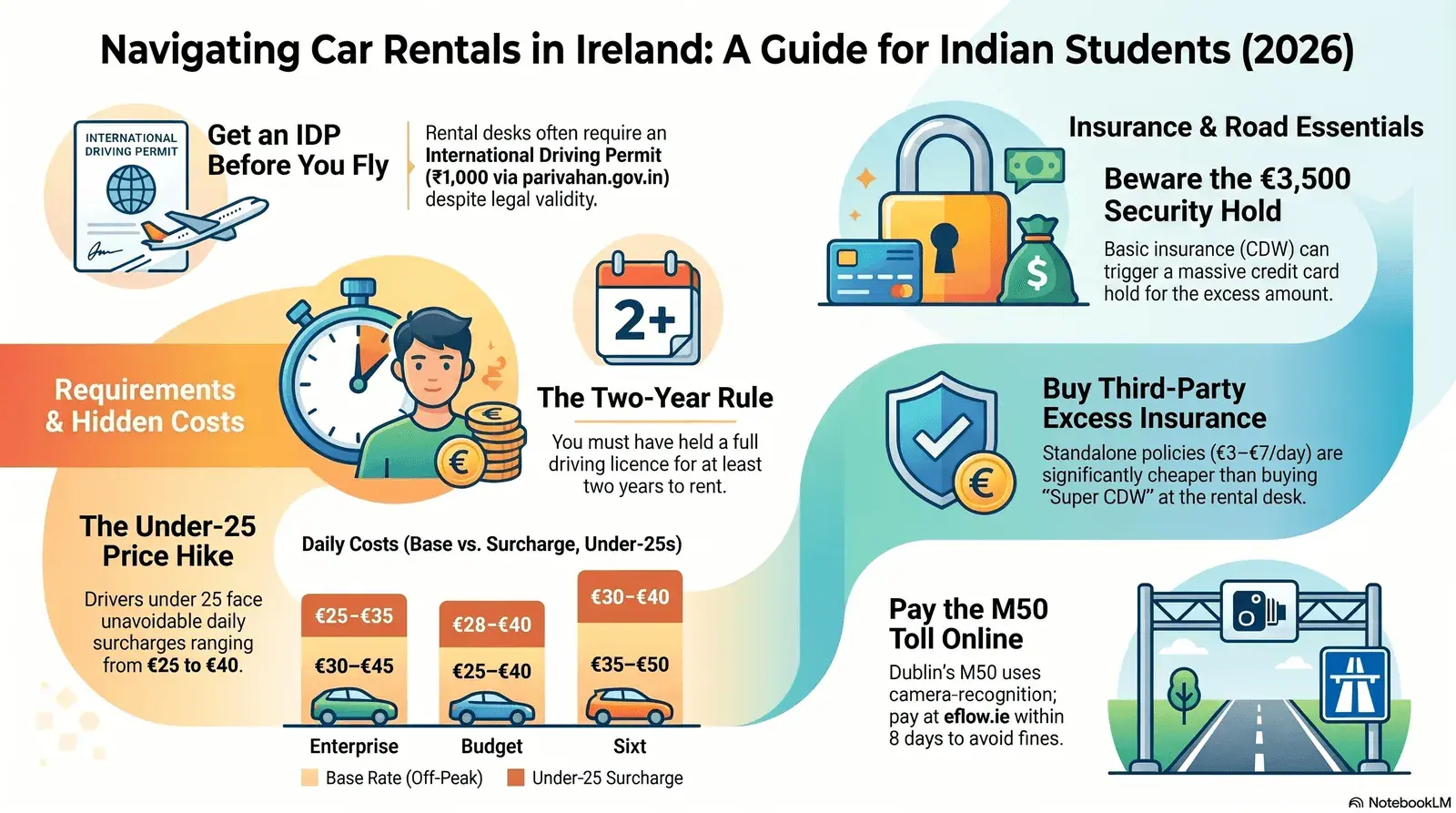
- Your Indian licence is valid for 12 months from arrival, but most rental desks also require an IDP — get one before you travel via parivahan.gov.in for ₹1,000.
- Under-25 surcharges are unavoidable — typically €26–€40 per day on top of the base rate — so factor this into your total before comparing prices.
- Basic CDW insurance leaves you exposed to a €1,000–€3,500 excess hold on your card; a Super CDW or third-party excess policy brings it to zero for roughly €12–€28/day extra.
Minimum rental age
21 years (some companies: 23–25)
Under-25 surcharge
€26–€40 per day
IDP required?
Not by law — but rental desks usually insist
Licence valid for
Up to 12 months from arrival
In this guide
- Can you drive in Ireland on an Indian driving licence?
- International Driving Permit: do you need one and how to get it
- Age restrictions: minimum 21, surcharges for under-25 drivers
- Best car rental companies for Indian students in Ireland
- Insurance: what is included and what additional cover to buy
- Driving on the left: practical tips for Indian drivers
- Long-stay students: converting your Indian licence to Irish
- Money-saving booking tips for students
Can You Drive in Ireland on an Indian Driving Licence?
Yes — a valid Indian driving licence permits you to drive in Ireland for up to 12 months from the date you arrive in the country. Ireland recognises driving licences issued by all countries for this initial 12-month period, provided the licence is current and has not expired. This rule applies equally to tourists, students on Stamp 2 visas, and other short-stay permit holders.
There is, however, an important practical distinction between the legal position and what car rental companies actually accept at their desks. While Irish road law allows you to drive on a valid Indian licence, many rental companies — particularly the larger chains at Dublin Airport, Shannon, and Cork — additionally require an International Driving Permit (IDP) alongside the original Indian licence. This is because Indian licences may contain regional-language text (Devanagari, Tamil, Telugu, etc.) alongside English, and rental staff in Ireland are not always trained to read or verify these. The IDP provides a standardised, internationally readable summary of your licence entitlements.
"Visitors are entitled to drive in Ireland using a current driving licence from their own country for up to 12 months." Once you become an Irish resident (not just a visitor or student), this window is still 12 months from the date of residency, after which you must apply for an Irish licence. Source: Citizens Information — Foreign Driving Licences.
One common confusion among Indian students: the 12-month clock starts when you take up residence in Ireland, not when you first arrive for orientation. If you begin your MSc programme in September 2025 and establish Irish residency from that point, your Indian licence remains valid at rental desks until September 2026 — in terms of legal driving entitlement. Rental desks are primarily checking whether the licence is current, not when your residency started.
On-the-Ground Insight: "My Bengaluru-issued licence is bilingual — English and Kannada script. The Europcar desk at Dublin Airport immediately asked for my IDP. When I said I didn't have one, they refused to hand over the car even though I had a confirmed booking. I had to take a taxi to my accommodation and sort it out later through the Indian Embassy in Dublin." — Priya R., UCD Dublin, arrived September 2025
The lesson is clear: obtaining an IDP before you travel eliminates this risk entirely. The process and cost are covered in the next section.
International Driving Permit: Do You Need One and How to Get It in India
An IDP is not a legal requirement to drive in Ireland, but most Irish car rental companies treat it as mandatory alongside a non-English-script licence — so in practice, you should get one before you leave India. An IDP is a standardised document that translates your driving entitlements into 12 languages, including French, German, Spanish, and English, and is recognised in over 150 countries.
How to apply for an IDP from India (before travelling)
The fastest route is through the Parivahan Sewa portal (parivahan.gov.in) operated by the Ministry of Road Transport and Highways. The fee is ₹1,000 and the IDP is valid for one year from the date of issue. You will need a valid Indian driving licence (not a learner's permit), a valid passport, two passport-size photographs, proof of address, and the online application form. Processing typically takes 2–7 working days at your Regional Transport Office (RTO), and some states now issue it on the same day.
Alternatively, you can apply in person at your local RTO. The process varies by state — states like Maharashtra, Karnataka, and Tamil Nadu generally process IDPs efficiently, while some smaller RTOs may take longer. Always apply at least two to three weeks before your travel date to avoid delays.
- Visit parivahan.gov.in → Services → Driving Licence → International Driving Permit
- Select your home state from the dropdown
- Fill in applicant and licence details, upload documents, pay ₹1,000 fee
- Book an appointment at your RTO (required in most states)
- Collect the IDP in person or request postal delivery
Already in Ireland and need an IDP renewal?
Indian nationals already residing in Ireland can apply for a fresh IDP through the Indian Embassy in Dublin. The Embassy of India, Dublin handles IDP re-issue applications. You must first initiate the application through the Parivahan portal, upload documentation including a receipt/letter from the Embassy, and pay the fee online. The licensing authority in India then issues the IDP and couriers it to your Irish address directly. This process typically takes 3–6 weeks, so plan ahead.
An IDP is always presented together with your original Indian licence — it is a translation document, not a standalone licence. Rental companies will ask to see both. Never leave your original Indian licence in your accommodation when you are driving.
Age Restrictions: Minimum 21, Surcharges for Under-25 Drivers
The legal minimum age to rent a car in Ireland is 21 years, and drivers under 25 face a mandatory young-driver surcharge that averages €26–€40 per day on top of the base rental rate. For most Indian students arriving on a September intake — aged 22 to 24 — this surcharge is unavoidable and can significantly inflate the true cost of renting.
It is also important to note that you must have held a full driving licence for at least two years to rent a car in Ireland. A learner's permit, even an Indian one, does not qualify. Rental companies verify this by checking the issue date on your licence.
| Company | Minimum age | Under-25 surcharge | Minimum licence held | Car class restrictions |
|---|---|---|---|---|
| Hertz Ireland | 23–24 (varies by car group) | ~€26/day | 2 years | Economy/Compact only for 23–24 |
| Avis Ireland | 23 | €26/day incl. tax | 2 years | Excludes prestige & 7-seaters |
| Europcar Ireland | 21 | €30–€35/day | 2 years | Limited to economy & compact |
| Enterprise Ireland | 21 | €25–€35/day | 2 years | Economy/Compact for under-23 |
| Budget Ireland | 21 | €28–€40/day | 2 years | Compact and below |
| Sixt Ireland | 21 | €30–€40/day | 2 years | Excludes SUV & premium |
A 3-day economy car rental quoted at €35/day becomes €61/day after a €26 young-driver surcharge — a 74% increase. Always use this formula: True Daily Cost = Base Rate + Young Driver Surcharge + Insurance Add-on. The base rate advertised on aggregator sites almost never includes the surcharge, which is collected at the desk.
Some companies, including Hertz, do not rent to drivers under 21 at all, regardless of the car class. If you are 20 years old and need transport, your only options are public transport, ride-sharing services like Uber (limited outside Dublin), or asking a friend aged 21+ to be the named driver.
Best Car Rental Companies in Ireland for Indian Students (Price Comparison 2026)
For budget-conscious Indian students, Enterprise, Budget, and Europcar consistently offer the most competitive base rates in Ireland, while Hertz provides the best student discount programme and Sixt tends to offer the sharpest pricing if booked three or more months in advance.
Ireland's car rental market is highly seasonal. Economy cars can cost as little as €18–€25 per day in February and March, yet the same vehicle at Dublin Airport in August can cost €80–€120 per day. Indian students with summer placements or field trips should book at least 6–8 weeks in advance during June–August.
| Company | Economy rate (off-peak) | Economy rate (peak July–Aug) | Student discount | Best for |
|---|---|---|---|---|
| Enterprise | €30–€45/day | €70–€100/day | 10% prepay online | Value, flexibility |
| Budget | €25–€40/day | €65–€95/day | No formal student rate | Lowest base price |
| Europcar | €35–€55/day | €75–€110/day | Up to 15% via Student Beans | Highest customer rating |
| Hertz | €40–€60/day | €80–€120/day | 15% off cars, 20% off vans | Student deals, airport locations |
| Sixt | €35–€50/day | €70–€105/day | Seasonal promo codes | Early bookings, well-maintained fleet |
| Avis | €38–€58/day | €75–€115/day | Wizz: occasional discounts | Wide branch network |
Rates above are indicative base prices excluding young-driver surcharge and insurance. Always compare on aggregators like AutoEurope or DiscoverCars (rated 4.6/5 on Trustpilot from over 200,000 reviews) which surface the full inclusive price, including taxes and surcharges.
Hertz student discount — how to claim it
Hertz Ireland offers 15% off cars and 20% off vans for students, accessible directly through the Hertz Students page. You need to present a valid student ID or letter from your Irish institution at the desk. Note that the young-driver surcharge still applies on top of the discounted rate if you are under 25.
Europcar student discount — Student Beans
Europcar partners with Student Beans to offer up to 15% off for verified students. Verify your student status at studentbeans.com, generate a discount code, and apply it at checkout. This can be stacked with off-peak pricing for meaningful savings. Europcar is also the highest-rated rental company by Irish customers in independent surveys.
Insurance: What Is Included and What Additional Cover to Buy
All car rentals in Ireland come with basic third-party liability insurance (mandatory by law) and Collision Damage Waiver (CDW) — but CDW is not full cover and nearly always leaves you liable for a significant excess of €1,000 to €3,500 in the event of an accident. Understanding what each layer of cover does (and does not) protect is the single most important financial decision you will make when renting a car in Ireland.
What CDW actually covers
CDW limits your financial liability for damage to the rental vehicle's bodywork — panels, bumpers, doors, and bonnet — but crucially does NOT cover tyres, windscreen chips or cracks, the undercarriage, lights, or wheel rims at most companies. It also does not cover theft of personal belongings from the car, accidents caused by driving under the influence, or damage caused by driving on unsealed roads (an important caveat if you plan to visit rural areas of the west coast).
If you choose basic CDW, the rental company will place a security hold on your credit card equal to the excess amount — typically €1,500–€3,500 depending on the vehicle. This is not a charge, but it blocks that amount from your available credit for the duration of the rental, which can be a problem if you have a lower-limit card.
| Insurance type | What it covers | Your liability | Typical daily cost |
|---|---|---|---|
| Third-party liability | Damage to other vehicles/property | None (legally required) | Included in all rentals |
| CDW (basic) | Vehicle bodywork damage | €1,000–€3,500 excess | Usually included in base rate |
| Super CDW / SCDW | Body damage, reduces excess to €0 | €0 for body damage | €12–€28/day (at the desk) |
| Windscreen & tyre cover | Glass chips, tyre punctures | €0 (if purchased) | €5–€10/day add-on |
| Third-party excess policy | Reimburses any excess charged | €0 (claim back after) | €3–€7/day (buy before travel) |
Third-party excess insurance — the smart student option
Rather than buying Super CDW at the rental desk (which can cost €28/day), consider purchasing a standalone car hire excess insurance policy before your trip — these reimburse you for any excess charged after an incident and cost as little as €3–€7 per day. Providers in Ireland include AIG Car Hire Excess Insurance and RentalCover.com. The key difference: you pay the excess upfront at the desk if there is a damage incident, then claim it back — which means you still need a card with enough headroom to absorb the hold.
Most Indian travel insurance policies — including standard plans from Bajaj Allianz, HDFC Ergo, and Tata AIG — exclude car rental excess liability by default. Read the policy exclusions carefully, or buy a dedicated car hire excess policy.
Can your credit card cover the excess?
Some premium Indian credit cards (such as the HDFC Infinia, Axis Magnus, or ICICI Sapphiro) do include overseas car rental insurance, but this benefit is rarely automatic and almost always requires you to pay the full rental on that specific card and then file a claim within 30–60 days. Check your card's benefit guide carefully and call the benefits helpline before relying on this. US and UK-issued credit cards (Amex Gold/Platinum, Chase Sapphire) tend to have stronger and more reliable car rental cover — if you have access to one, it may save you the daily insurance add-on.
Driving on the Left: Practical Tips for Indian Drivers New to Ireland
Ireland drives on the left-hand side of the road, which means the steering wheel is on the right-hand side of the car — the opposite of what Indian drivers are used to. Most Indian students adapt within a day or two, but the transition period carries real risk. The following practical tips come from the combined experience of thousands of first-time left-hand-traffic drivers.
1. The "drifting right" problem and how to fix it
The most common mistake for right-hand-traffic drivers in Ireland is unconsciously drifting to the centre of the road, because your muscle memory expects the steering wheel to be on the left. The fix is deliberate: keep reminding yourself to position the car so that the kerb is close on your left. On narrow rural roads and country lanes — which are common outside Dublin — this matters enormously. Hedgerows and stone walls can scrape wing mirrors in seconds.
2. Roundabouts — Ireland has nearly 2,000 of them
Ireland has one of the highest densities of roundabouts in the world — approximately 1,947 across the country — and the rules are: give way to traffic coming from your right, travel clockwise around the island, and signal left when exiting. This is the reverse of Indian roundabouts where you give way to traffic from the left. Practise this mentally before you drive: traffic from your right has priority, you go clockwise.
3. Request an automatic if you are not comfortable with left-hand gear shifts
Manual (stick-shift) cars are still far more common in Ireland than automatics, and in a manual left-hand-drive car you shift gears with your left hand — the opposite of India. If you are not confident driving a left-hand manual, book an automatic explicitly and confirm it at the time of reservation. Automatics typically cost €5–€15 per day more but are worth it for safety during the adjustment period.
4. Spend your first 10–15 minutes in the airport car park
Before joining the M50 motorway or N roads from Dublin Airport, drive around the airport's surface car park for 10–15 minutes to get used to the controls, the mirror positions, and the feel of sitting on the right side. This low-pressure practice run dramatically reduces anxiety when you join faster traffic. Major airports have ample car park space for this purpose.
5. Speed limits and road types
Ireland uses kilometres per hour (km/h): motorways (M roads) are 120 km/h, national primary roads (N roads) are 100 km/h, regional roads (R roads) and local roads are 80 km/h, and urban areas are 50 km/h. Narrow R roads in counties like Kerry, Mayo, and Donegal can be challenging even for experienced left-hand drivers — keep your speed well below the 80 km/h limit on unfamiliar rural routes.
- Drive on the left — always
- Seatbelts mandatory for driver and all passengers
- Blood alcohol limit: 50 mg/100 ml (lower than India's 30 mg/100 ml)
- Mobile phones: zero tolerance — €80 fine and 3 penalty points for handheld use
- Speed cameras are widely deployed on N roads and motorways
- Tolls on M50 (Dublin ring road) are electronic — no cash booths; pay online at eflow.ie within 8 days or face a fine
6. The M50 barrier-free toll — the most common catch for new drivers
The M50 motorway around Dublin has no toll booths — it operates entirely on electronic number-plate recognition, and foreign drivers must pay the toll online at eflow.ie within 8 days of travel or face a penalty. Some rental companies will pay the toll on your behalf and add an administrative charge of €10–€20 to your final bill. Check your rental agreement's toll policy at pickup and decide whether to manage it yourself through eflow.ie (cheaper) or let the company handle it.
Long-Stay Students: Converting Your Indian Driving Licence to an Irish One
India is not on Ireland's RSA list of "recognised states" for direct driving licence exchange, which means you cannot simply swap your Indian licence for an Irish one — you must go through the full Irish licensing process, though holding a full Indian licence for 2+ years reduces your mandatory lessons.
For students on a one-year or two-year programme who intend to drive throughout their stay, this matters because the 12-month grace period for using your Indian licence runs from when you establish Irish residency. If you plan to stay beyond that, start the Irish licence process in month 9 or 10 to avoid a gap.
The process for non-recognised foreign licence holders in Ireland:
- Pass the Irish Driver Theory Test (€45 fee, book at theorytest.ie)
- Apply for a learner permit at an NDLS office (€35 fee) — bring your full Indian licence, passport, proof of Irish address, and PPSN
- Complete Essential Driver Training (EDT) — normally 12 lessons with an approved driving instructor, reduced to 6 lessons if you have held a full foreign licence for 2+ years
- Pass the practical driving test (€85 fee, book at rsa.ie)
If you are on a one-year course, there is little benefit in starting the Irish licence process — you will likely leave before completing EDT and the test. Use your Indian licence (with IDP) for the full 12 months. If you are on a 2-year programme or plan to stay on a Stamp 1G graduate permit, begin the process around month 9 of year 1.
Money-Saving Booking Tips for Student Car Rental in Ireland
The cheapest time to rent a car in Ireland is February through April (off-peak), with economy cars available from €18–€30 per day at Dublin Airport. The most expensive period is July and August, when tourist demand peaks and supply tightens dramatically. Students booking rental cars for field trips, road trips, or airport pickups during term-time (October–May) will generally find prices 40–60% lower than summer rates.
Book via aggregators, not directly
Booking through comparison sites like AutoEurope, DiscoverCars, or KAYAK typically surfaces prices 15–25% lower than booking directly with the rental company website, because aggregators display the real all-in price (including airport surcharges and taxes) and create competitive pressure across suppliers. DiscoverCars in particular shows the full insurance excess and CDW terms upfront, making comparison genuinely like-for-like.
Use a "full-to-full" fuel policy
Always choose a rental with a "full-to-full" fuel policy — you collect the car with a full tank and return it full — rather than a "full-to-empty" policy where the company pre-charges you for a full tank at above-market rates. On a 3-day rental in Ireland, a full-to-empty fuel pre-payment can add €60–€90 to your total cost compared to buying petrol yourself at a station.
Avoid airport location fees if possible
Rental companies at Dublin, Shannon, and Cork airports add an "airport concession fee" of 12–17% to their base rates, which does not appear in the headline price on many booking sites. If you can arrange a transfer to a city-centre branch of Enterprise or Budget (both have locations within 2–3 km of Dublin Airport with shuttle buses), you can avoid this surcharge. For students arriving late at night when city branches are closed, the airport desk may be the only option — factor in the surcharge accordingly.
Check whether your credit card covers the toll and excess
Before you add insurance at the desk, spend five minutes checking your credit card's travel benefits. Some Amex, HDFC, and Axis premium cards include car rental loss-and-damage coverage when you pay with that card. Even partial cover can reduce the excess you need to worry about.
Pick an economy or compact car — avoid the upgrade temptation
Economy and compact cars are 50–55% cheaper than mid-size or SUV categories in Ireland and are genuinely more practical on narrow Irish country roads. A Volkswagen Polo or similar compact is easier to navigate through single-track lanes in Connemara or the Ring of Kerry than a larger vehicle — the "upgrade" offered at the desk is almost never worth it for student road trips.
Frequently Asked Questions
Is an Indian driving licence valid in Ireland?
Yes. A valid Indian driving licence permits you to drive in Ireland for up to 12 months from the date you arrive. After 12 months of Irish residency you must apply for an Irish driving licence, as India is not on Ireland's direct-exchange list.
Do I need an International Driving Permit (IDP) to rent a car in Ireland on an Indian licence?
An IDP is not legally required to drive in Ireland, but many car rental companies in Ireland insist on one alongside your Indian licence, especially if any text on your licence is in a regional script. Apply through parivahan.gov.in before you travel - the fee is ₹1,000 and it is valid for one year.
What is the minimum age to rent a car in Ireland?
Most rental companies in Ireland set a minimum age of 21 years. Some, like Hertz and Avis, accept drivers from age 23 or 24 depending on car class, subject to a young-driver surcharge of roughly €26-€40 per day.
How do I convert my Indian driving licence to an Irish one?
India is not a 'recognised state' under Irish RSA rules, so there is no direct exchange. Once you become a resident, you must apply for an Irish learner permit and pass the theory and driving tests, though holding a full Indian licence for 2+ years may reduce your mandatory EDT lessons from 12 to 6.
Which car rental company is best for Indian students in Ireland?
For price, Enterprise and Budget tend to offer the lowest base rates (€30-€60/day for economy cars). Hertz and Europcar offer student discounts of 10-15% via Student Beans or a student ID. Always compare on DiscoverCars or AutoEurope and factor in the insurance excess, not just the base price.
Planning your trip to Ireland? Compare live fares first.
Use our fare tools to find the best time and price to fly from India to Dublin, Shannon, or Cork before you book your rental car.
All information in this article — including Irish driving licence rules, RSA recognised-state lists, rental company age thresholds, young-driver surcharge rates, CDW excess amounts, IDP application fees and processes, road speed limits, and M50 toll rules — is based on publicly available information from the Citizens Information Ireland, the Road Safety Authority Ireland, the National Driver Licence Service, the Embassy of India in Dublin, and individual rental company websites as of June 2026. Surcharge rates, minimum ages, and insurance terms change frequently — always verify directly with your chosen rental company before booking. This article does not constitute legal, financial, or immigration advice. MyFlightOffers is not affiliated with any rental company, insurance provider, or government body mentioned herein.
- NEW Car Rental in Ireland for Indian Students 2026 — this guide: licence rules, age surcharges, insurance, and booking tips
- Ireland Banking Guide for International Students — how to open a bank account in Ireland, best accounts for students, and managing money from India
- Ireland Student Survival Guide: Hidden Subsidies and Discounts 2026 — transport passes, student discounts, tax credits, and cost-saving hacks most students miss
- Stress-Free Travel Guide for International Students in Ireland 2026 — flying home during holidays, TCS rules, baggage allowances, and airport tips
- Study in Ireland 2026: Visa, Housing and IRP Guide — everything you need before and after you land