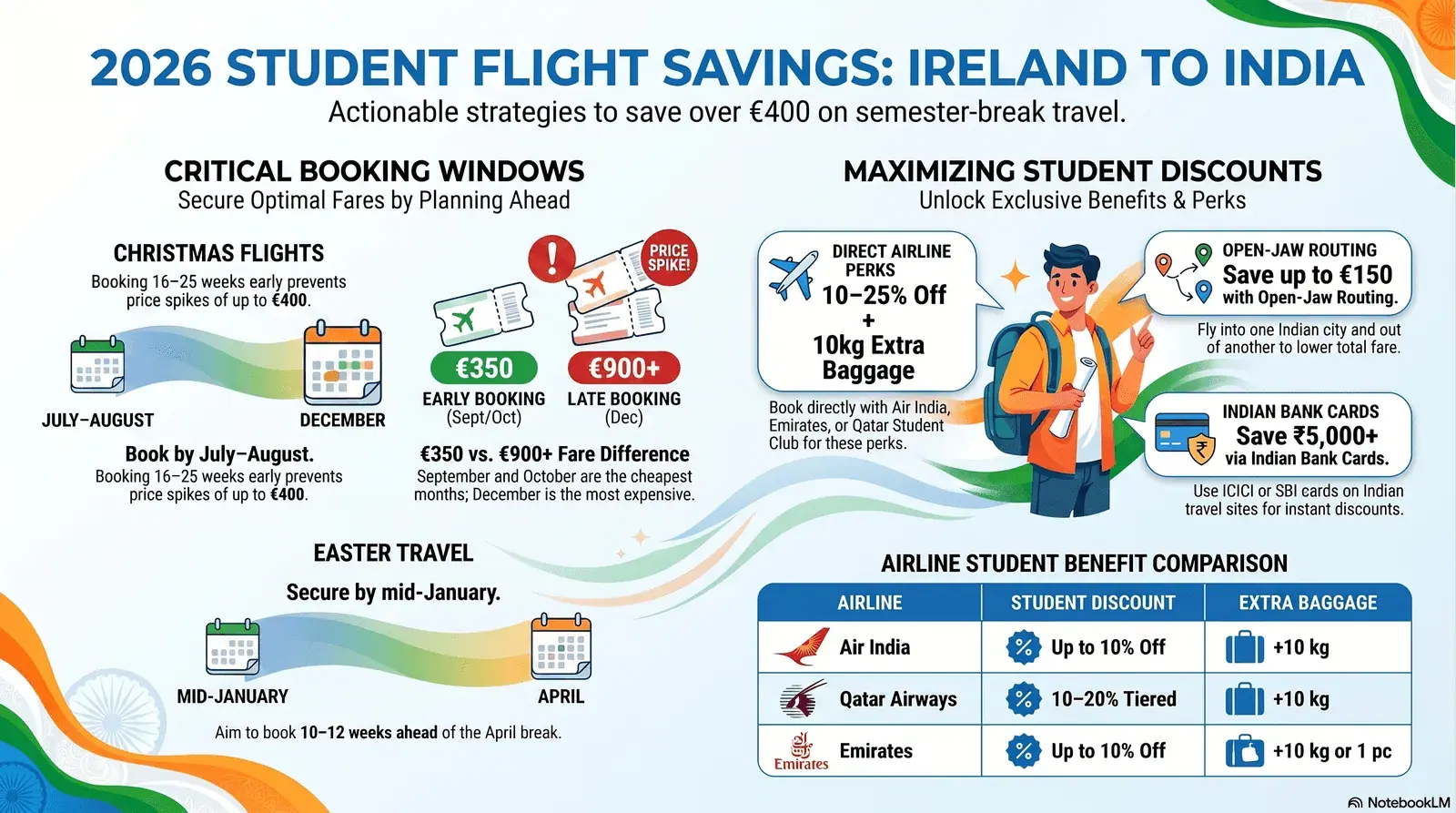
- Book Christmas 16–25 weeks early: July–August is when December fares are cheapest; waiting until October means paying €200–€400 more for the same seat.
- September and October are the cheapest months to fly Dublin–India, with average round-trip fares of €350–€500, versus €900+ at Christmas and peak summer.
- Air India and Emirates both offer student extras (10 kg baggage bonus + up to 10–25% fare reduction), but you must book directly on their websites, not through third-party OTAs, to activate the benefit.
September & October (avg. €350–€500 return)
December–January & late May (avg. €900–€1,300+)
July–August (16–25 weeks ahead)
Air India: 10% off + 10 kg extra baggage
In this guide
1. When Are the Semester Breaks at Irish Universities?
Irish universities follow three main holiday windows each academic year: Christmas (mid-December to mid-January), Easter (late March to mid-April), and summer (May or June through September). Understanding exactly when each break falls at your institution is the foundation of an affordable flight-booking strategy — even a one-week difference in your travel date can mean a €200 swing in fare.
Here are the approximate 2025–26 break dates across major Irish institutions. Always confirm directly with your university's academic calendar:
| University | Christmas Break | Easter Break | Summer Break Starts |
|---|---|---|---|
| University College Dublin (UCD) | Mid-Dec 2025 – 12 Jan 2026 | 27 Mar – 13 Apr 2026 | Late May 2026 |
| University College Cork (UCC) | 20 Dec 2025 – 12 Jan 2026 | Good Friday (3 Apr) – Easter Mon (6 Apr) 2026 | Early June 2026 |
| University of Galway | 19 Dec 2025 – 11 Jan 2026 | Late Mar – mid-Apr 2026 | Late May 2026 |
| National College of Ireland (NCI) | Mid-Dec – early Jan | Late Mar – mid-Apr | June 2026 |
The key insight is that these break dates are publicly known months in advance — and so are the fare surges that accompany them. Airlines and fare algorithms know exactly when students will need to fly, and prices reflect that demand.
2. Why Fares Spike and How Far in Advance to Book Each Window
Dublin–India fares spike because demand is concentrated: thousands of students on the same academic calendar all want the same travel dates within a two-week window, but airline capacity does not increase proportionally. The result is that prices follow a predictable pattern you can exploit if you plan ahead.
According to fare data from Momondo and KAYAK Ireland, the cheapest months to fly from Dublin to India are September and October, with average round-trip fares of approximately €350–€500. The most expensive months are January and May, where average round-trip costs can reach €1,000–€1,300.
Christmas Break: Book in July–August
For Christmas travel (mid-December), you should begin searching and booking in July or August — approximately 16–25 weeks before departure. KAYAK data shows that booking 25 weeks ahead delivers the absolute lowest fares, while booking 5 weeks ahead still saves about 28–39% versus last-minute. Waiting until October or November for December flights routinely means paying €300–€500 more per ticket.
Christmas fares from Dublin to India on popular carriers like Emirates, Etihad Airways, and Air India via Gulf hubs typically reach €900–€1,300 for economy. Set a Google Flights price alert in June so you catch the sweet spot when it arrives.
Easter Break: Book 10–12 Weeks Ahead
Easter 2026 runs from Good Friday (3 April) to Easter Monday (6 April), but most students travel in the surrounding two-week window, so book your Easter flights by mid-January 2026 — roughly 10–12 weeks before departure. Easter fares are significantly lower than Christmas because the break is shorter and fewer students make the 14-hour journey for just two weeks. Average round-trip fares for late March/early April range from €550–€750, versus the Christmas peak of €900+.
Many students skip the long-haul home at Easter and instead use the break for short European trips. If you do plan to fly to India, consider whether a quick Dublin–London connection via British Airways to Air India Express from London Heathrow offers a better combination fare than a single-ticket Gulf routing.
Summer Break: Avoid June and July, Target August or September Return
Summer is the longest break (3–4 months) and therefore the most flexible — yet it is also when fares are at their most volatile, with June and July seeing a 30–40% premium above the annual average driven by non-student leisure demand. Students who can wait to fly out in late August or return to Ireland in late September consistently pay €150–€250 less than those locked into June or July travel.
On-the-Ground Insight: "I made the mistake of booking my return flight home to Bangalore in June the night before results came out, because I hadn't planned ahead. I paid €580 one way on Emirates. My coursemate who booked the same route back to Bangalore in September paid €210. I spent the whole summer calculating how many months of groceries that difference would have covered." — Priya K., MSc Data Analytics, University of Galway, September 2025
3. Student Fares: Air India, Emirates, and StudentUniverse
Three platforms offer verifiable student discounts on Dublin–India routes in 2026: Air India's own student portal, Emirates Student Offer, and StudentUniverse — each with different eligibility rules, discount sizes, and baggage benefits.
| Platform / Airline | Discount | Extra Baggage | Age Limit | Verification Required | Where to Book |
|---|---|---|---|---|---|
| Air India Student Offer | Up to 10% off base fare | +10 kg on top of standard allowance | 12–30 years on travel date | Student ID, acceptance letter, or Student Visa | airindia.com only |
| Emirates Student Offer | Up to 10% off select fares | +10 kg or 1 extra piece (not applicable US/Canada) | No fixed cap; full-time enrollment required | Valid Student ID or CoE (Certificate of Enrollment) | emirates.com |
| Qatar Airways Student Club | 10%–20% tiered by fare class | +10 kg or 1 extra piece on select fares | 12–31 years | University ID / Enrollment letter | qatarairways.com |
| StudentUniverse (now BYOjet for Students) | Up to 30% vs. standard public fares on select routes | Depends on chosen airline; no extra allowance added by platform | 18–25 years (some routes to 30) | Active student enrollment; free verification on platform | studentuniverse.com |
Con to note: Air India's student discount applies only when booking directly on airindia.com or the Air India mobile app. You cannot combine this fare with cashback credit card promos from OTA platforms like MakeMyTrip or EaseMyTrip. If your bank card offer on an OTA saves more than the 10% airline student discount (which it sometimes does for higher-priced tickets), the OTA route can be the better deal — do the maths on your specific booking.
Additionally, Air India's APAAR ID-based student verification system (available on their validate page) may require Indian students to have a linked APAAR academic account. Non-Indian students enrolled in Irish universities should use their university enrollment letter as the verification document instead.
4. Open-Jaw and Multi-City Tricks to Save on Return Fares
An open-jaw ticket — where you fly into one Indian city and return from a different one — is consistently cheaper than two separate one-way tickets and often cheaper than a return to the same city, because it unlocks a different airline fare bucket that would otherwise be unavailable.
For example, if you are flying home to Delhi for Christmas but plan to visit relatives in Mumbai before returning, an open-jaw ticket routing Dublin → Delhi (outbound) / Mumbai → Dublin (return) through a Gulf hub will almost always cost less than booking DUB→DEL return separately plus DEL→BOM domestically. On Etihad through Abu Dhabi, this combination can save €80–€150 versus the equivalent two single tickets.
How to search open-jaw on Google Flights
On Google Flights, click the "Round trip" dropdown, select "Multi-city," then enter your outbound city pair in row one and your return city pair in row two. You can add up to five legs. Use the "Flexible dates" toggle to compare surrounding weeks. Google Flights' Dublin–Delhi tool covers this route and allows open-jaw combinations through the multi-city interface.
Key open-jaw combinations worth testing for Dublin-based Indian students:
| Routing | Best Carrier | Typical Saving vs. Same-City Return | Hub |
|---|---|---|---|
| DUB → DEL / BOM → DUB | Etihad via AUH or Emirates via DXB | €80–€150 | Abu Dhabi / Dubai |
| DUB → BLR / DEL → DUB | Qatar Airways via DOH | €60–€120 | Doha |
| DUB → MAA / HYD → DUB | Etihad via AUH | €50–€100 | Abu Dhabi |
| DUB → COK / DEL → DUB | Emirates via DXB | €40–€90 | Dubai |
5. Indian Bank Card Offers on OTA Platforms
If you or your family in India are booking Dublin–India flights via Indian OTAs like EaseMyTrip, MakeMyTrip, or Yatra, major Indian bank credit cards unlock significant instant discounts that stack with promotional fares. These offers are typically bank-funded and rotate each quarter, so confirm the current offer code before booking.
As of mid-2026, the key live offers include:
| Bank Card | OTA | International Flight Discount | Cap | Minimum Booking |
|---|---|---|---|---|
| ICICI Bank Credit Card | EaseMyTrip | 8% instant discount (code: ICICIEMT) | ₹5,000 | ₹20,000 booking value |
| SBI Debit Card | MakeMyTrip | 10% off international airfares (code: SBIDC) | ₹5,000 | N/A |
| IndusInd Bank Credit Card | MakeMyTrip | 10% instant discount on international flights | ₹5,000 | N/A |
| American Express | MakeMyTrip | 10% off every Thursday until Dec 2026 (code: AMEXEMI) + No-Cost EMI | ₹6,000 | N/A |
TCS on international flight bookings — does it apply?
Under the Liberalised Remittance Scheme (LRS), Tax Collected at Source (TCS) at 5% applies to overseas tour packages, but standalone international airline ticket purchases are not subject to TCS under 2026 rules. Booking a Dublin–Delhi flight directly on an OTA or airline website does not trigger TCS, regardless of the booking amount. However, if the booking includes hotel, tour, or package elements bundled together, a flat 2% TCS applies to the package value from 1 April 2026 (Budget 2026 replaced the old 5%/20% slabs). Clarify with the OTA whether your booking is classified as a standalone ticket or an overseas tour package before payment.
6. Baggage Strategy: Extra Checked Bag vs. Sending Parcels Home
For most students returning to Ireland after summer, the question is not just "how much will the ticket cost?" but "how much will it cost to move all my stuff back?" Indian students returning after spending a semester in Ireland often accumulate considerably more than one 23 kg bag — and the cost of the extra baggage can equal or exceed a low-cost connection fare.
What extra checked baggage costs in 2026
Adding a pre-booked extra checked bag on Air India on the Europe–India sector costs approximately USD 240 (around €220 at mid-2026 rates) per additional piece. At Dublin airport, adding baggage on the day of departure is always more expensive — typically 20–30% above the pre-booked rate. On Emirates, the extra piece cost varies by route and fare class but typically runs €100–€180 per additional 23 kg bag when pre-booked.
DHL courier from Ireland to India: when it makes sense
Sending a parcel from Ireland to India via DHL Express Ireland costs approximately €80–€150 for a 10–15 kg parcel (4–5 working day delivery), making it cheaper than an airline's extra bag fee for lighter shipments. For bulkier loads (30+ kg), the per-kg courier rate rises and extra airline baggage becomes more cost-competitive.
| Method | Weight | Approx. Cost (EUR) | Transit Time | Arrives With You? |
|---|---|---|---|---|
| Air India pre-booked extra bag | 23 kg piece | ~€220 | Same as flight | Yes |
| Emirates pre-booked extra bag | 23 kg piece | €100–€180 | Same as flight | Yes |
| DHL Express (Ireland → India) | 5 kg parcel | ~€50–€70 | 4–5 working days | No (arrives separately) |
| DHL Express (Ireland → India) | 15 kg parcel | ~€120–€160 | 4–5 working days | No (arrives separately) |
| FedEx (Ireland → India) | 15 kg parcel | ~€160–€210 | 3–5 working days | No (arrives separately) |
The practical rule: use courier shipping for clothes, books, and non-essential items you can live without for 5 days. Keep electronics, documents, and anything fragile in your checked baggage or carry-on where you have immediate visibility and insurance coverage under the airline's liability terms.
On-the-Ground Insight: "Before flying back from Dublin to Chennai after summer, I shipped two boxes of clothes and kitchen stuff via DHL — about 22 kg total — for around €130. It cost me roughly half what the airline would have charged for two extra bags. The boxes arrived at my parents' house three days after I did, which was fine since I was home for two months anyway." — Siddharth M., MSc Computer Science, UCC, Summer 2025
7. The True Cost Formula: What Your Semester-Break Flight Actually Costs
A €480 base fare that comes with only one 23 kg bag and charges €220 for an extra piece costs you €700 effectively — while a €580 fare that includes 40 kg baggage allowance costs €580 all-in and saves you €120. The True Cost Formula helps you compare correctly.
True Cost = Base Fare + Cost of Extra Checked Bag (if you need more than included) + Forex Markup Fee (if booking in non-EUR currency)
🧮 Student Flight True Cost Calculator
Calculate the real cost of your flight home after adding extra luggage fees and payment forex markups.
Forex markup when booking on Indian OTAs
If your family books a Dublin–India ticket on an Indian OTA using an Indian credit card denominated in INR, the transaction is processed in INR with no additional forex markup. However, if the booking site offers to charge in EUR (Dynamic Currency Conversion), always decline and pay in INR — the DCC conversion rate applied by the payment terminal typically carries a 3–5% markup above the mid-market rate, which on a ₹80,000 booking equals ₹2,400–₹4,000 in hidden cost.
If you are booking in Ireland on an Irish debit or credit card from an airline's website (such as airindia.com showing EUR prices), you are already paying in EUR with no forex conversion needed. The risk arises only when mixing currencies — for example, using an Indian card on a EUR-denominated page or an Irish card on an INR-denominated page.
Which airline gives the best True Cost for a student needing 2 bags?
If you need to travel with two checked bags (typical for students moving back for summer), factor in the included allowance and the extra-bag fee before choosing your airline. For a Dublin–Delhi flight during peak Christmas:
| Airline | Typical Christmas Base Fare (Economy) | Included Allowance | Extra Bag Cost (pre-booked) | True Cost (2 bags) |
|---|---|---|---|---|
| Air India (Student fare) | ~€850 | 25 kg + 10 kg student bonus = 35 kg | ~€220 per extra piece | ~€850 (if under 35 kg) |
| Emirates | ~€950 | 30 kg (Economy Classic) + 10 kg student bonus | €100–€180 | ~€950 (if under 40 kg) |
| Etihad Airways | ~€880 | 23 kg (Economy Saver); 30 kg (Economy Value) | €80–€150 | €880–€1,030 depending on fare class |
| Qatar Airways | ~€920 | 30 kg (Economy Classic) | €90–€170 | ~€920 (if under 30 kg) |
The Air India student fare becomes compelling for heavier packers: the 10 kg bonus brings total economy allowance to 35 kg with a base fare that, on some departure dates, undercuts Emirates and Etihad by €50–€100. However, Air India's on-time performance on the Dublin–India sector (routing via London or directly via partner code-share through Frankfurt or Delhi) has historically been variable — check recent reviews before booking on tight semester-break timelines.
1. Confirm exact break dates from your university's academic calendar. 2. Search on Google Flights 16–25 weeks before travel for Christmas, 10–12 weeks for Easter. 3. Compare the True Cost (base + extra bag) across Air India student fare, Emirates student offer, and standard public fares. 4. Try an open-jaw combination if you plan to visit multiple Indian cities. 5. If booking via an Indian OTA, whitelist international transactions on the card being used. 6. Never select Dynamic Currency Conversion — always pay in the card's native currency.
Frequently Asked Questions
When are the semester breaks at Irish universities?
Irish universities typically have three breaks: Christmas (mid-December to mid-January), Easter (late March to mid-April), and summer (May/June to September). Exact dates vary by institution - UCD, UCC, and University of Galway publish their academic calendars online each year.
How far in advance should I book Dublin to India flights for Christmas?
For Christmas travel, book at least 16-25 weeks in advance (July-August) to secure the cheapest fares. Christmas is the most expensive booking window of the year, with round-trip fares often exceeding €900-€1,200+. The further ahead you book, the more you save.
Which airlines offer student discounts on Dublin-India routes?
Air India offers up to 10% off base fares plus 10 kg extra baggage for students aged 12-30 via airindia.com. Emirates offers 10 kg extra baggage or 1 extra piece for verified students. Qatar Airways offers 10%-20% tiered student discounts through its Student Club. All require a valid student ID or enrollment letter.
What is the cheapest month to fly from Dublin to India?
September and October are consistently the cheapest months to fly from Dublin to India, with average round-trip fares around €350-€500. January and May are the most expensive months, with average fares exceeding €900. Avoid Christmas and Easter school-holiday windows for the lowest prices.
Does it make sense to ship luggage home rather than pay extra baggage?
It depends on weight and urgency. Adding an extra checked bag on Air India costs approximately USD 240 (around €220) per piece on the Europe-India sector. DHL courier from Ireland to India for a 10-15 kg parcel typically costs €80-€150, making courier shipping often cheaper for lighter non-urgent items. For heavy or fragile items needed on arrival, extra checked baggage remains the most convenient option.
Ready to book your semester-break flight home?
Compare live Dublin–India fares across all major carriers and booking windows before locking in your ticket.
All fare data, airline policies, bank card offer codes, baggage allowances, and academic calendar dates are based on publicly available official sources as of July 2026. Fares fluctuate daily; always confirm prices directly with airlines or OTAs before booking. Bank card promotional codes rotate quarterly — verify current terms on your bank's official website before use. MyFlightOffers is not affiliated with any airline, bank, or OTA mentioned. This article does not constitute financial or immigration advice.
- RELATED The Indian Student's Money Survival Guide in Ireland — budgeting, banking, and remittance essentials for life in Ireland
- RELATED Ireland Banking Guide for International Students 2026 — opening an Irish bank account, zero-fee cards, and remittance options
- RELATED Types of One-Way Student Flight Tickets Explained — flexible, open, and restricted one-way fares decoded
- RELATED Student Stress-Free Travel Guide 2026 — packing, airport logistics, and transit tips for Indian students flying to Ireland
- Hand Luggage Only on India-Ireland Flights 2026: Carry-On Rules for Emirates, Etihad, Qatar, Air India & BA — Carry-on rules for India-Ireland flights 2026: Emirates 7 kg, Etihad 7+5 kg, Qatar 7 kg, Air India 8 kg, BA 23 kg combined. Save €60–€150 flying bag-free.
- Best Time to Book Flights in 2026: What the Data Actually Shows — 2026 data on the best time to book flights: optimal booking windows, when the Tuesday myth breaks down, Dublin route-specific timing, and fare tracking tools.