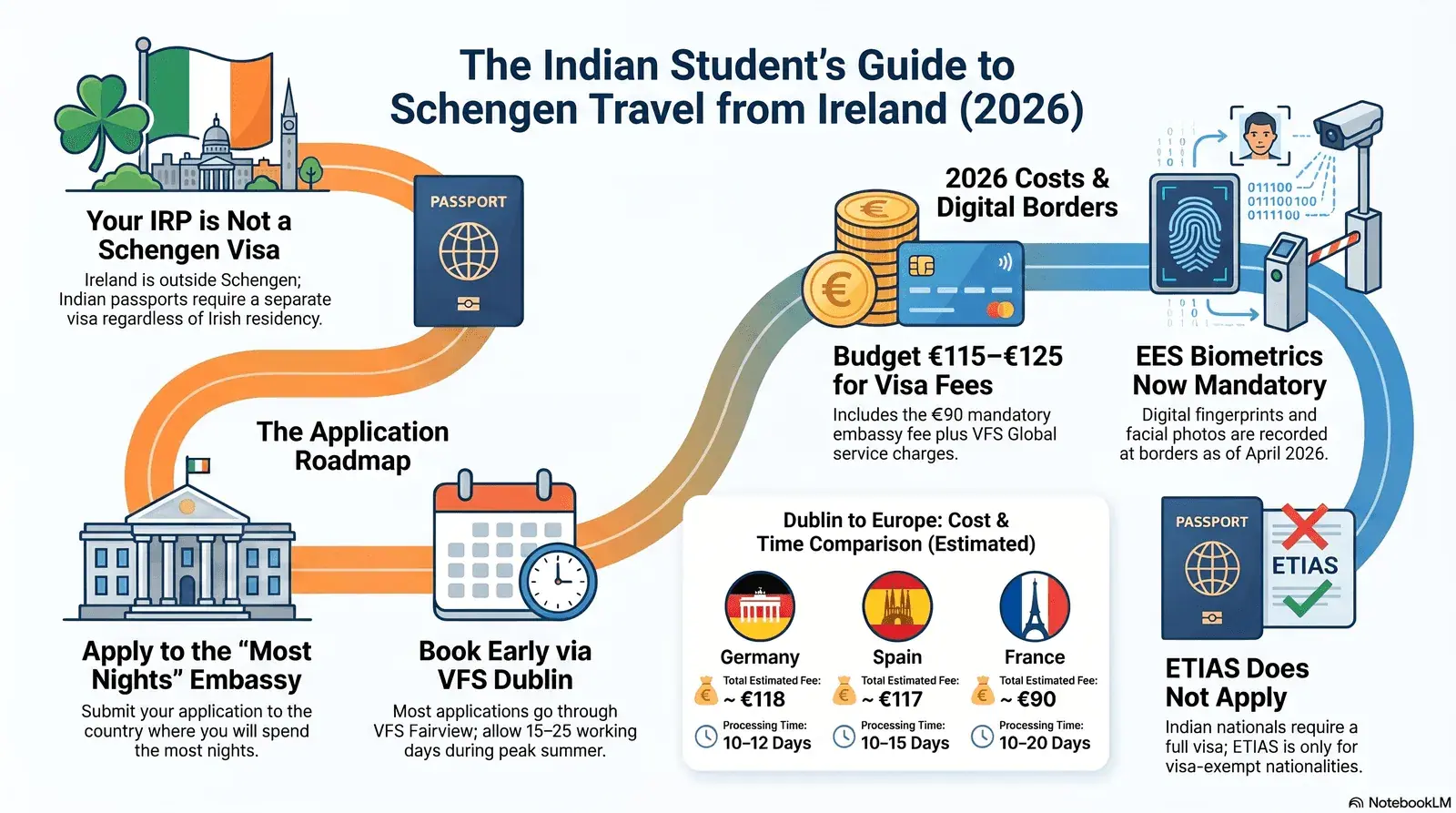
- Your Stamp 2 is not a Schengen visa: Ireland is outside the Schengen Area. Indian passport holders need a separate Schengen visa regardless of their Irish residency status or IRP card validity.
- Apply to the right embassy: Apply to the embassy of the country where you spend the most nights. The standard visa fee is €90 (set by EU regulation), plus a VFS Global service charge of approximately €25–€35. Allow 15–25 working days for processing.
- EES is live since 10 April 2026: Fingerprints and a facial photo are now recorded digitally at every Schengen border crossing. ETIAS does not apply to Indian nationals — only to visa-exempt nationalities.
Is Ireland in Schengen?
No — Ireland opted out. Schengen has 29 member states; Ireland is not one.
Schengen visa fee (2026)
€90 embassy fee + ~€25–€35 VFS service charge = ~€115–€125 total
Processing time
10–15 working days standard; up to 25 days during summer peak
EES effective date
Fully operational since 10 April 2026 at all Schengen external borders
In this guide
- Why Ireland is not in the Schengen Area
- What your Stamp 2 does and does not cover
- Step-by-step: how to apply for a Schengen visa from Ireland
- Which embassy to apply to — jurisdiction rules
- EES: the new biometric border system from April 2026
- ETIAS vs EES — what each one means for Indian nationals
- Schengen country comparison: processing times and fees
- Cheapest Schengen trips from Dublin for students on a budget
1. Why Ireland is Not in the Schengen Area — Explained Simply
Ireland deliberately opted out of the Schengen Area when the agreement was being developed, and its opt-out is enshrined in a protocol to the EU Treaties — meaning it cannot join Schengen without a full renegotiation of those treaties. Ireland shares a land border with Northern Ireland (part of the UK, which also left Schengen), and maintaining the Common Travel Area (CTA) with the UK was a higher political priority than Schengen membership. The CTA allows free movement between Ireland, the UK, the Isle of Man, Jersey, and Guernsey — a separate travel zone entirely.
As of June 2026, the Schengen Area includes 29 countries: the 25 EU member states that participate (all except Ireland, Cyprus, Romania, and Bulgaria — the latter two joined only in January 2025 for air/sea borders), plus four non-EU countries: Switzerland, Norway, Iceland, and Liechtenstein. Romania and Bulgaria completed their full Schengen land border accession in March 2025.
The Irish government has periodically discussed Schengen membership, but as of mid-2026 there is no active accession process. For the foreseeable future, Ireland will remain outside Schengen and Irish residency documents will carry no weight at Schengen border crossings.
2. What Your Irish Stamp 2/Stamp 1G Does NOT Cover for Europe Travel
Your Irish Residence Permit (IRP) with Stamp 2 (full-time student permission) or Stamp 1G (post-study graduate permission) grants you the right to live, study, and work in Ireland only — it does not function as a travel document for any other country, including Schengen members. This is a critical distinction that catches many Indian students off guard.
Specifically, your Stamp 2 IRP card does not:
- Allow visa-free entry to any of the 29 Schengen countries
- Substitute for a Schengen visa at any port of entry
- Grant any right to transit through a Schengen airport without a visa (unless you hold a valid UK visa alongside it — the UK Visa Schengen transit concession applies in some cases)
- Act as evidence of "sufficient ties" to automatically guarantee a Schengen visa (though it is helpful evidence for the officer)
What your Irish IRP does help with when applying for a Schengen visa:
- It proves you are legally resident in Ireland and therefore entitled to apply to Schengen embassies in Dublin (rather than in India)
- It serves as supporting evidence that you have a reason to return to Ireland after the Schengen trip (strong tie to your host country — a positive factor in visa assessment)
- It enables you to use Irish bank statements, university enrollment letters, and Irish accommodation proof as your financial and residential documentation
3. Step-by-Step: How to Apply for a Schengen Visa from Ireland
The application process in Ireland is straightforward but document-intensive — expect to gather materials over two to three weeks before your appointment. Here is the complete process for Indian students applying from Dublin in 2026:
Step 1 — Determine which embassy to apply to
Apply to the embassy of the Schengen country where you will spend the most nights. If you spend equal nights in two countries, apply to the first country of entry. See Section 4 for the full jurisdiction matrix.
Step 2 — Book your VFS Global appointment
Most Schengen embassies in Dublin process applications through VFS Global, whose Dublin centre is at Fairview, Dublin 3. France and Italy maintain their own visa sections directly. Book your VFS appointment online at the specific country's VFS portal. During June–August peak season, appointment slots can fill up 3–4 weeks in advance — book as early as possible. VFS Dublin operates Monday–Friday, 8:00 AM–3:00 PM for submissions and 2:00 PM–4:00 PM for passport collection.
Step 3 — Gather your documents
The core document set for a student applicant in Ireland is standardised across all Schengen embassies. Required documents include:
- Valid Indian passport — must be valid for at least 3 months beyond your planned Schengen departure date, with at least 2 blank pages
- Current IRP card (Stamp 2 or Stamp 1G) — front and back photocopy; must be valid for 3 months beyond your return date
- Completed Schengen visa application form (available from the embassy or VFS portal)
- Two recent passport-size photographs (35×45mm, white background, within the last 6 months)
- Irish bank statements for the last 3–6 months — stamped and signed on every page; most embassies require a minimum balance equivalent to €70–€100 per day of your stay (e.g. a 10-day trip requires approximately €700–€1,000 visible)
- College enrollment letter confirming your current student status and expected graduation date
- College ID card (photocopy)
- Proof of accommodation in Schengen territory (hotel booking confirmation, Airbnb reservation, or invitation letter from a host with their address proof)
- Travel itinerary with confirmed onward and return flights (note: some embassies accept provisional bookings — check the specific embassy's guidance)
- Travel insurance with a minimum medical coverage of €30,000, valid for the entire Schengen area and the full duration of your stay, including medical repatriation and emergency hospital cover
- Proof of accommodation in Ireland (lease agreement or college accommodation letter)
Step 4 — Attend your appointment and provide biometrics
You must attend in person at the VFS centre to have your fingerprints (all 10 fingers) and a facial photograph taken. Biometric exemptions apply only to children under 12, applicants who provided biometrics within the past 59 months (you can reuse them), and those with documented medical conditions preventing fingerprinting. Payments for the embassy fee and VFS service charge are made by debit or credit card at the centre — no cash accepted as of 2026.
Step 5 — Track and collect
Visa decisions are typically communicated within 10–15 working days; during summer peak (June–August), allow up to 25 working days. You can track your application online through the VFS portal. Passport collection is in person or via courier (fee applies). The Schengen visa sticker will specify the allowed entry dates, number of entries, and maximum days of stay (usually 90 days within any 180-day rolling window).
On-the-Ground Insight: "I applied for a Spain Schengen visa from Dublin in April for my May trip. I submitted everything online through VFS, attended my biometrics appointment in Fairview, and had my passport back in 9 working days. The most time-consuming part was getting my AIB bank statement stamped — they only do it at certain branches and you need to go in person. Book that at least a week before your VFS appointment." — Priya N., MSc Data Analytics, UCD, Class of 2026
4. Which Embassy to Apply to — Jurisdiction Rules Explained
The Schengen jurisdiction rule is clear: apply to the embassy of the country where you will spend the most nights on your trip. If you spend equal time in multiple countries, the first country of entry determines which embassy processes your application. If you are visiting only one country, that country's embassy handles your application regardless of entry route.
| Trip type | Which embassy? | Example | Application route in Dublin |
|---|---|---|---|
| Single Schengen country | That country's embassy | Only visiting France | French Embassy Dublin (direct — no VFS) |
| Multiple countries, one dominant | Country with most nights | 5 nights Spain, 2 nights Portugal | Spanish Consulate via VFS Global Dublin |
| Multiple countries, equal nights | First country of entry | 3 nights Netherlands + 3 nights Germany, enter Amsterdam first | Dutch Embassy via VFS Global Dublin |
| Transit only (no stay) | Transit country's embassy | Layover in Amsterdam en route to USA | Airport Transit Visa (check if required for Indian passport — generally yes) |
Key embassies in Dublin that handle Schengen visas for Indian applicants, as of June 2026:
- Embassy of France in Dublin — processes France visas directly (no VFS)
- Embassy of Italy in Dublin — processes Italy visas directly
- Germany, Spain, Netherlands, Sweden, Belgium, Austria — all via VFS Global Dublin
5. EES — The New Biometric Border System Live from 10 April 2026: What Changes at Schengen Borders
The EU Entry/Exit System (EES) became fully operational across all 29 Schengen external borders on 10 April 2026, replacing the traditional passport stamp with an automated digital registration that records your biometric data every time you cross a Schengen external border. For Indian students travelling from Ireland, this changes the experience at the border — but not whether you need a visa.
What EES records on each crossing:
- Your name and travel document details (passport number, expiry date)
- Four fingerprints and a facial photograph (captured in under 2 minutes at manned booths)
- Date and place of entry and date and place of exit
This data is stored for 3 years for visa holders (including Schengen visa holders like Indian students) and used to automatically calculate how many days you have used within any 180-day rolling window — the system will alert border officers if you have exceeded or are close to your 90-day maximum.
How EES works in practice at the airport
On your first entry into the Schengen Area after 10 April 2026, expect a slightly longer wait at passport control — approximately 5–10 extra minutes for initial biometric registration. After the first registration, subsequent entries are faster because your biometrics are already on file. Here is what happens step by step:
- Approach the manned border booth (for visa holders, you cannot use automated EES kiosks on first entry)
- Present your Indian passport and Schengen visa
- The border officer will ask you to place your fingers on a scanner — four fingerprints are taken
- A camera captures your facial image
- The system verifies your visa validity and checks your remaining allowable days
- You are cleared and can proceed — no physical stamp is placed in your passport
EES also makes overstaying far more detectable. Under the old system, worn or obscured stamps sometimes made it hard to track overstays. EES records entry and exit precisely and automatically flags anyone who has exceeded 90 days in 180. For students planning short trips — weekend breaks or one-week holidays — this system creates no complications. For anyone tempted to stretch a Schengen trip beyond their visa's validity, the consequences (ban from Schengen for up to 5 years) are now enforced algorithmically.
6. ETIAS vs EES — What Each Means for Indian Nationals in 2026
Indian nationals do not need ETIAS — it applies only to visa-exempt nationalities such as US, UK, and Australian passport holders. The European Commission itself clarified this point in April 2026: if your nationality requires a Schengen visa (as India does), you apply for and use that visa, and ETIAS is not required or applicable.
| System | Who it applies to | When it applies | Applicable to Indian passport holders? | Status in June 2026 |
|---|---|---|---|---|
| EES (Entry/Exit System) | ALL non-EU/Schengen nationals | At every Schengen border crossing | Yes — biometrics recorded every crossing | Live since 10 April 2026 |
| ETIAS (Travel Authorisation) | Visa-exempt nationalities only (US, UK, Canada, Australia, etc.) | Before travel — applied for online | No — Indian nationals need a visa instead | No confirmed date — EU withdrew its 2026 target in July 2026 |
When ETIAS launches (expected late 2026 or early 2027), it will require visa-exempt travellers to pay a €20 fee (raised from the originally planned €7) and receive a pre-travel authorisation valid for 3 years. This will not affect Indian students at all — your Schengen visa already serves as the pre-travel clearance.
7. Schengen Country Comparison: Fees, Processing Times and Tips for Indian Students in Dublin
The €90 embassy fee is fixed by EU regulation and is identical regardless of which Schengen country you apply to — the variation lies in VFS service charges and processing speed. Here is a comparison of the most popular Schengen destinations for Indian students in Ireland:
| Destination | Embassy fee (2026) | VFS service charge (approx.) | Total cost | Typical processing from Dublin | Application route |
|---|---|---|---|---|---|
| France | €90 | N/A (direct) | ~€90 | 10–20 working days | French Embassy Dublin direct |
| Spain | €90 | ~€27 | ~€117 | 10–15 working days | VFS Global Dublin |
| Germany | €90 | ~€28 | ~€118 | 10–12 working days | VFS Global Dublin |
| Italy | €90 | N/A (direct) | ~€90 | 15–25 working days | Italian Embassy Dublin direct |
| Netherlands | €90 | ~€25 | ~€115 | 10–15 working days | VFS Global Dublin |
| Portugal | €90 | ~€35 | ~€125 | 15–20 working days | VFS Global Dublin |
| Greece | €90 | ~€27 | ~€117 | 10–15 working days | VFS Global Dublin |
| Belgium | €90 | ~€26 | ~€116 | 12–18 working days | VFS Global Dublin |
Travel insurance is an additional mandatory cost. A single-trip policy covering the entire Schengen zone with €30,000 medical coverage typically costs €18–€35 from Irish providers such as AXA Ireland or Allianz Ireland, depending on destination, duration, and your age. Multi-trip annual policies (useful if you plan 3+ Schengen trips per year) run approximately €80–€120 per year and pay for themselves from the third trip onward.
Can my parents' Indian bank account substitute for my Irish bank statement?
Generally no — Schengen embassies in Dublin expect to see financial proof based in Ireland, given that you are applying as an Irish resident. Some embassies accept a sponsor letter from parents combined with their Indian bank statements, but this raises flags about your financial self-sufficiency as a student. The simplest and most reliable approach is to maintain €1,000–€1,500 in your Irish account (AIB, Bank of Ireland, or even Revolut Irish IBAN) and submit a 3–6 month statement from it. Some embassies do not accept Revolut statements — always check the specific embassy's document requirements.
8. Cheapest Schengen Trips from Dublin for Students on a Budget (2026)
Despite the visa overhead, European getaways from Dublin can be remarkably affordable — return flights from Dublin to popular Schengen cities start from as low as €30–€50 on Ryanair and Aer Lingus when booked 4–6 weeks in advance, and a full weekend trip to Lisbon or Barcelona can be done for under €250 total including flights, visa, accommodation, and food.
Budget breakdown for a 4-day Lisbon long weekend in October 2026 (illustrative scenario based on current fares):
| Cost item | Estimated cost | Notes |
|---|---|---|
| Return flight DUB–LIS (Ryanair) | €45–€90 | Cheapest month: November; October similar |
| Schengen visa (Portugal via VFS) | ~€125 | €90 embassy + ~€35 VFS service charge |
| Travel insurance (4 days) | €18–€25 | Min €30,000 medical cover required |
| Hostel/budget hotel (3 nights) | €60–€120 | Hostels in Lisbon average €20–€30/night per bed |
| Food & local transport | €50–€80 | Lisbon is notably affordable by Western European standards |
| Total estimate | ~€298–€440 | Lower end achievable with mid-week flights and hostel booking |
True Trip Cost = Return Flight + Schengen Visa Fee + VFS Service Charge + Travel Insurance + Accommodation + Daily Spend
The visa cost (€115–€125) is a fixed overhead on every Schengen trip regardless of destination. This means shorter, cheaper flights (a €45 Ryanair to Lisbon vs. a €70 Aer Lingus to Barcelona) make a proportionally bigger difference than the destination. Optimise your flights first.
Top 5 budget Schengen destinations from Dublin in 2026 for Indian students
| Destination | Cheapest flight (return, DUB) | Best months | Why it works for students |
|---|---|---|---|
| Lisbon, Portugal | €30–€60 (Ryanair) | November, March, April | Affordable city, warm weather extends into October, strong hostel scene |
| Barcelona, Spain | €35–€75 (Ryanair/Aer Lingus) | November, February | Direct flights, 24-hour metro, beaches + cultural sites |
| Amsterdam, Netherlands | €40–€80 (Ryanair/Aer Lingus) | January, October | High train connectivity to rest of Europe if combining countries |
| Berlin, Germany | €50–€90 (Ryanair/Aer Lingus) | January, November | Budget accommodation, vibrant student scene, VFS turnaround fastest |
| Vienna, Austria | €50–€100 (Ryanair) | January, February | Cheapest return found recently was €70; excellent public transport |
The key timing insight: January and November consistently deliver the cheapest Dublin-to-Europe fares across nearly every Schengen city. If your semester break falls in those months, book immediately and plan your Schengen application 6–8 weeks ahead to allow for processing. If you are travelling in summer (June–August), expect to pay 40–80% more for the same flights and apply for your visa at least 6 weeks before travel due to peak processing backlogs at VFS Dublin.
How to pay for your trip without losing money to forex fees
Using an Indian debit or credit card abroad within the Schengen zone typically incurs a Dynamic Currency Conversion (DCC) trap if you allow the merchant to charge you in INR — always select the local currency (EUR) at every terminal. Beyond that, Indian cards often carry a forex markup of 2–3.5% on top of every transaction. For a €300 trip budget, that is an invisible €6–€10.50 extra cost on every swipe.
If you have an Irish bank account with AIB, Bank of Ireland, or a euro-native fintech card like Revolut (Irish IBAN, euro account), you face no forex fees within the Schengen zone — transactions are EUR to EUR. This is by far the most cost-efficient option for students already based in Ireland. Revolut's free-tier weekend foreign exchange freeze (Saturday/Sunday surcharge) does not apply within the eurozone.
Frequently Asked Questions
Does an Irish Stamp 2 allow Indian students to travel to Schengen countries?
No. Ireland is not part of the Schengen Area. An Irish Stamp 2 (student permission) allows you to live and study in Ireland only. If you hold an Indian passport, you must apply for a separate Schengen visa before visiting any of the 29 Schengen countries, regardless of your Irish residency status.
Which Schengen embassy should I apply to from Ireland?
Apply to the embassy of the country where you will spend the most nights. If you are visiting multiple countries for equal durations, apply to the embassy of the first country you will enter. Most Schengen embassies in Dublin use VFS Global for appointment and document submission.
What is the Schengen visa fee for Indian students in Ireland in 2026?
The standard Schengen visa application fee is €90 (approximately £76 or ₹8,300) as of 2026. This goes directly to the embassy. You will also pay a VFS Global service charge, which varies by country but typically ranges from €25-€35. Total all-in cost is approximately €115-€125.
What is EES and how does it affect Indian students travelling through Schengen borders in 2026?
The EU Entry/Exit System (EES) became fully operational on 10 April 2026. It replaces passport stamping with a digital registration system that records your fingerprints, facial photograph, name, travel document, and the date and place of entry and exit at every Schengen border crossing. As an Indian visa holder, you will have your biometrics taken at the manned border booth on your first Schengen entry.
Do Indian students in Ireland need ETIAS to travel to Schengen countries?
No. ETIAS (European Travel Information and Authorisation System) is only required for visa-exempt nationalities. Since Indian passport holders require a Schengen visa, they do not need ETIAS. However, all Schengen border crossings are now automatically registered under EES regardless of whether you hold a visa or are visa-exempt.
Planning your flight from India to Dublin or Dublin to Europe?
Compare live fares before you book — our fare calendar tracks price movements on India–Ireland routes so you can spot the best window to buy.
All information in this article is based on publicly available official sources as of June 2026, including the European Commission's Migration and Home Affairs portal, Citizens Information Ireland, Irish Immigration Service, and individual Schengen embassy guidance published in Dublin. Visa fees, processing times, and EES/ETIAS rules are subject to change. Always verify current requirements directly with the relevant embassy or the European Commission Schengen portal before submitting your application. MyFlightOffers is not affiliated with any embassy, VFS Global, or immigration authority. This article does not constitute immigration or legal advice.
- NEW Ireland to Schengen Visa Guide 2026 — this article
- Study in Ireland 2026: Visa, Housing & IRP Complete Guide — everything you need to know before arriving, including Stamp 2 registration
- Ireland Banking Guide for International Students 2026 — how to open an Irish bank account, get an IBAN, and manage your money
- The Indian Student's Money Survival Guide in Ireland — TCS, remittance, forex cards, and making your money go further
- Stress-Free Travel Guide for Students 2026 — packing, transit visas, airport connections, and what to do if flights are delayed