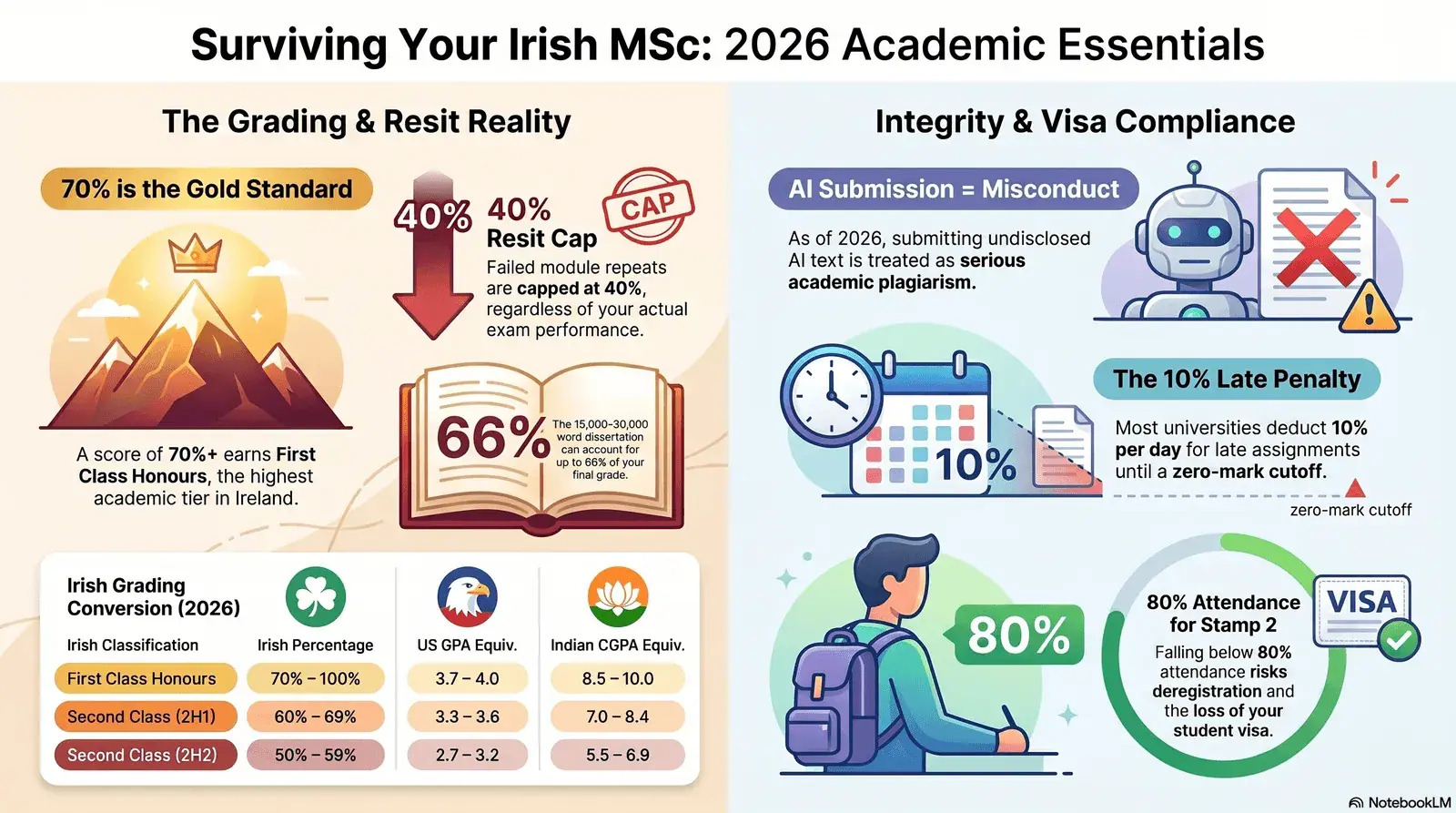
- First Class Honours starts at 70% — not 90% or 80% as in many other countries; understand the Irish grading bands (Pass 40–49%, 2.2 50–59%, 2.1 60–69%, 1st 70%+) before your first assignment.
- A resit grade is capped at exactly 40% regardless of how well you perform — failing a module has a permanent transcript impact, so treat every exam as your only chance.
- Turnitin and AI detection are standard practice at every Irish university; a plagiarism finding can trigger a formal academic misconduct process that puts your Stamp 2 visa at risk if it results in programme exclusion.
🎓 First Class Honours threshold
70% and above
NFQ Level 8 & 9 · QQI-defined
📉 Module pass mark
40% per module
Programme overall: 50% for MSc award
🔁 Resit grade cap
Maximum 40% on any repeat
Even if you score 95% — still recorded as 40%
📄 MSc dissertation
15,000–20,000 words
30–60 ECTS · Submitted August/September
10 questions answered in this guide
- How does the Irish university grading system work?
- How does my Irish grade convert to a GPA or CGPA?
- What is QQI and how does it certify your Irish degree?
- How does Turnitin work at Irish universities?
- What are the AI content detection policies in 2026?
- What is continuous assessment and how is it different?
- What exactly happens if you fail a module?
- How does the resit process work — and what is the 40% cap?
- How can academic failure affect your Stamp 2 visa?
- What does the MSc dissertation require and how is it graded?
1 How Does the Irish University Grading System Work?
The Irish university grading system classifies performance into named award bands, not raw percentages. A score of 70% or above earns a First Class Honours — the highest classification available — while 40% is the minimum threshold to pass an individual module. This framework applies to both undergraduate programmes (NFQ Level 8) and taught postgraduate Master's degrees (NFQ Level 9), and is standardised across all institutions recognised by Quality and Qualifications Ireland (QQI).
The classification bands for a taught Master's (NFQ Level 9) at the module and programme level are:
| Classification | Grade Band | Programme Award | What It Signals |
|---|---|---|---|
| First Class Honours | 70% – 100% | Distinction | Exceptional performance; highly competitive for PhD entry and graduate employers |
| Second Class Honours Grade 1 (2H1) | 60% – 69% | Merit | Strong result; most common classification for high-performing international students |
| Second Class Honours Grade 2 (2H2) | 50% – 59% | Pass | Awarded the degree; recognised by most employers; limits PhD direct entry |
| Module Pass (no degree classification) | 40% – 49% | — | Individual module passed; programme overall must still reach 50% to graduate |
| Fail | Below 40% | Fail | Resit required; both original and repeat grades appear on transcript |
In many Indian university systems, 70% indicates solid but unremarkable performance. In Ireland, 70% places you in the top tier of graduates. Equally, scoring 55% in an Irish module does not mean you have performed poorly — you have passed with a programme-level Merit-band score. Calibrate your expectations before your first submission or you will interpret a 2H2 result as failure when it is, academically, a full pass.
One important technical distinction: many Irish programmes describe the overall degree award using the terms Distinction, Merit, and Pass at programme level, while individual module grades use the First Class / Second Class Honours bands shown above. Your final degree parchment will show the programme-level award; your transcript will show every module grade individually.
2 How Does My Irish Grade Convert to a GPA or CGPA?
Irish universities do not issue GPA scores on transcripts. Your official document shows a percentage grade per module and an overall award classification. Converting these to a US GPA or Indian CGPA requires using the approximate equivalency scales below — and for formal recognition, a NARIC Ireland assessment.
| Irish Classification | Irish % | US GPA (4.0 Scale) | Indian CGPA (/10) | Indian % Approx. |
|---|---|---|---|---|
| First Class Honours | 70% – 100% | 3.7 – 4.0 | 8.5 – 10.0 | 75%+ |
| Second Class Honours Grade 1 | 60% – 69% | 3.3 – 3.6 | 7.0 – 8.4 | 65% – 74% |
| Second Class Honours Grade 2 | 50% – 59% | 2.7 – 3.2 | 5.5 – 6.9 | 55% – 64% |
| Pass (module level) | 40% – 49% | 2.0 – 2.6 | 4.0 – 5.4 | 45% – 54% |
For employment applications, visa sponsorship, or further study that requires a formally recognised international equivalency of your Irish qualification, use NARIC Ireland — the National Academic Recognition Information Centre operated by QQI. NARIC Ireland also evaluates foreign qualifications presented to Irish universities and employers. The table above uses widely cited approximate equivalencies; your individual situation may differ.
🧮 Irish MSc Weighted Grade & Classification Calculator
Input your individual module credits and grades to compute your overall weighted average grade and determine your projected degree classification under the Irish QQI framework.
The example grades of 58 and 62 are illustrative module marks, not grade boundaries — enter your own.
| Module Name | Credits (ECTS) | Grade (%) | Resit? |
|---|---|---|---|
3 What Is QQI and How Does It Certify Your Irish Degree?
Quality and Qualifications Ireland (QQI) is the statutory body established under the Qualifications and Quality Assurance (Education and Training) Act 2012. It maintains the National Framework of Qualifications (NFQ) — the 10-level hierarchy that determines the standard and level of every educational award in Ireland. Your Master's degree sits at NFQ Level 9. Your Honours Bachelor's sits at NFQ Level 8. A PhD is NFQ Level 10.
For international students, QQI matters in three practical ways. First, it ensures your Irish degree is recognised within the EU through the Bologna Process framework, which aligns qualifications across 49 European countries. Second, QQI quality-assures the institutions and programmes you attend — your programme must be on the Interim List of Eligible Programmes (ILEP), maintained by the Higher Education Authority (HEA), for your Stamp 2 student permission to be valid. Third, when you graduate and apply for employment or PhD programmes globally, NARIC Ireland provides the official documentation that translates your Irish grade into a format your prospective employer or institution can verify.
4 How Does Turnitin Work at Irish Universities?
Turnitin is the plagiarism detection platform used by all major Irish universities, including Trinity College Dublin, UCD, UCC, DCU, and University of Galway. It compares your submitted work against billions of academic sources, web pages, student submissions, and published journals, then returns a Similarity Score as a percentage. Critically, a high similarity score is not automatically plagiarism — and a low score is not automatically clean work.
Your lecturer reviews the full Turnitin report, not just the percentage. A 30% similarity score composed entirely of properly cited blockquotes may be acceptable. A 6% similarity score containing a three-sentence paraphrase of a source without attribution may constitute misconduct. The percentage is a screening tool, not a verdict.
| Severity Level | Typical Conduct | Standard Consequence |
|---|---|---|
| Level 1 — Minor | Unintentional, isolated inadequate citation | Written warning; opportunity to resubmit; grade penalty (typically −10%) |
| Level 2 — Moderate | Deliberate uncited passages; section-level copying | Zero mark on the specific assignment; academic record note |
| Level 3 — Serious | Systematic plagiarism across multiple sections or assignments | Module failure; formal Programme Board hearing; potential programme suspension |
| Level 4 — Severe | Contract cheating (paid submission services); fabricated research data; identity fraud | Programme expulsion; potential referral under Irish law; permanent academic record notation |
5 What Are the AI Content Detection Policies in 2026?
As of 2026, submitting AI-generated text as your own original work is treated as academic misconduct at all major Irish universities — functionally equivalent to plagiarism under their academic integrity policies. Turnitin's AI Writing Detection module, launched in 2023 and widely deployed across Irish institutions from 2024 onward, flags text that displays statistical patterns characteristic of large language model outputs. Lecturers receive an AI percentage indicator alongside the standard Similarity Score.
The institutional positions are nuanced — but the line is clear:
- Using AI to brainstorm, outline, or research is generally permitted. Using AI to draft and not disclosing it is not.
- Using AI-generated text with proper disclosure (noting in your submission that Section X was drafted with AI assistance and subsequently edited) is permitted on many programmes, but check your specific module policy — some assessments explicitly prohibit any AI use.
- Using AI to write your dissertation falls unambiguously into Level 3 or Level 4 misconduct at all institutions. The dissertation is a demonstration of original independent research. No disclosure provision resolves this.
AI policies are currently set at the individual programme and module level, not university-wide. Your Business Analytics module may prohibit AI entirely. Your Research Methods module may require that you use AI tools as part of the learning outcomes. The only document that governs your specific assessment is the module descriptor or assessment brief your lecturer provides. Do not assume a blanket rule applies.
6 What Is Continuous Assessment and How Is It Different?
Continuous Assessment (CA) is the dominant assessment model for Irish MSc programmes. Rather than one or two high-stakes final examinations, your grade accumulates across multiple assignments, group projects, presentations, and in some modules, a shorter end-of-semester exam. For students from Indian, Chinese, or other university systems where a single three-hour paper determines 70–100% of the module grade, this is one of the most significant adjustments to make.
A typical Irish MSc module might be structured as follows:
| Assessment Component | Typical Weighting | Format |
|---|---|---|
| Individual written assignment (case study / report) | 30% – 40% | 1,500 – 3,000 words; submitted online |
| Group project with presentation | 25% – 35% | Team deliverable + 10–15 min class presentation |
| Mid-module quiz or participation | 10% – 15% | Online MCQ or in-class discussion |
| End-of-semester exam (where applicable) | 20% – 40% | Closed or open-book; 2–3 hours |
Group work deserves special attention. Irish MSc cohorts are highly international, and lecturers expect all group members to contribute. Peer assessment components are increasingly common — where your teammates score your individual contribution separately from the group output. Turning up to the presentation having done minimal work will be visible, scored, and on your transcript.
7 What Exactly Happens If You Fail a Module?
If you score below 40% in any module, you fail that module. Most Irish universities grant one repeat opportunity — either a resit examination in August or a resubmission of the failed coursework element. Failing a module does not automatically mean you are removed from your programme, but it does immediately affect your degree classification calculation, and the consequences compound if the failure is not addressed.
The standard sequence of events after a module failure:
- Results are released (typically in January for Semester 1, May or June for Semester 2).
- A formal notification is sent to your student email confirming the failure and your repeat entitlement.
- You are assigned a repeat mechanism — either a new exam sitting or a fresh submission brief.
- The repeat takes place in the university's summer repeat examination session, typically August.
- August results are released, and the capped grade of 40% (regardless of your actual performance) is entered into your academic record.
- Both the original fail grade and the repeat grade appear permanently on your official transcript.
"I failed Data Analytics in Semester 1 — got 37%. I didn't really understand the resit rules until I met my programme director in February. I studied hard, sat the August repeat, and scored 79%. My transcript still shows 40%. That one module pulled my overall average down by nearly five points and dropped me from a potential Distinction to a Merit. I wish someone had explained this to me in September, not March."— Priya R., MSc Business Analytics, University of Galway, 2025 cohort
8 How Does the Resit Process Work — and What Is the 40% Cap?
The 40% cap is the single most consequential rule that international students routinely fail to understand before it affects them. It means that no matter how well you perform in a repeat examination or resubmission, your grade for that module is recorded as a maximum of 40% on your official transcript and used in your final classification calculation at 40%.
| Attempt | Scenario | Grade Recorded | Cap Applied |
|---|---|---|---|
| First submission | Normal marking; full range available | Actual mark (e.g., 38%) | None |
| Repeat (resit) | August exam or resubmission | Capped at 40% regardless of actual score (e.g., 85% → recorded as 40%) | 40% maximum |
| Second repeat (rare) | Programme Board discretion only | Varies; typically same cap applies | Varies |
| No repeat granted | Module permanently failed | Fail on transcript; programme exit may follow | N/A |
In a 90 ECTS MSc programme, a typical module carries 5–10 ECTS. If one 10 ECTS module contributes roughly 11% of your weighted average, and a 72% first-attempt grade is replaced by a 40% cap after a resit, the impact on your cumulative average is approximately −3.5 percentage points. That can move a borderline Distinction (71% overall) to a Merit (67% overall). Check your programme's ECTS weighting for each module before your first submission — the heaviest weighted modules are the ones where failure is most costly.
The summer resit session at most universities runs from late July to mid-August, with results released in September. If you have a resit, you are not expected to attend campus during that period — but your Stamp 2 permission remains valid and you must ensure your university registration is maintained. Contact your International Student Office if you are unsure of your enrolment status during the summer resit window.
9 How Can Academic Failure Affect Your Stamp 2 Visa?
Failing a module does not automatically revoke your Stamp 2 student permission. But the chain of events that can follow module failure — missed attendance thresholds, programme deregistration, or failure to re-enrol — can. Stamp 2 is not a visa; it is a condition of your registration certificate with the Immigration Registration Office (GNIB/IRP), and it is conditional on your continued full-time enrolment on an approved ILEP programme.
The specific academic failure scenarios that create immigration risk:
- Attendance below 80%: Most Irish universities require a minimum of 80% attendance across all taught modules. Falling below this threshold can trigger a formal non-attendance warning, and in serious cases, deregistration from the programme. Deregistration ends your ILEP enrolment and the basis for your Stamp 2.
- Failing to resit when required: If you are entitled to a repeat and do not take it, the module remains failed. Depending on your programme's exit requirements, this may prevent you from progressing to Semester 2 or graduating — which again affects programme standing.
- Repeating a year: If you fail enough modules to require repeating the year, you must formally re-enrol with your university. This extended enrolment allows you to apply for a Stamp 2 renewal at the Irish Immigration Service, but the renewal is not automatic — you must present proof of current valid enrolment, attendance, and fee payment.
Every major Irish university has a dedicated International Student Office that coordinates between the academic registry and the immigration registration authorities. If you are at risk of failing a module, contact this office before the results are finalised. They have experience navigating the intersection of academic difficulty and visa status, and can advise you on your options — including deferral, leave of absence, or re-enrolment pathways — before a recoverable academic problem becomes an unrecoverable immigration one.
10 What Does the MSc Dissertation Require and How Is It Graded?
The dissertation is the capstone of your Irish Master's degree and the single highest-weighted component in the entire programme. It typically carries between 30 and 60 ECTS credits out of a total 90 ECTS programme — meaning it may represent as much as two-thirds of your final classification weight — and requires 15,000 to 20,000 words of original, independently conducted research.
| Chapter | Typical Length | Approx. Mark Weight |
|---|---|---|
| Introduction & Research Question | 1,500 – 2,500 words | ~10% |
| Literature Review | 3,000 – 5,000 words | ~20% |
| Methodology | 2,000 – 3,500 words | ~20% |
| Findings & Data Analysis | 4,000 – 6,000 words | ~30% |
| Discussion & Conclusions | 2,000 – 3,000 words | ~15% |
| References & Appendices | As required | ~5% |
| Total | 15,000 – 20,000 words | 100% |
The standard dissertation timeline for a September-intake MSc:
- October – November: Research Methods module covers proposal writing; topic selection begins.
- January – February: Formal dissertation proposal submitted; supervisor allocated by your department.
- February – May: Literature review and methodology developed; data collection conducted (where applicable; ethics approval required for human subjects research — apply early, approval can take 6 – 8 weeks).
- June – August: Analysis, writing, and supervisor review meetings (typically fortnightly).
- August – September: Submission deadline (varies by institution and programme; typically between mid-August and mid-September).
If your research involves human participants — surveys, interviews, focus groups, or secondary data containing personal information — you must obtain ethical approval from your university's Research Ethics Committee before collecting any data. The application process varies by institution but typically takes four to eight weeks. Submit your ethics application at the same time as your dissertation proposal, not after. Collecting data before ethical clearance is a research integrity violation regardless of how innocuous the research appears to be.
At the 70% threshold, examiners are looking for original analysis and a genuine contribution to the existing literature — not just a competent summary of what others have found. The Findings and Discussion chapters carry the most weight. A research question you can defend, data you collected or analysed yourself, and conclusions that go beyond restating your sources: these are what separate a 68% (Merit) from a 72% (Distinction). Discuss your emerging findings with your supervisor regularly throughout the writing process, not only at the final review stage.
Quick-Reference FAQ
Q: What is a First Class Honours degree in Ireland?
A score of 70% or above across the weighted average of all modules
earns a First Class Honours. For a taught Master's (NFQ Level 9),
this is typically expressed as a Distinction on the degree
parchment.
Q: How does an Irish 2:1 compare to a US GPA?
A Second Class Honours Grade 1 (2H1, or Merit for a Master's)
corresponds to 60–69% and is approximately equivalent to a 3.3–3.6
GPA on the US 4.0 scale. For official recognition, request a NARIC
Ireland assessment via
qqi.ie.
Q: What is the minimum pass mark at Irish universities?
40% per individual module. The overall programme threshold for
awarding a taught Master's is typically 50%. Both thresholds apply
simultaneously — you must pass individual modules and reach the
programme average to graduate.
Q: What happens if I fail a module in my MSc?
You receive one repeat opportunity — usually a summer resit exam
or a resubmission. Your repeat grade is capped at a maximum of
40%, regardless of your actual performance. Both original and
repeat grades are shown on your transcript permanently.
Q: Is using AI tools like ChatGPT allowed for
assignments?
Submitting AI-generated text as your own work is treated as
academic misconduct at all major Irish universities. Limited,
disclosed AI assistance is permitted on many programmes. Check
your specific module assessment brief — policies vary by programme
and even by individual assignment.
Q: How long is a Master's dissertation in Ireland?
Typically 15,000–20,000 words. It is the highest-weighted
component of the programme (30–60 ECTS) and is submitted in August
or September of your final semester.
Q: Can academic failure affect my Stamp 2 student visa?
Yes — indirectly. Stamp 2 depends on your continued full-time
enrolment on an ILEP programme. Module failure does not directly
revoke Stamp 2, but deregistration or failure to maintain 80%
attendance can. Contact your International Student Office before
any academic difficulty becomes a registration issue.
Q: What is QQI?
Quality and Qualifications Ireland
maintains the National Framework of Qualifications (NFQ) and
operates NARIC Ireland. Your Irish Master's is NFQ Level 9. QQI
quality-assures the institutions you attend and provides
internationally recognised credential evaluations for employment
and further study outside Ireland.
This guide is part of the MyFlightOffers Study in Ireland resource for international students. Read the full series:
- Part 1 — Universities, Tuition Fees, Scholarships & Flights from India — top 10 universities, GOI-IES scholarship, cost of living breakdown, and booking your flight from Delhi or Mumbai to Dublin.
- Part 2 — Accommodation, Banking & Student Life → Coming soon
- Part 3 — Visa, Work Rights & Stamp 1G → Coming soon
- Ireland's One-Year Master's: Workload, Intensity & How Indian Students Cope (2026) — ECTS credit comparison, the Indian-to-Irish academic culture shift, semester-by-semester breakdown, and the month-by-month guide to managing year 1 effectively.
Planning to book your Dublin flight with an Indian bank card? Our guides cover the best cards for flight bookings, forex savings, and lounge access:
- Best HDFC Bank Cards for Flights & Travel 2026
- Best SBI Credit Cards for Flights & Travel 2026
- Best ICICI Bank Credit Cards for Flights & Travel 2026
- Airport Lounge Access in India: Complete Credit Card Guide 2026
- Finding Affordable Flights from Dublin to Delhi — visa requirements, airline guide, fare benchmarks, and booking windows.
- Is Ireland's One-Year Master's Recognised for PhD Admission? USA, Canada, Germany & Australia (2026) — Is Ireland's one-year Master's accepted for PhD entry in the USA, Canada, Germany and Australia? WES, ECTS thresholds and documented denial patterns.
Book your flight to Dublin before the August peak
Now that you know what to expect academically, find the best fare on your route — and book 3 to 5 months ahead of your September intake date to avoid the student surge surcharge.
Frequently Asked Questions
How does an Irish 2:1 (Second Class Honours Grade 1) compare to a US GPA?
A Second Class Honours Grade 1 (2H1) in Ireland corresponds to a grade range of 60-69%, broadly equivalent to a 3.3-3.6 GPA on the US 4.0 scale, or a 7.0-8.4 CGPA on the Indian 10-point scale. Official equivalency recognition requires evaluation through NARIC Ireland at qqi.ie.
What happens if I fail a module in my MSc in Ireland?
If you score below 40% in a module, you are typically entitled to one repeat or resit opportunity - usually a summer exam in August or a resubmission of failed coursework. The grade on any resit is capped at 40% regardless of performance. Both original and repeat grades appear on your official transcript, and the capped 40% is used in your final classification calculation.
Is using AI tools like ChatGPT allowed for assignments in Irish universities?
As of 2026, all major Irish universities treat submitting AI-generated text as your own work as academic misconduct. Most institutions permit AI as a research or brainstorming aid with explicit disclosure, but undisclosed AI-generated content is subject to the same disciplinary process as plagiarism. Always check your specific programme handbook before using any generative AI tool in assessed work.
Can failing modules affect my Stamp 2 student visa in Ireland?
Yes - indirectly but seriously. Your Stamp 2 student permission is conditional on continued full-time enrolment on an ILEP-listed programme. If academic failure leads to deregistration, you lose the basis for your Stamp 2. Repeating a year with university approval allows Stamp 2 renewal, but you must maintain at least 80% attendance and meet re-enrolment requirements. Contact your International Student Office before a failure becomes a deregistration.
What is QQI and why does it matter for international students?
QQI (Quality and Qualifications Ireland) is the statutory body that maintains the National Framework of Qualifications (NFQ) under the Qualifications and Quality Assurance Act 2012. Your Irish Master's degree sits at NFQ Level 9. QQI also operates NARIC Ireland, which provides official international recognition assessments for Irish qualifications - essential for employment or further study outside Ireland. Visit qqi.ie for official information.
All information about grading classifications, pass thresholds, resit rules, attendance requirements, academic integrity policies, Turnitin and AI detection practices, Stamp 2 immigration conditions, and dissertation requirements in this article is based on publicly available information from Quality and Qualifications Ireland (QQI), the Higher Education Authority (HEA), the Irish Immigration Service, and the official academic integrity and student handbooks published by Trinity College Dublin, University College Dublin, University College Cork, University of Galway, University of Limerick, and Dublin City University as of June 2026. University policies, programme structures, assessment weightings, and immigration rules are subject to change. Always verify current requirements directly with your university's academic registry, your programme director, and your International Student Office before making any academic or immigration decision. This article does not constitute legal, immigration, or academic advice. MyFlightOffers is not affiliated with any Irish university, QQI, HEA, or the Irish Immigration Service.