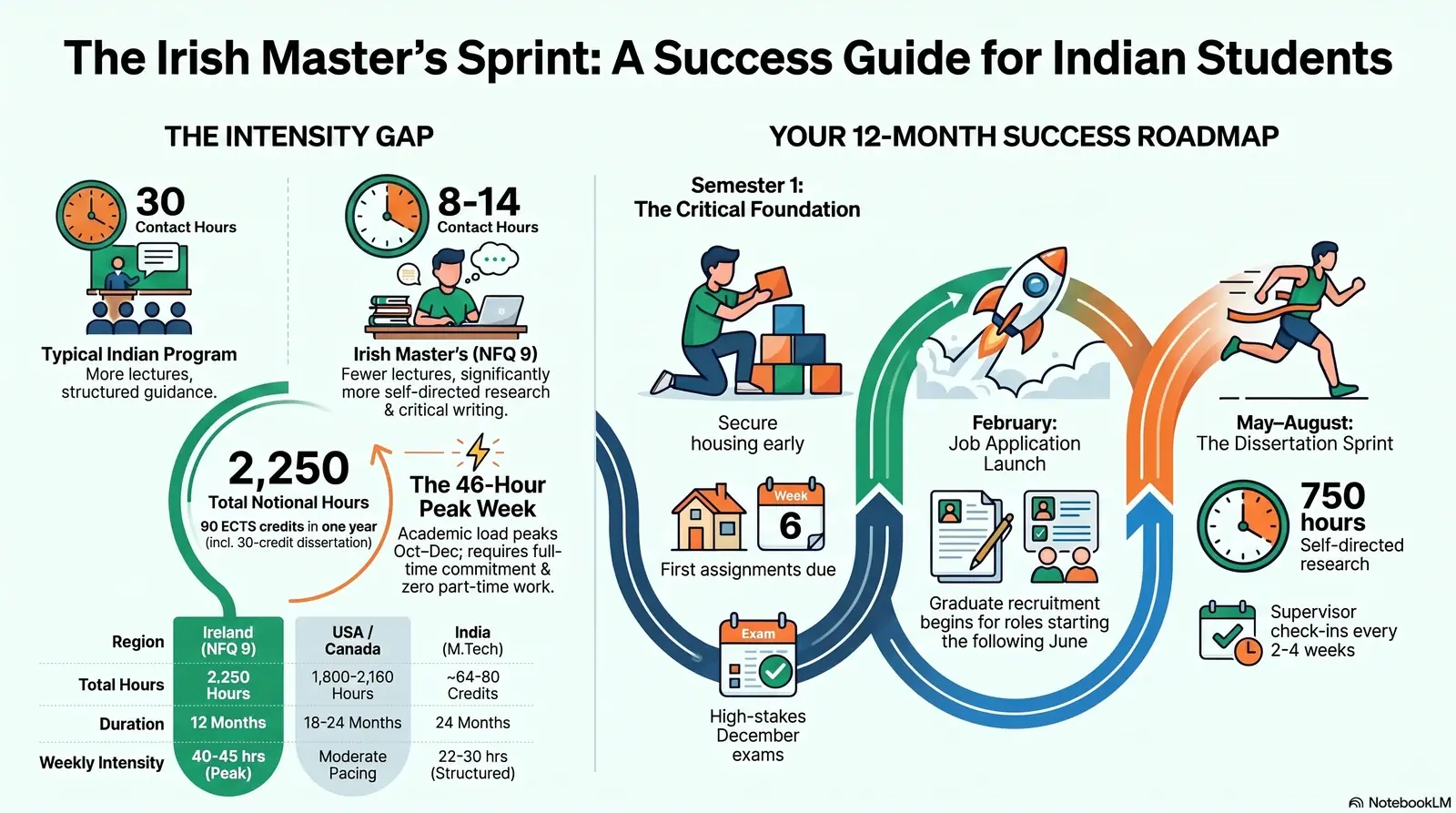
- Same depth, double pace. A typical Irish NFQ Level 9 Master's carries 90 ECTS credits (2,250 notional study hours). The curriculum is not watered down — it is delivered at roughly twice the weekly intensity of a two-year programme. Think full-time job hours, sustained for nine months of teaching.
- The academic culture shift is the hardest part, not the content. Indian undergraduates arrive expecting heavy lecture schedules and end-of-year exams. Irish postgraduate education runs on 8–14 contact hours per week, continuous assessment, and significant independent reading. Students who adapt fastest are those who understand this difference before they land.
- September is the danger month. Classes begin within days of arrival. Life admin (IRP card, PPS number, bank account, housing) and academic demands collide simultaneously. The students who struggle most are those who underestimate week 1–4. The students who thrive plan around it.
NFQ Level 9 — typically 12 months full-time (Sept–Aug/Sept)
90 ECTS = 2,250 notional study hours (60 taught + 30 dissertation)
8–14 hrs (lectures/tutorials) + 20–30 hrs independent study
Sept–Dec: new country admin + semester 1 peak assessment collision
In this guide
- What 90 ECTS actually means: comparing Irish to two-year and Indian programmes
- The three-phase Irish academic year: what happens each term
- Contact hours vs. independent study: a week in the life
- The Indian-to-Irish academic culture shift: what changes and why
- What Indian MSc graduates actually say
- Month-by-month: managing settling in, academics, and job search
- Practical tips that make the difference
What 90 ECTS Actually Means: Comparing Irish to Two-Year and Indian Programmes
An Irish taught Master's degree sits at NFQ Level 9 and is typically structured at 90 ECTS credits — equivalent to 2,250 notional student work hours. The "notional hours" measure covers everything: lectures, tutorials, labs, private reading, assignment writing, exam revision, and dissertation research. One ECTS credit equals 25 notional hours.
The standard curriculum at universities like University College Dublin (UCD), Trinity College Dublin (TCD), and DCU splits these 90 ECTS as: 60 ECTS of taught modules across two semesters, plus 30 ECTS dedicated to a research dissertation or major project. This 60/30 split is mandated by Quality and Qualifications Ireland (QQI) as the minimum for a full NFQ Level 9 award. Some programmes, particularly in business and technology, increase the taught element to 60 ECTS with a 30 ECTS internship or industry project instead of a traditional dissertation.
The critical question is whether this volume, delivered in 12 months, is genuinely comparable to what a two-year programme elsewhere delivers. The honest answer is: comparable in depth within the Irish curriculum design, but smaller in total volume than a 120 ECTS two-year European programme. The Irish degree is not a truncated version of a two-year programme — it is a programme designed from the outset to be comprehensive at 90 ECTS. Calling it "condensed" misrepresents both what was designed and what is delivered.
| Programme Type | Typical Credits | Total Notional Hours | Calendar Duration | Est. Weekly Hours (active study) |
|---|---|---|---|---|
| Irish Taught Master's (NFQ Level 9) | 90 ECTS | 2,250 | 12 months | ~40–45 hrs (teaching months) |
| Two-year European Bologna Master's | 120 ECTS | 3,000 | 24 months | ~28–32 hrs/week |
| USA/Canada Master's (coursework) | 30–36 US credit hrs | ~1,800–2,160 | 18–24 months | ~20–25 hrs/week |
| UK 1-Year Master's (comparable) | 180 UK credits = 90 ECTS | ~1,800 (UK standard) | 12 months | ~38–45 hrs (teaching months) |
| India M.Tech / M.E. (typical IIT/NIT) | ~64–80 credits (Indian system) | Variable | 24 months | ~22–30 hrs/week (structured timetable) |
Weekly hours calculated across active study months only (excluding vacation). Source: ECTS Users' Guide (European Commission), QQI NFQ documentation, individual university programme pages.
An Irish Masters delivers 2,250 notional hours across approximately 44 active academic weeks (52 calendar weeks minus Christmas, Easter, and other breaks). That works out to roughly 51 notional hours per active week — though in practice this is distributed unevenly, with peaks of 45–55 hours during October–December and March–May assessment periods and lower hours during January orientation and summer dissertation phases.
The Three-Phase Irish Academic Year: What Happens Each Term
The Irish taught Master's runs across three distinct phases rather than two neat semesters. Understanding the character of each phase before you arrive is the single best preparation you can do — because the demands shift dramatically between September and August, and students who plan for only one type of demand are blindsided by the others.
Phase 1: Semester 1 (September–December) — The Hardest Month
Semester 1 is when the Irish one-year Master's earns its reputation for intensity. Most programmes begin teaching in the second or third week of September. In the same fortnight, new international students are simultaneously: finding permanent accommodation (Dublin's rental market is one of the most competitive in Europe — see our accommodation crisis guide), registering with the university, registering for an IRP card (Irish Residence Permit), applying for a PPS number, opening an Irish bank account, and buying a SIM or eSIM for data.
The first assignment deadline typically lands in week 5 or 6 — about six weeks after landing. For a student who spent weeks 1–3 managing accommodation and admin, that leaves roughly two weeks of genuine study preparation for what may be a 2,500-word essay or a group project presentation. Students who arrive with housing secured, IRP appointments booked, and a basic understanding of the Irish assignment format have a significant advantage.
Core modules run throughout semester 1. Assessment in Irish universities is typically distributed: 30–50% of each module grade comes from continuous assessment (assignments, group work, presentations), with the remaining 50–70% from formal examinations in December or January. The December exam period is therefore high-stakes: students face multiple exams within 2–3 weeks while also completing end-of-term coursework submissions. It is common to have two or three simultaneous deadlines in the last week of November.
Phase 2: Semester 2 (January–May) — Calibrated Intensity
Semester 2 is still demanding but students who survived semester 1 enter it better calibrated. The Christmas break (typically 2–3 weeks) provides a genuine recovery window — and, crucially, is the ideal time to begin the dissertation literature review. Students who use the Christmas break for initial reading arrive in January with a headstart on the dissertation that pays dividends when submission deadlines arrive in August.
Semester 2 modules are often more specialised (electives, industry applications, advanced research methods) and the assessment weighting toward continuous work tends to increase further. Many programmes include a research proposal or project plan submission in March or April as a formal dissertation milestone. Easter break (typically 1–2 weeks) provides a second, shorter recovery window.
April and May are when job applications for graduate roles with June/July start dates peak. This creates the second collision of the academic year: semester 2 final submissions and job application deadlines often coincide in the same fortnight. Students who began networking in February and submitted applications in February–March are in a much better position than those who wait for the academic pressure to lift before starting the job search.
Phase 3: Dissertation (May–August) — The Independent Phase
The summer dissertation phase is the most self-directed period of the Irish Master's and is where the degree's academic rigour is most visible. The 30 ECTS dissertation (750 notional study hours) must be completed largely independently, with supervisor meetings every 2–4 weeks. For students starting fresh in May with no prior reading, 750 hours across 14–16 weeks of summer is a full-time commitment with little room for error. For students who began reading in January, the summer becomes significantly more manageable.
Submission deadlines vary by university: TCD typically sets mid-August, UCD late August, DCU early September. A viva voce (oral examination of the dissertation) may follow in September. See our MSc Dissertation Guide for the complete university-by-university breakdown of rules, word counts, and evaluation criteria.
Contact Hours vs. Independent Study: A Week in the Life
The most common source of shock for Indian students in the first weeks of an Irish Master's is how few timetabled hours there are. Eight to fourteen lecture or tutorial hours per week is typical — compared to 20–30 contact hours at most Indian engineering colleges. This is not reduced academic rigour: it is a different model of rigour, built on the expectation that students independently manage 20–30 additional hours of reading, writing, and preparation each week.
At UCD, for example, a typical semester 1 MSc week might include 10 timetabled hours (2 hours per module × 5 modules). Each ECTS credit implies approximately 25 hours of total student effort per year of credit — meaning a 5-credit module implies 125 notional hours over the semester, of which roughly 20–24 hours are timetabled contact and the remaining 100+ hours are independent. Across 5 modules running simultaneously, the weekly independent study expectation is approximately 20–25 hours minimum.
During assessment-heavy weeks (end of October, late November, April), total weekly engagement regularly exceeds 45 hours as students simultaneously attend lectures, complete assignment drafts, prepare presentations, and begin exam revision. This is not unusual — it matches what many graduate students in the USA and UK also experience — but it is a significant step up from the structured, externally-paced Indian undergraduate timetable.
- Monday: 2-hr lecture (Advanced Algorithms), 2-hr lab (Machine Learning lab submission due Friday)
- Tuesday: 2-hr lecture (Cloud Computing), 1-hr tutorial, 3-hr independent reading for Cloud assignment
- Wednesday: 2-hr lecture (Research Methods), group project meeting 1.5 hrs (presentation Thursday)
- Thursday: Group presentation (30%), 1-hr supervisor meeting (research proposal), 2 hrs writing Software Engineering assignment
- Friday: Machine Learning lab submission 11:59pm. 3 hrs exam revision (December exam 6 weeks away)
- Weekend: 8–10 hrs: Software Engineering assignment writing, Advanced Algorithms problem sets, Research Methods essay draft
- Total: approx. 42–46 hours
The Indian-to-Irish Academic Culture Shift: What Changes and Why
The most consistent finding from speaking with Indian graduates of Irish Master's programmes is that the content itself is rarely what challenges them — it is the pedagogical model. The Irish (and broadly British-tradition) approach to postgraduate education is built on a fundamentally different assumption about the student's role: active producer of original analysis, not skilled consumer of taught content.
In most Indian engineering and management undergraduate programmes, the dominant assessment model is the end-of-semester written examination covering a defined syllabus. Lecture notes, textbook chapters, and previous year question papers are the primary study materials. Excellence is demonstrated by accurate recall and application of taught frameworks. A student who attends every lecture and revises methodically will typically perform well.
Irish postgraduate assessment expects something different at every stage. An essay question that in India might ask "Explain the OSI model" will in Ireland ask "Critically evaluate the continued relevance of the OSI model in the context of contemporary cloud-native architectures, drawing on at least 8 peer-reviewed sources." The assessment is not testing knowledge recall — it is testing the student's ability to read, synthesise, argue, and write academically. Students who have not written a literature-engaged academic essay before will need to develop this skill quickly, typically within the first 4–6 weeks.
| Dimension | Typical Indian Undergrad (B.Tech/B.E.) | Irish Taught Master's (NFQ Level 9) |
|---|---|---|
| Weekly timetabled hours | 20–30 hrs (lectures, labs, tutorials) | 8–14 hrs (lectures, seminars, tutorials) |
| Primary assessment vehicle | End-of-semester written exam (60–80% of grade); lab practicals | Continuous assessment: essays, presentations, group projects, case studies (40–60%); plus formal exam |
| Reading expectation | Set textbook chapters; lecture notes sufficient for exam | 8–20 peer-reviewed journal articles per module per week; independent literature searching |
| Academic writing style | Technical report; answer-and-justify structure | Critical argument; thesis-driven essay; Harvard/APA referencing; original synthesis required |
| Feedback loop | Largely at end of semester via exam results | Frequent written feedback on coursework; lecturer office hours; writing centre support |
| Dissertation / capstone | Group or individual project (B.Tech); more independent for M.Tech | Individual research dissertation (30 ECTS); supervisor-guided but student-driven; 15,000–20,000 words typical |
| Grade distribution | Bell curve; median 55–65%; 75%+ is high distinction | First class 70%+; 2:1 upper (60–69%); 2:2 lower (50–59%); scoring 70%+ in Irish system is demanding |
| Lecturer interaction style | Formal; students rarely question or debate in class | Interactive seminars; debate and critical challenge expected; office hours and email actively encouraged |
Irish universities enforce academic integrity and Harvard/APA referencing from day one of the programme. Plagiarism detection software (Turnitin) is standard across all major universities. Students who have not previously cited academic sources correctly will face their first major academic honesty hurdle in weeks 4–6 when the first assignment is due. Most universities run a mandatory academic integrity module in the first two weeks — attend it. The university writing centre (available free at all major institutions) is the most underused resource by Indian students and the one that makes the most measurable difference to grades.
What Indian MSc Graduates Actually Say
First-hand accounts from Indian graduates of Irish Master's programmes paint a consistent picture: the year is demanding but manageable, the academic model is genuinely different from what most Indian students experienced in undergraduate education, and the students who struggle most are those who did not adjust their expectations before arrival.
On-the-Ground Insight: "I came from VIT Vellore, where we had lectures from 8am to 5pm basically every day. In UCD, I had maybe 12 hours of lectures a week for my MSc in Data Science. I genuinely thought it was going to be easy. Then I realised that what I was supposed to do with the other 30 hours of the week was read academic papers and write critical analyses. I had never written a literature review in my life. My first assignment came back with 'no critical engagement with sources' written across it. The UCD Writing Centre is what saved my semester 1 grade." — Priya V., MSc Data Science, UCD, Class of 2025
On-the-Ground Insight: "The first semester was brutal because two completely different things were happening at once. I was trying to find a place to live — I spent the first three weeks in an Airbnb because I had nowhere to go — and simultaneously my first assignment was due in week 6. I was researching Dublin apartments on my laptop while trying to read research papers on the other screen. Nobody prepares you for the life-admin workload of arriving in Ireland. If I did it again, I would book student accommodation before leaving India and spend the first two weeks only on admin so that from week 3 my entire attention could be on the course." — Karthik R., MSc Computer Science, DCU, Class of 2024
On-the-Ground Insight: "I hold an M.Tech from IIT Delhi and I completed an MSc in Artificial Intelligence at TCD. Objectively the TCD programme was more intensely paced — nine months of serious academic work versus two years at IIT, but the total depth of my IIT thesis was arguably greater simply because of the additional time. What surprised me was that the quality standard in Ireland was very high. My supervisor at TCD was more demanding about original contribution than my IIT supervisor had been. The one-year label is misleading — it implies a lesser experience, but the lived reality was rigorous." — Sandeep M., MSc Artificial Intelligence, Trinity College Dublin, Class of 2025 (previously M.Tech, IIT Delhi)
On-the-Ground Insight: "I struggled in semester 1 because I was working 20 hours a week in a restaurant — I needed the money for rent. By December, I had failed two modules. I had to repeat them in summer, which overlapped with my dissertation. The second year was miserable. If I could go back, I would have taken out a student loan or used savings to cover the first semester and not touched part-time work until January. The €14.90 minimum wage is not worth a failed module and a delayed graduation." — Amrita B., MSc International Business, UCC, Class of 2025
Month-by-Month: Managing Settling In, Academics, and Job Search in One Year
The Irish one-year Master's asks students to compress not just academic work but the full transition to professional and independent adult life in Ireland into twelve months. The students who manage this successfully do so by treating the year as three distinct seasons, each with its own primary objective — and by refusing to pursue all three objectives simultaneously at full intensity.
September
Arrival & Triage
Primary goal: secure housing and complete all life admin before the first assignment deadline. Classes begin immediately. Book IRP appointment before flying. Open a bank account (Revolut works instantly; traditional banks take 2–4 weeks). Get PPS number. Do not start part-time work. First assignment due approximately week 6.
October–November
Peak Academic Load
Multiple continuous assessment deadlines cluster here — group presentations, essay submissions, lab reports. This is the highest-risk period for grades. Do not work more than 8 hours per week part-time. Begin forming a peer study group if you have not already. Use the university writing centre for essay feedback before submission.
December–January
Exams + Recovery
December exam period (2–3 weeks). Christmas break immediately after. Use the break for rest and — critically — initial dissertation reading. Students who begin their literature review bibliography in January are significantly better positioned by August. Semester 2 begins mid-to-late January.
February–March
Calibrated & Networking
By now you understand the Irish academic system. Semester 2 is demanding but you are no longer navigating it blind. Begin job applications now — graduate roles with June start dates post deadlines in February–April. LinkedIn networking, university careers events, and campus recruitment start in earnest. Aim for 3–5 job applications per week alongside academic work.
April–May
Maximum Collision
The most stressful two months of the year. Semester 2 final submissions peak in April. Dissertation research proposal due at most universities in April or May. Job interview processes for roles you applied for in February–March are happening now. Students who have not yet applied for jobs face a difficult choice between dissertation and interviews. Prioritise: a job offer enables Stamp 1G; a failed dissertation delays graduation.
May–August
Dissertation Sprint
Taught modules are done. Full focus on the 30 ECTS dissertation. Students with January reading done can now write. Students starting cold face 750 hours of work in 14–16 weeks — which is doable but leaves little room for part-time work or travel. Submission typically mid-to-late August. Viva (oral examination) may follow in September. This is the best window for part-time work or consolidating a job offer.
Practical Tips That Make the Measurable Difference
Based on the consistent patterns in graduate accounts, these are the interventions that determine whether students leave Ireland with a First Class Honours and a job offer, or with a 2:2 and a lesson in hindsight.
Before You Fly: The Pre-Departure Checklist That Changes Your September
Book student accommodation — through your university's housing office — before leaving India. Dublin's private rental market is hostile to students arriving without Irish credit history or Irish referee contacts. University-managed accommodation, while more expensive per square foot, eliminates the housing variable in September entirely. If campus accommodation is unavailable, secure a 4-week Airbnb or short-term rental and use week 1–3 to find a permanent place. Do not arrive without a plan. See our pre-departure checklist for the full list.
Download the IRP appointment portal and book your slot before you land — appointments for IRP registration fill up weeks in advance at Burgh Quay (Dublin). Arriving in Ireland without a booked appointment means waiting weeks, which delays your legal ability to work part-time on your student permission.
Week 1: The Four Actions That Set Up the Rest of the Year
Find your university's writing centre, library induction session, academic integrity module, and careers service — and attend all four in your first week. These are not optional extras; they are the infrastructure that enables you to produce work at the quality standard Irish universities require and to translate your degree into employment within twelve months.
Referencing: Master Harvard Style Before Your First Deadline
Every essay and report at an Irish university requires full academic referencing, typically Harvard or APA style. This is non-negotiable. Install Zotero (free, open-source reference manager) in week 1 and begin using it immediately to collect every paper or book you read. The discipline of capturing references at the point of reading, rather than reconstructing them the night before submission, will save you hours per assignment and eliminate the risk of an accidental plagiarism finding.
The Part-Time Work Rule
Student visa holders in Ireland may work up to 20 hours per week during term and 40 hours during vacations. Legally permitted does not mean academically advisable. The evidence from graduate accounts is consistent: students working more than 8–10 hours per week during semester 1 are significantly more likely to fail or narrowly pass modules, damaging their overall grade classification. The academically safe strategy is: zero part-time work in September, a maximum of 10 hours in October–December, gradually increasing to 20 hours in semester 2 once you know how you are performing. Use subsidies and student discounts to reduce the financial pressure that drives overworking.
Dissertation: Start in January, Finish in July
The 30 ECTS dissertation is the single highest-weight deliverable of the Master's year. Students who begin reading in January and have 50–80 papers read and annotated by May write dissertations that are qualitatively better — because they have thought about the research problem for six months, not six weeks. Target at least 3–5 papers per week during the Christmas break and semester 2 on your dissertation topic. A bibliography of 60–80 sources that you understand deeply is worth more than a bibliography of 120 sources you skimmed under deadline pressure.
- Sort accommodation before you land. One week lost to flat-hunting in September is one week of lecture content and assignment time gone at the worst possible moment.
- Do not work part-time in semester 1. The compounding cost of a low grade in semester 1 — on your final classification, PhD eligibility, and employer perception — far exceeds the income.
- Start job applications in February. Companies that recruit in February and March have roles starting in June. Companies that recruit in May have roles starting in September. Your Stamp 1G clock starts at graduation — not at the job start date. Every month of delay costs you a month of your 24-month post-study work window.
If you are planning to use your Irish Master's to apply for a PhD abroad — in the USA, Canada, Germany, or Australia — the recognition picture is more complex than most students assume. See our dedicated guide: Is Ireland's One-Year Master's Recognised for PhD Admission? USA, Canada, Germany & Australia (2026).
Frequently Asked Questions
Is Ireland's one-year Master's degree as rigorous as a two-year Master's programme?
Yes — an Irish taught Master's at NFQ Level 9 (typically 90 ECTS credits) represents 2,250 notional study hours, compressed into approximately 9–10 months of teaching plus a 2–3 month dissertation. The academic content is not simplified; it is delivered at roughly double the weekly pace of a two-year programme. Students report weekly study commitments of 35–45 hours during peak teaching months, comparable to a demanding full-time job. The difference versus a two-year 120 ECTS programme is one of total volume (2,250 vs. 3,000 hours) not academic depth or rigour within the Irish curriculum design.
How do Indian students cope with the academic intensity of an Irish one-year Master's?
Most Indian students describe a significant adjustment in the first 6–8 weeks driven by two factors: the shift from India's exam-focused, high-contact-hour undergraduate model to Ireland's independent-study, continuous-assessment model; and the collision of academic demands with the life-admin burden of arriving in a new country (IRP card, PPS number, accommodation, bank account). Students who cope best arrive with housing sorted in advance, form study groups in the first week, start reading before the first assignment deadline, and avoid part-time work during September and October.
Can you realistically manage settling in, studying, and job searching in the same year in Ireland?
Yes, but only with deliberate sequencing. September is the highest-risk month — classes begin within days of arrival while life-admin tasks (IRP registration, bank account, PPS number, accommodation) also peak. October through December is the most academically demanding period. Job searching should begin by January at the latest for May/June graduate roles. The dissertation phase (May–August) is the best window for intensive job applications and interview preparation, as taught modules are complete. Students who attempt to simultaneously work 20+ hours per week, complete heavy assessment loads, and job search in semester 1 consistently report burnout.
How many contact hours per week does an Irish Master's have?
Most Irish taught Master's programmes deliver 8–14 contact hours per week during the taught semesters — far fewer than the 20–30 hours typical of Indian engineering undergraduate programmes. This is not a reduction in academic demand: the independent study expectation fills the gap. Each module credit implies roughly 5–8 hours of self-directed reading, assignment writing, and research per week beyond the timetabled session. At 5 modules per semester, total weekly engagement (contact + independent) realistically sits at 35–45 hours during October–December.
Planning to fly to Ireland for your Master's? Compare fares first.
Find the cheapest month to fly from India to Dublin and book before fares rise.
All information about ECTS credit frameworks, NFQ levels, university programme structures, and academic requirements is based on publicly available official sources from QQI, the European Commission, and individual Irish university websites as of July 2026. Programme structures, assessment weightings, and academic calendar dates are subject to change — always confirm with your specific programme office. Student accounts are based on publicly available community discussions and have been anonymised or composited. MyFlightOffers is not affiliated with any Irish university or admissions body.
- Is Ireland's One-Year Master's Recognised for PhD Admission? USA, Canada, Germany & Australia (2026) — country-by-country analysis: WES evaluations, ECTS credit thresholds, documented challenges, and the pre-application checklist for PhD candidates.
- MSc Dissertation in Ireland 2026: Timelines, Rules & Evaluation — university-by-university breakdown (TCD, UCD, DCU, UL, TU Dublin): word counts, submission deadlines, viva rules, and grading criteria.
- Study in Ireland 2026: Universities, Costs & Complete Guide — top Irish universities, course selection, scholarship options, and cost of living by city.
- Ireland Student Accommodation Crisis 2026: How to Actually Find a Place to Live — why Dublin's rental market is so hostile and the exact strategies that work.
- Dublin Networking Guide: Landing a Post-Study Job on Stamp 1G (2026) — how to build an Irish professional network during your Master's year to activate Stamp 1G immediately after graduation.