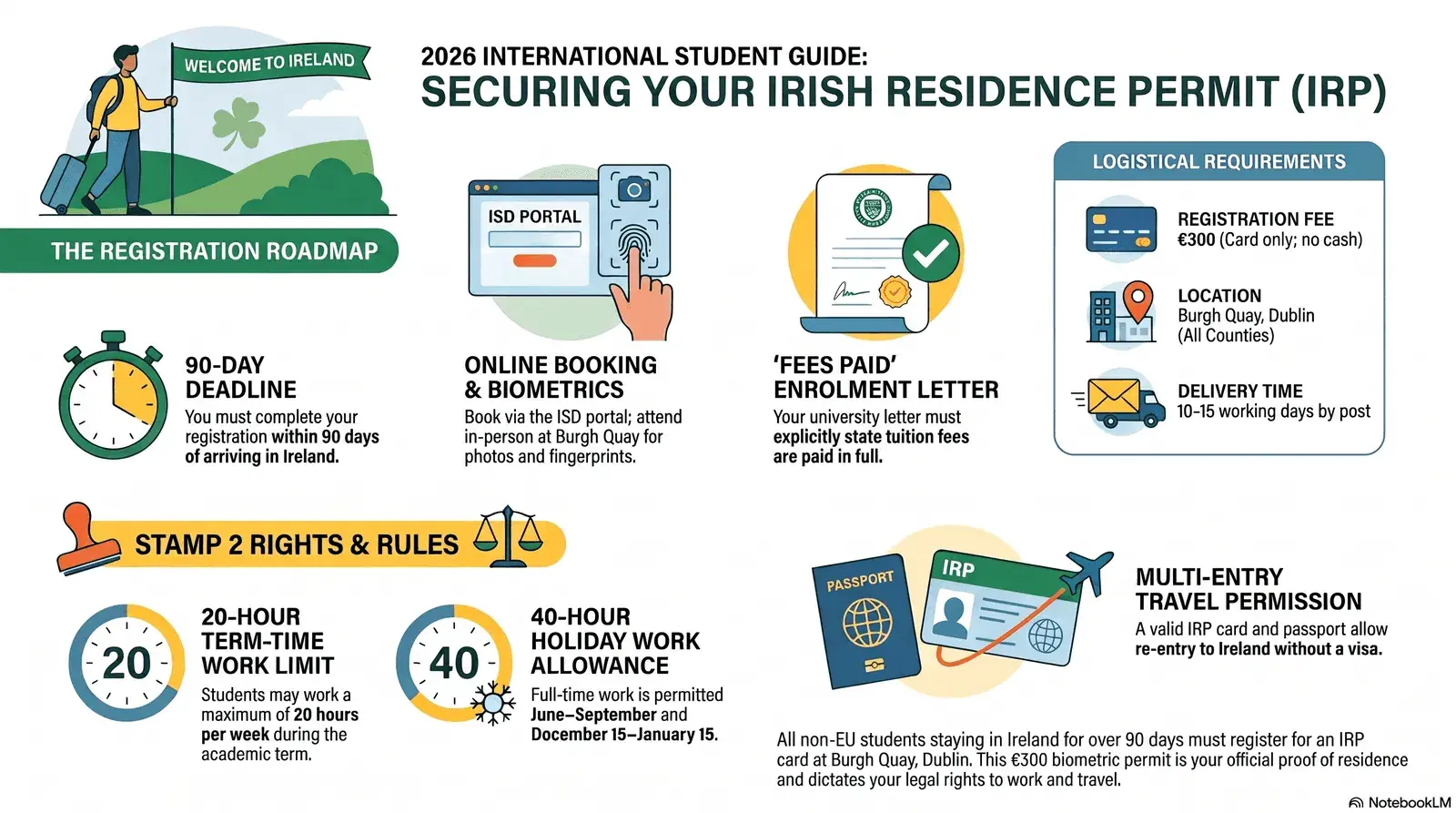
- Register within 90 days: All non-EEA/Swiss students must attend the ISD Registration Office at Burgh Quay, Dublin for first-time registration — regardless of what county they live in (Cork and Limerick included since July 2024).
- €300 fee, documents required: Bring your passport, valid proof of Irish address, full enrolment letter confirming fees paid, and proof of health insurance. The fee is €300 by card only — cash is not accepted.
- Card arrives in 10–15 working days: Your IRP card (Stamp 2) is posted to your registered address and grants you the right to study, work up to 20 hours per week during term (40 hours during holidays), and travel without a re-entry visa.
Within 90 days of first arrival in Ireland
€300 per adult — card payment only
Burgh Quay, Dublin — all counties, including Cork & Limerick
10–15 working days after your appointment
In this guide
- What Is the Irish Residence Permit (IRP) and Who Must Register?
- How Do You Book Your Burgh Quay IRP Appointment?
- What Documents Do You Need for Your IRP Appointment?
- What Happens on the Day of Your Registration?
- How Long Does It Take to Receive Your IRP Card?
- What Rights Does Your Stamp 2 IRP Card Give You?
- Can You Travel Abroad on a Stamp 2 IRP Card?
- When and How Do You Renew Your IRP Card?
What Is the Irish Residence Permit (IRP) and Who Must Register?
The Irish Residence Permit (IRP) is a biometric residence card issued by Immigration Service Delivery (ISD) that serves as your official proof of lawful residence in Ireland for more than 90 days. It replaced the older GNIB (Garda National Immigration Bureau) card and is now the document you will be asked to produce when opening a bank account, registering with a GP, applying for a PPS number, or returning through Irish immigration after travel abroad.
Every non-EEA, non-EU, and non-Swiss national who intends to stay in Ireland for longer than 90 days must register. For international students, this means the vast majority of non-EU arrivals — whether Indian, Pakistani, Nigerian, Filipino, Brazilian, or any other non-EEA nationality — must complete IRP registration. EU/EEA citizens (including those from Germany, France, Italy, Poland, and India after OCI activation does not apply here — OCI holders are still Indian nationals) do not register for an IRP but instead exercise their EU treaty rights.
Your IRP card will display an immigration Stamp that defines your permission to remain in Ireland and what you are legally permitted to do. For international students enrolled in a full-time Qualifying English Language School (QELS) or degree/postgraduate programme at a recognised institution, the relevant stamp is Stamp 2. Students on a short language course of eight weeks or less may receive Stamp 3, which does not carry work rights. Your university or college will specify which stamp applies to you.
Stamp 2 is granted during your primary course of study. When you graduate and transition to a Graduate Programme/Stay Back permission under the Third Level Graduate Scheme, Immigration Service Delivery issues a Stamp 1G instead, which grants full-time work rights for up to 24 months. If you are awaiting a job offer after graduation, ensure you apply for Stamp 1G renewal promptly — do not let your Stamp 2 lapse.
How Do You Book Your Burgh Quay IRP Appointment?
You book your IRP appointment online through the ISD Customer Portal (also called the Department of Justice Digital Contact Centre), where you create a personal account and select the earliest available slot for a first-time registration. Appointments are not walk-in — you must book in advance, and the individual being registered must be the one who creates and attends the appointment (names must match; no proxies allowed for adults over 16).
As of mid-2026, appointment slots at the Burgh Quay Registration Office typically open on a rolling basis up to several weeks ahead. In high-demand periods — particularly September and October when the bulk of September intake students arrive — availability can stretch to 8–10 weeks. The key tactic is to create your ISD account and check for cancellation slots regularly. Slots open and are cancelled throughout the day, and regular checking dramatically increases your chance of securing an earlier date.
You have 90 days from arrival to register, but the appointment itself may only be available 6–8 weeks out during peak intake seasons (September and January). If you wait until week 6 to start searching, you may find no appointments before your 90-day deadline. Register your ISD account on the day you arrive or within the first week, and book the first available slot even if it is several weeks away.
The office is located at 13–14 Burgh Quay, Dublin 2, D02 XK70, a short walk from Tara Street DART station and served by multiple Dublin Bus routes including routes 27, 49, and 56A. The Luas Red Line stops at Abbey Street, approximately a 10-minute walk. If you are travelling from outside Dublin — for instance from Cork City, Galway, or Limerick — you will need to plan a day trip to Dublin, as all counties (including Cork and Limerick since July 8, 2024) send first-time registrations to Burgh Quay rather than to local Garda offices.
The only exception to the Burgh Quay centralisation applies to students living in counties far from Dublin — such as Donegal, Mayo, Sligo, or Kerry — who may still be able to register through their local Garda District Headquarters. However, ISD guidance has progressively centralised registration into Burgh Quay, and the most current route is always to check your county's status on the official ISD website before making any plan.
What Documents Do You Need for Your IRP Appointment?
For a first-time student IRP registration, you must bring your valid passport, a completed address form (attached to your appointment confirmation email), an enrolment letter from your institution confirming full-time enrolment and full tuition fee payment, and proof of private health insurance covering the entire academic year including hospital treatment. Missing any single document will result in your appointment not being completed, requiring you to rebook — which in peak periods could mean another 6–8 week wait.
The table below summarises the full document checklist, who issues each document, and tips on what to watch out for:
| Document | Issued By | Key Requirements | Common Pitfalls |
|---|---|---|---|
| Valid Passport | Your home country government | Must be original (not a photocopy); valid beyond your registration date | Expired passports — even if you have a visa in the old passport — will result in a failed appointment |
| Address Form | ISD (attached to appointment confirmation email) | Print, complete, and sign before your appointment; must show your Irish address | Hotels, hostels, or Airbnb addresses are not accepted — you must have a fixed residential address |
| Enrolment Letter | Your college/university International Office | Must state: full-time course enrolment, course dates, and confirmation that tuition fees are paid in full for the current academic year | Letters that say "fees pending" or do not specify full-time status will be rejected; request an updated letter if in doubt |
| Proof of Health Insurance | Laya Healthcare, Irish Life Health, VHI, or equivalent private insurer | Must cover the full academic year period; must include hospital inpatient treatment | Travel insurance or EHIC (European Health Insurance Card) are not accepted substitutes for student private health insurance in Ireland |
| Proof of Irish Address | Landlord/letting agency, student residence provider, or utility company | A lease/licence agreement, official letter on headed paper from student accommodation, or utility bill in your name | A screenshot of a Daft.ie listing or WhatsApp message from a landlord is not sufficient — you need a signed, dated document |
| €300 Registration Fee | Paid at the office | Credit or debit card only — Visa and Mastercard accepted | Cash is not accepted. Prepaid travel cards without chip-and-PIN may be declined — use your main bank card |
On-the-Ground Insight: "My university gave me the enrolment letter the week before my appointment but it didn't mention that fees were fully paid — only that I was enrolled. The officer at Burgh Quay asked for a letter confirming fees, and I had to reschedule and wait another five weeks for the next available slot. My biggest advice: call your International Office specifically and ask them to include the phrase 'tuition fees paid in full for the current academic year' in the letter. Don't assume a standard enrolment letter will be enough." — Preethi K., University of Galway, MSc Data Analytics, 2025 September Intake
What Happens on the Day of Your Registration at Burgh Quay?
On the day of your appointment, you attend the ISD Registration Office at Burgh Quay at your scheduled time, present your documents to an immigration officer, pay the €300 fee, and have your biometric data (photograph and fingerprints) taken — after which your IRP card is produced centrally and posted to your address within 10–15 working days.
Arrive a few minutes before your slot — not an hour early, as the waiting area is small and the office runs on a timed appointment system. You will be directed to a queue on arrival, where your appointment confirmation and passport will be checked. You are then called to a registration desk where an immigration officer will review your full document pack. If everything is in order, you pay the €300 fee by card, your biometrics are taken, and your paperwork is processed on the spot.
The appointment itself typically takes 15–30 minutes. After the appointment, you will receive written confirmation of your registration — usually an OREG (Online Registration) number or a registration receipt. Keep this document carefully. It serves as your interim proof of registration while you wait for the physical IRP card to arrive, and your employer, bank, or college may request it.
The name on your appointment confirmation must exactly match the name on your passport. If you booked under a nickname, abbreviated name, or middle-name variation and your passport shows a different legal name, your appointment will not proceed. Always use your full legal name exactly as it appears in your passport when creating your ISD account.
How Long Does It Take to Receive Your IRP Card?
After your Burgh Quay appointment, your IRP card is printed centrally by ISD and posted to your registered Irish address — typically within 10–15 working days for first-time registrations. The Registration Office has no ability to expedite this process, and you should not expect the card to arrive any faster regardless of any urgency you flag on the day.
In 2026, ISD has been experiencing high volumes, particularly for renewal applicants. For first-time registrations the turnaround remains closer to the 10-working-day mark as of mid-2026, but renewal applications have been running at approximately 10 weeks processing time plus an additional 2 weeks for card production and delivery — a total of up to 12 weeks for renewals. The Migrant Rights Centre Ireland (MRCI) has published updated processing timeline notices in April 2026 reflecting these delays.
Contact ISD through the ISD Contact Centre (via the Digital Contact Centre portal, not by phone — ISD does not take general enquiry calls). Provide your OREG number or appointment confirmation reference. ISD will confirm whether your card is in production and advise on expected delivery. Do not apply for a duplicate card without ISD confirmation that the original was lost in the post.
If your card is lost or damaged, you should contact ISD to arrange a replacement. A replacement fee applies. The card is posted in a standard envelope from ISD — there is no tracked postage or signature-on-delivery, so if you live in student accommodation with shared post facilities, alert the front desk to watch for it.
What Rights Does Your Stamp 2 IRP Card Give You?
A Stamp 2 IRP card grants you the legal right to reside in Ireland for the duration stated on the card, work up to 20 hours per week during term time and 40 hours per week during designated holidays, use public services including the HSE (with health insurance), and re-enter Ireland multiple times without a separate re-entry visa (provided your IRP remains valid).
The work entitlement is defined with specific parameters by the Workplace Relations Commission and the Department of Justice:
| Period | Maximum Hours / Week | Holiday Dates (2026) | Notes |
|---|---|---|---|
| Term Time | 20 hours | Academic term dates vary by institution | Cannot average 20 hrs over weeks — each individual week must not exceed 20 hrs |
| Summer Holiday | 40 hours | 1 June – 30 September (inclusive) | Full-time employment permitted during this window |
| Christmas Holiday | 40 hours | 15 December – 15 January (inclusive) | Full-time employment permitted during this window |
| Self-Employment | Not permitted | N/A | Stamp 2 does not authorise self-employment, freelance, or sole trader activity |
Beyond work rights, your Stamp 2 IRP card enables you to open a bank account at major Irish banks such as AIB, Bank of Ireland, and KBC, or digital alternatives like Revolut and Wise. It is also required to apply for your PPS number through Revenue, which you need to work legally and to avoid emergency tax at 40% on your first payslips. The PPS number cannot be issued without a confirmed Irish address and your IRP card or, at minimum, written proof of your IRP application in progress.
Can You Travel Abroad on a Stamp 2 IRP Card?
Yes — if you hold a valid, in-date IRP card and a valid passport, you do not need a separate re-entry visa to return to Ireland, even if you are a visa-required national (for example, an Indian national who required a visa to enter Ireland originally). Your IRP card itself functions as a multi-entry travel document for the purpose of re-entering Ireland, according to ISD's official guidance on Travel and Re-Entry Visas.
The critical condition is that your IRP must be valid at the time you travel and at the time you return. If your IRP card expires while you are abroad, the airline may deny boarding for your return flight. In genuine emergency situations where you must travel and your IRP has expired or is lost, ISD does consider applications for Emergency Re-Entry Visas — but this is at their discretion, requires strong evidence of the emergency, and the processing time is not guaranteed.
If you are a visa-required national (e.g., Indian, Pakistani, Nigerian, Filipino national) and you choose to leave Ireland while your IRP renewal application is in progress but not yet approved, you will need to apply for a long-stay D re-entry visa at the nearest Irish Embassy or Consulate in your travel destination country before you can return to Ireland. This is not a quick process — Irish visa processing times vary by embassy. If you must travel before your renewal is approved, factor this in carefully. Check current ISD guidance before booking any flights.
Travelling within the Common Travel Area (CTA) — meaning travel between Ireland, the UK, the Isle of Man, Guernsey, and Jersey — does not typically require you to show your IRP card, as CTA movement is treated differently. However, you should always carry your passport and IRP card when travelling, as spot checks do occur, particularly on routes between Ireland and the UK where immigration officers may board coaches, ferries, or airport departures.
When and How Do You Renew Your IRP Card?
You can apply to renew your IRP card up to 12 weeks before it expires, and for Stamp 2 (student) holders, renewal must wait until your new academic course for the next year has started — you cannot renew before your enrolment in the next year's programme is confirmed. Renewal is done entirely online through the ISD online renewal portal — you do not need to return to Burgh Quay for a standard renewal.
The renewal fee remains €300 per adult. You will need to upload your new enrolment letter confirming enrolment in the next academic year and payment of fees, proof of valid health insurance, and your current IRP card details. ISD processes the application online and posts the renewed card to your registered address.
As of mid-2026, renewal processing times have been running at approximately 10 weeks, with a further 2 weeks for card printing and delivery. This means that if you apply the day your window opens (12 weeks before expiry), you may receive your renewed card just as your current card expires — or very shortly after. ISD acknowledges this and has confirmed that as long as you have proof of a submitted renewal application (your OREG reference number or confirmation email), you remain legally in Ireland for up to 12 weeks beyond your card's expiry date while your renewal is in progress.
If your IRP card expires on, say, 31 October 2026, count back 12 weeks to approximately 7 August 2026 — that is the earliest you can submit your renewal. Submit on that date. With current 10-week processing, you may not receive your new card until mid-October. Your OREG confirmation email is your proof of legal status during this gap. Do not travel abroad in the 4–6 weeks before your card expires unless you have confirmed the current ISD processing timeline and are comfortable applying for a D-visa to return if needed.
If you have changed your passport since your last registration (for example, your passport expired and you have renewed it), you do not need to attend Burgh Quay in person for just a passport update during a renewal — you can upload the new passport biodata page through the ISD online portal. However, if this is your first registration in a new country or your immigration category has changed, in-person attendance at Burgh Quay will be required.
Frequently Asked Questions
What is the Irish Residence Permit (IRP) and do I need one as an international student?
The Irish Residence Permit (IRP) is a biometric card issued to non-EEA/Swiss nationals who are legally permitted to remain in Ireland for more than 90 days. As an international student, you must register and obtain an IRP card - it replaces the older GNIB card and is your proof of legal residence.
Where do I register for my IRP card as an international student in 2026?
All first-time IRP registrations - regardless of which county you live in - are now processed at the Immigration Service Delivery (ISD) Registration Office at 13-14 Burgh Quay, Dublin 2, D02 XK70. This includes students in Cork and Limerick following the July 2024 change. You must book an appointment in advance through the ISD Customer Portal.
How much does IRP registration cost in Ireland 2026?
The IRP registration fee is €300 per adult, payable by credit or debit card only - cash is not accepted at the Burgh Quay Registration Office. This fee applies to both first-time registration and annual renewal.
How long does it take to receive my IRP card after my Burgh Quay appointment?
Your IRP card is printed centrally and posted to the address you provided at your appointment. Expect delivery within 10-15 working days. The Registration Office cannot expedite delivery once your appointment is completed.
Can I travel outside Ireland while waiting for my IRP card?
You can travel with your passport and your appointment confirmation letter as proof of your pending application. However, if you are a visa-required national and you leave Ireland before your renewal is approved, you will need to apply for a D re-entry visa at the nearest Irish Embassy or Consulate abroad before returning. Always check current ISD guidance before booking travel.
How many hours can international students work on Stamp 2 in Ireland?
Stamp 2 permits up to 20 hours of paid employment per week during term time and up to 40 hours per week during official holiday periods (June-September inclusive, and 15 December-15 January inclusive). You cannot be self-employed on Stamp 2.
Planning your Ireland journey? Compare live flight fares first.
Before you land in Dublin, find the best fares on flights from India and beyond. Use the MyFlightOffers fare calendar and flight search to book at the right time.
- URGENT Stamp 2 Bridging Permission September 2026: What to Do Before 30 September — English language students holding a bridging permission must renew to a full Stamp 2 before 30 September 2026; complete eligibility and ISD portal guide.
- NEW IRP Card Registration Guide (2026) — you are reading this guide
- Study in Ireland 2026: Visa, Housing & IRP Complete Guide — the full pre-arrival and arrival playbook for international students
- Ireland Banking Guide for International Students (2026) — how to open a bank account with your IRP card and PPS number
- Revenue Emergency Tax Guide for International Students — why you are taxed at 40% without a PPS and exactly how to fix it
- The Indian Student's Money Survival Guide in Ireland — forex cards, remittance, and budgeting for Indian students
- English Language Student Stamp 2 Bridging Permission 2026: Transition to Higher Education in Ireland — ISD Stamp 2 Bridging Permission 2026: who qualifies, documents needed, how to apply via INIS portal by 31 Aug, and IRP renewal for September.
- Stamp 2 to Stamp 1G: How to Apply for Ireland Graduate Permission Without Mistakes (2026) — Stamp 2 to Stamp 1G 2026: complete step-by-step guide — eligibility, €300 fee, document checklist, ISD portal walkthrough, timing traps, and refusal advice.
All information in this article is based on publicly available official sources from Immigration Service Delivery (ISD) and Citizens Information Ireland as of July 2026. Immigration rules, fees, processing times, and appointment procedures can change. Always verify the current position directly with ISD before your appointment. MyFlightOffers is not affiliated with ISD, the Department of Justice, or any university in Ireland. This article does not constitute immigration, legal, or tax advice.