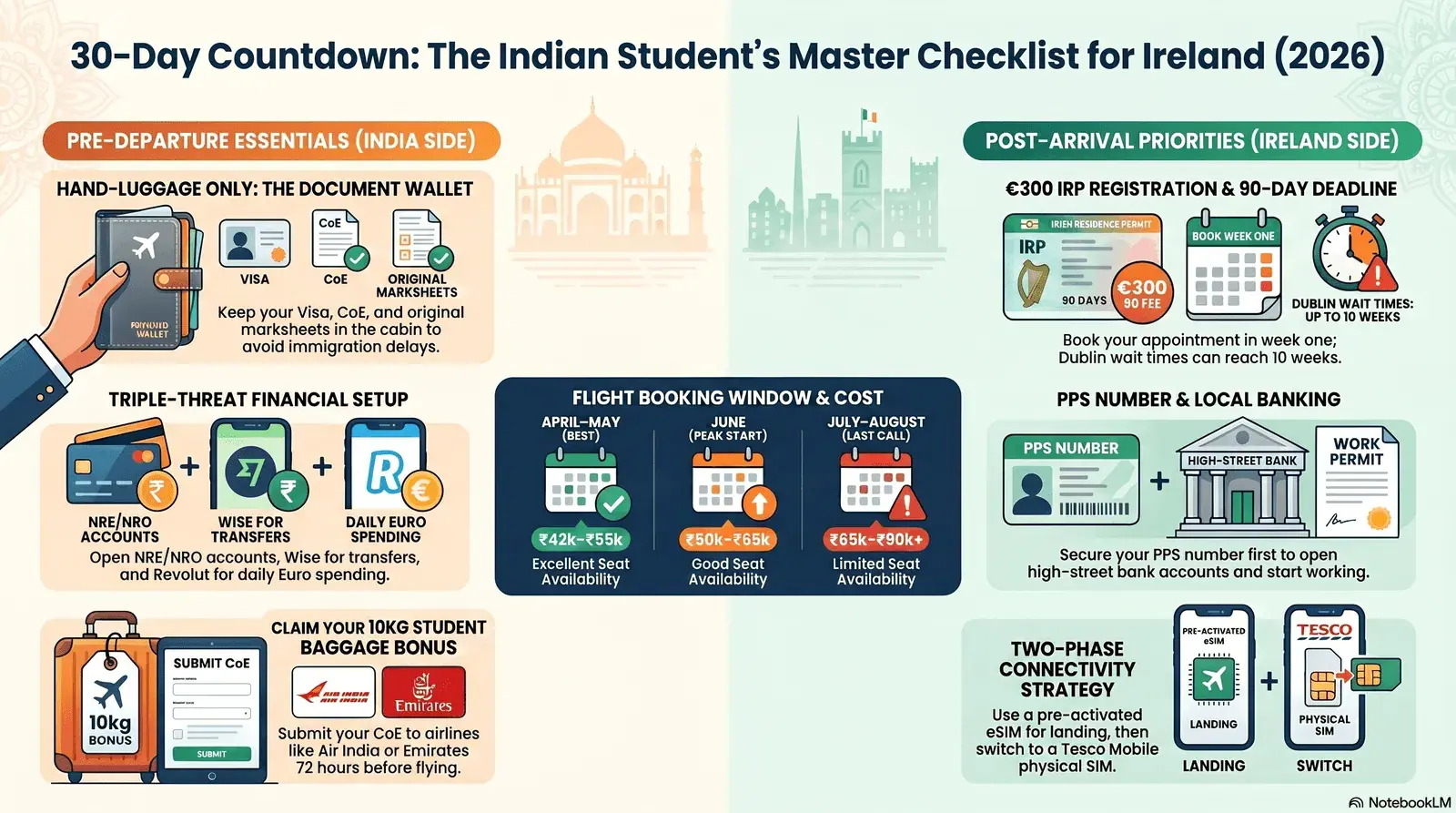
- Documents first, always in hand luggage: Your visa grant letter, CoE, original marksheets and travel insurance must travel with you in the cabin — delayed baggage can leave you without critical documents at Dublin immigration.
- IRP registration cannot wait: You have 90 days to register with Irish Immigration Service Delivery (ISD) and pay the €300 fee. Appointment wait times in Dublin can hit 8–10 weeks — book within your first week of arrival.
- Sort connectivity before you board: Activate an eSIM (Airalo, YeSim, Holafly) for day-one data, and plan to get a Tesco Mobile physical SIM once you arrive — it is the most widely used and affordable network for students in Ireland.
IRP Fee 2026
€300 per adult (first registration & renewal)
Proof of Funds Required
€10,000 + tuition (at least 50% paid if >€12,000)
Student Baggage — Air India
Standard 2×23 kg checked + 10 kg student bonus (with valid CoE)
Travel Insurance Minimum
€25,000 accident + €25,000 illness; 1-year cover for stays >12 months
In this guide
- Documents — the non-negotiable pile
- Banking — set up money before you leave India
- SIM and connectivity — eSIM vs Irish SIM
- Luggage — airline allowances and what to bring vs buy
- Health — GP letter, prescriptions and travel insurance
- Flight booking — one-way vs return, timing for September intake
- IRP and arrival — what happens in the first 90 days
1. Documents — the non-negotiable pile
Every critical document must travel in your hand luggage, not in checked baggage — a delayed bag at Dublin Airport could leave you without your visa grant letter during immigration checks. This is not a theoretical risk; airline baggage handlers routinely misroute luggage on multi-stop routes through Dubai, Abu Dhabi and Doha.
Organise your documents into a single A4 document wallet with the following items, and do a physical checklist 24 hours before departure:
| Document | What you need | Notes |
|---|---|---|
| Passport | Original + photocopy of all pages | Validity must extend at least 6 months beyond your intended stay |
| Visa Grant Letter | Printed copy (colour) | This is what Irish immigration officers check at the primary lane — do not rely on a phone screenshot |
| University Offer / CoE | Original Confirmation of Enrolment | Required at immigration and for IRP registration |
| Academic Marksheets | Originals: 10th, 12th, Bachelor's (if applicable) | University may ask to verify originals against submitted copies on arrival |
| Proof of Funds | Bank statements covering last 6 months | Ireland requires €10,000 in accessible funds + tuition (at least 50% paid for courses >€12,000) |
| Travel Insurance Certificate | Printed or digital copy with policy number | Mandatory for non-EU students; minimum €25,000 each for accident and illness |
| University Accommodation Letter | Address of your student residence or digs | Dublin immigration may ask for your first-night address |
| Emergency Contact Card | Phone number of Irish university contact and Dublin emergency number (999) | Write this on paper — if your phone dies at the airport, you need it |
On-the-Ground Insight: "At Dublin immigration I was asked to show both my visa grant letter AND my CoE simultaneously. I had the CoE in my checked bag. The officer made me wait while baggage was located — 40 minutes. From the next trip onwards everything goes in my backpack." — Priya N., UCD MSc Data Analytics, September 2025 intake
2. Banking — set up money before you leave India
The three financial tools every Indian student needs before boarding are: an NRE/NRO bank account (for transferring money home and receiving funds from India), a Wise multi-currency account for low-cost international transfers, and a Revolut account for day-to-day spending in euros. Setting all three up while still in India takes 2–3 days; trying to open them from Ireland is possible but slower.
NRE and NRO accounts
An NRE (Non-Resident External) account holds foreign-currency earnings and allows free repatriation to Ireland; an NRO (Non-Resident Ordinary) account holds Indian-source income such as rent, dividends or family gifts. In 2026, every major Indian bank — HDFC, ICICI, SBI, Axis — allows fully online NRE/NRO account opening via a 5-minute video call, replacing the old branch visit requirement.
Key rule: your NRE account only activates after you make the first transfer from your foreign bank (even a small amount such as €50). Keep your Indian mobile number active throughout the verification — OTPs are sent to it. Open your NRE and NRO account simultaneously in one application.
Wise — for transfers to and from India
Wise uses the mid-market exchange rate with a small transparent fee (typically 0.35%–0.65%), making it significantly cheaper than a bank SWIFT wire when sending money between Ireland and India. You can send directly to your Indian NRE/NRO account or to a UPI ID. Set up your Wise account in India before you leave — it can be verified with an Indian address and Aadhaar-linked PAN.
Revolut — for daily euro spending
Revolut offers a free Irish IBAN, instant account opening, and competitive exchange rates for day-to-day spending. Note: in 2026, Revolut does not offer an account product for Indian residents, and INR direct transfers from India are not supported — use Wise for that leg. Once you have an Irish address, Revolut works seamlessly for rent payments, grocery shopping, and splitting bills with housemates. When you sign up, use referral code REVOLUT-ANUBHA68LC at revolut.com/referral to receive a €20 bonus once eligibility conditions are met (conditions apply, valid July 2026).
3. SIM and connectivity — eSIM vs Irish SIM
The best connectivity strategy for the September 2026 intake is a two-phase approach: activate an eSIM before departure for instant data on landing, then switch to a Tesco Mobile physical SIM within the first week for long-term affordability.
Phase 1 — eSIM before you board
eSIMs are the fastest way to get connected — they activate before you even board the plane and work the moment you land. No physical SIM swapping, no hunting for a mobile shop at 10pm after a 9-hour flight. For a full hands-on review of the option we tested — including keeping your Indian number alive for OTPs — see our YeSim eSIM review. Leading Ireland-compatible providers in 2026 include:
| Provider | Plan | Activation | Best for |
|---|---|---|---|
| Airalo | Ireland 1 GB / 7 days from ~€4.50 | Instant QR scan | Budget-conscious, short stays |
| YeSim | Ireland 5 GB / 30 days from ~€9 | Instant app activation | First month coverage before getting Irish SIM |
| Holafly | Unlimited data from €19 / 7 days | QR code via email | Heavy data users, video calls on arrival |
Phase 2 — Activating international roaming on your Indian SIM
Before you switch off your Indian SIM, enable international roaming via your carrier's app — Jio, Airtel and Vi all allow this from the app in minutes. Roaming rates in Ireland are expensive (typically ₹1–4 per MB depending on your plan), so this is purely a safety net for the flight and the first hour at the airport, not a long-term solution. Turn roaming off once your eSIM is active.
Phase 3 — Tesco Mobile in Ireland (physical SIM)
Tesco Mobile is the most popular mobile network among Indian and international students in Ireland, primarily because prepay SIMs are available in any Tesco supermarket nationwide — including in Dublin, Galway, Cork, Limerick and Athlone. This is a physical SIM only; there is no Tesco Mobile eSIM option as of June 2026. Plans start from €10/month with 5G access, EU roaming included, and some plans include international calling to India.
Their Prepay Data Plus pack includes 100 GB of data and up to 3,000 calls and texts to other Tesco Mobile numbers. For students making frequent calls home, look at plans that include international minutes to India — some bundles cover calls to Indian landlines and mobiles from Ireland at no extra cost.
4. Luggage — airline allowances and what to bring vs buy in Ireland
For the India–Ireland route in 2026, the true cost of your flight includes your checked baggage allowance — a ₹55,000 fare with only 23 kg can cost ₹75,000 after adding excess baggage at the airport, while a ₹65,000 ticket with 46 kg is the cheaper option for students with two full bags.
True Cost = Base Fare + Cost of Extra Checked Bag + Forex Markup Fee
Always compare fares with their full baggage allowance, not just the headline price.
Airline baggage allowances on the India–Ireland route (2026)
| Airline | Economy Standard | Student Bonus | Verification needed |
|---|---|---|---|
| Air India | 2 × 23 kg checked + 8 kg cabin | Additional 10 kg with valid CoE + student visa | CoE and student visa copy at check-in |
| Emirates | 2 × 23 kg checked + 7 kg cabin | +10 kg via Emirates Student Offer | Valid student ID / CoE |
| Qatar Airways | 2 × 23 kg checked + 7 kg cabin | +10 kg or 1 extra piece via Student Club | University ID / Enrollment letter |
| Etihad Airways | 1 × 23 kg or 2 × 23 kg (fare-dependent) | Check Etihad website for student promotions | Student ID at check-in |
Always register your student status with the airline before check-in — do not wait until you get to the airport. Most airlines require you to submit your CoE or student ID through their website or student portal at least 72 hours before departure to activate the bonus allowance.
What to bring vs what to buy in Ireland
Pack what is expensive or hard to find in Ireland; buy what is cheap and bulky there. The following breakdown is based on actual price differences between Indian and Irish retail in 2026:
| Bring from India | Buy in Ireland |
|---|---|
| Indian spices, dals, rice (3–6 months supply), instant mixes | Bedding, towels, pillows (heavy, cheap at Dunnes, Penneys) |
| Medicines (prescription stock for 6 months), antifungal cream, ORS sachets | Umbrella and waterproof jacket (Ireland's weather demands them; buy a good one locally) |
| Pressure cooker (Indian-style — hard to find in Ireland) | Adapters and extension leads (Irish 3-pin plugs differ from Indian plugs) |
| Indian pickle, ghee, specialty condiments | Groceries (Indian stores in all major cities — see below) |
| Formal clothes (Indian fabric quality is significantly better per €) | Winter coat (a proper insulated Irish winter coat for -2°C to 10°C temperatures) |
Indian and Asian grocery stores across Ireland
You will not need to bring a year's supply of Indian groceries — all major Irish cities have well-stocked Indian and Asian grocery stores. Here are the top options by city:
- Dublin: Spice Bazaar (Tallaght, Swords, Phibsborough, Blanchardstown); Asia Market (Mary Street — largest Asian grocery in Dublin); Mini India (Westmoreland Street + Sandyford, with same-day delivery before 4pm)
- Galway: Spice Bazaar Galway; several Asian and halal supermarkets on Shop Street and Eyre Square
- Cork: Cestaa.ie delivers free to Cork for orders above €59; local Asian food shops near Cork City centre
- Limerick: Mini India Limerick (same-day delivery available); several Indian grocery outlets in the city centre
- Athlone: Spice Bazaar Athlone; eBazaar.ie (1,600+ Indian grocery items with free delivery over €29.99) covers Athlone via nationwide delivery
5. Health — GP letter, prescriptions and travel insurance
Get a detailed letter from your GP in India covering your medical history, current medications (with generic names, dosages and quantities), and any ongoing conditions — this letter is your first document when registering with an Irish GP on arrival.
Prescription medications
Carry a minimum 6-month supply of any prescription medications in your checked baggage (in original pharmacy packaging with prescription label), plus a 2-week emergency supply in your hand luggage. Irish pharmacies can fill Indian prescriptions only after an Irish GP has reviewed and reissued them — this can take 2–4 weeks if the GP has a long waiting list. Do not assume you can get your medication immediately on arrival.
Travel insurance — what to get
Travel insurance is mandatory for all non-EU international students in Ireland. The minimum required coverage is €25,000 for accidents and €25,000 for illness, with hospitalization coverage included. For stays longer than 12 months, the policy must cover a full year. Providers that are commonly accepted by Irish universities include Swisscare, Policybazaar's Ireland plans (from Indian carriers), and Allianz Travel India.
HSE and GP registration on arrival
Ireland's public healthcare is provided by the Health Service Executive (HSE). As a student, you may be entitled to reduced-cost or free GP care through your university's student health service — check this as soon as you arrive. Register with a local GP (family doctor) within your first two weeks. Waiting lists at popular practices near universities can run 6–8 weeks, so do not delay.
6. Flight booking — one-way vs return, timing for the September intake
A one-way ticket to Dublin is the correct booking choice for the September intake — it signals genuine immigration intent, matches your visa conditions, and avoids paying for a return leg you will not use.
One-way vs return — the honest comparison
Some Indian families pressure students to book return tickets "just in case." The logic is understandable but financially flawed for an MSc student with a September intake:
- Your Stamp 2 visa is designed for a one-way journey followed by IRP registration. Dublin Airport immigration officers routinely see Indian students on one-way tickets and expect this — a return ticket does not make the immigration check easier.
- On competitive Gulf-hub routes (via Dubai, Abu Dhabi or Doha), one-way fares from major Indian cities to Dublin are often 60–80% of the round-trip fare. The gap is smaller than on transatlantic routes.
- You are paying for the return leg in full up-front, even though you cannot know when you will actually travel back (Christmas, Easter, end of course). Fares will be different by then — book the return separately when you know the date.
When to book — the September 2026 intake timing
Book your outbound flight to Dublin between late April and mid-June for the best combination of fare and seat availability for a September departure. The sweet spot is 12–16 weeks before your travel date. After June, September inventory fills rapidly as university accommodation confirmation letters go out and families commit to travel dates.
| Booking window | Typical India–Dublin one-way fare (economy) | Seat availability |
|---|---|---|
| April–May (5–6 months out) | ₹42,000–₹55,000 | Excellent — all route options open |
| June (3–4 months out) | ₹50,000–₹65,000 | Good — peak fares beginning |
| July–August (<2 months out) | ₹65,000–₹90,000+ | Limited — last-minute premium applies |
Compare fares across Gulf hub options — Emirates (Dubai), Qatar Airways (Doha), and Etihad (Abu Dhabi) all operate daily connections to Dublin via their hubs. Air India flies direct Delhi–Dublin (DXB–DUB) seasonally; check for summer schedule availability.
On-the-Ground Insight: "I booked in late May for a 4 September departure and paid ₹48,500 via Qatar Airways through Doha. My batchmate who booked in August paid ₹78,000 for the same route. The difference was enough to cover almost 2 months of groceries in Galway." — Rohan M., NUI Galway MSc Computer Science, September 2025 intake
Hub comparison — which Gulf stopover is best?
For most Indian cities, Doha (DOH) via Qatar Airways and Dubai (DXB) via Emirates offer the most frequent daily connections to Dublin, with minimum connection times of 1.5–2 hours at their respective hubs. Abu Dhabi via Etihad is a strong option for students from Mumbai, Hyderabad and Bengaluru. Addis Ababa (ADD) via Ethiopian Airlines offers competitive fares but longer journey times (18–22 hours total).
7. IRP and arrival — what happens in the first 90 days
Within 90 days of arriving in Ireland, every non-EU student must register with the Immigration Service Delivery (ISD) to receive their Irish Residence Permit (IRP) card — the registration fee is €300 per adult.
How IRP registration works in 2026
As of 13 January 2025, all first-time IRP registrations are handled by Immigration Service Delivery (ISD) nationwide — the old system of registering at local Garda stations is discontinued. The process is fully centralised and appointment-based:
- Book your appointment online at irishimmigration.ie as soon as you arrive — Dublin wait times in late 2025 were 8–10 weeks, so book in week 1.
- Attend your appointment with: your passport, visa grant letter, CoE, proof of accommodation, and €300 (paid by card at the appointment).
- Your IRP card is posted to your registered address within approximately 2–3 weeks after the appointment.
PPS Number — the other essential early task
Your PPS (Personal Public Service) Number is Ireland's tax and social services identifier — you need it to open an Irish bank account, start part-time work, and register with a GP. Apply at your local Intreo Centre (social welfare office) or online within your first 2 weeks. Bring your passport, visa grant letter, CoE, and proof of Irish address.
Once you have your PPS number, you can open an account with AIB, Bank of Ireland, or An Post Money (which has no minimum income requirement, making it popular with students). Your Revolut account can function as a primary current account until then.
Frequently Asked Questions
What documents do Indian students need to fly to Ireland in 2026?
You need your valid passport, Irish student visa grant letter, university offer letter or Confirmation of Enrolment (CoE), original academic marksheets (10th, 12th, degree), travel insurance certificate, and proof of funds. Keep all documents in your hand luggage - never in checked baggage.
Do I need to register for an IRP on arrival in Ireland?
Yes. All non-EU students staying more than 90 days must register with Immigration Service Delivery (ISD) within 90 days of arrival to get their Irish Residence Permit (IRP). The registration fee is €300. As of 2025, all first-time registrations go through ISD - the old Garda station route is discontinued. Book your appointment as soon as you arrive, as wait times in Dublin can run 8-10 weeks.
Should I get an eSIM or a Tesco Mobile SIM for Ireland?
Get an eSIM before you board so you have data the moment you land. Providers like Airalo, Holafly, and YeSim offer Ireland-specific eSIM plans that activate instantly. Once settled, most students switch to Tesco Mobile - a physical SIM available at any Tesco store in Ireland - for better long-term value. Plans start from around €10/month with 5G access and EU roaming included.
Should I book a one-way or return flight to Ireland as a student?
A one-way ticket is the standard choice for students on the September intake. A student visa is your onward documentation - Dublin Airport immigration officers expect one-way tickets from students. You are paying for a seat you will not use if you buy a return ticket you have no intention of using. Always compare fares on a fare comparison engine before booking.
Which Indian grocery stores are in Dublin, Galway, Cork, Limerick and Athlone?
Spice Bazaar has the widest physical network with stores in Dublin (Tallaght, Swords, Phibsborough, Blanchardstown), Galway, Athlone, and Clonmel. Mini India has stores in Dublin and Limerick with same-day delivery. Cestaa.ie and eBazaar.ie deliver across Ireland. Asia Market on Mary Street, Dublin is one of the most popular for Asian and Indian groceries in the city centre.
Ready to book your Dublin flight? Compare live fares first.
Use our fare calendar to find the cheapest dates for your September intake flight from India to Dublin, and search across airlines for the best India–Ireland baggage deals.
All information in this article is based on publicly available official sources as of June 2026. Visa conditions, IRP fees, baggage policies, and insurance requirements are subject to change. Always verify current information directly with Irish Immigration Service Delivery, your airline, and your university's international office. MyFlightOffers is not affiliated with any organisation mentioned. This article does not constitute financial, tax, or immigration advice.
- GUIDE Ireland Banking Guide for International Students 2026 — how to open an Irish bank account, get a PPS number, and manage money as a non-EU student
- GUIDE The Indian Student's Money Survival Guide in Ireland — forex cards, Wise transfers, budgeting and avoiding common financial mistakes
- GUIDE Types of One-Way Student Flight Tickets Explained — open-jaw, multi-city and standard one-way tickets for students
- GUIDE Study in Ireland 2026 — Visa, Housing and IRP Complete Guide — the end-to-end roadmap from visa application to settling in Ireland