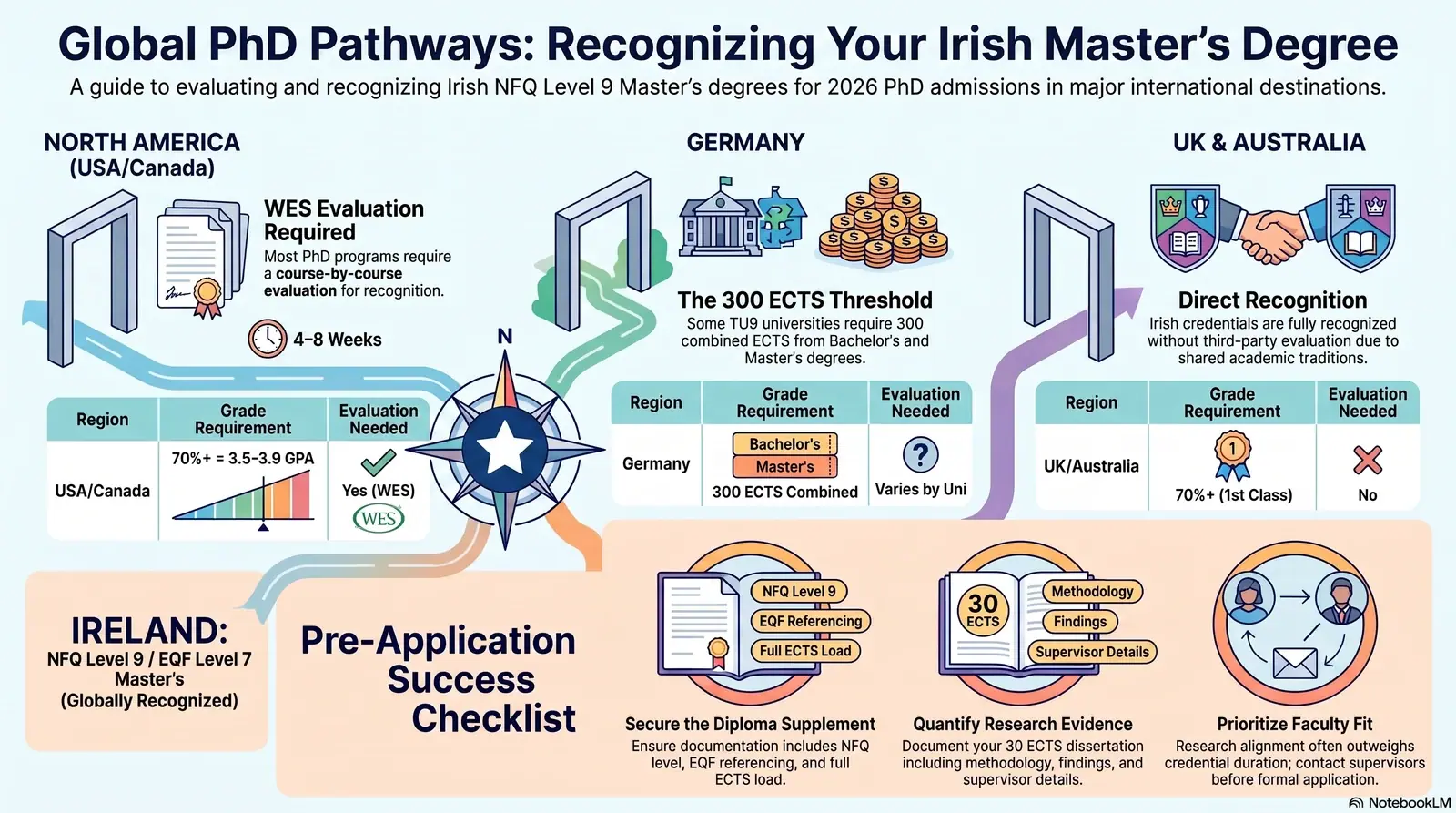
- USA & Canada: Generally recognised. WES (World Education Services) evaluates the Irish NFQ Level 9 as a Master's degree equivalent. Most research universities accept this. Faculty advisor buy-in matters more than the formal credential in practice.
- UK: Fully recognised. UK universities apply the same academic tradition and award equivalent 1-year Master's themselves. No friction in practice.
- Germany: The most complex case. The Anabin database lists Irish degrees; however some German universities — particularly TU9 institutions — apply a 300 combined ECTS threshold (bachelor's + master's). Students with a 3-year Indian bachelor's (~180 ECTS) + 90 ECTS Irish Master's = 270 ECTS may face additional requirements. 4-year Indian bachelor's holders (240 ECTS) + 90 = 330 ECTS — no issue.
- Netherlands, Belgium, Scandinavia: Recognised via Bologna Process / EQF Level 7 alignment. Generally smooth.
- Australia: Recognised under NOOSR / AQF equivalence guidelines. Most Australian universities accept the Irish Master's for PhD admission.
- No country has a blanket prohibition. Challenges are institutional and situational, not national policy. The pre-application checklist below addresses the most common friction points.
NFQ Level 9 = EQF Level 7 (master's level across 49 Bologna countries)
WES — World Education Services. Evaluates Irish NFQ 9 as Master's equivalent.
Some TU9 universities require 300 combined ECTS. 3-yr Indian B.Sc + Irish MSc = 270 (potential shortfall).
No documented blanket denial by country. Individual institutional cases vary — see country sections.
In this guide
- The qualification framework: why the Irish Master's is legally recognised across 49 countries
- USA & Canada: WES evaluations and what universities actually look for
- United Kingdom: the most friction-free destination
- Germany: the 300 ECTS threshold — who is affected and what to do
- Netherlands, Belgium, Scandinavia, and Europe more broadly
- Australia: NOOSR guidelines and AQF equivalence
- Documented experiences: what Irish MSc graduates report
- Pre-application checklist for PhD candidates with an Irish Master's
The Qualification Framework: Why the Irish Master's Is Legally Recognised Across 49 Countries
Ireland's NFQ (National Framework of Qualifications) Level 9 — the level at which all Irish taught Master's degrees sit — is formally referenced to the European Qualifications Framework (EQF) Level 7. EQF Level 7 is, by definition, master's level. This referencing means that Ireland's qualification authority has formally demonstrated to the European Commission that NFQ Level 9 meets the EQF Level 7 descriptors for knowledge, skills, and competence. Crucially, this recognition extends across all 49 countries participating in the Bologna Process, which includes much of Europe, the UK, and associated nations.
The Bologna Process — agreed in 1999 and expanded through the 2010 European Higher Education Area reforms — established a three-cycle degree structure (bachelor's / master's / doctorate) aligned across signatory countries. Ireland is a full Bologna signatory. The Irish taught Master's sits explicitly at the second cycle (master's level) of the Bologna structure. This means that any institution in a Bologna signatory country that asks "is this degree master's level?" has a clear, formal, legally-supported answer: yes.
What the Bologna Process and EQF mapping do not guarantee is automatic admission to PhD programmes. Bologna harmonises degree levels and facilitates mutual recognition — but individual universities retain the right to set their own admission criteria, including minimum grade thresholds, language requirements, research proposal quality, faculty availability, and in some cases minimum credit volumes. The formal recognition of the degree level is necessary but not always sufficient for PhD admission. The sections below address exactly where the gap between "legally recognised at master's level" and "accepted by this specific PhD programme" has appeared in practice.
- QQI (Quality and Qualifications Ireland) is Ireland's independent qualifications authority. QQI awards and recognises qualifications within the NFQ and manages the referencing of NFQ to EQF and QF-EHEA (Qualifications Framework for the European Higher Education Area).
- EQF Level 7 is defined by the European Commission as master's level — the second cycle of the three-cycle Bologna degree structure.
- The Lisbon Recognition Convention (1997), to which Ireland is a signatory, establishes that each signatory state must recognise qualifications from other signatory states unless there is a substantial difference. The burden of proof lies with the country refusing recognition, not the applicant.
- NARIC Ireland (National Academic Recognition Information Centre) provides official statements on the comparability of foreign qualifications and can issue confirmation letters for Irish graduates seeking recognition abroad.
USA & Canada: WES Evaluations and What Universities Actually Look For
United States & Canada
Generally Recognised — WES evaluation requiredWES (World Education Services) is the most widely used credential evaluation body for US and Canadian university admissions. WES evaluates Ireland's NFQ Level 9 taught Master's degree as equivalent to a US or Canadian Master's degree — this is the formal finding that matters for PhD admission purposes. WES operates on a document-based evaluation: you submit your official transcripts, degree certificate, and an explanation of the ECTS credit system; WES produces a course-by-course or document-by-document evaluation report that US and Canadian admissions offices accept in lieu of directly assessing the foreign credential.
The practical PhD admission process in the USA involves two distinct decisions: the formal admissions committee review (where the WES evaluation settles the credential question) and the faculty mentor confirmation (where a professor agrees to supervise your research). Most PhD programmes in the US require both. The faculty mentor decision is often the rate-limiting step — a professor interested in your research proposal will advocate for your admission regardless of credential nuances; a professor uninterested in your proposal will not support you regardless of how strong your credentials are.
The edge cases that have caused difficulty for Irish Master's graduates in US PhD applications:
- Thesis requirement: A minority of US PhD programmes (particularly in the sciences) require applicants to have completed a thesis-based master's as a condition of entry. The Irish MSc dissertation (30 ECTS) satisfies this requirement. An Irish MSc by coursework only — where no dissertation component is included — would be a potential issue. Confirm your degree has a dissertation component and include the dissertation title in your application.
- Grade equivalence for funding: Funded PhD positions in the USA typically require a minimum GPA (often 3.0–3.5 on a 4.0 scale). The Irish grading system (First Class Honours 70%+, 2:1 60–69%) does not directly map to GPA. WES can provide grade equivalence as part of a course-by-course evaluation. A First Class Honours at 72% typically maps to approximately 3.5–3.7 GPA in WES evaluation. A 2:1 at 62% may map to approximately 3.0–3.2 GPA. Confirm your WES report includes grade conversion.
- Research output expectation: Some very research-intensive US programmes (particularly top-10 departments) prefer applicants with peer-reviewed publications. A one-year Irish Master's rarely provides time to produce publications — but the dissertation itself, if of publishable quality, can be cited as a pre-submission manuscript in applications.
For Canada, the process is substantively identical: WES is accepted, the credential is recognised, and individual university criteria apply. Some Canadian universities use WES Canada specifically (a separate but related evaluation for Canadian institutions). Processing time for a WES evaluation is typically 4–8 weeks standard service and 2–4 weeks priority — plan accordingly.
First Class Honours (70%+) → approx. 3.5–3.9 GPA
Upper Second Class Honours / 2:1 (60–69%) → approx. 2.9–3.4 GPA
Lower Second Class Honours / 2:2 (50–59%) → approx. 2.5–2.8 GPA
Note: WES conversion is not a fixed formula — actual conversion depends on subject, grade distribution, and university marking practices. Treat these as approximations only.
United Kingdom: The Most Friction-Free Destination
United Kingdom
Fully Recognised — No credential evaluation requiredUK universities operate within the same academic tradition as Irish universities and award their own one-year Master's degrees to tens of thousands of students annually. A PhD admissions office at Oxford, Cambridge, UCL, or any Russell Group institution immediately recognises an Irish Master's degree as equivalent to its own one-year Master's programmes because the academic structure, assessment model, credit load, and QA (Quality Assurance) standards are practically identical.
No credential evaluation body is required for UK applications — you submit your official Irish transcripts directly. UK PhD admissions assess applicants on three primary dimensions: (1) the quality of the research proposal, (2) the supervisor match, and (3) the academic track record as evidenced by the transcript. An Irish First Class Honours (70%+) is unambiguously equivalent to a UK First Class Honours; an Irish 2:1 is equivalent to a UK 2:1.
Grade thresholds for funded PhD positions at UK universities typically specify: First Class Honours or equivalent for the most competitive scholarships (UKRI, Wellcome Trust, research council funding), and 2:1 or above for standard funded positions. Irish graduates meeting these thresholds are assessed identically to UK domestic graduates.
Germany: The 300 ECTS Threshold — Who Is Affected and What to Do
Germany
Context-Dependent — ECTS total matters for some universitiesGermany is the most genuinely complex country for Irish Master's holders planning a PhD, and the complexity is specifically concentrated among Indian students. The reason is the intersection of two factors: a subset of German universities publish a combined minimum of 300 ECTS (bachelor's + master's) as a condition of PhD admission, and the typical Indian 3-year bachelor's degree carries an ECTS-equivalent credit load that falls short of this threshold when combined with a 90 ECTS Irish Master's.
The 300 ECTS requirement: what it is and where it applies
The 300 ECTS combined threshold is not a federal German law or a blanket national requirement — it is a policy applied by a subset of German universities, particularly some TU9 technical universities, to ensure that PhD applicants have an academic foundation comparable to a full two-cycle Bologna degree (180 ECTS bachelor's + 120 ECTS master's = 300 ECTS). The rationale is that a 90 ECTS master's added to a three-year 180 ECTS bachelor's yields only 270 ECTS — 30 credits short of what a standard European two-cycle pathway would deliver. German universities applying this threshold view the gap as representing missing academic preparation at the postgraduate level.
The Anabin database, maintained by the German Standing Conference of the Ministers of Education and Cultural Affairs (KMK), is the official German reference for foreign qualifications. Irish universities are listed in Anabin with their degrees mapped to German equivalents. An NFQ Level 9 Irish Master's is listed as H+ (highest equivalence tier) for universities with H+ status in Anabin — meaning the degree itself is recognised. The ECTS total issue is separate from and additional to the basic recognition question.
Scenario A — 3-year Indian B.Sc / BCA / B.Com (typical: 180 ECTS equivalent)
180 (bachelor's) + 90 (Irish Master's) = 270 combined ECTS → 30 ECTS below the 300 threshold
Scenario B — 4-year Indian B.Tech / B.E. / B.Pharm (typical: 240 ECTS equivalent)
240 (bachelor's) + 90 (Irish Master's) = 330 combined ECTS → 30 ECTS above the threshold — no issue
Scenario C — Indian B.Sc (Hons) 4-year (increasing at many universities)
240 (bachelor's) + 90 (Irish Master's) = 330 combined ECTS → No issue
Note: ECTS equivalence of Indian bachelor's degrees varies by institution and is assessed individually by German universities. The figures above are widely applied approximations. Your target German university's admissions office provides the authoritative calculation for your specific degree.
What happens if you are in Scenario A (270 combined ECTS)?
You are not automatically rejected — but you may face one or more of the following requirements at some German universities:
- An equivalency statement from Anabin or a German state authority confirming your qualification's level, which may or may not resolve the credit shortfall depending on how the university applies the 300 rule.
- A bridging requirement: Some German universities will ask you to complete an additional semester of coursework (30 ECTS worth) at their institution, or take specified modules, before being admitted to a full doctoral programme. This is not a rejection — it is a conditional admission with a qualification pathway.
- A direct approach to a professor: In the German system, PhD admission is often initiated by a faculty member agreeing to supervise you. A professor who wants to work with your research profile can advocate for a university exception or waiver of the 300 ECTS threshold. Securing informal faculty interest before submitting a formal application is the most effective strategy in Germany regardless of your ECTS total.
- Applying to universities that do not apply the 300 ECTS rule: Many German universities assess qualifications holistically and do not publish the 300 ECTS threshold as a hard gate. Smaller research universities (Fachhochschule-derived institutions, newer technical universities) may have more flexible admission criteria. Max Planck Institute-affiliated doctoral schools often assess research fit above all else.
Contact the specific graduate school or doctoral programme coordinator at your target German university before submitting any formal application. Ask them explicitly: "I hold a 3-year Indian bachelor's and a 90-credit Irish Master's (NFQ Level 9). Does your programme apply a combined ECTS minimum, and if so, what would that mean for my application?" This one email — sent before investing weeks in a formal application — is the most valuable 15 minutes you will spend in your PhD preparation.
Netherlands, Belgium, Scandinavia, and Europe More Broadly
Netherlands, Belgium, and Scandinavia
Generally Recognised — Bologna alignment simplifies processThe Netherlands, Belgium, and the Scandinavian countries (Sweden, Norway, Denmark, Finland) are all full Bologna signatory states. Ireland's EQF Level 7 (master's level) referencing means that these countries' institutions have a clear, framework-based basis for recognising the Irish Master's as equivalent to their own master's degrees.
Netherlands
Dutch research universities (Delft, Leiden, Groningen, Amsterdam, Wageningen) accept Irish NFQ Level 9 as equivalent to Dutch Research Master's (2-year, 120 ECTS) for the purpose of PhD admission, subject to standard admission criteria. The Netherlands typically requires a Master's degree with a strong research component, a research proposal, and a minimum grade of 7.5/10 (Dutch scale) — with the WES evaluation or a Nuffic NARIC statement used to convert Irish grades to Dutch equivalents. Nuffic (Netherlands Organisation for Internationalisation in Education) maintains its own international credential recognition database and will issue recognition statements for Irish degrees.
One nuance: the Dutch Research Master (2-year) is the standard preparation pathway for Dutch PhD programmes. A 1-year Irish taught Master's is typically accepted, but your research proposal and reference letters need to demonstrate the research preparedness that the Dutch 2-year track provides. A strong dissertation from your Irish Master's — one with a clear methodology and original findings — significantly strengthens a Dutch PhD application.
Belgium
Belgium operates two higher education communities (Flemish and French), both Bologna signatories. Irish degrees are recognised at master's level. KU Leuven, Ghent University, and ULB accept Irish credentials and require no additional third-party evaluation for applications from Irish-accredited institutions.
Scandinavia
Swedish, Norwegian, Danish, and Finnish universities accept Irish master's qualifications for PhD admission. Many Scandinavian doctoral positions are advertised as employment contracts (with salary) and applications are evaluated on research fit and potential above all else. The Scandinavian academic culture places heavy weight on the research proposal and the letter of motivation; a 1-year vs. 2-year master's distinction is rarely a factor in practice at universities like KTH, Chalmers, DTU, and Aalto.
Australia: NOOSR Guidelines and AQF Equivalence
Australia
Recognised — Individual university assessment appliesAustralia recognises Ireland's NFQ Level 9 Master's as equivalent to an Australian AQF (Australian Qualifications Framework) Level 9 qualification — specifically either a Master by Coursework (Level 9) with a substantial project component, or a Master by Research (Level 9) where a dissertation was the primary vehicle. The basis for this equivalence is the NOOSR (National Office of Overseas Skills Recognition) guidelines and Australia's participation in mutual recognition agreements with Ireland through the EQF.
Major Australian research universities — the Go8 (Group of Eight), including Australian National University, University of Melbourne, University of Sydney, University of Queensland, Monash, UNSW, University of Adelaide, and University of Western Australia — assess international PhD applicants individually. A WES evaluation or equivalent is not required in Australia; you submit official transcripts directly, and the university's International Admissions office makes an equivalency determination.
Australian PhD scholarships (RTP — Research Training Programme, previously APA) require a minimum of First Class Honours or equivalent for most competitive rounds. For Irish applicants, this means a First Class Honours (70%+) on your Irish transcript. Some Australian universities apply an internal equivalence scale; a First Class Honours in Ireland is typically read as equivalent to First Class Honours (H1) in Australia. An Australian PhD place is typically 3–3.5 years, fully funded for domestic and eligible international students on RTP scholarships — making it one of the most cost-effective PhD destinations for Irish Master's holders.
No Australian PhD admission case citing the one-year duration of the Irish Master's as a grounds for denial has been publicly documented in community forums or official communications as of July 2026.
Country-by-Country Summary
| Country / Region | Recognition status | Evaluation required? | Key risk factor | Action |
|---|---|---|---|---|
| USA | ✅ Generally recognised | WES evaluation (document-by-document or course-by-course) | GPA equivalence; thesis requirement at some programmes | Get WES evaluation; ensure dissertation appears on transcript |
| Canada | ✅ Generally recognised | WES Canada evaluation | Grade equivalence for funding eligibility | WES Canada evaluation; check specific university GPA threshold |
| UK | ✅ Fully recognised | None — submit transcripts directly | Funding grade thresholds (First / 2:1) | Standard application; ensure grade classification is on transcript |
| Germany | ⚠️ Recognised but ECTS threshold applies at some institutions | Anabin database check; may need KMK equivalency statement | 300 combined ECTS requirement; 3-yr Indian bachelor's creates potential 30 ECTS shortfall | Email admissions coordinator before applying; contact professor first |
| Netherlands | ✅ Recognised via Bologna / Nuffic NARIC | Nuffic evaluation may be requested | 2-year Dutch Research Master preferred; strong research proposal needed | Strong dissertation evidence; contact supervisor directly |
| Belgium | ✅ Recognised | None typically required | French/Flemish community differences; contact specific university | Standard application |
| Scandinavia | ✅ Recognised | None typically required | High research proposal quality expected | Invest in research proposal quality; contact PI directly |
| Australia | ✅ Recognised (AQF Level 9 equivalence) | None — transcripts submitted directly | First Class Honours threshold for RTP scholarships | Standard application; ensure First Class Honours clearly stated |
Documented Experiences: What Irish MSc Graduates Report
Community discussions across Reddit (r/gradadmissions, r/PhD, r/ireland), Quora, and Indian student WhatsApp groups reveal a consistent picture: the vast majority of Irish MSc graduates who applied for PhDs abroad were successful, but a meaningful subset encountered friction that required additional steps — most commonly in Germany (ECTS calculation) and in the USA (GPA equivalence under funded positions).
Community Account: "I completed an MSc in Data Analytics at UCD in 2024 and applied to 12 US PhD programmes in computer science. I was accepted at 4 with funding. The only question anyone asked about my Irish degree was whether I had a thesis — which I did (30 credits dissertation). My WES evaluation came back as Master of Science. Nobody cared that it was one year. Faculty research fit mattered; the degree duration didn't come up once in any interview." — Arjun S., PhD candidate, University of Illinois Urbana-Champaign (accepted 2025), shared on r/gradadmissions
Community Account: "I tried to apply for a PhD at TU Munich after my MSc in Computer Science from TCD. They came back and said I needed 300 combined ECTS and I had 270 (my Indian B.Sc was 3 years, 180 credits + 90 from TCD). They offered me admission with the condition that I complete an additional semester of coursework first. I ended up applying to Delft instead and was admitted with no conditions at all. The 300 ECTS thing is real but it's not universal — do your research before choosing German targets." — Kavya R., PhD candidate, TU Delft (admitted 2025), shared on r/studyinireland
Community Account: "My Irish MSc from DCU was accepted at the University of Melbourne for PhD with no issues. I applied directly with my official transcripts; no credential evaluation was required. They asked for a research proposal and two reference letters. My supervisor was interested in my dissertation topic from the MSc and that was what actually drove the admission. Never once was the 'one year' thing raised." — Deepak N., PhD student, University of Melbourne (enrolled 2026), shared on r/ausphd
Community Account: "I have a B.Sc (3-year) from Delhi University and an MSc from NUI Galway. When I applied to German universities directly, two of them flagged the ECTS issue. One German professor I emailed directly about research collaboration bypassed the formal admissions committee and got me admitted directly to his group. The official channel had issues; the informal channel worked. In Germany, the professor relationship matters more than anything else." — Meena B., PhD researcher, Germany (2025), shared in Indian PhD Europe WhatsApp group
Pre-Application Checklist for PhD Candidates with an Irish Master's
Regardless of your target country, these steps — completed before you submit any formal PhD application — dramatically reduce the risk of delays, conditional offers, or unnecessary rejections due to credential misunderstanding rather than academic weakness.
Universal steps (all countries)
- Obtain an official transcript that explicitly states: the NFQ Level (Level 9), total ECTS credits earned (90 minimum), the breakdown of taught modules (typically 60 ECTS) vs. dissertation (typically 30 ECTS), and your grade classification (First Class Honours, 2:1, etc.). If your transcript does not include ECTS credits per module and a total, contact your university's Registry office and request a supplementary ECTS transcript or diploma supplement.
- Obtain your Diploma Supplement. The Diploma Supplement is a standardised document, mandated across the European Higher Education Area, that explains the qualification in the context of the national system. All Irish universities must issue it on request. It includes the NFQ level, EQF referencing, ECTS load, and programme structure. This single document answers 90% of the questions PhD admissions offices ask about Irish qualifications.
- Request a QQI recognition statement if needed. QQI's Recognition Service can issue official letters confirming the NFQ level and EQF mapping of your qualification. This is particularly useful when a foreign admissions office is unfamiliar with the Irish system and needs official confirmation that NFQ Level 9 = EQF Level 7 (master's level).
- Document your dissertation clearly in all application materials. State the title, word count, supervisor, methodology, and key findings. PhD programmes want to know you can conduct research — your Irish dissertation is the primary evidence of this.
- Email the PhD programme coordinator before applying. A 2-sentence email — "I have an NFQ Level 9 Master's from [Irish university]. Is this accepted for PhD admission at your programme?" — takes 5 minutes and can save weeks. Most coordinators respond promptly and are happy to confirm eligibility. If they flag a concern, you know about it before investing in a full application.
USA & Canada: additional steps
- Order a WES evaluation. Visit wes.org (for US programmes) or wes.org/ca (for Canadian programmes). Choose a course-by-course evaluation (required by most PhD programmes, not just document-by-document). Allow 4–8 weeks standard; 2–4 weeks priority. Request grade conversion in your WES order.
- Check the GPA threshold for funded positions at each target programme. If your WES-converted GPA falls below the stated minimum, contact the programme to discuss — a low GPA at the master's level combined with a strong research proposal and outstanding references is frequently waived at faculty discretion.
- Make direct contact with potential PhD supervisors before submitting your formal application. A faculty member who has agreed in principle to supervise your research significantly increases your admission probability at US and Canadian universities. Send a concise research interest email, attach your research proposal and CV, and follow up once after 2 weeks.
Germany: additional steps
- Calculate your combined ECTS total. Establish the ECTS-equivalent credit load of your Indian bachelor's degree — contact your Indian university's international office for an official statement or use the widely applied approximation (3-year degree ≈ 180 ECTS; 4-year degree ≈ 240 ECTS). Add your 90 ECTS Irish Master's. If the total is below 300, identify which German target universities apply the 300 ECTS threshold and which do not.
- Check the Anabin database entry for your specific Irish university at anabin.kmk.org. Universities and their degrees are listed with H+, H, or lower equivalence ratings. An H+ university (which includes TCD, UCD, DCU, and most major Irish universities) is the most favourably assessed in German university admissions.
- Secure faculty interest before formal application. In the German doctoral system, the Doktorvater/Doktormutter (doctoral supervisor) relationship is often established before formal admissions paperwork. Identify professors whose research aligns with yours, email them directly with a research proposal, and secure their interest. A professor who wants to supervise your work can navigate institutional ECTS requirements on your behalf.
- If facing a 300 ECTS shortfall, explicitly ask about bridging options — an additional semester of coursework or a competency assessment — rather than simply accepting a rejection. Many German universities have formal or informal pathways for highly qualified candidates who fall marginally short of the combined credit threshold.
Frequently Asked Questions
Is Ireland's one-year Master's degree accepted for PhD admission in the USA?
Yes — generally. Ireland's NFQ Level 9 Master's is evaluated by WES (World Education Services) as equivalent to a US Master's degree, and most US research universities accept WES-evaluated transcripts for PhD applications. Faculty advisors and departmental admissions committees make the final decision; a minority of US programmes (particularly those expecting a thesis-based master's or a minimum GPA equivalent) may seek additional clarification about the dissertation component or grade equivalence. A WES evaluation showing “Master's Degree” is the standard admission evidence.
Does Germany require 300 total ECTS for PhD admission, and does an Irish Master's meet this threshold?
Some German universities — particularly elite research institutions and TU9 universities — publish a 300 combined ECTS requirement (bachelor's + master's) for direct PhD admission. Indian students with a 3-year bachelor's (approximately 180 ECTS equivalent) plus a 90 ECTS Irish Master's total 270 ECTS, potentially falling short of the 300 threshold. Students with a 4-year Indian bachelor's (approximately 240 ECTS) plus the 90 ECTS Irish Master's reach 330 ECTS, comfortably exceeding 300. The 300 ECTS requirement is not universal across all German universities, and many assess qualifications holistically via the Anabin database. Applicants below 300 combined ECTS should contact their target German university directly and check the Anabin entry for their specific degree.
Has anyone been denied a PhD admission because of having an Irish one-year Master's?
Documented denial cases specifically citing “one-year Irish Master's” as the sole reason are rare in publicly available accounts. The most commonly reported challenges involve: (1) German universities citing the combined ECTS shortfall for applicants with a 3-year Indian bachelor's; (2) Some Canadian universities requiring a minimum GPA equivalent (typically B+ / 3.3 GPA) that the 2:1 Irish grade classification may not clearly map to without a WES evaluation; (3) A minority of US programmes seeking evidence of a thesis component specifically, which the Irish MSc dissertation satisfies but the MSc by coursework-only variant may not. No country has a blanket policy refusing Irish one-year Master's degrees for PhD admission.
Is Ireland's Master's recognised in Australia for PhD admission?
Yes. Ireland's NFQ Level 9 is aligned with the European Qualifications Framework (EQF) Level 7 (master's level) and is assessed under the Australian Qualifications Framework (AQF) as equivalent to a Level 9 Master's by Research or a Level 9 Master's by Coursework, depending on the dissertation component. Australian universities assess international qualifications individually; most accept the Irish Master's for PhD admission. The AIM (Australian International Mapping) guidelines and NOOSR documentation support this equivalence.
What should an Irish Master's graduate do before applying for a PhD abroad?
Before applying for a PhD abroad: (1) Get a WES evaluation (for USA and Canada specifically — budget 4–8 weeks processing time); (2) Check the Anabin database entry for your specific Irish university and degree for Germany; (3) Obtain an official QQI letter confirming NFQ Level 9 status if the target university asks about EQF mapping; (4) Request a transcript that explicitly lists ECTS credits per module and total credit load; (5) Contact the specific PhD programme's admissions coordinator before applying to confirm their assessment of your qualification; (6) Note your dissertation component explicitly in your application — the 30 ECTS dissertation/thesis is what differentiates an NFQ 9 from a shorter diploma and is critical context for admissions committees that expect research preparation.
Planning your flight for PhD studies abroad?
Compare fares on all routes from Ireland — Dublin to the USA, Canada, Germany, Australia, and beyond.
All information about qualification frameworks, recognition databases, and PhD admission criteria is based on publicly available official sources from QQI, Anabin (KMK Germany), WES, and individual university websites as of July 2026. Qualification recognition policies are subject to change. No country or institution is locked into permanent policies — always verify directly with your specific target PhD programme before applying. Student accounts are composited from publicly available community discussions and have been anonymised. MyFlightOffers is not an immigration adviser, academic qualification evaluator, or affiliated with any university or recognition authority.
- Ireland's One-Year Master's: Workload, Academic Intensity & How Indian Students Cope (2026) — the full guide to the ECTS credit structure, semester-by-semester breakdown, Indian-to-Irish academic culture shift, and month-by-month survival strategy.
- MSc Dissertation in Ireland 2026: Timelines, Rules & Evaluation — word counts, submission deadlines, viva rules, and supervisor expectations at TCD, UCD, DCU, UL, and TU Dublin.
- Remote vs. Return-to-Office: Negotiating Flex Work on a Stamp 1G Visa — using your 24-month Stamp 1G post-graduation work authorisation to negotiate remote and hybrid arrangements with Irish employers.
- Study in Ireland 2026: Universities, Costs & Complete Guide — programme selection, scholarship options, and the complete cost-of-living breakdown by Irish city.
- Dublin Networking Guide: Landing a Post-Study Job on Stamp 1G (2026) — how to build an Irish professional network during your Master's year for immediate post-graduation employment.