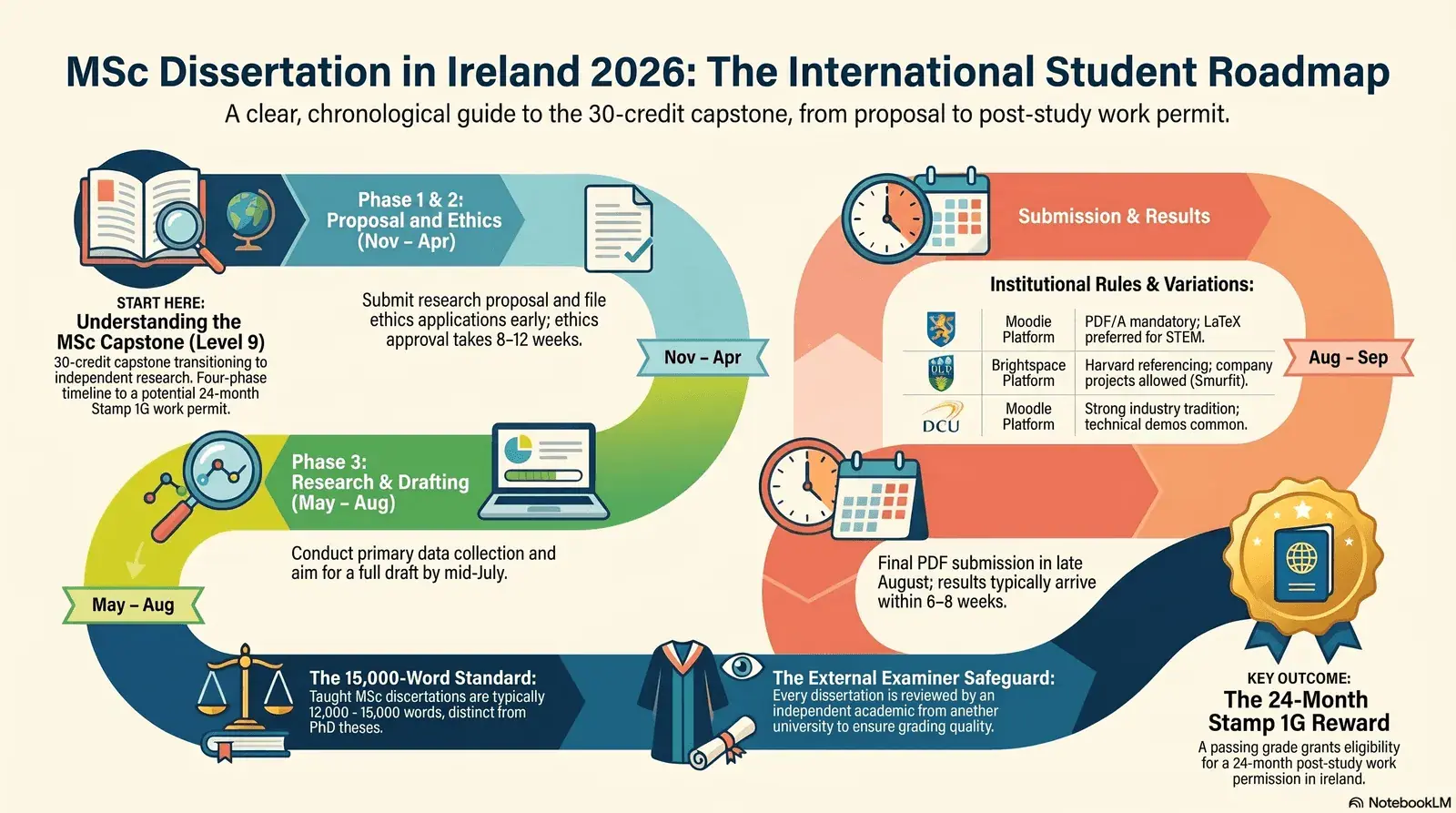
- Your dissertation is 12,000–15,000 words worth 30 ECTS credits — one-third of your total Master's — and is typically submitted in late August/early September for September-intake students, far earlier than most international students expect.
- If your research involves human participants, data, or ethical considerations, start your ethics approval application in semester 1 — university ethics boards take 8–12 weeks to respond, and you cannot begin data collection without approval.
- Your dissertation result directly affects your Stamp 1G eligibility — a First Class Honours (70%+) or 2.1 result strengthens your graduate employment applications during the 24-month post-study work period; a fail means a re-submission before you can graduate.
📄 Standard word count
12,000–15,000 words
Excluding references & appendices
📅 Submission window
Late August – Early September
For September-intake programmes
🎓 ECTS credit weight
30 credits (of 90 total)
NFQ Level 9 taught Master's
🛂 Post-graduation work rights
Stamp 1G — 24 months
To seek graduate employment in Ireland
7 questions answered in this guide
- What is an MSc dissertation in Ireland — and how is it different from a thesis?
- What is the exact MSc dissertation timeline for September-intake students?
- How do dissertation rules differ between TCD, UCD, DCU, UL, and TU Dublin?
- What academic support will my Irish university provide?
- How is my MSc dissertation graded and evaluated in Ireland?
- What must I verify before I submit? (Pre-Submission Checklist)
- What happens after I submit? Stamp 1G, results, and next steps
For the vast majority of international students on a taught Master's programme in Ireland, the dissertation is the single largest and most consequential piece of academic work they will produce. Carrying approximately 30 out of 90 ECTS credits, it is not simply a final assignment — it is the capstone output that defines your NFQ Level 9 qualification, validates your specialist knowledge to future employers, and directly shapes the strength of your post-study Stamp 1G application.
Yet most international students arrive in Ireland having never encountered a dissertation at this level. Confusion between a dissertation and a thesis, uncertainty about submission timelines, and a lack of clarity on how work is evaluated cause unnecessary stress at exactly the wrong moment. This guide clears all of that up with verified, institution-specific facts — not generic advice.
1 What Is an MSc Dissertation in Ireland — and How Is It Different from a Thesis?
An MSc Dissertation in Ireland is the final independent research project of a taught Master's degree (NFQ Level 9), typically 12,000–15,000 words, completed over 3–4 months. A Thesis is a longer original research contribution associated with research degrees such as MRes or PhD (NFQ Level 10), running 40,000–80,000+ words over 1–4 years.
This is one of the most common points of confusion for international students arriving from Indian, Chinese, or North American academic systems, where the two terms are used interchangeably. In the Irish higher education system — governed by Quality and Qualifications Ireland (QQI) — they are formally distinct:
| Feature | MSc Dissertation (Taught) | Thesis (Research / PhD) |
|---|---|---|
| Degree type | Taught Master's — NFQ Level 9 | Research degree — NFQ Level 9–10 |
| Typical word count | 12,000–15,000 words | 40,000–80,000+ words |
| Duration of research phase | 3–4 months (concurrent with modules) | 1–4 years (full-time research) |
| Original knowledge contribution required? | Not mandatory — applies existing knowledge to a problem | Mandatory — must advance academic knowledge |
| Supervision ratio | Often shared or assigned late in Year 1 | Dedicated primary supervisor from day one |
| Viva voce (oral defence) | Varies — not universal for taught MSc | Mandatory at all Irish institutions |
| ECTS weight | Typically 30 credits of 90 | Constitutes the full programme credit |
Your Irish student permission (Stamp 2) is tied to your specific programme type via the Interim List of Eligible Programmes (ILEP). Graduates of taught MSc programmes (NFQ Level 9) and PhD graduates both receive 24 months of Stamp 1G post-study work permission — but through different immigration tracks. Confirm your programme appears on the current ILEP list via irishimmigration.ie before enrolment, not after.
2 What Is the Exact MSc Dissertation Timeline for September-Intake Students?
The standard taught MSc dissertation cycle in Ireland runs from November/January through to late August or early September of the following year — divided into four distinct phases, each with formal checkpoints.
Topic Selection & Research Proposal
Identify your research question — either from a supervisor-published topic list or by proposing your own. Submit a 500–1,000 word research proposal to your department. Some universities (DCU, TCD) require a brief before Christmas; others (UL, TU Dublin) formally assign topics in January. If your research involves human participants, your ethics application must also open here.
Literature Review & Interim Checkpoint
Complete your literature review chapter (typically 3,000–4,000 words of your final word count). Most programmes require an Interim Progress Report worth approximately 10% of your total dissertation grade by April, confirming your methodology is sound and data collection has begun.
Primary Research & Full Draft Writing
The most intensive phase. Conduct primary data collection — surveys, interviews, system builds, or dataset analysis. Write your methodology, results, analysis, and conclusion chapters. Bi-weekly supervisor meetings are critical here. Aim for a complete first draft by mid-July to allow at least 4–5 weeks of revision before submission.
Final Submission & Examination
Upload your final PDF to your institution's submission portal (Moodle, Brightspace, or Turnitin Direct). Most institutions require digital submission only; some still require a bound physical copy. Results typically return within 6–8 weeks. Your Stamp 2 student permission remains valid through this result-waiting period.
MSc Dissertation Timeline & Word Planner
Input your target deadline and word count to map out your 2026 Irish university milestone tracker.
📅 Your Key Milestone Deadlines
📄 Recommended Chapter Word Breakdown
| Chapter / Section | Weight | Target Word Count |
|---|---|---|
| Intro & Research Question | 15% | - |
| Literature Review | 25% | - |
| Methodology | 20% | - |
| Analysis & Findings | 25% | - |
| Conclusion & Layout Adjustments | 15% | - |
If your research involves interviews, surveys, focus groups, or any personal data from human participants, you must submit a formal ethics application to your institution's Research Ethics Committee before any data collection begins. This is not optional — it is a regulatory requirement under GDPR and the Declaration of Helsinki. At most Irish universities, ethics review takes 8–12 weeks. Missing this window by starting data collection in March when you should have filed in November can entirely block your submission. Open the ethics process in Phase 1 without exception.
3 How Do Dissertation Rules Differ Between TCD, UCD, DCU, UL, and TU Dublin?
Yes, submission formats, referencing styles, ethics processes, and even whether a viva is expected differ meaningfully between Irish universities — even within the same NFQ Level 9 framework. Here is what each institution requires in practice.
| University | Submission Platform | Format & Referencing | Industry Project Allowed? | Oral Component Common? |
|---|---|---|---|---|
| Trinity College Dublin (TCD) | Moodle + TCD Library repository | PDF/A mandatory; LaTeX preferred for STEM/Computing; Harvard or IEEE by department; strict 2.5cm margins, 12pt Times New Roman or 11pt Arial | Case-study based; company data used but formal co-supervision is rare | Yes — common in STEM MSc programmes; check your school |
| University College Dublin (UCD) | Brightspace | Word or PDF accepted; Harvard referencing standard; programme handbook specifies margins and fonts for each school | Smurfit Business School allows company dissertations with signed NDA | Occasional — more common at Smurfit MBA level than taught MSc |
| Dublin City University (DCU) | Moodle + DCU Online Library | LaTeX strongly encouraged for Computing; Word accepted for Business and Communications; IEEE (Computing) or APA (Business/Comms) | Yes — strong industry dissertation tradition, particularly in Data Analytics and Computing | Less common; final-year technical demonstrations or poster sessions more typical |
| University of Limerick (UL) | Sulis (UL Brightspace) | UL-specific dissertation template mandatory (available on Sulis from Week 1); Harvard for business disciplines; APA for psychology and social science | Yes — co-op placement research can directly feed into the dissertation with an industry supervisor formally appointed | Rarely required for taught MSc; common for research degrees only |
| TU Dublin | Brightspace | APA or IEEE depending on school; Word and PDF both accepted; applied artefacts (working software) may reduce the word count requirement | Yes — applied technical dissertations with working system builds are the standard expectation in Computing programmes | Technical demos replace vivas in many Computing and Data Science programmes |
Every Irish university publishes a programme-specific dissertation handbook detailing exact word count, formatting requirements, ethics procedures, submission deadlines, and grading rubrics. International students who do not read this in September spend the rest of the academic year discovering rules they should have known on day one. Find it in your student portal (Moodle, Brightspace, or Sulis) in your first week. If it is not yet posted, email your programme coordinator and request the current draft — it exists, even pre-semester.
4 What Academic Support Will My Irish University Provide?
Every Irish HEI on the ILEP list provides international students with an assigned academic supervisor, free access to a Postgraduate Writing Centre, and library access to major research databases including Scopus, ScienceDirect, and IEEE Xplore.
Academic Supervisor
Supervisors are assigned by your department, usually in December or January. Their role is to guide your research direction and methodology — not to proofread your drafts or produce your literature review. The standard expectation is bi-weekly meetings of 30–45 minutes. Prepare a written one-page progress update 24 hours before each meeting. Supervisors respond significantly better to students who demonstrate structured, documented progress than to those who arrive with verbal updates and open-ended questions.
Postgraduate Writing Centre
All major Irish universities operate a free Postgraduate Writing Centre or Academic Writing Service, offering one-to-one consultations, dissertation structure workshops, and feedback on academic register and phrasing. For international students whose primary language is not English, or who studied in a different academic tradition, this service is genuinely transformative. Book your consultation slot in January — waiting lists build from April onwards and slots disappear entirely in July and August.
- TCD Academic Practice & eLearning
- UCD Writing Centre
- DCU Learning & Development
- UL Library Learning Support
Library Research Databases
Your student card grants access to databases worth thousands of euro in personal subscriptions. Use them from Week 1, not Week 30. The primary databases for MSc research in Ireland:
- Scopus — broad multidisciplinary coverage; best tool for systematic literature reviews
- IEEE Xplore — essential for computing, engineering, and electronics research
- ScienceDirect — life sciences, social sciences, and pharmaceutical research
- ACM Digital Library — computing, AI, and human-computer interaction
- JSTOR — humanities, social sciences, and business management
5 How Is My MSc Dissertation Graded and Evaluated in Ireland?
MSc dissertations in Ireland are assessed by two examiners — an Internal Examiner from your department and an External Examiner from a separate institution — using a standardised rubric that typically awards Distinction (70%+), Merit (60–69%), Pass (50–59%), or Fail (below 50%).
| Assessment Type | What It Involves | Typical Programmes | Duration |
|---|---|---|---|
| Written Submission Only | Internal and External Examiner review the document independently; no oral element | Most taught MSc in Business, Humanities, Social Sciences, Finance | N/A |
| Viva Voce (Oral Defence) | 30–60 minute defence of research methodology and conclusions before an academic panel | STEM and Science MSc at TCD and UCC; selected programmes at UCD; all PhD degrees | 30–60 minutes |
| Technical Demo / Artefact Review | Live demonstration of working software, machine learning model, cloud system, or dashboard | Computing, Data Science, AI, Cloud programmes at DCU, TU Dublin, UL | 20–30 minutes |
| Poster Presentation | Visual research summary presented to a board of examiners who ask questions | Business, MBA, Project Management, and Healthcare Management programmes | 10–15 min per examiner |
What examiners actually look for: the standard grading rubric
While exact weightings vary by department, most Irish MSc dissertation rubrics assess the following components:
- Research Question Clarity (15–20%): Is the problem well-defined, specific, and researchable within the available timeframe?
- Literature Review (20–25%): Is existing scholarship comprehensive, critically evaluated, and properly cited — not merely summarised?
- Methodology (20–25%): Is the research design appropriate for the question, justified against alternatives, and sufficiently detailed to be replicated?
- Analysis and Findings (20–25%): Are results presented accurately, interpreted correctly, and explicitly linked back to the research question?
- Writing Quality and Structure (10–15%): Is the document well-organised, professionally written, and formatted to specification?
Ireland's use of External Examiners — independent academics drawn from other Irish or international universities — is a genuine quality safeguard built into the Irish higher education system. The external examiner reviews both the dissertation and the internal marking to ensure consistency with national and international standards. This means your grade is validated beyond your own institution's internal assessors. An exceptionally strong dissertation can be upgraded by an external examiner who recognises its quality against a broader benchmark. It also means that inflated internal marking cannot go unchallenged.
6 What Must I Verify Before I Submit? (Pre-Submission Checklist)
A pre-submission checklist covering Turnitin similarity, reference formatting, ethics compliance, supervisor sign-off, and file format is the most effective safeguard against submission rejection or last-minute delays on an Irish MSc dissertation.
- Ethics clearance obtained and documented — If your research used human participants, attach your ethics approval certificate as an appendix. Confirm with your supervisor that all data collection remained within the approved scope.
- Turnitin draft similarity score below your institution's threshold — Run a draft submission at least 14 days before the deadline. Most Irish institutions expect below 20% overall; TCD and UCD typically expect below 15% for postgraduate work. Paraphrase flagged passages — do not simply delete them.
- Word count verified and within ±10% of the stated limit — Count only your main body text. Exclude the abstract, table of contents, references, and appendices from your total unless your handbook specifies otherwise.
- Referencing style consistent throughout and cross-checked — Every in-text citation must have a corresponding reference list entry. Every reference list entry must have a corresponding in-text citation. Use Mendeley or Zotero to auto-generate in the required style (Harvard, APA, IEEE, or Chicago as specified in your handbook).
- Academic integrity declaration signed and attached — Most Irish universities require a signed declaration confirming the work is entirely your own, submitted as the first page of your document. Download this form from your student portal, not from memory.
- File format compliant and tested — Submit as PDF or PDF/A unless your handbook specifies Word. Ensure all fonts are embedded, images are not blurred, and tables have not shifted during PDF conversion. Open the PDF on a different device before upload.
- Supervisor has given written approval of the final draft — Confirm via email (not verbal) that your supervisor has reviewed the penultimate draft and supports submission. Some programmes require a formal supervisor sign-off form attached to the submission package.
- Primary research data securely stored and backed up — Interview recordings, survey data, and datasets must be securely stored for a minimum of 5 years under GDPR and your institution's research data management policy. Back up to a university-provided drive (not solely a personal laptop or external hard drive).
- Hard copy requirements confirmed — Some programmes still require a spiral-bound or hardbound physical copy submitted to the department office by a specific date. Printing and binding takes 24–48 hours. Confirm this requirement in Week 1, not the week of submission.
- Submission portal access confirmed 72 hours in advance — Log into Moodle, Brightspace, or Turnitin Direct at least 3 days before the deadline to confirm your submission assignment is active and you know the exact upload path. Portal outages on deadline day are not accepted as grounds for late submission at most Irish institutions.
7 What Happens After I Submit? Stamp 1G, Results, and Next Steps
After final dissertation submission, results are typically released within 6–8 weeks. A passing grade at any level triggers your eligibility to apply for Stamp 1G post-study work permission, which grants NFQ Level 9 graduates 24 months to seek graduate-level employment in Ireland without an employer sponsor.
| Grade Classification | Typical Mark Range | Immigration and Career Outcome |
|---|---|---|
| Distinction | 70% and above | Full pass; degree awarded; strong positioning for competitive graduate roles and Irish Research Council funded postdoctoral pathways |
| Merit | 60%–69% | Full pass; degree awarded; solid foundation for most graduate roles |
| Pass | 50%–59% | Full pass; degree awarded; Stamp 1G available |
| Referral | 40%–49% | Resubmission required within a set window (typically 3–6 months); may require Stamp 2 extension from the Irish Immigration Service |
| Fail | Below 40% | Degree not awarded; Stamp 2 cannot be renewed for this purpose; seek independent legal advice on immigration options |
Applying for Stamp 1G after your Master's degree
Once your results letter is issued and your degree is formally conferred, you can apply for Stamp 1G via the Irish Immigration Service. NFQ Level 9 graduates receive 24 months of Stamp 1G, issued as an initial 12-month permission with a 12-month renewal. You must apply within six months of receiving your final results, and you must hold valid Stamp 2 at the time of application. During Stamp 1G, you can work full-time — up to 40 hours per week — without a separate work permit.
If you secure employment in an eligible occupation at €40,904 or above per year, you can apply for a Critical Skills Employment Permit (CSEP) during your Stamp 1G window. After 21 months on a CSEP, you become eligible for Stamp 4 — granting the right to work in any role without a permit, and opening the pathway toward Irish citizenship by naturalisation after five years of continuous legal residence.
Dissertation submission in late August means the September–October window is when many international students travel home to celebrate, visit family, or relocate for a graduate role. August and September are also peak fare months for Dublin–India and Dublin–mainland China routes. To protect your budget: check the MyFlightOffers monthly fare calendar for the cheapest booking windows and search live fares on your intended route at least 6–8 weeks before your planned departure — not after you finish your viva.
Frequently Asked Questions
What is the difference between an MSc dissertation and a thesis in Ireland?
An MSc Dissertation is the final research project of a taught Master's degree (NFQ Level 9), typically 12,000–15,000 words, completed over 3–4 months. A Thesis is a longer original research contribution (40,000–80,000+ words) required for research degrees such as MRes or PhD (NFQ Level 10), taking 1–4 years. In the Irish academic system the two are formally distinct — unlike in North American or Indian systems where the terms are used interchangeably.
Does every MSc dissertation in Ireland require a viva voce?
No. A formal oral defence is not universally required for taught MSc programmes in Ireland. It is mandatory for all PhD dissertations. Some MSc programmes at TCD, UCC, and UCD include an oral element; others rely entirely on written submission and examiner panel review. Technical demonstrations are common for Computing and Data Science programmes at DCU and TU Dublin. Check your programme handbook in Week 1.
Can I base my MSc dissertation on a workplace or industry project in Ireland?
Yes, at several Irish universities. University of Limerick and DCU have well-established traditions of industry-connected dissertations. Academic supervision is always retained. If proprietary company data is involved, a signed non-disclosure agreement between the university and the company is typically required before research begins.
What is a safe Turnitin similarity score for an MSc dissertation in Ireland?
Most Irish universities flag submissions above 20% for review; TCD and UCD typically expect below 15% for postgraduate work. Self-plagiarism — reusing your own previously submitted coursework without proper attribution — is detected and treated the same as external plagiarism. Run a draft check at least 14 days before your deadline so you have time to properly paraphrase flagged passages.
What happens if my dissertation is referred?
A referral (typically 40%–49%) means your work did not reach a full pass but is deemed capable of being brought to pass standard. You will be given a specific resubmission deadline — usually 3–6 months from the original submission date — and a clear list of corrections required. During this period you may need to apply for a Stamp 2 extension from the Irish Immigration Service. Contact your programme coordinator and your university's international student office the day you receive a referral outcome.
How many words is an MSc dissertation at an Irish university?
Most Irish universities set MSc dissertation word counts between 12,000 and 15,000 words, excluding references and appendices. Computing and data science programmes sometimes accept shorter submissions (10,000-12,000 words) when accompanied by a working software artefact. Always verify the exact limit in your programme handbook.
When do MSc students in Ireland submit their dissertation?
For September-intake taught Master's programmes, the final submission deadline falls in late August or early September of the following year - approximately 11-12 months into the programme. TCD and UCD typically set late August deadlines; TU Dublin may extend to mid-September for certain programmes.
What happens after I submit my MSc dissertation in Ireland?
After submission, an Internal and External Examiner independently assess your work. Results are typically released within 6-8 weeks. Outcomes include Distinction (70%+), Merit (60-69%), Pass (50-59%), Referral, or Fail. Following a Pass at NFQ Level 9, you can apply for Stamp 1G post-study work permission, granting 24 months to seek graduate-level employment in Ireland.
- Study in Ireland 2026: Universities, Costs & Flights — Part 1 — Top 10 Irish universities, GOI-IES scholarships, IELTS requirements, cost of living by city, and flights from India and China
- Finding Affordable Flights from Dublin to Delhi 2026 — Airline-by-airline comparison, booking windows, baggage hacks, and e-Arrival Card requirements for your post-graduation trip home
- Airport Lounge Access in India: Complete Credit Card Guide 2026 — DreamFolks vs Priority Pass, spend-based criteria, and guest access strategies before your connecting flight to Dublin
- Axis Bank Credit Cards for Flights 2026 — EDGE Miles, Atlas vs Magnus, and the April 2026 partner changes for booking your Ireland flights with an Indian credit card
- Is Ireland's One-Year Master's Recognised for PhD Admission? USA, Canada, Germany & Australia (2026) — WES evaluation results, Germany's 300 ECTS threshold, Anabin database, NOOSR (Australia), and the pre-application checklist for PhD candidates
Finishing your dissertation in August? Book your flights before the peak hits.
August–September is the most expensive period for Dublin–India and Dublin–China routes. Check the fare calendar now, set a price alert, and book at least 6–8 weeks before your planned departure to avoid the post-graduation travel surge.
All dissertation word counts, submission deadlines, grading criteria, ethics approval processes, referencing requirements, database access policies, university platform names, and immigration rules described in this article are based on publicly available information from individual Irish university websites — tcd.ie, ucd.ie, dcu.ie, ul.ie, tudublin.ie — as well as Quality and Qualifications Ireland (QQI), the Irish Immigration Service, and Enterprise Ireland as of June 2026. Academic rules, submission formats, ethics timelines, grading rubrics, and immigration policies change regularly and without prior notice. Always verify current requirements through your programme's official handbook and your university's postgraduate research office before making any academic or travel decision. MyFlightOffers is not affiliated with any Irish university or government body mentioned in this article. This article does not constitute legal, immigration, or academic advice.