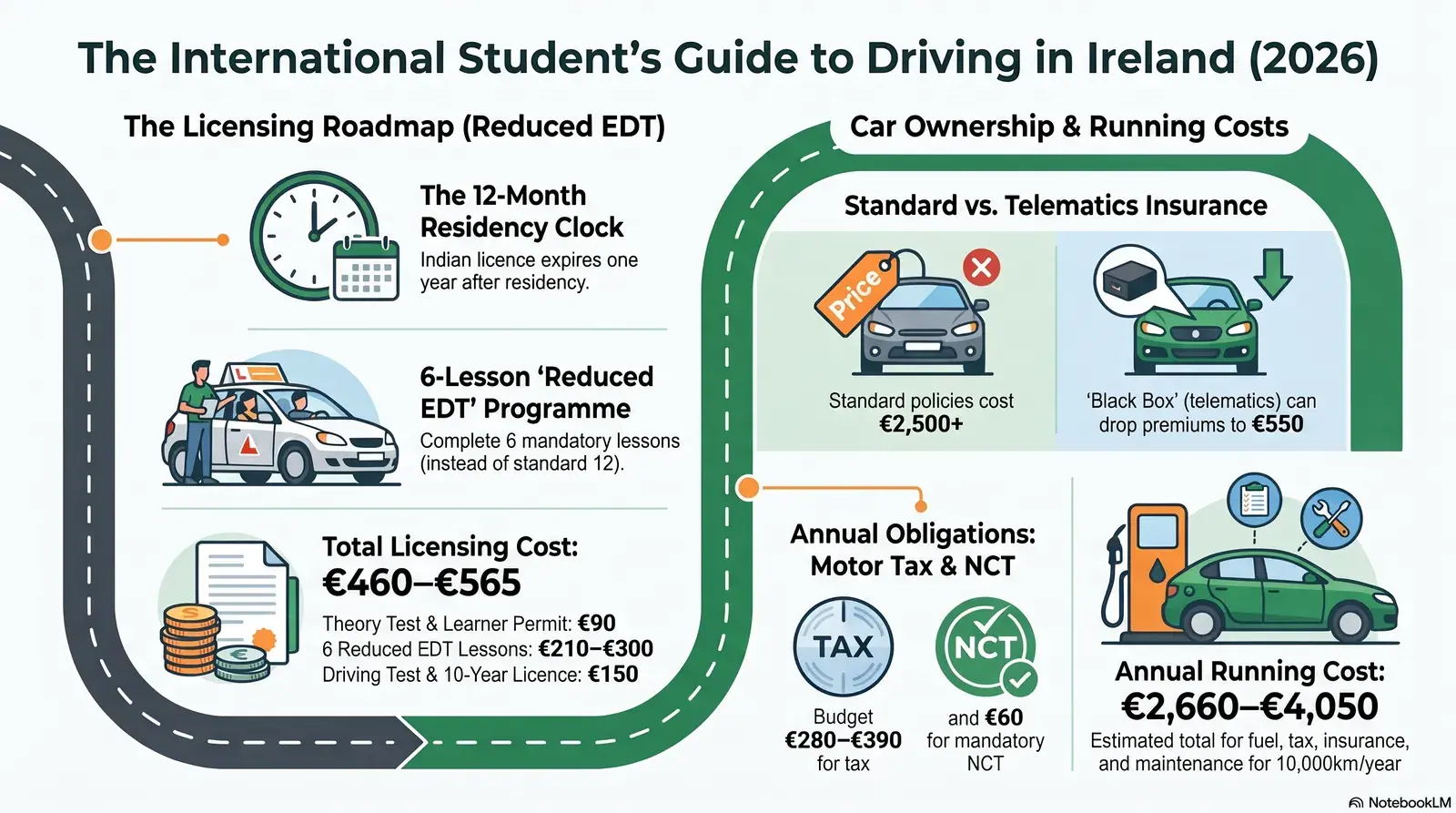
- 12-month window: Your valid Indian driving licence lets you drive in Ireland for up to 12 months after becoming normally resident — after that date it is no longer legal to use it.
- No direct exchange: Ireland does not exchange Indian licences at the NDLS counter. You must complete 6 Reduced EDT lessons with an RSA-approved instructor and pass the Irish driving test. Total cost: roughly €450–€540.
- Insurance is the biggest shock: First-year car insurance for a newly licensed driver in Ireland can run €2,500–€5,000+ per year. A telematics (black box) policy can bring this closer to €550–€900, but only if you drive carefully.
Can you drive in Ireland with an Indian driving licence?
Yes — a valid, full Indian driving licence allows you to drive legally in Ireland for up to 12 months from the date you became “normally resident” in the country. Ireland recognises driving licences from all countries, not just EU member states, provided the licence is current and covers the vehicle category you want to drive (most Indian licences cover category B — standard cars).
Two important distinctions apply. First, you must be the holder of a full licence (not an Indian learner or provisional). Second, the 12-month period is measured from the date you became normally resident — defined in Irish law as intending to reside in Ireland for at least 185 days per year — not from your first arrival date for orientation week. For most Stamp 2 students, normal residency begins from the date your institution registers you as an enrolled student.
If your Indian licence is issued only in Hindi script with no English translation, the National Driver Licence Service (NDLS) may require a certified English translation before you can use it as supporting evidence for a learner permit application. Modern bilingual Hindi–English Indian licences issued since 2014 are generally accepted as-is.
The 12-month residency clock: what happens when it expires?
Once 12 months of normal residency have passed, your Indian licence loses its legal validity in Ireland, and driving on it becomes an offence under Irish Road Traffic law. This catches many students off guard because the licence itself has not expired — only its recognition in Ireland has lapsed.
The practical timeline for most September-intake students looks like this: if you arrive in August 2025 and establish normal residency in September 2025, your Indian licence is valid until September 2026. You should aim to sit your Irish driving test and receive your full Irish licence well before that deadline — ideally by June or July 2026 — because RSA test slots can book out six to eight weeks in advance during the summer peak.
During the 12-month window you may drive any insured vehicle. After that window, if you have not yet passed your Irish test, you must hold a valid Irish learner permit and be accompanied by a qualified driver at all times.
On-the-Ground Insight: “I didn’t realise my Indian licence had a ticking clock until a classmate mentioned it in February. I scrambled to book EDT lessons and only got my test slot for late August — two weeks before the 12-month mark. Don’t leave it that late. Book the theory test as soon as you arrive.” — Riya M., TU Dublin, September 2025 Intake
How to get an Irish driving licence: the Reduced EDT route for Indian students
India is not on Ireland’s licence exchange list, meaning you cannot swap your Indian licence for an Irish one at the NDLS counter. However, Indian licence holders are eligible for the Reduced Essential Driver Training (EDT) programme — a shortened version of the standard 12-lesson course that requires only 6 lessons before sitting the driving test.
Here is the step-by-step process as of July 2026:
Step 1 — Pass the Irish Driver Theory Test
Book and pass the theory test through the Road Safety Authority (RSA) before doing anything else. The test costs €45, covers Irish road signs, rules, and hazard perception, and is computer-based at theory test centres across Ireland. Allow two to four weeks of study using the official RSA Road Rules publication or a free app. Your theory test certificate is valid for two years.
Step 2 — Apply for an Irish Learner Permit at the NDLS
Visit an NDLS centre with your original Indian driving licence, theory test pass certificate, a valid passport, proof of Irish normal residency (utility bill or bank statement), and an eyesight report signed by a registered optician. The learner permit fee is €45 from 1 January 2026. Your Indian licence is returned to you but you must surrender it when you receive your full Irish licence.
Your Indian licence must be a full licence and still valid. If it expired before you applied, contact the NDLS to confirm how to proceed — you may need to declare your driving history in writing.
Step 3 — Complete 6 Reduced EDT Lessons
Because you hold a full foreign licence, you qualify for the Reduced EDT programme — just 6 mandatory lessons instead of the standard 12. Find an RSA-approved driving instructor in your city (most schools advertise Reduced EDT explicitly). Lesson prices vary: expect €35–€50 per lesson, making the 6-lesson block €210–€300 in total. The lessons cover key areas prescribed by the RSA: technical checks, controls, junctions, overtaking, roundabouts, and night/motorway driving.
Step 4 — Book and Pass the RSA Driving Test
Book your driving test online via the RSA website once you have completed your 6 EDT lessons. The test fee is €85 per attempt. Slots in Dublin and Cork book out fast in summer months; Galway, Limerick, and Athlone generally have better availability. If you fail, you must wait a minimum of six weeks before rebooking — factor this into your 12-month timeline.
Step 5 — Apply for Your Full Irish Driving Licence
Within two years of passing the driving test, apply at any NDLS centre for your full Irish licence. A 10-year licence costs €65. At this point you surrender your Indian licence permanently — it is sent to the Indian licensing authority. Keep a certified photocopy before surrendering it.
Full cost breakdown: Indian student pathway to an Irish driving licence
Via the Reduced EDT route, the total mandatory cost of obtaining an Irish driving licence is approximately €450–€540 — significantly less than the €770–€900 a first-time Irish learner pays for the standard 12-lesson programme.
| Step | Cost (2026) | Notes |
|---|---|---|
| Driver Theory Test | €45 | RSA-administered; book at rsa.ie; pass valid for 2 years |
| Eyesight Report | €10–€25 | Signed by registered optician; many pharmacies offer this |
| NDLS Learner Permit | €45 | Fee increased from €35 on 1 January 2026 |
| Reduced EDT — 6 Lessons | €210–€300 | RSA-approved instructor; 6 mandatory lessons (vs 12 for first-timers) |
| RSA Driving Test | €85 | Per attempt; 6-week minimum wait between attempts if failed |
| Full Irish Licence (10-year) | €65 | Applied for after passing; Indian licence surrendered at this point |
| Total (Reduced EDT route) | €460–€565 | Vs €770–€900 for standard first-time Irish learners |
Sources: NDLS Fees 2026; RSA; Citizens Information.
Buying a used car in Ireland: a step-by-step guide for students
The Irish used-car market is accessible on a student budget — reliable cars in the €4,000–€8,000 bracket are plentiful on DoneDeal, Carzone, and private sale — but every purchase requires two independent checks before you hand over money.
Step 1: Run a car history check (Cartell or MotorCheck)
Before viewing any car, pay for a digital history check to verify it has no outstanding finance, write-off history, or clocked mileage. The two main providers in Ireland are Cartell and MotorCheck. A standard single-vehicle report costs approximately €19.95 from either service (July 2026). The report reveals outstanding PCP or hire-purchase finance agreements, NCT history and mileage readings, stolen vehicle status, VRT payment confirmation, write-off or total-loss registration, and the number of previous Irish owners.
Important caveat: for cars imported from the UK after Brexit, both Cartell and MotorCheck show only the Irish history from the point of import. Any accident, finance, or clocking that happened in the UK before import is invisible to Irish checks. On UK-imported vehicles, also run a UK MOT history check (free via the DVLA website) to see mileage readings from the UK period.
Step 2: Get a pre-purchase inspection
Always have the car independently inspected by a qualified mechanic before agreeing to buy. The AA Ireland offers pre-purchase inspections starting around €120–€150 and will travel to the seller’s location. A friend with mechanical knowledge is a free alternative, but a professional inspection on any car over €5,000 is well worth it. Common issues in the Irish used-car market include rust on the undercarriage (caused by road salt), worn timing belts, and gearbox wear on high-mileage diesel engines.
Step 3: Check VRT and motor tax status
All cars sold in Ireland must have Vehicle Registration Tax (VRT) already paid at the point of first Irish registration — verify this on the Cartell or MotorCheck report. VRT is a once-off tax calculated as a percentage of the car’s Open Market Selling Price (OMSP) based on CO² emissions, ranging from 7% for cars emitting under 50g/km to 37% for cars emitting over 190g/km. You are not liable for VRT on a car that is already registered in Ireland, but an unregistered UK import placed for sale privately is a red flag.
Step 4: Budget for year-one costs beyond the purchase price
Budget research firm Autoza estimates that a €10,000 car typically costs an additional €1,200–€1,800 in the first year beyond the purchase price, covering motor tax, insurance excess, servicing, and any remedial repairs. For students on a tighter budget in the €4,000–€6,000 car range, those ancillary costs often match or exceed the vehicle’s value — factor this carefully before buying.
Car insurance for Indian students in Ireland: costs and strategies
Car insurance for a newly licensed driver in Ireland is the single largest ongoing expense of car ownership, often running €2,500–€5,000+ per year in the first year after passing the test. The Irish insurance market prices risk heavily on driving experience in Ireland or the UK, regardless of how long you have held an Indian licence or how clean your Indian driving record is.
Why Indian NCB is not widely accepted
Irish insurers maintain a standard list of countries whose no-claims bonus (NCB) they automatically recognise, which includes the EEA, UK, USA, Canada, Australia, New Zealand, Japan, and South Africa — India is not on this list. Some insurers may consider Indian NCB documentation on a case-by-case basis, but you must supply a formal NCB letter from your Indian insurer on company letterhead, stating the number of claim-free years, dated within the past two years. The practical result is that most first-time Irish policy holders with an Indian driving history are quoted as a “new driver” in terms of NCB discount level.
Telematics (black box) policies: the student-friendly option
Telematics or “black box” car insurance policies use a device or app to monitor your speed, braking, cornering, and time of driving — and reward safe behaviour with lower premiums. For newly licensed drivers in Ireland, this is often the only route to an affordable premium. AIG BoxClever advertised comprehensive insurance from €550 for a 22-year-old student in Dublin as of mid-2026 (conditions apply; based on telematics eligibility). An Post Insurance and Aviva also offer telematics products. Black box policies can reduce a new-driver premium by 10–30% if you maintain safe driving scores.
Key restrictions with black box policies: night-time driving (typically midnight–5 a.m.) is heavily penalised and some policies cap the kilometres you can drive per year. Read the small print on both before buying.
Practical tips to reduce your insurance quote
Use a broker rather than going direct to a single insurer — brokers access multiple underwriters including specialist markets that consider international driving history. Always declare your Indian driving experience and years held honestly on your application. Adding a more experienced named driver (e.g., a housemate who has held a full Irish or UK licence for 3+ years) can reduce the base quote significantly, but only add them if they genuinely have access to and use the car; “fronting” — naming someone as the primary driver who is not — is insurance fraud and invalidates the policy.
| Insurance Type | Typical Annual Cost (2026) | Best For | Key Restriction |
|---|---|---|---|
| Standard (no NCB) | €2,500–€5,000+ | Anyone who needs full flexibility | High cost in year one |
| Telematics / Black Box | €550–€1,200 | Safe, mostly daytime city drivers | Night driving heavily penalised; possible km cap |
| Third Party Only | €800–€2,000 | Older low-value cars (<€3,000) | No cover for your own vehicle damage |
| Named Driver Added | 20–40% discount on base | Students with an experienced housemate | Named driver must genuinely use the car |
Sources: AIG BoxClever 2026; Settle.ie Average Premiums 2026; Citizens Information.
Motor tax and NCT: your annual obligations as a car owner in Ireland
Every car registered and driven in Ireland must have both valid motor tax and, for cars 4 or more years old, a current NCT certificate at all times — driving without either is a criminal offence that results in fixed penalty notices and can invalidate your insurance.
Motor tax rates (2026)
Motor tax in Ireland is calculated in one of three ways depending on when the car was first registered, with rates unchanged in Budget 2026. Cars first registered before 2008 pay by engine size (cubic centimetres); cars registered between July 2008 and December 2020 pay by NEDC CO₂ emissions; and cars registered from January 2021 onward pay by the newer WLTP emissions measure. Annual rates range from €120/year for the lowest-emitting vehicles to €2,400/year for the highest-emitting band. A typical used petrol hatchback in the €5,000–€8,000 student budget range (1.2–1.6L, registered 2014–2018, NEDC 120–140g CO₂) falls in the €280–€390/year motor tax band. Pay annually via motortax.ie; paying quarterly costs roughly 13% more per year.
The National Car Test (NCT)
The NCT is Ireland’s equivalent of the UK MOT — a mandatory roadworthiness inspection for all passenger cars 4 or more years old, administered by NCTS. The test costs €60 online. The first NCT is due on the 4th anniversary of the car’s first registration in Ireland. After that, cars up to 10 years old are retested every 2 years; cars over 10 years old must be tested annually. You can book up to 90 days before your due date and the new certificate runs from your original due date, so early booking does not shorten the validity window.
If your car fails the NCT, a partial retest costs €40 where testing equipment is needed, or is free for visual-only failures. Common student-car NCT failures include worn tyres, failed brake lights, cracked windscreens, and expired shock absorbers. Budget €100–€300 as a contingency for first NCT remedial work on any older used car.
When buying a used car, always ask for the existing NCT certificate and verify its expiry date on Cartell. A car that is one month away from its NCT due date is a negotiating point on the purchase price — or a reason to walk away if the seller refuses to reduce the asking price.
Fuel, tolls, and parking: what running a car in Ireland actually costs in 2026
As of July 2026, the national average fuel price in Ireland is approximately €1.73/litre for petrol and €1.71/litre for diesel — among the highest in Europe, driven by excise duty and carbon tax. For context, a 40-litre fill of a typical 1.4L petrol hatchback at an urban forecourt costs around €69 and provides roughly 480–560 kilometres of mixed driving.
Toll roads
Ireland operates a network of barrier-free toll roads, the most significant of which is the M50 ring road around Dublin. The M50 is managed by eFlow and tolls are charged electronically via camera. The per-trip cost in 2026 is €3.80 if you pay the next day online (video toll), €3.20 with an eFlow Post-Pay account, or €2.60 with an electronic tag fitted to your car. Payment must be made by 8 p.m. the following day; missed payments escalate from a €4 surcharge to €50, then €123.50, and finally to court action. If you commute on the M50 twice daily, an eFlow tag costs roughly €1,350 per year for M50 tolls alone.
Other toll roads include the Dublin Port Tunnel (€3.10 for cars in the daytime), the M1 Drogheda bypass, and a small number of river crossings in Limerick and elsewhere. Citizens Information maintains an up-to-date list of all Irish toll rates.
Parking
Parking in Dublin city centre costs €2–€4 per hour in most multi-storey car parks, with a maximum daily charge of €10–€20 depending on the car park and time of day. Monthly residential parking permits in Dublin range from €50/year in low-demand outer suburbs to €750 for a two-year permit in high-demand central zones. Most university campuses offer student parking permits: UCD charges €100 per academic term (€200 for two terms), while TU Dublin caps its car-park rate at €11/day for students. Students living within 3–5 km of campus will almost always find the Leap Card and cycling more economical than parking. For longer commutes (Maynooth, Celbridge, Bray), a park-and-ride combination with the DART or commuter rail is the most cost-effective option.
| Running Cost | Typical Annual Amount | Notes |
|---|---|---|
| Fuel (10,000 km/year, petrol) | €1,500–€1,800 | Based on €1.73/litre (July 2026); varies with mpg |
| Motor Tax | €280–€390 | Typical 2014–2018 petrol hatchback; pay annually to avoid 13% quarterly surcharge |
| Insurance (telematics) | €550–€1,200 | New Irish licence holder; safe driver with black box |
| NCT (biennial, amortised) | €30–€60 | €60 per test every 2 years (10-year-old+ cars: annually) |
| M50 Tolls (daily commuter) | €1,350 | Twice daily, eFlow tag rate €2.60 per trip |
| Servicing & Maintenance | €300–€600 | Annual service at an independent garage; tyres separate |
| Total (non-M50 commuter) | €2,660–€4,050 | Excluding purchase price and one-off licence costs |
Is owning a car worth it as an international student in Ireland?
Car ownership makes genuine sense for students based outside Dublin or in areas with poor public transport connectivity — but for students in Dublin city or within walking or cycling distance of campus, the annual cost of €2,600–€4,000+ per year for a budget car rarely justifies the convenience.
The strongest use cases for student car ownership in Ireland are: studying at the University of Limerick (UL) or Athlone TU (ATU) where public transport is limited; living in rural Connacht or Munster with irregular bus services; undertaking a work placement or internship in a business park not served by public transport; or doing regular food shopping at out-of-town supermarkets (Lidl, Aldi) where bulk buying is significantly cheaper than city-centre stores.
For Dublin-based students, the Leap Card, cycling infrastructure, and an annual Dublin Bikes membership at €35/year often cover 90% of transport needs at a fraction of the cost. If you need a car occasionally — for weekend trips or airport runs — car hire or GoCar car-sharing is cheaper than ownership unless you drive over 8,000–10,000 kilometres per year.
If you do proceed, the financially optimal path is: use your Indian licence for the first academic year while you settle in and study for the theory test, aim to pass your driving test before the 12-month residency mark, and buy a well-checked used car once you have your full Irish licence and can demonstrate a few months of Irish insured driving history for next year’s insurance renewal.
Annual True Cost = Purchase Price ÷ Years Owned + Insurance + Motor Tax + Fuel + NCT + Servicing
On a €6,000 car owned for 2 years with telematics insurance, the total annual cost of ownership is approximately €5,660–€7,050/year (including depreciation). Compare this to a Dublin annual Leap Card (~€1,650/year) before deciding.
Frequently Asked Questions
Can I drive in Ireland with an Indian driving licence?
Yes. A valid full Indian driving licence lets you drive legally in Ireland for up to 12 months after you become normally resident. After 12 months, you must hold an Irish learner permit or full Irish licence.
Can I exchange my Indian driving licence directly for an Irish one at the NDLS?
No. India is not on Ireland’s licence exchange list. You must apply for a learner permit, complete 6 Reduced EDT lessons with an RSA-approved instructor, and pass the RSA driving test. The total cost is approximately €460–€565.
How much does it cost to get an Irish driving licence as an Indian student?
Via the Reduced EDT route (for existing foreign licence holders), the mandatory costs total approximately €450–€540: theory test €45, learner permit €45, 6 Reduced EDT lessons at €35–€50 each (€210–€300), RSA driving test €85, and the 10-year Irish licence €65.
Does Irish car insurance accept Indian No Claims Bonus?
Not automatically. India is not on the standard list of countries whose no-claims history Irish insurers recognise (which typically includes EEA, UK, Australia, USA, Canada, Japan, South Africa). Some insurers will consider it on a case-by-case basis if you supply a formal letter from your Indian insurer dated within the last two years. Use a broker to find the most receptive underwriters.
What is the NCT and when is it due?
The NCT (National Car Test) is Ireland’s mandatory roadworthiness inspection for passenger cars aged 4 or more years. It costs €60 online. The first test is due on the 4th registration anniversary; cars up to 10 years old are tested every 2 years; cars over 10 years are tested annually.
How much does motor tax cost in Ireland?
Motor tax ranges from €120/year (lowest CO₂ band) to €2,400/year (highest CO₂ band). A typical 2014–2018 petrol hatchback used by students costs around €280–€390/year in motor tax. Rates were unchanged in Budget 2026.
🧮 Annual Car Ownership Cost Estimator (Ireland 2026)
Enter your situation to estimate what owning a car in Ireland will actually cost you per year — based on verified 2026 figures from this article.
Planning your move to Ireland? Compare flights first.
Whether you’re flying in with bags full of books or heading home for the semester break, compare live fares and check the monthly fare calendar before you buy.
All information in this article is based on publicly available official sources as of July 2026, including the NDLS, RSA, Citizens Information, and insurance provider websites. Motor tax rates, licence fees, NCT costs, and insurance premiums are subject to change. Always verify current figures directly with the relevant authority before making financial decisions. MyFlightOffers is not affiliated with any organisation mentioned and this article does not constitute legal or financial advice.
- GUIDE Ireland Banking Guide for International Students 2026 — how to open an Irish bank account, the best accounts for students, and how to transfer money home affordably
- GUIDE The Indian Student’s Money Survival Guide in Ireland — forex cards, TCS, Revolut, and every cost Indian students face when living and studying in Ireland
- GUIDE Study in Ireland 2026: Visa, Housing & IRP Guide — the complete pre-departure and post-arrival checklist for new students
- GUIDE Ireland Student Survival Guide: Hidden Subsidies & Discounts 2026 — student concessions, SUSI grants, and subsidies most students never claim