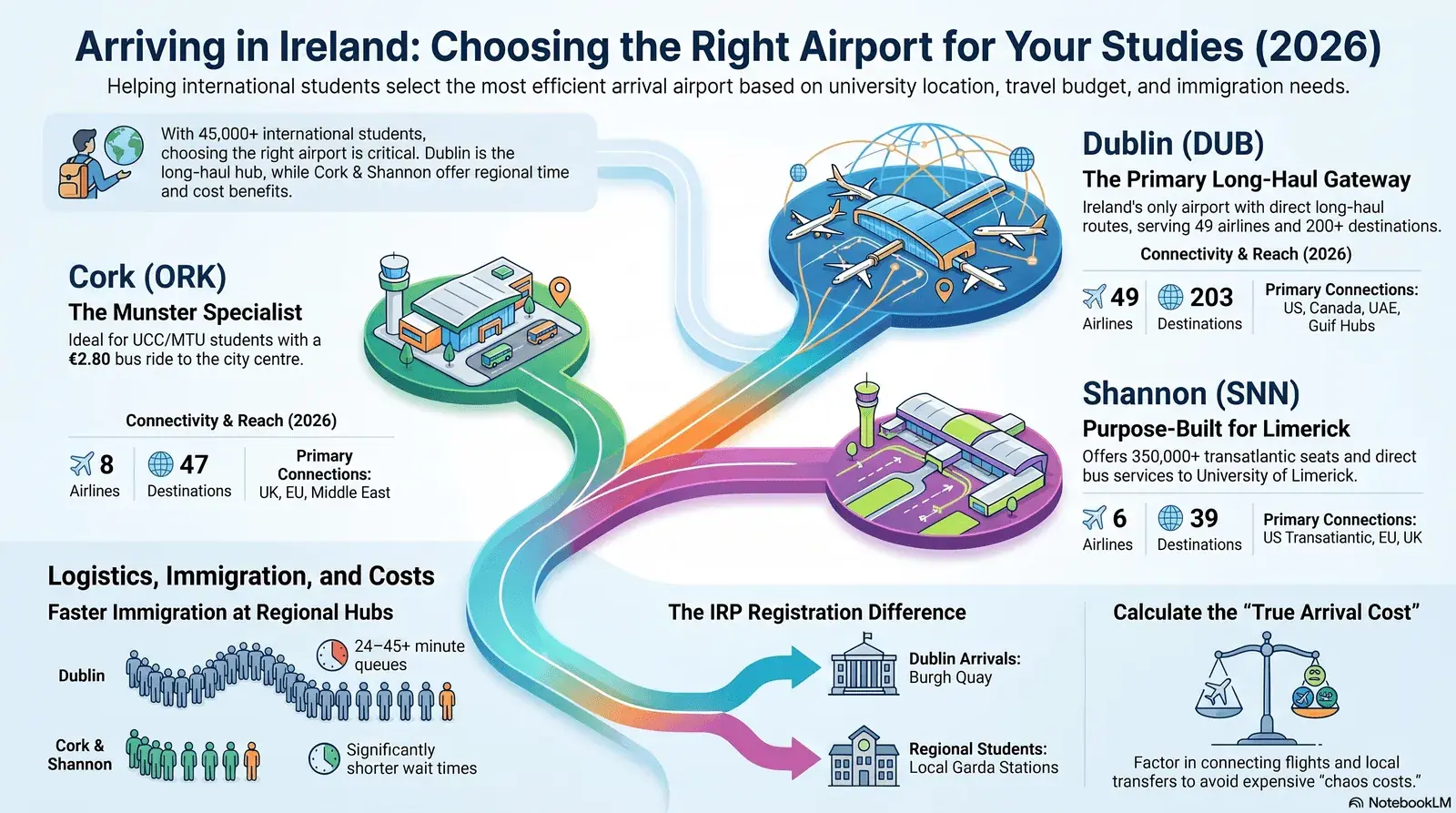
- Dublin is the default for most students: 49 airlines, 200+ destinations, and the only Irish airport with direct long-haul routes mean most non-EU students will land here regardless of where their university is.
- Cork is best for Munster students: UCC, MTU Cork, and CIT students gain a short, €2.80 bus ride (20 min) from Cork Airport — but all intercontinental passengers still require a European hub connection.
- Shannon is purpose-built for UL Limerick: ~36km away with a direct bus service, and Shannon's 2026 schedule (39 destinations across 6 airlines) is the largest in 17 years.
Dublin Airport (DUB)
49 airlines · 203 airports · Best for all non-EU long-haul arrivals
Cork Airport (ORK)
8 airlines · 47 destinations · Best for UCC, MTU & Munster colleges
Shannon Airport (SNN)
6 airlines · 39 destinations · Best for University of Limerick
IRP Registration Fee
€300 — must register within 90 days of arrival at ISD
In this guide
- Why most students should fly into Dublin
- Cork Airport — best for UCC and Munster
- Shannon Airport — best for University of Limerick
- Is flying into Cork or Shannon ever cheaper?
- Ground transport from each airport to major student cities
- IRP registration and first-week logistics
- Full airport comparison table
1. Why Most Students Should Fly into Dublin Airport
Dublin Airport (DUB) is the right choice for the overwhelming majority of international students because it is the only Irish airport with direct access to the transatlantic and long-haul markets, and it serves universities across the entire country via an extensive coach network. As of June 2026, 49 airlines operate from Dublin to 203 airports across 42 countries on 5 continents, according to Dublin Airport's own published statistics. No other Irish airport comes close to that coverage.
Dublin handled over 36.4 million passengers in 2025 — 1.8 million more than 2024 — and in April 2026 it recorded its 13th consecutive month of growth with a 1.1% increase year-on-year. The scale of the airport matters for students: more routes means more fare competition, more flexible booking options, and easier last-minute rebooking if your visa or visa extension is delayed.
For students arriving from India, Nigeria, Pakistan, Kenya, the Philippines, or any country without a direct European route to Cork or Shannon, Dublin is not optional — it is the only practical entry point. Even Air India's direct Delhi–London Heathrow (LHR) route requires a separate Heathrow–Dublin flight, and connecting through Dublin is typically more convenient than going Heathrow–Cork or Heathrow–Shannon because the Dublin coach network reaches every major Irish city.
What is the non-EU immigration queue like at Dublin?
Immigration processing at Dublin Airport for non-EU passport holders currently averages 24 minutes, rising to 30–50% longer during peak months (July, August, December). Ireland uses a dual-lane passport control system — EU/EEA citizens have typically 40–60% faster queues. The busiest periods are early morning (6:00–9:00 AM) when transatlantic overnight flights land simultaneously, and evening (6:00–10:00 PM) when long-haul flights from Asia and the Gulf arrive in clusters.
Plan to allow at least 60–90 minutes from landing to exiting arrivals during peak summer periods. Carry your Irish student visa sticker, your university offer/enrolment letter, and evidence of accommodation for the first few weeks — the immigration officer may ask to see these, even though you should already have your visa pre-cleared.
Dublin Airport has two terminals. Terminal 1 handles Aer Lingus transatlantic flights, most non-EU carriers, and Ryanair. Terminal 2 handles United, Delta, American Airlines, and some Aer Lingus services. Check your arrival terminal in advance — T1 and T2 have separate immigration queues and the walk between terminals is 10–15 minutes.
2. Cork Airport — Best for UCC, MTU Cork, and Munster Students
Cork Airport (ORK) is the ideal arrival airport if you are enrolled at University College Cork (UCC), Munster Technological University (MTU), Cork Institute of Technology, or any institution in Cork city or county. Cork Airport is just 6 km from Cork city centre and 7.5 km from UCC campus, and Bus Éireann's direct Air Coach service (Route 226/226A) runs from the airport to Parnell Place Bus Station every 30 minutes for just €2.80 — a 20-minute journey.
In 2026, Cork Airport has grown significantly. As of June 2026, 8 airlines operate to 47 non-stop destinations in 14 countries. Ryanair, Aer Lingus, and Ryanair UK are the dominant carriers. Lufthansa increased its Cork–Frankfurt service to 5 flights per week in Summer 2026, strengthening connections to 150+ Lufthansa destinations worldwide. Aer Lingus also added two new 2026 routes — to Nice (from 6 May) and Santiago de Compostela (from 1 June) — and Cork handles approximately 1,123 flights per month (259 per week).
Does Cork Airport have direct flights from India, Nigeria, or the US?
No — as of June 2026, Cork Airport has no direct intercontinental routes to Asia, Africa, the Americas, or Oceania. The only non-European services are Middle Eastern connections, and even those are limited. Students arriving from India, Nigeria, Pakistan, the Philippines, or the US must connect through a European hub — typically London Heathrow (via British Airways), Frankfurt (via Lufthansa), Amsterdam Schiphol (via KLM), or Paris CDG (via Air France) — before catching the short onward hop to Cork.
The London–Cork route is popular for Indian students arriving via an LHR connection. British Airways and Aer Lingus both operate this route. However, be aware that connecting through London on separate tickets means you will need to collect your checked luggage at LHR, clear UK border control (requiring either a UK visa or a landside transit exemption), and re-check your bags — an important logistics consideration we cover in the student flight tickets guide.
On-the-Ground Insight: "I flew Delhi–London–Cork with British Airways on two separate tickets to save €180 compared to Dublin. The problem was that I forgot you need to actually go through UK immigration to re-check your bag at Heathrow — and I only had a transit visa. I had to pay for an impromptu £60 hotel and rebook the Cork leg the next morning. Dublin would have been €180 more upfront but saved me about €300 in chaos costs." — Priya N., UCC Nutrition, September 2025 Intake
3. Shannon Airport — Best for University of Limerick Students
Shannon Airport (SNN) is the optimal arrival gateway for students at the University of Limerick (UL), with the campus located approximately 36 km from the terminal and regular bus connections including a direct J.J. Kavanagh service from UL to SNN. Shannon's 2026 schedule is its largest in 17 years: 39 destinations across 13 countries, served by 6 airlines — Aer Lingus, Delta, Discover Airlines, Ryanair, Ryanair UK, and United.
Shannon's key differentiator is its transatlantic reach. In Summer 2026, Shannon operates direct flights to 5 US cities: Boston and New York–JFK (Aer Lingus), Newark and Chicago (United Airlines), and New York–JFK (Delta Air Lines). Total transatlantic capacity in 2026 exceeds 350,000 seats — the highest since 2018 — according to the Shannon Airport Group. This is significant for Indian students who may route via the US on certain alliance fares, though in practice most India–Ireland itineraries still connect via Gulf or European hubs into Dublin.
New Shannon Summer 2026 routes include Ryanair services to Rome (from late March), Warsaw, Poznan, and Madrid, plus Discover Airlines to Frankfurt. For UL students heading home for Christmas via Frankfurt (Lufthansa connections) or travelling to European cities during semester breaks, Shannon is genuinely competitive.
How do I get from Shannon Airport to University of Limerick?
The most convenient option is the J.J. Kavanagh bus service, which runs a direct daily connection between UL campus and Shannon Airport (SNN), with the journey taking approximately 40–50 minutes. Alternatively, Bus Éireann Route 51 and Route 343 connect Shannon Airport to Limerick Colbert Station in Limerick City Centre, from where a connecting service reaches UL. The full door-to-campus journey via this route takes approximately 1 hour 7 minutes including transfer time.
A taxi from Shannon Airport to UL runs approximately €45–€60 depending on traffic. If you are arriving with two or more pieces of heavy luggage, splitting a taxi with a fellow student is often more practical than navigating bus connections. Shannon Airport also benefits from dramatically shorter immigration queues compared to Dublin, especially in September and January — the two main intake months for UL.
4. Is Flying into Cork or Shannon Ever Cheaper than Dublin?
Yes — for students whose universities are in Munster or the Mid-West, flying into Cork or Shannon can sometimes save €50–€200 on the total journey cost when you account for the cost of onward ground transport from Dublin. The logic works like this: if you fly into Dublin but your university is in Cork, you face a €20–€35 Bus Éireann Expressway coach ticket (Dublin–Cork, approximately 3 hours) or a €40–€70 Irish Rail ticket on top of your Dublin city transfer. Compare that with Cork Airport's €2.80 bus fare directly to Cork city centre.
However, the main caveat is that Cork and Shannon have fewer airlines and less fare competition, which means base fares from outside Europe are often €100–€300 more expensive on the Cork or Shannon legs than equivalent Dublin-routed itineraries. The calculation requires checking both options — and the hub connection quality (transit time, same-ticket vs. self-connection risk) is also part of the true cost equation.
True Arrival Cost = Long-haul base fare + Connecting flight to ORK/SNN + Airport–campus transfer cost
Compare that against: Long-haul base fare to DUB + Dublin city transfer + Intercity coach/rail to your city. The route with the lower total — including time value — is the right choice.
5. Ground Transport from Each Airport to Major Student Cities
Dublin Airport has the most extensive and affordable coach network, with Aircoach and Dublin Express both offering city centre connections from €6–€8 booked online, plus intercity coaches to Cork, Galway, Limerick, and Waterford departing from city centre hubs.
Dublin Express runs a fast premium coach service from Dublin Airport to 15+ city centre stops — including Temple Bar, Trinity College, and O'Connell Street — for €8 one-way booked in advance. Aircoach tickets start from €6 online. Both services take approximately 30–45 minutes to the city centre depending on traffic. For reaching universities across Ireland from Dublin Airport, the standard route is coach to city centre then Irish Rail or Bus Éireann Expressway intercity from the relevant station.
Cork Airport's 226/226A bus runs every 30 minutes between the airport and Parnell Place Bus Station for €2.80 — the cheapest airport transfer of any of the three Irish airports relative to campus distance. A taxi from Cork Airport to UCC takes approximately 8–10 minutes and costs €17–€25 depending on traffic. Cork is 6 km from the city centre and 7.5 km from UCC campus.
Shannon Airport's bus connections to Limerick City via Route 51 and 343 take approximately 60–75 minutes (including transfer) and cover the approximately 24 km road distance. J.J. Kavanagh's direct UL–Shannon service is the most convenient option for UL-bound students with heavy luggage. Shannon Airport also benefits from a large free car park for students being picked up by friends already based in Limerick.
Airport Comparison Table: Dublin vs Cork vs Shannon (2026)
This table compares the three Irish international airports across the metrics that matter most for an arriving international student in 2026.
| Feature | Dublin (DUB) | Cork (ORK) | Shannon (SNN) |
|---|---|---|---|
| Airlines operating | 49 | 8 | 6 |
| Destinations (non-stop) | 203 (42 countries) | 47 (14 countries) | 39 (13 countries) |
| Long-haul (non-EU) direct flights? | Yes — US, Canada, UAE, Gulf hubs | No — EU/Middle East only | Yes — US transatlantic (Boston, NYC, Newark, Chicago) |
| Best for universities | DCU, TU Dublin, UCD, TCD, RCSI, NUIG, NUI Maynooth, all national | UCC, MTU Cork, CIT | University of Limerick (UL), MIC Limerick |
| Airport to city centre (bus) | €6–€8 (30–45 min) | €2.80 (20 min) | ~€12–€15 (60–75 min via Limerick) |
| Airport to campus (taxi) | €30–€50 to Dublin city | €17–€25 (8–10 min to UCC) | €45–€60 (40 min to UL) |
| Non-EU immigration queue | ~24 min average (up to 45+ in peak) | Shorter — lower volume | Shortest of the three — low passenger volume |
| Annual passengers (approx.) | 36.4 million (2025) | ~3.5 million (2025 est.) | ~1.8 million (2025 est.) |
| IRP registration | Burgh Quay, Dublin (online booking) | Local Garda station in Cork | Local Garda station in Limerick |
| 2026 schedule highlight | 14th consecutive growth month (Apr 2026) | Lufthansa 5x/week to FRA; new Aer Lingus routes to Nice & SCQ | Largest schedule in 17 years; 5 new routes including Rome, Warsaw, Madrid |
6. IRP Registration and First-Week Logistics: Does Airport Choice Matter?
Yes — your arrival airport determines where you will register your immigration permission, and the process differs meaningfully between Dublin and regional airports. As of January 2025, the Immigration Service Delivery (ISD) (not the Garda National Immigration Bureau) handles all first-time registrations. You must register within 90 days of arrival.
If you arrive in Dublin: Book an appointment at the Burgh Quay Registration Office online via burghquayregistrationoffice.inis.gov.ie. Dublin appointments have historically been very competitive — book as early as possible, ideally before you leave your home country. Slots in August–September are particularly scarce due to the autumn student intake surge.
If you arrive in Cork or Limerick (Shannon): You register at your local Garda (police) station. For UCC students in Cork, this is typically Cork Garda stations. For UL students in Limerick, it is the Limerick Garda station. Regional Garda stations generally have shorter waits than the Burgh Quay office in Dublin during peak intake season — this is a genuine practical advantage for Cork and Shannon arrivals.
Regardless of which airport you land in, you will need the same set of documents for IRP registration: your passport (with Irish visa sticker), a letter of enrolment from your university, proof of address in Ireland, evidence of private health insurance, and a bank statement or receipt showing your college fees have been paid. The fee is €300, payable by card at the time of registration. Your IRP card arrives by post within approximately 10 working days of your successful registration.
You must register your immigration permission within 90 days of arriving in Ireland. Missing this deadline can create complications for your Stamp 2 student permission and your ability to legally work part-time. If you cannot get a Burgh Quay appointment within 90 days, contact ISD proactively — do not simply let the deadline pass. See Citizens Information for the full official explanation of the registration process.
What else should I do in the first week after landing?
The first week is a logistical sprint regardless of which airport you arrive at — the key items are accommodation, SIM card, bank account, and booking your IRP appointment. Here is the practical sequence:
On arrival day: confirm your accommodation booking, buy a prepaid Irish SIM card (Three Ireland and Vodafone Ireland both have desks in Dublin Airport arrivals; for Cork and Shannon you can buy one in any city phone shop), and orient yourself to your university's campus. In the first 48 hours: register with your university's international office, apply for your PPS Number (see our Ireland visa and IRP guide), and open a student bank account — AIB, Bank of Ireland, and Credit Unions are common choices. Within week one: book your IRP appointment, register with a GP surgery, and sign up for the Student Leap Card for discounted public transport.
Students arriving in Cork or Shannon often find the first week less stressful than Dublin arrivals: smaller cities, shorter queues at Garda stations for IRP, and a closer-knit international student community at campus. Dublin's advantage is the sheer concentration of services — banks, embassies, international food stores — all within easy reach.
Frequently Asked Questions
Should I fly into Dublin, Cork or Shannon as an international student?
Most international students should fly into Dublin Airport, which handles over 36.4 million passengers annually and connects to 200+ destinations. Cork Airport is the best choice for students at UCC, MTU Cork, and other Munster institutions. Shannon Airport is best suited for University of Limerick (UL) students - it is only ~36km from campus.
Does Cork Airport have direct international flights for students arriving from outside Europe?
No. As of June 2026, Cork Airport has no direct intercontinental routes to Asia, Africa, or the Americas. Passengers from India, Nigeria, Pakistan, and other long-haul origins must transit through a European hub such as London Heathrow, Frankfurt, Paris CDG, or Amsterdam before connecting to Cork.
How do I get from Dublin Airport to the city centre?
The cheapest way is Dublin Express or Aircoach coach services (from €6-€8 one-way booked online), which connect Dublin Airport to 15+ city centre stops including Trinity College and O'Connell Street. Taxi fares run €30-€50 depending on traffic. The TFI Leap Card is accepted on Dublin Bus routes from the airport.
How far is Shannon Airport from University of Limerick?
Shannon Airport is approximately 36km from the University of Limerick campus. There is no single direct bus, but Bus Éireann Route 51 and Route 343 connect Shannon to Limerick Colbert Station, with connecting services to UL. J.J. Kavanagh also runs a direct UL-Shannon Airport service. The total journey takes approximately 1 hour.
Do I need to register for my IRP card immediately after landing?
No - you have 90 days from arrival to register your immigration permission with Immigration Service Delivery (ISD). However, you must book your appointment online at the Burgh Quay Registration Office (Dublin) or your local Garda station (outside Dublin) and pay the €300 registration fee. Your IRP card typically arrives within 10 working days of registering.
Compare live fares for your Dublin, Cork, or Shannon routing
Use the MyFlightOffers fare calendar to compare prices across multiple hub connections and arrival airports before you book — so you know the true cost of each routing option.
All airport route data, flight frequencies, and bus fares in this article are based on publicly available official sources as of July 2026, including Dublin Airport statistics, Cork Airport's official schedule announcements, Shannon Airport Group press releases, and Bus Éireann route information. Route schedules, fares, and immigration procedures change regularly. Always verify current information directly with the relevant airport, carrier, or Immigration Service Delivery before making travel decisions. MyFlightOffers is not affiliated with any organisation mentioned. This article does not constitute immigration or legal advice.
- NEW Study in Ireland 2026: Visa, Housing & IRP Complete Guide — step-by-step visa application, Stamp 2 conditions, and IRP registration walkthrough
- Ireland Student Survival Guide: Hidden Subsidies 2026 — SUSI grant, TFI Young Adult Card, food banks, and every subsidy most students miss
- Ireland Banking Guide for International Students 2026 — opening a student bank account, PPS number, and avoiding fees
- Types of One-Way Student Flight Tickets Explained — open jaw vs. one-way vs. multi-city for your first flight to Ireland