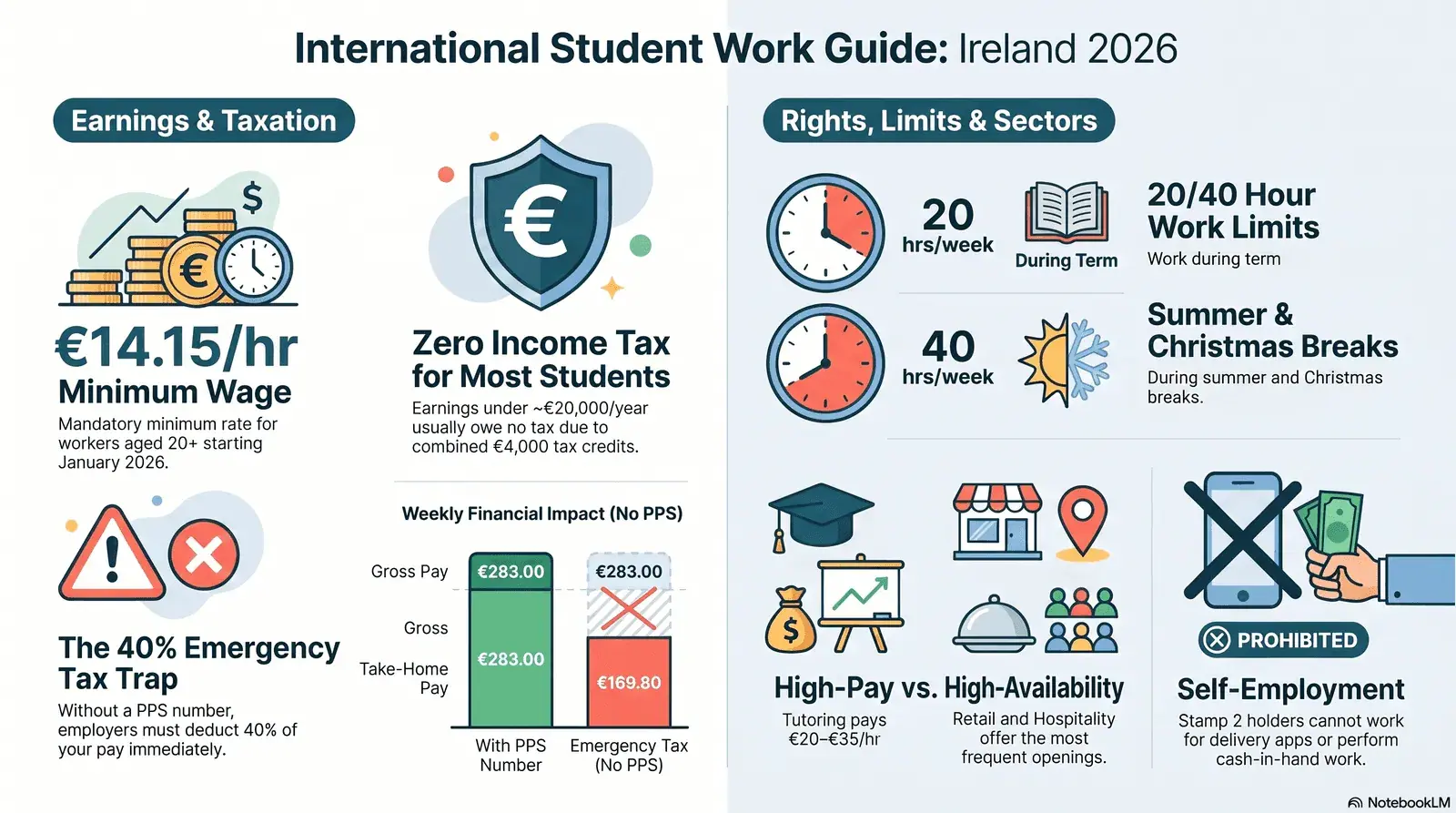
- 20 hrs/week term-time, 40 hrs/week in holidays — hard weekly caps on Stamp 2, combined across all employers. Breaching this risks your visa renewal.
- Apply for your PPS number before your first payslip — without it, employers deduct emergency tax at a flat 40% with no credits. Register your job on Revenue myAccount immediately after receiving your PPSN.
- Best hourly rates: tutoring (€20–€35), IT support (€15–€25), research assistant (€16–€19) — all significantly above the €14.15 minimum wage floor.
In this guide
- Work rights on Stamp 2 — exact hours and holiday periods
- Minimum wage and what you actually take home in 2026
- Best-paying sectors: tutoring, tech, research assistant
- Most available sectors: hospitality, retail, campus jobs
- Sectors to avoid and why
- Where to find part-time jobs in Ireland
- PPS number, Revenue myAccount and avoiding emergency tax
What are the work rights for international students on Stamp 2 in Ireland in 2026?
International students holding Irish Residency Permit (IRP) cards with Stamp 2 permission may work up to 20 hours per week during term time and up to 40 hours per week during two officially designated holiday periods: 1 June to 30 September (summer) and 15 December to 15 January (Christmas/New Year). These are absolute weekly maximums — not rolling averages — and the cap applies to the combined total hours worked across every employer.
A critical point that catches students off guard: if you work 12 hours at a café and 10 hours at a supermarket in the same term-time week, you have exceeded your 20-hour limit even though neither employer individually knows this. The Workplace Relations Commission (WRC) and the Irish Naturalisation and Immigration Service (INIS) can verify employment records, and breaching your work permit conditions is grounds for refusing a Stamp 2 renewal or future visa applications. Several students lose their IRP renewals each year because of this. Keep a weekly log.
- Term-time limit: 20 hours per week maximum (combined across all jobs)
- Summer holiday (40 hrs/week permitted): 1 June – 30 September 2026
- Christmas holiday (40 hrs/week permitted): 15 December 2026 – 15 January 2027
- Self-employment: not permitted on Stamp 2
- Freelance/gig work (Deliveroo, TaskRabbit as contractor): legally ambiguous — treat as self-employment and avoid
- Authority: Irish Immigration Service Delivery (IISD) and Workplace Relations Commission (WRC)
Students on Stamp 1G (post-study work permission) are not subject to the 20-hour cap and may work full-time in any sector. If you are on Stamp 2 and your course ends, switching to Stamp 1G opens significantly more employment options — see our guide to Study in Ireland 2026 — Visa, Housing and IRP for the transition process.
What is the minimum wage in Ireland in 2026 and what do students actually take home?
Ireland's national minimum wage is €14.15 per hour since 1 January 2026 for workers aged 20 and over — one of the highest minimum wages in the European Union — and it applies equally to full-time, part-time, casual, agency, and student workers with no lower student tier. Sub-rates apply only for age: €12.74/hr at 19, €11.32/hr at 18, and €9.91/hr under 18. Most university students are at least 20 and receive the full rate.
What you actually take home depends on two taxes: income tax and the Universal Social Charge (USC). For 2026, you receive a Personal Tax Credit of €2,000 and an Employee (PAYE) Tax Credit of €2,000 — a combined €4,000 — which means a single person can earn approximately €20,000 per year before owing any income tax. A Stamp 2 student working 20 hours/week for 30 term weeks earns roughly €8,490 annually at minimum wage, which sits well below the income tax threshold. Most students pay zero income tax in term time.
USC (Universal Social Charge) is a separate levy that cannot be reduced by your tax credits. The critical threshold: if your total income for the year exceeds €13,000, USC applies to your entire income from euro one — not just the excess. A student earning €13,001 faces USC on the full amount at 0.5% on the first €12,012, then 2% on the remainder. If your annual earnings approach €13,000 (about €433/week for 30 weeks), factor in this cliff-edge when deciding your hours near year-end.
| Scenario | Hours/Week | Weeks | Gross Annual | Income Tax | USC | Approx. Take-Home |
|---|---|---|---|---|---|---|
| Term-time minimum wage | 20 | 30 (term) | €8,490 | €0 | €0 (under €13K) | ~€8,490 |
| Term + summer full-time | 20 term / 40 summer | 30 + 17 | €18,122 | €0 (under credits) | ~€297 | ~€17,825 |
| Tutoring at €25/hr (term only) | 10 | 30 | €7,500 | €0 | €0 | ~€7,500 |
| Research assistant €18/hr | 15 | 30 | €8,100 | €0 | €0 | ~€8,100 |
Estimates based on 2026 tax credits (€4,000 combined) and USC rates. PRSI contribution of 4% applies on earnings above €352/week — not included in above for simplicity. Verify your exact liability using Revenue myAccount.
🧮 Student Part-Time Net Income Calculator
Estimate your gross and net annual income under 2026 Irish tax rates (PAYE, USC) and Stamp 2 student work hour limits.
What are the best-paying part-time jobs for international students in Ireland in 2026?
The three highest-paying accessible part-time roles for international students in Ireland in 2026 are private tutoring (€20–€35/hr), IT and tech support (€15–€25/hr), and university research assistant positions (€16–€19/hr) — all significantly above the €14.15/hr minimum wage floor and achievable within the 20-hour weekly cap.
Private tutoring — up to €35/hr
Private academic tutoring is the highest-paying flexible option available to international students with strong subject expertise — rates range from €20/hr for Leaving Certificate subjects to €35/hr for university-level maths, science, or programming tutoring. Demand is consistently high in Dublin, Cork, and Galway for tutors in STEM subjects, English language, and Irish secondary school exam preparation. The most effective channels are your university's internal tutoring notice boards, local community Facebook groups, GrindsIreland.ie, and word-of-mouth via fellow students. At 10 hours of tutoring per week at €25/hr, a student earns €1,000/month — entirely tax-free at that income level in 2026.
IT and tech support roles — €15–€25/hr
Students enrolled in computer science, data analytics, or engineering programmes frequently secure part-time IT helpdesk, junior developer, or QA testing roles at Ireland's tech multinationals and SMEs, typically paying €15–€25/hr — rates that reflect Ireland's tight technology labour market even at junior/part-time level. Dublin's Silicon Docks area (home to Google, Meta, Amazon, and Microsoft Ireland) regularly posts student intern and part-time roles on Indeed Ireland and LinkedIn. A strong GitHub portfolio and relevant coursework are more important than Irish work experience for landing these roles.
University research assistant — €16–€19/hr
Research assistant (RA) roles at Trinity College Dublin, University College Dublin, University of Galway, and University College Cork pay approximately €16–€19/hr in 2026 and are the most academically valuable part-time option — hours are structured around your course timetable and supervisors actively favour their own enrolled postgraduate students. RA positions are typically funded by research grants and posted on university HR portals and faculty notice boards rather than public job sites. Email your department head or check UniversityVacancies.com and Indeed Ireland under "research assistant" filtered to your institution's city.
On-the-Ground Insight: "I landed a part-time RA position at my university in Galway paying €17.50/hr for 12 hours a week. My supervisor allowed me to schedule around lectures, which was impossible at the café jobs my classmates were taking. The money was slightly less than peak tutoring rates, but the thesis experience and reference letter made it worth every hour — and no weekend shifts." — Ananya R., MSc Data Analytics, University of Galway, September 2025 Intake
What are the most readily available part-time jobs for students in Ireland?
The most available and easiest to obtain part-time jobs for international students in Ireland in 2026 are hospitality (cafés, restaurants, pubs), retail (supermarkets, clothing, convenience), and campus-based roles (library, student union, campus cafés) — all hiring at or slightly above the €14.15/hr minimum wage, with immediate availability across all university cities.
Hospitality: cafés, restaurants and pubs — €14.15–€16/hr plus tips
Hospitality is the fastest sector to enter with no prior Irish work experience — barista, kitchen porter, waiter, and bar work roles are available immediately in Dublin, Cork, Galway, Limerick, and Athlone, with many cafés and restaurants running perpetual open applications. Tips in busy Dublin city centre establishments can add €3–€6/hr effective to your hourly rate on Friday and Saturday shifts. The downside: weekend and late evening shifts are the most available, which conflicts with study commitments. Walk in with printed CVs to local cafés rather than applying online — managers hire on impression and availability, not credentials. Chains like Starbucks Ireland, Insomnia, and McDonald's Ireland have structured student schedules and consistent contracts.
Retail: supermarkets and high street — €14.15–€15/hr
Major Irish supermarket chains — Tesco Ireland, Dunnes Stores, Lidl Ireland, and Aldi Ireland — recruit student workers year-round, offer guaranteed contracted hours, and provide structured payroll that correctly applies your tax credits from day one once you supply your PPS number on the HR onboarding form. Retail is preferable to uncontracted cash-in-hand hospitality roles from a tax compliance and visa-risk standpoint. Lidl and Aldi also run above-minimum-wage starting rates at approximately €14.80–€15.30/hr for permanent part-time positions as of January 2026.
Campus jobs — library, student union, admin — €14.15/hr
Campus roles at your own university are the gold standard for work-study balance — shifts are structured around the academic calendar, supervisors understand exam pressures, and you never face a commute. Common campus positions include library assistant (scanning, shelving, reader services), student union shop cashier, campus café barista, faculty admin support, and student ambassador roles for open days. Pay is at minimum wage but the flexibility premium is substantial. Check your university's careers portal and student union notice boards — these roles are rarely advertised on external sites and go to students who check early and apply directly.
Which sectors should international students avoid in Ireland and why?
International students on Stamp 2 should avoid cash-in-hand informal work, zero-hours gig platform contracts (where you are classified as a self-employed contractor), and industries where employers routinely expect unpaid overtime or unrecorded hours — both because these breach immigration conditions and because they leave you without payslips needed to prove compliant employment history if your IRP renewal is questioned.
| Sector / Role Type | Risk | Why to Avoid | Better Alternative |
|---|---|---|---|
| Cash-in-hand informal work | HIGH | No payslips; cannot prove compliant hours at IRP renewal; unpaid wages have no WRC recourse | Any PAYE-contracted role |
| Gig apps as self-employed contractor (Deliveroo, etc.) | HIGH | Self-employment not permitted on Stamp 2; Deliveroo Ireland classifies riders as contractors | Retail, campus café roles |
| Door-to-door sales / commission-only | MED | Irregular hours, income unpredictability, pressure to work excess hours | Tutoring, campus admin |
| Unregistered domestic cleaning | MED | Often cash-based; no employment contract; no injury cover | Campus cleaning contracted via university services |
| High-pressure bar work (late nights) | LOW | Not illegal, but shifts typically 11pm–3am; impacts lecture attendance and academic performance | Daytime café or campus role |
A note on food delivery apps specifically: Deliveroo Ireland and Uber Eats Ireland classify most delivery riders as independent contractors, not employees. Self-employment is explicitly prohibited on Stamp 2. While enforcement has historically been inconsistent, the immigration service has flagged gig platform contracts as a compliance risk in its 2026 guidance. The safest position is to avoid these platforms entirely and choose PAYE employment instead.
Where can international students find part-time jobs in Ireland in 2026?
The most effective channels for finding part-time student work in Ireland in 2026 are your university careers office portal, Indeed Ireland (filtered to "part time" and your city), Parttime.ie (Ireland's dedicated student job board), and the walk-in method for hospitality and retail — walking in directly with a printed CV and asking to speak with a manager is consistently more effective than online applications for café and restaurant roles.
- Campus roles: Your university's own careers portal (TCD Careers, UCD Careers Connect, myGalway Jobs)
- Research assistant: UniversityVacancies.com, department faculty boards, direct email to your supervisor
- Tutoring: GrindsIreland.ie, college Facebook groups, department notice boards
- Tech/IT: LinkedIn Jobs, Indeed Ireland, GradIreland.com
- Hospitality and retail: Walk-in with CV + Parttime.ie + Indeed Ireland
- General student jobs: StudentJob.ie, your college's student union job board
The walk-in method deserves emphasis. In Irish hospitality culture, dropping in with a physical CV between 10am–12pm (before the lunch rush) and asking the manager directly signals initiative and confidence — qualities hospitality employers value above experience. Bring ten copies of a one-page CV and spend a Saturday morning visiting cafés, restaurants, and hotels near campus. Expect to hear back from at least two or three within the same week. This approach is faster than online applications, which receive hundreds of responses per listing in major cities.
How do international students set up their PPS number and avoid emergency tax in Ireland?
Your Personal Public Service (PPS) Number is your Irish tax identification number — without it, your employer is legally required to deduct emergency tax from every payslip at a flat 40% rate with no credits applied, meaning you lose almost half your gross pay until you register. Apply the week you arrive in Ireland, not when you have a job offer.
Step-by-step: Getting your PPS number in 2026
The PPS number application process in 2026 is online-first via MyWelfare.ie, followed by an in-person appointment at your nearest Intreo Centre — the entire process from application to number issuance typically takes two to four weeks, so begin immediately on arrival.
- Create a basic MyGovID account at MyGovID.ie using your email address
- Apply online at MyWelfare.ie under "Get a PPS Number" and book an Intreo appointment
- Attend your Intreo appointment with: valid passport, Irish address proof (utility bill or bank statement under 3 months old), and a letter from your college confirming enrolment
- Receive your PPS number by post within 1–2 weeks of the in-person appointment
- Register on Revenue myAccount using your PPS number and register your employer (employer's tax registration number is on your contract) to activate your tax credits
If you start a job without providing your PPS number and registering on Revenue myAccount, your employer deducts emergency tax at the higher rate (40%) with no Personal Tax Credit or Employee Credit applied. On a €14.15/hr wage at 20 hours/week, that's ~€141.50 gross per week — but you'd take home only ~€84.90 under emergency tax, versus ~€141.50 under correct taxation (since most students owe zero income tax). That's a loss of €56.60 per week, or €678 over a 12-week term. You can reclaim overpaid emergency tax via Revenue myAccount, but it takes time and requires effort. Prevention is faster than recovery.
Once your PPS number is registered and your job is linked on Revenue myAccount, Revenue.ie will issue a Tax Credit Certificate (TCC) to your employer confirming your standard rate cut-off point and credits. From the following payslip, deductions will be calculated correctly. If you change jobs or take on a second job, you must notify Revenue via myAccount each time to split or transfer your credits appropriately — otherwise, the second employer also defaults to emergency tax.
On-the-Ground Insight: "I started at a Dublin café in October without having registered my PPS number yet — I thought I'd do it 'later'. For six weeks I lost almost 40% of every payslip to emergency tax. When I finally sorted Revenue myAccount in November, I got a tax refund of about €380, but it took until February to process. Do not repeat my mistake — get the PPS number sorted before your first shift, not after." — Deepak S., MSc Finance, University College Dublin, September 2024 Intake
Frequently Asked Questions
How many hours can international students work in Ireland in 2026?
International students on Stamp 2 permission can work up to 20 hours per week during term time and up to 40 hours per week during the two designated holiday periods: 1 June to 30 September (summer) and 15 December to 15 January (Christmas). These are hard weekly limits - not averages - and apply across all employers combined.
What is the minimum wage in Ireland in 2026?
The national minimum wage in Ireland has been €14.15 per hour since 1 January 2026 for workers aged 20 and over. Students aged 19 receive 90% (€12.74/hr), aged 18 receive 80% (€11.32/hr), and under-18s receive 70% (€9.91/hr). Most university students are aged 20+ and are entitled to the full €14.15/hr rate.
Do I need a PPS number before I can start working in Ireland?
You technically can start work before receiving your PPS number, but your employer must put you on emergency tax until you register it. Emergency tax withholds a flat 40% income tax with no credits applied - so you will lose significantly more from each payslip. Apply for your PPS number immediately on arrival via MyWelfare.ie and then register your employment on Revenue's myAccount portal to receive the correct credits.
What are the best-paying part-time jobs for students in Ireland?
The best-paying options in 2026 are: private tutoring (€20-€35/hr), IT/tech support (€15-€25/hr), research assistant roles at universities (€16-€19/hr), barista and hospitality (€14.15-€16/hr plus tips), and retail (€14.15-€15/hr). Campus-based jobs - library, student union, on-campus cafés - also tend to offer the most flexible scheduling around lectures.
Can I work in two jobs as an international student in Ireland?
Yes, you can hold more than one part-time job, but the combined weekly hours across all employers must not exceed 20 hours during term time (or 40 during designated holidays). For example, you cannot work 15 hours at a café and 15 hours at a supermarket simultaneously during term - the 20-hour cap applies to the total across all jobs.
Planning your move to Ireland? Compare flights first.
Once your job search is sorted, use MyFlightOffers to find the best fare for your Ireland arrival flight and track prices across airlines on the DEL–DUB, BOM–DUB, and HYD–DUB routes.
All work hour limits, minimum wage rates, tax credits, USC thresholds, and PPS application procedures are based on official Irish government sources as of June 2026. Immigration rules, minimum wage, and tax rates can change — always verify current figures directly with Citizens Information Ireland, Revenue.ie, and Irish Immigration Service Delivery. This article does not constitute immigration, tax, or legal advice.
- NEW Internships and Work Placements on a Stamp 2 Visa: 2026 Rules for International Students in Ireland — the full legal framework for course-integrated placements: 20-hour exception, 50% duration rule, €14.15/hr minimum wage, PPS setup and how to spot internship scams
- NEW Revenue.ie Emergency Tax Guide for International Students — step-by-step on reclaiming overpaid emergency tax and registering with Revenue myAccount
- The Indian Student's Money Survival Guide in Ireland — banking, remittances, Revolut, Wise and living on a student budget in Ireland
- Ireland Student Survival Guide — Hidden Subsidies 2026 — student leap card, GP visit card, SUSI grant and cost-of-living supports you may not know about
- Study in Ireland 2026 — Visa, Housing and IRP Guide — Stamp 2 application, IRP registration and switching to Stamp 1G
- Student Internships and Placements in Ireland 2026: Full-Time Hours on Stamp 2 — Stamp 2 students can work full-time on accredited placements in Ireland 2026. Learn where to find paid internships, your €14.15/hr rights, and the CSEP pathway.
- Student Clubs and Societies in Ireland 2026: Network, Save Money and Get Hired — Irish student societies 2026: how they save money (€12/week Leap Card), build your network and boost your CV for Irish employers. When to join and what to prioritise