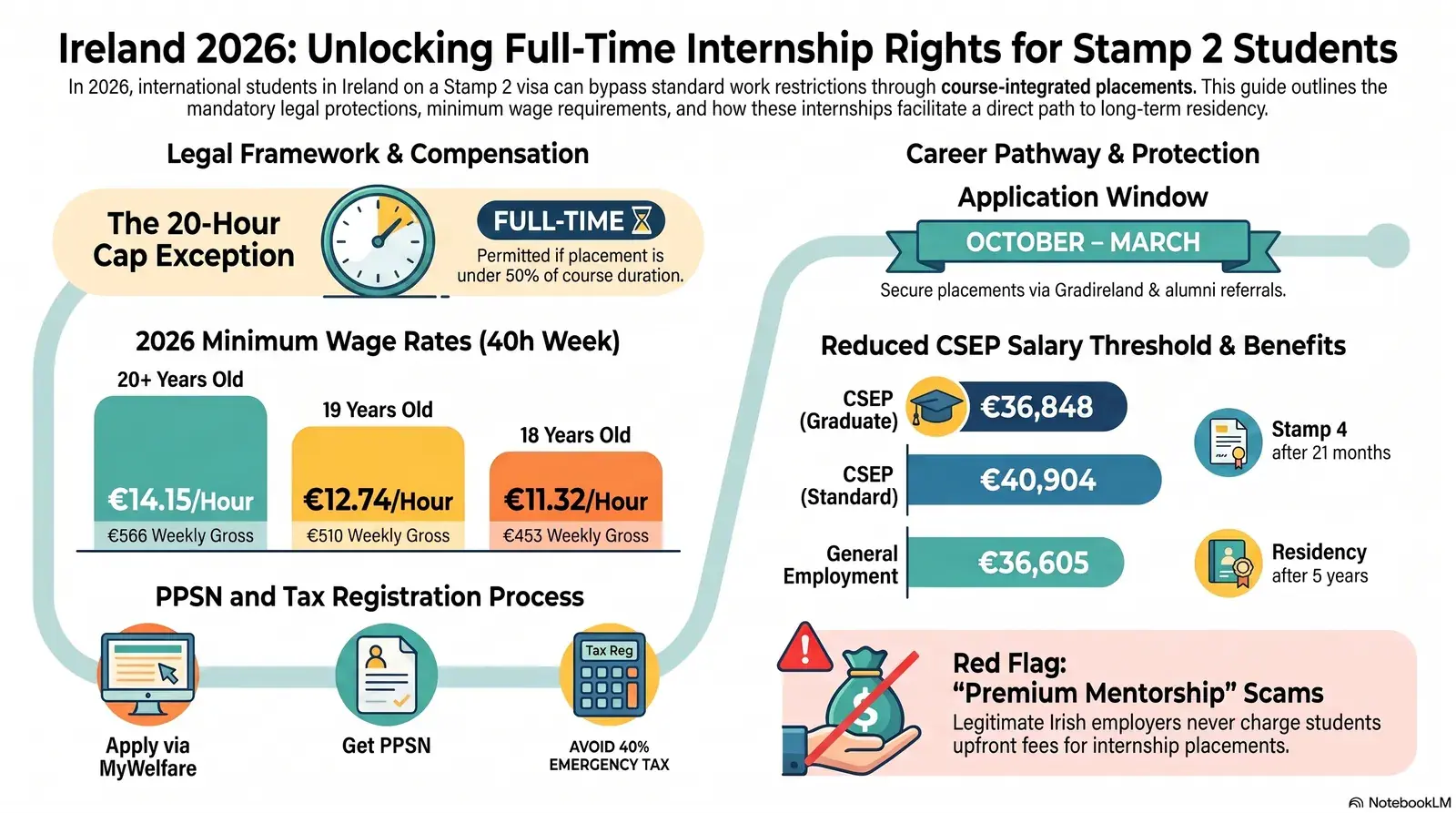
- The 20-hour cap does not apply to course-integrated placements: NFQ Level 7+ students on ILEP-listed programmes can work full-time hours during a placement that forms an integral part of their degree — but the placement cannot exceed 50% of total course duration (6 months maximum for a one-year MSc).
- Every paid placement must meet minimum wage: The Irish national minimum wage from 1 January 2026 is €14.15/hour for workers aged 20+. All work experience arrangements that constitute employment are covered — "unpaid trial shifts" extending beyond a reasonable assessment period are illegal.
- A strong placement record materially improves your CSEP chances: Documented Irish work experience in a critical skills field narrows the gap to the €40,904 salary threshold (or €36,848 graduate carve-out as of March 2026) and makes employer sponsorship conversations easier.
Yes — for course-integrated ILEP placements at NFQ Level 7+
50% of course duration (6 months for a 1-year MSc)
€14.15/hr (age 20+) from 1 January 2026
€40,904 (or €36,848 within 12 months of graduation)
In this guide
- The work placement exception to the 20-hour cap
- The 50% rule: how long your placement can last
- Paid vs unpaid placements — your employment rights
- Finding a placement: careers offices, Gradireland and LinkedIn
- Summer internships at Irish tech and pharma companies
- How placement experience feeds your Stamp 1G and CSEP pathway
- PPS number and tax on placement income
- Red flags: internship scams targeting international students
- Frequently asked questions
1. The work placement exception to the 20-hour cap
If your programme is at NFQ Level 7 or above and is listed on Ireland's Interim List of Eligible Programmes (ILEP), you can work full-time hours during an approved work placement without the standard 20-hour weekly cap. The exception exists because these placements are treated as an academic component rather than casual employment.
To benefit from the exception, three conditions must all be satisfied simultaneously, as set out by Immigration Service Delivery (ISD):
First, your course must be a major award at NFQ Level 7 (Ordinary Degree) or higher — meaning Level 7, 8 (Honours Degree), 9 (Masters) or 10 (PhD). The vast majority of full-time MSc, MBA and degree programmes at Irish universities and ITs qualify. Short certificates or English-language courses do not.
Second, the programme itself must be listed on the ILEP. Your college's international office can confirm ILEP status; it is also searchable on the ISD website. Non-ILEP programmes have no placement exception — the 20-hour cap applies at all times.
Third, the placement must form an integral part of the academic programme and its completion must contribute to the final award. Ad hoc work experience arranged independently of your college does not qualify. Your placement must be formally sanctioned by your institution, appear in your course documentation, and be supervised.
Outside of an approved placement, Stamp 2 holders may work a maximum of 20 hours per week during term time, rising to 40 hours per week during official college holiday periods (June, July, August, September, and 15 December to 15 January). Exceeding these limits outside a formal placement puts your immigration permission at risk.
The placement exception does not change your underlying Stamp 2 immigration permission or create a separate visa. You remain on Stamp 2 for the duration. Employment must also be in an employed capacity — self-employment or freelance arrangements are not permitted under Stamp 2 or the placement exception.
2. The 50% rule: how long your placement can last
The placement or internship component of your course cannot exceed 50% of the total course duration — so for a standard one-year Irish MSc (12 months), the absolute maximum placement length is 6 months. This rule is set by ISD and is non-negotiable regardless of what your employer or college might prefer.
In practice, most Irish one-year master's programmes structure placements in one of two ways: a shorter industry placement of 8–12 weeks embedded during the academic year, or a longer 4–6 month placement in the second semester or immediately following coursework completion. Both are legal provided the total placement time stays under the 50% ceiling.
For two-year programmes (common in engineering, science and business), the 50% ceiling allows up to 12 months of placement across the entire course — typically delivered as one continuous sandwich year or split across semesters. For four-year undergraduate degrees, placements of up to two academic years are theoretically permissible, though ISD guidance usually aligns with Erasmus+ and institutional norms.
Your IRP (Irish Residence Permit) card reflects your Stamp 2 permission period, not your placement separately. If your placement runs beyond the date your current Stamp 2 expires, you must renew your IRP before the placement starts — or you will be working without valid permission. Factor in the ISD appointment backlog (often 6–8 weeks in Dublin) when planning your placement calendar. See our full guide on IRP Card Registration in Ireland 2026.
3. Paid vs unpaid placements — your employment rights
Any arrangement where you perform work for an Irish organisation must be paid at least the national minimum wage unless it falls within a narrow set of exempted categories — and Irish employment law applies in full from your first day, regardless of your immigration status.
The Irish national minimum wage rates from 1 January 2026 are as follows: €14.15 per hour for workers aged 20 and over, €12.74 per hour for workers aged 19, €11.32 per hour for workers aged 18, and €9.91 per hour for workers under 18. These rates are set annually by the Low Pay Commission and apply to all employees regardless of nationality, hours worked, or immigration status.
| Age | Minimum Hourly Rate (2026) | Weekly pay at 40h (approx.) | Monthly pay at 40h (approx.) |
|---|---|---|---|
| 20 and over | €14.15 | €566 | €2,452 |
| Age 19 | €12.74 | €510 | €2,207 |
| Age 18 | €11.32 | €453 | €1,962 |
| Under 18 | €9.91 | €396 | €1,717 |
Beyond pay, you are entitled to a written statement of your employment terms within five days of starting. You must receive a detailed payslip showing gross pay, all deductions, and net pay. You are also entitled to rest breaks (15 minutes for every 4.5 hours worked, 30 minutes for every 6 hours), public holiday entitlements, and protection against unfair dismissal under the Workplace Relations Commission (WRC).
When are unpaid placements legal?
Genuinely unpaid placements are legal only in a narrow set of circumstances: where no employment relationship exists and no work of commercial value is performed. Shadow schemes, brief observation visits, and structured student learning days can be unpaid. However, if you are performing real work tasks — writing code, managing social media, handling customer queries — that have commercial value to the host organisation, you must be paid at minimum wage.
ISD guidance for unpaid internships specifies that the host must ensure the arrangement conforms with Irish employment law. In practice, many "unpaid internship" postings circulating in Ireland are of questionable legality when scrutinised against the minimum wage legislation. The WRC provides a confidential helpline (1800 80 80 90) where you can check whether an arrangement breaches the Act.
On-the-Ground Insight: "My placement letter said it was unpaid because I'd be 'gaining industry experience.' But I was writing production code and attending client calls every day. When I checked with WRC, they told me I should be getting at least €14.15 an hour. The company sorted it out quickly once I raised it — they just hadn't thought through the legal position." — Rohan M., MSc Computer Science, University College Dublin, September 2025 Intake
4. Finding a placement: careers offices, Gradireland and LinkedIn
The three most effective channels for international students to secure a placement in Ireland are their college careers centre, Gradireland, and a structured LinkedIn outreach campaign — and the sequence matters because employer relationships built through careers offices convert at a materially higher rate than cold applications.
Your college's careers development centre is your first and most powerful resource. Every Irish university — including UCD, Trinity, UCC, University of Galway, and TU Dublin — has employer partnerships that are not publicly advertised. Placement officers can make direct introductions, especially for industries where the institution has a track record (e.g. pharma for UCC Cork, fintech for TU Dublin). Book a placement appointment in your first month — not six weeks before you need one.
Gradireland is Ireland's official graduate careers platform, run by the Association of Higher Education Careers Services (AHECS) and GTI Ireland. Internships are filterable by sector, location, and start date. Critically for international students, many listings specify whether they are open to non-EEA nationals — saving wasted applications to roles that require existing work authorisation beyond Stamp 2. The Gradireland annual Careers Fair (typically held in October) allows direct face time with recruiters from over 150 Irish employers.
On LinkedIn, the highest-converting approach for placement searches is a two-step sequence: first connect with your college's alumni in your target sector (filtering by "studied at [your university]" in LinkedIn's People search), then message them to request a 20-minute informational call. Not a job ask — a genuine conversation about their career path. Internship leads from warm alumni referrals convert at roughly 3–4 times the rate of applying through a careers portal. Set your profile to "Open to Work" with "Internship" and "Work Placement" selected, and list your Stamp 2 work authorisation explicitly to head off HR queries.
Register with careers centre — October/November. Attend Gradireland Careers Fair — October. Begin LinkedIn outreach to alumni — November. Apply to posted placements — November through January. Secure an offer — January through March for a summer or second-semester start. For summer-only placements at large tech or pharma companies, many application portals open in October/November and close in January — earlier is consistently better.
5. Summer internships at Irish tech and pharma companies
Ireland hosts European headquarters for most of the world's top technology and pharmaceutical companies, and many run structured internship programmes that are open to international students with Stamp 2 work authorisation — provided the placement is course-integrated and the student can demonstrate this to HR.
In the technology sector, companies such as Google, Meta, Apple, Amazon, LinkedIn, and Microsoft have Dublin offices with summer internship intakes. Application windows for summer positions typically open in October–November for the following June–August period. Engineering, data, product management and finance roles are most common. Competition is high and most programmes expect applicants to be in the penultimate year of a degree, though some MSc placements are accepted.
The pharmaceutical and life sciences sector is equally significant. Ireland is the largest pharmaceutical exporter in the EU, with major sites operated by Sanofi, MSD (Merck), AbbVie, Pfizer, and Hovione. Sanofi's Summer Student Programme runs from June to August and recruits third-level students across science, engineering and business. MSD offers placements of varying duration to match where students are in their programme. AbbVie's student opportunities require a minimum of one year of college completed and a relevant degree programme.
| Company | Sector | Programme type | Typical application window | Key locations |
|---|---|---|---|---|
| Technology | STEP / EMEA Engineering internship | October–January | Dublin (Grand Canal Dock) | |
| Meta | Technology | Software Engineering / Business intern | September–December | Dublin (Grand Canal) |
| Amazon | Technology | SDE / Business internship | October–February | Dublin, Cork |
| Sanofi | Pharma | Summer Student Programme (Jun–Aug) | February–March | Waterford, Dublin |
| MSD Ireland | Pharma | Student placement (variable duration) | Rolling / January–March | Cork, Dublin, Carlow |
| AbbVie | Pharma | Student placement (BA/MA/PhD) | November–February | Sligo, Dublin |
| Pfizer | Pharma | Undergraduate / MSc placement | January–March | Dublin (Grange Castle), Cork |
For all of these programmes, the critical document you need ready is a letter from your college confirming that the placement is an integral, graded component of your programme and that it appears in your official course schedule. Without this letter, HR teams will often apply the standard Stamp 2 20-hour restriction or decline to proceed. Get this letter from your registrar or programme coordinator before your first interview.
6. How placement experience feeds your Stamp 1G and CSEP pathway
A successful placement in Ireland directly improves your Critical Skills Employment Permit (CSEP) prospects by shortening the employer trust gap — companies that have already worked with you during a placement are far more likely to sponsor your CSEP after graduation than a company hiring you cold from a CV.
After you graduate from a Stamp 2 programme, you have a six-month window to apply for the Stamp 1G Graduate Permission (see our full roadmap). Stamp 1G gives you 12 months (Level 8) or 24 months (Level 9/Masters) to find CSEP-eligible employment. Graduates who completed a placement typically convert to a job offer from their placement employer at a rate significantly above the general Stamp 1G job-seeker average.
The 2026 CSEP salary thresholds you need to know
From 1 March 2026, the Critical Skills Employment Permit requires a minimum annual salary of €40,904 for roles on the Critical Skills Occupations List, or €68,911 for any role not on the Ineligible Occupations List. A graduate carve-out sets a lower threshold of €36,848 for applicants within 12 months of their qualification date — a meaningful difference if your offer is in that band.
| Permit type | Minimum salary (from 1 Mar 2026) | Key condition | Stamp 4 pathway |
|---|---|---|---|
| CSEP — Critical Skills list role | €40,904/year | Role must appear on Critical Skills Occupations List; relevant degree required | Stamp 4 after 21 months |
| CSEP — Graduate carve-out | €36,848/year | Within 12 months of qualification date | Stamp 4 after 21 months |
| CSEP — High earner route | €68,911/year | Role not on Ineligible Occupations List; any profession | Stamp 4 after 21 months |
| General Employment Permit | €36,605/year | Labour Market Needs Test required; 50:50 EEA workforce rule | Long-term residency after 5 years (slower) |
The Stamp 4 advantage of the CSEP is substantial: after just 21 months of employment, you receive Stamp 4 residency, which means you no longer need an employment permit to work, your spouse or partner gains the right to work freely in Ireland, and you can change employers without immigration risk. The General Employment Permit takes approximately five years to reach equivalent residency rights. A good placement that converts to a CSEP offer is not just a CV line — it can accelerate your entire life plan in Ireland by years.
When negotiating a salary for a post-placement offer, use the CSEP thresholds as your floor, not your target. If an employer asks you to accept below €40,904 (or below €36,848 in your first year out), remind them that signing below threshold means they cannot sponsor your CSEP — which is typically not in their interest if they want to retain you.
7. PPS number and tax on placement income
You need a Personal Public Service (PPS) number before your first paid placement day — you cannot legally receive pay in Ireland without one, and starting without it means your employer must apply emergency tax at 40% on all your earnings.
Apply for your PPS number through MyWelfare.ie as soon as you arrive in Ireland. You will need to book an in-person appointment with your local Intreo / Social Welfare office. Bring your passport, your Irish address proof (e.g., a tenancy agreement or utility letter), and your college enrolment letter. Processing typically takes 4–6 weeks after the appointment, so start this process in your first week in Ireland — not when you have a placement offer.
Once you have your PPS number, take two further steps before your placement starts. First, register the new job in your Revenue myAccount by adding your employer's registered number. This triggers Revenue to issue a Revenue Payroll Notification (RPN) to your employer, which sets your correct tax credits so normal PAYE deductions apply rather than emergency rates. Second, check that your employer has the RPN before your first payslip — it is your employer's responsibility to retrieve it, but chasing it proactively prevents the emergency-tax headache.
Your 2026 tax credits as a student placement worker
For the 2026 tax year, the Personal Tax Credit is €2,000 and the Employee (PAYE) Tax Credit is €2,000, giving a combined annual credit of €4,000. Tax credits are applied against income tax calculated at the 20% standard rate, so €4,000 of credits shelters the first €20,000 of earnings (€4,000 ÷ 0.20). A student on a paid placement earning up to roughly €20,000 in the year therefore pays no income tax at all — though USC and PRSI can still apply above their own separate thresholds.
Most placement students working June to August on a 40-hour per week contract at €14.15/hour will earn approximately €7,050 over the summer. Applied against annual credits of €3,875 at the 20% rate, no income tax is due on that amount — though USC (Universal Social Charge) still applies once weekly earnings exceed €304. PRSI (Pay Related Social Insurance) applies at 4% on weekly pay above €352.
If your employer applies emergency tax before your RPN is issued, you will see deductions of approximately 40% on your payslip. Once the RPN issues, any overpayment is refunded through your payslip automatically. If you do not register in time and emergency tax runs for several weeks, file a claim through Revenue myAccount at year end — most placement students reclaim €300–€700 this way. Claims can be made for up to four prior tax years.
8. Red flags: internship scams targeting international students
International students on Stamp 2 are disproportionately targeted by exploitative and fraudulent placement arrangements, primarily because they may be unfamiliar with Irish employment law and feel reluctant to raise concerns for fear of jeopardising their immigration status. Being able to identify red flags before you sign anything is essential.
The most common scam in 2026 is the "Premium Mentorship" scheme advertised as an internship on job boards. These arrangements ask you to pay an upfront fee (typically €200–€500) for "industry training" or "mentorship access" before a paid role begins. Legitimate internships and placements never charge the student — if a fee is requested, it is a scam.
Extended unpaid trial shifts are the second-most common form of exploitation. A trial shift to assess a candidate is legal when it is brief (typically one shift, or a few hours for a technical assessment). However, employers who ask for multiple consecutive unpaid "trial weeks" before deciding on employment are using your labour without lawful pay. This is a minimum wage violation and can be reported to the WRC confidentially — you do not need to give your name.
Phantom internships on social media are a third category: ads posted on Facebook, Instagram, or WhatsApp groups that promise high-salary placements in "fintech" or "marketing" but request your passport copy and PPS number upfront as part of an "application process." No legitimate employer needs your PPS number or passport scan before you are hired. Sharing these details with unknown parties creates identity fraud risk.
- Asked to pay any fee before starting
- Asked for passport, PPS, or bank details before receiving a formal offer letter
- More than one consecutive unpaid trial shift requested
- No written contract or employment terms provided within 5 days of starting
- Role described as "training" or "shadowing" but involves performing real commercial work
- Salary described as "commission only" or "performance pay" with no guaranteed base
- Employer cannot confirm PAYE registration or explain payslip deductions
Your college's International Office and Student Union are both confidential reporting points. The WRC helpline (1800 80 80 90) is free, confidential and does not share information with ISD — raising a complaint about a wage theft or scam does not put your Stamp 2 at risk. According to a University Observer analysis, approximately one in four young people who undertook unpaid internships in Ireland reported experiencing bullying, verbal harassment, or inappropriate behaviour. You have every right to leave an exploitative placement and report it.
Frequently asked questions
Can international students on a Stamp 2 visa do an internship in Ireland?
Yes. Students enrolled on NFQ Level 7 or higher courses listed on the ILEP can undertake internships or work placements that form an integral part of their academic programme, without the standard 20-hour weekly cap applying. The placement must be course-integrated and count towards the final award.
What is the 50% rule for work placements in Ireland?
The work placement or internship component of a course cannot exceed 50% of the total duration of that course. For a one-year MSc (12 months), the maximum allowed placement is 6 months. For a two-year programme, placements can run up to 12 months.
What is the minimum wage for interns in Ireland in 2026?
The Irish national minimum wage from 1 January 2026 is €14.15 per hour for workers aged 20 and over. Workers aged 19 receive €12.74 per hour, those aged 18 receive €11.32 per hour, and workers under 18 receive €9.91 per hour. All work placements must be paid at least minimum wage.
Do I need a PPS number to do an internship in Ireland?
Yes. You cannot legally work or receive pay in Ireland without a PPS number. Apply via MyWelfare.ie as soon as you arrive; processing typically takes 4–6 weeks. Without registering your job on Revenue's myAccount, your employer will apply emergency tax at 40%, which you can reclaim later.
How does a placement help with a Critical Skills Employment Permit after graduation?
A placement in a critical skills sector gives you documented Irish work experience, makes you a more compelling hire for CSEP-sponsoring employers, and may allow you to negotiate a salary above the €40,904 CSEP threshold (or €36,848 graduate-carve-out threshold as of March 2026). It also narrows the time between your Stamp 1G start and securing sponsored employment.
Planning your Ireland flight? Compare live student fares first.
Before your placement starts, lock in a good fare home for semester breaks. Use our Dublin Fare Calendar to spot the cheapest travel windows.
All information in this article is based on publicly available official sources as of July 2026, including Immigration Service Delivery (ISD), Citizens Information Ireland, and Workplace Relations Commission. Immigration rules, salary thresholds and minimum wage rates are subject to change. Always verify current information directly with ISD, Revenue, and your college's international office. This article does not constitute immigration, legal, financial or tax advice. MyFlightOffers is not affiliated with any organisation mentioned.
- RELATED Critical Skills Employment Permit After Stamp 1G: The 2026 Roadmap from Graduate to Stamp 4 — full breakdown of CSEP requirements, salary thresholds, and the 21-month Stamp 4 pathway
- Revenue.ie Emergency Tax Guide for International Students — how to fix your tax code and claim back overpaid tax
- Best Part-Time Jobs for International Students in Ireland 2026 — sectors, pay rates and how to get hired quickly
- IRP Card Registration Guide Ireland 2026 — renewing your IRP before your placement starts to avoid lapsing permission