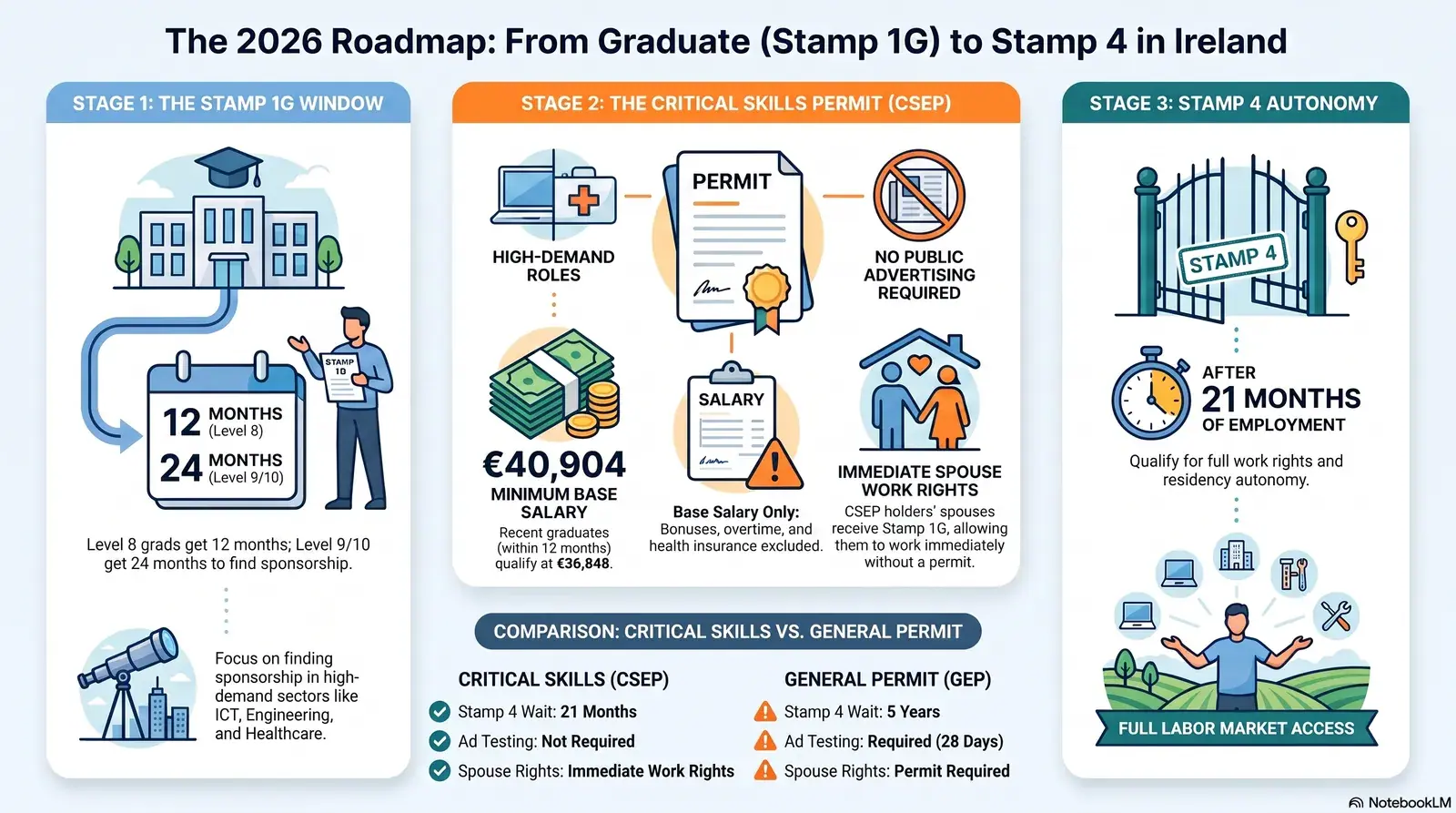
- New salary floor from 1 March 2026: The Critical Skills Employment Permit requires a base salary of at least €40,904 per year (or €36,848 if you graduated within the past 12 months). Bonuses and allowances do not count.
- Stamp 4 in 21 months: Once you start on a CSEP, you qualify for Stamp 4 — full, permit-free work rights and the right to start a business — after just 21 months of employment, regardless of when you first got your IRP.
- No Labour Market Needs Test: Unlike the General Employment Permit, a CSEP does not require your employer to advertise the role publicly first — making it significantly faster and simpler to obtain.
What is the full Stamp 2 to Stamp 4 journey for Indian graduates?
The journey runs in four distinct stages — Stamp 2 (student), Stamp 1G (graduate), employment permit (CSEP or GEP), and finally Stamp 4 — and typically takes between three and five years from the day you first landed as a student.
Here is how each stage connects:
- Stamp 2: Your student permission. You may work up to 20 hours per week during term time and up to 40 hours during academic breaks. You cannot apply for a CSEP while on Stamp 2 — you must first graduate.
- Stamp 1G: Granted after registering your completed qualification with the Immigration Service Delivery (ISD). Allows up to 40 hours per week for any employer, with no employment permit required. Duration: 12 months (Level 8) or 24 months (Level 9 and Level 10).
- Critical Skills Employment Permit (CSEP) or General Employment Permit (GEP): You secure a qualifying job offer, your employer (or you) applies through Employment Permits Online, and DETE issues a permit. The permit is initially valid for 2 years.
- Stamp 4: After 21 months on the CSEP, you apply to ISD for Stamp 4 permission. Stamp 4 lets you work for any employer, start your own business, and access a far wider range of social entitlements. After 5 years of reckonable legal residence, you can apply for Irish citizenship by naturalisation.
According to DETE's 2024 statistics, 39,390 employment permits were issued in Ireland in 2024 — a 27% increase on 2023 — with over half being Critical Skills Employment Permits. ICT, engineering, and healthcare dominate the list, which means the pathway is well-trodden and employer familiarity with the process is growing.
Your Stamp 1G window: duration and timing strategy
Stamp 1G gives Level 8 graduates 12 months and Level 9 or Level 10 graduates up to 24 months (an initial 12 months renewable for a further 12) to find and start qualifying employment — and the sooner you apply for your permit within that window, the more buffer you have against processing delays.
In practice, your Stamp 1G period begins when you register with ISD after graduation, not from the date DETE processes your permit application. This distinction matters: DETE's standard processing time runs 4 to 8 weeks, and Trusted Partner employers can reduce that to 2 to 4 weeks. If you are a Level 8 graduate with only 12 months of Stamp 1G, apply for the permit the moment your employer signals a formal offer — not after probation, not after the trial period.
You can hold a Stamp 1G and start your CSEP application at any point while your Stamp 1G permission remains valid. If you are already inside Ireland on Stamp 1G, you apply for the permit from within Ireland. The existing rule, confirmed by Citizens Information, is that applicants already holding a Stamp 1, 1G, 2, 2A, or 3 IRP can apply from within the country without needing to leave.
CSEP 2026 requirements: salary, occupation, and employer rules
From 1 March 2026, the Critical Skills Employment Permit requires a minimum base annual salary of €40,904 for roles on the Critical Skills Occupation List, or €36,848 if you completed your qualifying degree within the 12 months before the application date — and only your base salary counts.
The Critical Skills Occupation List, maintained by the Department of Enterprise, Trade and Employment (DETE), covers the majority of ICT, engineering, and healthcare roles that Irish employers hire internationally for. As of the May 2026 update, four new roles were added: optometrists, IP professionals, geospatial surveyors, and riggers in the games industry. Common roles held by Indian graduates include software developer, data scientist, systems analyst, cybersecurity specialist, mechanical engineer, electrical engineer, chemical engineer, and registered nurse.
For roles not on the Critical Skills Occupation List, the CSEP route remains open if the annual salary is at least €68,911, provided the occupation is not on DETE's ineligible categories list.
Additional eligibility rules set by DETE:
- The job offer must be for a minimum of 2 years.
- You must be directly employed and paid by the Irish employer — recruitment agency or contractor arrangements do not qualify.
- You must hold a degree or higher qualification relevant to the role (for occupations in the €40,904 salary band).
- The employer must be registered with Revenue, actively trading in Ireland, and registered with the Companies Registration Office.
- No more than 50% of the employer's workforce can be non-EEA nationals. Start-ups supported by Enterprise Ireland or IDA Ireland may apply for a waiver of this requirement.
- No Labour Market Needs Test is required — the employer does not need to advertise the role publicly.
The application fee is €1,000, payable by the employer or employee. If the application is refused or withdrawn, 90% of the fee is refunded. After arrival, you must register your IRP, which costs an additional €300.
CSEP vs General Employment Permit: which route applies to you?
The Critical Skills Employment Permit is the faster and more generous route: no Labour Market Needs Test, faster Stamp 4 eligibility, and immediate spouse work rights. The General Employment Permit exists as the fallback for roles that fall below the CSEP threshold or are not on the critical skills list.
| Feature | Critical Skills Employment Permit (CSEP) | General Employment Permit (GEP) |
|---|---|---|
| Minimum salary (from 1 March 2026) | €40,904 (or €36,848 for recent graduates) | €36,605 (or €32,691 for healthcare assistants and home carers) |
| Occupation restriction | Must be on the Critical Skills Occupation List (or salary ≥ €68,911) | Any role not on the ineligible list; Labour Market Needs Test required in most cases |
| Labour Market Needs Test | Not required | Required (28 days public advertising) unless salary exceeds €64,000 |
| Stamp 4 eligibility | 21 months after starting employment | Not directly; must accumulate 5 years of legal residence through ongoing permits |
| Spouse work rights | Spouse gets Stamp 1G (full work rights, no permit needed) | Spouse needs a Dependent/Spouse/Partner Employment Permit |
| Application fee | €1,000 (90% refunded if refused) | €1,000 for new permits; €500 for renewals under 6 months, €750 over 6 months (90% refunded if refused) |
| Change of employer | After 9 months; same occupation classification; max 3 changes | New application for each employer change |
In short: if your role and salary qualify for the CSEP, always choose it over the GEP. The Stamp 4 shortcut alone — 21 months versus potentially 5 years — makes the CSEP the strategically superior route in almost every scenario where it is accessible.
Trusted Partner employers: faster processing, simpler paperwork
Employers who have registered with DETE's Trusted Partner Initiative (TPI) get dedicated processing lanes that can halve the standard 4- to 8-week permit timeline down to 2 to 4 weeks, which is critical when your Stamp 1G has only weeks remaining.
A Trusted Partner employer holds a Trusted Partnership Number that they include with employment permit applications. DETE awards this status to companies that demonstrate consistent, compliant permit activity, full Revenue and corporate compliance, and a track record of upholding Irish employment law. Large Irish-registered tech companies, multinational healthcare groups, and IDA-supported firms are most likely to hold this status.
When evaluating job offers, it is worth asking HR whether the company is a Trusted Partner. The difference between a 2-week and an 8-week processing timeline can mean the difference between your Stamp 1G covering the full period or expiring before the permit arrives. If the employer is not a Trusted Partner, build in at least 8 to 10 weeks of buffer before your Stamp 1G expires.
How to pitch CSEP sponsorship to an Irish employer
Most Irish employers who are already hiring internationally understand the CSEP process, but smaller companies may need a concise, factual briefing — your job is to make sponsorship feel low-risk and administratively straightforward.
The key talking points when approaching an employer about sponsorship:
- No Labour Market Needs Test: Unlike many other permit categories, CSEP does not require the employer to run a 28-day public advertising campaign. The company can proceed directly to a permit application once you have a signed offer letter.
- Fee split: Either the employer or you can pay the €1,000 application fee. Many Indian graduates successfully negotiate for the employer to absorb the cost as part of the offer package.
- Processing time: Standard 4 to 8 weeks; faster (2 to 4 weeks) for Trusted Partner employers. Work can begin once the permit is issued.
- No ongoing headcount restriction: The 50% non-EEA cap applies at application time, not throughout employment. Employers with significant overseas hiring pipelines generally do not encounter this issue.
- No renewal hassle for 2 years: The initial CSEP is valid for 2 full years, reducing administrative overhead compared to annual renewals.
On-the-Ground Insight: "My employer had never sponsored a visa before, but they were willing when I walked HR through the exact DETE checklist. The key was showing them that there was no advertising requirement and that they would get 90% of the fee back if anything went wrong. We submitted the application in week 10 of my Stamp 1G and the permit came through in 5 weeks — I had no gap in my right to work." — Priya M., MSc Data Analytics, UCD, 2025 intake
Stamp 4 after 21 months: what you can actually do
Stamp 4, which you can apply for from ISD after 21 months on a CSEP, removes the employment permit requirement entirely — you can switch employers freely, take on freelance work, set up your own company, or take a career break without triggering a permit review.
Specific rights unlocked by Stamp 4 include:
- Work for any employer in any role without needing a work permit.
- Start or be a director of an Irish limited company.
- Access most social welfare entitlements (subject to habitual residence conditions).
- Your spouse or de facto partner retains their Stamp 1G rights independently of your Stamp 4 status.
- Stamp 4 is issued for 2 years initially and is renewable provided you continue to satisfy the residence criteria.
Critically, following a 2024 rule relaxation confirmed by Fragomen, the 21-month clock runs from when you started employment on the CSEP — not from when you first registered your Stamp 1 IRP. Graduates who previously registered a Stamp 1 IRP before their permit was issued now benefit from a shorter effective wait.
After 5 years of total reckonable legal residence in Ireland, you can apply for citizenship by naturalisation. Note that time spent on Stamp 2 (student permission) is generally not reckonable residence for naturalisation purposes — only Stamp 1, 1G, and Stamp 4 periods count. An Indian graduate who started on Stamp 1G, moved to CSEP in month 6, and obtained Stamp 4 at month 27 would already have 2 years and 3 months of reckonable residence by that point.
Changing employer on a Critical Skills Employment Permit
From 2 September 2024, you can change employer after just 9 months with your original CSEP employer, down from the previous 12-month requirement, as long as you stay within the same occupation or occupation classification on your original permit.
The conditions for a valid employer change under the Employment Permits Act 2024 are:
- At least 9 months must have elapsed since you started your first CSEP employment (exceptional circumstances such as corporate redundancy can waive this).
- You can make a maximum of 3 employer change applications over the lifetime of the permit.
- A new signed contract of employment must be submitted with the change application.
- You must start work with the new employer within 1 month of the updated permit being issued.
- You cannot begin the new role until the permit is formally reissued by DETE.
- Internal moves within the same company (promotions, lateral transfers) are permitted if you are using the same core skills.
If you reach Stamp 4 at 21 months, none of these restrictions apply — you can change employer, role, and even sector without any notification to DETE.
Common CSEP refusal reasons and how to avoid them
The most common grounds for CSEP refusal in 2025 and 2026 involve salary structuring, employer compliance status, and occupation classification mismatches — all of which are avoidable if you check the requirements before submission.
The critical failure points that applicants encounter:
- Salary below threshold due to bonus inclusion: Employers and applicants sometimes present a total compensation package (base + bonus + health insurance) as the "annual salary." DETE looks only at the base contractual salary in the written employment contract. If the base falls below €40,904, the application will be refused regardless of what the total package looks like on paper.
- Employer not compliant with Revenue: The employer must be current with all Revenue filings and registered with the CRO. A pending Revenue audit or delinquent return can block the application.
- Role not matching the occupation on the Critical Skills List: Job title mismatch is a frequent issue. "Data Engineer" may be interpreted differently by DETE than "Software Developer." It is worth reviewing the exact occupation codes on the list and ensuring your offer letter description aligns with DETE's occupational language.
- Degree not relevant to the role: A Level 9 degree in Business that supports a software development role application may draw scrutiny. Be prepared to provide a cover letter explaining how your qualifications relate to the role.
- More than 50% non-EEA workforce: Check with HR on the company's current non-EEA headcount percentage before applying. Start-ups can apply for an EI/IDA waiver.
If your application is refused, DETE is legally required to provide the specific grounds. You have 28 days to submit a formal review under Section 13 or 17 of the Employment Permits Act. If the refusal was based on an administrative error or a misinterpretation of documentation, an appeal can succeed. Where the underlying facts do not meet the criteria, a new application addressing the deficiencies is the more practical route.
Salary negotiation: making sure your offer clears the threshold
The March 2026 increase to €40,904 caught some employers by surprise, particularly those who had previously benchmarked entry-level roles at €38,000 to €39,000 and relied on a bonus to bridge the gap — a structure DETE's 2026 audit guidance has explicitly disallowed.
When entering salary negotiations:
- The €40,904 base is a floor, not a target. In Dublin's ICT and engineering market, entry-level roles for Indian MSc graduates typically come in at €42,000 to €50,000 base — well above the CSEP minimum for most applicants.
- The recent-graduate concession of €36,848 applies only if you received your qualifying degree within the 12 months before the permit application date — not the date you started looking for a job. If your degree was awarded in September 2025, this concession expires in September 2026.
- If an employer offers a package that includes a bonus that would push you over €40,904 but leaves your base below it, negotiate to convert part of the bonus into base pay. DETE's position, as documented in the MRCI's March 2026 update on new thresholds, is unambiguous: bonuses, overtime, commission, allowances, and benefits in kind do not count toward the Minimum Annual Remuneration figure.
- For General Employment Permit roles, the threshold is €36,605 base from 1 March 2026 (or €32,691 for healthcare assistants and home carers).
One additional lever: the graduate-rate concession (€36,848) can occasionally make the CSEP accessible for roles that would otherwise sit below the standard threshold. A newly graduated software developer offered €37,500 base would qualify under the graduate rate in their first year, even though that salary would fail the standard threshold.
Frequently Asked Questions
What is the minimum salary for a Critical Skills Employment Permit in 2026?
From 1 March 2026, the minimum annual salary is €40,904 for occupations on the Critical Skills Occupation List. If you graduated within the 12 months before applying, the threshold is lower at €36,848. For roles not on the list, the salary must be at least €68,911.
How long after starting on a CSEP can I apply for Stamp 4?
You can apply for Stamp 4 permission after 21 months of employment on a Critical Skills Employment Permit, regardless of when you first registered your Stamp 1 IRP. Stamp 4 is issued for 2 years and can be renewed.
Do bonuses count toward the CSEP salary threshold?
No. Only your base annual salary counts toward the Minimum Annual Remuneration (MAR) threshold. Bonuses, overtime, commission, allowances, and benefits in kind are all excluded under DETE's 2026 enforcement guidelines.
Can I change employer on a Critical Skills Employment Permit?
Yes, but only after 9 months with your first employer (reduced from 12 months in September 2024). You can change employer up to 3 times and must remain within the same occupation or occupation classification on your original permit. You cannot start with the new employer until the permit is formally reissued.
What work rights does my spouse get if I hold a Critical Skills Employment Permit?
Your spouse or de facto partner can obtain a Stamp 1G Irish Residence Permit, which gives them full access to the Irish labour market without needing their own employment permit — they can work up to 40 hours per week for any employer.
What happens if I am made redundant on a Critical Skills Employment Permit?
You must notify DETE using the redundancy notification form within 28 days of dismissal. DETE will then allow you 6 months to find another qualifying role. Once you find a new job, you can apply for a new CSEP. If your original job title is no longer on the critical skills list, DETE will still consider applications for the same job title with a 2-year offer.
Flying back to India during your job search? Compare live Dublin fares now.
India–Ireland student routes via Emirates, Qatar, and Etihad fill fast during summer and end-of-semester breaks. Check the fare calendar before your Stamp 1G window narrows.
All information in this article is based on publicly available official sources as of July 2026, including Citizens Information (updated 2 April 2026) and DETE. Immigration rules, salary thresholds, and occupations list contents change regularly. Always verify current information directly with DETE, ISD, or a qualified immigration adviser. MyFlightOffers is not affiliated with any government body. This article does not constitute immigration or legal advice.
- NEW Stamp 2 to Stamp 1G: How to Apply for Ireland Graduate Permission Without Mistakes (2026) — the step-by-step ISD portal process (€300 fee), full document checklist, six-month results window, timing traps to avoid, and what Level 9 graduates must prove for the second 12-month renewal
- NEW Internships and Work Placements on a Stamp 2 Visa: 2026 Rules for International Students in Ireland — how a course-integrated placement bypasses the 20-hour cap, the 50% duration rule, minimum wage rights (€14.15/hr in 2026), and why placement experience dramatically improves your CSEP sponsorship odds
- NEW Bringing Your Spouse and Family to Ireland as an Indian Student or Graduate (2026 Guide) — once you have your CSEP, use this guide to start the family join visa process from day one: financial thresholds, documents, spouse Stamp 1G work rights, schooling costs and Dublin vs regional city budgets
- NEW Irish Citizenship for International Students 2026: Reckonable Residence, Naturalisation and the Passport Path — the logical next step after Stamp 4: which stamps count toward the 5-year clock, total costs (€1,125), the 70-day travel rule, and what Indian nationals must know about renouncing their citizenship
- RELATED Revenue Emergency Tax Guide for International Students in Ireland — how to claim back overpaid PAYE and USC once your CSEP and PPS number are in order
- RELATED Ireland Banking Guide for International Students 2026 — opening an Irish bank account before your CSEP starts, direct debits for payroll, and the best accounts for new workers
- RELATED The Indian Student's Money Survival Guide in Ireland — budgeting from Stamp 2 through Stamp 1G and into your first CSEP-sponsored role
- RELATED Targeting 2026 Skill Gaps: High-Salary Sectors Hiring Graduates — which Irish sectors have the most CSEP-eligible roles and where Indian graduates are landing jobs