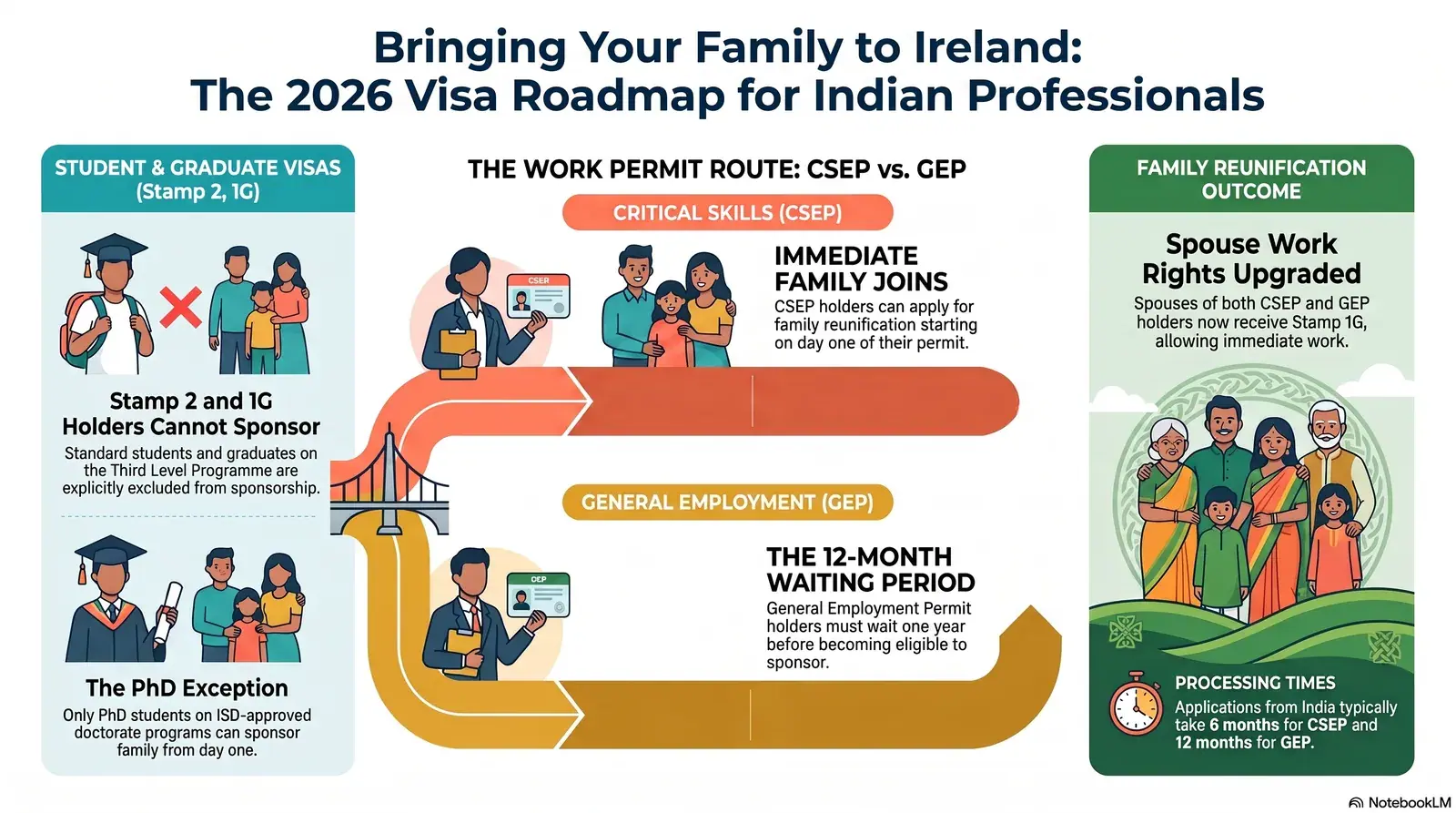
- Stamp 2 and Stamp 1G cannot sponsor family: Neither students nor graduates on the Third Level Graduate Programme are eligible sponsors under Ireland's Non-EEA Family Reunification Policy. The wait is real — you need a work permit first.
- CSEP is your fastest route: Critical Skills Employment Permit holders can apply for family reunification from day one. A CSEP salary of €40,904+ (2026 minimum) comfortably meets the updated June 2026 income thresholds. Spouses get Stamp 1G, letting them work for any employer without a separate permit.
- Processing takes 6–12 months from India: Category B (CSEP) applications take roughly 6 months at the Irish Embassy in New Delhi; Category C (GEP) applications take around 12 months. Apply as early as possible — current queue depths mean actual waits often exceed official estimates.
Cannot sponsor — except PhD students on ISD-approved scholarship or doctorate programme
Cannot sponsor — explicitly excluded from eligible sponsor categories (June 2026 ISD policy)
Can sponsor day 1 — spouse gets Stamp 1G work rights; Category B financial threshold met by permit minimum salary
Can sponsor after 12 months — spouse gets Stamp 1G work rights; €30,000 gross salary threshold applies
In this guide
- Stamp 2 students: the hard truth about bringing family
- Stamp 1G graduates: why you still cannot sponsor
- CSEP holders: immediate family reunification from day one
- GEP holders: family join after 12 months
- The visa application: thresholds, documents, and processing times
- Spouse work rights compared by stamp type
- Schooling and childcare: costs and enrolment
- Realistic budget: family of three in Dublin vs regional cities
- Common refusal reasons and how to appeal
- Frequently asked questions
Can a Stamp 2 Student Bring Their Spouse to Ireland?
No. Students on a Stamp 2 immigration permission — whether studying a master's, bachelor's, or language course — are explicitly listed as ineligible sponsors under Ireland's Non-EEA Family Reunification Policy (updated June 2026). The Immigration Service Delivery (ISD) states clearly: "Those in Ireland as students (except for those listed in Category B)" cannot sponsor family reunification.
The sole student exception is PhD students enrolled in a doctorate programme that is accredited in Ireland and approved by the ISD. These doctoral students qualify as Category B sponsors, meaning their spouse or partner can apply to join from day one of the permit. However, standard postgraduate and undergraduate students on Stamp 2 have no sponsorship rights.
Some advisors suggest bringing a spouse on a tourist (short-stay C) visa and then converting in-country. This is not permitted. The ISD explicitly states: "If you entered the State on a Short Stay 'C' Visa... you must complete a Family Dependent Application Form." More critically, from 1 June 2026, short-stay (C) visa refusals can no longer be appealed at all, removing the safety net for failed workaround attempts. Do not attempt this route.
The practical implication for most Indian students is stark: if you are on a one-year master's programme in Ireland, your spouse cannot legally join you during that year. The options are to plan your family's arrival around your post-study employment — specifically, around obtaining a work permit.
Stamp 1G Graduate: Can You Sponsor Your Spouse?
No — and this surprises many graduates. The Third Level Graduate Programme (Stamp 1G) is explicitly listed alongside students as an ineligible sponsor category under the June 2026 ISD policy. Even though Stamp 1G holders can work up to 40 hours per week and actively seek employment, they are treated the same as students for sponsorship purposes.
This matters enormously for the typical Indian MSc graduate in Ireland. After completing a one-year master's, you receive Stamp 1G for 24 months (Level 9) or 12 months (Level 8). During this entire period, you cannot sponsor your spouse or children to join you in Ireland, no matter how long you have been resident or how much you earn.
Even if you spend two years on Stamp 1G actively working and earning above the income thresholds, none of that time counts toward family reunification eligibility. The moment you transition to a CSEP or GEP, the clock starts fresh — day one for CSEP, 12 months for GEP. Plan your job search and offer negotiation with this timeline in mind.
On-the-Ground Insight: "I spent two years on Stamp 1G assuming I could bring my wife over once I had a stable job and income. My immigration lawyer told me in month 18 that none of that time counted — I had to wait until I actually got my CSEP stamped. We finally applied the week my permit arrived. The whole waiting period was almost three years from when I first landed in Ireland." — Karan M., Software Engineer, Dublin, MSc Computer Science TU Dublin 2023
CSEP Holders: Immediate Family Reunification from Day One
Critical Skills Employment Permit (CSEP) holders are Category B sponsors, the most favourable category for family reunification, and they can apply for a family join visa from the very first day their permit is issued. There is no minimum residency waiting period. As soon as you have your CSEP approval letter from the Department of Enterprise, Trade and Employment, your spouse or partner can begin their visa application.
The CSEP minimum salary in 2026 is €40,904 per year for occupations listed on the Critical Skills Occupations List, and €68,911 per year for non-listed occupations. Both figures comfortably exceed the June 2026 Category B income requirements, which are assessed on a case-by-case basis tied to the permit's existing salary criteria rather than a separate fixed threshold.
Common roles that attract CSEP eligibility for Indian graduates include software engineers, data scientists, machine learning engineers, cybersecurity analysts, and certain healthcare professionals. If your job offer meets the salary and occupation criteria, the CSEP is almost always preferable to the GEP for family reunification purposes.
From 12 June 2026, ISD raised the Category A (Irish citizen) sponsor income threshold to €75,000 gross over three years (€25,000/year average). Category B (CSEP holders) were largely insulated from this change — their existing permit salary requirements (€40,904+ per year) already exceed the new Category A benchmark. Category C (GEP) sponsors must show €30,000 gross income in the prior year for a spouse application.
GEP Holders: Family Can Join After 12 Months
General Employment Permit (GEP) holders are Category C sponsors and must wait 12 months from the date their permit is issued before applying for family reunification. During this 12-month period, your spouse and children in India must continue to wait. Only after 12 months of continuous residence on a valid GEP can you initiate the family join process.
The financial threshold for a Category C sponsor bringing a spouse or partner is €30,000 gross income in the year immediately before the application. This threshold is set by ISD's Financial Thresholds page (last updated June 2026). If you are also bringing children, the threshold rises significantly — for one child, you need net income above €39,780 (approximately €50,200 gross); for two children, net income above €45,032 (approximately €60,200 gross). These figures are based on the Department of Social Protection's Working Family Payment income limits for 2026.
One critical change introduced in May 2024 — which remains in effect as of July 2026 — is that spouses and de facto partners of GEP holders now receive Stamp 1G permission rather than the old Stamp 3. This upgrade means GEP spouses can now work for any Irish employer without their own employment permit. Children under 16 receive Stamp 3; children 16 and over receive Stamp 1G (a rule that took effect from 26 November 2025).
The Visa Application: Financial Thresholds, Documents, and Processing Times
Your family members in India must apply for a Category D "Join Family" long-stay visa, which is processed through Immigration Service Delivery (ISD) after submission at the Irish Embassy in New Delhi via VFS Global. The application is completed online through the AVATS portal, and originals are lodged at the VFS centre. Processing happens at the Embassy and typically does not begin until all documents are received and verified.
Financial Thresholds by Sponsor Category (2026)
The table below summarises the current financial requirements from the official ISD Financial Thresholds page, updated June 12, 2026. Only the income of one sponsor is counted — you cannot combine your salary with your spouse's earnings already in Ireland to meet the threshold.
| Sponsor Category | Who Qualifies | Waiting Period | Spouse Income Threshold | 1 Child (extra) |
|---|---|---|---|---|
| Category A | Irish citizens | None | €75,000 gross over 3 years (€25,000/yr avg) | Same threshold applies |
| Category B | CSEP holders, PhD students (ISD-approved), researchers on Hosting Agreements | None (day one) | Met by existing permit salary (€40,904+ CSEP minimum) | Same permit conditions |
| Category C | GEP holders, Reactivation Permit holders, independent Stamp 4 holders | 12 months | €30,000 gross in prior year | Net €39,780 (~€50,200 gross) for 1 child; net €45,032 (~€60,200 gross) for 2 children |
| Ineligible | Stamp 2 students (non-PhD), Stamp 1G graduates | N/A | N/A — cannot sponsor | N/A |
🧮 Family Join Eligibility Checker (2026)
Enter your permit type, gross annual salary, and the number of children you plan to bring. The checker uses the official ISD financial thresholds (June 2026) to tell you whether you currently qualify. The salary box opens on an illustrative €45,000 — roughly a typical post-study graduate salary in Ireland, not a published threshold — so enter your own gross figure before relying on the result.
Document Checklist for the Join Family Visa
The official Irish Embassy New Delhi checklist (updated July 2025) requires the following core documents. Missing even one document will delay the application and reset your queue position.
- Completed AVATS online visa application form (long-stay D category, "Join Family")
- Valid passport with at least 12 months remaining from the date of application
- Marriage certificate (apostilled and translated into English if in a regional language)
- Birth certificates for any children included in the application
- Sponsor's passport copy and current Irish Residence Permit (IRP card)
- Sponsor's employment contract and three months of recent payslips
- Sponsor's P60 or Revenue MyAccount tax summary showing annual income
- Proof of accommodation in Ireland (lease agreement or property ownership documents)
- Bank statements from the last 6 months (sponsor's Irish account and Indian accounts)
- Police clearance certificate from India (Apostille required)
- Evidence of relationship — photographs together, joint financial accounts, communication records
Processing Times from India (2026)
Official processing times are approximately 6 months for Category B applications and 12 months for Category C, measured from the date the complete file is received by the Irish Embassy in New Delhi — not from the VFS lodgement date. However, as of April 2026, the Dublin visa office was working through applications submitted in early-to-mid 2024, suggesting actual wait times can substantially exceed official guidance, particularly for Category C cases.
The Irish Embassy in India does not publish a live queue tracker. To follow up, sponsors in Ireland can contact ISD's Customer Service Portal after six months have elapsed from document receipt. Always reference your application number in any correspondence.
Spouse Work Rights in Ireland by Stamp Type
Whether your spouse can work in Ireland — and under what conditions — depends directly on the immigration permission they receive when they arrive, which in turn depends on your sponsor category. This is one of the most practically significant differences between joining a CSEP holder versus a GEP holder versus a Stamp 4 holder.
| Your Stamp | Spouse/Partner Immigration Permission | Can Spouse Work? | Children Under 16 | Children 16+ |
|---|---|---|---|---|
| CSEP | Stamp 1G (immediate on arrival) | Yes — any employer, no separate permit needed (except self-employment) | Stamp 3 (cannot work) | Stamp 1G (can work) — from Nov 2025 |
| GEP | Stamp 1G (upgraded from Stamp 3 as of May 2024) | Yes — any employer, no separate permit needed (except self-employment) | Stamp 3 (cannot work) | Stamp 1G (can work) — from Nov 2025 |
| Stamp 4 | Stamp 3 (dependent permission) | No — must obtain a separate Dependent Employment Permit with a job offer to work | Stamp 3 (cannot work) | Stamp 3 (requires separate permit) |
The May 2024 Stamp 3 to Stamp 1G upgrade for GEP spouses is significant but applies only to spouses and de facto partners, not to other dependants. If your dependent parent or in-law joins you under a GEP, they receive Stamp 3 and cannot work. The rule explicitly states: "This change does not apply to a spouse or partner in Ireland on other immigration permissions (for example, student or visitor) or to any other dependents."
If your spouse already holds a Stamp 3 in Ireland as a GEP dependent, ISD confirmed that their permission was amended to Stamp 1G conditions from 15 May 2024. They can provide prospective employers the official ISD letter explaining this arrangement. No new IRP card is needed to begin working; the updated conditions apply automatically.
Schooling and Childcare: Costs and Enrolment in 2026
Ireland's public primary and secondary schools are free for all residents with valid permission to remain, regardless of nationality — making schooling significantly more affordable than most families expect when budgeting for a move. Your child does not need to be an Irish citizen or hold any specific stamp to attend a State school; lawful residence is sufficient.
Free State Schooling
All primary (ages 4–12) and secondary (ages 12–18) schools funded by the State are free of charge to attend, with the exception of voluntary contributions requested by some schools (typically €100–€250/year — these are genuinely optional, not obligatory). Enrolment is through the individual school's admissions process — contact the school directly; there is no centralised online portal at primary level.
For newly arrived families, the Department of Education's enrolment guidance recommends contacting schools in your area six to twelve months before the intended start date, as popular schools in Dublin 2, Dublin 4, and the commuter belt often have waiting lists. Regional cities (Cork, Galway, Limerick, Athlone) typically have less pressure on school places.
Free Pre-school: The ECCE Scheme
The Early Childhood Care and Education (ECCE) scheme provides free pre-school to all children aged between 2 years and 8 months and 5 years, covering up to 3 hours per day, 5 days per week, for 38 weeks per year — at zero cost to parents. This is one of Ireland's most underused benefits among immigrant families. To avail of it, register your child with an ECCE-approved childcare provider using your PPS number and proof of the child's date of birth and residence permission.
Paid Childcare for Under-2.5 Years
For children under 2 years and 8 months, paid childcare (crèche or childminder) is the only option, and it is one of the largest budget items for families in Ireland. Full-time crèche fees in Dublin range from €800 to €1,400 per month in 2026. Childminders (in-home carers) charge approximately €5–€10 per hour per child. Outside Dublin — in Cork, Galway, or Limerick — the range drops to approximately €650–€1,100 per month for a full-time crèche place.
The government's National Childcare Scheme (NCS) provides subsidies based on income. For families where the sponsor earns €40,000–€60,000, the NCS universal subsidy of €1.40 per hour (approximately €168 per month for 30 hours per week) can reduce the out-of-pocket cost modestly. Apply through MyGovID once you have a PPS number for your child.
Realistic Budget: Family of Three in Dublin vs Regional Cities
A family of three (two adults, one child) living in Dublin on a single CSEP-level income should budget approximately €4,200–€5,500 per month for all essentials in 2026, excluding discretionary spending. Regional cities cut this figure by 20–30%, making Cork, Galway, or Limerick substantially more financially sustainable for families in the early years after reunification.
| Expense Category | Dublin (monthly) | Cork / Galway / Limerick (monthly) | Notes |
|---|---|---|---|
| Rent (2–3 bed) | €2,100–€3,600 | €1,400–€2,200 | Outer Dublin suburbs (e.g. Blanchardstown, Tallaght) are at the lower end |
| Groceries (family) | €500–€650 | €450–€600 | Lidl / Aldi weekly shop for Indian cooking approx. €120–€150; Indian stores add €50–€100/month for spices and specialty items |
| Utilities (gas + electricity) | €200–€350 | €180–€300 | Irish winters are damp; heating costs are higher Oct–Mar |
| Transport (2 adults) | €300–€450 | €150–€280 | TFI 90-minute caps and Leap card discounts apply; car ownership adds €400–€600/month |
| Childcare (child under 2.5) | €800–€1,400 | €650–€1,100 | ECCE free scheme kicks in at age 2y8m; NCS subsidy may reduce this by €100–€170/month |
| Health insurance | €150–€300 | €150–€300 | Private insurance (VHI, Laya) recommended; public waiting lists for non-emergency care can be 12–24 months |
| Estimated Total | €4,050–€6,750 | €2,980–€4,780 | Pre-tax income needed: approx. €70,000–€90,000 in Dublin; €50,000–€65,000 in regional cities to live comfortably |
These figures assume public schooling (free) once the child is of primary school age, and ECCE (free) from 2y8m. Families who opt for private or international schooling should add €4,000–€22,000 per year in tuition, which significantly changes the calculus.
On-the-Ground Insight: "We moved to Galway rather than Dublin specifically because of the cost difference. My CSEP salary of €52,000 would have left us barely breaking even in Dublin once rent and childcare were factored in. In Galway, we pay €1,650 for a two-bed apartment, our daughter started the free ECCE scheme three months after we arrived, and we actually save €400–€500 per month. The tech sector here is strong — I work at an IDA-supported company. It was the right call." — Priya S., Data Engineer, Galway, MSc Data Analytics NUI Galway 2022
Common Refusal Reasons and How to Appeal
The most common reasons for join family visa refusals in 2026 are failure to meet the financial threshold, insufficient evidence of the genuine relationship, and the sponsor being in an ineligible category. Understanding these in advance dramatically improves application quality.
Top Refusal Reasons
ISD and immigration practitioners consistently identify five categories of refusal, based on the Non-EEA Family Reunification Policy and appeal decisions published by the Immigrant Council of Ireland:
- Financial threshold not met: The sponsor's P60 or payslips show income below the required threshold. Note that State benefits (jobseeker's allowance, child benefit) do not count toward the threshold. Additionally, from June 2026, sponsors must not have been "mainly reliant on State supports for a continuous period of two years or longer immediately prior to application."
- Insufficient relationship evidence: The relationship between sponsor and applicant is not adequately evidenced. For a spouse, the marriage certificate alone is often not enough — joint bank accounts, photographs together, call/message logs, and joint travel history are all helpful.
- Ineligible sponsor category: The sponsor is on Stamp 2 or Stamp 1G (most common for Indian applicants who mistakenly apply before obtaining a work permit).
- Accommodation proof inadequate: A valid lease in the sponsor's name covering a property of reasonable size is required. Some cases are refused because the lease has expired or the property is deemed overcrowded for the additional family members.
- Unlawful presence: If the family member has ever been in Ireland unlawfully (e.g., overstayed a tourist visa), ISD may refuse on this ground alone and issue a Notification of Intention to Deport.
How to Appeal a Refused Join Family (D) Visa
If your family member's long-stay D visa is refused, you have the right to appeal within two months of receiving the written refusal letter. The appeal must be submitted in writing to the Visa Appeals Officer and should include a cover letter addressing each specific refusal reason, along with any new or additional documents that address the grounds for refusal.
The appeal is reviewed by a different officer who was not involved in the original decision — an important procedural safeguard. You may engage an Irish immigration solicitor to draft the appeal letter. Key solicitors with track records in family reunification cases include those accredited by the Law Society of Ireland.
From 1 June 2026, Ireland removed the right of appeal for short-stay (C) tourist and visitor visa refusals. This only affects Category C short-stay applications — the long-stay D "Join Family" visa retains a two-month appeal window. Do not confuse the two visa types when seeking advice.
Frequently Asked Questions
Can a Stamp 2 student bring their spouse to Ireland?
No. Stamp 2 students — whether on an undergraduate, master's, or language programme — cannot sponsor family reunification in Ireland. The only student exception is PhD students studying for a doctorate accredited in Ireland, who qualify as Category B sponsors. Graduates on Stamp 1G are also explicitly excluded from sponsoring family.
Can a Stamp 1G graduate sponsor their spouse to join them in Ireland?
No. Graduates on the Third Level Graduate Programme (Stamp 1G) are explicitly listed as ineligible sponsors under Ireland's Non-EEA Family Reunification Policy. You must transition to a work permit (CSEP or GEP) before you can sponsor family to join you.
What is the financial threshold for a CSEP holder to bring their spouse in 2026?
CSEP holders are Category B sponsors. The financial threshold for a Category B sponsor is deemed met by virtue of their permit conditions — a CSEP requires a minimum salary of €40,904 per year (or €68,911 for non-listed occupations), which satisfies the income requirement. Category B sponsors can apply immediately from day one of their permit.
Can the spouse of a CSEP holder work in Ireland without a separate employment permit?
Yes. The spouse or de facto partner of a Critical Skills Employment Permit holder receives Stamp 1G immigration permission upon arrival in Ireland. Stamp 1G allows the holder to work for any employer in Ireland without needing their own employment permit. Self-employment remains subject to separate rules.
How long does a join family visa from India take to process in 2026?
Processing times vary by sponsor category. Category B (CSEP holders) applications typically take approximately 6 months once all documents are submitted to the Irish Embassy in New Delhi. Category C (GEP holders, Stamp 4) applications take approximately 12 months. As of mid-2026, the Dublin visa office was processing applications submitted in early-to-mid 2024, so actual wait times can exceed published estimates.
Are Irish public schools free for children of immigrants?
Yes. Irish public primary and secondary schools are free for all residents, regardless of immigration status, once the child has valid permission to remain in Ireland. The government's Early Childhood Care and Education (ECCE) free pre-school scheme is also available for children aged 2 years and 8 months to 5 years, covering up to 3 hours per day, 5 days a week, for 38 weeks.
Planning your family's move to Ireland? Start with the flight.
Compare one-way and return fares from Indian cities to Dublin on Emirates, Etihad, and Qatar Airways — and use our fare calendar to find the cheapest month to fly.
All information in this guide is based on publicly available official sources, primarily the Immigration Service Delivery (ISD) website and the Citizens Information portal, as of July 2026. Ireland's immigration policy can change — particularly income thresholds and sponsor category rules. Always verify current information directly with ISD or a qualified Irish immigration solicitor before making decisions. This article does not constitute legal, financial, or immigration advice. MyFlightOffers is not affiliated with any government body or immigration service mentioned.
- POPULAR Critical Skills Employment Permit After Stamp 1G: The 2026 Roadmap from Graduate to Stamp 4 — how to get the CSEP that unlocks family sponsorship
- Ireland Banking Guide for International Students 2026 — setting up accounts, PPS numbers, and sending money home
- The Indian Student's Money Survival Guide in Ireland — budgeting, forex cards, and avoiding costly mistakes
- Irish Citizenship for International Students 2026 — naturalisation, reckonable residence, and the passport path
- Study in Ireland 2026: Visa, Housing and IRP Complete Guide — everything for first-year students before they land