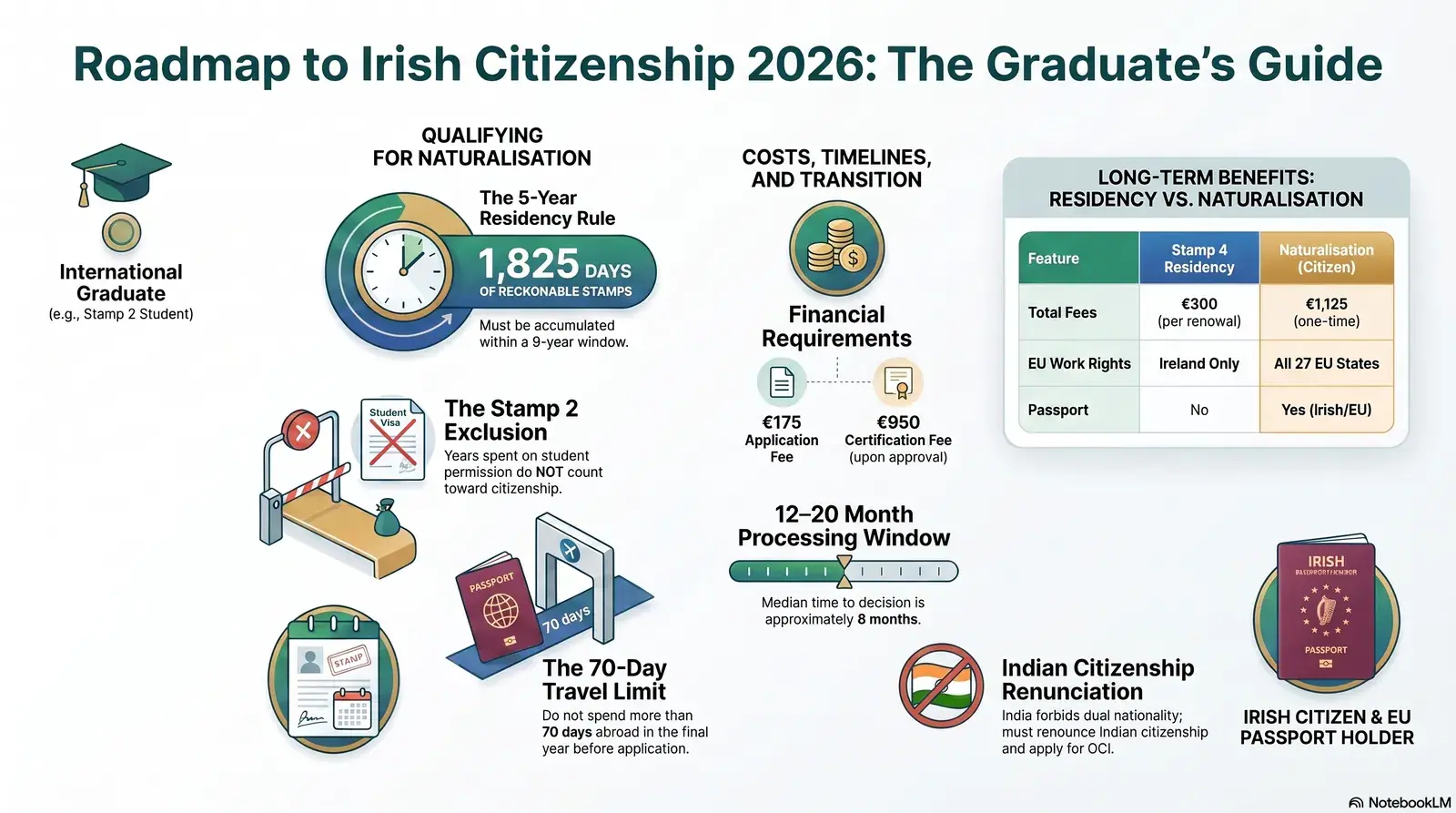
- Stamp 2 does not count: Your years studying in Ireland on a student permission are excluded from the reckonable residence calculation. You need 5 years of qualifying stamps (Stamp 1, 1G, 3, 4, or 5) out of the last 9 years.
- Total cost is €1,125: A non-refundable €175 application fee plus a €950 certification fee on approval. Processing currently takes 12–20 months from submission to your naturalisation certificate.
- Indian nationals must renounce their Indian citizenship: Ireland allows dual citizenship; India does not. After renouncing, most former Indian nationals apply for an OCI (Overseas Citizen of India) card to retain visa-free access to India.
€175
Non-refundable; paid online at time of application
€950
Paid after decision; free for refugees, €200 for minors
5 years in 9
Including 12 months continuous immediately before application
70 days
+30 days for exceptional circumstances
12–20 months
Median ~8 months to decision; ceremony adds 2–6 months
Not permitted
India does not recognise dual nationality; renunciation required
What Is Reckonable Residence and Which Stamps Count?
Reckonable residence is the legal term for time spent in Ireland that counts toward the five-year qualifying total for naturalisation. Not every period of lawful stay qualifies — only certain immigration permissions are recognised under the Irish Nationality and Citizenship Act 1956 (as amended).
The precise rule, as set out by Citizens Information (updated April 2026), is that you need:
- 1 year of continuous reckonable residence immediately before the date of your application, and
- 4 further years of reckonable residence during the 8 years before that.
In total, you need 5 years (1,825 days) of reckonable residence within the 9 years before you apply. You can use the online residency calculator on irishimmigration.ie to work out whether you meet the threshold.
Immigration stamps that count toward naturalisation
The following immigration permissions are counted as reckonable residence for non-EEA nationals:
- Stamp 1 — held on a valid employment permit (Critical Skills, General, Intra-Company Transfer)
- Stamp 1G — the Third Level Graduate Scheme permission. The Department of Justice confirmed in 2022 that Stamp 1G counts regardless of whether you hold it as a graduate or as the spouse or partner of a CSEP holder. When using the residency calculator, select “Stamp 1” from the dropdown as Stamp 1G is not yet listed separately.
- Stamp 3 — typically held by dependants of employment permit holders
- Stamp 4 — the most common long-term permission, held after CSEP completion (usually at 21 months) or via various other routes
- Stamp 5 — Without Condition as to Time; counts in full
The Stamp 2 problem: why your Masters years do not count
Time spent on a Stamp 2 or Stamp 2A (student permission) is explicitly excluded from reckonable residence — including all time spent on a student visa, whether for undergraduate or postgraduate study or for internships integrated into your course.
This catches many Indian Masters graduates by surprise. If you spent 12 months (September 2023 to September 2024) studying for your MSc in UCD, DCU, or UCC on a Stamp 2, that entire year contributes zero days toward your naturalisation clock. The same applies to two-year programmes: a student who arrived in September 2023 and graduates in September 2025 has accumulated no reckonable residence after two years of fees and study.
Your clock starts only when you move onto a qualifying stamp — typically Stamp 1G at graduation, and then Stamp 1 or Stamp 4 once you secure a job.
Level 9 (Masters) graduates get a 12-month Stamp 1G, extendable to 24 months if they have not found a CSEP-qualifying job. Level 8 (undergraduate) graduates get 12 months only, with no extension. Neither counts Stamp 2 time. Plan your 5-year clock from your Stamp 1G start date, not from when you first arrived.
How to Calculate Your 5 Years of Qualifying Residence
The calculation runs backward from your intended application date: you need 1 year continuous immediately before you apply, plus 4 more years of reckonable time in the 8 years before that — for a total of 5 qualifying years within a 9-year window.
Days are counted from your IRP (Irish Residence Permit) card registration dates. The ISD uses your IRP records as the primary evidence of lawful residence. A gap in your IRP (an expired card not renewed on time) is one of the most common reasons applications are delayed or refused.
For a typical Indian Masters graduate on the CSEP pathway, the practical timeline looks like this:
- Year 0–1 or 0–2: Stamp 2 (student) — 0 days reckonable
- Year 1–2 or 2–3: Stamp 1G (graduate) — counts in full
- Year 2–3.75 or 3–4.75: Stamp 1 (CSEP, first 21 months) — counts in full
- Year 3.75+ or 4.75+: Stamp 4 (after CSEP) — counts in full
- Earliest possible naturalisation application: approximately 5 years after your first qualifying stamp (Stamp 1G graduation date)
In plain terms: an Indian student who arrived in September 2022 on Stamp 2, graduated in September 2023, started their CSEP job in October 2023 (Stamp 1), converted to Stamp 4 in July 2025, and maintains continuous residence, would become eligible to apply for naturalisation in approximately October 2028 — roughly 6 years after first arriving in Ireland.
The Naturalisation Application: Step by Step in 2026
All applications for Irish naturalisation are submitted online through the INIS Online portal (inisonline.jahs.ie) and decided by Immigration Service Delivery (ISD) on behalf of the Minister for Justice, who retains absolute discretion to grant or refuse naturalisation.
Fees in 2026
| Fee type | Amount | When paid | Refundable? |
|---|---|---|---|
| Application fee | €175 | At time of application | No |
| Certification fee (adult) | €950 | After approval, before ceremony | N/A |
| Certification fee (minor/widow) | €200 | After approval, before ceremony | N/A |
| Certification fee (refugee/stateless) | Free | — | N/A |
Source: Citizens Information, updated April 2026
For most Indian graduates applying as adults, the total out-of-pocket cost is €1,125 (€175 + €950). You cannot appeal a refusal in a traditional sense, so investing in a thorough application is worthwhile.
Documents and the scorecard system
ISD uses a “scorecard” system introduced in 2023 that lets you submit a wider range of documents to evidence your identity and residence history. You must score at least 150 points across each of two categories: identification, and residency.
Core documents you will always need include:
- A certified colour photocopy of the biographic page of your current passport (certified by a solicitor, commissioner for oaths, peace commissioner, or notary public)
- All IRP cards from your time in Ireland (or certified evidence of each permission period)
- Your birth certificate (certified copy)
- A statutory declaration of good character (made before a solicitor or commissioner for oaths)
- Evidence of your reckonable residence calculation (generated via the ISD online calculator)
The full points guide is in the Citizenship Guidance Document (ISD, April 2024). Higher-value documents (a current IRP card, a passport showing Irish entry stamps) score more points than lower-value ones (utility bills). If your documents are in a language other than English, you must provide a certified translation from a member of the Irish Translators’ and Interpreters’ Association.
E-vetting: the Garda background check
Before ISD issues its decision, every applicant receives an invitation to complete an e-vetting application through An Garda Síochána’s National Vetting Bureau. The check covers your criminal record, driving offences, ongoing investigations, pending cases, and any civil orders (such as barring orders). Respond promptly — slow e-vetting responses are one of the main causes of processing delays.
You must disclose any offences on your application form. Minor driving offences are unlikely to result in refusal, but they must be declared. Undisclosed offences discovered via e-vetting are a direct route to refusal and potential permanent inadmissibility.
Processing times and ceremony wait in 2026
ISD processed a record 33,000 naturalisation decisions in 2025, and the median time from submission to decision has improved to approximately 8 months (down from 15 months in 2023 and 19 months in 2022). Accounting for the time between a positive decision letter and a citizenship ceremony (typically 2–6 months), plus the 4–6 weeks for the certificate to arrive afterward, applicants submitting a complete file in 2026 should budget 12–20 months from submission to receiving their naturalisation certificate.
Citizenship ceremonies are held at the INEC in Killarney. The June 2026 ceremonies conferred citizenship on approximately 5,000 people from more than 120 nationalities. Once you have your certificate, you can immediately apply for an Irish passport — you cannot apply before then.
On-the-Ground Insight: “I submitted my application in January 2025 with every document ready and responded to e-vetting within 48 hours of the invitation. I got my approval letter in September 2025 — just under 8 months. The ceremony was in December and I had my passport by February 2026. The key was not having any gaps in my IRP history and keeping copies of every renewal letter.” — Priya M., Indian national, DCU MSc graduate, naturalised December 2025
The 70-Day Travel Rule: How Much Can You Leave Ireland?
In the 12-month period immediately before your naturalisation application, you may spend a maximum of 70 days outside Ireland. The day you leave and the day you return do not count as absences.
An additional 30 days may be permitted if you left Ireland for exceptional circumstances, including health reasons, family circumstances, employment or study obligations, or voluntary humanitarian service. You must proactively explain these absences in your application — ISD does not automatically grant the extra allowance.
This is a significant change from the previous six-week (42-day) limit. The liberalised 70-day rule, introduced via amendments to the Irish Nationality and Citizenship Act, reflects modern employment realities: frequent business travel, visiting family in India, and international conference attendance no longer necessarily block your application. However, you should keep comprehensive records — flight boarding passes, passport stamps, and accommodation receipts — to demonstrate your actual travel history in case ISD requests clarification.
Note that the 70-day rule applies specifically to the final 12 months. During the other four years of your qualifying residence, the law requires continuous reckonable residence but does not impose a hard day-count on individual trips. Practical guidance from immigration solicitors suggests that stays abroad of more than three consecutive months in earlier years may nonetheless raise questions about the continuity of your residence.
Irish Citizenship Benefits: Why the EU Passport Is Worth the Wait
Irish citizenship grants you a full EU passport, which means the right to live, work, study, and vote in all 27 EU member states without any further visa, work permit, or residency application.
In concrete terms, an Irish citizen can move to Germany for a job, apply for a Dutch mortgage, retire in Portugal, or send their children to school in France — all without any immigration paperwork. For Indian graduates building international careers, this degree of mobility is transformative. Compare it to Stamp 4, which is a strong permission within Ireland but gives you zero additional rights anywhere else in Europe.
Additional benefits include:
- Consular protection: You can use any EU member state’s embassy for consular assistance in countries where Ireland has no embassy.
- No more IRP renewals: As an Irish citizen you no longer need to renew your immigration permission. Your right to be in Ireland is unconditional and permanent.
- Voting rights: You can vote in Irish general elections, referenda, and European Parliament elections.
- Irish passport: The Irish passport is one of the world’s most travel-friendly, offering visa-free or visa-on-arrival access to approximately 190 countries including the USA under ESTA.
- Family benefits: An Irish citizen’s children born abroad can be registered on the Foreign Births Register and claim Irish citizenship.
Dual Citizenship and the India Renunciation Rule
Ireland permits dual and multiple citizenship and does not require you to renounce your existing nationality when you naturalise as Irish. The problem lies with India: the Indian Citizenship Act 1955 does not recognise dual nationality, which means Indian nationals who become Irish citizens are legally required to surrender their Indian citizenship.
You cannot carry both an Indian and an Irish passport simultaneously. The renunciation process involves:
- Completing Form XXII (Declaration of Renunciation of Indian Citizenship) via the Ministry of Home Affairs portal
- Submitting the declaration and supporting documents to the Embassy of India in Dublin
- Surrendering your Indian passport to the Embassy
- Receiving a formal renunciation certificate
Most people time the renunciation to coincide with their naturalisation ceremony: you become Irish at the ceremony, and you renounce your Indian citizenship in the weeks immediately after.
What happens after you renounce: the OCI card
After renouncing Indian citizenship, most former Indian nationals apply for an OCI (Overseas Citizen of India) card, which provides lifelong visa-free entry to India and various rights equivalent to those of Non-Resident Indians.
The Citizenship (Amendment) Rules 2026, notified by the Ministry of Home Affairs on 30 April 2026, introduced a fully digital OCI application and renunciation process. All OCI registration, re-issuance, renunciation, and cancellation requests must now be submitted electronically through the OCI Services portal — physical document submission to the Indian consulate is no longer required. A new e-OCI option also allows registered applicants to receive a digital OCI instead of a physical card.
OCI status does not give you the right to vote in Indian elections, hold certain government jobs, or purchase agricultural land in India, but for the vast majority of former Indian nationals it provides the most important practical benefit: the ability to travel to India without a visa and to live there for extended periods.
Once you are naturalised as Irish, your Indian passport is no longer valid for international travel. You must use your Irish passport to exit Ireland, travel internationally, and enter India (with your OCI card). Using an invalid Indian passport may cause problems at border control and with immigration in India. Apply for your OCI card promptly after naturalisation and before booking any India travel.
Stamp 4 vs Long-Term Residency vs Naturalisation: Which to Aim For?
These three immigration outcomes are often confused. They represent progressively deeper legal integration into Irish society, with very different rights, costs, and requirements.
| Feature | Stamp 4 | Long-Term Residency | Naturalisation (Irish Citizen) |
|---|---|---|---|
| Eligibility basis | 21 months on CSEP; various routes | 5 years on Stamp 1 or Stamp 4 | 5 years reckonable residence in 9 years |
| Application fee | €300 (IRP renewal) | €500 (one-off) | €175 + €950 = €1,125 total |
| Work rights in Ireland | Full (no permit needed) | Full (no permit needed) | Full (no permit needed) |
| Work rights in EU | None (Ireland only) | None (Ireland only) | Full freedom of movement in all 27 EU states |
| Irish passport | No | No | Yes |
| Requires renewal | Yes (every 1–5 years) | Yes (every 5 years) | No (permanent, unconditional) |
| Counts toward naturalisation? | Yes | Yes (it grants a Stamp 4) | N/A |
| Voting rights | No (EU/local elections only for some) | No | Yes (all Irish and European elections) |
| Best for | Immediate work flexibility; stepping stone | Long-term stability without committing to citizenship | EU mobility, permanence, passport strength |
Source: Immigration Service Delivery (ISD) and Citizens Information, July 2026
Long-Term Residency (LTR) is an often-overlooked middle option. After five years on qualifying stamps (generally Stamp 1 or Stamp 4), you can apply for LTR and receive a five-year Stamp 4 for a one-off €500 fee. LTR renewals are straightforward and require no further employment sponsor. It is a good option if you are not yet sure whether to commit to renouncing your Indian citizenship, but it does not give you any EU rights and your Irish stay remains conditionally renewable.
Naturalisation is the terminal step. Once you are Irish, no further immigration applications are ever needed for Ireland or any EU state. The €1,125 cost, the 12–20 month wait, and the India renunciation requirement are the trade-offs. For most long-term residents the EU passport is the decisive factor.
Timeline Case Study: 2026 Masters Graduate to Irish Citizen
To make the abstract concrete, here is a realistic year-by-year map for an Indian MSc graduate who arrived in Ireland in September 2025 and wants to plan the fastest realistic path to an Irish passport.
| Period | Status | Stamp | Days reckonable | Running total |
|---|---|---|---|---|
| Sep 2025 – Sep 2026 | MSc student | Stamp 2 | 0 | 0 |
| Sep 2026 – Sep 2027 | Graduate job seeking / employment | Stamp 1G | 365 | 365 |
| Sep 2027 – Jun 2029 | CSEP (Critical Skills Employment Permit) | Stamp 1 | ~630 | ~995 |
| Jun 2029 – Sep 2031 | Post-CSEP (Stamp 4 granted at 21-month mark) | Stamp 4 | ~830 | ~1,825 |
| Sep 2031 | Eligible to apply for naturalisation | Stamp 4 | — | 1,825+ days |
| Sep 2031 – Jun 2033 (estimate) | Application processing + ceremony | Stamp 4 (continuing) | — | — |
| ~Jun 2033 | Irish citizen | Irish passport | — | — |
In this scenario, a student who arrived in September 2025 could become an Irish citizen in approximately mid-2033 — roughly 8 years after first arriving. Accelerating this is possible if the job and CSEP are secured immediately on graduation and if ISD’s processing times remain at or below 12 months.
The key lever is not your arrival date but your Stamp 1G start date — the day after graduation when your student permission expires and your graduate permission begins. Missing your Stamp 1G renewal, applying late, or having a gap in your IRP can push your five-year clock back by months or years.
Common Reasons for Naturalisation Refusal and How to Avoid Them
The Minister for Justice has absolute discretion to refuse naturalisation, and refused applicants cannot lodge a formal appeal (though a judicial review is possible). The most common avoidable reasons for refusal include the following.
- Gaps in IRP registration: Even a single month where your IRP card expired and was not renewed on time can break your “continuous reckonable residence” in the final 12 months. Renew your IRP card at least two weeks before the expiry date, every time.
- Undisclosed offences: The e-vetting check will surface matters you have not declared. Always disclose fully and explain the circumstances — the non-disclosure is typically treated more seriously than the underlying offence.
- Insufficient evidence of residence: Failing to score 150 points in the residency scorecard (because you cannot locate old utility bills or rental agreements) is common. Keep all documents from the moment you arrive in Ireland.
- Travel abroad exceeding 70 days in the final year: Common for people with family in India or frequent business travellers. Count your absences before you apply and ensure you are within the limit.
- Future intentions not evidenced: You must state in good faith that you intend to continue living in Ireland after naturalisation. If your application suggests you plan to immediately relocate, ISD may question this.
- Application before you are eligible: Using the wrong calculation (including Stamp 2 years) and submitting too early results in an automatic rejection and loss of the €175 application fee.
Frequently Asked Questions
Does Stamp 2 count towards Irish citizenship?
No. Time spent in Ireland on a Stamp 2 or Stamp 2A (student permission) does not count as reckonable residence for naturalisation. This means your one-year or two-year Masters degree in Ireland does not bring you any closer to the 5-year qualifying total.
Does Stamp 1G count towards Irish citizenship?
Yes. The Department of Justice has confirmed that all time spent on Stamp 1G counts as reckonable residence for naturalisation, regardless of whether you hold it as a graduate or as the spouse/partner of a Critical Skills Employment Permit holder.
How long does Irish naturalisation take in 2026?
The median processing time for a decision is approximately 8 months from submission. Adding time for a citizenship ceremony and receipt of the certificate, applicants should expect 12 to 20 months in total from a complete application to becoming a citizen.
What are the fees for Irish naturalisation in 2026?
The non-refundable application fee is €175. If your application is approved, there is a further certification fee of €950 for most adults. The total cost is therefore €1,125 in most cases.
Can Indian citizens have dual Irish and Indian citizenship?
No. Ireland permits dual citizenship and does not require you to renounce Irish citizenship, but India does not recognise dual nationality. Indian citizens who naturalise as Irish citizens must renounce their Indian citizenship. After renouncing, most former Indian nationals apply for an OCI (Overseas Citizen of India) card, which gives them visa-free entry to India and various other rights.
How many days can I travel outside Ireland before my naturalisation application?
You can spend up to 70 days outside Ireland in the 12 months immediately before your application. An additional 30 days may be allowed for exceptional circumstances such as health reasons, family circumstances, or employment or study obligations. The day you leave and the day you return are not counted as absences.
Flying home to India while you build your Irish residence clock?
Track your Dublin–India fare calendar so you book at the right time every year — and never miss a cheap window during your qualifying residence period.
All information in this article is based on publicly available official sources including Citizens Information (updated April 2026), Immigration Service Delivery (ISD), and the Embassy of India in Dublin as of July 2026. Immigration rules, processing times, fees, and Indian citizenship law can change. Always verify current information directly with ISD or a qualified immigration solicitor before making any application. MyFlightOffers is not affiliated with any organisation mentioned. This article does not constitute immigration, legal, or financial advice.
- NEW Bringing Your Spouse and Family to Ireland as an Indian Student or Graduate (2026 Guide) — once you hold Irish citizenship (or a work permit en route), the stamp-by-stamp rules on who can sponsor family, the updated June 2026 financial thresholds, and spouse Stamp 1G work rights
- NEW Irish Citizenship 2026: Reckonable Residence & Naturalisation — this guide
- Critical Skills Employment Permit After Stamp 1G: The 2026 Roadmap from Graduate to Stamp 4 — the CSEP pathway, salary thresholds, and employer pitching guide
- Ireland Banking Guide for International Students 2026 — opening accounts, managing money, and the cheapest ways to send money home
- The Indian Student’s Money Survival Guide in Ireland — budgeting, forex cards, and financial planning for your Masters year
- Revenue Emergency Tax Guide for International Students in Ireland — how to reclaim overpaid tax as you move from study to work
- Study in Ireland 2026: Visa, Housing & IRP Guide — the complete pre-arrival checklist covering visa applications and first-month essentials