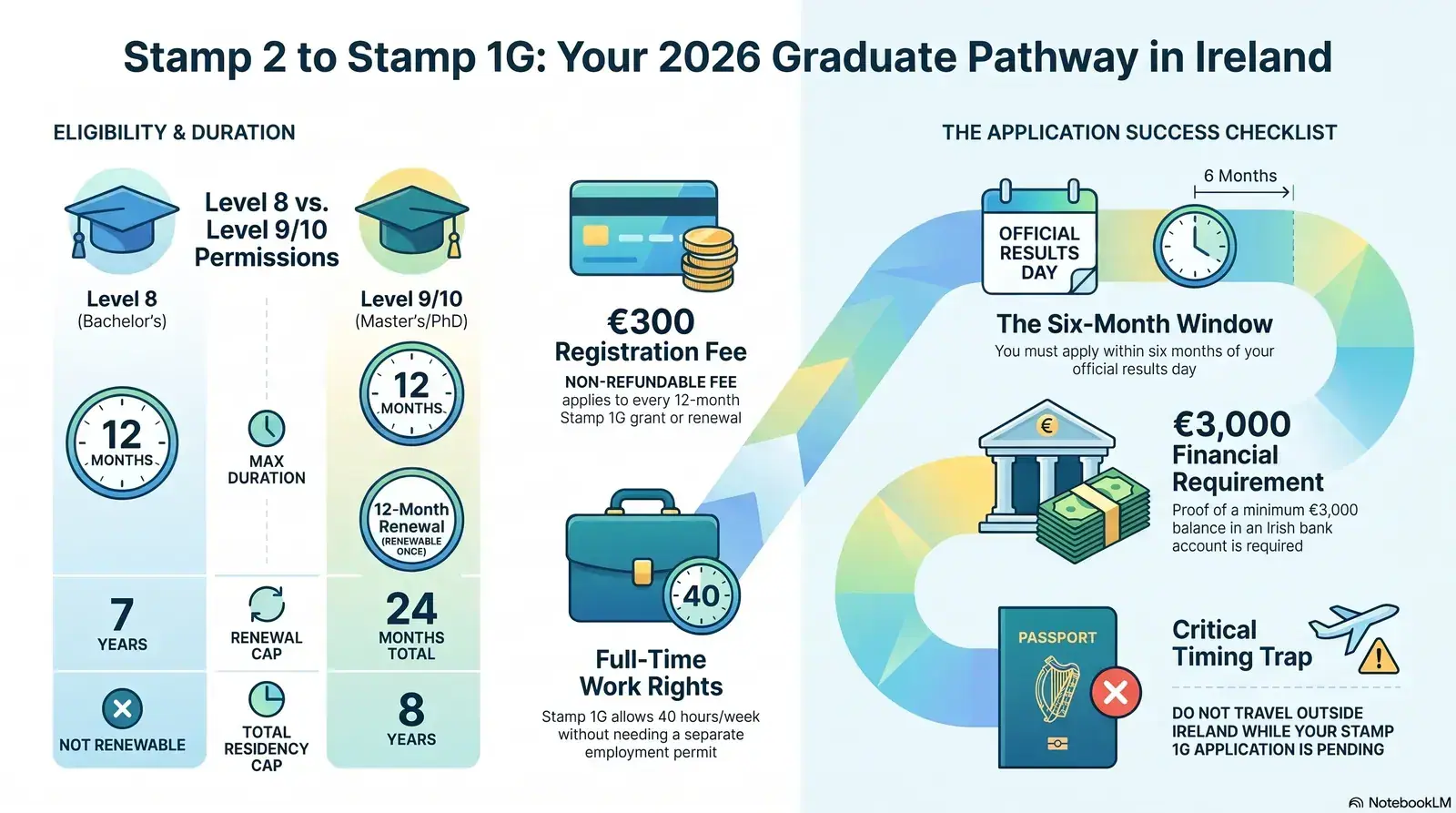
- Apply within 6 months of results day, not graduation day: Your clock starts the moment official results are published — not when your degree is conferred. Missing this window means you must leave Ireland.
- The fee is €300 and the process is fully online: Since November 2024, all Stamp 1G applications go through the ISD online portal. There are no in-person appointments.
- Level 9 graduates get 24 months (in two 12-month blocks): The second 12 months requires you to demonstrate active job-seeking — it is not automatic.
€300
Results day (not graduation)
12 months (non-renewable)
24 months (2 × 12 months)
Who is eligible for Stamp 1G in Ireland?
You are eligible for Stamp 1G if you are a non-EEA national who completed a full-time degree listed on Ireland's Interim List of Eligible Programmes (ILEP) at NFQ Level 8 or above, and you currently hold a valid Stamp 2 student permission. EEA, Swiss, and UK nationals do not need Stamp 1G — they have free movement rights.
The ILEP is the definitive list of programmes approved for immigration purposes. If your course is not on it, you cannot obtain Stamp 1G regardless of your results. Before applying, verify your programme name on the ISD ILEP page. Most programmes at Irish universities and Institutes of Technology are listed — short professional diplomas and English language courses are not.
Level 8 vs Level 9: permission duration comparison
The duration of your Stamp 1G permission depends entirely on the NFQ level of your award, not the length of your course or your nationality. The table below summarises the key differences you need to understand before applying.
| Feature | NFQ Level 8 (Honours Bachelor's) | NFQ Level 9 / Level 10 (Master's / PhD) |
|---|---|---|
| Initial Stamp 1G duration | 12 months | 12 months |
| Can be renewed? | No — one grant only | Yes — one further 12 months |
| Total Stamp 1G available | 12 months maximum | 24 months maximum |
| Total student + Stamp 1G cap | 7 years | 8 years |
| Work rights | 40 hrs/week, no permit needed | 40 hrs/week, no permit needed |
| Application fee (per grant) | €300 | €300 (each renewal is a separate €300) |
| Renewal evidence required | N/A | Proof of active job-seeking (interviews, agency registration, job applications) |
After Stamp 1G, the Critical Skills Employment Permit (CSEP) — which requires a salary of at least €40,904 (or €36,848 under the recent-graduate rate, as of 1 March 2026 per the Department of Enterprise) — is typically the next step. Level 9 graduates have twice the runway to secure a role that meets the threshold.
The six-month window: when does your clock start?
Your six-month application window begins on the date your official results are published, not the date of your graduation ceremony. For most Irish universities, this is the date your academic transcript or result letter is issued — which can be weeks or even months before the conferral ceremony.
This distinction causes serious problems every year. Students who wait until graduation to start their paperwork sometimes discover their six-month window is nearly expired. According to Immigration Service Delivery (ISD), you must submit a complete Stamp 1G application before your Stamp 2 permission expires and within six months of your official award date.
Practically speaking, "official award date" means the date on your results letter or the date results are released on your university's student portal — not the academic year end date, not the course completion date, and not the conferral date. If your results release date is 20 June 2026, your deadline is 20 December 2026, regardless of when your ceremony is held.
Many students believe they can apply from graduation day. In fact, you should apply as soon as your official results are confirmed — ideally within two to four weeks. This gives ISD time to process the application and post your IRP card before your Stamp 2 expires.
What documents do I need for a Stamp 1G application in 2026?
The ISD portal requires you to upload six categories of documents; missing even one will result in your application being returned incomplete, restarting the processing clock. Gather all documents before logging into the portal.
| Document | What it proves | Acceptable form |
|---|---|---|
| Passport | Identity and travel document | Original; must have at least 6 months validity remaining from application date |
| Current IRP card | Your valid Stamp 2 immigration status | Must not be expired. If your IRP card is expiring, renew it before applying for Stamp 1G |
| Academic award proof | Degree completion at qualifying ILEP level | Degree parchment (scroll), or an official letter from your Registrar confirming the award. Provisional results printout alone is not accepted |
| Private health insurance | Minimum €25,000 in-hospital cover from an Irish provider | Current policy document or certificate from a provider such as VHI, Laya Healthcare, or Irish Life Health. The policy must cover accidents and in-hospital care |
| Proof of Irish address | You are resident in Ireland | Utility bill, lease agreement, or Irish bank statement dated within the past three months |
| Bank statement showing funds | Financial capacity to remain in Ireland | Irish bank account statement showing a minimum of €3,000. ISD does not specify an exact period, but a recent statement (within 1–3 months) is standard |
One point many students miss: the health insurance must be purchased from an Irish provider. International travel insurance policies — including policies taken out in India before departure — are not accepted, even if they provide high coverage amounts. Budget approximately €400–€700 per year for a basic student health plan that meets the €25,000 minimum threshold.
How to apply on the ISD portal: step-by-step walkthrough and the €300 fee
Since November 2024, all Stamp 1G applications — whether your first grant or your second-year renewal — must be submitted through the ISD online registration portal. There are no in-person registration offices for this application.
Here is the step-by-step process as it works in August 2026:
- Create or log in to your ISD account at irishimmigration.ie. Use the email address registered with your university, as ISD may cross-reference records.
- Choose "Applications for Permission to Remain in the State" then select "Registration Renewal."
- Select "Stamp 1G" from the immigration permission dropdown. Do not confuse this with "Stamp 1" (employment permit holders) or "Third Level Graduate Scheme" (an older label for the same permission — both refer to Stamp 1G).
- Upload your documents in the formats specified (PDF preferred; JPG/PNG accepted for IRP cards). Ensure each file is under the portal's size limit — typically 5 MB per file.
- Pay the €300 registration fee by debit or credit card. This fee is non-refundable, including if your application is refused. The fee applies to each grant and each renewal separately — Level 9 graduates pay €300 for the first year and a further €300 for the second-year renewal.
- Submit and note your reference number. ISD will issue an acknowledgement email. Keep this as your reference for any follow-up correspondence.
Once approved, ISD posts your new IRP card showing Stamp 1G to your registered Irish address. Processing typically takes three to five weeks. During busy graduation seasons (June through October), this can extend to eight to ten weeks according to ISD's own timelines page. You can submit your application up to 12 weeks before your current Stamp 2 expires, so apply early.
Critical timing traps that cause Stamp 1G refusals
The single most common reason for Stamp 1G refusal is a Stamp 2 permission that expires before the application is processed. ISD requires your Stamp 2 to remain valid not just at the time you submit, but at the time your application is decided. If processing takes eight weeks and your Stamp 2 expires after six, you become undocumented — and ISD will refuse your application.
Here are the four timing traps most frequently reported by graduates:
Trap 1 — Applying too late in your Stamp 2 window. Apply as soon as results are confirmed. If your Stamp 2 expires in October and your results come in July, do not wait until September. Allow at least 10–12 weeks' buffer between your application date and your Stamp 2 expiry.
Trap 2 — Travelling outside Ireland while your application is pending. If you leave Ireland while your Stamp 1G application is being processed and your original Stamp 2 expires during your absence, you may be denied re-entry or your application may lapse. The safe approach is to remain in Ireland until your new IRP card is in hand. If travel is unavoidable, contact ISD in advance.
Trap 3 — Confusing the six-month results window with the IRP expiry date. You must satisfy both deadlines simultaneously. If your results come in September and your Stamp 2 expires in November, you have a very tight window. Apply immediately after results, do not wait to see whether processing is quick.
Trap 4 — Renewing your Stamp 1G too late (Level 9 graduates). For the second-year renewal, you can only apply six to eight weeks before your first Stamp 1G grant expires. Applying too early means ISD may reject the renewal as premature. Set a calendar reminder to apply in that precise window.
Contact your university's International Student Office immediately. Some universities can provide a bridge letter confirming your student status while awaiting ISD processing. This does not extend your legal permission but demonstrates good faith. You should also contact ISD directly and explain your situation in writing.
On-the-Ground Insight: "I submitted my Stamp 1G application in late June after my results came out, but I had already booked flights home for July to see family. My Stamp 2 expired in August. I had to cancel my flights because nobody told me I shouldn't leave Ireland while the application was pending. I finally got my IRP card nine weeks after applying. That summer cost me €400 in cancelled flight fees." — Priya R., MSc Data Science, University College Dublin, Class of 2026
Your working rights between graduation and Stamp 1G grant
While your Stamp 2 is still valid — whether your Stamp 1G is pending or not yet applied for — you continue to work under your existing Stamp 2 conditions: 20 hours per week during academic term, or 40 hours per week during holiday periods.
The moment your Stamp 1G IRP card is issued and in your hands, your working conditions change entirely. On Stamp 1G, you may work up to 40 hours per week in any role, for any employer, without needing a separate employment permit. There are no sector or role restrictions at this stage — Stamp 1G is the most flexible working permission in Ireland short of Stamp 4 (which you can apply for after 21 months on a Critical Skills Employment Permit).
According to the Higher Education Authority (HEA) Graduate Outcomes Survey 2025, the median salary of Irish university graduates nine months after graduation is €37,000, with 49% of graduates earning over €40,000 annually. The Critical Skills Employment Permit minimum salary threshold of €40,904 (as of 1 March 2026) is therefore within reach for graduates in technology, engineering, finance, and life sciences roles — the sectors that most commonly sponsor international graduates.
The General Employment Permit — the alternative work permit route if you do not qualify for CSEP — requires a minimum salary of €36,605 (2026 rate, per the Department of Enterprise, Trade and Employment). It also requires a Labour Market Needs Test, meaning your employer must demonstrate no suitable Irish or EEA candidate was available. CSEP has no Labour Market Needs Test, which is why securing a CSEP-qualifying role during your Stamp 1G period is the better-documented pathway.
Level 9 graduates: the 8-year cap and the second 12-month block
If you hold a Level 9 or Level 10 award (Master's degree, Postgraduate Diploma at NFQ Level 9, or Doctoral degree), you are entitled to a total of 24 months of Stamp 1G permission, granted in two separate 12-month blocks. This is the key advantage of the Master's route for international students planning to build a career in Ireland.
The second 12 months is not automatic. When your first Stamp 1G year is nearing expiry, you must apply to renew it through the ISD portal (the same process as your first application, again paying €300). Crucially, you must demonstrate to ISD that you have been actively seeking graduate-level employment during your first year. Acceptable evidence includes:
- Confirmation emails or screenshots of online job applications submitted
- Interview invitation or rejection letters from employers
- Proof of registration with graduate recruitment agencies (LinkedIn Recruiter messages, FRS Recruitment or similar agency confirmation)
- Attendance at career fairs or university graduate employment events
ISD does not specify a minimum number of applications. What matters is demonstrating a sustained, good-faith effort to access "suitable graduate-level employment." A single interview invitation with evidence of continued searching is typically sufficient. Students who spent the year travelling or not working toward employment may have their renewal refused.
The 8-year total cap for Level 9 graduates
The combined total of all time spent in Ireland on a student visa (Stamp 2) and on graduate permission (Stamp 1G) cannot exceed 8 years for Level 9 graduates, or 7 years for Level 8 graduates. This cap is calculated from your first date of entry to Ireland as a student, not from when you started your Master's degree.
For most Indian students who complete a one-year Master's in Ireland (after having entered the country as a student for the first time), the relevant time horizon looks like this: one year of Stamp 2 → two years of Stamp 1G → this leaves five further years within the 8-year cap. In practice, the vast majority of graduates secure employment and move to an employment permit within the first one to two years, making the cap a non-issue. But students who did a language course or lower-level qualification before starting their Master's should calculate their remaining time carefully.
What to do if your Stamp 1G application is refused
A refusal letter from ISD will state a specific reason for the decision. The most common reasons are an expired Stamp 2 at time of decision, insufficient funds (less than €3,000 in an Irish bank), incomplete documentation, or a qualification from a programme not listed on the ILEP.
If your application is refused, you have two options:
Option 1 — Appeal within 2 months. You can submit a formal written appeal to ISD addressing the specific concern in the refusal letter. There is a two-month deadline from the date of the refusal notice. An appeal keeps your original application reference alive. If you receive a refusal due to a missing document, gather that document and send it with your appeal letter.
Option 2 — Reapply immediately. There is no mandatory waiting period for a reapplication. If the refusal was due to an administrative error or a missing document you can now provide, a fresh application is often faster than waiting for an appeal decision. Pay the €300 fee again and upload all required documents.
Once your Stamp 2 expires and your Stamp 1G is refused, you have no legal permission to remain in Ireland. You should leave the country before your Stamp 2 expiry and re-enter on a student visa if you are continuing studies, or return to Ireland after resolving the documentation issue and reapplying. Remaining in Ireland without a valid immigration permission — even briefly — creates a record of non-compliance that can affect future Irish visa applications.
If you believe ISD made a factual error in the decision (for example, they stated your programme is not on the ILEP but it is), contact your university's International Student Office for assistance. Universities with a strong ILEP record can often write directly to ISD on your behalf. You may also consult an immigration solicitor — professional advice is worth considering if you are approaching the 8-year cap or if a refusal could jeopardise a pending employment permit application.
Frequently asked questions
Who is eligible for Stamp 1G in Ireland?
Non-EEA graduates who completed a full-time degree listed on the Interim List of Eligible Programmes (ILEP) at NFQ Level 8 or above, while holding Stamp 2 student permission, are eligible. Level 8 graduates get 12 months; Level 9 and above get up to 24 months.
What documents do I need for a Stamp 1G application in 2026?
You need: a valid passport (6+ months remaining), your current Stamp 2 IRP card, official proof of your award (degree parchment or letter from your institution), private Irish health insurance with at least €25,000 in-hospital cover, proof of Irish address, and evidence of at least €3,000 in an Irish bank account.
How long does the Stamp 1G application take to process?
Processing typically takes 3 to 5 weeks through the ISD online portal. During peak periods (June to October, when most graduates apply), this can extend to 8 to 10 weeks. Your IRP card is posted to your registered Irish address once the application is approved.
Can I work while my Stamp 1G application is being processed?
While your Stamp 2 is still valid and you have submitted your Stamp 1G application, you may continue working within your Stamp 2 working rights (20 hours per week during term, 40 hours during holidays). Once Stamp 1G is granted, you may work up to 40 hours per week in any role without a separate employment permit.
What happens if my Stamp 1G application is refused?
You can appeal the refusal decision within 2 months by addressing the specific concerns raised in the refusal letter. Alternatively, you can reapply immediately — there is no fixed waiting period. Common refusal reasons include an expired Stamp 2, insufficient funds, incomplete documents, and courses not listed on the ILEP.
Planning to fly home before graduation? Compare fares first.
Confirm re-entry permission with ISD before booking any flights home. Many graduates fly home between results and their Stamp 1G decision. If your Stamp 2 is still valid and you have applied for Stamp 1G, check re-entry requirements with ISD first — then compare Dublin fares for the best return timing.
All immigration rules, fees, and procedures described in this article are based on publicly available official sources from Immigration Service Delivery (ISD) and Citizens Information Ireland as of August 2026. Immigration rules change — always verify current requirements directly with ISD before applying. MyFlightOffers is not affiliated with the Irish government or any immigration authority. This article does not constitute legal or immigration advice. For complex situations, consult a qualified immigration solicitor.
- NEW Stamp 1G to Critical Skills Employment Permit 2026: New €40,904 Threshold, Graduate Carve-Out and Roadmap to 2027 — the full CSEP application checklist, graduate carve-out at €36,848, and high-earner route at €68,911
- Critical Skills Employment Permit After Stamp 1G: The 2026 Roadmap from Graduate to Stamp 4 — salary thresholds, Trusted Partner employers, and the 21-month path to Stamp 4
- Study in Ireland 2026: Visa, Housing and IRP Card Guide — everything you need to know before you arrive, from visa applications to registering your IRP card
- Ireland Banking Guide for International Students 2026 — opening a bank account, zero-fee options, and how to meet the €3,000 Stamp 1G funds requirement
- The Indian Student's Money Survival Guide in Ireland — budgeting, remittances, tax credits, and the PPS number you need before starting work