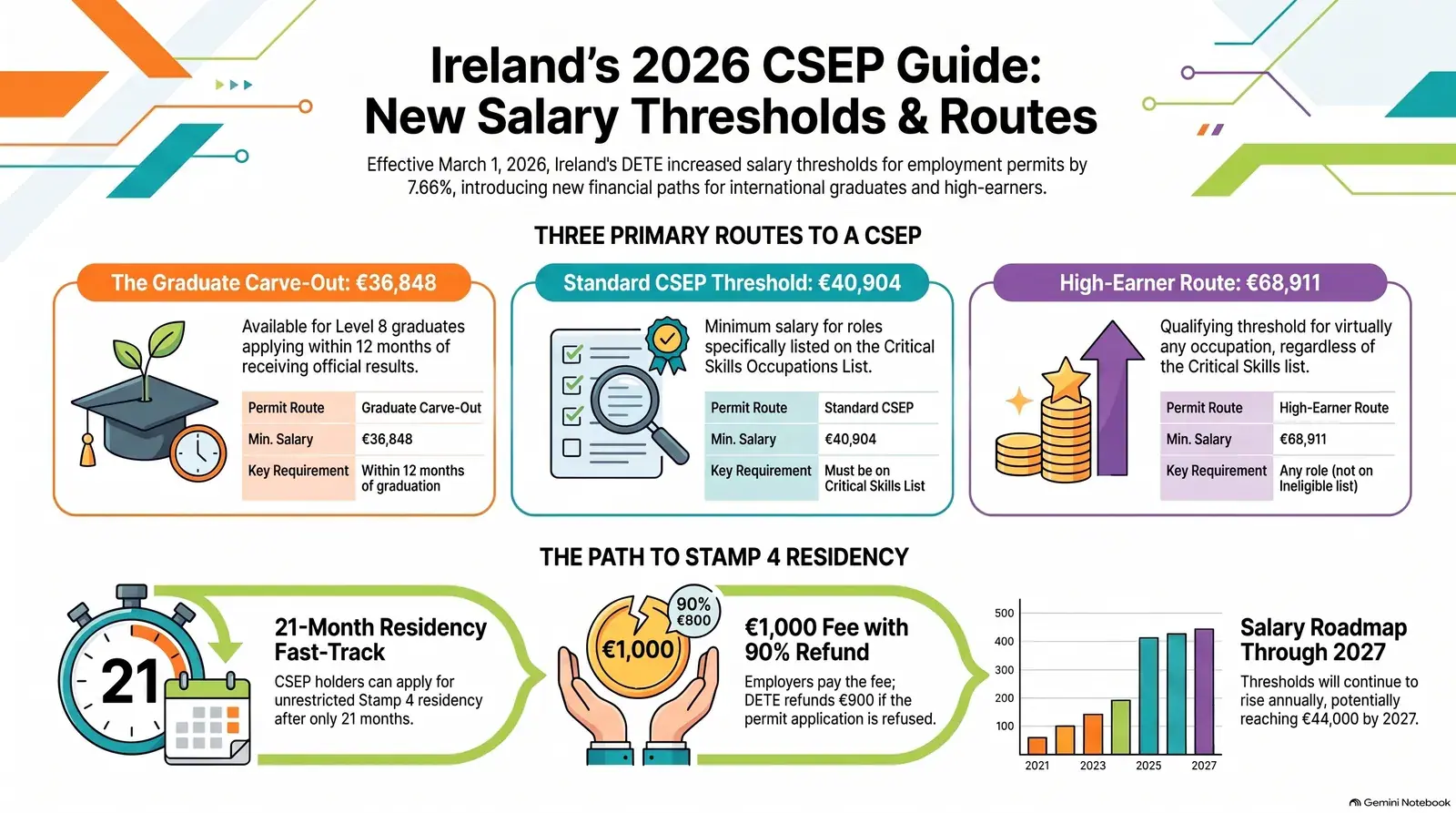
- New standard threshold: The CSEP minimum salary is €40,904 from 1 March 2026 (up 7.66% from €38,000), for occupations on the Critical Skills Occupations List.
- Graduate carve-out: If you qualified within the past 12 months, your minimum drops to €36,848 — €4,056 lower than the standard floor.
- High-earner route: Any occupation (not on the ineligible list) qualifies at €68,911, regardless of whether it appears on the Critical Skills list.
€40,904/yr — Critical Skills list occupations
€36,848/yr — qualified within last 12 months
€68,911/yr — any degree-level role, any occupation
21 months on CSEP → apply for Stamp 4
In this guide
- What changed on 1 March 2026?
- The graduate carve-out: €36,848 for recent graduates
- The high-earner route: €68,911 for any occupation
- Three CSEP routes compared
- DETE's salary roadmap to 2027 and beyond
- Practical job-hunt strategy on Stamp 1G
- Step-by-step: the Stamp 1G to CSEP process
- Stamp 4 after 21 months: long-term residency
- Frequently asked questions
What changed on 1 March 2026? The new CSEP salary threshold explained
From 1 March 2026, the Critical Skills Employment Permit (CSEP) standard minimum annual salary rose 7.66% to €40,904, implemented under DETE's Minimum Annual Remuneration (MAR) Roadmap published in December 2025. This is not an isolated adjustment: every employment permit category in Ireland saw the same percentage increase on the same date, reflecting the government's commitment to phased salary alignment with labour market conditions through 2030.
Before this change, a graduate on Stamp 1G needed a CSEP-eligible job offer worth at least €38,000 per year to transition to sponsored employment. From March 2026, that number is €40,904 for standard applicants. For most technology, engineering, science, and healthcare roles — the occupational groups that dominate the CSEP — this threshold remains well below typical market salaries, so the practical impact on high-demand sectors is minimal. However, for graduates targeting entry-level or junior roles in emerging critical skills categories, the €2,904 rise can move certain offers from "above threshold" to "below threshold", requiring negotiation or a switch to the General Employment Permit (GEP) route instead.
The General Employment Permit minimum also rose on 1 March 2026, from €34,000 to €36,605. This matters because some graduates on Stamp 1G will find their employer is willing to offer a salary between €36,605 and €40,903, placing them in GEP territory rather than CSEP territory. The CSEP is generally the more advantageous permit (faster Stamp 4 access, spouse Stamp 1G rights immediately), so it is worth exploring whether a salary top-up to €40,904 is negotiable before settling for a GEP.
The CSEP minimum is the salary your signed employment contract must show at the time of application. If your employer offers €40,000 — €904 below the new floor — that application will be returned unprocessed. Either the employer raises the offer to €40,904, or the application must be submitted as a GEP instead.
The graduate carve-out: why recent graduates qualify at €36,848
If you obtained your qualifying degree within 12 months of the date you apply for a CSEP, you benefit from a lower minimum annual salary of €36,848 — approximately €4,056 below the standard threshold of €40,904. This graduate carve-out was introduced alongside the March 2026 threshold hike specifically to avoid pricing recent graduates out of the CSEP system at a time when their career value is highest but their negotiating power is lowest.
The carve-out applies when all of the following are true: your qualification is at NFQ Level 8 (Honours Bachelor's) or above; the degree was awarded by an institution whose programme appears on the Interim List of Eligible Programmes (ILEP); the job offer is for an occupation on the Critical Skills Occupations List; and the date of application is within 12 calendar months of your official results date (not your graduation ceremony date — use the results notification letter).
In practice, most international graduates complete their master's degree in May or September. A May 2026 results letter means the graduate carve-out is available until May 2027. A September 2025 results letter means it expired in September 2026. Missing the 12-month window by even a day means the standard €40,904 threshold applies. If your results letter is approaching its 12-month anniversary, prioritise CSEP applications over other permit types before the window closes.
These are two separate clocks. Your Stamp 1G is valid for 12 months (extendable to 24 months for master's graduates). The CSEP graduate carve-out clock runs from your results letter date, independently of your Stamp 1G expiry. A master's graduate on their second 12-month Stamp 1G extension may still qualify for the carve-out if the results letter is within 12 months — or may not, if it has been more than 12 months since the letter.
The high-earner route: €68,911 and why almost any occupation qualifies
At an annual salary of €68,911 or above, a CSEP is available for virtually any occupation in Ireland, regardless of whether it appears on the Critical Skills Occupations List — provided the role is not on the Ineligible Categories list. This route also allows relevant experience to substitute for a formal degree, making it uniquely flexible for senior professionals and career-changers.
The high-earner route threshold also rose from €64,000 to €68,911 on 1 March 2026 (the same 7.66% upward adjustment). At that salary level, roles such as senior product manager, principal data analyst, senior finance business partner, or experienced supply chain director — none of which may appear by name on the Critical Skills Occupations List — qualify for the most advantageous employment permit in the Irish system. The employer must still be an Irish-registered, Revenue-compliant entity, and the role must carry a signed contract at the qualifying salary. The permit fee is €1,000 for a two-year permit.
For international graduates on Stamp 1G who are targeting senior or specialist roles where their niche expertise commands above-average market rates, the high-earner route removes the occupational list constraint entirely. If an employer offers €70,000 for a role in, say, computational linguistics or fintech risk — occupations that may not be enumerated on the current Critical Skills list — the high-earner route is the correct CSEP pathway.
Three CSEP routes compared (2026)
There are three distinct eligibility routes for the Critical Skills Employment Permit in 2026, each with different salary floors, occupational constraints, and degree requirements. The table below summarises each route so you can identify which applies to your situation before engaging with an employer.
| Route | Minimum Annual Salary (Mar 2026) | Occupation Requirement | Degree Required? | Graduate Carve-Out Available? |
|---|---|---|---|---|
| Standard CSEP | €40,904 | Must be on the Critical Skills Occupations List | Yes — NFQ Level 8+ | No |
| Graduate Carve-Out CSEP | €36,848 | Must be on the Critical Skills Occupations List | Yes — NFQ Level 8+, within 12 months of results | Yes — within 12 months of qualification |
| High-Earner CSEP | €68,911 | Any occupation not on the Ineligible list | Degree OR relevant experience | No |
| General Employment Permit (GEP) (for reference) | €36,605 | Any occupation not on the Ineligible list | No mandatory degree requirement | Graduate lower rate: €34,009 |
Source: DETE December 2025 MAR Roadmap & Citizens Information Ireland. Effective 1 March 2026.
DETE's salary roadmap to 2027 and beyond: what to expect
DETE's December 2025 Minimum Annual Remuneration (MAR) Roadmap confirms that the March 2026 increase is the first in a series of phased uplifts running through 2030, with the next review and adjustment expected in 2027. All employment permit categories will continue to rise on approximately the same 7–8% annual trajectory, meaning the CSEP standard threshold could reach approximately €44,000 by 2027 and approach €50,000 by 2029–2030 if the pace holds.
The roadmap does not publish a fixed schedule of exact future figures — the precise 2027 percentage will be set after a mid-cycle review of labour market data and the National Minimum Wage trajectory. Ireland's National Minimum Wage stood at €14.15 per hour from 1 January 2026 (source: Workplace Relations Commission), and employment permit thresholds are calibrated to remain meaningfully above the minimum wage to ensure the CSEP retains its high-skill character.
For graduates currently on Stamp 1G, the roadmap has two practical implications. First, if you are within three to six months of an offer that just clears the current €40,904 floor, do not assume the threshold will stay flat — budget negotiations may need to factor in the anticipated 2027 rise if your permit renewal will fall in that year. Second, the graduate carve-out at €36,848 is also subject to review; DETE has not confirmed whether the carve-out differential will be preserved at the same €4,056 margin in 2027, so recent graduates should use the carve-out window while it is available at the current differential.
Some roles in healthcare and agri-food have historically operated under sub-standard MAR floors. These are being phased out by 2030, rising 9% in 2026 to €32,691. By 2030, all permit categories are expected to converge on a unified minimum structure, which will further constrain low-salary CSEP applications in those sectors.
Practical job-hunt strategy on Stamp 1G: before and after the threshold
The most effective strategy on Stamp 1G is to target roles that clear the appropriate CSEP threshold — €36,848 if you are within 12 months of your results, or €40,904 otherwise — rather than accepting a GEP offer and then trying to convert later. The CSEP provides a faster path to Stamp 4 (21 months vs. a longer path under GEP), immediate Stamp 1G rights for your spouse or partner, and access to a wider range of subsequent immigration options.
Should you target roles above or below €40,904?
If you are still within your 12-month graduate carve-out window, you should specifically target roles at €36,848 or above and confirm with the employer that the occupation appears on the Critical Skills Occupations List before signing any contract. Many technology, data, and engineering roles that appear in Irish job postings for 2026 carry salaries of €40,000 to €55,000 at entry level, which clears both the carve-out and the standard threshold. However, some public-sector adjacent roles in research or non-profit, and some roles in the arts or humanities, may fall between €34,000 and €36,848 — placing them below even the carve-out floor and forcing a GEP application instead.
For graduates whose 12-month carve-out window has already closed, the strategy shifts to roles that clearly exceed €40,904. Sectors where this is consistently achievable in 2026 include software engineering (entry-level salaries typically €50,000–€70,000), data science (€48,000–€65,000), pharmaceutical regulatory affairs (€45,000–€60,000), and financial risk analysis (€42,000–€55,000). All four sectors appear on or are closely aligned with the Critical Skills Occupations List.
How to present your application to employers
Employers in Ireland who have not sponsored a CSEP before may be unaware that the permit application fee of €1,000 (for a two-year permit) is borne by the employer — not the employee — and that 90% of that fee is refunded if the application is refused. Many graduate employers are deterred by perceived complexity rather than actual cost. Providing a clear one-page overview of the CSEP process — typically a 4-to-8 week wait via the Employment Permits Online System (EPOS) — can materially improve an employer's willingness to sponsor.
Trusted Partner employers (companies that DETE has pre-vetted for regular high-volume permit applications, including Google, Meta, Stripe, and Amazon) receive priority processing in 2–4 weeks. If you are targeting one of these employers, the process is faster and the employer infrastructure for sponsorship is already in place. First-time sponsors typically take 6–12 weeks from initial agreement to permit issue, so factor this into your Stamp 1G expiry planning.
On-the-Ground Insight: "My employer had never sponsored a permit before. I printed a one-page summary from the DETE website showing the €1,000 fee, the 90% refund if refused, and the 6-week processing timeline. Once they saw the refund policy, the hesitation disappeared. We submitted in April 2026, the permit came through in late May, and I transitioned off Stamp 1G in June." — Priya M., MSc Data Science, University College Dublin, 2025 Graduate
Step-by-step: the Stamp 1G to CSEP application process
The Stamp 1G to CSEP transition involves two parallel processes: the employer-led permit application through DETE's EPOS portal, and the IRP (Irish Residence Permit) renewal through Immigration Service Delivery (ISD). Both run concurrently once the permit is issued; the IRP renewal converts your Stamp 1G card to a Stamp 1 card tied to your new employer and permit.
The key documents required for a CSEP application in 2026 are: a signed employment contract showing the qualifying annual salary; your passport (valid for the duration of the permit); original degree certificates with certified English translations if the originals are not in English; a current curriculum vitae; the employer's Certificate of Incorporation (from the Companies Registration Office (CRO)); and the employer's tax clearance or Revenue compliance evidence. Missing any of these causes the entire application to be returned, resetting the processing clock.
| Step | Action | Who does it | Typical timeline |
|---|---|---|---|
| 1 | Agree salary and role; confirm occupation is on Critical Skills list | Employee + employer | Before submitting |
| 2 | Employer registers on EPOS portal and creates employer profile | Employer | 1–3 days |
| 3 | Employer submits CSEP application with all documents via EPOS | Employer | Submit at least 12 weeks before intended start date |
| 4 | DETE processes application | DETE | 4–8 weeks (2–4 weeks for Trusted Partners) |
| 5 | Permit issued; start work on Stamp 1 (pending IRP update) | Both | Day of issue |
| 6 | Employee applies to ISD to update IRP card to Stamp 1 (CSEP) | Employee | Within 3 months of permit issue |
| 7 | Spouse/partner applies for Stamp 1G via ISD | Spouse/partner | Concurrent with Step 6 |
Sources: DETE and Immigration Service Delivery (ISD), August 2026.
The application fee for a CSEP is €1,000 for a two-year permit, or €500 for a permit of less than two years. First-time applicants are almost always better served by the two-year permit — it provides employment certainty, triggers the 21-month clock toward Stamp 4 immediately, and gives your employer confidence in a longer-term working relationship. If the application is refused, 90% of the fee (€900 for a two-year permit) is refunded to the employer. This refund provision is a materially important selling point when convincing first-time sponsors.
If your Stamp 1G is within 8 weeks of expiry when you submit the CSEP application, processing may not complete before your current permission lapses. Apply for a Stamp 1G renewal through the ISD online portal in parallel if there is any risk of overlap. A lapsed IRP does not automatically invalidate a pending permit application, but it does create a gap in your lawful residence record that can complicate future Stamp 4 applications.
Stamp 4 after 21 months: the path to long-term residency
After 21 months of working in Ireland on a Critical Skills Employment Permit, you become eligible to apply for Stamp 4 residency — the most unrestricted long-term permission in the Irish immigration system, allowing you to work for any employer without a work permit, and to self-employ. The 21-month clock starts from the date your CSEP is issued, not the date your IRP is updated, so keep a copy of the original permit issue letter.
Your spouse or partner also benefits immediately when you receive your CSEP: they are entitled to apply for a Stamp 1G permission of their own, which lets them work for any employer in Ireland without requiring a separate employment permit. This Stamp 1G for dependants is linked to the CSEP holder's permit status and is renewed in line with the main permit. When the CSEP holder transitions to Stamp 4, the spouse's Stamp 1G status is typically maintained and can be converted to Stamp 4 in due course.
Stamp 4 residency is valid for up to five years and is renewable. It provides a stepping stone toward Long-Term Residency (under EU Directive 2003/109/EC) after five years of continuous lawful residence, and toward Irish citizenship (naturalisation) after five years of reckonable residency. For Indian and non-EEA graduates who plan to build a long-term career in Ireland, the Stamp 1G → CSEP → Stamp 4 → Long-Term Residency pathway is the clearest and most reliable route to permanent settlement, generally achievable within five to six years of initial entry.
- Month 0: Results issued, Stamp 1G begins (24-month maximum for master's graduates).
- Months 6–18: Secure CSEP-eligible job offer, employer submits permit application via EPOS.
- Month ~9–20: CSEP issued; Stamp 1 IRP card issued; 21-month Stamp 4 clock starts.
- Month ~30–41: Stamp 4 application submitted after 21 months on CSEP.
- Year 5–6: Long-term residency or naturalisation pathway opens.
Frequently asked questions
What is the new CSEP salary threshold from 1 March 2026?
From 1 March 2026, the Critical Skills Employment Permit minimum annual salary rose to €40,904 for occupations on the Critical Skills Occupations List. This is a 7.66% increase from the previous floor of €38,000, implemented under DETE's MAR Roadmap published in December 2025.
What is the graduate carve-out salary for the CSEP in 2026?
Graduates who obtained their qualification within 12 months of applying for a CSEP can qualify at a lower threshold of €36,848 per year, provided the role is on the Critical Skills Occupations List. The 12-month window runs from your official results letter date, not your graduation ceremony date.
Can I get a CSEP for a role not on the Critical Skills list?
Yes. If your annual salary is €68,911 or above and the occupation is not on the ineligible list, you qualify for a CSEP regardless of whether the occupation appears on the Critical Skills Occupations List. This high-earner route also allows relevant experience to substitute for a formal degree.
How long does it take to apply for a CSEP in Ireland?
Standard processing time is 4 to 8 weeks via the Employment Permits Online System (EPOS). Employers registered as Trusted Partners (e.g. Google, Meta, Stripe) typically receive decisions in 2 to 4 weeks. Submit the application at least 12 weeks before the intended start date to allow for any queries or document requests.
When can I apply for Stamp 4 after getting a CSEP?
You can apply for Stamp 4 residency after 21 months of working in Ireland on a Critical Skills Employment Permit. Stamp 4 allows you to work for any employer without an employment permit and is the primary stepping stone toward long-term residency and eventual naturalisation.
Booking your flight to start your Irish career? Compare fares first.
Whether you are flying Dublin–Delhi, Dublin–Mumbai, or any other India–Ireland route, compare live fares across Emirates, Etihad, Qatar Airways, and Air India before you commit to a date.
All information in this article is based on publicly available official sources as of August 2026, including DETE, ISD, and Citizens Information Ireland. Employment permit thresholds, processing times, and application requirements are subject to change. Always verify current requirements directly with DETE and Immigration Service Delivery before submitting an application. This article does not constitute immigration or legal advice.
- NEW Stamp 1G to CSEP 2026: Full threshold and application guide — you are here
- Study in Ireland 2026: Visa, Housing & IRP complete guide — everything you need before you arrive
- Revenue emergency tax guide for international students — how to recover overtaxed pay in Ireland
- The Indian student's money survival guide in Ireland — banking, remittances, and forex from day one
- Ireland banking guide for international students 2026 — opening an account, Revolut, and AIB vs. BOI compared