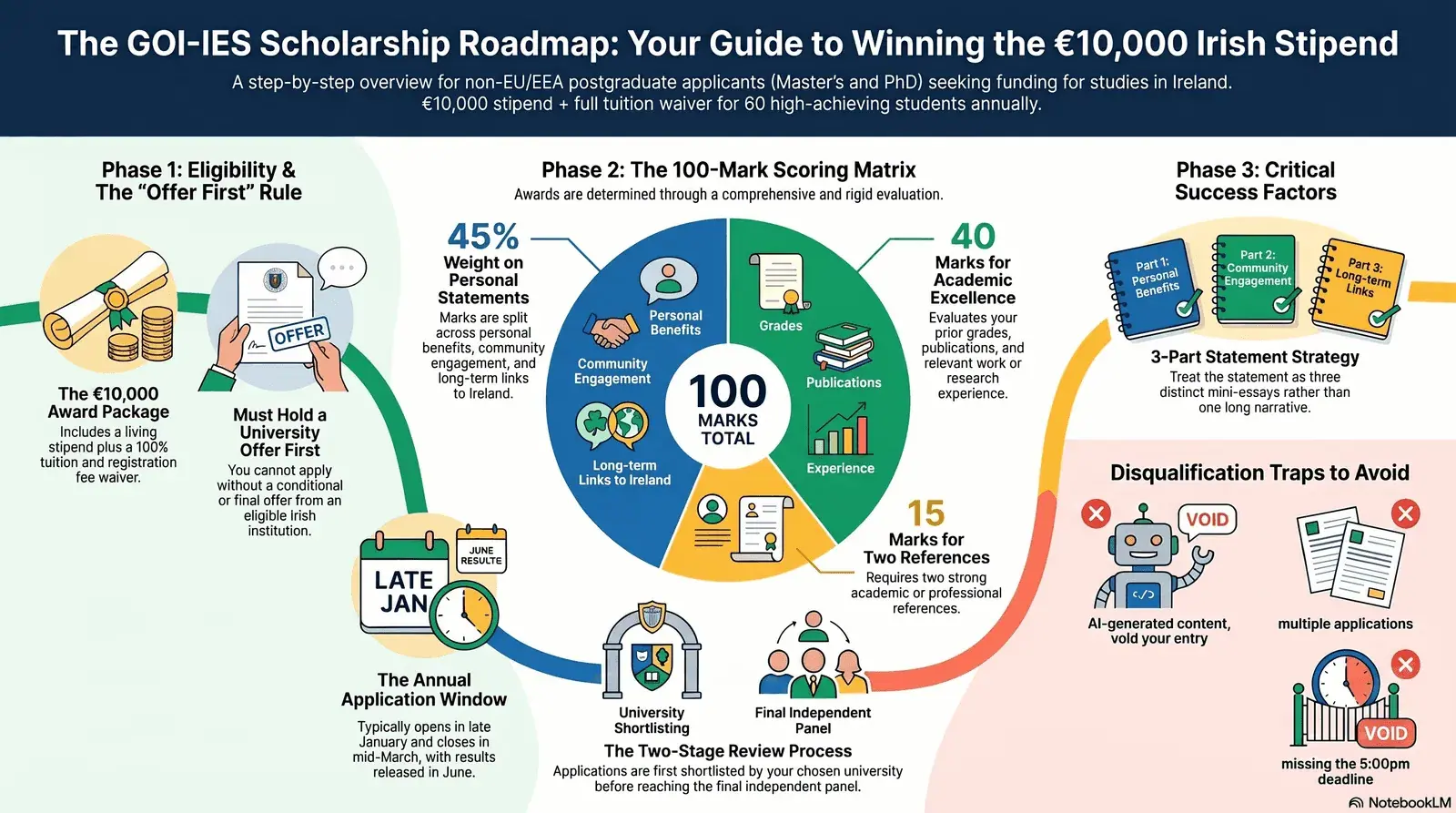
- High Value: The Government of Ireland International Education Scholarship (GOI-IES) awards a €10,000 stipend and a full tuition waiver for one year of postgraduate study.
- Strict Admission Offer Rule: You cannot apply without a conditional or final admission offer in hand from an eligible Irish institution.
- Score-Driven Matrix: Selection is based on a rigid 100-mark evaluation (40 marks for academics/experience, 45 marks for personal statement, and 15 marks for references).
Total award value
€10,000 stipend + full tuition waiver
One academic year, host institution pays the waiver
Scholarships per year
60, capped at 5 per institution
Across all eligible Irish HEIs combined
Who can apply
Non-EU/EEA/UK/Swiss nationals
With a Master's, PgDip, or PhD offer in hand
Next likely window
2026/27 cycle closed; next ~Jan 2027
Based on the HEA's consistent annual pattern
11 questions answered in this guide
- What exactly is the GOI-IES, and how much is it worth?
- Who is eligible — and who is explicitly excluded?
- Why you cannot apply without a university offer first
- When does the GOI-IES open and close each year?
- The 5 steps to actually submit your application
- How GOI-IES applications are really scored (the 100-mark breakdown)
- The institutional secret: why your university decides your fate first
- How to write a personal statement that scores on all three criteria
- How to brief your two referees so their letters actually score points
- The disqualification traps that quietly sink strong applications
- What happens after you submit, and how to prepare while you wait
- Quick tips for applicants
- FAQ
1 What Exactly Is the GOI-IES, and How Much Is It Worth?
The Government of Ireland International Education Scholarship (GOI-IES) is a state-funded award, administered by the Higher Education Authority (HEA), that gives a non-EU postgraduate student €10,000 toward living costs plus a full tuition and registration fee waiver for one academic year of study in Ireland. It is jointly funded by the Government of Ireland and the participating higher education institutions (HEIs), who are required to match the scholarship by waiving the awardee's tuition and registration charge in full — described by the HEA as the minimum matched-funding contribution institutions must make.
The scholarship funds one year of full-time, in-person study at NFQ Level 9 or 10 — that is, a taught master's degree, a postgraduate diploma, or a research master's/PhD — across any discipline, subject to places being available. Sixty scholarships are funded each year across all eligible Irish HEIs combined, with an upper limit of five awards per institution. The stipend is paid to your host HEI in two €5,000 instalments (one per semester), which the HEI then passes on to you, sometimes broken into smaller monthly payments.
Value: €10,000 stipend + 100% tuition/registration waiver for one year. Scope: NFQ Level 9 (master's, postgraduate diploma) or Level 10 (PhD), full-time, in-person, minimum one-year duration. Volume: 60 awards/year, maximum 5 per institution. Funder: Government of Ireland and participating HEIs. Administered by: the HEA. The award does not extend beyond one academic year, even on two-year master's programmes — though a host HEI can choose to extend the fee waiver itself across a three-semester course.
The programme traces back to Ireland's International Education Strategy 2010–2015 and has since been linked to successor national strategies on skills and global engagement, which is part of why it is funded so consistently year after year despite being genuinely competitive.
2 Who Is Eligible — and Who Is Explicitly Excluded?
You are eligible for the GOI-IES only if you meet all four official conditions at once: a non-EU/EEA/UK/Swiss domicile of origin, a conditional or final offer for an eligible postgraduate programme, no prior GOI-IES award, and citizenship other than Russian or Belarusian. These four conditions are checked automatically the moment you start the online application — fail any one of them and the system blocks you from the rest of the form.
| Condition | What it means in practice |
|---|---|
| Domicile of origin | Outside the EU/EEA, Switzerland, and the United Kingdom. There is no nationality-based restriction beyond this and the Russian/Belarusian exclusion below. |
| Programme offer | A conditional or final offer for a full-time, in-person taught master's, NFQ Level 9 postgraduate diploma, or research master's/PhD, each at least one year long, at an eligible Irish HEI. |
| No prior award | You must never have previously held a GOI-IES scholarship. |
| Citizenship | Russian and Belarusian nationals are not eligible to apply, regardless of where else they may be domiciled. |
Higher education institutions located in Northern Ireland are not eligible under this programme, even though they are geographically on the island of Ireland. Fully online degrees are not eligible at all, and undergraduate (NFQ Level 8) courses are excluded outright. Blended courses are only eligible if the scholar attends every in-person component and lives in Ireland for the full duration of the award. There is no age limit, and asylum seekers and refugees may apply under the same criteria as any other candidate.
3 Why You Cannot Apply Without a University Offer First
You cannot submit a GOI-IES application without first holding a conditional or final offer of admission from an eligible Irish institution — the scholarship form is built around your offer, not the other way round. Applying for your course and applying for the GOI-IES are two completely separate processes run by two different organisations, and the second cannot start before the first has produced a result.
The HEA accepts three forms of proof: an official offer letter from the institution, an offer email sent specifically from the relevant Admissions Office, or a screenshot of your applicant portal — and all three must explicitly state the correct upcoming academic year. If you have deferred your admission, or you are already partway through a multi-year programme (a second-year PhD student, for example), you need a separate letter from your HEI confirming you will continue studying in that academic year. Both conditional and final offers are accepted, but because some institutions prioritise final-offer holders during their own shortlisting (see Question 7), it is worth asking your HEI's international office directly which they prefer.
Apply to your Irish master's or PhD programme first, through that institution's own admissions process. Only once you hold a written offer should you start the GOI-IES form — and even then, confirm with your HEI's international office that your specific course is actually being put forward for GOI-IES that year, since institutions decide which of their own courses they nominate.
4 When Does the GOI-IES Open and Close Each Year?
The GOI-IES follows the same annual rhythm every year: the call opens in late January, closes in mid-March, and results are released in early June — though the exact 2027/28 dates have not yet been published. The table below shows the most recently published cycle, which is your best template for planning the next one.
| Milestone | Date |
|---|---|
| Call opens | 29 January 2026 |
| Last date for queries to the HEA | 5 March 2026 |
| Application deadline | 5:00pm Irish time, 12 March 2026 |
| Results released | Early June 2026 |
| Studies commence | September or October 2026 |
If you are reading this after mid-March 2026, that specific deadline has passed. The dates above are not a prediction — they are the verified rules from the HEA's 2026 Call Document, and they are the most reliable evidence available for how the next cycle will likely run. Bookmark the official GOI-IES page and start your university application now, so that you already hold an offer the moment the next call opens.
5 The 5 Steps to Actually Submit Your Application
Winning a GOI-IES place comes down to five sequential steps: securing your university offer, briefing two referees, drafting a three-part personal statement, submitting through the online portal before the deadline, and surviving a two-stage institutional and independent review. Skipping or rushing any one of these tends to be where strong candidates lose marks they didn't need to lose.
- Secure an eligible university offer. Apply directly to your target Irish HEI through that institution's own admissions procedure — this is entirely independent of the GOI-IES system. You need a conditional or final offer for a full-time, in-person NFQ Level 9 or 10 programme before you can even start the scholarship form.
- Identify and brief two referees early. Give them weeks, not days. References are worth 15 of the 100 available marks, and — unlike most scholarship systems — it is the candidate, not the referee, who uploads the finished reference document. See Question 9 for exactly what they need to write.
- Draft a personal statement that hits three distinct sub-criteria. The statement carries 45 of the 100 marks, split into three 15-mark components. Treat it as three short, targeted answers rather than one flowing essay. Question 8 breaks down each part.
- Submit through the online application portal before the deadline. Create your account, complete every section, and submit before 5:00pm Irish time on the closing date. There are no late submissions and no amendments whatsoever once you have clicked submit — re-check everything first.
- Pass the two-stage review. Your application is first screened for eligibility by the HEA, then shared with your named HEI, which shortlists it based on institutional strategic alignment (Question 7), before an independent panel of assessors scores the shortlisted applications.
6 How GOI-IES Applications Are Really Scored (the 100-Mark Breakdown)
GOI-IES applications are marked out of 100: 40 marks for academic qualifications and experience, 45 marks split across three personal-statement sub-criteria, and 15 marks for two references — and you need at least 60 marks just to stay in contention. This is the verified marking scheme published in the HEA's official call document, not an approximation.
| Evaluation component | Marks | What is being assessed |
|---|---|---|
| Academic qualifications, achievements & work experience | 40 | Grades, prior qualifications, publications, and relevant work or research experience. |
| Personal statement — benefit of the scholarship | 15 | The benefit of becoming a scholar to you personally and professionally, to your host HEI, to Ireland (economically and socially), and to your home country. |
| Personal statement — engagement beyond your studies | 15 | How you will get involved in Irish society during your studies and help raise awareness of the GOI-IES programme. |
| Personal statement — long-term interest in Ireland | 15 | The extent of your long-term interest in Ireland and how you will maintain links with the country as a scholar and later as an alumnus. |
| Two references | 15 | The specificity and relevance of two references uploaded through the application portal. |
| Total | 100 | Minimum 60 marks required to be considered |
Only applications scoring at least 60 marks are considered at all. Among those, the top 12 ranked applications nationally — exactly 20% of the 60 awards available — are automatically funded purely on the basis of excellence. The remaining 48 awards are allocated with institutional factors layered on top of the score: each HEI's international strategic priorities, the cap of five awards per institution, and a broad balance across countries of origin, study levels, and fields of study. A 78-mark application from a heavily oversubscribed HEI can lose out to a 70-mark application elsewhere — which is exactly why Question 7 matters as much as your raw score.
7 The Institutional Secret: Why Your University Decides Your Fate First
Before the HEA's independent panel ever scores your application, your own university decides whether to forward it at all, shortlisting candidates based on how well they fit that institution's international strategy rather than on raw merit alone. Concretely: the HEA runs an initial eligibility check, then shares every eligible application with the named HEI. That institution shortlists based on alignment with its own international strategic objectives — published guidance points to factors such as the applicant's country of origin, the proposed study cycle (master's, postgraduate diploma, or PhD), the institution's available capacity, and the applicant's field of study. Only shortlisted applications ever reach the independent assessment panel that allocates the 100 marks described in Question 6.
Read your target university's published internationalisation or strategic plan before you write a single line of your personal statement. If a university has publicly committed to growing a particular regional student base, building research capacity in a specific field, or expanding partnerships with your home country, say so explicitly and connect it to your own profile. This is not generic flattery — it is direct evidence to the exact office that decides, first, whether your application is even forwarded to the HEA's panel. It is also worth contacting your HEI's GOI-IES contact (listed in Appendix 1 of the HEA's call document) to confirm your specific course is being nominated that year, since institutions choose which of their courses to put forward.
8 How to Write a Personal Statement That Scores on All Three Criteria
A strong GOI-IES personal statement treats the brief as three separate 15-mark mini-essays rather than one flowing story — each answering a distinct question the call document asks for. Generic "Ireland is a wonderful place to study" language scores poorly against all three; specificity is what the marking scheme is built to reward.
- Sub-criterion 1 — the benefit of the scholarship (15 marks): Name the specific skills or knowledge you will gain, why this exact programme and HEI deliver them, and one concrete way that knowledge will be used back in your home country or for Ireland's economic or social benefit. Avoid vague claims about "personal growth" with nothing measurable behind them.
- Sub-criterion 2 — engagement beyond your studies (15 marks): Name one or two concrete activities — a student society, volunteering, mentoring younger students from your country, or working with your university's international office to promote the GOI-IES to future applicants — rather than a vague promise to "get involved in Irish culture."
- Sub-criterion 3 — long-term interest in Ireland (15 marks): Describe a plausible, specific post-study connection: plans around Ireland's Stamp 1G post-study work permission, a professional network you intend to build, a research collaboration, or active alumni engagement after you return home or move on.
The HEA's call document is explicit that vague or generic statements are likely to result in lower assessment scores, and that the application must be the applicant's own work — it is prohibited to have the application drafted by a third person or to include AI-generated content. Use AI tools, if at all, only to check grammar or structure your thinking, and always write the substance yourself in your own voice.
9 How to Brief Your Two Referees So Their Letters Actually Score Points
Your two references are worth 15 of the 100 available marks, and the GOI-IES rules are specific enough that briefing your referees properly can be the difference between a vague letter and one that actively supports your score. The HEA publishes a dedicated Referee Guide as part of the call documentation — share it with your referees directly rather than assuming they already know the format.
- Each reference should be 500 to 700 words and should clearly address how long the referee has known you, their own professional background, why you specifically fit the GOI-IES candidate profile, and any other information relevant to your application.
- References must be written in English; if a referee is more comfortable in another language, the reference must be professionally translated and notarised, and the referee must personally review the translation before it is sent to you.
- References need an official letterhead and organisational contact details (or a brief explanation if, for example, the referee has retired).
- Referees must have no close personal, familial, or financial relationship with you, to preserve impartiality, and the reference must be dated within one year of the call's closing date.
- Critical and easy to miss: the GOI-IES portal currently has no feature for referees to upload their own letters. It is the candidate who uploads each reference, so you need the finished document in hand from each referee well before the deadline.
10 The Disqualification Traps That Quietly Sink Strong Applications
Most GOI-IES applications that get disqualified are sunk by procedural mistakes, not weak profiles — submitting twice, using an ineligible course level, or having a third party or an AI tool draft the statement. None of these require a weak academic record to trigger; they are structural, not qualitative, failures.
- Submitting more than one application. A maximum of one application per candidate is allowed per cycle. Submit a second one — even for a different course or HEI — and all of your applications are disqualified, not just the extra one.
- Applying with an ineligible course level. NFQ Level 8 (honours bachelor's) courses and fully online programmes are not eligible under any circumstances.
- An offer document that doesn't match the academic year. Your offer letter, admissions email, or portal screenshot must explicitly state the correct upcoming academic year — a generic or outdated offer document can sink an otherwise strong application.
- Third-party or AI-generated content. Explicitly prohibited in the call documentation; the statement must be your own original work.
- References from someone too close to you. A referee with a close family, personal, or financial relationship to you compromises the impartiality the HEA requires.
- Missing the literal deadline. 5:00pm Irish time on the closing date is final — there is no grace period and no way to amend or add to a submitted application.
- Failing the first screening question. Russian or Belarusian nationals and previous GOI-IES recipients are blocked automatically at the very first eligibility question, before the rest of the form even opens.
11 What Happens After You Submit, and How to Prepare While You Wait
Once you submit, your application moves through an HEA eligibility screen, an HEI shortlist, and an independent assessor panel — and if you are successful, the real work of preparing your visa, housing, and finances starts immediately. You will receive an automatic confirmation email on submission, and you may be updated again after key stages, such as once your HEI has completed its shortlisting.
The HEA's decision is final, and because of the very large number of applications received, individual feedback is not given to unsuccessful candidates. Successful applicants receive an official award letter, and the scholarship generally cannot be transferred to a different course or institution — the narrow exception is if your specific course is cancelled due to low enrolment, in which case a transfer may be approved case by case with both the HEA's and the HEI's prior agreement.
The HEA's own guidance to successful candidates warns that the cost of living in Ireland, particularly accommodation in Dublin, can be considerably higher than in other countries, and that the €10,000 stipend is unlikely to cover it completely. It is paid through your host HEI in two €5,000 instalments across the two semesters, so you need enough of your own funds to cover accommodation deposits and your first weeks in Ireland before that first instalment arrives. Start researching your student visa requirements the day you receive your award letter — visa processing is genuinely slow, and many HEIs will not accept late arrivals.
Some HEIs ask you to pay a deposit or part of your tuition fee to secure your place before GOI-IES results are out — you are allowed to apply for the GOI-IES regardless of whether you have paid this. If you are wiring that deposit from India, note that under the Reserve Bank of India's Liberalised Remittance Scheme, education remittances funded by a loan from a specified financial institution currently carry 0% Tax Collected at Source (TCS), while self-funded education remittances attract a reduced 2% TCS on amounts above the ₹10 lakh annual threshold (down from 5% previously, under the rates effective from April 2026). This is general information, not tax advice — confirm the current rate with your remitting bank, since TCS thresholds and rates are revised periodically.
Quick Tips for GOI-IES Applicants
- Apply to your Irish HEI months before the GOI-IES window opens, so you already hold a final — not just conditional — offer when applications open.
- Treat the personal statement as three separate 15-mark mini-essays, not one flowing narrative.
- Hand referees the call document's exact "candidate profile" wording so their letters map directly onto the marking scheme.
- Read your target HEI's internationalisation or strategic plan before writing your statement, and reference it directly.
- Never submit more than one application "just in case" — it disqualifies everything you've submitted.
- Build a backup funding plan; the €10,000 stipend is a contribution toward living costs, not a guarantee of full coverage.
- Save every offer document as both a PDF and a dated portal screenshot, and double-check it states the correct academic year.
- Write the statement yourself. AI-generated or third-party content is explicitly prohibited and can void your application.
Frequently Asked Questions
What is the Government of Ireland International Education Scholarship (GOI-IES)?
The GOI-IES is a scholarship administered by Ireland's Higher Education Authority (HEA) and funded jointly by the Irish government and Irish higher education institutions. It awards 60 scholarships per year, each worth a €10,000 stipend plus a full tuition and registration fee waiver, for one academic year of full-time, in-person master's, postgraduate diploma, or PhD study in Ireland.
How much money do GOI-IES scholars actually receive?
Each scholar receives a €10,000 stipend, paid through their host institution in two €5,000 instalments across the two semesters, plus a 100% waiver of tuition and registration fees from that institution for the scholarship year. The award does not extend beyond one academic year even on longer programmes.
Do I need a university offer before I can apply for the GOI-IES?
Yes. You must hold a conditional or final offer of admission to an eligible master's, postgraduate diploma, or PhD programme at an eligible Irish institution before you can submit a GOI-IES application. The online application form includes a preliminary eligibility screen that blocks applicants who do not yet have an offer.
Can undergraduate students apply for the GOI-IES?
No. The GOI-IES funds only NFQ Level 9 programmes (taught master's degrees and postgraduate diplomas) and NFQ Level 10 programmes (research master's degrees and PhDs). Undergraduate, Level 8 honours bachelor's, and fully online degrees are not eligible.
Who is excluded from applying for the GOI-IES?
Applicants domiciled in the EU/EEA, Switzerland, or the United Kingdom are excluded, as are Russian and Belarusian nationals and anyone who has previously held a GOI-IES award. Higher education institutions located in Northern Ireland are also not eligible to host scholars under the scheme. Asylum seekers and refugees may apply under the same criteria as other candidates.
How are GOI-IES applications scored?
Applications are marked out of 100: 40 marks for academic qualifications, achievements and work experience; 45 marks for the personal statement, split into three 15-mark sub-criteria; and 15 marks for two references. A minimum of 60 marks is required even to be considered, and the top 12 ranked applications nationally are automatically funded on the basis of excellence.
Can I use AI tools or a third party to write my GOI-IES personal statement?
No. The official GOI-IES call documentation explicitly states that applications must be the candidate's own work, and that it is prohibited to have an application drafted by a third person or to include AI-generated content. Applications found to violate this are subject to disqualification.
What is the GOI-IES scholarship?
A Higher Education Authority-administered award that gives 60
non-EU postgraduate students per year a €10,000 stipend and a full
tuition and registration fee waiver for one academic year of study
in Ireland at NFQ Level 9 or 10.
Do I need a university offer before applying?
Yes. You must hold a conditional or final offer of admission
before you can even begin the GOI-IES application form, which
screens for this automatically.
Can undergraduate students apply?
No. Only NFQ Level 9 (master's, postgraduate diploma) and Level 10
(PhD) programmes are eligible. Undergraduate and fully online
courses are excluded.
Are Indian students eligible for the GOI-IES?
Yes. Indian nationals meet the core domicile requirement, since
India is outside the EU/EEA, Switzerland, and the United Kingdom,
provided every other eligibility condition (offer, study level, no
prior award) is also met.
What disqualifies a GOI-IES application?
The most common reasons are submitting more than one application,
applying with an ineligible course level, mismatched offer
documents, third-party or AI-generated statement content,
conflicted referees, and missing the literal 5:00pm deadline.
When does the next GOI-IES cycle open?
The 2026/27 cycle ran from 29 January to 12 March 2026. Based on
that consistent annual pattern, the next cycle is expected to open
around January 2027, but exact dates are published only on the
official HEA GOI-IES page
when the call opens.
Heading to Ireland for your studies?
Once your offer — and hopefully your scholarship — is confirmed, lock in your flight to Dublin before the September intake surge pushes fares up.
All eligibility criteria, scholarship values, scoring weightings, dates, and procedural details in this article are based on the Higher Education Authority's official 2026 GOI-IES Call Document, 2026 GOI-IES FAQs, and the HEA's GOI-IES webpage (hea.ie/policy/internationalisation/goi-ies/), as published and last verified in June 2026, together with publicly available guidance from individual Irish higher education institutions on TCS treatment of foreign remittances. The HEA and DFHERIS may revise eligibility criteria, scholarship values, the marking scheme, and the annual timeline at any time without prior notice, and TCS rates and thresholds are set by Indian tax authorities and subject to change. Always verify current terms directly on hea.ie before applying, and consult your bank or a qualified tax advisor on remittance taxation. MyFlightOffers is not affiliated with the Higher Education Authority, the Government of Ireland, DFHERIS, or any Irish higher education institution mentioned in this article. This article does not constitute financial, tax, immigration, or legal advice.
- Scholarships for Indian Students in Ireland 2026: University Merit Awards Beyond GOI-IES — full breakdown of university merit awards (€1,100–€10,000), IRC research funding (€34,000/year), and India-domiciled Inlaks, JN Tata, and KC Mahindra options that can be stacked on top of the GOI-IES.
This guide expands on the scholarship overview in our broader Ireland series. For universities, tuition benchmarks, IELTS requirements, cost of living by city, and post-study work rights under Stamp 1G, read Should I Study in Ireland? — Universities, Courses, Costs & Flights (2026). Once your travel dates are set, compare fares in Finding Affordable Flights from Dublin to Delhi, and check how your Indian bank card can reduce forex costs on application fees and deposits in our Indian Payment Guides section. Also, compare the value of an Irish degree post-Brexit with a UK degree in our Post-Brexit Passport guide.